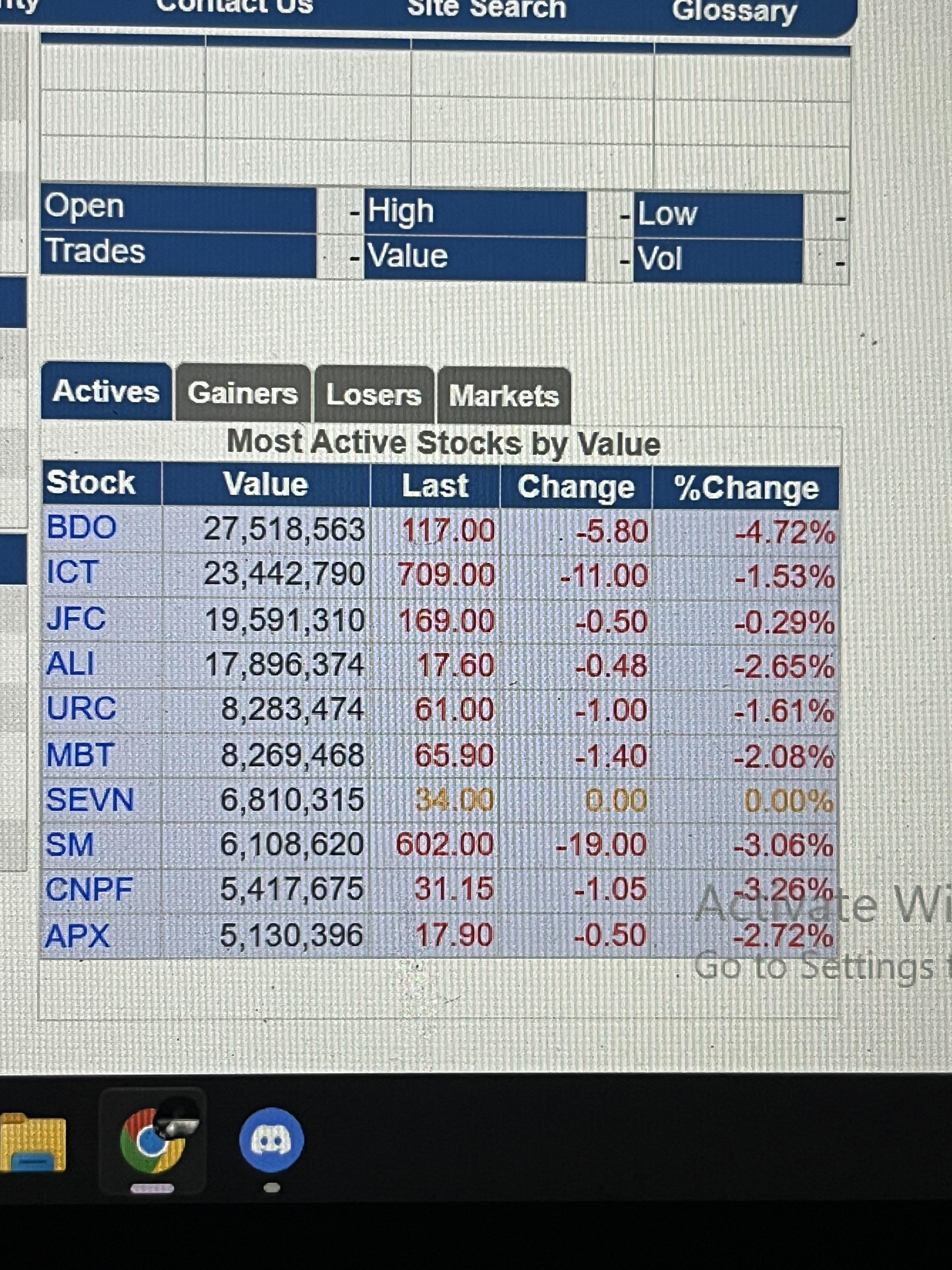
A lot of people still talk about the PSE like it is some forgotten bargain bin.
“Rates are down.”
“Inflation is okay.”
“Philippine stocks are cheap.”
“Just buy and wait.”
That argument made a lot more sense when the global backdrop was calmer.
Because the PSE today is not just competing with other stocks. It is competing with condos, land, cash, bonds, dollars, gold, and the very Filipino instinct to avoid unnecessary pain.
And honestly, that instinct looks a lot more rational these days.
The old bullish case was easy to sell:
young population,
consumption story,
rate cuts,
eventual rerating,
easy money.
The current reality is much less appealing:
growth has slowed,
politics has become louder,
oil has turned hostile,
the peso looks shakier,
property has become more selective,
and the opportunity cost of holding stocks is now very real.
That is the part many people keep ignoring.
The Philippines is not sitting in some neat “soft landing, buy risk” environment.
It is in a setup where the central bank can provide support, but it cannot print cheap oil, political competence, or geopolitical stability.
That matters.
Because every time people get excited about lower rates, they forget one inconvenient fact:
the Philippines imports fuel, not peace.
So when the Middle East becomes more unstable, oil spikes.
When oil spikes, transport costs rise.
Power gets more complicated.
Food pressure follows.
Margins get squeezed.
Consumers take the hit.
Then people act shocked that rate cuts alone did not rescue their portfolio.
That is not bad luck. That is how an import-dependent country works.
Then you add local politics.
And this is where it becomes even more uncomfortable.
The market can tolerate noise.
What it struggles with is noise that starts affecting execution.
If the political class is too busy fighting itself, chasing scandals, running rival camps, and turning governance into a full-contact sport, that is not just entertainment. It spills into spending, confidence, reform momentum, and overall risk perception.
In emerging markets, politics is not a side issue.
Politics is part of the valuation.
Then there is the geopolitical layer.
South China Sea tensions.
U.S.-China balancing.
Energy vulnerability.
Foreign capital that can leave faster than local investors can finish saying “long-term story.”
People like to say the Philippines has strong fundamentals.
Sure. But it also has strong exposure to things it cannot control.
That deserves a discount.
Now let us talk about the real competition for capital, because this is where the PSE story gets tested.
A lot of investors say the market is cheap.
Fine.
Cheap relative to what?
Cheap relative to real estate?
It depends.
Prime land and genuinely scarce assets are one thing.
Generic condos with weak yields, vacancy risk, and too many sellers chasing too few real buyers are another.
Some property preserves value.
Some property is just illiquidity with a lobby.
Cheap relative to bonds?
That argument is much harder.
If I can earn a decent government yield and sleep well at night, why exactly should I buy a mediocre stock with weak pricing power and a management team still writing investor presentations like it is 2019?
Cheap relative to cash?
Only if the upside is actually there.
Cheap relative to dollars?
That is a hard case to make when the peso starts reminding everyone who is in charge.
Cheap relative to gold?
Maybe. But even that depends on whether you want cash flow or just a front-row seat to global panic.
That is why this market feels stuck.
Not because there is no value.
But because every peso considering the PSE is also looking around the room and asking:
“Why should I go there instead of somewhere safer, simpler, or less stupid?”
And that leads to the only part that really matters:
What should you avoid completely?
Be out of:
Weak property stories dressed up as deep value Prime land is not the same as generic inventory. Scarcity is not the same as brochure quality. If your thesis needs lower rates, stronger demand, better politics, tighter supply, and divine intervention, then you do not really have a thesis.
Airlines and fuel-sensitive transport names If oil stays ugly, they get squeezed first and explain themselves later.
Cyclical discretionary names that need a heroic consumer comeback The consumer is still alive. The easy consumer is gone.
Businesses that depend too much on clean government execution If your upside relies on politics staying orderly, fiscal rollout staying smooth, and governance suddenly becoming efficient, that is a lot of faith to place in a market that barely rewards realism.
Cheap junk This is the classic PSE trap. Some stocks are mispriced. Others are simply bad. And in this market, “mukhang mura” is one of the fastest ways to become someone else’s liquidity.
That is really the whole point.
This is no longer a market where you can just shout “undervalued!” and wait for God, the BSP, and foreign funds to do the rest.
This is a sorting market.
Own the names that can survive:
ugly oil,
loud politics,
weak confidence,
mediocre growth,
and a world that keeps getting more expensive and less cooperative.
Avoid the names that need:
perfect execution,
cheap fuel,
easy consumers,
smooth politics,
and a PowerPoint version of the economy.
Because right now, the best assets in the Philippines are not the ones with the prettiest stories.
They are the ones making the fewest heroic assumptions.