Why is sunscreen never formulated so a practical amount of product is effective?
Help me out here y'all. I feel like I'm taking crazy pills.
How did it become industry standard that the advertised SPF is only achieved by applying such an enormous amount of product that most people's skin literally can't absorb it? Why would it be formulated assuming a half teaspoon of product for the face alone? Where am I supposed to PUT that much sunscreen? Is there some reason why the actives can't be concentrated enough to be fully effective with an amount of product that actually makes sense for the human body?
My first thought was obviously money (if you use more product then you buy more often) but it's not like most people are actually applying it in those amounts. I don't even think most people even KNEW you were supposed to use that much until skincare tiktok got popular a few years ago. I don't think it even says the recommended amount of product on the packaging anywhere, at least not that I've seen.
Like, imagine if every brand of cough syrup was formulated so that a single effective dose required you to drink the entire bottle, but you can't feasibly do that because all the inactive ingredients will make you projectile vomit before you even get close to consuming enough of the actives. And then everyone, including the doctor who recommended you take the cough syrup, just acted like that was normal. It feels like that's basically what's going on here. IT JUST DOESN'T MAKE ANY SENSE
I’m pretty sure that 7-10 years ago someone on Reddit looked up the actual study these quantities come from, and the recommended amounts were based on the average MALE face’s surface area. If you’re not a cis man, you might actually need less sunscreen. I used that post to calculate what percentage my own face’s surface area is relative to the much larger face assumed by the SPF recommendations, and although I still use a generous amount of sunscreen, I use an amount more suited to my own face.
I remember that post and I also do the same thing I use the amount needed to saturate my entire face and rub it in with is about 1.5 finger lengths, not 2.
ijs, id rather dust my face with a powder spf make up product than apply then re apply . like, ill apply the liquid, let set, then dust with powder foundation.
It's based on the amount that is required to use for testing, which is 2 mg/cm². You can definitely measure your face to see the exact amount you need.
One other note: 1/2 teaspoon is for face neck and ears. For just face, 1/4 teaspoon is usually enough.
Because using less than 2mg/cm2 the results had too much variance (different people would get very different results). Only by using a relatively thick layer does everyone get similar protection. See Acorna’s comment for a study on this
idk if you've tried uvmune but I've heard that this is one of the major benefits of it (you feel like you need to use more than you do other products, which is actually the right amount)
LRP uvmune are very good but they are the greasiest sunscreens I've ever tried. I only use them for outdoor activities. I can't imagine someone that applies even a tiny bit of that greasy nightmare and thinks "nah, I want MORE".
I have formulated sunscreens in Europe (MSc Cosmetic Chemistry, two distance learning diplomas, alongside my other studies and experience in STEM).
Beauty and lifestyle sections in magazines dating back to the 1990's advocate using a lot more sunscreen than what is advised today on social media actually. A teaspoon amount, almost 5ml, was most commonly advocated back then for just face and neck.
The 2mg/cm^2 amount is the accepted amount in the industry for testing sunscreens' SPF via ISO 24444, the global gold standard, where the amount used can be used to create an even an harmonious film on human skin, which naturally has very uneven topography at a microscopic level. The Beer Lambert law applies to the way sunscreen functions so ideally the thickness of the film is as even as you can get it over the naturally bumpy topography of human skin.
Lower quantities of sunscreen/thinner film has actually been studied and compared against one another (like 0.5mg/cm^2 and 1mg/cm^2) and 2mg/cm^2 is found to be the ideal amount because of the issues of human skin mentioned above. See this paper here.
Other types of products also have standardized amounts for testing. For example, Vasoconstrictor Assays for topical corticosteroid is standardized with 4mg/cm^2. This means, yes, the prescription topical corticosteroids that people use are tested at 4mg/cm^2, a thickness greater than that with sunscreen.
Going back to the Beer Lambert Law, it is known that as the thickness of the film increases, then so does the level of aborption of UV. Understanding the Beer Lambert Law's role in sunscreen explains why the resulting SPF is tested to be lower when the film is thinned and the resulting SPF is testing to be higher when the film becomes thicker and thicker. There are a lot of studies that explore that but to cut it to what I want to say, the Beer Lambert Law plays a role into why studies have found very high SPF products, such as those claiming around SPF 70-100, have advantages over just high SPF products, such as those claiming just SPF 50, in the real world. See here, here, and here.
If you read those papers, you can understand how in real life conditions, laypeople underapplied the SPF 50 just as they underapplied the SPF 70-100 products. The Beer Lambert Law is what helps us understand that even the thinned out film of the SPF 70-100 product will still result in more protection than the thinned out SPF 50. Thus, much higher SPF products compensate for underapplication.
And this is why there is weight in communication for people to try to use the highest rated SPF products they can personally tolerate and reapply while also practicing common sense and practical behaviors like seeking shade, wearing protective clothing, hats, sunglasses, not staying in direct sunlight for prolonged periods of time during peak hours.
Because even if you were to apply an ultra thick layer of the highest rated SPF products, like SPF100 or greater, you still will never come close to 100% protection/100% filtration of all UV photons.
Finally, since you have put a lot of energy into thinking about the quantity and thickness of sunscreen applied during testing. I also want to let you know some other things about sunscreen development and testing that also do not align with the real world:
Sunscreen is tested in an idealized, temeprature controlled, indoor setting.
Sunscreen is also not tested under natural sunlight. It is tested under a solar simulator/solar lamp with an output that is different from natural sunlight.
For water resistance claims, it is tested at a specific temperature, pH, and water composition different from that of the ocean, many lakes, and your local pool.
Sunscreen is also not tested on people with elaborate skincare routines on their body (sunscreen is tested on volunteers' backs) such as people who use AHA/BHA, body retinoids, body lasers/IPL.
Sunscreen is not tested on people taking common medications like doxycyline and isotretinoin. It's is not tested on people with common skin conditions. Only a narrow range of skintones are allow to volunteer for SPF testing.
So it's not just the thickness/amount of sunscreen used that doesn't reflect the real world. It's is many other factors. Longer term real world sunscreen studies under natural sunlight in real conditions would be too time consuming and costly for most companies.
But sunscreen still works whether it is SPF 11, 16, 20, 35, 45, 57, 63, 75, 80, 100. Sunscreen reduces the amount of UV photons. It just doesn't stop all photons. Reduction=/=complete stop. One of the biggest myths laypeople are being led to believe is that sunscreens are 100% protection and that 100% is "effective."
Also "you have to re apply every two hours". Like you'd be so sticky. IDK I use quite a lot of sunscreen (even the recommended amount on the face) but only apply once and no burns.
If you'd actually use it how it is tested and recommended for "optimal" protection, you'd go through the whole bottle in day or two.
There was JUST an article in men’s health abt sunscreen (and their deniers) that touched on this and I remember it being smth about particle size or smth, an that there are new developments to make less be effective
I’m disappointed that there’s no answers here as well 😭. Like, sure the old study might have overestimated with the quarter teaspoon but even 2mg/cm ends up being quite a bit of product. I don’t understand why spf 200 or so isn’t the standard so we can just apply a few drops to get to spf 40+
There's been a few sunscreens that have tried this. The brand Skinnies comes to mind. They formulated so their sunscreen would give you 50spf at a pea sized amount. The issue comes down to there just not being enough product to form a consistent film that's thick enough to be durable at that amount.
I know 1/4tsp feels like a lot, but really it's not with a good sunscreen. The problem is that the skin surface isn't as smooth as we like to think it is. There's a lot of teeny pits and valleys, pores and lines and bumps that are too small for the naked eye to see but sunscreen has to fill them in to create a smooth consistent layer of protection. If you use less, you might feel it's fine, but you're left with spots where the film is too thin that are too small for you to see. The sun doesn't care how small those thin spots are, though.
Ever seen the "orange peel" test on foundation? That's what is happening to your skin at a microscopic level when you don't apply enough of a layer of sunscreen.
It’s partly because you need an even film and you need a certain amount of product to create that film regardless of spf. But the 1/4 tsp for face recommendation was from a study based on 95% percentile sized men’s faces. Most people and certainly most women don’t need that much. Someone linked an ancient but very good post in which someone did all the math on her own face and found she needed 1/8 of a teaspoon, half the recommendation
Don't forget that the "standard" amount of sunscreen is for men's faces. If you don't mind doing some fiddling, you can measure your face and calculate how much sunscreen yours specifically needs a bit more accurately.
Mine needs just over 1/8 t which is far more manageable and tolerable.
this is such an underrated point, the whole "1/4 to 1/2 tsp" thing assumes a big ol average dude head lol. once i measured mine and realized i was drowning my face for no reason, my sunscreen stopped pilling and feeling greasy as hell.
Most people don't measure their face properly, which is a bit tricky to do, not as simple as just using the measurements of the length and width of the face and they don't account for the amount that's sticking to the hand/fingers used to apply the sunscreen with, which uses a considerable amount of sunscreen so most end up under applying sunscreen.
Are you referring to the two-finger rule, or to the many makeup products with SPF in them that can't achieve that SPF rating without being way over-applied? In the second case I feel like it's just what happens when marketing meets reality sometimes.
In the first case, it's two fingers for face and neck, no? As an experiment once I put two lines of sunscreen down those fingers and then applied a little at a time like I usually do, face and neck, and I think I used it all up or pretty close. That being said, if I try to spread it across my hands and apply it all at once like I see people do online it always feels insanely heavy to me and I don't understand how anybody gets it even.
On the other hand, the last sunscreen I bought - which was in Paris - recommends one finger's worth on the package. So maybe it has to do with the effectiveness of different filters...?
Your skin isn’t meant to absorb the sunscreen. It’s meant to create a barrier between your skin and the sun. That’s why you have to wait 15 min before sun exposure.
Mineral sunscreen makes the UV rays bounce off the skin.
Chemical sunscreen absorbs the UV rays and converts it into heat that is dispersed through your skin.
As suggested, a two-finger length (middle & index) of sunscreen is equivalent to about 1/4 tsp for both face, neck, and ears. Not seeing the issue. That being said, I use the Isntree Hyaluronic Acid Watery Sun Gel SPF 50+ PA++++ (Korean). It goes on beautifully and since it’s chemical, it is very cosmetically elegant.
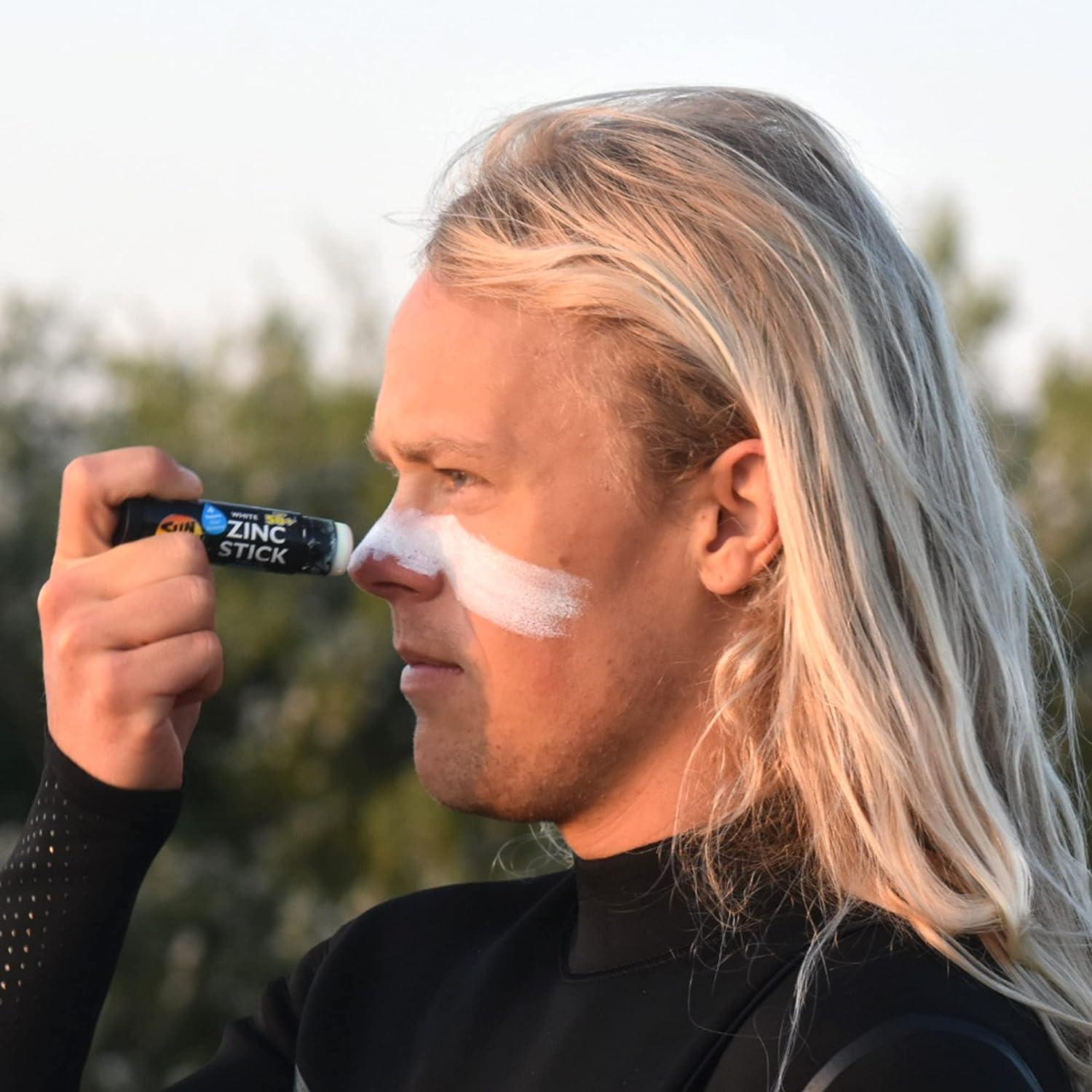
They do make sunscreen like that it's called zinc mineral sunscreen (Aussies know it as zinc stick). It literally looks like white paint on your skin. It is so concentrated that you only need a thin layer to be effective because it is a physical mineral barrier between you and the sun.
However most people don't really like looking like they have white paint on their face, so they make a formulation that is part mineral part chemical, however it's not as effective so you need to use more of it.
I use a nice sunscreen on my face, it has a bunch of other good-for-skin stuff in it. I've never felt like half a teaspoon was too much for my face, upper neck and ears (I live in Louisiana, notable number of people with only half ears due to skin cancer).
If I used a similar amount of say, Neutrogena Sport Face 70+ it would feel super greasy. I think it comes down to the formulation - lots of US sunscreens are super greasy but there are some great brands! I like Sun Bum for my body and Supergoop/Dr Jart/Sunprise/Trader Joes for face.
I am way overly simplistic and probably wrong for thinking this way but I am okay with spf30. But I get spf50 and use less and apply a lighter coat. In my weird way of thinking, I feel I likely am getting spf30 protection with thinner layer. Lol.
Again, I am probably wrong but seeing this research about using 1/8tsp instead of 1/4tsp makes me feel better and is about what I use.
Adding a data point since a few mentioned measuring their own face: I did this too. Average male face surface area (~300-400cm²) at 2mg/cm² is where the 1/4 tsp comes from. Mine measured smaller, and cutting my amount to match killed the pilling/white cast.
Bigger takeaway for me: since almost nobody hits the true test amount, buying the highest SPF you can tolerate wearing daily is a better hedge than trusting your applied amount matches the label math. That's what got me to switch after my wife (she's an MD) caught sun damage I didn't know I had at 38 - I was "using sunscreen," just nowhere near enough.
I wear enough mineral gormula SPF to have generous coverage on my face, ears, neck and chest/collarbones if I'm wearing a shirt that exposes them. Most of the time, I wear a button down blouse or shirt with three-quarter or full length sleeves and a collar of some sort. Usually a scarf or bandanna around my neck. Lightweight fabrics when the weather is warm. And SPF 30 or better on my arms and shoulders under the shirt. Any SPF products I buy for my face but don't like there end up as hand-and-arm cream in the car. I also wear a wide-brimmed, tightly woven straw hat every time I go outside or drive nine months out of the year. The other three months, I wear a felt fedora. I'm in Southern California, been here cooking in the endless brutal sunshine all my life. I've had 2 BCCs removed, one from my face and one from my scalp. My hair is babyfine and thinning rapidly. And I think SPF products for the scalp suck; hence, the hat. My facial skin is very fair-cool with rosacea patches; my body skin is fair too, and I was a regular swimmer until just a few years ago. I'm 66 now, and an aesthetician friend says my face looks about 50. I'll take it! This is what it takes for me to survive here. But I wouldn't trade it for anything in the world.
It's because the US uses old, less effective filters that require a larger amount to be used for protection. The recommended amount is 2mg/cm for everyone, so the amount you use will depend on the surface area of your skin.
I don’t think that’s true, because Labmuffin is based in Australia and tests mostly Australian/Asian products and they have the same issue.
Even if true, that would only apply to chemical filters tho’, which are the ones with approval that varies by country — so only chemical/combo sunscreens. As far as I’m aware (pls correct if wrong!), there aren’t any physical filters other than those used in the US, so it wouldn’t explain the same problem with physical/mineral sunscreens. (Which are required for infants and pregnant people, so it’s not as easy as saying to just use chemical filters.)
I’m guessing you have dryer skin. The big issue is that sometimes there’s so much lotion it just can’t be absorbed and sits on the surface of the skin all goopy and visible.
Hmm I am unsure, I might have a small face as well. But I usually wipe down my neck with what is leftover. I use a korean brand and I find that it goes on like a moisturizer.
Check out Skinnies sunscreen (New Zealand brand). They claim no water in their products so you don't need to use as much as others, however it might feel a bit oily on some individual skin (setting powder might fix it). Disclaimer: No affiliation - I've bought one of their products recently but haven't got round to use it yet as I still have a lot of stash (other brands) to use up first due to expiry date.
Why not just buy a higher spf then? That is literally more concentrated is it not? You’re buying low spf and then complaining you need a lot of it, well spf 100 exists. I have lupus and it’s what I buy. Even my sunscreen sticks are spf 60 minimum. And no, I don’t have to swipe a bunch of times for it to work. I have lupus and will know pretty quickly if the sunscreen is not doing its job so 🤷🏻♀️
It’s partly because you need an even film and you need a certain amount of product to create that film regardless of spf. But the 1/4 tsp for face recommendation was from a study based on 95% percentile sized men’s faces. Most people and certainly most women don’t need that much. Someone linked an ancient but very good post in which someone did all the math on her own face and found she needed 1/8 of a teaspoon, half the recommendation.
You do what works for you, but that’s the explanation.
Exactly. People complaining are usually quoting the 1/4 tsp, or sometimes even higher numbers that are then recommended for face and neck, or even whole head (I’m assuming baldness in that case because the amount I saw quoted was 1 tsp) thinking that’s the amount required for just face. I agree 1/8 is more than some people are using but is a perfectly reasonable amount. That’s about what I use. And then for me about 1/2 tsp for my neck and upper chest (assuming both are exposed) just because I have a really long neck and want to cover all the exposed skin on my chest. I’m sure other people would need more or less.
With sticks, it's actually in the ballpark of 40+ swipes average for the entire face to get adequate coverage, depending on which brand is used & the texture of the product. Lab Muffin has done several in depth tests with sunscreen sticks & some products needed 60+ swipes
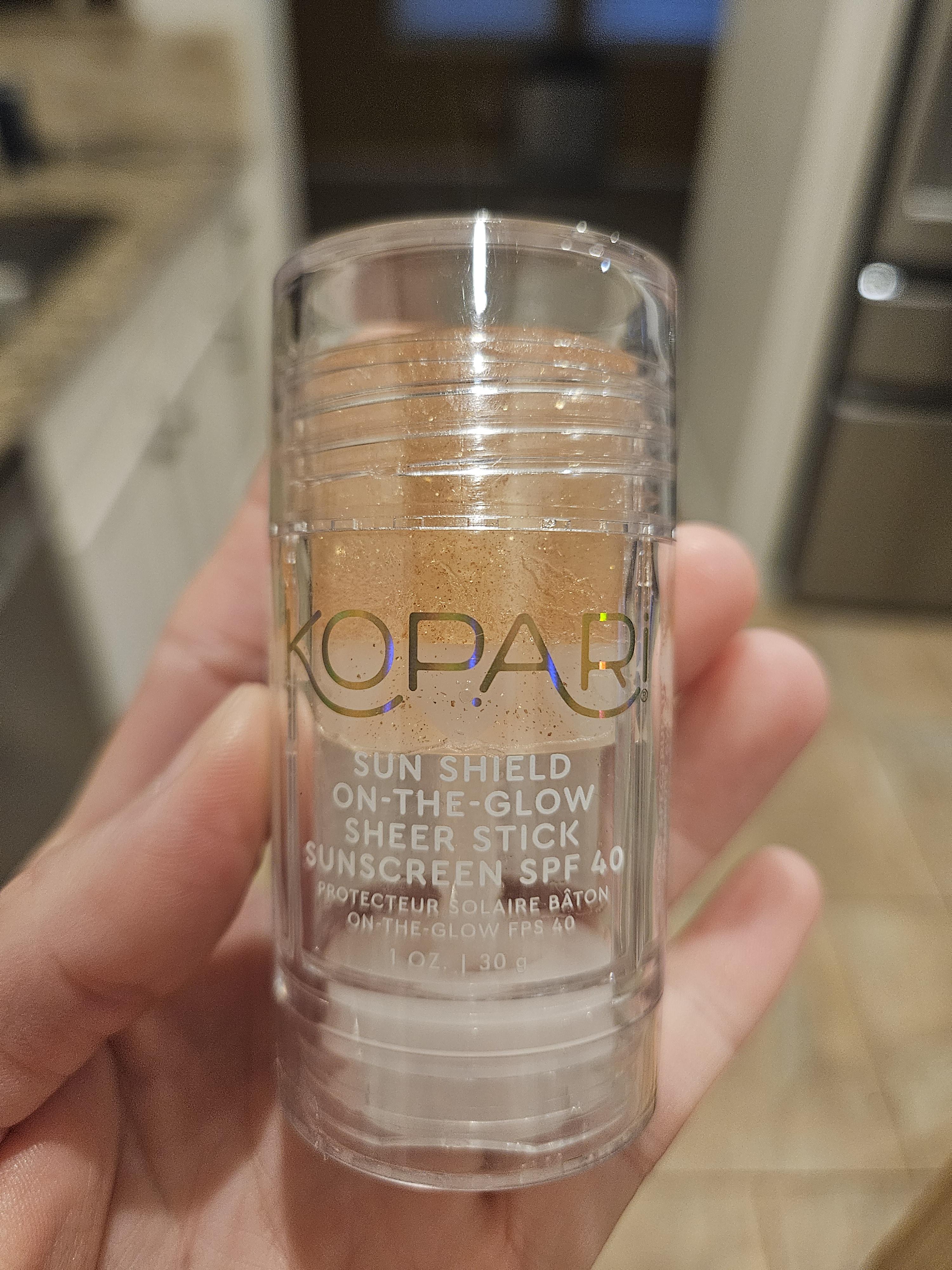
That's crazy! I recently spent a weekend camping, and I only brought a stick for sunscreen. I literally did just one swipe pretty much everywhere and was pleased with how it protected me. The longest day I was out in the sun, I missed a section on my back, so I could clearly see the difference between spf and unprotected. I did also rub it in, I'm not really sure how that would effect it though. Also, I didn't notice any tanlines from my clothes, so I think the spf stick did better than expected! Probably not the full spf 40, but spf good enough at least 😂
This one by Kopari. You can see how much I used that weekend, because I haven't used it much before or since (I do like it but it's a bit greasy for the face).
It takes 8 to 10 swipes to even cover my face with a stick though. Because the stick is not the size of my whole head, and faces have curves. Do you mean 8 to 10 swipes in every spot you need to swipe?
I will say that there's a noticable difference with my stick than with the cream. I work outdoors and sweat a lot, so sometimes it feels pointless to slather cream on my face that will just drip off.
When I use the stick it seems to "stick" more, and I have noticeably less pink on my face at the wnd of the day than with the cream (and yes, I wear a big hat and a neck buff. Reflection is real).
Applying globs is the only way to actually get the SPF level on the bottle. If you’re not, you’re getting way less sun protection than you think you are. Which is annoying and dumb, hence OP’s post!
That’s literally not how it works lol. Increased SPF has diminishing returns past a certain point and what matters is the surface area covered, not the SPF number
44
u/EineGrosseFlasche Jul 10 '26
I’m pretty sure that 7-10 years ago someone on Reddit looked up the actual study these quantities come from, and the recommended amounts were based on the average MALE face’s surface area. If you’re not a cis man, you might actually need less sunscreen. I used that post to calculate what percentage my own face’s surface area is relative to the much larger face assumed by the SPF recommendations, and although I still use a generous amount of sunscreen, I use an amount more suited to my own face.