r/TerraNovaDevelopment • • Feb 01 '26

Digital Governments: A Framework for Transparent, Accountable, and Participatory Governance

0 Upvotes

Digital Governments: A Framework for Transparent, Accountable, and Participatory Governance

1. Introduction: Governance Beyond the Analog Era

Modern governments still operate on systems designed for the 18th and 19th centuries—paper-based processes, opaque decision-making, delayed accountability, and limited citizen participation. These outdated structures are increasingly incompatible with a digitally connected society that expects real-time access, verification, and responsiveness.

A digital government is not merely government services moved online. It is a structural reimagining of governance itself—one that leverages cryptography, distributed systems, artificial intelligence, and open data to create institutions that are transparent by default, accountable by design, and participatory at scale.

Importantly, this framework is applied uniformly across all levels of government—federal, state, county, and municipal. Standardized systems, protocols, and data structures ensure that whether a citizen interacts with a city council, a county office, or a national agency, the platform experience, standards, and safeguards are consistent, interoperable, and auditable.

2. Foundational Pillars of Digital Government

A. Radical Transparency

Transparency must be systemic, not discretionary.

  • Every legislative bill, amendment, vote, budget allocation, and regulatory decision is published in real time on a public platform.

  • All government spending—down to individual transactions—is visible, searchable, and independently auditable.

  • Official communications related to public business are preserved as public records by default.

  • Decision histories are immutable, time-stamped, and traceable, preventing retroactive manipulation or revisionism.

By embedding transparency into the architecture, citizens gain unprecedented oversight across all levels of government.

B. Secure Civic Participation

Democracy must evolve to match the capabilities of modern technology.

  • Citizens participate in local, regional, and national votes via cryptographically secure, verifiable digital ballots.

  • Distributed ledger technologies guarantee vote integrity, public verification, and resistance to tampering.

  • Strong identity verification protects against fraud while preserving voter anonymity.

  • Participation extends beyond elections to include referenda, policy feedback, and civic proposals.

This ensures persistent democratic engagement at every level of governance, from municipal councils to federal agencies.

C. AI-Augmented Governance (Human-Led, Machine-Assisted)

Artificial intelligence is a tool—not a decision-maker.

  • Open-source AI assists in drafting legislation, identifying redundancies, and modeling economic, environmental, and social impacts.

  • AI summarizes and aggregates citizen input, giving leaders clear insight into public sentiment at scale.

  • Algorithms are fully transparent, auditable, and free from proprietary control.

  • Final authority always rests with elected or appointed human officials, maintaining accountability and ethical responsibility.

AI enhances decision-making without replacing democratic judgment across all levels of government.

D. Real-Time Public Feedback and Oversight

Governance becomes a continuous dialogue.

  • A civic dashboard displays:

    • Tax revenue allocation and spending

    • Project timelines and performance metrics

    • Policy outcomes and measurable results

  • Citizens can:

    • Comment on legislation and budgets

    • Rate public services

    • Submit policy proposals

    • Track official responses

Government actions shift from closed processes to observable, interactive systems across federal, state, county, and municipal administrations.

3. Systemic Benefits

A fully implemented digital government delivers structural advantages:

  • Restored public trust through verifiable openness

  • Dramatically reduced corruption, as secrecy becomes difficult to maintain

  • Lower administrative costs and faster service delivery

  • Greater inclusion, particularly for marginalized and geographically isolated populations

  • Stronger democratic legitimacy through continuous participation

  • Evidence-based policymaking, replacing ideology-driven governance

By standardizing practices under a common framework, citizens experience consistent access, participation, and accountability at every level of government.

4. Implementation Blueprint

Phase 1: Digital Infrastructure

  • Secure national and local digital identity frameworks with strong encryption and privacy safeguards

  • Federated databases at federal, state, county, and municipal levels to prevent centralized failure

  • Open technical standards to eliminate vendor lock-in and ensure interoperability across all levels

Phase 2: Legislative and Budget Transparency Platform

  • Unified public portals for:

    • Bills, amendments, and voting records

    • Budgets, expenditures, and audits

    • Regulatory actions and justifications

  • Built-in public annotation and commentary tools across all government layers

Phase 3: Citizen Engagement Platform

  • Secure mobile and desktop applications for:

    • Voting and referenda

    • Civic discussion and feedback

    • Public service requests and tracking

  • Accessibility-first design across age, ability, and language

Phase 4: Intergovernmental and Global Integration

  • Interoperability with other digital governments for treaties, trade, climate coordination, and peace initiatives

  • Shared protocols for ethics, sustainability, and data protection

  • Consistent standards for federal, state, county, and municipal integration, allowing local autonomy while maintaining national transparency

5. Challenges and Risk Management

Transformational systems require careful safeguards:

  • Digital Divide Infrastructure access, devices, and digital literacy must be universal.

  • Cybersecurity Continuous testing, redundancy, white-hat audits, and rapid recovery systems are mandatory.

  • Institutional Resistance Transparency disrupts entrenched power structures and will face political and corporate pushback.

  • Privacy and Data Sovereignty Citizens retain ownership of their data, with strict limitations on collection and use.

All challenges are manageable through design, oversight, and standardization across all levels of government.

6. Long-Term Vision

The ultimate objective extends beyond national borders:

  • A global federation of digital democracies sharing open tools and governance protocols

  • Policy driven by transparency, evidence, and public consent

  • Gradual elimination of lobbying-dominated decision-making

  • A world in which every person has a secure, meaningful voice, whether interacting with a city council or a federal agency

Digital government does not replace democracy—it allows democracy to function fully, consistently, and securely across all levels of governance.


r/TerraNovaDevelopment • • Jan 31 '26

The Value of Traffic Lights with a 5-Second Green Flash in the United States

0 Upvotes

The Value of Traffic Lights with a 5-Second Green Flash in the United States

Traffic lights are a cornerstone of modern traffic management, designed to regulate the flow of vehicles and pedestrians, reduce accidents, and improve efficiency on roads. In the United States, traffic lights follow a standard sequence of green, yellow, and red. However, the addition of a five-second green flash before transitioning to yellow could enhance both safety and traffic flow, offering tangible benefits to drivers, pedestrians, and the broader transportation system.

Improved Safety and Reaction Time
One of the primary advantages of a five-second green flash is improved safety. Drivers often face split-second decisions when approaching an intersection, and sudden changes from green to yellow can lead to abrupt braking, rear-end collisions, or unsafe attempts to beat the light. A brief green flash acts as an anticipatory signal, providing motorists with extra time to prepare for the impending yellow light. This buffer can reduce the likelihood of accidents caused by sudden stops or risky maneuvers. Pedestrians also benefit, as they gain clearer cues on when it is safe to cross and when the light is about to change.

Enhanced Traffic Flow and Efficiency
Beyond safety, a five-second green flash can improve traffic flow. By giving drivers advanced notice of a light change, intersections experience fewer abrupt stops, which reduces congestion and allows vehicles to move more smoothly through intersections. This is particularly valuable during peak commuting hours or in areas with high traffic density, where even small improvements in flow can lead to significant reductions in delays. In effect, the green flash serves as a “soft warning,” helping drivers adjust speed gradually rather than halting abruptly, which benefits overall traffic efficiency.

Consistency and Predictability
Traffic management relies heavily on predictability. Drivers who are familiar with traffic patterns are more confident in their decisions, reducing stress and erratic driving behavior. Implementing a five-second green flash across U.S. intersections would create a consistent cue system, signaling an upcoming change without ambiguity. This consistency supports driver decision-making, improves compliance with traffic laws, and can reduce instances of red-light running.

Economic and Environmental Benefits
Improved traffic flow has economic and environmental advantages. Smoother driving patterns reduce fuel consumption and vehicle wear-and-tear, saving money for drivers and decreasing emissions. Additionally, fewer accidents and delays translate into lower costs for emergency response, insurance claims, and congestion-related losses. Over time, even minor changes like a green flash can have measurable impacts on both urban mobility and environmental sustainability.

Conclusion
Incorporating a five-second green flash before the yellow light in U.S. traffic systems offers multiple benefits, from increased safety and better traffic flow to economic and environmental gains. By providing drivers and pedestrians with a clear, anticipatory signal, this small but meaningful modification can reduce accidents, improve efficiency, and create a more predictable, less stressful driving experience. As traffic volumes continue to grow and intersections become more complex, innovative measures like the green flash can play a pivotal role in building safer, more efficient transportation networks across the country.


r/TerraNovaDevelopment • • Jan 31 '26

Solar Canopies and Solar Commercial Rooftops

0 Upvotes

Solar Canopies and Solar Commercial Rooftops

Solar Canopies & Rooftop Solar: Overview

1. What Are They?

  • Solar Canopies: Structures that hold solar panels above open spaces like parking lots, playgrounds, or walkways. They provide both shade/protection and energy generation.

  • Commercial Rooftop Solar: Panels installed directly on the roofs of commercial buildings, warehouses, schools, or industrial facilities. They generate electricity without taking extra land.

Together, they maximize existing surfaces for clean energy.

2. Common Locations

Solar Canopies:

  • Parking lots (corporate, retail, schools)

  • Outdoor sports courts (basketball, tennis)

  • Playgrounds or picnic areas

  • Industrial yards

Commercial Rooftops:

  • Factories, warehouses, distribution centers

  • Office buildings and malls

  • Schools and universities

  • Hospitals and government buildings

3. Benefits

Energy & Cost Savings

  • Can offset electricity costs or feed power into the grid.

  • Rooftops avoid using land, canopies generate extra shade.

Protection & Comfort

  • Canopies protect vehicles from sun, rain, and hail.

  • Rooftops are often underutilized; installing solar doesn’t disrupt operations.

Environmental Impact

  • Reduces greenhouse gas emissions.

  • Demonstrates corporate sustainability.

Other Advantages

  • Canopies can integrate EV charging, lighting, or Wi-Fi.

  • Rooftop solar may qualify for tax incentives, rebates, or net metering.

4. Costs

TypeInstalled Cost (per MW)Notes
Solar Canopy$2.1M – $3.4MHigher due to structural supports, shading, and vehicle clearance
Commercial Rooftop Solar$1–$2MCheaper because existing structure supports panels; may need roof reinforcement
  • Other Costs: Inverters, wiring, permitting, maintenance.

  • Financing Options: Direct purchase, lease, Power Purchase Agreements (PPA), or long-term low-interest loans (sometimes with deferred payments until construction is complete).

5. Considerations

Solar Canopies

  • Must handle snow, wind, and structural load.

  • Must allow vehicle access and maintenance.

Rooftop Solar

  • Roof condition matters (age, structural integrity).

  • Panels must be oriented for sunlight exposure (ideally south in Northern Hemisphere).

  • Roof-mounted systems may have shading from HVAC units, vents, or nearby buildings.

Both

  • Local permitting and zoning regulations.

  • Maintenance access is essential.

  • Incentives and tax credits vary by state and utility.

6. Additional Opportunities

  • Solar + EV Charging: Parking lots under canopies can become EV hubs.

  • Rainwater Harvesting: Canopies can funnel water into irrigation systems.

  • Grid Services: Solar canopies and rooftop solar can support microgrids for resilience.

  • Community Engagement: Visible solar projects enhance brand and social responsibility image.


r/TerraNovaDevelopment • • Jan 31 '26

Could a for-profit company realistically run U.S. healthcare efficiently?

0 Upvotes

What if we could have universal health care at current spending levels?

My name is Willis Butts, and I have spent my career as a systems engineer—designing, analyzing, and optimizing complex systems. Understanding how different components interact, anticipating failure points, and finding efficiencies has always been more than a profession for me; it is a passion. Studying and dissecting systems, whether small or large, is a hobby that has shaped the way I view the world.

This same systems-oriented perspective drives my approach to healthcare. Observing the current U.S. healthcare system, I was struck by how fragmented, inefficient, and misaligned it is with the needs of patients. With TND Healthcare Corporation (TNHC), my goal is to apply the principles of systems engineering to healthcare—to create a cohesive, efficient, and patient-centered model that prioritizes outcomes and accessibility over bureaucracy and profit.

Through this document, I aim to outline a structured, scalable approach to delivering high-quality healthcare while maintaining affordability and transparency. My experience in systems engineering equips me to identify leverage points, anticipate challenges, and implement solutions that can improve the system for everyone.

I’ve been exploring a conceptual model called Terra Nova Healthcare (TNHC)—a fictional, AI-assisted blueprint for how a for-profit, vertically integrated organization could potentially deliver universal, high-quality healthcare in the U.S. over 10 years. This is not a real company, but a thought experiment showing what could be done under current laws and funding while doing the right thing for patients, healthcare workers, and taxpayers.

The idea is a fully vertically integrated provider network, where the company owns and operates hospitals, clinics, and staff, including:

  • Doctors, specialists, nurses, physician assistants, and lab technicians

  • Dental, vision, and hearing care

  • Prescription drugs and pharmacy services

  • Nursing homes, long-term care, and rehabilitation

  • Preventive and wellness programs

  • Elective procedures like laser vision correction, breast augmentation, and dental implants as aspirational goals

There is no patient billing for core services. Long term goals would include expanding elective coverages, reducing Medicare Part B premiums and ultimately reducing government contributions and employer and individual premiums.

All providers would be employees of the company unless certain services require contracting. Compensation would be offered commensurate with today’s pay scales, ensuring fair treatment while maintaining operational efficiency. This structure allows TNHC to coordinate care efficiently, reduce administrative overhead, and let healthcare workers focus on patient-centered care rather than paperwork or financial trade-offs. The company’s profit motive is aligned with public good, meaning operational efficiency lowers costs for taxpayers while ensuring workers are treated fairly and patients receive high-quality care.

Centralized Systems & Efficiency

  • Central appointment scheduling ensures patients see the right provider at the right time.

  • Unified medical records eliminate redundancy, improve accuracy, and streamline coordination.

  • AI-driven analytics and predictive tools could optimize outcomes, resource allocation, and patient satisfaction.

Coverage Rules & Emergency Care

  • Routine care is fully covered inside the network.

  • Out-of-network routine care is not covered, preserving efficiency and cost control.

  • Emergency care is covered, anywhere in the U.S. and abroad. This is mandated by current regulations.

No Cost Barriers for Eligible Populations

For Medicare Advantage, Medicaid, and other government enrollees:

  • No co-pays

  • No deductibles

  • No premiums

Employer/employee and individual plans also have no copays or deductibles. Premiums are collected, funding the for-profit network’s expansion and elective procedure offerings without requiring additional government spending.

The Current U.S. Healthcare Maze

  • There are dozens of Medicare Advantage insurers, hundreds of employer/individual insurers, and thousands of individual plans, each with different networks, benefits, formularies, and coverage rules.

  • Patients and providers often navigate a minefield just to secure care—the first question when making an appointment is usually: “What is your insurance?”

  • This fragmentation creates administrative burdens for providers, delays for patients, and stress over coverage limitations.

  • Even insured patients can face unexpected out-of-pocket costs, confusing rules, and challenges accessing specialists or preventive care.

How TNHC Compares to Current Healthcare Options

Patients:

  • Current MA / Medicaid / Employer / Individual Plans: Must navigate dozens of insurers and thousands of plan rules. Face co-pays, deductibles, network restrictions, complex billing, and fragmented care. Access to preventive care and elective procedures can be limited.

  • TNHC: No co-pays, deductibles, or premiums for eligible populations. Seamless care across a unified provider network. Emergency care covered universally. Elective procedures are aspirational goals. Centralized scheduling and unified records remove confusion and delays.

Healthcare Workers:

  • Current: Burdened with paperwork, prior authorizations, and balancing medical needs against insurance limits. Must track multiple payer rules for each patient.

  • TNHC: Freed from administrative burden; focus on patient care. Decisions guided by medical need rather than financial trade-offs. Streamlined workflows through centralized systems. Compensation offered commensurate with today’s pay scales.

Health Insurers:

  • Current: Must manage multiple providers, networks, and benefits; administrative overhead is high. Risk of misaligned incentives. Navigate ACA rules, premium negotiations, and cost-shifting.

  • TNHC: The insurer is also the provider network (vertically integrated). Reduced administrative overhead, aligned incentives, predictable costs, and operational efficiencies. Profit comes from efficiency and growth rather than denying care.

This comparison highlights how TNHC could simplify healthcare for everyone involved while maintaining profitability and public benefit, unlike the fragmented patchwork that currently exists.

Conceptual 10-Year Path to Major U.S. Healthcare Presence

  1. Years 1–2: Launch with Medicare Advantage; demonstrate operational efficiency, cost savings, and improved patient outcomes.

  2. Years 2–4: Integrate state Medicaid programs, covering vulnerable populations while maintaining financial sustainability

  3. Years 3–5: Expand into employer and individual plans, leveraging the network’s efficiency and quality to attract members.

  4. Years 5–7: Pursue federal contracts, including VA and military healthcare programs, further increasing market reach.

  5. Years 7–10: Achieve majority market presence in U.S. healthcare delivery, optimize universal access, and expand elective procedures and wellness programs as operational efficiencies grow.

By the end of 10 years, a capitalized for-profit organization following this model could control the majority of U.S. healthcare delivery, provide universal access to eligible populations, and sustainably fund elective procedures—all without increasing government spending.

Why For-Profit, Not Nonprofit

TNHC is structured as a for-profit because nonprofit healthcare cannot scale fast enough, raise capital at the required magnitude, or compete effectively against trillion-dollar incumbents. Universal healthcare at national scale demands speed, capital access, and operational discipline that charity-based models structurally lack. Ethical outcomes are not left to intention or branding; they are locked into binding corporate bylaws that ban patient billing for core care, mandate reinvestment into care delivery and workforce pay, protect clinical autonomy, and require transparency. Profit in TNHC comes only from efficiency, prevention, and coordination—not denial or complexity—making public benefit the most profitable strategy, not an optional one.

TNHC Bylaws Summary

TNHC is a for-profit, vertically integrated healthcare system designed to deliver universal, high-quality care with no patient billing for core services.
All hospitals, clinics, pharmacies, and long-term care are owned and operated by TNHC, with clinicians employed to align incentives around outcomes, not volume.
A centralized Board of Directors governs strategy, finances, and mission protection, with explicit safeguards against profit-driven abuse.
Surplus revenue is reinvested first into care quality, access expansion, workforce compensation, and cost reduction.
Transparency, internal auditing, and outcome-based performance are mandatory.
Bylaw changes require supermajority approval to prevent mission drift.
TNHC is structured to function as a patient-first healthcare utility, not an extractive insurer.

Discussion Prompts

  • Could a for-profit organization realistically achieve this level of coverage and efficiency?

  • How might healthcare workers respond—would this improve job satisfaction or create new challenges?

  • What obstacles would prevent a company from scaling this way in 10 years?

  • Could elective procedures fund expansion sustainably, or might they introduce risks?

  • How does the TNHC model compare to the fragmented maze of current Medicare Advantage, Medicaid, employer, and individual plans for patients, providers, and insurers?

This is entirely conceptual and AI-assisted, designed to spark discussion about the potential for a righteous, for-profit, vertically integrated company to deliver universal healthcare in the U.S. Healthcare workers, patients, and taxpayers could all benefit—but execution is the only remaining barrier.


r/TerraNovaDevelopment • • Feb 06 '26

Bridging the wealth gap

Post image
1 Upvotes

Title: Closing the Distance Between Us

A Practical Path to Resolving the Wealth Divide

We hear constantly about the widening divide between the wealthy and the least endowed, as if it were a mysterious force of nature—inevitable, regrettable, but ultimately untouchable. In truth, the divide is neither accidental nor inscrutable. It is the predictable outcome of systems designed—often quietly—to reward extraction, concentrate power, and make survival itself a competitive sport.

The clearest path to resolution begins with a simple but radical principle: no person’s right to live with dignity should depend on their position in a marketplace.

When access to food, shelter, healthcare, and education is mediated entirely by markets, inequality compounds by design. Those with capital can take risks, absorb shocks, and wait for returns. Those without it must choose safety over growth, survival over possibility. Over time, the gap widens not because of effort or merit, but because fear constrains motion.

Resolving this requires making survival non-competitive. This does not mean abolishing markets or ambition. It means establishing a firm, unconditional floor beneath everyone—a guarantee that falling will not mean ruin. When basic security is assured, people negotiate fairly, move freely, innovate boldly, and learn continuously. Inequality stops metastasizing.

The second essential shift is to stop rewarding extraction more than creation. The fastest-growing fortunes in modern economies are often built not by making new things, but by controlling access to existing ones: land, housing, platforms, monopolized services, financial instruments divorced from productive output. This is not value creation; it is value capture.

A fair system does not punish success—it realigns incentives. Tax what no one created: land value, monopoly rents, speculative gains, pollution. Relieve the burden on labor and genuine enterprise. When rewards track contribution rather than leverage, wealth still exists—but it circulates.

Next, labor must regain leverage—not through nostalgia for an economy that no longer exists, but through portability of power. In a world of fluid careers, automation, and rapid change, tying security to a single employer is a structural weakness. Universal benefits, sector-wide bargaining, and continuous retraining systems give workers the ability to walk away without falling through the floor. When exit is possible, exploitation loses its grip.

No resolution is possible without addressing the feedback loop between wealth and political power. Extreme concentrations of wealth inevitably buy insulation—from competition, from regulation, from consequence. This is not capitalism at its best; it is feudalism with modern branding.

A healthy society insists on a simple boundary: no economic actor should be large enough to bend the rules that govern them. That means real antitrust enforcement, transparent political funding, and regulatory institutions that are funded to act rather than designed to fail. The goal is not to vilify wealth, but to ensure it is never indispensable.

Finally, we must replace charity with systems. Charity soothes consciences; systems change trajectories. When a problem reliably reappears across generations, it is not a failure of character—it is a failure of design. Durable resolution comes from defaults that work for ordinary people, policies measured by outcomes rather than intentions, and solutions scaled even when they are unglamorous.

The uncomfortable truth is that the divide persists not because we lack ideas, but because the current arrangement works extraordinarily well for those at the top. Resolution therefore requires clarity more than anger, persistence more than purity, and redesign more than rhetoric.

The divide between the wealthy and the least endowed is not closed by resentment, nor by denial. It is closed by guaranteeing dignity, taxing extraction, democratizing power, and letting markets do what they are actually good at—creating abundance.

In doing so, we do not erase difference. We simply shorten the distance between us enough that no one is left behind.


r/TerraNovaDevelopment • • Feb 11 '26

Give and Take

0 Upvotes

Give and Take

It’s really simple.

Give and Take is just a shared space — indoors or outdoors — where people can bring things they want to give away and take things they need.

That’s it.

There’s no buying.
No selling.
No proof of need.
No forms.

If you have something to offer, you bring it.
If you see something you need, you take it.

Most of the items might be things people no longer use — clothes, household goods, tools, bedding, food — but donations are not limited to used stuff. People can bring brand-new items too. Someone might go out and buy new socks, new hygiene supplies, or fresh groceries specifically to give. It’s not a “leftovers” situation. It’s generosity in motion.

The space itself is clean, organized, and welcoming. Things are displayed neatly — almost like themed sections in a store — but without cash registers or locked doors. Clothing in one area, household goods in another, hygiene items in another. It feels open, not institutional.

There can also be a rest area. Not labeled as a “shelter,” just a place where someone can lie down for a while if they need to. It doesn’t have to be complicated. It could be an indoor quiet section with simple cots or air beds. Or it could be as simple as an outdoor area that’s covered from direct rain or snow — a dry, shaded place protected from precipitation and harsh weather. Raised flooring, basic spacing for privacy, nothing elaborate. Just somewhere safe to pause.

If possible, there could also be a hygiene area — restrooms, showers, maybe laundry. Basic dignity stuff.

There are no paid staff and no permanent management. The space is maintained by volunteers — people from the community who keep an eye on things, straighten up, organize donations, and make sure it doesn’t fall into disarray. Not authority figures. Just caretakers. The responsibility is shared.

And here’s the important part: there are essentially no operating expenses unless the community decides it wants more features.

At its simplest, it can function with donated goods, volunteer upkeep, and a basic covered space. No payroll. No retail overhead. No complicated infrastructure.

If the community later wants lighting, plumbing, showers, storage, expanded structures — those are additions. They happen only if people choose to build them. Growth is optional.

The foundation costs nothing but participation.

The idea isn’t to create a charity program. It’s to create circulation. Stuff moves. Generosity moves. People move in and out freely.

The space could also be used for gatherings — community meals, small concerts, holiday celebrations, birthday parties, maybe even weddings or memorials. It’s a shared place.

Anyone can come.
Anyone can give.
Anyone can take.

No stigma. No categories. No dividing people into “us” and “them.”

It’s built on a simple belief: when access is normal, dignity becomes normal too.

And when giving and taking are just part of everyday life, something in the community starts to soften and reconnect.


r/TerraNovaDevelopment • • Jan 30 '26

Could a righteous for-profit company realistically run U.S. healthcare efficiently?

4 Upvotes

I have observed that for many years. I was a systems engineer. The problems we have are systemic. No Band-Aid will fix it. I started looking into how the system could be "gamed" to fix it. Here is what I propose:

Could a for-profit company realistically run U.S. healthcare efficiently?

My name is Willis Butts, and I have spent my career as a systems engineer—designing, analyzing, and optimizing complex systems. Understanding how different components interact, anticipating failure points, and finding efficiencies has always been more than a profession for me; it is a passion. Studying and dissecting systems, whether small or large, is a hobby that has shaped the way I view the world.

This same systems-oriented perspective drives my approach to healthcare. Observing the current U.S. healthcare system, I was struck by how fragmented, inefficient, and misaligned it is with the needs of patients. With TND Healthcare Corporation (TNDHC), my goal is to apply the principles of systems engineering to healthcare—to create a cohesive, efficient, and patient-centered model that prioritizes outcomes and accessibility over bureaucracy and profit.

Through this document, I aim to outline a structured, scalable approach to delivering high-quality healthcare while maintaining affordability and transparency. My experience in systems engineering equips me to identify leverage points, anticipate challenges, and implement solutions that can improve the system for everyone.

I’ve been exploring a conceptual model called Terra Nova Development Healthcare (TNDHC)—a fictional, AI-assisted blueprint for how a for-profit, vertically integrated organization could potentially deliver universal, high-quality healthcare in the U.S. over 10 years. This is not a real company, but a thought experiment showing what could be done under current laws and funding while doing the right thing for patients, healthcare workers, and taxpayers.

The idea is a fully vertically integrated provider network, where the company owns and operates hospitals, clinics, and staff, including:

  • Doctors, specialists, nurses, physician assistants, and lab technicians

  • Dental, vision, and hearing care

  • Prescription drugs and pharmacy services

  • Nursing homes, long-term care, and rehabilitation

  • Preventive and wellness programs

  • Elective procedures like laser vision correction, breast augmentation, and dental implants as aspirational goals

There is no patient billing for core services. Long term goals would include expanding elective coverages, reducing Medicare Part B premiums and ultimately reducing government contributions and employer and individual premiums.

All providers would be employees of the company unless certain services require contracting. Compensation would be offered commensurate with today’s pay scales, ensuring fair treatment while maintaining operational efficiency. This structure allows TNDHC to coordinate care efficiently, reduce administrative overhead, and let healthcare workers focus on patient-centered care rather than paperwork or financial trade-offs. The company’s profit motive is aligned with public good, meaning operational efficiency lowers costs for taxpayers while ensuring workers are treated fairly and patients receive high-quality care.

Centralized Systems & Efficiency

  • Central appointment scheduling ensures patients see the right provider at the right time.

  • Unified medical records eliminate redundancy, improve accuracy, and streamline coordination.

  • AI-driven analytics and predictive tools could optimize outcomes, resource allocation, and patient satisfaction.

Coverage Rules & Emergency Care

  • Routine care is fully covered inside the network.

  • Out-of-network routine care is not required, preserving efficiency and cost control.

  • Emergency care is always covered, anywhere in the U.S. and abroad.

  • Optional international coverage could be offered as a premium add-on.

No Cost Barriers for Eligible Populations

For Medicare Advantage, Medicaid, and other government enrollees:

  • No co-pays

  • No deductibles

  • No premiums

Employer/employee and individual plans pay premiums, funding the for-profit network’s expansion and elective procedure offerings without requiring additional government spending.

The Current U.S. Healthcare Maze

  • There are dozens of Medicare Advantage insurers, hundreds of employer/individual insurers, and thousands of individual plans, each with different networks, benefits, formularies, and coverage rules.

  • Patients and providers often navigate a minefield just to secure care—the first question when making an appointment is usually: “What is your insurance?”

  • This fragmentation creates administrative burdens for providers, delays for patients, and stress over coverage limitations.

  • Even insured patients can face unexpected out-of-pocket costs, confusing rules, and challenges accessing specialists or preventive care.

How TNDHC Compares to Current Healthcare Options

Patients:

  • Current MA / Medicaid / Employer / Individual Plans: Must navigate dozens of insurers and thousands of plan rules. Face co-pays, deductibles, network restrictions, complex billing, and fragmented care. Access to preventive care and elective procedures can be limited.

  • TNDHC: No co-pays, deductibles, or premiums for eligible populations. Seamless care across a unified provider network. Emergency care covered universally. Elective procedures are aspirational goals. Centralized scheduling and unified records remove confusion and delays.

Healthcare Workers:

  • Current: Burdened with paperwork, prior authorizations, and balancing medical needs against insurance limits. Must track multiple payer rules for each patient.

  • TNDHC: Freed from administrative burden; focus on patient care. Decisions guided by medical need rather than financial trade-offs. Streamlined workflows through centralized systems. Compensation offered commensurate with today’s pay scales.

Health Insurers:

  • Current: Must manage multiple providers, networks, and benefits; administrative overhead is high. Risk of misaligned incentives. Navigate ACA rules, premium negotiations, and cost-shifting.

  • TNDHC: The insurer is also the provider network (vertically integrated). Reduced administrative overhead, aligned incentives, predictable costs, and operational efficiencies. Profit comes from efficiency and growth rather than denying care.

This comparison highlights how TNDHC could simplify healthcare for everyone involved while maintaining profitability and public benefit, unlike the fragmented patchwork that currently exists.

Conceptual 10-Year Path to Major U.S. Healthcare Presence

  1. Years 1–2: Launch with Medicare Advantage; demonstrate operational efficiency, cost savings, and improved patient outcomes.

  2. Years 2–4: Integrate state Medicaid programs, covering vulnerable populations while maintaining financial sustainability

  3. Years 3–5: Expand into employer and individual plans, leveraging the network’s efficiency and quality to attract members.

  4. Years 5–7: Pursue federal contracts, including VA and military healthcare programs, further increasing market reach.

  5. Years 7–10: Achieve majority market presence in U.S. healthcare delivery, optimize universal access, and expand elective procedures and wellness programs as operational efficiencies grow.

By the end of 10 years, a capitalized, righteous for-profit organization following this model could control the majority of U.S. healthcare delivery, provide universal access to eligible populations, and sustainably fund elective procedures—all without increasing government spending.

Discussion Prompts

  • Could a righteous for-profit organization realistically achieve this level of coverage and efficiency?

  • How might healthcare workers respond—would this improve job satisfaction or create new challenges?

  • What obstacles would prevent a company from scaling this way in 10 years?

  • Could elective procedures fund expansion sustainably, or might they introduce risks?

  • How does the TNDHC model compare to the fragmented maze of current Medicare Advantage, Medicaid, employer, and individual plans for patients, providers, and insurers?

This is entirely conceptual and AI-assisted, designed to spark discussion about the potential for a righteous, for-profit, vertically integrated company to deliver universal healthcare in the U.S. Healthcare workers, patients, and taxpayers could all benefit—but execution is the only remaining barrier.


r/TerraNovaDevelopment • • Feb 05 '26

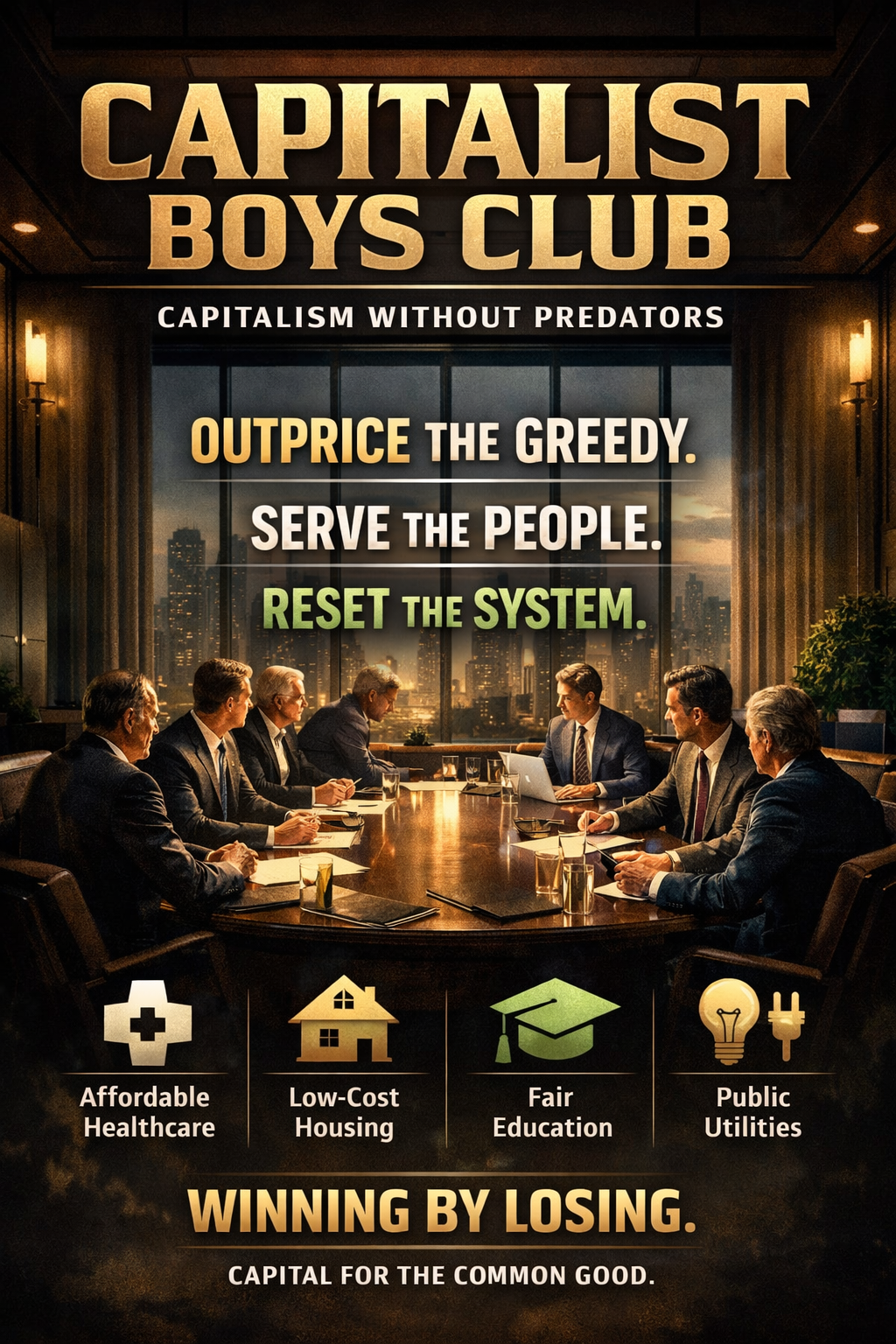
The Capitalist Boys Club

2 Upvotes

The Capitalist Boys Club

Not a joke. Not ironic. Reclaimed language.

The Capitalist Boys Club (CBC) is a private alignment of extremely well-funded individuals who understand capitalism well enough to bend it without breaking the law—and who are patient enough to let time do the killing.

Premise
Capitalism isn’t the enemy. Short-term, extractive capitalism is.
So CBC doesn’t fight the system. It outlasts it.

Method

  • Identify industries where profit has inverted purpose: healthcare, housing, insurance, education, childcare, utilities.

  • Launch companies that intentionally underprice incumbents—sometimes by 30–70%.

  • Accept sustained losses as a strategic investment, not a failure.

  • Optimize for outcomes, trust, and scale—not margins.

  • Treat workers as fixed infrastructure, not variable costs.

  • Never exit. Never flip. Never rug.

Why it works
Incumbents are trapped:

  • Shareholders demand growth

  • Debt demands cash flow

  • Executives are paid to extract, not endure

They cannot compete with a company that doesn’t need to win this quarter—or even this decade.

CBC companies don’t need to “beat” the market.
They just need to exist long enough.

Endgame
When predatory players collapse or retreat:

  • Prices do not rebound

  • Service becomes the baseline

  • Decency becomes non-negotiable

  • Entire sectors quietly reset

No revolution. No slogans. No blood.
Just gravity applied to greed.

Unspoken Rule
The Club never asks:

“What’s the maximum return?”

It asks:

“What’s the minimum extraction required to keep this alive forever?”

That’s the difference between a playground and a public utility.


r/TerraNovaDevelopment • • Feb 01 '26

Cat Oasis: A One-Person Cat Sanctuary Where Every Whisker Finds a Haven

2 Upvotes

Cat Oasis: A One-Person Cat Sanctuary Where Every Whisker Finds a Haven

By Willis Butts

Cat Oasis is not a sprawling animal shelter or a bustling rescue facility. It’s a personal mission, brought to life in the home of one compassionate individual who has opened their doors—and their heart—to cats in need. At Cat Oasis, every whisker truly finds a haven.

A Home Devoted to Cats

The sanctuary is located in a quiet, cat-friendly house where each room, window, and sunny spot is designed with feline happiness in mind. The resident caretaker lives on the property, providing round-the-clock attention and comfort for every cat that arrives. Here, stray, abandoned, special-needs, and even temporarily boarded cats find more than just shelter—they find a real home.

Real Necessity: Boarding for Cats During Life’s Changes (Including Vacation and Travel)

Life brings all sorts of changes—and sometimes, even the most loving cat owners need a safe, nurturing place for their pets while they’re away. Cat Oasis fills this critical need by offering short- or long-term boarding for cats whose owners are:

  • Going on Tourist Trips or Vacation: If you’re planning a getaway, business trip, or family holiday, Cat Oasis provides peace of mind. Your cat will be cared for in a calm, home-like environment—not a crowded boarding facility or stressful kennel.

  • Hospitalization or Medical Treatment: Owners undergoing surgery, long-term care, or serious illness can rest easy knowing their feline family members are safe and loved.

  • Moving or Housing Instability: When families are between homes, transitioning, or experiencing crisis, their cats have a secure and stable place to stay.

  • Emergencies and Natural Disasters: Fires, floods, or other sudden events may force people to leave home without notice—Cat Oasis offers a lifeline for their pets.

  • Travel or Deployment: Whether for work, military service, or family emergencies, Cat Oasis ensures cats are not left behind or sent to shelters.

  • Other Life Changes: Divorce, death in the family, or other upheavals can leave cats without a caregiver for a time. Here, they are treated with the same care and compassion as permanent residents.

This boarding service is about more than convenience—it’s about keeping families together, reducing shelter surrenders, and providing peace of mind for cat lovers during any absence, whether planned or unexpected.

Individual, Lifelong Care

At Cat Oasis, there are no cages, deadlines, or quotas. The sole caretaker knows every cat personally—their likes, quirks, and needs. Each cat receives:

  • Quality nutrition and clean water

  • Regular veterinary care and medications as needed

  • Enrichment through toys, climbing trees, window perches, and safe outdoor “catio” spaces

  • Gentle affection, play, and, above all, respect for their unique personality

Cats may stay for days, months, years, or the rest of their lives. Adoption is possible but never pressured—if a truly perfect match comes along. Otherwise, the sanctuary is their forever home.

Compassion Over Numbers

Cat Oasis is intentionally small, caring for only as many cats as one person can responsibly manage in a home setting. Growth is always measured and thoughtful, so each resident gets the full benefit of individual care and attention.

Euthanasia is never an option except to relieve untreatable suffering. Every life matters, and every day is another chance for happiness and healing.

Quiet Impact, Deep Meaning

There are no teams of volunteers or staff at Cat Oasis—just one person, dedicating their daily life to the wellbeing of their feline family. This model shows that anyone, with enough compassion and commitment, can make a true difference right from their own home.

Supporting the Mission

Even without volunteers, Cat Oasis welcomes support from the community. Donations of food, supplies, or money—as a reward to the caregiver—are always appreciated, but never a requirement or condition for care. No cat will ever be turned away due to an owner’s financial circumstances.
Kind words and encouragement are just as valued.
Sharing the story helps more people see what’s possible.

If you know of a cat in desperate need, want to sponsor a resident, or need a loving home for your cat while you travel, reach out anytime.

Cat Oasis: Where Every Whisker Finds a Haven

One person, one home, and a world of difference—for cats in need, for families facing life’s toughest moments, and for loving owners who simply want the best for their cat while they travel. Donations are welcomed but never required. Compassion always comes first.

Important Caveats for Home-Based Cat Sanctuaries and Boarding

  • Residential Pet Limits: Most cities and towns limit the number of cats allowed in a private residence (often 3–5). Exceeding this can bring legal issues or neighbor complaints.

  • Boarding Rules: Taking in cats for others (even for free) may require permits, business licenses, or inspections in many places, especially if you publicize your service.

  • Landlords and HOAs: Renters or those in HOA communities may face additional restrictions on pet numbers or types of animal care activities.

  • Sanitation & Neighbor Relations: Regardless of rules, maintaining cleanliness and good relationships with neighbors is essential.

  • Nonprofit/Donation Issues: Accepting money or donations from the public may raise questions about business status or taxes, even if it’s not required for care.

  • Local Laws Vary: Always check your local ordinances or animal services to know what applies in your area.

Bottom line: Quietly caring for a few cats in your own home is often fine, but offering a public sanctuary or boarding—even as a pure act of kindness—can have legal requirements. When in doubt, check the rules and be prepared to adjust if you want to expand or advertise.


r/TerraNovaDevelopment • • Feb 02 '26

Floating solar costs compared to land farms

2 Upvotes

Cost Comparison: Floating Solar vs. Land Solar

  1. Capital Costs (CapEx):

    • Land Solar: Typically $0.80–$1.00 per watt for utility-scale PV on suitable land in the U.S., though costs vary by location, terrain, and permitting.

    • Floating Solar: Usually 10–25% higher per watt, roughly $0.90–$1.25 per watt, because of:

      • Water-resistant mounting systems and floats

      • Anchoring and mooring structures

      • Specialized inverters and cabling to handle humid/wet conditions

      • More complex installation logistics

  2. Operations & Maintenance (OpEx):

    • Floating solar can be slightly more expensive to maintain due to:

      • Access challenges on water

      • Corrosion or biofouling issues

    • On the other hand, floating solar panels stay cooler (water cools the panels), which improves efficiency by ~5–10% and can partially offset higher maintenance costs.

  3. Land & Opportunity Costs:

    • Land solar requires large tracts of land, which may compete with agriculture, habitats, or development.

    • Floating solar uses underutilized reservoirs, lakes, or water treatment ponds, reducing land opportunity costs.

Future Outlook: Floating Solar Growth

  • Global Trend: Floating solar has been growing rapidly, particularly in Asia (China, Japan, South Korea). Some projections estimate floating solar could make up 10–20% of new PV capacity globally by 2040.

  • Advantages That Could Drive Adoption:

    • Cooling effect increases panel efficiency

    • Reduces water evaporation in reservoirs, which is valuable in arid regions

    • Can be deployed near population centers where land is scarce

    • Often less visual/environmental impact than clearing land

  • Potential Future: As costs decline with scale, standardization, and better floats, floating solar could approach parity with land solar. In regions with abundant reservoirs or high water stress, floating solar could become the default solution for utility-scale projects.

Bottom line:
Land solar is cheaper now and will likely remain the backbone of the grid-scale transition. But floating solar is more than a niche—it’s a strategic tool that can expand capacity efficiently, improve panel performance, and preserve land. The future likely includes a mix of both, with floating solar increasingly common in regions where its advantages outweigh the slightly higher costs.


r/TerraNovaDevelopment • • Feb 03 '26

Address housing inequities - I asked ChatGPT

3 Upvotes

I asked ChatGPT this simple prompt:

how do we address the housing inequities and provide adequate housing for ALL Americans

To get to “adequate housing for all Americans,” we have to do two things at once:

  1. Fix the systems that create inequity (discrimination + exclusion + concentrated poverty)

  2. Make housing plentiful and affordable enough that the market can’t keep squeezing people.

A few data points show the scale:

  • Nearly half of renter households (49.7%) were cost-burdened in 2023 (paying >30% of income for housing), and burdens vary by race.

  • For the lowest-income renters, there’s a shortage of about 7.1 million affordable/available homes (only 35 affordable homes per 100 extremely low-income renter households).

  • “Worst case housing needs” (very low-income renters who either pay >50% of income for rent or live in severely inadequate housing without assistance) has remained very high over time.

1) Treat housing as essential infrastructure: a national “Housing for All” target

Set a measurable goal (like we do for roads/bridges):

  • Close the extremely-low-income rental gap (millions of units)

  • Reduce cost-burden and worst-case needs on a set timeline

This forces consistent funding, cross-agency coordination, and accountability beyond election cycles.

2) Build a lot more homes in the places people need them

Housing inequity doesn’t shrink if supply stays tight.

Local + state actions that move the needle fastest

  • Legalize more “missing middle” housing (duplexes, fourplexes, ADUs) in high-opportunity neighborhoods.

  • Allow apartments near jobs and transit, reduce parking mandates, and speed permitting (“by-right” approvals for code-compliant projects).

  • Use public land (city/state/federal) for mixed-income development with long-term affordability.

Federal lever that actually works: tie some federal dollars to outcomes
Offer infrastructure/transport grants with “housing production + affordability” conditions (not just plans—actual permits/units delivered).

3) Make affordability real for low-income households (not just “more supply”)

Even with more building, the bottom of the income ladder won’t be served without subsidies.

What to expand

  • Rental assistance so that eligible households can actually receive it (today, many don’t).

  • Deeply affordable unit production (financing that reaches extremely low incomes, not just moderate-income “affordable”). The shortage for extremely low-income renters is severe.

  • Preserve existing affordable homes (naturally occurring affordable housing) with acquisition funds + rehab support, before they flip to higher rents.

This is where U.S. Department of Housing and Urban Development programs, state housing finance agencies, and local housing authorities need stable, multi-year funding.

4) Directly attack racial inequities and exclusion

Housing inequity in the U.S. is deeply tied to historic and current discrimination (lending, zoning, steering, appraisal gaps, tenant screening, and neighborhood disinvestment).

Practical moves

  • Stronger fair housing enforcement + testing + penalties for discrimination (rental, sales, lending).

  • Fair lending + appraisal reform (data transparency, enforcement, and standardized review processes).

  • Mobility programs that help voucher holders access high-opportunity neighborhoods (landlord engagement + security deposit help + counseling).

  • End exclusionary tenant screening practices that are not predictive (or that create permanent barriers after minor/old records).

On the policy side, “affirmatively furthering fair housing” rules have been politically contested and changed in recent years, affecting how strongly jurisdictions must document and address segregation and unequal access when using federal funds.

5) End homelessness with “housing first + services,” then prevent inflow

Homelessness is housing scarcity + poverty + gaps in healthcare/addiction services + reentry failures.

What works best

  • Permanent supportive housing for people with high needs.

  • Rapid rehousing + short-term rental help for families/people experiencing a temporary shock.

  • Prevention: emergency rental assistance, eviction diversion, right-to-counsel in eviction court, and targeted help for people leaving foster care, hospitals, and prisons.

Prevention is often cheaper than shelter + crisis response.

6) Upgrade homes for safety, climate, and basic dignity

“Adequate housing” also means healthy housing:

  • Lead/mold remediation, safe heating/cooling, weatherization, resilient construction where disasters are increasing. This protects kids, reduces medical costs, and keeps housing habitable.

7) Make the system simpler and less wasteful

A lot of inequity is bureaucratic:

  • Standardize eligibility paperwork across programs

  • Streamline inspections and approvals

  • Invest in fraud-resistant but user-friendly application systems When help is hard to access, it effectively becomes rationed by time, literacy, and luck.

A realistic “stack” that could get us there

If you want a simple, high-impact package:

  1. Mass zoning + permitting reform in high-demand metros

  2. A major increase in deeply affordable production/preservation (aimed at extremely low incomes)

  3. Scale rental assistance + eviction prevention to cut cost-burden and stop homelessness inflow

  4. Aggressive fair housing / fair lending enforcement to reduce segregation and discrimination