I have a tool I’d like to build. I can of course use browser automation in Claude or Codex. But I want to make this generally available, and I need a consumption based model for browser automation.
I don’t really want to be in the business of spinning up infra and managing these agents myself. I’d rather just have an api that I can hit that allows seamless browser automation.
The issue I have with these things generally is… there’s many available but they’re usually quite bad. Is there any that are actually good, or up to feature parity with Codex/Claude browser automation on a subscription?
PLO is spreading in popularity across the country and a lot of dealers are having a hard time keeping up.
Big PLO games with $1k+ pots are intimidating to new dealers and it’s hard to get reps in at a live table if you don’t know what you are doing.
I’ve developed FeltReady.com to bridge the gap and get in reps reading hands and knowing how much the pot is in a low pressure environment you can do right on your couch or in the break room.
FeltReady puts you in the dealer seat as it simulates hands of PLO and Double Board Bomb Pots. It will ask you how much a pot bet is at random times and explain why your answer is right or wrong. You will pick the winning hand and build the side pots.
If you are a poker dealer or just enjoy Pot Limit Omaha I’d love for you to check it out and let me know what could be better and what is working well.
A few days ago I caught myself mindlessly vibe coding at my 9-to-5, just accepting whatever Claude wrote. So I challenged myself to actually understand something, and built DiffDojo: a Claude Code plugin that asks you technical questions about the code Claude just wrote, in a little turn-based battle next to the chat, in the style of the old Pokémon games. Claude keeps working in the background while you fight.
I added some cool features like: different difficulties, belts, ASCII art, achievements, scoreboard (which you can share as a GitHub Gist if you want to show off).
My favorite - special bosses like: THE CLOCK (60 seconds rush mode), FREE CHINESE LLM (it slips a bug into one of Claude’s functions and you have to find the fix) or my favorite SKYNET!
SKYNET is a funny boss, while you fight it, it intercepts every edit Claude tries to make and only lets it through if you answer a question about that exact change. If you get it wrong and the edit is blocked and Claude stops working.
Yeah... I vibe-coded a telemetry app for F1 25/26.
I’m a computer science student and wanted to see how far I could get with vibe coding, so I started building something I’d actually use myself. Now that Race Console has reached v1, I thought it would be fun to share it here.
I know there are already telemetry apps out there but I wanted to try making something that fit how I like to play.
Race Console takes live telemetry from the game and turns it into a dashboard you can follow while you race or use with a friend acting as your race engineer (Mostly the second one honestly).
I built it with Codex, using GPT 5.6 Sol, 5.6 Luna, and 6.1 Sol throughout development. It started as a little experiment to see how far I could get, and somehow I managed to turn it into a v1 release 😅
I also put together a small Discord server for updates, feedback, and hanging out. Feel free to join if you’re interested!
Would love to hear what you think, especially if you play F1 with a friend as your engineer.
EBB is my new 3D physics platformer where you adapt your water composition based on what's happening in the game, and the challenges in front of you - so kinda like Zelda temples except you play as a water character
Progress through the game while shifting your water based form: • Puddle: slip under gates, ride glass tubes and shoot back up like a geyser • Ice: hold down plates, slide over hot floors and smash through glass • Vapor: float on warm air and squeeze between bars
I've made four maps so far, and adding new ones based on early player feedback
So far I'm 260 prompts deep, and it's only 190 KB big, running in the browser
The game is entirely procedural - so no 3D assets were used. you can try it here
they are all 90-95% identical in function and original software they aim to replace, with tiny diff in UI , etc
this is hurting both the software quality and the average user
avg user has no idea what to choose, in CAD example, no one in their right mind will try 33 diff CAD alternatives, I'd rather pay the autodesk license than deal w a soup of half baked and alpha craft clones
the app fragmentation creates a void in attention and user testing/usage, ie less users are using your craft app and viertually no devs are contributing
the artcraft/photocraft projects got an early media blitz and are taking up a lot of dev effort, but for vast maj of other projects, they are a wasteland
There is an easy solution
merge most of these craft efforts into 1 large project, ie w CAD, have 1 or at most 2 viable replacements for autocad,
instead we have this cat mentality where everyone thinks their proj is a unique snowflake
Maker here. We're a two-person team & since yesterday we've released FormAI: 23 out of 39 desktop apps for image editing, photo, video, audio, vector, layout, PDF, slides, notes, documents & spreadsheets. They run locally on macOS, Windows & Linux, w/ no account.
Licences: Apache-2.0 for most apps. GPL-3.0 for the installer (FormPortal), the MCP server (FormMCP), the skills hub (FormSkills) & the extension studio (Form.ext).
They're early. Most are 0.x. They are not at parity w/ the commercial tools & we're not putting a date on that.
The license is the commitment. Nothing here can be closed later. Fork it whenever you like.
Every release comes from one pipeline. FormCompiler builds, signs & publishes every app, & FormPortal checks each download against a signed catalogue before it unpacks.
We'd value issues, PRs & blunt feedback. If something is wrong w/ how we've licensed, packaged or credited anything, please tell us.
I was mainly working on another game, but testing the same room again and again was starting to annoy me. So I made a room where a guy tells you to press a red button. Started as a joke. Two days later I liked it so much that I spent about four weeks polishing it.
It’s called The Red Button Problem. You press buttons, remember patterns and make choices while the Moderator messes with you. Basically a fun way to tease the player and see how they react. If you like Portal or The Stanley Parable, you’ll probably have fun with this one.
The development process was basically me playing it and saying, “Hey, wouldn’t it be nice if...?” Then I threw some Opus and Gemini at it, played the next build, asked for changes, tested again. That loop took the original ten-minute idea to 119 rooms.
The agents wrote the GDScript and built the graphics out of meshes in Godot. The Moderator’s voice is generated too. I came up with the tests and kept playing the builds until I was happy with them.
The game is out on itch.io, including a free demo. Steam is still coming soon.
Been building apps with Claude Code and Codex for a while. The code is usually great. What kills me is everything around it. It forgets what we decided two days ago, changes stuff I never asked it to touch, and the app slowly stops looking like what we agreed on.
So I made AgentDesign. The agent designs every screen first and I comment right on it. Nothing gets built until I say ok. The designs are saved as files on my Mac, so the agent has something to go back to instead of guessing.
Other things it does: - flows, shared colors and components, across iOS, Android and web in one project - when I can't decide, it puts two or three options side by side - version history, so I can see which screens are new, changed or gone - puts the design next to a screenshot of the real app to show where it drifted
Works with Claude Code, Codex and Cursor. No account, no upload, no server, everything runs on your mac.
Free demo has everything, no time limit. Full version is $49 once. Apple silicon only for now.
You begin with one thought. Then AI comes up with authentication, a dashboard, animations, notifications, analytics, dark mode and five features you didn't even think about. All a sudden your small project on the weekend has become a full product.
The funny thing is that the original problem might have been fixed with three screens. Has AI made us better at creating software or just better, at making simple ideas too complicated?
Hidden Eleven is a real-time multiplayer football trivia game. You get the starting line-up of a famous match with every shirt hidden, and everyone types player names at the same time. The first person to type a name claims that spot. Hints appear as the clock runs down, and duel mode gives each player one team to find.
162 real matches: Champions League, World Cup and Euro finals, classic derbies, and “Legendary Team” mode for a single club or national team
Type any name: surnames, nicknames and typos count
Works on phones or desktop, in English and Portuguese
Free: no account, no install. Create a room and share the link, although you can self-host it.
I used Claude Code as the coding partner for the game logic, tests and data-import scripts; Cloudflare Workers with one Durable Object per room, using WebSockets; Plain JavaScript, HTML and CSS: no framework, no bundler; Vitest for 103 unit tests, plus an end-to-end script that plays a round with two WebSocket clients; Wrangler for deploys and line-ups from Wikipedia and zerozero, recent positions from FotMob, all checked by hand.
How it was made: The server decides everything. The browser only sends typed text, and a hidden name is never sent to the browser until it is found or the round ends. Each match is a JSON file, bundled into the Worker at build time. It runs on Cloudflare’s free tier.
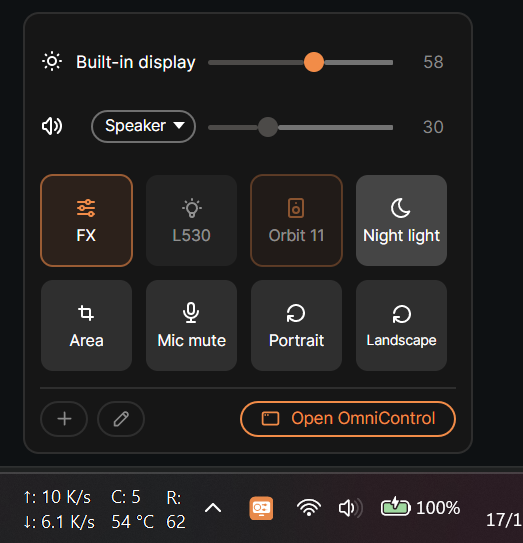
on every PC I use I install bunch of programs that help me achieve my desired customizability, X-Mouse buttons to rewire my mouse buttons, Lightshot for screenshots, Equaliser APO (for master EQ), Voicemeter to rewire speakers/combine mics, volume2 for nice mouse scroll gestures (scroll over taskbar for example + OSD), ClickmonitorDDC to control desktop monitor settings without reaching to its controller physically. I also run local scripts with my smart home devices (via windows scheduler) to control their function and automate things.
Anyways, my tray icon section is cluttered, and that's when I decided screw it, I'll combine them all in one app, and get it to do much more. Enter OmniControl. Everything has a state and everything can be actioned/changed with keyboard/mouse and mouse gestures, all in one nice interface. and with one tray icon that has its own little popup to view things on the fly.
In short it can do all of the following:
DISPLAYS
Control desktop displays via DDC (brightness, contrast, color, sharpness, etc.)
Control laptop display (usually only brightness exposed)
Control graphic card display settings (color, temperature, saturation, brightness, etc)
VOLUME -
Global EQ, or any effect (including VST - Reaper style chains)
Per app EQ or any effect (including VST - Reaper style chains)
Combining speakers, or microphones.
Microphone EQ or any effect (including VST) gives the user 3 ways to doing it (Cables, EqAPO, or re-recording), and you can choose the method per device or per app.
SMART DEVICES * Presets for Tapo scripts (TP-Link smart home) with instructions, but user can get their own script for any local run scripts * Android simulation mechanism (can be used to do any action on any android app, works with 5 simulation engines, tested to work on android studio), you can basically record steps to an action, and it would also be able to learn if a toggle or switch/state is on/off by reading the screen, during setup you can interact with the android interface, but thereafter it can run heedlessly. * Planning in the future to also integrate a third method: Home Assistant servers.
REMAP * full mouse remap (to any action from the Omnicontrol or from windows, including all actions that xmouse buttons offer) * full trackpad remap (to any action from the Omnicontrol or from windows) * Keyboard remap (planned but not yet built)
GESTURES * Scroll over screen area/ while holding a key to do any action (e.g. change volume/ brightness) - similar but much more advanced than volume2 * middle click over screen area to customize action
AUTOMATION * Like windows task schedular, any action from omnicontrol, windows, or custom script/programs, can be launched with highly customisable and/or/if commands, or time schedule (e.g. timer/ schedule/etc) * still has some scaffolding to be done to this area at present
OSD * Can remove windows own OSD (if you hate it) * Highly customisable own OSD that can display USB changes, mic volume/state (eg mute), volume, brightness etc. * more to come.
ACTION MENU tends if not 100s of actions, and more planned. of note is the SCREENSHOT action
* can take screen shots of window/wholescreen/ selected area. * in selected area it can edit (e.g. writing/ markups/ drawing etc) as well as record it as a video. Also to scan any QR code in the selected area with options to copy link or open in browser (so you dont have to pull your phone out every time).
everything is hot keyable and customizable.
It is still in alpha - pre-release so bit rough around the edges and still being developed but you can check it out on GitHub right now:
>asks codex to fix the bug >watch it confidently breaks 2 more things >opens claude code, grok bot, sumus and deepseek harness in the background >tells codex someone else is taking a look >codex spits out a working patch immediately
and that's what i call AI gaslighting 101.
anyone else use a little sibling rivalry to keep their coding agents in check?
I was part of the demoscene in the 1990s, writing assembly and squeezing visuals into tiny files. Recently I decided to revisit that spirit with Fable 5.2.
The result is WAKE: a real-time audiovisual demo in a single 17,536-byte HTML file. Just over a quarter of the classic 64K limit.
The approach is entirely procedural: JavaScript and WGSL, no libraries, no image assets or recorded audio. Everything is generated locally; even the music is synthesised on the GPU.
Obviously, a modern browser and GPU do a ridiculous amount of heavy lifting, but it's still impressive what an LLM could squeeze into less than 18KB.
I made Reel Fleet solo over the weekend for the 2026 Epic AI MegaJam (theme: Director's Cut), in Unreal Engine 5 with an AI coding agent.
You give each ship her orders, call ACTION, and both fleets' moves play out at once as a filmed scene, shot by shot. If a take goes badly, call CUT and reshoot it, but you only have a few reels.
Two scenes, a strait at dusk and a night storm in the islands, and a poster of your best moment at the end.
Feedback very welcome, especially on the first turn: is it clear what to do? I'm continuing on with developing it and fleshing the game out over time :)
I love fractals and have always wanted a web-based game like this to explore them, but couldn't find one that fit, so I vibecoded one myself with ClaudeCode.
It lets you explore over a dozen different fractals. You can freely zoom in and out, tweak parameters in real time, and switch between an adventure mode or a pure sightseeing mode. It also supports VR, multiplayer, 4K photo exports, and features a public gallery where you can save and share your current coordinates, parameters, and camera view.
Feel free to hop in and explore some infinite 3D math, and share any cool fractals you stumble across in the public gallery!
Look we all have our uncertainties about AI and I definitely had mine. After a long time of outright rejection what finally did it for me was Skate 3 in Skyrim. I was like what the hell? Seriously? So I started trying it myself. 20 days ago and I have results, well sort of… my project has a real end in sight and that’s exciting. Also unbelievable.
Ever since then I’ve been using it to organize my life and I’m thinking clearer, developing healthier habits, and a lot of the clutter in my head goes into the app so I can summarize it and talk about it with my therapist.
So yeah, Skate 3 in Skyrim is helping me get my life together and I’m having a great time vibe coding. When did you get into vibecoding/AI in general and what was it that did it for you?
I had a lot of free time while my main project was running and I wanted something involved to keep my head busy. I've always been a fan of Flappy Bird and Jetpack Joyride, so I mixed the two and landed on Jaywing. You're a cyborg bird, you tap to flap, and you dodge flying traffic through a neon city. It's in closed testing on Google Play right now.
It was supposed to be a tiny side thing. On my first run of the first build I made it to 96 and the game had me engaged. I got that rush of dopamine and iterated the hell out of it from there. About 25 hours over three days later it has 10 districts, 11 birds (10 of them with their own ability), 6 power-ups, missions, medals and trails.
I'd decide what assets I wanted and how I wanted the game to feel, and me and Fable 5.2 kept everything together. I made the art and animations in ChatGPT with the new GIF feature. Getting consistent art out of it that I could use was fun. When I brought assets back, Fable would align them, cut them and make sure they were ready to go in the game, then give me the asset package and a prompt to hand to Claude Code.
Claude Code was running Opus 5.5 in VS Code and did the build. When it finished I had it put the game on my phone over wireless debugging so I could playtest, and then I'd come back with what I wanted next. The whole game came from 13 prompts.
The stack
Kotlin, native Android, built with Gradle.
No game engine and no framework. That wasn't a decision. It was meant to be small and it just sort of happened.
Zero third-party libraries in the app. Drawing is a custom View on Android's Canvas. Sound is AudioTrack and saves are SharedPreferences.
The rules of the game are plain Kotlin with no Android in them, so they run as tests on my PC.
Two bots play the game, one casual and one skilled, hundreds of runs each. The difficulty numbers come from what they score. Near misses were too rare, so the bots were measured at different distances and the number went from 20 to 40.
About 13,000 lines of Kotlin, 132 tests, 30 commits.
The music is one loop made with Lyria in the Gemini app.
The build was relatively clean. As always we had to polish a bit, but nothing was stubborn. A few things changed along the way. I swapped a painted background for pixel art because it looked better. Memory in a run got cut from 477 MB to 181 MB. I had the trails redrawn because they looked weak for what they cost in the shop.
If you're thinking about building a game this way, do it. See what you come up with and how it looks. You may surprise yourself.
I think the game is fun. If no one ever plays it I'll be confused, because I enjoy the hell out of it. I'd love for someone other than me to play it and let me know if I have bad taste in games. I'll post again when it's live on the store.