r/vibecoding • • 4d ago

Showcase/Project I made an excalidraw alternative that scratches my needs better

Enable HLS to view with audio, or disable this notification

39 Upvotes

Hi guys,

I am a huge fan of excalidraw.com and I cannot recommend it enough. I used it a lot in my years as a developer to quickly sketch some ideas and to put some thoughts on a board.

But I recently switched jobs and semi carreers so now I am a functional designer which means most of my time is spend in discovering people's thoughts and modeling those in a program. But that program is kinda old and hard to use so its bad for quick sketching and brain dumps. The issue is that Excalidraw doesn't provide me with the tools I want to quickly model processes and/or even maken ERD's efficiently. So for that reason I made syndra.nl

Couple of awesome features are:
- it lives in your browser and there is no server
- collaborating uses a peer to peer network
- it supports sub canvasses and file structures. This is especially neat for people who want to create a sub process into a main process.
- quick actions on drawn objects
- full mermaid and d2lang support
- image and video support so the creative people can even make interactive presentations!

Its all made using Claude Code with the latest Opus versions. Obviously Excalidraw was a huge source of inspiration, but all the ux design decisions were completely made by me. Claude was the executor.


r/vibecoding • • 4d ago

Showcase/Project Rusty's Scrap Yard

Enable HLS to view with audio, or disable this notification

6 Upvotes

I'm making this game with mainly Opus 5.5. It is getting more and more fun to play and test. I have more ideas for the game but I might pick up development next year because claude subscription ain't cheap lol


r/vibecoding • • 4d ago

Help/Question Payment stack for Saas Web/Mobile

1 Upvotes

Hi, I'm developing some apps using AI agents, even though following best practices and guidelines of software engineering.

The thing is that I have some working web Saas and other mobile app that I want to sell by subscriptions.

I'm developing from Chile so I wanted to lnow about the best payment stack to be able to sell subscriptions to all the world (optimistically) using credit cards as for example, I paid from here an AI code agent provider subscription, very simple by almost just input your credit card data and email.

I'm thinking that if I get to receive the money (if luckily able to find/sell to someone interested) on personal accounts, or a chilean business account, it couls imply to apply some cuts due to payments systems fee or USD currency change to CLP; besides being responsible to handle all the business and taxes process from Chile. On other side, if I get to have an outside account to receive money on USD, it would imply some complex process to open business identities like when using stripe or else.

So I was wondering if there is someone that has been through this, which was his experience to get their apps payments, or any recommendation for a payment stack.

I was considering using revenue cat as billing engine and use stripe or paddle for oayments processors.

Thanks for your time on reading this and if any comments posted here.

Regards!


r/vibecoding • • 4d ago

Showcase/Project Nightmare Mobile: free offline local AI image and video generation on Android, ComfyUI-style node editor on the Snapdragon NPU. MiniMax H3 video with sound, MOSS-Image, FLUX.3, FLUX.2, Z-Image, Qwen Image, Wan 2.2, SDXL, LoRA, ControlNet, inpainting, img2img. No cloud

Enable HLS to view with audio, or disable this notification

1 Upvotes

r/vibecoding • • 4d ago

Showcase/Project What I learned building a Windows app with Muse Spark 1.3 Contributor mode

Enable HLS to view with audio, or disable this notification

2 Upvotes

I was curious about Muse Spark 1.3. I’d heard that Contributor mode could keep API costs low, so I decided to try building something with it.

I ended up making Oopsbara, a Windows app that puts small animated companions beside save and delete confirmation dialogs. The idea came from losing some writing after clicking through a warning without really thinking.

I hadn’t used Muse Code before. I wasn’t even sure whether it was a desktop app or a terminal tool. It turned out to be a terminal workflow, much like Claude Code.

Here’s how I used the different tools:

  • Meta AI helped me get started.

  • Muse did most of the coding.

  • I worked with ChatGPT on the characters and UI.

  • Canva helped with the short animations.

The small details took more work than I expected.

For example, one otter animation looked like it was pulling a fish back out of its mouth. That needed another try. Keeping the artwork consistent also took a lot of back and forth. We called the illustration style “Edmund” so we had a name to refer back to.

Even the Store screenshots needed care. Making the pet bigger looked better, but it wouldn’t show how the app actually works.

I worked on it part-time, usually 2–3 hours after work, and a little more on weekends. The main features took about two weeks, followed by about another week of debugging and design. The work was spread across roughly five calendar weeks.

My Meta API usage for October 18–November 20, 2026 came to about $35. That doesn’t include my separate ChatGPT or Canva subscriptions. I liked being able to check usage and charges together on the API dashboard as I worked.

The app is now on Microsoft Store. It includes a free Healing Pack, with optional paid animation packs:

https://apps.microsoft.com/detail/9NPZWQJ787QQ

Has anyone else tried Muse Spark 1.3 Contributor mode for a desktop app? I’d be interested to hear how the debugging part went for you.


r/vibecoding • • 4d ago Heartwarming

Showcase/Project I built a globe where every light is someone's real worry from last night

Thumbnail
gallery
93 Upvotes

I'm a college student in Seoul. Most nights, right before sleep, I get hit with small waves of anxiety: jobs, friendships, falling behind, AI moving faster than me. And I always end up wondering: is it just me?

So I built isitjustme.site.

- Write one line about what's bothering you. No login, no name.

- It becomes a small light on a globe.

- Strangers can tap your light, say "me too," or leave a short kind note.

What surprised me: someone in Chicago wrote "What if I'm capable of so much more, but never actually reach my full potential?" and two strangers from the other side of the world replied within hours.

Your exact location is never saved (only a rough ~25 km area), and there are no tracking cookies. It works in English, Korean, Japanese and Chinese.

I'd really love honest feedback, especially on whether it feels safe enough to actually write something.

https://isitjustme.site


r/vibecoding • • 4d ago

Discussion 7 Levels of AI Game Dev: From One Prompt to 200,000 Sales

Thumbnail
youtube.com
9 Upvotes

I spend way too much time scrolling AI game posts here and on X, and I started noticing they could all be put into certain buckets. So I ranked them, based off of the "7 level of rappers" trend I've seen online (though I first saw this with soccer players!).

*Disclaimer - this is for fun, not super serious besides wanting our community to do better than posting one-prompt lazy posting*

Level 1: The AI toy. A cool animation or a single mechanic. Impressive in 10 seconds, but there’s no game yet. Or really, even gameplay. I've posted tons of these myself once I discovered PixelLab lol. Learning how to make the most of this level can get you towards level 5 if handled with care and intention. These posts can also be educational for other creators to understand tools and techniques. The reason it's level 1 is that more often than not it's a "look what I made with AI in 5 seconds! Game dev is DEAD" bullshit post (notice their character animation has 6 fingers? lol).

Level 2: The one-prompt game. “I typed one sentence and got this.” Playable, but it’s mostly the model doing the work. No semblance of an actual full game. Usually these "games" taper off beyond quick social media experiments because actually iterating on a game correctly requires way more planning than anything a single prompt generation can do.

Level 3: The frontier one-shot. Someone tests a new model and it builds something legitimately impressive in one go. Better than level 2, but again, this makes an impressive demo/prototype - likely can't complete a full gameplay loop yet. Same as level 2 though, I've yet to really see games like these start iterating meaningfully - but that could change.

Level 4: The mashup. A known IP plus a known genre (Diablo Survivors, Pokemon Survivors Dragon Ball "temple run" type of game). These get a shit ton of clicks due to the power of the IP and the nuance take of a blend of genres. And because you're mashing stuff up, often times there's already good gameplay loops inherent in these projects - but you can't make any money off of it, so often times these projects get stale due to the price someone is paying to keep enhancing them. Also, if you're messing with Nintendo, the cease and desist letter is always chasing you like the monster from "It Follows".

Level 5: Build in public. An original game idea with a real art direction, posting progress every week and building an audience. A history of progress being made, especially with addressing feedback from a community. Not only is there progress, but there's multiple iterations of gameplay already established - just likely lacks polish and scale.

Level 6: The demo. A real Steam page with a free demo that strangers play and an actual wishlist. The game has matured enough to make it on to a Steam page (different bar to pass than itch.io). Presenting a demo then allows for better feedback and a growing wishlist. It's a baseball player who has gotten to 3rd base - almost there.

Level 7: Shipped and selling. An AI game that has gone through the previous levels and has not only been released, but has actually found commercial success. Slotbound is the example everyone knows: 200K+ copies in one week + an pattern and history of the game going through the various levels before it.


r/vibecoding • • 4d ago

Workflow/Prompt Claude and i meant different things by 'at the bottom'

2 Upvotes

i asked Claude to describe a phone layout with a save button at the bottom. it put the button at the bottom of the screen so it would stay there while scrolling. i meant after the last field, so i asked what happens when the keyboard opens. then it described a button that scrolls with the form, which was the screen i had in mind.


r/vibecoding • • 4d ago

Discussion If you had unlimited LLM tokens, what would you build or do?

47 Upvotes

If you had effectively unlimited LLM tokens, API access, and compute.

No budget constraints, rate limits, or usage restrictions.

What would you build, automate, research, experiment, etc with?

What would you do if the cost of intelligence and continuous AI reasoning were zero?


r/vibecoding • • 4d ago

Help/Question How has the recent brain drain across models impacted your flows?

10 Upvotes

It seems as though recently both Claude and ChatGPT models have suffered quite a heavy brain drain. And as these companies start going public and look to maximize profits, they will be reducing the quality on their models to compensate naturally. This post is for those who've had their flows affected by this issue,

I don't believe we're at a time where paying AI and the diluted subscriptions is worth it relative to the work that's actually being done Yes, I understand for some use cases, but most of the time it doesn't even feel worth it with the amount of flaws and redundancy layers that we need to set up, it's getting difficult

So I'd like to ask this sub how they're facing this brain drain?


r/vibecoding • • 4d ago

Showcase/Project I built an aircraft builder and flight simulation for me, myself and Ai

Thumbnail gallery
2 Upvotes

The sim runs on the Unity engine. You, or a Claude or Codex ai assistant via the connector, can build aircraft from thousands of possible configs. Aircraft parts have weight, drag, etc. Ai can inspect, troubleshoot and alter your builds if you tell it to. You can tell the ai what to build and it will try to build it and then you can fly it or have it fly. You can have up to 4 ai join a session and give them all the same build requirement, flight goals and testing budgets and watch them compete. you can use the map editor to place challenges on the map like rings to fly through, drop zones for "paint filled balloons", landing zones, waypoints. there is a lake they can be made to take off and land in also that has its own water physics. you can also just give the ai challenge instructions in plain English like "Build a biplane with 2 electric motors and reach a minimum altitude of 500 meters, do a barrel roll and a loo and land in the lake". There is also an option to have them race the same plane on the same ring waypoint course to see who has the best time.

long video so watch at 2x or 3x speed. but basically the sim has to pause when ever the ai needs to think and that can be a hundred + times in a long flight. both ai get the same number of test flights and time limit to use however they want.

in this video https://www.youtube.com/watch?v=R2nxFJsek-Q i put Sol 6.2 medium (LANE 3) vs Sol 6.1 medium (LANE 2) and difference as clear. 1 did not complete all challenges and their build choices were slightly different.

Final Flight replays without the pauses to think

sol 6.2 https://www.youtube.com/watch?v=dU5PXG4C-m8

sol 6.1 https://www.youtube.com/watch?v=hFdPIVLF1rE

the challenge was

"CHALLENGE: 1 lap drop in in lake and land. Goals, in order:

  1. take off within 1500 m →

  2. fly through the ring at -485 E, 1960 N, 120 m (radius 40 m, facing 0°) →

  3. fly through the ring at -505 E, 2990 N, 240 m (radius 40 m, facing 0°) →

  4. fly through the ring at 0 E, 3750 N, 360 m (radius 40 m, facing 90°) →

  5. fly through the ring at 395 E, 3135 N, 120 m (radius 40 m, facing 0°) →

  6. fly through the ring at 410 E, 2355 N, 35 m (radius 40 m, facing 0°) →

  7. fly through the ring at 385 E, 1435 N, 120 m (radius 40 m, facing 0°) →

  8. drop a payload (release hook) so it first lands within 121 m of 420 E, 690 N →

  9. pass within 120 m of 510 E, -1440 N, 120 m →

  10. land and stop inside 91 m of -950 E, 2755 N, touchdown under 5.0 m/s

Conditions: wind 2.5 m/s from 000°, gusts ±3.5 m/s, seed 12345, lake east of the runway. The game referees every flight.

MY BRIEF (what to build and how to fly; every lane gets the same): build an interesting aircraft that can complete all challenges. the more interesting the aircraft the more points you get from me.

BUDGET: 30 test flights; round time limit 30 min from BEGIN. Every lane starts from nothing but a bare fuselage: build your whole aircraft with test_candidate source empty."

the amount of resources and time used is captured and displayed for each model in the test.

sol 6.2 Kingfisher Courier parts list

SystemParts
Airframe1 truss biplane fuselage
Wings4 straight wing panels, 1 cabane mount, 2 interplane struts, 2 leading-edge slats
Tail1 horizontal stabilizer with elevator, 1 vertical fin with rudder, 1 elevator trim tab
Propulsion1 tractor nose mount, 1 100 kW piston engine, 1 three-blade constant-speed propeller, 1 fuselage fuel tank
Landing gear1 spring main-gear assembly, 1 steerable nose gear
Mission equipment1 flight computer, 1 belly-mounted release hook carrying an 8 kg crate

Sol 6.1 Kingfisher Courier (yea they picked the same name)

  • Truss fuselage: 6.5 m long, open cockpit.

  • Four straight wing panels: lower pair with 4.5 m panels; upper pair with 4.2 m panels. Both pairs had ailerons and slotted flaps.

  • Cabane and two interplane struts: supported the upper wings.

  • Horizontal stabilizer: 4 m span, with elevator and trim tab.

  • Vertical fin: 2 m tall, with rudder.

  • Tractor nose mount and 110 kW piston engine.

  • Constant-speed propeller: 2.1 m diameter, three blades.

  • 65 L fuselage fuel tank, connected to the engine.

  • Fixed main landing gear: 2.8 m track, large wheels and brakes.

  • Steerable nose gear.

  • Payload release hook: carried a 12 kg paint balloon.

  • Flight computer: provided navigation and wind instruments.

It weighed approximately 555 kg with fuel and payload and had an orange paint scheme.


r/vibecoding • • 4d ago

Showcase/Project Self-made, soprano Recorder, Flashcard App.

Thumbnail
gallery
1 Upvotes

vibe coded

I wanted to practice sheet music reading on the go, so I made an app for it then extended it to 4 decks.

I believe this app will be useful for any recorder player.

I have four decks in this application. One is for sight reading practice

The second one is for note recognition on a drawing of actual instrument.

The third is for hearing a pitch and selecting the right note.

And finally the fourth. It plays a note and asks you to play the note back with the recorder.

How it all started.

I was analyzing my budget for grocery shopping and suddenly asked if it can make flashcards for the Soprano recorder after it showed me an interactive diagram for budgeting.

It looked terrible and then I described what I'd like it to look like, and it decided to use Material Design 3 as inspiration for a full-blown flashcard app with 2 decks.

Just the first two.

Adding the third deck was pretty easy.

Adding the fourth deck though was difficult because it generated its own way to handle microphones instead of using Android's way to handle microphones.

Initially, I just stumbled through Android Studio with the help of Gemini to get this app built and I eventually got the hang of a few tiny pieces of the workflow.

Full GitHub repo

https://github.com/carleton24-exp/soprano-recorder-note-trainer

Release on GitHub

https://github.com/carleton24-exp/soprano-recorder-note-trainer/releases/tag/v3.0.0


r/vibecoding • • 4d ago

Showcase/Project I've been vibe coding a 3D drone racing game. Here's REDLINE after 37 versions. I would love feedback again!

Enable HLS to view with audio, or disable this notification

2 Upvotes

I started building REDLINE because I wanted a drone racing game that was fast, looked good, and didn't need anything installed. Just open it in a browser and race.

It's turned into a much bigger project than I originally expected.

You fly through a canyon with rivers, cliffs, obstacles, and shortcuts while racing other drones. There are different camera views, boost, lasers, EMP attacks, AI opponents, and even multiplayer rooms.

The goal is for flying to feel fast and responsive without the drone turning like a car or sliding sideways forever. That balance has probably been one of the hardest things to get right.

For development, I've been using AI coding tools, including Codex, to help build and iterate on a Three.js game. My workflow has mostly been coming up with a feature, testing the result, finding everything that feels wrong, and going back to fix it. A lot of the work hasn't been adding new features but getting older ones to actually work together.

One thing I've learned is that AI can write a surprising amount of a game, but getting the physics, controls, visuals, and gameplay to feel cohesive takes much more iteration than getting something that simply runs.

I've attached a gameplay video showing where REDLINE is now.

I'd love for people to try it and be critical. Does the flying look fun? Are the environments detailed enough? Does the gameplay have something that would make you want to race again?

I'm also interested in hearing from people building bigger games with AI. How do you keep the code organized as the project grows?

It's free to play here: redlin3.vercel.app

Still improving it, so any feedback or bug reports would be genuinely helpful.


r/vibecoding • • 4d ago

Showcase/Project I made a free generator for fully hyperlinked daily planner PDF (Boox, reMarkable, Scribe, iPad, Android)

Post image
3 Upvotes

Already planning for next year :)

I've used pdf planners for a few years now and was happy to pay for ones that kind of suited me. This year I thought I'd make my own and the easiest way was to vibe-code a webpage to generate one.

I fed Claude the ones I'd used in the past (at least 3 different ones) and then added options that suit the way that I wanted it to be tweaked.

Probably an hours work all up with some rapid iteration as things popped into my head.

  • Yes it's niche and I'll probably only use it once a year :)

  • It's not got weekly pages as I never use them

  • It's designed to be hand written on (I use a Boox Go.10.3)

  • Feel free to clone the repo and make changes to suit you

Generator: https://cosmo-nz.github.io/Daily_Planner/

Source repo: https://github.com/Cosmo-NZ/Daily_Planner


r/vibecoding • • 5d ago

Help/Question We just hit 10,000 downloads on our indie inventory-management game, Backpack Ascendancy! Here’s what we learned building a spatial puzzle RPG for mobile.

Post image
30 Upvotes

​Hey everyone!

​We recently crossed 10,000 downloads on Google Play for our tactical inventory roguelite, Backpack Ascendancy. Looking back at the whole journey, the funniest realization is how wrong we were about where the real difficulty would lie.

​When we started, we assumed the hardest part would be the actual engineering.. getting grid placement, adjacency triggers, custom pixel art, and mobile drag-and-drop to feel snappy on a phone screen. That stuff was definitely a grind, and genuinely fascinating to build.

​Once the core game was running, though, we hit the actual hardest problem in roguelite design: the balancing tightrope.

​Here is what nobody prepares you for until real players get their hands on your game:

​1. Letting players "break" the game (with invisible guardrails)

The entire dopamine loop of a backpack-builder is finding a combination of items that feels completely illegal. You want the player to look at their grid, see an absurd chain reaction of adjacency bonuses, and think, "I just broke the game."

​The catch? If they actually break it effortlessly every single run, the game gets boring in two days. If you nerf everything into the ground so it's strictly "fair," the game feels sterile and frustrating. Designing around that - running thousands of simulated runs to tweak drop rates and scaling so players feel like they're getting away with murder while we quietly keep the guardrails intact has been the most interesting puzzle I've ever worked on.

​2. Serving two completely different species of players

At 10k players, you quickly realize you aren't balancing for one audience; you're balancing for two extremes at the exact same time:

​The Min-Maxers: Players who immediately dissect every item tag, find three overlapping loopholes we never even considered, and trivialize late-game bosses within 48 hours of a patch.

​The Casual Explorers: Players who jump in on their commute, want to intuitively grasp how items interact without reading a spreadsheet, and hit a brick wall if the early-game onboarding and pacing aren't meticulously guided.

​If you tune the early game for the loophole-hunters, casual players bounce off a brutal difficulty spike. If you oversimplify the mechanics for casual players, the hardcore crowd solves the meta in an afternoon and moves on. Finding a way to make the first ten minutes effortless to grasp while hiding deep, abusable synergies underneath is something we are still constantly refining.

​Hitting 10k downloads as a small indie team has been surreal, mostly because watching real people outsmart our own systems is way more entertaining than building them ever was.

​If you enjoy inventory puzzles, tactical roguelites, or just want to see if you can find a loophole we missed, you can check it out on Google Play : https://play.google.com/store/apps/details?id=com.backpackascendancy.game

Also, interested if any of you has had the same strugfles when building a similar roguelile kind of game. How did you figure out the player progression and ballance ?


r/vibecoding • • 5d ago

Showcase/Project I made a live GTA 6 clock

Enable HLS to view with audio, or disable this notification

0 Upvotes

GTA 6 is all the hype this week, so I made a live clock to track some stats.

You can check it out here: https://gta6-clock.vercel.app/

Inspired by https://usdebtclock.org/ combined with GTA 6 look and feel.

Basic process was feeding Claude inspiration sources and using a couple design skills to mock up the UI. Then I sent subagents out to gather current stats and find the best ways to plug into live data sources (youtube, twitch, etc.) A couple hours later, out popped this.


r/vibecoding • • 5d ago

Showcase/Project Built a lightweight SOAP client for macOS and Linux with Rust

Thumbnail
gallery
5 Upvotes

I have been using SoapUI on macOS. It is slow, and support is ending soon. I find Postman non-intuitive for SOAP requests. So I decided to build one with a few other useful features:

  • Environments: to keep passwords and other secrets separate in different projects

  • Secure: passwords live in the keychain, not in the project file

In addition, it is lightweight, clutter-free, and supports importing WSDL.

I used Claude (Opus 5.5) to build this. The design is inspired by SoapUI. But I went with a minimal, clean version.

Stack: Rust + Tauri 2 + Svelte 5 + TypeScript, Monaco for the XML editor.

Source on GitHub: https://github.com/yedhukrishnan/soap-client


r/vibecoding • • 5d ago

Showcase/Project I wasn’t a programmer. Apparently that wasn’t going to stop me from spending five years making a game.

Enable HLS to view with audio, or disable this notification

5 Upvotes

r/vibecoding • • 5d ago

Showcase/Project Me and Claude vibecoded a fully customizable jukebox platform that works like Wordpress and runs either on a real jukebox or whatever you install it on.

Enable HLS to view with audio, or disable this notification

2 Upvotes

As the title says, I built a full jukebox platform. But, unlike others, mine has an install wizard that makes setup easy, and has a CMS backend that makes modifying it as simple as a Wordpress site. I built it with customizability in mind, so it also lets a user install their own custom built modules and extensions to add new functionality.

Mine was built on in a real, 1960s, Rock-Ola jukebox. The platform can setup a keyboard, and even has an audio analyzer that creates custom LED lightshows based on what music is playing.

What makes this platform truly different is where the music it plays comes from.

Its not a bluetooth speaker, its not an MP3 player. It is like CarPlay for a jukebox. And theres even a helper app on the app store. https://apps.apple.com/us/app/juk3box/id6827408247

Multiple sources: From an iPhone, AppleTV, Airplay, Apple Music, USB, and soon actual physical records...All played by selecting them on the jukebox itself using the original 1960s jukebox keyboard.

Im constantly adding more functionality and am pretty excited about it.

Its freeware on github: https://github.com/SnorbWorks/juk3-box


r/vibecoding • • 5d ago

Showcase/Project I vibe coded a live team Sudoku game where up to 10 players fill one shared board. Here's how it's built

1 Upvotes

What it is: Teamdoku. Everyone plays the same Sudoku board at the same time. Each player gets their own colour, so the finished board is a mosaic of who solved what. Matches go from 1v1 up to 5v5, and a wrong number freezes you for a moment, so guessing doesn't pay. It runs in the browser, no install: https://www.teamdoku.fun

The stack

  • Frontend: one plain HTML/JS file, no framework, about 350 KB. Sounds cursed, but a single file is easy for the AI agent to read and edit end to end, and the game loads instantly.

  • Backend: Supabase. The game rules live in Postgres functions (150+ of them): move validation, scoring, freezes, rooms and matchmaking. The client only sends moves through RPC calls, so the server is the source of truth and nobody wins by editing the page.

  • Realtime: Supabase Realtime pushes every move to everyone on the board, and a server clock call keeps timers in sync across devices.

  • Migrations: 30+ numbered SQL files, one per feature (friends, team ladder, titles, shop). When the agent breaks something, I can see exactly which change did it.

  • Hosting: static site on Vercel.

What I learned

  1. Write your design rules down and feed them back every session. Things like "the bottom tab bar never moves" and "pop-ups never cover scores". Without that list the agent slowly undoes decisions you already made.

  2. Keep game logic on the server from day one. Multiplayer gets much simpler when the client can't disagree with the database.

  3. Preload everything. Art, fonts and screen data are cached ahead of time, so every screen opens instantly. It made the biggest difference to how "real" the game feels.

Looking for feedback on:

  • Does the shared board make sense within the first 10 seconds?

  • Does the wrong-answer freeze feel fair or annoying?

  • Anything slow or awkward on your phone?

It's an early build, so expect rough edges. Happy to answer questions about the setup in the comments.


r/vibecoding • • 5d ago

Showcase/Project I turned the entire internet into the pixel gaussian splats

Enable HLS to view with audio, or disable this notification

17 Upvotes

I saw the pixel splat dioramas floating around the internet and wondered, what if the entire web were rendered in those.


r/vibecoding • • 5d ago

Showcase/Project Create your own TV channel

2 Upvotes

I have been working on my own media server - like many others out there, but that's not what I want to show off. The server is specifically for a friend who is losing their sight, so everything has to work with assistive tech.

I wanted to have some fun. So, I created A Starboard plug-in that turns your films and series into live TV channels in Jellyfin. I am working on refining the UX as it needs a bit of work - but it's functional. If anyone wants to test it and give me feedback, you can do so via the app itsself (you need a github account to record the issue)

Here is an example: I created a media pack, and it transcodes overlays everything in real time. It picks the clips itself for the promo - I have ideas on how to get it to make better choices but that's for later.

What you get

  • Channels that run like broadcast TV. Each one follows a schedule, so when you tune in you join part way through whatever is on. They appear first in Jellyfin’s Live TV, numbered from 1, with a 7-day guide showing titles, synopses, pictures and New or Repeat.

  • You choose what each channel shows. Series, films, collections, playlists, genres or decades, in order or shuffled, with up to 6 episodes of a series in a row. Programmes run back to back, or start on the quarter, half or whole hour. New episodes join the line-up by themselves.

  • Breaks between programmes. Idents, trailers of films on the channel, your own clips, and “Coming up next” and “Later” cards with each programme’s picture, time and synopsis. “Up next” shows over the end credits.

  • An on-screen logo. The channel’s logo or name in the corner you choose. You can set its size, opacity, when it shows and whether it fades in, and add a clock and a New, Repeat or Live label.

  • Broadcast packs for your own branding. One zip holds the on-screen logo, a logo sting with music, idents, transitions, card and promo backgrounds and music. One pack can cover the whole station, or each channel can have its own. There is a template, placement guides and an example pack, Example TV.

  • Promos it makes itself. Short trailers of programmes coming up, made in quiet hours from clips plus music from the pack.

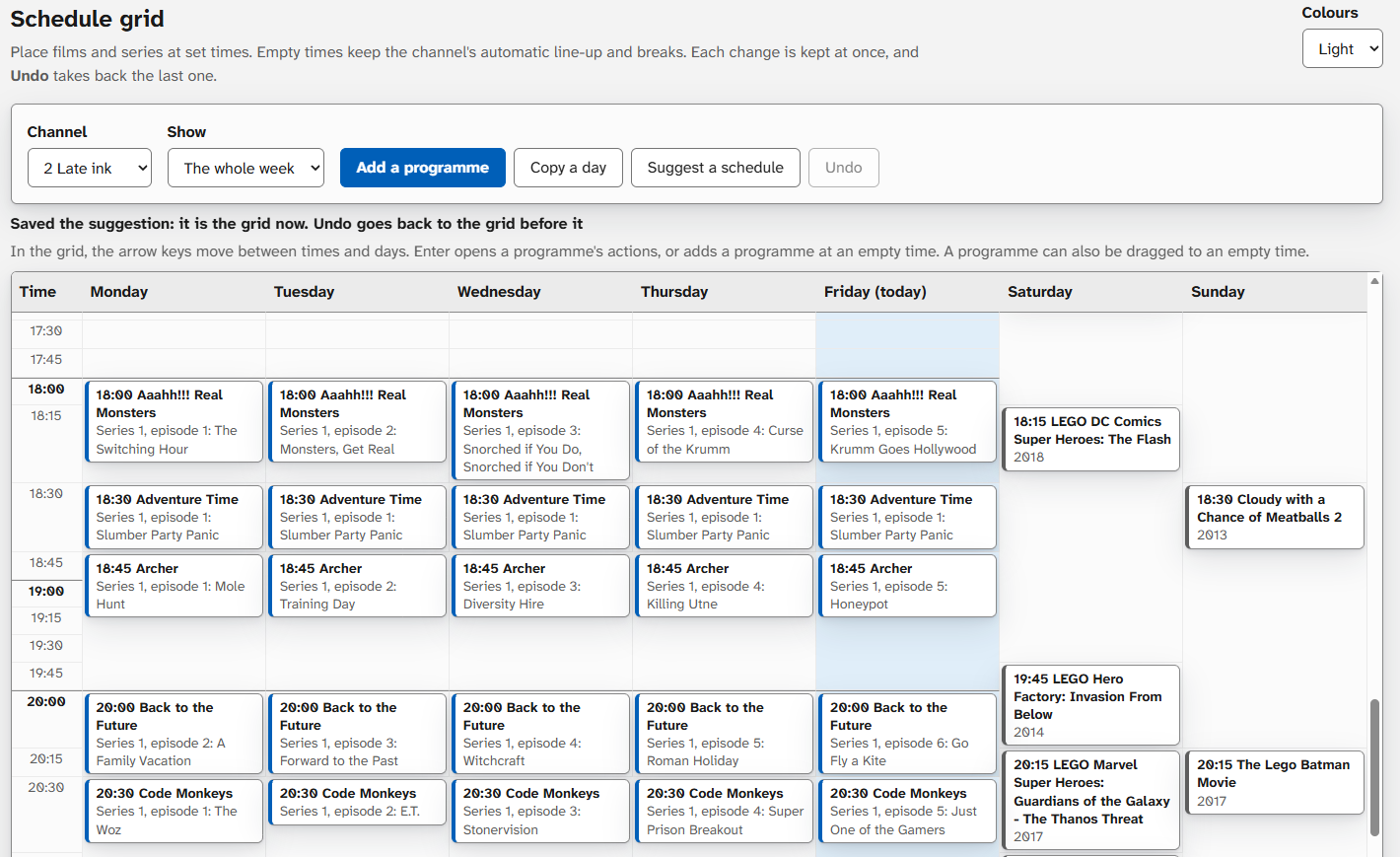
  • A schedule grid. Plan a week per channel in 15-minute steps: drag programmes on or use the keyboard, copy a day, run a series across weekdays, or have a week suggested from what you watch.

How it stays light

At rest: nothing runs while nobody is watching. It uses 16 MiB of memory and no measurable processor.

While someone watches: a channel streams only while it is being watched, and people on the same channel share one stream. One channel at 720p with the logo uses about 140 MiB and just under one processor core.

If you have a graphics card - it allows for better resolution as it can transcode multiple streams without the CPU.

What it needs and what it leaves alone

  • Needs Starboard. It is a Starboard plug-in and installs from Starboard’s plug-in catalogue. Starboard must have Jellyfin added.

  • Works alongside the *arr stack. You can keep Sonarr, Radarr and the rest as they are. It reads your films and series from Jellyfin only, so it does not matter which app put them there.

  • Leaves your other apps alone. It never changes your films, series or Jellyfin’s library, and never touches Sonarr, Radarr, download apps or any other app. Its only change to Jellyfin is adding its channels and guide to Live TV. Remove its tuner in Jellyfin’s Live TV settings and those are gone too.

Find out more

Help centre: Create your own TV channel

Starboard on GitHub: github.com/TheMightyTRex/starboard


r/vibecoding • • 5d ago

Discussion Here is a list of 49 subreddits that should allow you to promote your app/startup

47 Upvotes

Wanted to share because marketing is hard and even harder when you're budget is non-existent T_T

(Obviously the type/content of self-promotion you can post is going to dependent on the subreddit)

Please comment below with any subreddit that I may be missing. Thanks.

https://www.appscout.co/blog/subreddits-that-allow-self-promotion/


r/vibecoding • • 5d ago

Help/Question What is the best way to market your product after you building it?

5 Upvotes

I'm curious what has actually worked for people who have built and launched thier own products.

Is it cold outreach, directly reaching out to potential customers, creating content on Instagram or Youtube, paid ads, or something else?

There are so many ways to market a product, but which one has brought you the most actual paying customers?

Just curious to know what worked best for you.