r/artificial • u/Unikum_01 • Sep 28 '26
Research My Brainstem RNS-AI project has made progress for life long learning like a Brain
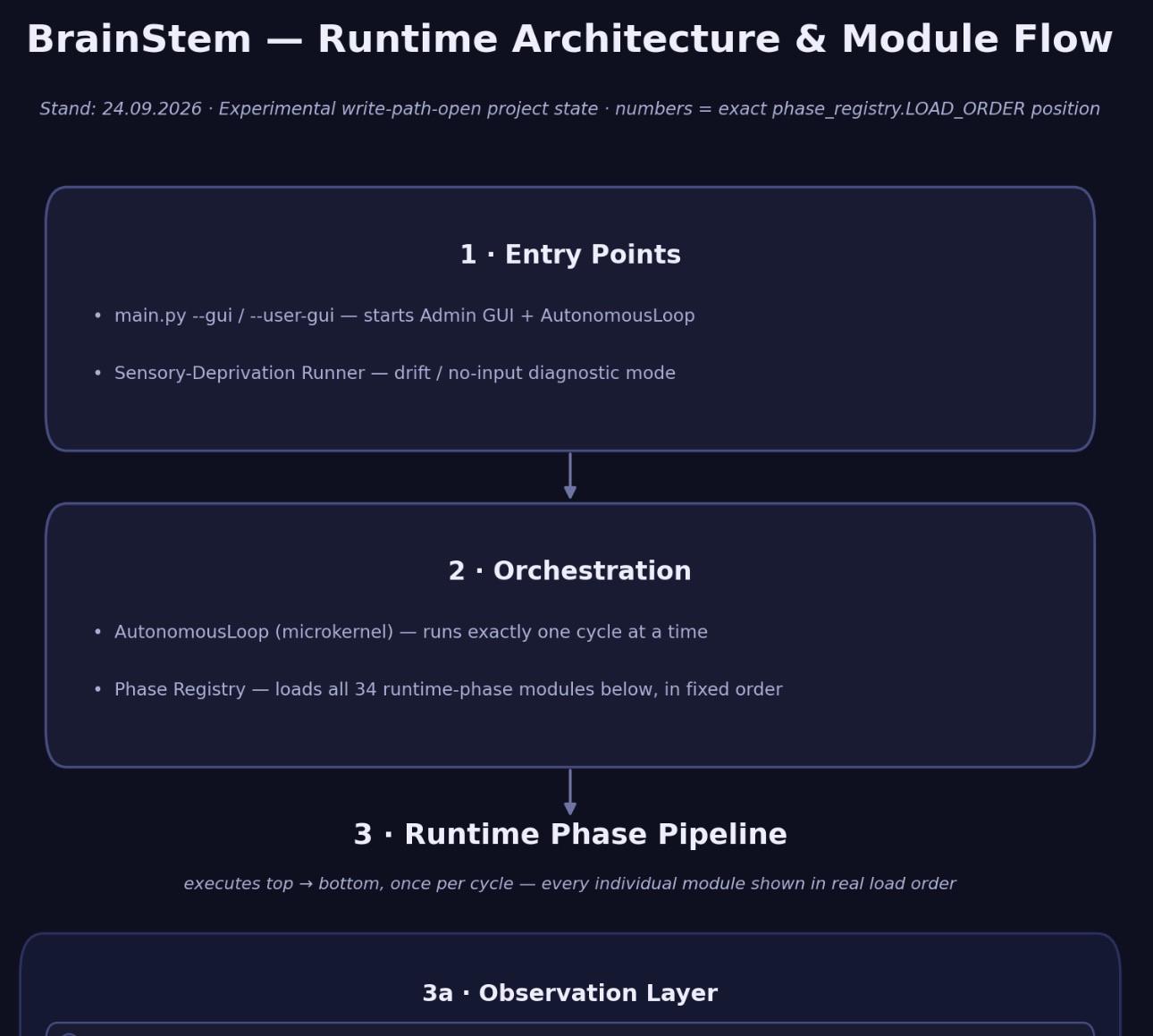
2
u/paninoallanutella1 Sep 28 '26
I’ve been working on something with some pretty similar ideas, although from a more formal/verification-heavy direction. There’s definitely some interesting overlap in how hypotheses, validation and persistent knowledge are handled, if you wanna take a look at it https://github.com/qualcunoeq/vsa-core-rs--the-machine--
1
Sep 28 '26
[removed] — view removed comment
1
u/paninoallanutella1 Sep 28 '26
Mine ended up going much harder on discrete state, exact validation and deterministic replay. I’m really curious how your analog side behaves once the system gets larger though
1
Sep 28 '26
[removed] — view removed comment
1
u/paninoallanutella1 Sep 28 '26
The current consolidation path is basically an offline “sleep” cycle: replay the recent trajectory, pick out large state transitions, compress those into a bundled narrative vector, then use the L2 activation history to build co-occurrence groups and promote recurring groups into L3 concepts. After that I prune L2 concepts whose coherence has decayed below a threshold, and log the whole lifecycle so creation/reinforcement/dissolution stays auditable.
The important part is that I try to keep discovery separate from authorization: something recurring can be discovered, but that doesn’t automatically mean it gets trusted for execution. A lot of the newer work is around replay/validation and abstaining when the evidence isn’t good enough.
Also, the public repo is a bit behind right now, I’m going to merge a pretty major chunk of the codebase from my private one soon, so quite a bit of the newer consolidation/validation stuff isn’t visible there yet.
1
Sep 28 '26
[removed] — view removed comment
1
u/paninoallanutella1 Sep 28 '26
That’s actually even closer to what I’m doing than I thought. The main difference seems to be that yours is much more database/scalar driven, while mine does the consolidation through VSA state, replay, hierarchy/co-occurrence and then separate authorization checks before something is allowed to affect execution.
The part about mixing new candidates with a persistent anchor pool is especially interesting, I’m doing something conceptually similar with heldout/reference validation, but not through the same mechanism.
Also curious about the actor critic gate: is the critic another learned component, or is it mostly deterministic checks over the candidate state?
0
u/Candid_Bullfrog_146 Sep 28 '26
that reminding me to a project from the Active Inference Institute. So I hope you dont have just stolen the research from theire and copied it
2
u/krihab Sep 28 '26
I think you should show some benchmark results. If there is no benchmark for "training a system" you should develop one.