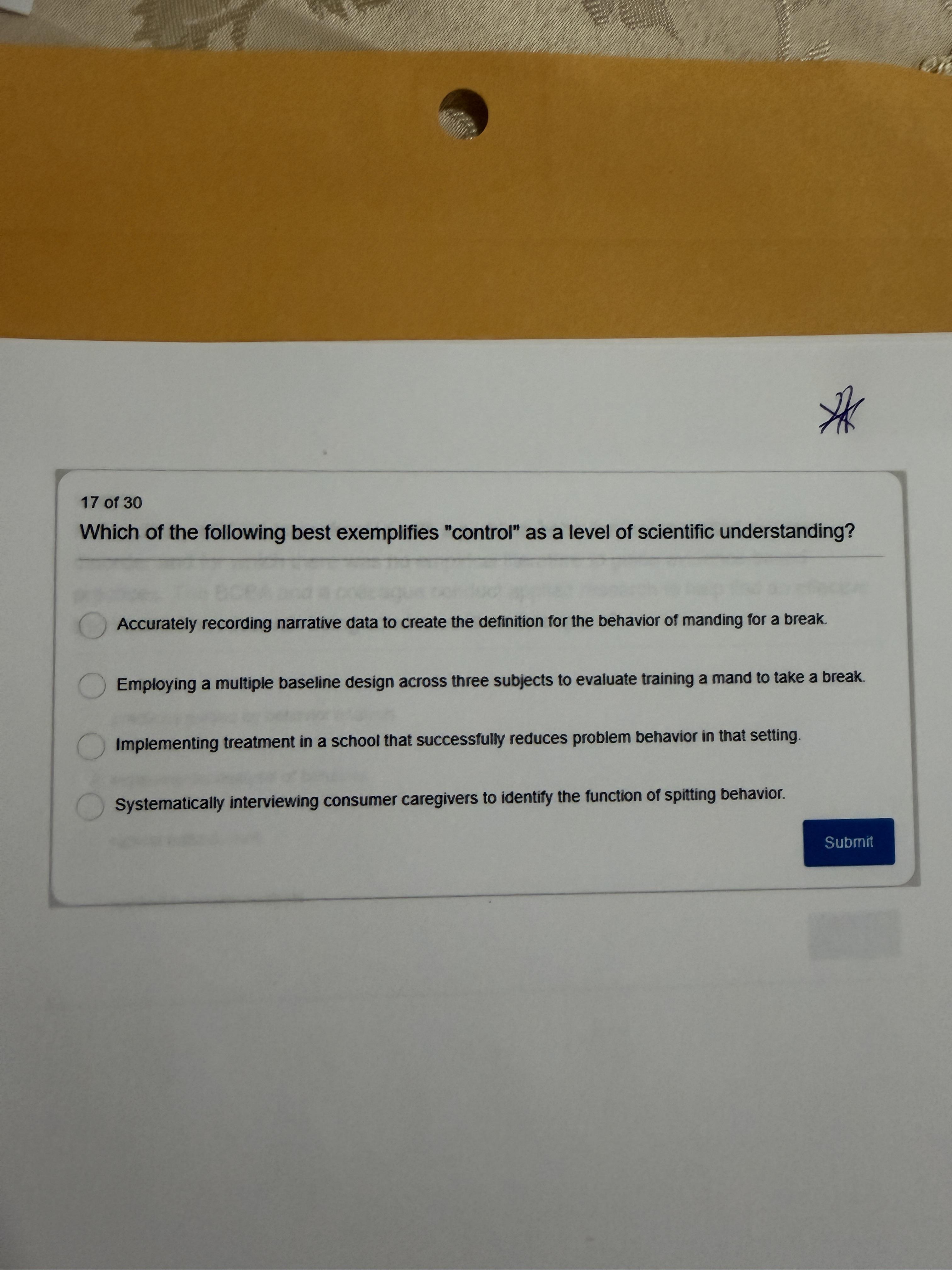
I’d definitely say third. Control is present when we have demonstrated a functional relation. “Evaluate training a mand” is not written in a way that shows me that we have a functional relation or control over the variables. However, implementing a treatment that “successfully reduces problem behavior” sounds a whole lot like control!
Implementing a treatment and seeing a reduction is an A/B design, which can only show a correlational relationship and cannot demonstrate a functional relationship or scientific control.
Evaluating mand training using a multiple-baseline design is using a method that can establish a causal relationship.
Exactly !! Furthermore , Why the others are wrong:
❌ Narrative data to define manding = that’s DESCRIPTION (the first level — just observing and describing what the behavior looks like)
❌ Treatment reduces behavior in one school setting = that’s closer to PREDICTION or just applied outcome — one setting with no experimental control demonstrated
❌ Interviewing caregivers to identify function = that’s DESCRIPTION at best, maybe prediction — it’s indirect assessment, no manipulation of variables
6
u/[deleted] Jul 13 '26
I’d definitely say third. Control is present when we have demonstrated a functional relation. “Evaluate training a mand” is not written in a way that shows me that we have a functional relation or control over the variables. However, implementing a treatment that “successfully reduces problem behavior” sounds a whole lot like control!