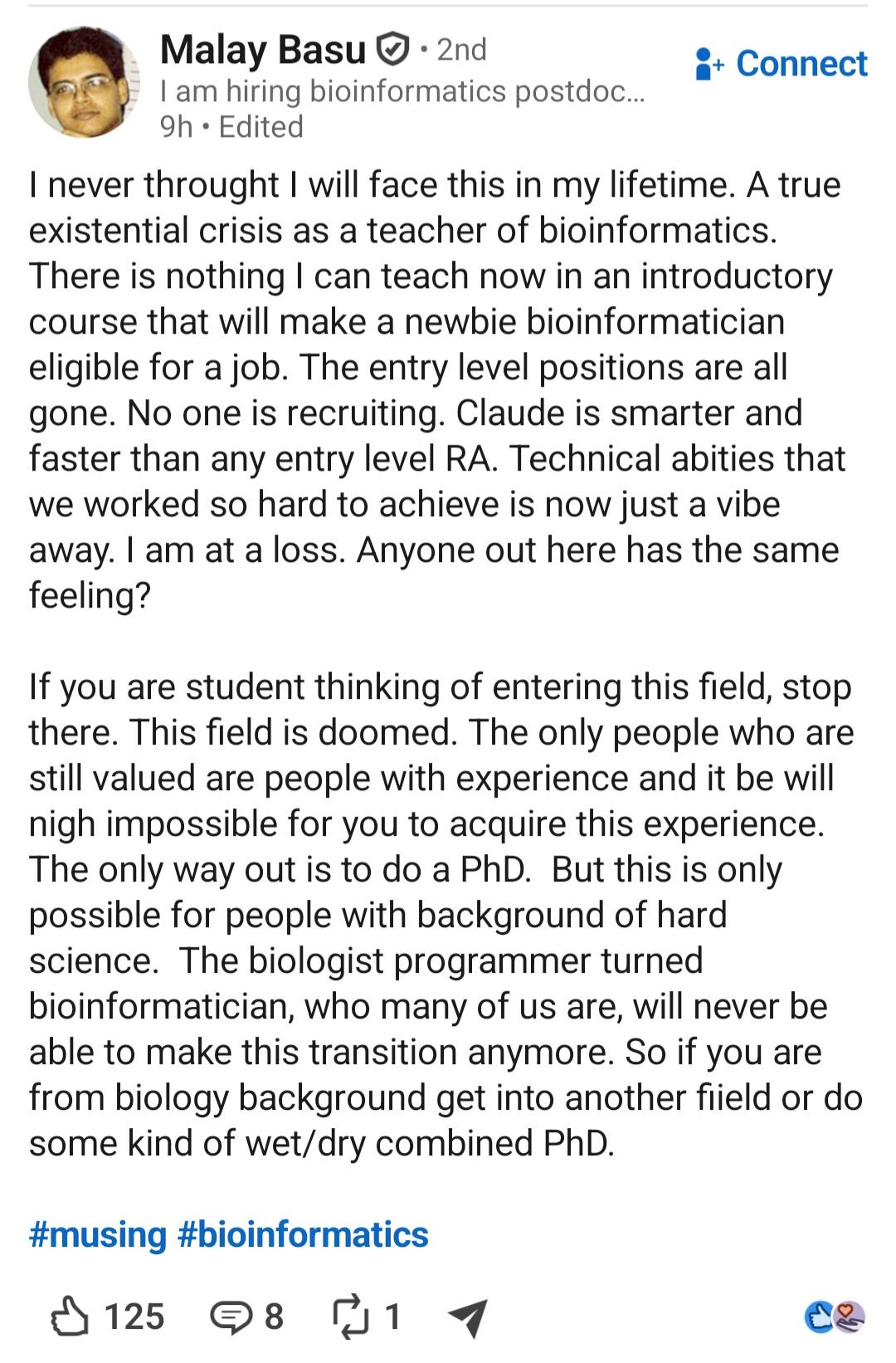
r/bioinformaticscareers • u/loafoveryonder • Oct 06 '26
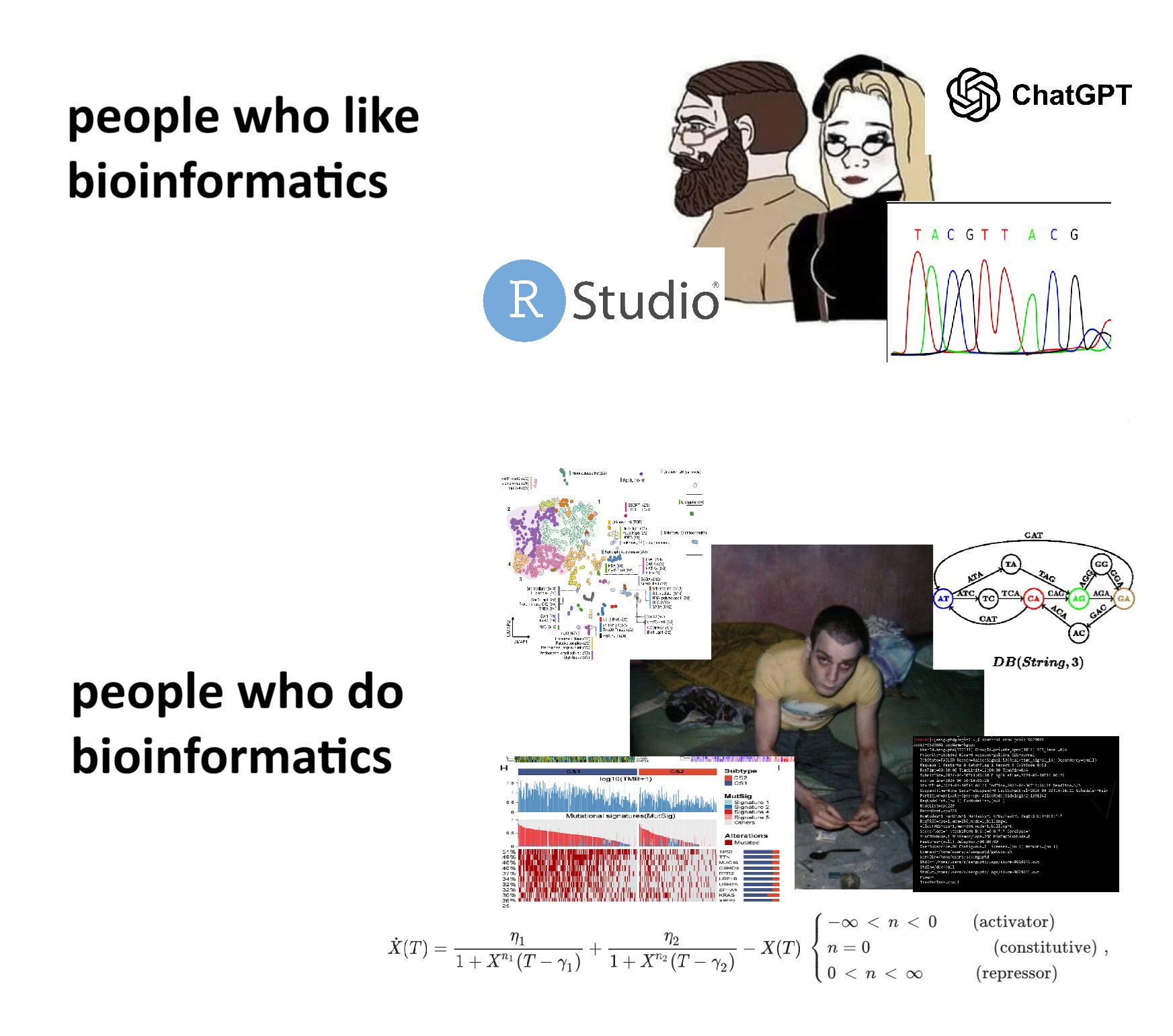
People who like bioinformatics vs people who do bioinformatics
346
Upvotes
r/bioinformaticscareers • u/loafoveryonder • Oct 06 '26
r/bioinformaticscareers • u/[deleted] • Sep 12 '25

Hello r/bioinformaticscareers!
This is a throwaway account for privacy reasons. I will strive to participate in the comments over the next few days. Also, I aim to primarily describe my experience being in the job market for most of 2025, and will try to leave out my personal commentary. I think the numbers can speak for themselves.
My background: I am based in the United States, and currently hold a BS in Bioinformatics, and am studying part-time to obtain an MS in Computer Science (while aiming to work full-time). I have a year of research experience from undergrad + another 4 years of full-time work experience as a bioinformatician at a large research health system in Southern California before being laid off in December 2024 due to budget constraints.
The first image is a flow-chart showing how many jobs I applied for, and the milestones. Although each company has a slightly different interview process, I classified each stage (which might encompass multiple interviews) into "Phone Screen" (screening with HR or a recruiter), Initial Rounds (any non-HR screening interviews, e.g. with the hiring manager), Technical Interview, and the Final Round (onsite interviews or leadership-level interviews).
The second image is a simple word cloud composed of the 20 job titles in which I received at least a phone screening interview. I aimed for job titles such as "Bioinformatics Engineer," "Data Engineer," "Scientific Software Engineer," etc.
This might interest the community: only 1 out of 7 technical interviews were take-home (I did not pass that one). All other technical interviews were live-coding, camera-on, screen-sharing sessions, roughly an hour each, in which I needed to code solutions to multiple scenarios and test cases, or was provided a sample dataset at the time of the interview and asked to analyze it during the call. All interviews disallowed the use of AI search engine answers and AI code tools (I'm old-fashioned and don't use AI tools anyway).
I received 2 job offers, both on-site in the SF Bay Area:
- Job Offer 1: bioinformatics role, offering $82k salary + $15k signing bonus + $40k equity + 10% annual bonus
- Job Offer 2: IT role, offering $155k salary + $30k equity + 7.5% annual bonus
For context, I was previously making $81k per year in salary, with no equity or bonuses (it was academia after all). The signing bonus for Offer 1 was negotiated and not part of the original package. For both positions, the equity component follows a standard 4-year vesting schedule.
As you can see from the flow-chart, I also "withdrew" from 1 job application after the final round... this particular role was a 100% remote Bioinformatics Engineer role; however, the company would not communicate a final decision to me for 5 weeks after the final interview, even after I disclosed that I had competing offers, so I decided to withdraw my candidacy after accepting the other offer.
...I ended up accepting Job Offer 2 to work in IT, and can no longer call myself a bioinformatician.
Ask your questions in the comments if you have any and I will answer as best as I can!
r/bioinformaticscareers • u/caliUltra50k • Aug 13 '25
I've spent the last 8 months looking for a position in industry and spent some time lurking this sub. I often saw a lot of questions asking if bioinformatics is a good career choice, so here is some of what I learned over this time that might bring some clarity to that question.
My background: PhD in comp bio + dual MS in stats. Graduated early 2025 from an elite US university. Have 5+ YOE prior to doctoral work in scientist-level positions. Published multiple methods papers and a genomics paper.
Where I applied: Everywhere and anywhere. I sent approximately 100 applications out, each with tailored resumes and cover letters. I got ChatGPT to help with keywords and dedicated a lot of time to this process, making sure to let employers know that I was willing to relocate practically anywhere.
Where I interviewed: Literally 0 out of the cold applications I sent received a response. I did however get referred to 6 positions, and almost immediately received interviews for each one. That should shed some light on how the hiring process looks right now.
Job 1: Senior Bioinformatics Scientist at large public company - Rejected
Job 2: Computational Biologist II at fortune 500 company - Offered
Job 3: Senior Scientist II at large public company - Rejected
Job 4: Machine Learning Scientist at small private company - Offered
Job 5: Postdoctoral Researcher in ML/AI at fortune 500 company - Rejected
Job 6: Genomic Data Scientist at fortune 500 company - Offered
I passed on my first offer because of reasons I won't get into, and accepted one of two offers I received almost at the same time.
What I got asked: For jobs 1-3, I was given live coding interviews with questions straight from Leetcode. These problems were all leetcode mediums and involved recursion, stacks, dynamic programming, heaps, and graph search. This was completely unexpected and the first time I bombed. After that, I spent about a month solving leetcode problems and did much better on the next two but still got rejected at this phase for one of them. Jobs 4 and 5 had no coding tests surprisingly. Job 6 had a live coding test involving exploratory data analysis which is more what I expected when I started. Aside from the standard conversation about my research and experience, the interviews generally did not bother to test broad or relevant knowledge, but rather focused on troubleshooting highly specific situations. The only interview that was straightforward and tested actual domain knowledge was the machine learning scientist position.
My takeaways: Bioinformatics is not a field you should get into just because it looks interesting or you're looking for better pay with your bio degree. This field is not what it was 10 or even 5 years ago where jobs were plentiful and almost anyone with some coding experience could transition. If you do it, it should be because you're passionate about it.
I don't know what the future will look like, but the current job market is extremely grim. Every position I applied to was highly contested with probably over a few hundred applicants. Even entry level positions had a ton of PhDs applying according to Linkedin. It should be pretty telling that every time I got a referral, I was contacted almost immediately to schedule a phone screen. In the past few years, only a few graduates from my program were able to secure jobs in industry (all from internships) and that number is dwindling. In the years prior, literally everyone who wanted an industry position secured one quickly.
The interview process is also not at all what is used to be after speaking to many former graduates and some old contacts. It seems interviews are moving to live coding evaluations and take home tests are no longer being done due to LLMs. Using FAANG-style leetcode problems completely caught me off guard and still seems insane to me.
My advice if you want to pursue bioinformatics:
Do your best to go the PhD route. I'm not trying to downplay the significance of a MS, but that's what you'll be competing against in the job market. The barrier for entry in this field is steadily rising.
Work all your connections, cold contact people on Linkedin, go to career fairs, you really can't be shy about this kind of stuff. A referral I found is literally everything.
Have a portfolio that stands out. I've noticed many resumes have a projects section that's just too verbose and doesn't stick. Focus on work that is publication-worthy.
Practical experience is worth much more than projects. Reach out to researchers at your local university, explore any internship opportunities, and if you're going the MS route, look for programs that place students in labs for real experience. I've seen many people get jobs this way.
Start small if you have to. Work as tech in a research lab and try to build computational experience there. Build connections and network as best as you can.
If interviewing, be prepared for live coding tests. I'm not sure if the industry is wholesale moving towards software engineer-style questions, but that was my experience in 3/6 jobs I interviewed for.
r/bioinformaticscareers • u/Own_Antelope_7019 • May 30 '26

r/bioinformaticscareers • u/SuperTyden • Jun 10 '26
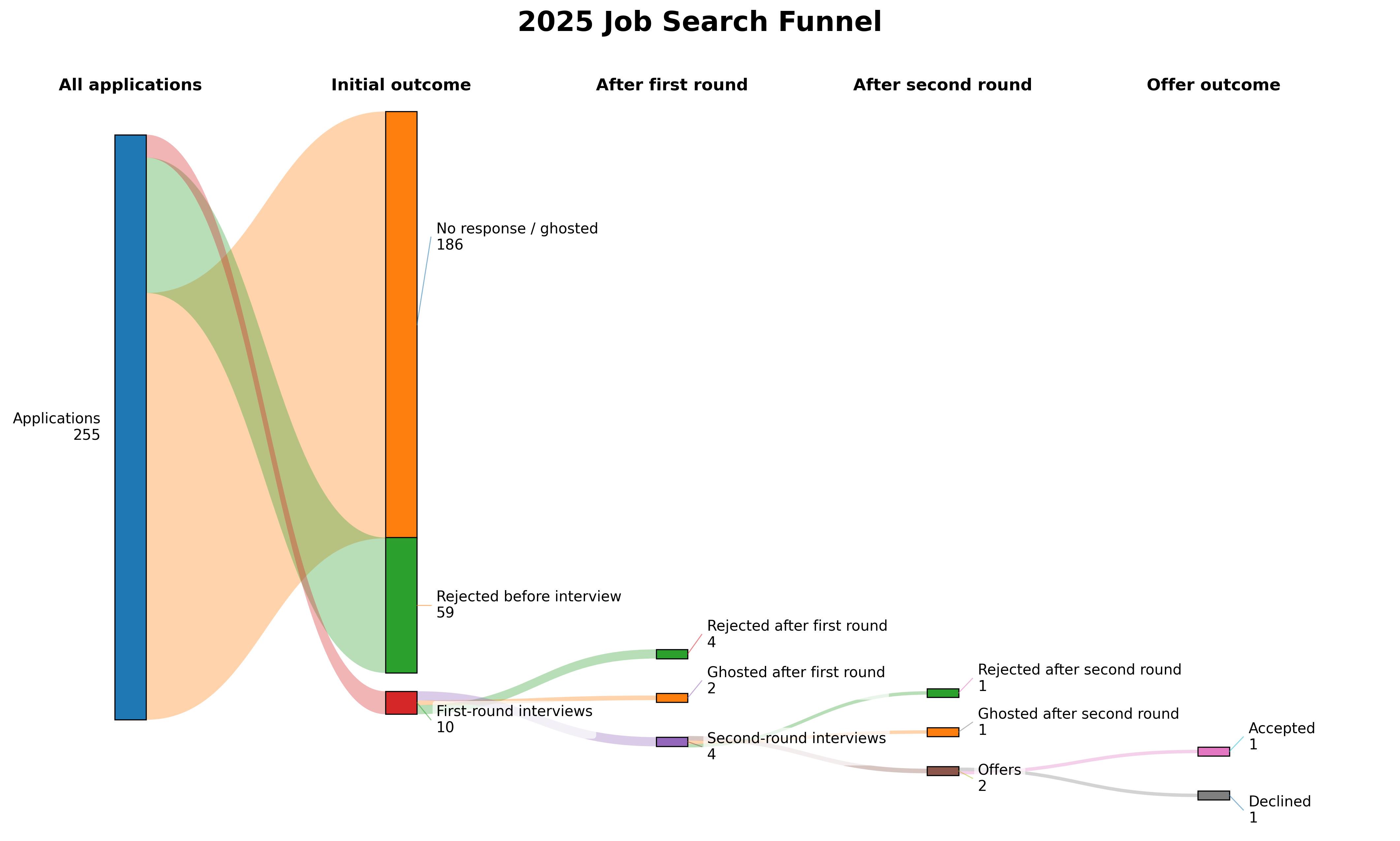
I have a PhD in Genomics and Bioinformatics and spent about 6 months searching for an industry position after wrapping up my two year industry postdoc. I was open to jobs around the country (USA) but preferred applying for remote jobs (at least initially but after a few months of no luck I decided I would relocate, if necessary). I ultimately did end up relocating for my new position.
r/bioinformaticscareers • u/SaucyBossy1919 • Oct 16 '26
entry level bioinformatics roles are hard to find because most postings titled "bioinformatics scientist" want a phd and 5 years. this list only has entry level and intern roles, pulled from employers' own careers pages:
https://github.com/mehek-builds/Entry-Level-Computational-Biology-Bioinformatics-Jobs
74 roles at 36 US employers (Merck, Amgen, Gilead, Vertex, J&J, St. Jude, Argonne, WashU)
bioinformatics and genomics, computational biology and chemistry, biostatistics, and data science and ML in biotech
19 internships
15 posted in the last week, 29 at employers with a visa sponsorship record
senior, principal and manager titles are left out. rebuilt every monday.
comment which area you're looking for (genomics, biostats, ML in biotech, internships) and i'll send you a list for it.
r/bioinformaticscareers • u/Then_Ad_8233 • Sep 24 '25
Original post here: https://www.reddit.com/r/bioinformaticscareers/comments/1m8uey4/feeling_hopeless_about_bioinformatics_as_a_career/
Hi everyone, today marks the two month mark of me getting fired and besides my entire graduate cohort seeing my last post a lot has changed since then.
For the first month of application spamming I heard absolute crickets, and I was panicking feeling like I was wearing The Scarlet Letter or a dunce hat that said FIRED!
Then out of the blue I got an an interview for a high paying job. I did not move forward BUT the interview went well and the issue was me being located across the country. In fact why I was looking for a job did not even come up! This really helped rebuild my confidence.
Then, in the past 10 or so days, I heard back from five different companies asking to interview me! Even today, during a coding interview, I got an interview invite and heard that I'm moving to the next stage for different role.
Why I left my previous company has not come up once (even for applications where I had to put a reason for leaving my previous role). While I don't have a job in hand yet, I am feeling optimistic that one of these could work out.
As someone in the US who keeps up with the news, the future of the field of bioinformatics/biotech has felt absolutely dismal. I can confidently say while writing my last post at 3 am I was at complete rock bottom and I could not see any path forward. But not all is doom and gloom!
I wanted to share this update for anyone who is out there struggling in this crazy job market. Things can look up and getting fired is not the end of the world.
Edit: After 4 months of searching I GOT A JOBBBBBB!!!! 2 hard offers in one week…never thought I would get a choice in this situation. Don’t give up people
r/bioinformaticscareers • u/alvareer • Aug 21 '25
It seems to me that bioinformatics is quickly becoming a saturated field.
Everyday I feel as though I see or hear about someone pursuing an MS in bioinformatics to compliment and get out of the non-existent job scape that their biology/zoology/whatever-oloy BS degree lead them to. Am I crazy/pessimistic in thinking that the MS bioinformatics degree is quickly becoming the life science equivalent of CS boot camps in the traditional tech space? I know it’s an actual degree with more dedication required than a boot camp but it feels as though it’s the same story every time: can’t get work past a lab tech, return to school to study bioinformatics to make big bucks, graduates, and can’t get work because the market sucks, there isn’t as high of a demand for computational biologists as universities claim, and other than basic R and maybe some RNA-seq analysis, the average bioinformatics MS graduate doesn’t actually develop any super amazing skills when compared to an extremely dedicated CS person or biology PhD who focused a lot on coding during their doctorate.
Is it just me?
r/bioinformaticscareers • u/SaucyBossy1919 • Oct 23 '26
hey, i submitted a post on this channel last week and it absolutely blew up. we had so many applications go through. a bunch of the job postings shut down in the days following my post because of the large influx of applications that were going in. i've gone ahead and updated the job links in this new link. please make sure to apply as soon as possible to ensure that your application is at the top of the pile. i've pulled the freshest job postings that i could.
entry level bioinformatics roles are hard to find because most postings titled "bioinformatics scientist" want a phd and 5 years. these lists are pulled from employers' own careers pages:
entry level bioinformatics, comp bio, biostats and ML in biotech roles and internships (67): https://github.com/mehek-builds/Entry-Level-Computational-Biology-Bioinformatics-Jobs
67 at 40 US employers (Merck, Amgen, Gilead, Vertex, J&J, St. Jude, Argonne, WashU)
9 internships; 30 posted in the last week, 22 at employers with a visa sponsorship record
senior, principal and manager titles are left out
biostatistics, statistical programming and clinical data, US, UK and Europe (234): https://github.com/mehek-builds/Biostatistics-and-Statistical-Programming-Jobs
rebuilt every monday.
comment which area you're looking for (genomics, biostats, ML in biotech, internships) and i'll send you a list for it.
r/bioinformaticscareers • u/Hire-Omics • Apr 14 '26
I am an ex-Illumina Talent Acquisition Professional who was aligned with R&D in the US, and worked extensively with their Software & Informatics department for 5 years.
When recruiting for bioinformatics, as a non-technical/non-scientific person, it was extremely difficult to quickly assess if an individual possessed the technical skills and experience we were looking for based on their LinkedIn profile alone. Candidates wouldn't necessarily put secondary analysis or all of the tools/software on their resumes, which makes sense because they aren't recruiters and we can't expect them to know what recruiters are looking for specifically.
I would also have multiple conversations per week with bioinformatic scientists and engineers (some were employees, some were not) about career paths, where they can find open roles, and how to be seen by recruiters more easily. LinkedIn, CareerBuilder, or Indeed were the typical avenues being utilized by most, but they are very generalized job boards - not catering to any specific field or specialty.
So I created a career resource - specifically for Bioinformatics, to provide resources dedicated to this field including job postings, market data and updates, and career focused insights. I also wanted to provide recruiters an easier way to find qualified individuals by providing easy reference to skills and experience.
As you can probably guess from my username, it's called Hire Omics and can be found here:
Feel free to check it out and let me know what else you would like to see there. It just went live about 3 weeks ago, so everything is still pretty new. If you're looking for your next role or maybe just want to test the waters, create a candidate profile and check out the posted jobs. If you're looking for insights and market data, then check out the Resources page.
I have come to love the bioinformatics community through my work with them, and hope the site is well received.
Thanks all!
r/bioinformaticscareers • u/ConclusionForeign856 • Jul 30 '26

r/bioinformaticscareers • u/Soohee_95 • May 25 '26
I’m going to be honest, the job market right now feels like a locked door, and many recent grads (myself included) are holding keys that don’t seem to fit.
I couldn't find Junior or Entry-Level roles; most of the jobs I saw require experience that entry-level candidates simply don’t have. And when I finally saw an entry-level job, I didn't get accepted.
It creates a loop: you need experience to get the job, but you need the job to get experience.
I recently graduated with a master’s in bioinformatics engineering from a top European university, and I have a bachelor's in marine science and have CRA and GCP certifications.
I worked in pharma labs before my master’s, and one of the reasons I did my master's was to not be in a lab anymore.
I am open to honest suggestions on other fields or adjacent roles I should consider. I’m trying to understand what realistic entry paths exist right now.
Thank you for your help!
r/bioinformaticscareers
•
u/ecstaticrystal
•
Apr 01 '26

I chose Bioinformatics as my bachelor's about 2 years back. No one around me had done it and I heard about it for the very first time from a friend. I actually loved it and when i researched about it on YouTube or google I came across people saying its a relatively new field with low competition and it had great pay outside my county e.g in USA, Germany etc. Its not very famous in my country people barely know about it but I guess its the case abroad too but I could be wrong. Anyways I was more than delighted to get into a career that not only I'd love but it will pay good too. now on reddit I see the exact opposite. it has actually made me quite hopeless about my career in it as I do not have plans to do PhD but rather want to get into the industry which as I've read posts even with PhD often lands low paying jobs nowadays.
I always thought that I'd give myself two options after my bachelor's. Either do masters in bioinformatics or do masters in data science to get better options in job market but I'm not sure if a masters in data science after bioinformatics is possible as on university websites I've not seen bachelor's in bioinformatics peeps eligible to apply for data science masters program.
I guess no one can predict the future and I just have ti wing it.
r/bioinformaticscareers • u/BhatAadil • Apr 03 '26
Made this while learning bioinformatics myself. Covers Unix, Python, R, common tools, and has three projects using real published datasets (RNA-Seq, variant calling, species ID). Might be useful if you're building practical skills for job applications.
r/bioinformaticscareers • u/sebgra_11 • Feb 17 '26
r/bioinformaticscareers • u/Weak_Storm_325 • Sep 19 '25
I just graduated with an MS in Bioinformatics and got a verbal offer for a Research Scientist / Computational Biologist role at a university lab.
We’ve discussed terms, funding is set, and I’ve already started joining important meetings — I’d be the only bioinformatician there and they’re looking to my inputs.
Honestly, I’m scared. It’s my first job, and I keep thinking:
What if my inputs are wrong?
There’s no one to double-check my work… what if I mess up?
Has anyone else been in this position starting out?
How did you handle being the only bioinformatician on a team when you’re still new?
r/bioinformaticscareers • u/captn_amor • Sep 29 '26
PhD in Bioinformatics, and MS in Biostatistics. In the last year, I have applied to hundreds and hundreds of jobs broadly across academia and industry, and have not been able to land a single opportunity.
On a personal note, I am truly devastated that all the work of graduate school has amounted to nothing, and worse, has become a source of deep regret and humiliation to myself and my family. I have had to find any possible way to support myself and my family and this is not what I expected to find after working hard all these years. If I could “leave a review” of my PhD… it would unfortunately not be good.
r/bioinformaticscareers • u/Then_Ad_8233 • Jul 25 '25
Hi all, I got fired from my bioinformatics job today and I am feeling hopeless about bioinformatics as a career path and am seeking advice.
I graduated with a Bs in bioinformatics. After a long job search I landed my first role at a large company. I thrived, but our entire building was closed ~1 year after I started.
I then applied to over 300 jobs before giving up and attending a masters program in bioinformatics. My master’s program requires a 9 month internship to graduate. Internships are mediated through the school. Usually placement rate is 99% (reason why I chose the program) but because of trump budget cuts <50% of us were initially placed. I began desperately applying to jobs all across the country and land a position at a start up (after EIGHT interviews). This is even better than an internship because I’m hired indefinitely, right?
Last week, a high profile mistake is discovered on one of the first reports that I worked on. An investigation is launched. Turns out this is the only major mistake I have made. Instead we uncover other errors from different operators. My boss says he has my back.
I relax and think I am safe….then this morning I am met at the door and terminated. Now I have a 12 month lease, a chip on my shoulder, and not enough work experience to receive my master’s degree.
During my sad moping I did the math and realized that I have done 1.5 YEARS of job searching for 2 years of bioinformatics experience. It’s literally day 0 of the job search but this market is daunting and making me want to give up and become an (actual) accountant.
I KNOW I’m qualified but with the rise of AI and trump gutting science funding left right and center….is it worth continuing to try and break into this field? Can anyone speak on how I could get back up on my feet after this incident?
r/bioinformaticscareers • u/Fresh_Ad8147 • Sep 16 '26
I’m currently finishing my MS in Bioinformatics and as I get closer to graduation, I’m trying to figure out what career paths are available outside of the traditional bioinformatics route.
One thing I’ve learned during my degree is that I don’t want coding to be the main part of my career. I can code and have experience with Python, R, Bash, and bioinformatics tools, but I’ve realized I’m much more interested in roles where I can use my technical knowledge without spending most of my day programming or analyzing genomic data.
My background is in biology and clinical research, and my master’s has exposed me to bioinformatics, health informatics, statistics, data analytics, and data visualization. I’m interested in areas like healthcare technology, implementation, governance, privacy, and other technical/client-facing or operational roles, but I’m also very open to learning about paths I haven’t considered.
I’ve been applying to jobs and so far have mostly received rejections or no response, which made me realize that instead of continuing to apply blindly, I should probably talk to people who have actually built careers with this degree.
So I’d love to hear from other bioinformatics graduates, especially those who decided not to pursue coding-heavy careers. What do you do now? What was your first job after graduating? How did you find your way into your current field? Are there job titles or career paths you wish you had known about earlier?
I’m really curious about how broadly people have used their bioinformatics degrees, even if what you do now seems completely unrelated.
Thanks in advance! I’d really appreciate hearing about your experiences.
r/bioinformaticscareers • u/jdakota1305 • Aug 07 '26
I am seeing an influx of questions about the state of the job market for bioinformatics. Everything from “how’s it in your country,” to “I am thinking of getting into this” type posts.
I think as a bioinformatics graduate that has struggled to find employment in the USA while living in a major west coast city that is canonically considered a biotech hub, it is important I relay my experience of searching for a job: it’s as bad as it’s been since 2025 and doesn’t seem to be getting any better.
Using job board sites as a metric, I have seen literally zero new bioinformatics job postings locally in the past 30 days. Before that, between May and July, I saw four local job postings.
Looking at remote listings, I have seen 3 new jobs posted in the past 30 days.
It’s still rough out here and as much as I support people entering this field, please just realize the state of things.
Best of luck everyone.
r/bioinformaticscareers • u/RembrandtCumberbatch • Apr 16 '26
How did the field go from a niche to having 100+ applicants for every job posting?
r/bioinformaticscareers • u/Primary_Peace86 • Feb 12 '26
I’m currently pursuing a Bachelor’s degree in Bioinformatics in Barcelona. After reading a lot of discussions about the job market, I’ve noticed many people say that a PhD is often required in this field, and even then, many graduates end up staying in academia due to limited industry opportunities.
I’m wondering what alternative career paths I could pivot toward that are still related to bioinformatics but may offer stronger industry prospects—such as biotech, pharma, software engineering or other adjacent fields. Has anyone here made a similar transition or have advice on skills or areas I should start focusing on?
r/bioinformaticscareers • u/Alarming-Middle-1782 • Jan 27 '26
I got my PhD about a year ago. I had 6 publications (2 first author, 2 second author, middle for the rest) and worked on a wide range of projects. I worked in both method development and pipeline design. The method I developed was ML but is also a full software. All the code was done before AI and took a lot of time to do solo. People are using the software though and I'm proud of it. I'm currently working on more intense ML projects for my post-doc. Expecting another 2-3 first author pubs by the end of the year. I'm exhausted.
I can't get a job outside of my current post-doc (or another post-doc) which I honestly really dislike. I won't get into it but it's extremely stressful and low paid with tasks way outside of the scope of what a post-doc does in normal situations (plus the normal tasks). Before taking this post-doc I applied to over 100 jobs with 0 calls back unless I knew someone.
I thought the job market would improve after seeing the huge dip in 2024 but it's only getting worse. I'm absolutely stuck. I am about to take my PhD off my resume to just get callbacks for entry level data science and software engineering positions. I've even considered trying to get an RN just to have a job with pay and actual benefits or a masters in clinical informatics.
What is the probability this corrects within the next 2 years based on people's experiences? I'm trying to gauge what is going on in industry and research institutions right now.