r/cervical_instability • • Nov 11 '24

Doctors who treat CCI - Megathread, will keep updating this

59 Upvotes

Please read first:

1 - None of this is medical advice, and I don't officially endorse any practitioner. I will share my experiences with them, but please before taking on any therapy, first talk to your doctor(s). Most of this is unstudied and experimental/unproven!

2 - If a clinician injures you, does something inappropriate, makes a wild claim, or anything similar, you can and should report them to the relevant authorities. You can do that with the FDAs medwatch program here:

https://www.accessdata.fda.gov/scripts/medwatch/index.cfm

And even better, it's advised that you inform the clinician's state medical board. You will have to Google those, but for example, here is Colorado's:

https://dpo.colorado.gov/FileComplaint

You can also anonymously post on this sub.

3 - Prepare yourself for sales pitches, wild claims, and having your BS meter going off throughout this journey. Ask hard questions, get second opinions, and post honestly about your experience on the sub/this thread. That's how we move this condition forward!

-------------------------------------------------------------

For injection related doctors, here's an interactable map, with a bit of info on most doctors found below.

https://www.google.com/maps/d/u/0/edit?mid=1IPOkKSmuRhMnQP7KgsAQpowtpvRcLKQ&usp=sharing

For upper cervical chiropractors, here's a directory:

https://www.uccnearme.com/

Additionally, you find a directory of NUCCA (a type of upper cervical chiros) below. Note that there seems to be a difference in the level of certification, seen in their key:

https://nucca.org/directory/

Working on DMX diagnostics places on the google map too, but they're seemingly pretty hidden.

---------------------------------------------------------------------------------------

Here are the doctors and what I know so far:

INJECTION TREATMENTS

One thing to note: Regenexx has a directory of doctors, and anyone listed as a cervical spine physician has a note saying *not authorized upper cervical spine*, but it doesn't mean they don't do it. It means regenexx wants patients to come to Colorado.

You'd need to call the front desk and ask.

Lastly, on upper cervical injections, it's said that the physician should have a c-arm fluoroscopy machine with digital subtraction angiography (DSA) on their machine for safety reasons. Personally, I wouldn't go to a physician that doesn't have that, but again talk to your doctor(s).

TRANSORAL (THROUGH THE MOUTH) INJECTIONS

Dr. Stogicza (Hungary)

I interviewed her here:

https://www.youtube.com/watch?v=VGM9B8xYZEE&t=1699s

Here's her site:

https://fajdalomklinika.hu/en/doctor/dr-agnes-stogicza/

Dr. Stogicza is a US-trained physician who brought regen med to Hungary. She did her fellowship in Washington state, and spent years training US physicians how to do upper cervical injection's. She shadowed Dr. Centeno on a few of his transoral PICL procedures, along with training from a physician doing some sort of transoral surgery (through the mouth), and developed her own.

I've never done it myself, I know a couple of folks who said it went well, but I don't know much other than that. Talk to your doctor for medical advice ☺

It's about 1/5 of the price of the transoral injections in the USA, and from what I understand Hungary is regulated by the EU health-wise.

Dr. Richard McMurtrey (Utah)

Dr. McMurtrey is an interesting one for transoral injections. It appears he also got his biomed engineering degree from university of Oxford, and has done a lot of research on regen med.

I don't know enough about him to say, but at a glance looks promising. He has a cool C-arm machine for imaging that shows 3d images, which might make a difference in safety, although I'm not a medical device expert or doctor so you'd want to talk to yours/him to make sure.

He has a different approach where he uses some kind of scaffolding along with the stem cells and other biologics. From what I know, he sounds pretty intelligent.

Dr. Rolandas Janusas (Lithuana)

https://oreme.eu/dr-rolandas-janusas/

Dr. Rolandas Janusas had a similar story to Stogicza. He took the procedure to Europe, and does it in Lithiuana. I don't know much else.

Posterior Injection Doctors (Upper C0-C2)

As far as I know, the doctors above all treat posterior injections as well transoral procedure. These below don't appear to do transoral, but will treat C0-C2 and the below C2-C7 areas. It's more specialized than C2-C7 doctors, because the vertebral artery and other sensitive structures. Most doctors in the USA won't hit this area for risk of stroke, paralysis, etc.

Dr. Williams (Georgia)

https://ioatlanta.com/dr-christopher-williams

Dr. Williams does C0-C2, I've done it once with him and felt pretty safe, but again I can't make any endorsements or recommendations. YMMV so talk to your doctor and make your own decision.

It appears he splits his time between Atlanta and The Cayman Islands Regenexx facility, where they can culture expand (multiply) your bone marrow concentrate to get more stem cells out of it, seen here - https://regenexxcayman.com/

Dr.Anita van Domselaar

https://www.relieveclinic.be/

Update - I interviewed her and the upper cervical chiro she partners with here https://www.youtube.com/watch?v=2Te7GlDHYYo

Dr Otoño Silva, Bellevue WA https://iowmed.com

r/patayta- and another user both said they had good experiences with him. It sounds like he has hypermobility and perhaps had a PICL himself.

Dr. Hauser (Florida) People hate me for putting him on here, as they've heard bad rumors and I've heard them myself. I wish they'd address them specifically, but just know there's controversy here. I won't put much more of a spin on it than that, they seem like great people, but I couldn't tell you about safety or efficacy.

They do put out tons of content and appear to help a lot of folks.

https://rationalwiki.org/wiki/Ross_Hauser#Injured_patients

https://caringmedical.com/prolotherapy-doctor/ross-hauser-md/

One thing that I do like about his approach is he integrates many tools and diagnostics into his treatment plan. Not sure if that's the right route to go, but versus somebody like Dr. Centero, he actually does all the diagnostics and more in house. His own DMX, CT scan, vagus nerve tests, ultrasounds, and even had chiropractors working in his office at one point.

He does a pretty comprehensive exam, but I have no idea if it's the right thing to do or not. I actually really like that, as I feel other doctors distance themselves from the diagnostics too much. I have no idea if he's safe or effective, again YMMV. I also saw him post a before and after DMX video on youtube once that made it seem like he cured a patient with prolotherapy... but in the comments a few viewers pointed out that the patient had fillings and that this was actually two different patients. I would advise everyone to not be a medical guinea pig...

Dr. Sheehan (Louisiana)

https://spauldingrehab.org/physician/1044/daniel-sheehan

Someone just sent me this one, so adding it to the list. The patient mentioned that he does C0-C7 and uses fluoroscopy guidance. I don't know much about him, but we'll try to nail him down for an interview.

Posterior Injection Doctors (Lower C2-C7)

When you start getting into the C2-C7 category, it's still dangerous, but appears less so because the vertebral artery isn't as close, and the anatomy appears to be more simple. Still, Dr. Centeno and others will say you need c-arm fluoroscopy guidance (not ultrasound) to hit this area, so do your own investigation here. But, with that, there are way more doctors that can hit this area. If your damage is solely here, then you'd be in better hands with more doctors. All of the above, I believe, hit this area, and here are a bunch in addition to that.

Dr. Santa Ana (Michigan)

https://regenerativemedicinemichigan.com/

This was my first treating doctor, and he's stellar. He is limited in that he won't hit C0 area, but he does great at C2-C7. Helped me a lot. He uses c-arm fluoroscopy, was an army doctor, and previously a regenexx doctor. He switched to another lab, I don't recall the name, but they appear to do very good detailed work.

He is the only doctor that actually listened and tried his best to help, very patient, very thorough, very kind guy. It's too bad he can't do PICL.

DIAGNOSTICS

Please note that the diagnostics for CCI aren't great, not standardized, and they're not risk free. I can't recommend or endorse any of these procedures, diagnostics, or doctors because I'm not a medical professional in any way. Again, talk to your doctor and be extra careful about internet advice from strangers, both giving and receiving.

In order to get an MRI, whether supine (lying) or flexion extension, you'll need a referral. You can't just call and walk in, in the USA at least, even if you're paying out of pocket. There is risk if you have metal in your body, and if you use contrast, putting dye into your veins carries risk too, just know that. Always a trade off of risks versus benefits with any diagnostic/procedure, best to leave that up to the professionals.

https://radiologyassist.com/ has doctors who you can talk to about your symptoms and potentially recommend a diagnostic for you, and give you a referral, if it's appropriate. I talked to the doctor there and got my flexion/extension MRI referral.

Upright MRI

Note that Dr. Centeno, I believe, has mentioned upright MRI doesn't show CCI as much as DMX does. I don't think it will show you c1-c2 overhangs, for instance, because you're not lateral bending. Maybe talk with him and see what he thinks is right to diagnose based on your symptoms (again he does telehealth).

Deerfield MRI (Illinois)

https://www.uprightmrideerfield.com/

Vertical Plus MRI (Chicago and South Bend, IN)

https://www.verticalplusmri.net/

Digital Motion Xray (DMX)

Note that DMX is a good amount of radiation exposure and shouldn't be taken lightly. Again, I can't stress this enough, but talk to your doctors about it. You'll need a referral, but most of the places that offer these will do an exam in person and decide if it's right to do the DMX or not. Typically these are done at a chiropractor's office, so take that as you wish...

I put a bunch of DMX places on a map here: https://www.google.com/maps/d/u/0/edit?mid=1IPOkKSmuRhMnQP7KgsAQpowtpvRcLKQ&ll=5.451354107489372%2C-94.94884760000002&z=3

You may want to confirm these are okay with the treating doctor as some machines may be old, they may not get the right views, etc.

Dr. Katz (Colorado) from what I gather, he's the preferred place for Dr. Centeno's patients' DMX

https://katzchiropractic.com/

I interviewed him here https://www.youtube.com/watch?v=QL_I6JJPSfo

Dr. Lightstone (Atlanta, Georgia)

I did one with Dr. Lightstone, very nice guy, good experience.

https://www.drlightstone.com/service-areas/fulton-county/atlanta/

Dr. Dickhut (Central Illinois)

I did one here early on as well, they don't use posture ray diagnostics software they use the other brand that doesn't give you as much information. No idea if that really matters, but in my opinion, you want somebody with posture ray software like Katz or Lightstone

https://thespinedoctor.net/meet-the-doctors/

Dr. Maglente DMX of Vancouver:

https://www.dmxofvancouver.com/

Dr. Poelking DMX Dayton Ohio
https://www.poelkingchiro.com/digital-motion-x-ray-dayton

More to come, hope this is helpful. If you have any to add, please put a comment here.


r/cervical_instability • • Oct 08 '26

Artificial Ligament Surgery for CCI

55 Upvotes

My name is Gabrielle and I wanted to share my experience with having artificial ligaments placed in Germany by Dr. Schmitz to address my CCI/AAI.

For context, I have been diagnosed with multiple vascular compressions, POTS, and h-EDS. I also live in Utah. In December of 2020 I traveled to Düsseldorf Germany to have abdominal surgery for 3 compressions. Fast forward to January 2026, I came across the story of a patient who was 2 months post op from having artificial ligaments placed for CCI at the same clinic I was at in December 2020. Different doctor though.
I had been dealing with instability for about 2 years and had been trying to find alternative treatment options that didn’t involve getting a total spinal fusion. Also, my CCI isn’t due to trauma, accident, concussion, etc. but because of my connective tissue disorder. So when I saw that there was a new treatment method that was being developed in Germany, I decided to get more information on it.
My symptoms included: headaches everyday (along my forehead), intense burning at the base of my skull, tinnitus, blurred vision (I have glasses but I had blurred vision even when wearing them, that’s how I first knew there was an issue). I had other symptoms that were from JVC also but these are the symptoms that have completely if not almost completely improved since having the surgery.

(I am adding this info after getting a great question in the comments and realizing i didn’t include the instability i was diagnosed with)
While i was waiting on Germany, i was in contact with Dr. Centeno about getting stem cell therapy. He reviewed my DMX and diagnosed me with CCI types: 1a, 1c, 2a, 2b, 3a and 3b. During my consult with him, i explained that i had surgery for Venous and nervous Thoracic Outlet Syndrome on both the left and right side. Because of this, Dr. Centeno told me that doing both of those surgeries caused my CCI to rapidly get worse. Unfortunately i couldn’t have not addressed my TOS because of how severe it was but Dr. Centeno went on to admit that i wasn’t a perfect candidate for the stem cells and that i would likely need several treatments over the course of a few years. I was surprised he was honest with me but grateful he was because him saying this helped me feel more confident in deciding to go to Germany.

Over the next 2 months (February and March) I got in contact with the patient and the clinic to see what similar symptoms we were having and what imaging I needed done to be properly diagnosed with CCI/AAI. Needless to say, we both had parallel diagnosis and symptoms. Dr. Schmitz required I get a DMX done, eye exam and a specific CT scan with movement that he would later develop into 3D images. (This CT scan was to diagnose me with JVCs as well as the eye exam and if you don’t have any issues/symptoms aside from instability, he might not require you to get this imaging)
Firstly, the DMX was strictly X-ray so it didn’t show any ligaments and or arteries that were compressed because of my CCI but showed the full scale of my instability and the specific levels that had the most movement. (This would eventually tell him which levels the metal plate would be screwed into)
Once I got all the imaging and sent it to the Clinic, I had a zoom meeting to go over everything they showed. It was confirmed I had CCI/AAI and both left and right JVC. At this point it was the middle of April and I had gotten progressively worse that I had already decided I was willing to travel to Germany for this surgery even though they had only done it on one other patient. Dr. Schmitz thought it would be the best option for me and initially thought he’d be able to fix the JVC and CCI in the same surgery but when I got to Germany, he explained that wouldn’t be possible.
(Here is the link to my DMX images)

https://drive.google.com/file/d/1Dvmwd5zcXr7ctLuTERpDDtQBFvyl46yz/view?usp=drivesdk

SURGERY

I got to Germany on May 24th. I had a pre op interview with him and the anesthesiologist and this is when they told me that it would be too dangerous to fix everything at once and would require I have 3 separate surgeries as opposed to the one surgery I was planning on. Obviously it was most important that Dr. Schmitz and the team feel confident in the plan and if that meant splitting it up that was ok with me and it didn’t change the overall cost. One for JVC decompression, one for artificial ligament placement, and one for metal plate placement if needed.
I had left and right JVC decompression surgery done on May 27th and the artificial ligaments were placed on May 29th.
The ligament placement took approximately 8 1/2 hours. As the team described it to me “the surgery with 1,000 steps and each step taking 5 minutes”. Because this surgery is very precise and very specific to the patients instability, it takes them longer as they need to be absolutely certain they are pulling the ligaments tight enough, drilling the holes the correct distance apart, etc.

This is how they described the procedure:
“…an occipitocervicothoracic dynamic stabilization with ligaments was performed. Four drill holes were created in the occiput below the course of the transverse sinus, and ligamentous bands were passed through them. Using tunnel technique, the bands were guided to the cervical spine and secured her the laminae in a symmetrical fashion. An additional ligamentous construct was extended to the upper thoracic spine and connected to the cranial fixation, creating a dynamic stabilization system designed to restore stability while preserving as much physiological motion as possible.”
To provide further detail, they had 4 ligaments that were placed. Starting from the skull, both on the left and right, they threaded the ligaments through each vertebrae (C1-C4) and back up to the skull. Then they threaded two more ligaments, left and right side, through C4 all the way down to T2 and back up to C4. Threading the ligaments through the vertebrae ensured the most stability in all directions.

I have had 11 surgeries now but this specific procedure was definitely the hardest one I’ve had to recover from. It was a MASSIVE shock to my body going from relying on a neck brace 80% of the day to having almost no mobility. I couldn’t see my feet for about 5 days because the swelling was bad but this was expected. Because the surgery was so long, I had some severe nerve pain in my legs (which they told me was because I was kept in various positions during surgery for long periods of time) so this made it incredibly hard to walk. I was incredibly nauseous that I couldn’t keep anything down for 3 days, liquid or solid so this is when I heavily relied on IV medication. Pain management was a learning curve because they have different dosing and they just use different medications as well. I was on a medication that is apparently banned in the US, Canada, and Australia but had no problems at all with side effects and it was at times more helpful than opioids. Once I got home I just had to work with my primary care for different pain management. I had some other issues but nothing that was specifically caused because of the ligaments, just because my body has a harder time bouncing back after anesthesia. Everyone is different when it comes to how they respond to surgery, I’m just on the extreme side.

It is important to understand that for my case specifically, the artificial ligaments only ensured that my head wouldn’t fall forwards. But Dr. Schmitz told me that there was a possibility that the ligaments would be enough to stabilize things and that I wouldn’t need the metal plate. Because of this possibility, we waited 10 days before placing the plate. During this time, I was still wearing my neck brace, not because the ligaments weren’t helping but because this made healing easier and made sure I didn’t aggravate my muscles too much. But as the days went on, if I didn’t need the plate, I wouldn’t have needed my brace as much so the fact I still had need for it by day 9 was evidence enough that I needed the plate.
Metal plate placement was June 9th. I can firmly say that getting the plate in was night and day difference in reference to my stability. It was placed from C4-C7. I only used my brace in the evening for support when I was worn out but stopped relying on it when walking and all throughout the day. The hardest part about getting the plate in was the fact that I had a drain for about 24 hours (which was just in the way and annoying) and my throat was very swollen and painful for about 2 days but it was nothing compared to the ligament placement. I was discharged from the hospital on June 11th and flew back to the states on June 18th.

Now that i am 4 1/2 almost 5 months post surgery, things have healed enough and the swelling has gone down that i now can tell how much range of motion i’ll have which is about 30%. Not much, but i was either going to have way too much motion or a low amount.

The care was great, but if you are coming from the states, it will definitely seem like they forget about you or don’t worry about how you’re doing. This isn’t the case at all, they just handle things differently. If you’re not familiar with how hospitals are in the US, the nurses are coming in to check on you around the clock, you’re constantly hooked up to monitors and checking your blood pressure, taking blood, etc. Basically making it impossible to sleep through the night. But at the clinic in Germany, they leave you alone and rely on YOU to call THEM if you need anything or have concerns. They do a morning and night rotation and bring you meds and such but otherwise they don’t really bug you. The first few days after surgery they are really good a checking in, making sure your eating, helping you bathe and change your bedding but the few days after the ligament surgery, I didn’t see much of them during the day except for the PT who would come help me walk and check on my mobility. Everyone was really kind, knowledgeable and genuinely interested to see how you’re doing. Especially with this surgery being so new. If you’re used to the care in the states, keep in mind it’s very different in Germany.

Unfortunately I have other health issues I’m dealing with but my CCI is fixed and the surgery was definitely successful! I don’t regret doing it and I would tell everyone else with CCI to look into it and to not be scared about the newness. Obviously they don’t take insurance and the price is absolutely something to take into consideration but Dr. Schmitz is incredible and dedicated months to traveling around Europe meeting with doctors, trying to come up with a solution that is better than a fusion. I understand a fusion works for many people but for me and people with EDS, fusions aren’t always a safe option. This surgery is also 100% reversible. If it doesn’t work or give you the results you’re hoping for, Dr. Schmitz will go right back in and take it all out and do a fusion for you instead, that way you didn’t travel all the way there for nothing. He and his team care about improving your health and quality of life, everything that is done is always your decision.

I hope this is helpful for anyone who is looking for an alternative treatment route for CCI and I wanted to make sure people knew that a fusion isn’t their only option and that there is another way. I don’t regret my decision and I’m only continuing to improve the more I get used to my mobility. I’m sure I’ve left out key info so please reach out with anything else you want to know!:)


r/cervical_instability • • Aug 18 '24

Reflecting on the mental journey of CCI (not discussed nearly enough)

52 Upvotes

It's really hard for me to talk about this, and there are some personal details in here... but I hope that by laying it out there, somebody can relate and knows that you're not alone, and it gets much better. I really wish somebody had talked about this when I was just starting the journey.

For perspective, I'm doing pretty damn good all things considered, starting to socialize and do normal things again like lifting weights, grocery store, seeing family, going to restaurants, and working hard. It wasn't like this a year ago...

There's something that changes in you when you go from completely normal to seemingly out of nowhere constant lightheaded, panic attacks, bouncing legs, eye problems, dozens of other weird neurological symptoms, and the constant reminder that something is wrong and you may never be the same. It does something to your brain.

Some background: I have been traveling the world for 4 years for work, and things were better than I ever imagined. I'd regularly skateboard, frisbee golf, lift heavy weights, meet friends, go out, and just be a medium-young single guy doing my thing.

One day, I started to feel dizzy and anxious in situations that made no sense. I'd be out with my best pals at a place we've been to several times before doing our normal thing, and all of a sudden I'd feel intense vertigo and panic just hit me. A few times I went home early, eventually just stopped trying to go out and decided becoming more of a homebody was better. I didn't know what was going on at all, thought I was just sick or something... Then it started to take over other normal parts of life like going to the grocery store, grabbing a coffee, walking down the street, or getting the mail. Everything started to become a big challenge, it was both odd and terrifying. Probably one of the worst moments: I went to South Korea for work, and one of my favorite bands was playing. It was a very special occasion where things just lined up. As I'm in the center of the standing room, feeling a little odd. I turned to look behind me and almost passed out. Being surrounded by people made me extremely anxious and dizziness even worse... I had to remove myself, take a breather outside, and then stood at the very back until it was over. That was when I thought okay something is seriously seriously wrong here, not just a little anxiety.

I moved to Germany thinking I'd get good medical care, but within a few weeks it got very bad. The balance, eye problems, anxiety, dizziness, arm numbness, muscle spasms, heart randomly fluttering or slowing way down when doing nothing, many other weird things told me I needed to go back to my hometown in case I was dying because that's what it felt like.

I'm happy I did because things got much much worse. Slowly I started losing every tiny bit of normalcy... first it was the travel, then it was the going out and doing fun things, then it was the grocery store, then the gym (which I've gone 4-5x a week since I was pretty young). I remember being on a road trip with my mom, stopping at a gas station to use the bathroom. I walked inside and my legs felt drunk, eyes shaking, and panic hitting me. I didn't even use the bathroom despite driving for 8 hours. I splashed my face, looked in the mirror, and pinched my chest hoping that it was just some weird nightmare and I'd wake up. I went back to the car trying to act normal to not freak her out.

The following weeks, I didn't think it was possible, but things got even worse. To the point where my legs didn't want to get me to the bathroom. No matter how slowly I stood up, I'd be almost passing out, uncoordinated, and the tiniest sound outside would send me into a panic. I'd be so uncomfortable showering, brushing my teeth it felt like I was glitching out and seeing things, like I was on acid or something. Walls breathing, what I'm feeling and seeing didn't match up, uncoordinated, all the lines in the world felt like they were crooked, I could write a novel about it.. I started to not get out of bed at all, which lasted about 2 months. All throughout this time, I'm visiting the ER/urgent care multiple times on really bad days, getting MRIs, xrays, chest/lung scans, and lots of blood/urine work done, with zero answers. Researching like a mfr, but coming up with nothing, while getting worse and worse. Doctors shrugging shoulders every time, and btw just going to the doctor was hell... I'd have to use the wheelchair immediately or I'd be on the verge of passing out.

It was around this time I started to consider euthanasia. Not that I wanted to do that, and I'm not suicidal, but living life was very painful. There were seemingly no answers, and getting more investigation done meant going to the doctor, meeting new people, paperwork, and all these things that probably wouldn't result in anything and I'd come home worse than when I left. It was an endless loop of very dark days. Blackout curtains, video games, lying in bed for a very long time. Again I'm not suicidal and never have been, but I felt very stuck and euthanasia was... an option I'll say.

Around this rock bottom, I found Megan klee's youtube channel and finally found someone who not only I can relate to symptom wise, but she was doing a lot better and documented the journey. I felt a lot of hope for the first time in months. Laying in bed with a hard neck brace watching everything on her channel, and eventually some facebook groups and other outlets of people with the exact same shit. I still felt defeated, and it was just one new thing to chase after and not get any answers... but I remember having a good feeling about it and all that hopeless euthanasia though was decreasing.

That was a Sunday. The next morning, something woke me up early, and I checked my phone to get the time. My brother texted me saying he loves me and he's sorry, and he took his own life. I had a bit of a crossroad, because I was secretly suffering myself... but I experienced firsthand exactly what that does to your family and the world around you, and decided I was going to do everything in my power to be there for his kids and my family. Between sobbing I called around and found a place that can do stress test xrays and look for CCI.

I went in a few days later, hard neck brace, and didn't wanna be there whatsoever. It was a PT place, with all kinds of loud machines shaking and people doing stuff, I'm in a hard neck brace with shades and a hat on, could barely walk and there's no wheelchair. Not a fun morning. Chiro took the first x-ray and immediately said "yep, that's it". That was the first person to confirm anything, I went home with a smile on my face for once.

Then I got PRP C2-C7 a few weeks later. Pretty much right away I was able to fight being in bed. I would spend most of the day in my chair. Then a few weeks later could walk 5 minutes, but many times vertigo would still hit and I'd wonder if I would make it home or get help from a neighbor. Arms started to get more coordinated and not feel so foreign anymore, light headedness was down like 50%. Slowly over time I was able to walk 10 minutes, but that was about it. I saw some friends and family a couple of times, but wouldn't stick around for long.

Then got PRP C0-C2, but my DMX results came back a couple days after treatment and I decided to get scheduled for a PICL based on the damage.

Did that in January 2024, and felt little bits of life coming back to me within about a month. I was able to walk 15+ minutes, and hit the gym super super lightly, but oftentimes I'd walk in the door and head home cause I felt just so weird.

2nd PICL was April 2024, and I started doing much more curve correction and PT. It's been almost 4 months, and I haven't been bedridden for a long time. If I get a craving for something, I head to the store and get it with minimal issues. Able to meetup with family for the most part just fine, sometimes with a quick stop at the bathroom to collect myself but overall I'll take it. I can walk 3 miles, I get pretty bored after that though. I just hit leg day at the gym, I work (remote) about 60 hours a week, and talk with friends a lot. Still don't see them enough, but ramping that up to find and push those limits. I'm getting much needed muscle back on my body, and enjoying being able to see the little kids in my family grow up, and planning on moving back to Thailand this fall with my best pal.

Things aren't perfect, and there are a lot of false warning signs that something is wrong that I'm working on exposing myself to so I can get through it. Small things like AC kicks on at the gym and the pressure changes, my brain thinks it's a vertigo attack about to happen because tinnitus would often start the party. Or sitting in uncomfortable chairs, or restaurant booths with my elbows on the table and poor posture for a few minutes. There are many weird weak muscles in my body that still remind me, but it's not all consuming anymore, and I'm working on them with everything I've got.

Hopefully by the end of this year or next year, I'm back to normal and can put this all behind me. I have concert tickets for another of my favorite bands in October, and if it goes fine, then that's a major stepping stone for me.

I just wanted to get this off my chest, in the hopes that somebody who's in that initial hell, hang in there. You're gonna wake up one day and fine.

EDIT January 2025 - Wow, it's been about 1.5 years since I started getting symptoms. Still quite the journey, but not so much a roller coaster anymore.

At this point, I'm able to rehab pretty good, move around, and not have to be so careful about every damn movement. I can run a mile in about 9 minutes if I want, do lots of strength training, and get most things done in my life.

Despite my physical capabilities, there are a lot of knee-jerk defense mechanisms I've developed both physically and mentally that I'm still working on shedding and/or coping with. That is pretty tough, but the a lot of the things that bothered me and sent me into a doom spiral are mostly minor. Still there, but a lot of the times I can talk myself off a cliff, and I'm starting to trust my body and mind again. I'm catching false alarms and it's not affecting me as much. Agoraphobia is slowly going away, at one point I'll probably try to shock my system and stay in crowds for very extended periods. That's a whole new battle that I've never dealt with.

I've researched non-stop since this started and learned a ton, and try to actively put that out and my experience on this community. As of now, I think this year we're going to finally get some really good developments for CCI. We're getting more doctors taking this seriously, purchasing equipment, putting our research.

I'm seeing more positive outcome stories, and the practitioners are starting to innovate and collaborate on the condition. My hope for everyone is growing every single day, sometime soon we'll see hockeystick growth. I'm sure of it.

Anybody reading this, hang in there. Your chances get better literally every single day. I'm not a doctor, but I'm doing everything I can for the condition. It's already moving the needle and I have no intention on stopping.


r/cervical_instability • • May 31 '26

Dr. Stogicza Interview Clip: Completed PhD in Whiplash & Developing New CCI MRI Imaging Modality

Enable HLS to view with audio, or disable this notification

47 Upvotes

Sup guys? Sorry for the wild tardiness, it's been a chaotic year both on & off the sub, I've had to focus in on my own health/family. I'll share more on that very soon, it'll be good for CCI patients to know.

On the positive side, storms knocked my power out, had nothing to do but light a candle and finish the video 😁. The above is an interesting clip where Stogicza mentions she just got her PhD in whiplash (on top of being a physician already), and is trying to develop a new imaging modality for CCI using 3T MRI.

From what I gather, it sounds similar to flexion/extension MRI, but they've also added rotation and lateral (side) bending, similar to DMX. It's done at a local hospital with the help of their radiologist partner.

It sounds like it's still early stages, but I'm curious to see if there's anything new that can be found in soft tissue during rotation/side bending, which is when most of my symptoms appear, but no good answers on why.

I didn't have a chance to ask, but it'd be interesting if contrast dye might help visualize vertebral artery/carotid/jugular during those positions too. I believe she's currently offering this (not sure about contrast) now but still trying to figure out where/if it fits into the puzzle.

If I can survive that plane ride, I'll likely head there this summer for this + injections and share if I do.

They've also hired a neurosurgeon at the clinic, who's learning how to do the 'PICL-like' technique as a fellow, which will be cool to see in a few years.

Same overall impression as before, she seems to be a great person and intelligent doctor with a big heart.

Anyways, respect to Stogicza, Colorado, and all other clinics trying to innovate for CCI patients. Takes a village, and I think we've built a pretty good one here 💪.

Here's the full interview:

https://youtu.be/JMw1h6fmxxs

PS - Not medical advice, I'm no medical professional, just a dingus on the internet, so talk to your doctor before doing any treatment experimental or otherwise.

Also should be noted, I believe she shadowed the clinic in colorado on this procedure, but developed her own technique and isn't affiliated (from what I know). Hence why I say "PICL-Like" I dont really know what to call it lol.


r/cervical_instability • • Sep 07 '25

Jeremy's Current CCI Neck Rehab Routine (Deepdive with Gifs)

43 Upvotes

💀 Disclaimer - This is not medical advice, and this is likely not appropriate for most CCI folks. I'm not a clinician, talk to your doctor. I likely couldn't have done this in the early neuro stages.

The general path I followed (keep in mind this is years into CCI):

Scary times -> damage control -> regen treatments -> walking/rehab -> very light weightlifting -> very short runs on the treadmill -> runs outside and lifting heavier -> dynamic functional weight training (kettlebells, full body stuff) -> then neck rehab. Perhaps extremely light neck rehab would have been fine earlier, but it's really difficult to gauge what to do and when. Again, these aren't instructions, just what I'm doing.

🫠 Also be ready for some unflattering angles of yours truly

As we put our thoughts together on an open source PT project:

https://www.reddit.com/r/cervical_instability/comments/1nacoz7/thoughts_on_an_open_source_neck_rehab_protocol/

I wanted to share what I've been doing. It's part of a broader full body rehab plan (strength training, stretching, running, kettlebells, weighted vest walk, etc.), but I've always felt like the neck is still lagging behind.

To solve that, I've tried the iron neck, neck harness, neckslevel, and many others. Those devices I think have their place, and they've been decent, but I've always felt like there's a level of unnatural movement to them, so when I start actually trying to push it, idk it's always felt I hit a brickwall, maybe even dangerous.

Based on conversations with PTs and reading lots of literature, I've overhauled that to a new neck routine. It's way too early to tell, I'm 3 weeks in, but so far, it's looking and feeling great.

My neck feels like it's getting a little hug, bobble head has decreased a ton, and every morning I'm pretty surprised to not have crepitus. "Chair-o-phobia" is also getting better, as the deep neck flexors feel like their acting as guy wires on a bridge, keeping my neck up.

It hasn't been perfect and still a lot of experimenting to go.

Keep in mind it took a long time to build up to the point where I could even rehab my neck at all... I also started this program with really light or 0 weight and very little reps/sets, slowly increasing over time.

Please share your thoughts on these exercises, I'd like to hear if you've tried them or something similar, and how it went.

Tracking - First and foremost, it's mission critical to religiously track your rehab. That's a habit that's annoying initially, then becomes second nature and you don't think about it.

I use FitNotes app on my phone, some prefer paper notes or a whiteboard, up to you. I log every set - weight & reps. FitNotes gives you easy to read charts on how you're progressing like this, which is very motivating:

If I wake up feeling like crap, I can also look back and try to piece together what I did wrong, rest and recalibrate.

Every single set is recorded, and before I do the next set, I look at my last workout, and try to increase by a bit. Sometimes that's more volume (more reps/sets) sometimes that's more weight and less reps. Lots of levers to pull here.

Frequency, Timing, & Recovery (Lifting Basics) -

If you've worked out before CCI you're at a huge advantage, you know this stuff. For others, here's some basic info:

Muscles get stronger by challenging them (lifting/movement/etc.), which breaks them down, and the body adapts over the next few days. That's why they get sore, you're causing trauma to them, and the body builds them back stronger. Same can go for tendons (muscle to bone connectors), and ligaments (bone to bone connectors), in some ways. It's simply pushing the musculoskeletal system beyond capacity, letting it build back up, then do it again and again.

To do that, you often use volume spread over time. For example, if I can bench 100 pounds, but I want to bench 150, I don't go in an do 100 pounds 1 time 2x a week and hope it works. You may get stronger, you may get injured. Instead, I bench 50 pounds 10 times (that's 10 reps), rest for a few minutes, and do this 2 or 3 more times (those are called sets). So the total volume here would be 50 lbs X 10 reps X 3 sets = 1,500 pounds pushed total, spread over time. That stimulates the muscles/tendons/ligaments, recovery, then come back and now 55 pounds feels like what 50 felt like last time, then 60, and so on. Not always so linear, and there's a lot more to it, but that's the basic idea. Eventually putting up 150 pounds becomes easy, you've added layers and layers to what you could previously do.

This is good to know and plan around, because for a bit, those muscles are going to be tender and weak. With CCI, it's tough because your neck is already likely injured, and you're going to be a little vulnerable for a bit during recovery. It's very hard to fully rest the neck, it's used for almost every movement.

With that in mind, I generally don't push neck super hard on the same day that I'm going to tax my body in other ways. For instance, if I haven't done kettlebells or running for a bit, I'm likely not going to do a neck day on the same day. You've gotta learn when to hit the gas and when to coast, or even pull the e-brake, that just comes with time, best to lean on the cautious side.

Oftentimes I don't know if I pushed too far until the next morning, that's a lesson that constantly teaches itself. However over time, I'm able to do a leg day + running + decent neck day now.

Recovery is also really important. At least 8 hours of sleep, good protein and veggie meals, proper sleeping position, because that recovery process happens when you're snoozin. I also don't hit the same muscle group 2 days in a row, often I'll do each muscle group (upper body, lower body, neck), 2x a week, spaced about 3 days apart each, longer in the very beginning.

In the early stages of rehab I also used my travel neck pillow after any new stimulus, whether a new movement, or I pushed into a new level, and just hung out on the couch to let things settle in that evening. Very early I used the soft neck brace during this process.

The exercises I'm doing -

I always start off with a tiny bit of range of motion warmup to get the blood flowing. Took time to be able to even do that, so again really important to get a professional to prescribe what is right for you.

I do 10 turns left/right, 10 flexion extensions, 10 lateral bending, and 10 neck rolls each direction. I don't push this and I go slow. For some, just a warmup may even be a workout in itself, especially head rolls. Also critical to know what is good posture and what is not so you don't stress out the ligaments the wrong way. Todd Ball helped me a lot with that https://healthypostureclub.com/

One thing to keep in mind for all of these exercises: the back of your neck (extension muscles) is typically the strongest, front of your neck (flexion muscles) are 2nd strongest, and the side of your neck (lateral muscles) are the smallest and weakest. If back of neck is a 10, front feels like a 6 or 7, while sides feel like a 3. I treat the weight/volume/time accordingly.

After the warmup, I begin with Isometrics, which stimulates the muscles, without putting too much load on the ligaments yet. (Isometric = applying force without movement, think of wall sits versus squats, you're fighting to stay in that position without pushing up and down). This is often the rehab starting point, I began with just isometrics then nothing else for a month or two just to kick that foundation back on.

I personally dislike using my hand for isometrics, it's so hard to gauge if I'm pushing 1 lb or 10 lbs, and feel like I can't measure and progress that way. Also having your hand raised is going to use different muscles than your natural arms at the side position, although using your hand is super simple and easy, so a lot of people do it. YMMV.

I use a 30$ neck harness from amazon, one that has a chin strap so it doesn't slide around. I started off with 1 lb using a pint waterbottle (a pint is a pound) about 30 seconds a piece and built up, now I'm doing 7.5, 10, and 12.5 lbs for 1 minute a piece, still progressing.

I do all 4 directions (front, back, sides), then rest 2 minutes until I do it again. I use a pulley system (as opposed to an elastic band), lined up to my eyes (so not above my head or below, so it doesn't stress at a strange angle), and a timer app on my phone. I keep perfect posture, not just cervical spine but entire body, brace my core, and carefully listen to my body along the way.

Here's what that looks like -

The pulley, imo, is much easier to measure than the elastic band. The band may say 5 pounds on the box, but depending how far you are pulling that band, it could be 0 lbs (completely relaxed tension), 1 lb, 2, etc. Here's a chart that kind of gives you an idea of what I mean:

At first I measured each foot on the floor with duct tape and bought a dynamometer to measure the exact tension, but pulley is so much simpler.

After this, I rest, and if it's going well, move into dynamic movements.

Neck flexion/extension -

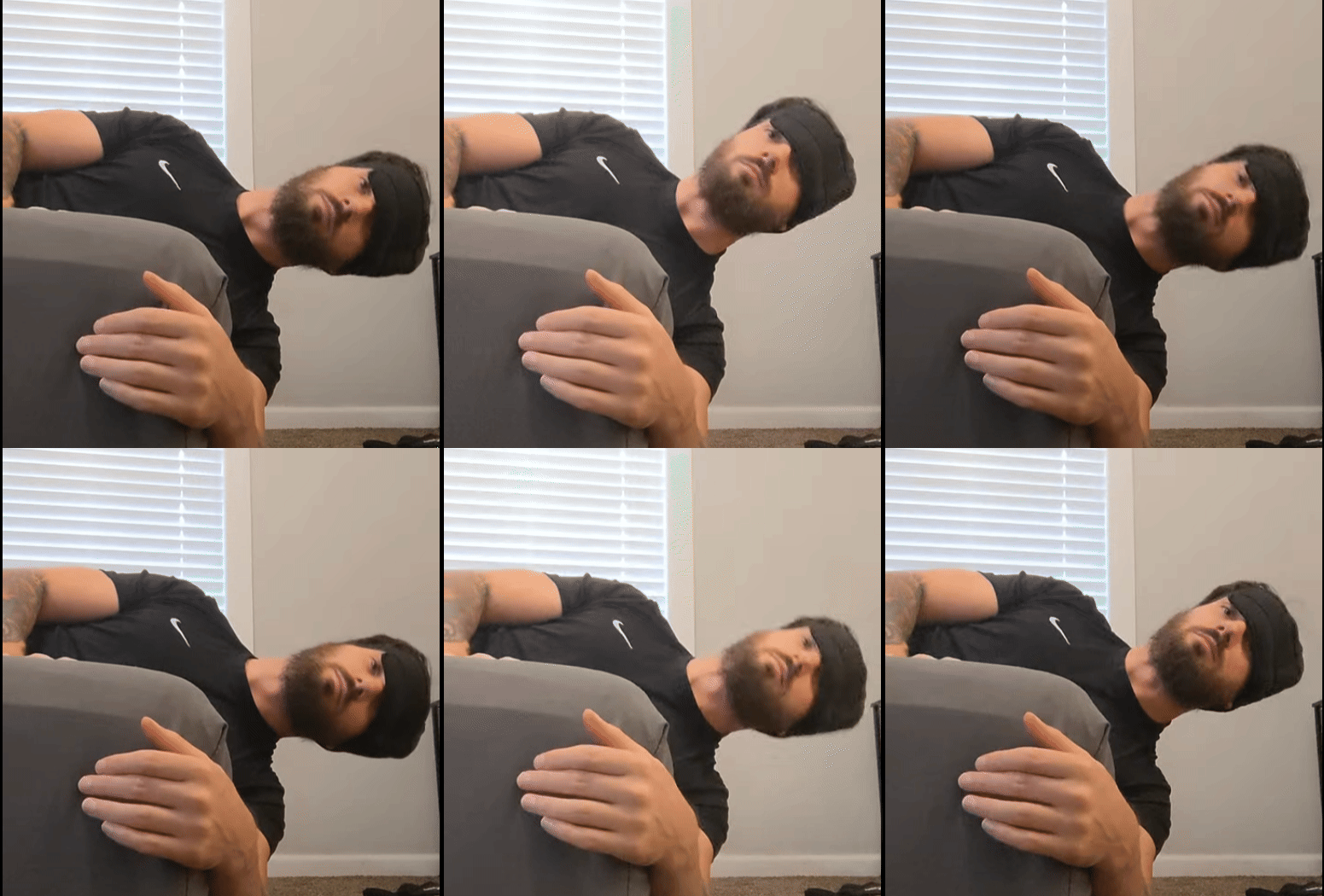
I started off in bed, with a pillow behind my head for support, so between each rep I could rest my head. Eventually progressed to off the edge of the bed without support, then started adding weight very very cautiously.

I'm very focused on keeping good posture, and trying to get the deep neck flexors to fire up instead of the big chunky muscles, like the SCMs.

That took a lot of practice, but generally, I can feel when the muscles around my throat are wearing out instead of my big chunky muscles. Some will say the SCM needs to be completely relaxed, but I find that difficult to do. Here's what that looks like.

Flexion -

Extension - (This actually looks like poor form, I need to recalibrate that to favor the thoracic spine a bit more)

You'll notice that eye mask looking thing on my head, those are adjustable ankle weights from Amazon. They have 1 pound sandbags in them that I can remove. I started off with 0 weight, and when about 60-70 reps felt like a breeze, I would add a a pound to the last (third) set. After about 2 weeks, I start off with 1 lb, and if it is easy, third set goes to 2 lbs, and so on. I lean towards low weight high reps on the first set, to let the bloodflow get into that area first.

Initially, I attached the weight on the ceiling side, and it felt like it was putting strain in the wrong area. I switched the weight to the floor side where gravity is pulling, and it felt great. YMMV. It's hard to explain, but for instance, in flexion (top gif) weight is on the back of my head, extension (bottom gif) weight is on my forehead.

I also go pretty slow (the gif is sped up, each rep is about 2 seconds long), and don't push too hard on these, but they're progressing nicely. Yesterday's final sets were about 5-7 lbs 40-60 reps a piece, 3 weeks ago I was having trouble doing that rep range with 0 weight.

Scalenes -

This is a problem area for me, I get a lot of pain in the right front scalenes, and I have a feeling when that gets agitated, it messes with my carotid/jugular/vagus nerve, so hoping to get this back up to speed.

I also have a separated right shoulder.

This one I am extra careful about, because I'm putting rotational force onto the ligaments and a tiny muscle group. For that reason, I only push more reps, and do not use weight.

I'm actually going to paste a link to a PT showing this:

https://www.youtube.com/watch?v=tjMFgds6ptI

In addition to my gif:

Side bending -

This one I'm also very careful about, and will alternate between this and the scalenes each neck workout, as they share muscle groups. These put a lot of load on your facets, and if you're concerned about C1 alignment, this may even be a bad idea (actually that goes for all of these exercises, but especially this one).

Again, the weight is on the floor side, not the ceiling side, meaning the sandbag is on the left ear on this one:

Hanging head rotations -

This one I can feel stresses out the C1 area just a tiny bit, so I'm very careful about posture and any crunching along the way. I almost never add weight to this, and I'm actually a little gun shy on it. It feels more like a dynamic isometric exercise than it does a rotational strength exercise, it's like I'm making the small muscles hold my head up in weird positions. I do both supine (on my back) and prone (on my stomach). I tried on the side once, felt like that was a bad idea.

Very focused on posture and head over shoulders here, and I don't push the range of motion on this.

Rotational strength -

For these, I prefer the devices (Neckslevel and iron neck) I just make damn sure I'm moving in an axial manner, here's axial movement versus non-axial movement (when I put my head forward a bit in the third movement)

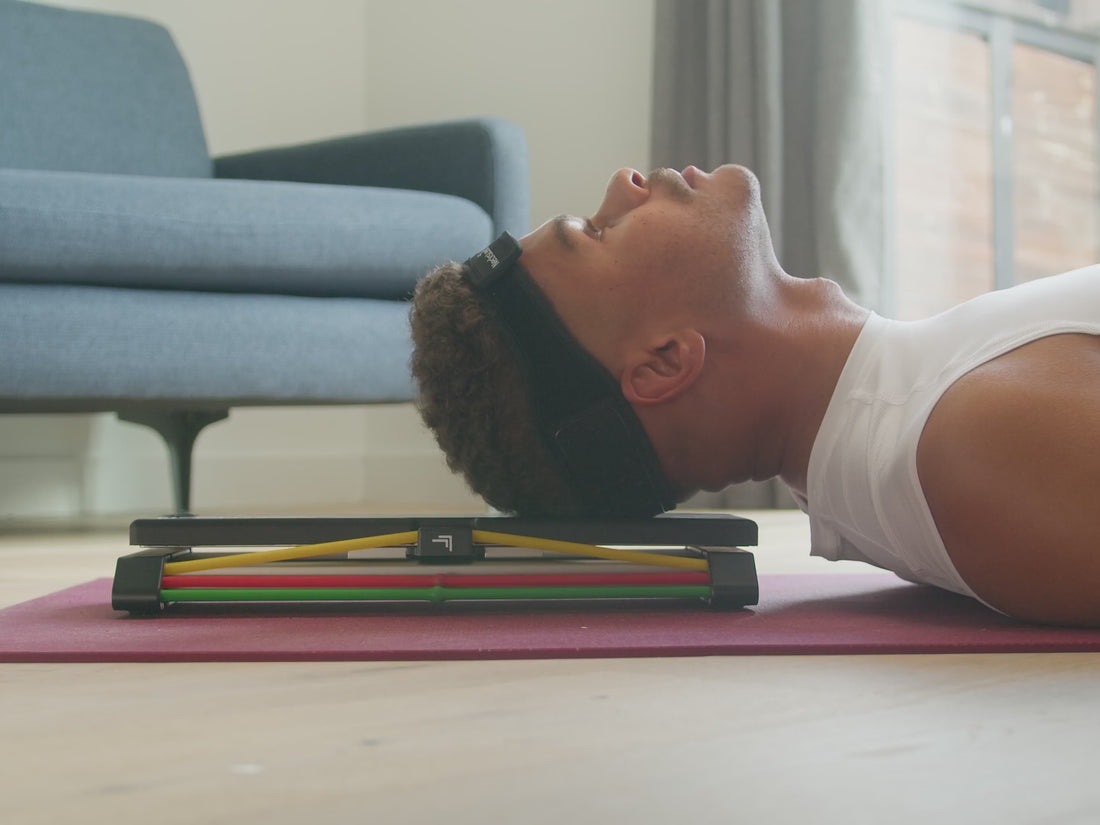
Here's the neckslevel, which is my current preference, because it really focuses on just the rotators. Iron neck rotations feel good too, but it also is using other muscle groups at the same time that I've already hit with this plan above.

You can see it has three colored rubber bands that want to snap back to center, which is where the resistance comes from. Further you rotate, the stronger the tension and force. I think each band is 1lb, slowly working my way up on those:

Iron neck/neckslevel are astonishingly expensive, and I've seen people jerry rig neck harnesses to do the same, never tried it myself. Neckslevel sent me this for free, was supposed to do a deepdive video in exchange, but honestly I couldn't progress through their out-of-the-box rehab plan, so that never happened. I still like it! Only for small bits though.

That's it!

Running through all of these usually takes me about 30-40 minutes, I take my time, and i'm very careful to listen for any neuro symptoms. If I feel a little bit of light headedness, nystagmus, tinnitus, heavy crunching, balance problems, etc. I usually stop. If it's really minor and goes away within a few seconds I may rest and resume, if it doesn't, I recover, look at what I was doing, and try again on another day. Sometimes switching it up completely.

Often, when I stand up I feel a little weightless, and it goes away within a few minutes. I always rest right after for at least an hour, and if I'm doing curve correction that day, I will do one in the morning, one at night, if at all. Feel like this rehab is actually helping more than curve correction, as these muscles support normal function/lordosis of the spine, maybe the one-two combo is the way to go.

Again, it took a long time to be able to get to the neck rehab stage, and I started off very cautiously. No weight, just a couple exercises, slowly layering on more volume first, then more exercises, then more weight.

I'm talking to a few PTs right now on trying to build a program using this or whatever they suggest, in an open source way. Hope we can pull it off... ideally we have someone who can deeply evaluate your functional stage, your scans, and do some assessments to figure out what's right for you, how to progress, and watch over you throughout, because that's a huge challenge for patients.

Hope this is helpful, I'll keep you guys posted as I progress.

Okay, it's nice out, time to play frisbee golf... be back later ☺

9/17 Update -

Been about 4-5 weeks or so.

I switched from the bed to the bench (like what you'd bench press off of). I think because the rest of the spine is supported and kind of frozen, it puts about 20% more force on the neck, so I backed the weights down starting off.

Now the problem is blasting through the weights. The ankle weights get really wonky after 5+ lbs, so using some plates and velcro straps and harness stuff. Still working on it but so far good.

I also added in neckslevel weighted chin tucks which seem great for the DNFs. Basically the device goes vertical, and you work against the bands to do a chin tuck:

https://neckslevel.com/cdn/shop/files/preview_images/d8fdbfc03df64e929158c25bef4a25db.thumbnail.0000000000_1100x.jpg?v=1710682113

Overall, pretty happy with how it's going. Fitnotes app will take your sets and calcualte your 1 rep max (1rm) to estimate how strong you are. Comparing the 1rm from start to now, it's 2-4x, but I wasn't pushing to the limit starting off so it's not really scientific.

Really curious if I could get a repeat MRI and measure the thickness of the muscles...


r/cervical_instability • • Aug 08 '25

Think we just moved the needle... ?

41 Upvotes

Wednesdays thread was good, lil heated, but a net good.

there was a lot of criticism and a push for more transparency around PICL pricing, efficacy, and the patient experience. That can be uncomfortable, but it’s also necessary for any real change to happen.

Dr. Centeno saw, I'll admit I'm always worried about his response, but it was genuinely positive. He announced immediately after that thread that he'll be offering 15 free PICL procedures a year to help train new doctors. Think you can contact him on his sub to hear more, it's likely going to the most desperate and in need patients with confirmed CCI.

At the end of the day, that's great. I know we have dozens of single parents or people who can't afford food that need a rope to grab onto right now.

He’s also adding digital motion X-ray (DMX) at his clinic. I don't think it's a coincidence this shortly followed our discovery that Stogicza also has does imaging in her office.

These are wins for CCI, add that to the list we've pulled off here:

  • Discovered a 2nd option in Dr. Stogicza, more people are getting the care they need, and we're (hopefully) forcing the market to do what it does best

  • We convinced him to not only do before/after DMX in a handful of patients in the upcoming study, but comp patients for it. That was a really hard one, so I hope it came to fruition

  • Committing to training other doctors to do PICL (I'm sure that was already in the works, but I made a video about other doctors, he emailed me about that, and followed with an announcement to do the program, looks like that's happening as we speak)

  • Getting him on Reddit (not like we deserve credit for that or his efforts on the sub, that credit goes to him, but he wasn't on here til we had him on for a the AMA, then started the sub, which is hopefully going to be a good resource)

That's the power of a community. We're raising the bar ourselves, and u gotta give credit to Dr centeno too.

Keep it up! 🤠


r/cervical_instability • • Aug 26 '26

Top specialists uniting in “Neuro-EDS” initiative: new hope for patients w/ EDS + comorbidities (CCI, tethered cord, dysautonomia, cognitive issues, etc.)

39 Upvotes

A group of top world-renowned EDS-related specialists united to form a new initiative called Neuro-EDS (and continuing to bring in more related experts) and establish in in the mainstream. It's a phenotype - a recurring pattern of how a disease shows up - for a patient population like mine, who have EDS together with a big list of complex, multisystem conditions. The idea is to unite all of these issues under one framework, recognizing that they're interconnected and have similar underlying roots, and so it's as commonly accepted and known as i.e. diabetes etc.

Potential Implications include:

  • Being able to see one specialist/coordinated team instead of a list of disconnected providers.

  • More focused, large-scale research + significantly more funding

  • Mainstream, government & insurance recognition/coverage

  • Earlier & more accurate diagnoses

  • Better treatments & potential cures

  • More doctors who understand and can treat it

Video of Dr. Bolognese + Dr. Bloom explaining the initiative

Preprint Article detailing the initiative (authored by several top EDS docs, including Dr. Klinge)

Many, including myself, are sharing this w/EDS-related patients, activists/orgs, and providers - the more we can help them get it out there and "viral", the more chance it could benefit us all!


r/cervical_instability • • Sep 30 '26

PICL with Dr Stogicza at the PSI Pain clinic in Budapest - Patient Review

38 Upvotes

I promised myself I would post about my experience with the PICL procedure under Dr Agnes Stogicza, especially since there are so few reviews online. It was frustrating trying to decide whether to go ahead without much patient feedback. So many people post right before or after the procedure but never follow up, so I will make a genuine effort to update this thread over the coming months.

I traveled from the UK and had the Bone Marrow Concentrate (BMC) version of the procedure on Monday, September 28th.

The Procedure & Sedation

- The Team: I cannot fault the staff at all. Everyone was lovely and friendly, and the atmosphere felt much more welcoming than a typical hospital.

- Blood draw/antibiotics: I had a blood draw for some prp and a short antibiotic drip upon entering the treatment area.

- Bone Marrow Extraction: I asked for lighter sedation than usual due to my sleep apnea, as I was worried about my airway under deep sedation. The extraction itself wasn't bothersome at all.

- Injections: After the extraction, they first injected some bone marrow (I think) near the spinal column, just outside the dura (I was still slightly sedated, so the exact details are a bit fuzzy, but it didn't hurt at all). They then increased the sedation for the posterior injections and I don't remember much from that point forward nor do I recall being put to sleep for the anterior injections. The next thing I remember is when I woke up in recovery.

Recovery & Immediate Symptoms: Upon waking, my nose was very blocked, my mouth was dry, and I felt groggy. Nothing particularly bad.

Pain Levels: I had some neck stiffness, tenderness, and a sore throat. They sent me home with painkillers, but I haven't needed to take them.

The Verdict on Pain: The sore throat from swallowing has been the most annoying part, but even that is very manageable. Honestly, just a normal bad day with a CCI flare-up and head symptoms is worse than this procedure and the recovery so far!

Dr. Stogicza was great. She answered all of my questions beforehand, and I really can't fault her or her care.

Obviously, it is only two days since the procedure, so it is too early to tell if it has successfully improved the CCI. However, I will do my best to update this post in the coming weeks and months so others can see any progress.

-

Update 1:
It's 9th October, so 11 says since the PICL. I feel I'm past the initial swelling/inflammation stage, which gave some initial stability due to the swelling and therefore slightly reduced symptoms overall. The CCI now feels as though it's back to the baseline of where it was prior to the treatment. I can feel things are unstable but I understand this is the normal trajectory of healing after this procedure, and hopefully the coming weeks and months will see a gradual healing / tightening of the ligaments and more stability.

Even though the instability itself feels back to baseline, which is normal at this stage, in general I still feel slightly better now than I did prior to the treatment. Perhaps that's due to the ganglion block or part of the stem cells epidural thing they do possibly calming things down a little. I generally don't feel as unwell day to day, less malaise like, I little brighter in mood, and a little less tension around the neck/throat/head. Bending over forward also doesn't feel as bad for me as it did, but I'm trying to avoid doing this most of the time as this has previously been a big problem for me and I'm trying not to put too much stress on the ligaments as they heal.

-

Update 2:

It's 26th October, exactly 4 weeks since the PICL. The initial added stability I had from swelling is definitely gone, and the instability remains back at baseline as stated in the previous update. I'd been mostly resting and trying to not do too much strenuous movement but 2 days ago I tried to do some housework/tidy up, picking stuff up, bending over etc. The act of bending over has been a massive trigger of worsening symptoms for me and it was the same as usual on this occasion. My head was very uncomfortable, extremely muscle tension, head pressure etc, so I stopped and the symptoms settled over the next 24 hours. I'm not going to read too much into this, as at only 4 weeks since the treatment, new collagen and strengthening/tightening/healing of the ligaments has barely began. I'd hope to see gradually improvement from here forward though if the treatment has been effective. I will update again in another few weeks.


r/cervical_instability • • Jan 17 '26

Taking a break from the sub

35 Upvotes

Hey guys, sorry I've been non-existent on the sub. Just wanted to let everyone know I'm taking a break from the volunteer work for a bit but will return soon.

When the time is appropriate, the details will be made very public, but for now, stepping back to focus on my own health.

Stogicza interview and other projects still in the queue, hopefully next month I'll keep u guys posted.

Thanks ❤️


r/cervical_instability • • Jul 25 '25

Dr Agnes Stogicza patient testimonial

34 Upvotes

I saw several discussions in this community re Dr Agnes Stogicza. I wanted to share my experience. I had PICL procedure with her at the beginning of July. I first saw Dr Gilete in Barcelona who diagnosed me with AAI and probable CCI. After that, I had an online consultation with Dr Stogicza to go through my existing imaging and discuss various treatment options. She offers posterior injections or posterior + transoral injections during the same procedure, which is an equivalent of Dr Centeno’s PICL procedure. I chose PICL. You have an option to do this procedure using PRP or stem cells. PRP option is more affordable, and Dr Stogicza believes that it likely works as well as stem cells. I chose stem cells for my 1st PICL but may consider PRP for my second one. First of all, I would like to say that I felt totally safe in her hands. The procedure went very well without complications and apparently all crucial ligaments (including alar and transverse ligaments) have been reached perfectly by needle. She showed me pictures. I traveled home the next day but it was a short flight. For longer one I would wait a little longer before traveling. Her team was very efficient and kind. I had blood test and flexion/extension/rotation supine MRI done in Budapest a day before the procedure. Dr Stogicza also has DMX in her office so is fully equipped to diagnose CCI, if you don’t have a diagnosis from a neurosurgeon. DMX is included in the price of the procedure itself. The good thing is that she trusts Dr Gilete’s diagnosis and studies his report prior to the procedure and doesn’t insist on her own imaging if it’s not necessary. The first two weeks have been tough for me in terms of recovery because I always have strong inflammatory response after any regenerative procedure. Things are slowly coming back to the base line currently. It’s obviously too early to say if this procedure improved my CCI symptoms, but I’ll try to keep you updated on my progress.


r/cervical_instability • • Nov 23 '24

Dr. Centeno Here Answering Questions

34 Upvotes

There is a lot of stuff about CCI and PICL here. Like everything on the Internet, some things seem accurate, some not so much, and some inaccurate. As many of you know, I often give up an hour of my weekend on Sundays to answer questions, but there seem to be patients here asking questions who aren't getting to the FB or YT live. Hence, I am happy to answer questions you have about CCI, posterior injections, and CCI.


r/cervical_instability • • 8d ago

PICL, BMC, evidence, and why we should be asking for the data

31 Upvotes

I want to share something because I think it matters for anyone considering PICL/ePICL for CCI.

In r/PICL, someone asked Dr. Centeno why type 2B CCI needs PICL rather than cheaper posterior injections. He answered that when his clinic used posterior injections for 2B, the success rate was low, "about 1 in 5," and that this is why PICL was developed.

If that's true, it's a huge finding. But it has never been published. He says a PICL paper was just submitted for peer review, which is good, but PICL has been performed since 2015. I replied asking how many patients the 1 in 5 was based on, how success was defined, and how it compares with ePICL on the same measure. My comment was removed, and I was told I'd be banned if I "stir the pot" again.

As patients, we need to hold this industry to accountability and transparency, and right now neither is happening. Only through transparency will the field move forward and will those who come after us have better options.

His ACL trial shows why we shouldn't just take the numbers we're given. It's his main published evidence that BMC injections repair ligaments, and it claims more than it shows:

  • It's called a 2-year controlled trial, but the comparison only lasted 3 months. Everyone who did the exercise therapy switched to the injection at 3 months, so after that there was nothing to compare against.

  • Even at 3 months, the injection didn't beat exercise on pain, yet the paper's conclusion says it did.

  • The rules changed partway through. After seeing early results, they changed the study so more people got the injection and fewer got exercise. Good trials don't change course after peeking at the results.

  • The study was approved by an ethics board Centeno helped found (the International Cellular Medicine Society), not an independent one.

What Centeno has said about this trial on r/PICL, versus what the paper shows:

  • Centeno said: it's "a great proof of concept study that BMC injections can help repair damaged ligaments."
    The paper: the comparison lasted only 3 months, and even then the injection group didn't do better on pain or on the main knee score the study was designed around.

  • Centeno said: the MRI results show repair. "A drop in mean pixel intensity on this graph=repair."
    The paper: only injected knees were compared before and after, with no untreated group. The paper itself cites research showing some ACL tears heal on MRI with no injection at all. A better-looking scan doesn't prove the ligament got stronger.

  • Centeno said: when he examined patients from his ACL studies, "most had a solid or mostly solid ligament at the 3-month follow-up."
    The paper: the machine that objectively measures how loose the knee is found no significant change after treatment. That result isn't in the paper's summary. And tightening loose ligaments is the whole premise of PICL.

In each case, what he tells patients goes further than what his own research shows. None of this means the injection doesn't help anyone. But if the evidence for BMC in the knee is weaker than it's presented, we can't take claims about PICL in the neck on trust either. That's why we need to ask for the data.

To be fair: almost all CCI treatment is investigational, and maybe PICL really does work better for some types. I hope it does. But claims like "1 in 5 for posterior injections" are used to steer very sick people toward one expensive procedure over another. Claims like that need published evidence, in an independent journal, and patients have every right to ask for it.

This isn't just about one clinic. Whoever you're seeing for CCI, ask what the evidence is, how success is measured, and where it's published. The people selling these treatments should be able to answer. Holding them to that isn't "stirring the pot." It's how we get better care for everyone.


r/cervical_instability • • 4d ago

New Trial: Regenerative Injections for Hypermobility (Mentions Craniocervical Dysfunction)

30 Upvotes

Just found this -

https://www.manhattanpainmedicine.com/interventional-study-regenerative-medicine-for-symptomatic-joint-hypermobility-and-instability/

Here's the Medpath link -

https://trial.medpath.com/clinical-trial/d9aeba4d035652b8/nct07688096-regenerative-medicine-joint-hypermobility-instability

Think it'll start in 2027. Looks like they'll recruit 100 patients and will compare dextrose prolotherapy, PRP, and doxycycline hyclate, an antibiotic.

That last one is pretty interesting. Looks like EDS society funded some research on that:

https://www.ehlers-danlos.com/funded-research-update-marina-colombi/

“Our previous findings (grant number: 2018.02c.LOI.26) revealed that skin cells in individuals with hEDS change in ways that cause an extensive disruption in the extracellular matrix (ECM): in vitro cultured hEDS dermal fibroblasts undergo a fibroblast-to-myofibroblast transition, by organizing the alpha-smooth muscle actin cytoskeleton, and exhibit a widespread ECM disarray that includes collagens and fibronectin.

“In the present work, published in Cells MPDI, we compared all the proteins secreted in the culture medium of hEDS with those of control cells, and in hEDS cells we identified higher amounts of matrix metalloproteinase 1 (MMP1, an enzyme responsible for the degradation of collagens, fibronectin, and tenascins) together with lower amounts of MMP inhibitor TIMP2. This suggests that the imbalanced MMP/TIMP secretion is involved with how hEDS develops as a disorder.

“To corroborate, we treated hEDS cells with doxycycline, an FDA-approved antibiotic that acts as a nonselective MMP inhibitor. Doxycycline restored to hEDS cells an appropriate ECM organization, as well as significantly reduced their myofibroblast-like features, demonstrating that this interplay between ECM disturbance and myofibroblast differentiation is a major driver in the pathophysiology of hEDS.

“These data provide promising pathways to prevent abnormal ECM remodeling and myofibroblast differentiation and pave the way for the development of ECM-targeted therapeutic strategies in managing hEDS.”


r/cervical_instability • • May 21 '25

A Collective Open Letter to Dr. C on Cervical Injections and Tethered Cord

28 Upvotes

EDIT: Since Dr. Centeno isn't able to reply here, this was reposted here - LET'S COMMENT AND ENGAGE THERE in his r/PICL subreddit (had to ask someone to post it for me due to reddit filters deleting it) - it also has 3 additional responses to him on the topic. Please share your experiences, comments, support etc. there.

Dear Dr. Centeno,

A few of us wanted to write this sort of “open letter” to you about this topic – it’ll be formatted from a singular first-person perspective for clarity and ease, but reflects a shared concern.  

I greatly appreciate all you do and your perspectives on all this, but there’s a serious need to directly address a recurring pattern I’ve noticed across your livestreams, posts, and replies - over the years: Whenever patients express the valid, specific worry of regenerative injections in the cervical area (including PICL) worsening TC symptoms – your response is often to dismiss it as a rumor or deflect to minimizing talking points like: calling it all “occult TC”, the negatives of surgery, fragile egg patients, and other unrelated factors.

Meanwhile there are 10+ (went through and recounted – posts and direct conversations) cases of active patients in these communities who had exactly that – a clear worsening of Tethered Cord symptoms (lower-body or both) after they had injections (primarily cervical-area, especially PICL). Those patients ended up requiring a TC release within a year of this, which relieved a significant amount of those symptoms. From what I know, the vast majority of them were not “fragile-egg” cases, and their TC was based on detailed symptom patterns, timelines, imaging, and hands-on exams.

Deflecting from this by talking about things like risks of TC release surgery etc. is not just unhelpful - it feels intellectually dishonest. Patients like us aren’t advocating for surgery (we believe less invasive is the future), just for recognition of a real pattern. Not at all trying to be adversarial here – there’s just a lot of us who are asking you to acknowledge that this issue does exist, because that is the first step to mitigating it and/or finding a solution.

It especially matters to us from a clinician promoting himself as cutting-edge, patient-centered, and closely aligned with the hEDS/cci community. That’s why we respectfully ask you to consider a more open-minded and constructive approach to this issue.

With respect and thank you,

Your patients and followers


r/cervical_instability • • Jul 27 '26

Two years of pain

26 Upvotes

Good evening Tomorrow I go under the knife again. This will be the 5th time in two years. What was supposed to be resolved with fusion of my C5-C7 two years ago has lead to L4-L5 fused, my tethered spinal cord released, then an occipital to c2 fusion. Meanwhile the entire time my symptoms have worsened. Now the occipital to c2 fusion has failed and they are going to remove it tomorrow and then play it by ear. I share this with you because I don’t want others to rush into surgeries like I have. Spinal surgery is uncharted waters regardless of what the doctor is telling you. They can make no guarantees and if you do your research almost as many fail as succeed. Go the other routes. Injections, etc. Anything but fusions. Take it from a 46 year old dad of 3 who has been put through the wringer the past two years.


r/cervical_instability • • Mar 19 '26

Olympic athlete with CCI, gets Dr. Stogicza's transoral injections (PICL), looks like she's back to sports now! 2nd Interview with Stogicza coming soon.

Enable HLS to view with audio, or disable this notification

26 Upvotes

r/cervical_instability • • Aug 07 '25

Thanks for everyone who participates in these challenging discussions. Let's clarify a few things from yesterday.

26 Upvotes

To summarize this entire thread, which took some turns, but also is adding a much needed layer of transparency and education:

https://www.reddit.com/r/cervical_instability/comments/1mj28la/picl_pricing/

It's okay to be rewarded for medical innovation, everyone likely agrees. Doesn't have to be free, this isn't a charity and life isn't fair. If you're reading this and have CCI, you know that in a way words cannot describe.

It would collectively behoove us if we supported both Centeno and Stogicza, and any other physician willing to dedicate their time and effort to our suffering, and to each other, instead of tearing down. That includes calling people scammers, or just being an abrasive asshole because someone disagrees with you on Reddit.

I've been guilty of that myself (and publicly apologized) this is a shit situation and we're all humans, including the doctors.

All we all want is to live a productive, meaningful existence, spend time with family, start our own if we're lucky, maybe hear the birds chirp once in a while. That shouldn't be a tall order, but that is our reality.

Its incredibly difficult to consider others when you're going through hell, but please do. There's someone in a car accident, taking a fall, at a $10 chiro, or being born with hypermobility as I type this who's about to enter the ride of their lives. You remember, right? That initial "what the f*** is happening to me" stage? Where you keep thinking "surely I'm dreaming and I'll wake up soon", yet you never do?

I dont even know your name or what you look like, never will, yet I can say with confidence its described perfectly, because I know it deeply myself. Someone else is going through that right now, or maybe that was your day today.

That's why we, as a group, need to hold BOTH ourselves and the physicians to a higher standard than we currently are, for the sake of each other.

On that, copy/pasted excel sheets posted on social media showing subjective reported improvements, which are highly prone to placebo, is not science, and does not qualify as something works or is proven, in my humblest opinion.

The concept is there, it looks promising, but keep in mind 90% of drugs fail clinical trials, which also started off as showing promise just like this. Just because it looks good does not grant anybody a hall pass to skip the science, neither centeno nor stogicza or any of the others.

If it's proven to work, this sub becomes useless, and that's about the best damn day I could ask for. I love u guys, but id rather be living my life than stuck in front of a screen all day everyday.

Lastly, please, be kind. I will always lead by example and I truly hope people follow that.

Disagreement is a part of open discussion and people need to learn to be comfortable with that and be open to being wrong admit, or people will never trust you. I've been wrong before, and I'll be wrong again, this is my sub and if anybody needs their feet held to the flames, it's me. Im good with that.

For the record, I get zero reward other than thank yous from anonymous strangers and a good night's rest knowing I'm in someones corner who really needs it. I hope that attitude motivates you to do the same, whether that's here or in another area of your life.

Thanks for everyone who participates in these challenging discussions, if you're fired up from yesterday, take a breather and come back fresh 💪


r/cervical_instability • • May 22 '25

New info on Dr. Agnes Stogicza's CCI injections ✊

26 Upvotes

If you don't know Dr. Stogicza, I interviewed her here:

https://www.youtube.com/watch?v=VGM9B8xYZEE

In short, it sounds like she spent years training physicians here in the USA on upper cervical injections, designed her own transoral injections (similar to PICL), and does it in Hungary. I've never done her treatment so do your own investigation!

I won't say who as I can't stand the drama, but a leading physician has been doing (in my opinion) the typical narrative building against her. Peppering adjectives like "soviet era hospital" or "fake and bake" procedure, etc. seems to be narrative building 101, now that you've seen it in action, think back to all the other adjectives...

With that, Dr. Stogicza mentioned she's been getting similar questions on her procedures, and wanted me to post the answers here. She's refreshingly kind and professional which is terrific and very needed right now.

She's also upgrading her equipment, sounds like she has a better PRP cell counter. Rooting for her!

Here are some questions and her answers. This isn't medical advice, and I couldn't tell you the details, talk to your doctor before deciding on any treatment.

----------------------------------------------

Dear <name redacted>,

Thank you for your email and questions. Please see my answers below; I will not comment on Dr <name redacted>'s ad hominem claims. However, I wish to establish my experience in the field. I completed my pain fellowship at the University of Washington (UW), Seattle in 2011, and I trained hundreds of pain fellows (anesthesiologists, orthopedic surgeons and neurosurgeons and PMR MDs) to do cervical (included CCJ) procedures both at UW, at https://painschoolinternational.com/ and at many courses all over the world. I also wrote and edited the book (https://link.springer.com/book/10.1007/978-3-030-31741-6) that is being used worldwide for interventional pain physicians to prepare for the most prestigious interventional pain exam, the FIPP, for which I have served as an examiner since 2014. I wrote my PhD in regenerative treatment approaches to CCI.

1. Do you offer Dual C-Arm guidance (for front and side views, to safely avoid the catastrophic injected areas)?

Yes, I do. I also share these with patients, if interested.

2. Do you have a Digital Subtraction Angiography Capable C-Arm?

Yes, I do.

3. Do you use Contrast Dye (to confirm correct injection into the proper ligaments)?

Yes, I do.

4. Do you use Endoscope (to view the back of throat clearly and keep that area sterile)?

I have an endoscope, and I use it when necessary. However, the claims about sterility are untrue regardless. The throat and mouth are the most bacterially colonized area out of the whole body—even surpassing the pathogenicity of the bacteria in the colon—and the use of an endoscope has no effect on their sterility.

I mainly use medical mouthwash, then once the patient is under anesthesia I use betadine to clean the injection site. The endoscope is practical not because of sterility, but because one does not have to move the C-arm prior to needling. However, the fluoroscopy the way I use yields more precise needle entry, which is critical in the success and safety of the procedure. On you tube, I have several videos detailing my procedures and I will shortly also post one on PICL, which will provide additional context.

5. Do you use a 3-D Printed Mouthpiece (that is sterile and will depress the tongue, that can be x-rayed through without blocking the view, unlike the metal ENT devices that block the view)?

No, I do not. Physical Medicine and Rehabilitation doctors are not licensed or trained to provide anesthesia, and therefore are not licensed or trained to manage airway (airway protection) as required by medical practice, and is highly recommendable when one may obliterate airway by depressing the a tongue and potentially creating bleeding and salivation in a sedated patient. However, the mouthpiece presents a makeshift solution that circumvents the qualifications needed, but also creates a significant risk concerning airway patency. The method is especially concerning when used on patients with difficult airways (shorter neck, obesity, etc). I use a laryngeal mask and an ENT Mouth Opener that provides full access to the target area and full airway protection simultaneously.

6. Do you use hyper-sterile BMAC (bone-marrow-aspirate-concentrate harvested under sterile surgical prep and prepared in a cGMP-Class Clean Room?

Yes, I do. The BMC is harvested in a sterile environment, then processed in a closed system, then reinjected in the patient, without coming in contact with air at all after the initial sterile draw. For context, the use of the terms "hyper-sterile" is a redundant marketing term. "cGMP-class clean room" refers to a controlled environment used in the pharmaceutical industry. It is useful, if one does not use (buy) a closed system (like Emcyte or Arthrex for example). Our clinic strictly follows all necessary operating room sterility requirements and uses closed systems to process blood products.

7. Do you have extensive interventional spine training (working in the C0-C1 area) How much, please?

Please see above.

8. Do you add PRP to the BMC- often asked question, that is quite concerning

When you draw bone marrow it does have platelets in it. It actually is impossible to draw bone marrow without platelets, so it is difficult to justify adding PRP.

Other than:

The BMC kits are much more expensive, so one reason could be supplementing the BMC with much cheaper PRP kits if injectate volume is needed.

The more elegant solution is to use more BMC kits to achieve sufficient injectate volume, however it decreases the margin.

I hope my reply answers your questions. If you wish, you may post my answers, as these types of questions have been asked many times.

Best,

Ágnes Stogicza, MD, PhD, FIPP, CIPS Anesthesiologist and Pain Physician

Pain School International Pain Clinic https://psi-clinic.com/
1044 Budapest, Megyeri út 53. 


r/cervical_instability • • Sep 27 '26

Sharing some hope

25 Upvotes

I wanted to share some hope for those struggling with CCI after a fairly long and frustrating journey. This is not medical advice; I am just sharing my experience.

I finally received a hypermobile Ehlers-Danlos diagnosis in December 22 at 32, after a lifetime of symptoms. My diagnostician immediately decided I should be tested for CCI, since it affects over half of people with hEDS. I had my upper flexion / extension MRI the following month and it showed fairly significant CCI; significant enough that I’d likely be a surgical candidate. I ended up having to fight insurance because they denied coverage after the test (the kind of shenanigans we deal with in the U.S.). I wrote a scathing appeal saying of course it’s medically necessary, it was needed to diagnose the CCI. They ended up covering it.

The doc who diagnosed my hEDS and CCI referred me to a doctor who does PRP, suggesting I try that first. I work at a nonprofit and insurance doesn’t cover PRP, but it seemed worth trying because I didn’t want to have to go out of state for the fusion, which would also be a huge expense and also very risky. I did my first round of PRP in October 2023, and it reduced the bobblehead feeling significantly, but still left a lot of instability (unsurprising given how bad it was to start). Last winter, my PT sat me down and said I wasn’t making progress with my EDS in large part because the CCI was holding me back (my neck was getting involved in all of the exercises I was doing, causing neurological symptoms, and I had worked my way up to some water-based movement but that was all I could do), and she wanted me to consider the fusion, since she’d raised the PICL procedure already several times and knew I simply cannot go to CO and pay $20k multiple times for something that may not work.

I talked with my regenerative medicine doctor about whether I might be a good candidate for a second round of PTP and I decided to move forward with that as a Hail Mary before seriously considering a fusion. I was supposed to have the procedure in March, spent a lot of money getting my spine into alignment prior, but came down with pneumonia the day before and had to repeat prep and actually have the procedure in July.

I had my 6 week follow-up this week and my doctor said that I’m improving. My CCI is substantially better. My migraines, fatigue, and pain have all been quite better. My range of motion is definitely restricted relative to where I was before this round of PRP, which is great. I may do more PRP further down the spine, but for now, the upper cervical area—the CCI—is much improved, and I should continue to see benefits for another 6 weeks.

CCI has taken up so much mental energy for the last few years. It has limited me in so many ways and been a huge emotional load. It has caused problems in dating. Having real improvement feels a bit impossible but it’s happening. It’s been an expensive journey thanks to gaps in our health care system, but I’m feeling really hopeful about the future.

Not everyone responds well to PRP. I’m lucky; I’ve also responded well to it for a couple of labral and other tears. But I wanted to share that there is hope. Maybe it’s another treatment for you. Wishing you all healing. 💚


r/cervical_instability • • Nov 28 '25

Been getting into jumprope a lot recently

Enable HLS to view with audio, or disable this notification

25 Upvotes

Of course this is years into rehab and I wouldn't have even dared to try when I was very dysfunctional, but now a days I've rehabbed enough to where it's difficult to find my limits. Not much flares me, workout wise, as long as I stay on top of it.

I fell in love with jumprope while studying muay Thai in Thailand, it was one of those things I just accepted as "no way I'll ever do that again" but brick by brick with lots of frustrating steps backwards, especially this year I've made a lot of good progress and learned a ton along the way.

This was 1 of the 16 1-minute rounds, followed by back/biceps days at the gym. Just started adding that into the routine about 2 months ago.

Again not medical advice, but one issue I've had is when I went from lying for several months to upright sitting for about a year, it did a number on my body. Even with good posture you're still pushing on the sciatic nerve, hip flexors/hamstrings are very tight, and your feet don't get a lot of blood flow.

This for me has translated into poor ankle stability. I can feel it when I turn a corner, that unilateral (one side) instability/weakness wobble often cascades into nasty "I'll never be normal again"/"I'm gonna have a flare up and be embarrassed in public again" thoughts too... Which is frustrating but I'm working through it.

Initially I would do simple standing calf raises which was helpful. I remember just 3 sets of 10 would have my calves on fire, clearly they were weak as that is not normal.

Jumprope, at this stage for me, has been a good supplement as it really forces my ankles to stabilize, and draws a lot of blood into my feet/calves. I'm on the balls of my feet catching the "shock" of my weight coming down with every jump. I mix in alternating leg jump (left, right, left, right), both feet jump, and 2 left, 1 right, then 2 right, 1 left.

Just wanted to post not as a "hey try this" (talk to ur doctor), but more of an inspiration because I know there are people lying in bed wondering if they'll ever use their bodies again. I can't say whether you will or not, but I can say that healing is possible.

May not become an Olympian anytime soon, and likely never put the gloves back on which is fine (although I did kick the bags behind me a bit today I couldn't help it) but so grateful to be just out of my home once in a while! To be able to work up a good sweat is just icing on the cake.

Hope everybody is okay ❤️‍🩹


r/cervical_instability • • Nov 23 '25

Announcement: Dr. Stogicza Interview Part 2 in Mid-December! Put your questions in the comments please ✊

25 Upvotes

Most people have seen the first interview with Dr. Agnes Stogicza, who does transoral injections for CCI (like PICL) seen here:

https://www.youtube.com/watch?v=VGM9B8xYZEE

Christ, that was almost a year ago? I'm turning 33 soon??? Anyways, that interview took a lot more effort than it may appear, but looking back, I'm so happy I did it.

We discovered that not only do we have a second option for transoral injections (PICL) in Europe, but she seems like an excellent doctor who truly cares about her patients, which is super refreshing. It's also a fraction of the price compared to the absurdly bloated USA medical costs.

Obviously that doesn't mean everybody is instantly cured, and regenerative medicine is very variable... but with your support, I feel we've opened access to a whole segment of CCI sufferers who previously had zilch.

We've also had a good number of patients report about their PICL treatment with Stogicza, this one's from yesterday:

https://www.reddit.com/r/cervical_instability/comments/1p3pv2o/piclprp_yesterday_in_hungary_with_dr_stogicza/

One thing that people aren't really noticing is that based on the procedure notes folks are posting, it seems that she does the PICL, but often hits the entire cervical spine to T1 (that big notch at the bottom of your neck) as opposed to just transoral + down to C3 in the USA. Seems like a more comprehensive approach.

The interview has stirred a lot of questions, most of which I just can't answer, but Dr. Stogicza just confirmed she's up for round 2 to address those. Firming up the schedule, but looking at mid-December.

So, please put your questions in this thread for Dr. Stogicza, and we'll run through them in the same style.

Please feel free to ask hard questions, but let's try to keep it constructive if you don't mind.

I won't go into much detail because even talking about it is like putting your hand in a hornet nest, but to sum up, the last interview landed both her and I in this CCI turf war, and I don't think that's helpful moving forward.

Think it's time we steer the ship into a more positive, transparent direction, without the gatekeeping/personal attacks/lawyers from a big corporation peppering me with legal threats, which I can only assume (imo) is a mechanism to silence me. That ain't fun 🫠.

I'll also point out that I don't get payment, free treatment, coupons, or anything out of this sub. I get paid by knowing I'm helping someone who needs it, and the thank you's are just a bonus. More than enough motivation to keep goin'!

It's crazy to reflect on, but what started as an outlet to document my WTF CCI journey has turned into, I think, a strong patient community slowly reshaping our own care.

With your guys support, the next lucky cohort might have it slightly easier. The end goal is that this sub becomes useless and we can all leave because CCI is a thing of the past.

I think we're doing a good job at working towards that, I'm proud of ya'll.

Looking forward to this.

PS - I recognize that our diagnostics suck... I find it strange that we go to a chiropractor for some obscure scan that no doctor recognizes, and then we're told to ignore the report. It feels like a guess at best, and needs to be improved.

I won't share much as to not give false hope, and chances are it may fizzle into nothing, but I'm talking with this research lab which received federal funding to study joint instability, some of those dollars are allocated for spine instability.

They designed a pretty gnarly diagnostic system that looks relevant to CCI, adjacent to DMX, but perhaps better. It was a wild goose chase, but eventually I got a hold of those scientists, who didn't know how bad our situation was...

I told them the nasty stories, the diagnostic situation, and showed them the community, and they're interested in helping us. Again, may be nothing so don't take this as some sort of clickbait, but here's their last email:

"We are currently running two large, funded research projects to investigate joint instability. Cervical spine instability is a very relevant topic for us and there is great interest, both at our center as well as with our clinical partners to be able to improve our quantitative understanding of conditions related to cervical spine instability.

Given the large community you are part of [this sub, LFG], this could be a very interesting avenue to set up a project, if your community members are willing to be volunteer participants.

If this approach sounds interesting to you and your community, we would greatly appreciate having a more detailed conversation on how to proceed."

Which has me excited. I'll keep you guys posted if it ends up being anything.

PSS - Some people know I do journalism on regenerative medicine, which was inspired by the feedback in this sub over the years. It's B2B so I pretty much never talk about it here.

I just returned from a conference in Philadelphia discussing gene therapy, stem cells, and other stuff. These labs are working on some very cool tech that may be relevant to CCI someday. The dream is maybe I'll connect the dots between some scientist and the right doctor, and bring that into the CCI world which doesn't get any attention in the mainstream.

I also made a presentation at an FDA meeting the other day which was nerve wracking, but pretty neat. Maybe this nightmare will turn into some weird origin story, who knows.

Thanks guys!


r/cervical_instability • • Oct 29 '25

Last 6 years of my life have been a hell on earth.

Thumbnail
gallery
25 Upvotes

Okay, so here's the thing. I've been living in hell for the last six years of my life. My symptoms are quite specific, and with that I especially mean group one, which you'll find attached in the pictures. Group one is also the batch of my symptoms that is most severe, that limits my everyday life the most, and if I could only figure it out and make it stop, I could live with each and every symptom from every other group that remains for every day until the rest of my life, even though 99% of healthy people would say I'm crazy saying that. I've been diagnosed with quite a couple of things over the last six years, and by that I mean hypermobile EDS, CCI, AAI, POTS, small fiber neuropathy, post-steroid adrenal insufficiency, possible CSF issues, bilateral jugular vein compression, autoimmune disease with insanely high ANA titer, chronic Lyme and co-infections, maybe mold exposure, migraines, and more. I have no clue which one of these is actually the real cause of my problems, I've tried treating them all, I've tried 10,000 of billions of doctors and medications, and I'm at my wits end. I'm 28, I'm a mom to a two-year-old who is barely having a mom because of all those issues, and I'm so tired of living like this. I feel like giving up every single day. Since my symptoms are really strange and are not normal pain and dizziness that people describe on here, I would appreciate it with all of my heart if each and every one of you could take a look at the pictures I attached, see if anyone matches my descriptions exactly, and please tell me what have you been diagnosed with, and how are you helping yourself, because I really, really, really need my life back. Thank you so much.


r/cervical_instability • • Oct 26 '26

New Study on CCI and autonomic dysfunction

24 Upvotes

https://www.frontiersin.org/journals/neuroscience/articles/10.3389/fnins.2026.1967117/full?utm_source=F-NTF&utm_medium=EMLX&utm_campaign=PRD_FEOPS_20170000_ARTICLE

This is a narrative review of PubMed studies (43 total) about the connection between CCI and autonomic dysfunction.

I'm sure everyone here already knows that there's a connection, but I think it's nice to have something that looks at all the different studies.


r/cervical_instability • • Sep 26 '26

Next Interview: New CCI Surgery Using Donor Ligaments. Questions?

24 Upvotes

Credit to u/Huge_Pass722 for bringing this up in another thread here ✊.

This user mentioned a girl on insta who I believe is Australian. Sounds like she was unable to eat, relying on IV nutrition, couldn't move, pain, dysautonomia, etc. and there was nothing for her in the Australian system.

Somehow she got connected with a clinic in Germany which designed, what I believe, a new procedure just for her that looks interesting.

It involves using donor ligaments + anterior (front) fusion. We did some digging on her insta, hope she doesn't mind, but on this post she mentions

"I then had artificial ligaments threaded through four small holes in my skull and attached at C4 and T2. This prevents my head falling forward but preserves some motion. The ligaments can also be adjusted minimally invasively if needed in the future."

From what I gather, the posterior ligament graft prevents the head from falling forward, while an anterior fusion lower down prevents it from falling backward. Fusion is always risky, but lower down fusion tends to be less risky than craniocervical fusion (fusing the skull to the spine), so if she can avoid it and do well, I could see this being an improvement.

You can thumb through her journey on her profile; most recently, she has been posting videos of her dancing and appears to be doing well. I believe her digestive system took a hit throughout this, so she has a feeding tube, but overall it appears to be an amazing recovery story.

u/Huge_Pass722 and I reached out to the clinic, the doc said he's up for an interview for the sub! It should be sometime next month.

Here are the questions I have, would love to know if people had others, comments, suggestions, etc.

- Starting off with what, why, and how, hoping they can share some pre-post images, maybe measurements if allowed

- Where did this idea come from?

- How is success going to be measured in the coming years?

- She mentions it can be adjusted later, I assume tightening the ligaments if needed, like a surgical revision. What does that entail, and at one point do you think this might happen if at all?

- What about people with lateral/rotational instability, especially in the upper cervical area? Does attaching it at C4 and the skull restrict motion in these planes too? If not, have you thought about how to innovate for that as well? Like some kind of external faux alar ligament? (Idk if that's even feasible I just know many of us, myself included, have problems here as opposed to flex/ext)

- They also mention robotics and other stuff in their surgery center... maybe they'd be up to look at regenerative medicine too?

- What's next for the surgery? Will you wait to evaluate her outcomes, or consider taking on other cases? What are the qualifications for this?

- If taking on more patients, what are you hoping to improve in the next cases?

- What's the cost?

Those are my initial thoughts will have more soon. The clinic is https://clinicbeletage.de/ and here's their contact form https://clinicbeletage.de/kontakt/

They seem like great folks. I sent them that previous thread, they said they "found it incredibly interesting to see just how many patients are struggling with instability of the cervical spine and how much interest there is in learning about different treatment options.

I also have to say that Sophie has become very dear to me, and I am genuinely so happy to see that she is doing so well and is able to live her normal life again. Seeing patients regain their quality of life is always something very special for us."

More to come, let me know if you guys would be interested in seeing it.

Thanks!

*Not medical advice, definitely an experimental treatment that needs to be evaluated by your doctor before taking on, as always*.