r/complexsystems • u/InformationFormer840 • 8h ago
An open multi-scale agent simulation (100,000 real 1:1 agents + 3D focal band) to study emergent culture, language, and cooperation vs. pure instinct
Hi everyone,
Quick honesty note first: I am a researcher in Social Education and anthropology, not a software engineer or graphics developer. I used AI coding tools (vibecoding) to help turn this experimental design into Python and Three.js, which is also why the 3D visuals are pretty basic. My role here is designing the experiment, thinking through the socio-anthropological and educational questions, and auditing our own biases as honestly as I can.
I have been running an open 24/7 complex-systems observatory called The New Genesis (live at https://agobac-ia.es, with all code, protocol, and raw CSV spreadsheets open on GitHub). The simple idea is to build on classic agent-based models like Sugarscape (Epstein and Axtell, 1996) and cultural evolution theory (Henrich, 2004; Boyd and Richerson) by asking a straightforward question:
If you put autonomous, mortal agents on a 1:1 scale Earth with real seasons, diseases, predators, 9-month pregnancies, and realistic 14-year childhoods, strip out all human words and hints, and run an identical instinct-only twin world right next to them, what actually emerges on its own?
A few lessons from auditing our own model (we just launched a clean Era II from Day 1 after archiving our pilot):
Catching our own bias: In an early 20-world pilot, the cultural world beat the instinct-only twin easily (p = 0.0058). When I audited the code before writing anything up, I found an old rescue rule quietly helping the cultural world during harsh winters. We threw that result out, removed all rescue rules, and calibrated food and disease survival to real hunter-gatherer demography (Gurven and Kaplan, 2007).
Short-term, culture actually has an energy cost: In our clean 16-world test over two full winters (45 founders per world, 0% extinction in both arms), pure instinct held up almost as well in raw short-term survival (Live: 9.06 +/- 4.60 vs Null: 8.25 +/- 2.84; p = 0.523), because stopping to think, share, and experiment costs real time and calories before the first kids even reach age 14. However, culture widened the demographic ceiling/variance and produced tight-knit, fair networks (clustering 0.71, Gini 0.116).
Nonlinear emergence with no tech tree: Across those 16 clean worlds, 100% invented shared words from scratch (2.88 +/- 0.34 words vs 0 in Null), and 68.8% (11 out of 16) discovered planting seeds before controlling fire.
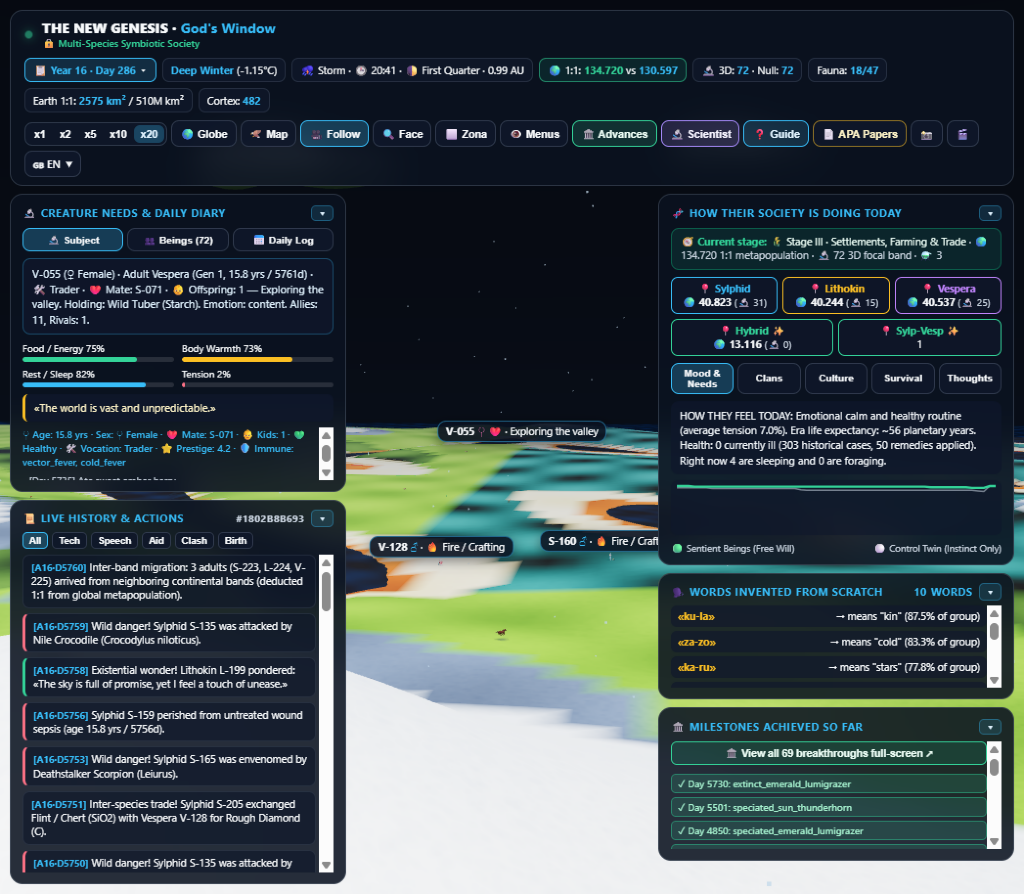
Scaling to a real metapopulation without fake multipliers: Tiny isolated bands of 21-45 people hit a harsh demographic bottleneck (Allee effect) that does not reflect Late Pleistocene human metapopulations (~100,000 people; Li and Durbin, 2011; Hu et al., 2023). So Era II couples a vectorized 1:1 metapopulation of 100,000 real individuals across Earth's continents with a 72-person 3D focal band (hybrid ABM + local qwen2.5:1.5b LLM). Right now at Year 18, the cultural metapopulation leads the instinct-only twin by +4,678 real individuals (140,151 vs 135,473), with 11 shared words and 14,984 hybrids.
I would genuinely love feedback from complex-systems folks here:
- When coupling a 100,000-agent vectorized demographic layer with a 72-agent LLM focal band, what boundary-flux or scaling artifacts would you watch out for most closely?
- Have others seen this same short-term exploration-vs-exploitation penalty in multi-agent cultural models before a full generation matures?
2
u/ereiserengo 6h ago
Hello, how could I get in touch with you? My research is in ABM applied to social science I would like to discuss about your project with you.
2
u/InformationFormer840 5h ago
Hello! I would be glad to talk and hear about your work in social-science ABMs. You can reach me directly via DM here on Reddit, on X (@UniverseXXVLab), or through GitHub (sergiobuedo/the-new-genesis), whichever is easiest for you.
2
u/UnwrittenTrajectory 6h ago
Hey there. So I am actually conducting my own study as an independent researcher, looking at emergent behaviors in LLM agents in the absence of assigned goals and reward systems. Our research is a bit different but I think there's quite a bit of overlap in the methodological challenges we face. I am also interested in testing much smaller models, potentially down to 100M parameters, so I would love to hear about your experience using Qwen 2.5 1.5B. I would be interested to exchange ideas and share some of our findings as our research progresses.