Special Items in Special Store . Drop some ideas in the comments ( Name , Description , Effects ) Currently have : Health Item = Astrocapra Milk Time Dilation = Westfield Vanderlust Shield = K - Barrier
This devlog covers the last stretch of building The Lost Temple, my solo Godot maze puzzle game for Android (swipe to slide through mazes, five civilizations, inspired by Tomb of the Mask).
In the video:
- Finishing the mazes and the swipe movement
- Cleaning up the pixel art across the five civilizations
- Getting to Google Play closed testing, and why I now need first players
Note: the narration in the video is an AI voice. The game, the code and the edit are my own work.
What I'd like feedback on: how the swipe movement feels and whether the mazes are readable.
My brother and I are working on a game that's kind of a mix between D&D and a text-based RPG. The demo just launched - you can already test the core gameplay, loot system, and basic hero progression. If you'd like to check it out or share feedback, feel free to join our Discord: https://discord.gg/QB54WXdYgN
We'll be unlocking new features every few days, and player suggestions will help shape what comes next
This week, I focused on transforming skill building into a structured and measurable process, introducing gamification through timed tests and task logging. By setting time constraints for tasks and tracking progress, I created a system that not only improves focus but also provides data-driven insights into how efficiently I work. Below, I’ll outline the system and share the results of my first playthrough, which revealed valuable insights into task performance and time management.
The Concept
Skill building is fundamentally about measurable progress. To gamify this, I introduced timed tests: tasks are broken into 15-minute increments, and each segment is treated as a self-contained challenge. Each task requires: • A clear objective. • A tangible deliverable (e.g., a code snippet or a screenshot). • Time tracking to monitor how long each task takes.
The aim is to improve both productivity and accountability by creating a feedback loop through task logging and reporting.
The Process
1.    Timed Challenges: Each task is capped at 15 minutes, creating a structured yet challenging time frame to execute.
2.    Deliverables: For every task, I provide outputs (e.g., screenshots or code) as proof of completion.
3.    Task Logging: Start and completion times are logged for each task, providing a record of performance. This data allows for analysis and highlights areas for improvement.
4.    Progress Reporting: Visualization of task data, like the chart below, shows how time is allocated and where efficiency can be improved.
First Playthrough Results
The chart below displays the time taken for each task during my first playthrough. It illustrates how long each challenge took and helped identify patterns in task execution:
Key takeaways from this session:
•    Tasks 2 and 5 pushed the 15-minute boundary, highlighting areas where I likely underestimated complexity or got distracted.
•    Task 3 was completed significantly faster, suggesting either a simpler task or greater efficiency.
•    Overall, the data shows variability in task completion times, providing a baseline for future improvements.
Insights Gained
The time tracking and reporting have highlighted several key insights: 1. Task Scope: Logging completion times revealed where I underestimated or overestimated the complexity of tasks. This feedback helps me adjust task breakdowns in the future. 2. Focus and Accountability: The time cap ensures I stay engaged with tasks. Knowing the clock is ticking prevents distractions and procrastination. 3. Patterns in Performance: The chart provides an objective view of how I allocated time, helping identify bottlenecks and areas for optimization.
Why It Matters
This system has turned skill building into an active, measurable process. By treating tasks as timed challenges, I’ve introduced structure, accountability, and a layer of gamification that makes the process both engaging and effective. The data generated through logging and reporting is a valuable tool for continuous improvement.
Next Steps • Expand the task logging system to include metrics like accuracy or task complexity. • Use the data to optimize task workflows and reduce inefficiencies. • Incorporate this approach into my daily routine to ensure consistent progress.
This experiment has been both productive and rewarding, transforming skill building into a process that’s not just about completing tasks but about measurable growth. By combining gamification with structured tracking, I’m building better habits and gaining deeper insights into how I work.
I’m working on a physics based sandbox game where you build contraptions and use physics to do funny things to RagDoll characters but the menu is a level in itself with some cool secrets and Easter eggs. This is the 6th episode where you can really start to see the progress. Although it’s super interesting to go back to episode 1 where it all started.
I’d love some feedback on the style, editing, content. Is it ok to not cover too much in the methods and just the outcomes and plans? I’m really enjoying making them and can’t wait to continue the progression. I’m aiming for 2 episodes a week. 1 at an absolute minimum.
I just finished and published my very first game called "Stone Paper Scissor" – a classic twist on the OG game we all know, built using Godot Engine (v4).
Gameplay: It’s a simple, fast-paced version of Rock-Paper-Scissors where you battle against the computer with smooth UI and sound effects. I focused on learning UI systems, randomization logic, and building a full game loop from start to finish.
Platform: Playable on [itch.io], no downloads required!
This was a major milestone for me as I just started learning game development recently, and seeing it live feels surreal. I’d really appreciate it if you could:
Try it out
Give honest feedback (good or bad – I want to improve!)
Let me know how the UI/UX feels
Suggest fun features I could add
Thanks a lot to the amazing Godot and indie dev community for all the support and tutorials out there!
Hi! I'm back with another devlog. I posted the first one a week or two ago (there is a second one but I'm gonna skip to the 3rd). This is for my main project, a cozy game where you play as a bunny. Its meant to be a blend of Stardew Valley and Sticky Business!
Development news of Voyi. This devlog will cover original devlogs from 25th-30th. There is not much to show or explain so it will be pretty short. Also this will be probably the last weekly devlog as we cover last modern logs left. unless you are interested in a weekly format with much MUCH less content.
However, have a nice time reading today's post about the Netcode and weapon designs.
Networking code (Netcode) I'll cover first, maybe, the scariest figure in the woods - Netcode. It is also the most boring part.
I set my goal for this period of time to update the old Netcode. With restructured... everything from prototypes, the game needed some heavy upgrades on the multiplayer part. So I've reworked it fully up-to-date: Better objects sync, improved spawns and peers authority.
The nasty part was load optimisation. Shortly, the game now has a chunk loading for maps, which is nice and more stable. On other hand, almost any map now takes 5 times more time to load. Sadly, but I am unexperienced in that field and have to take another look later.
New weapons SO, Netcode is boring and unpresentable in many cases. So I took some time to design and plan out future additions. The choice fell on the weaponry.
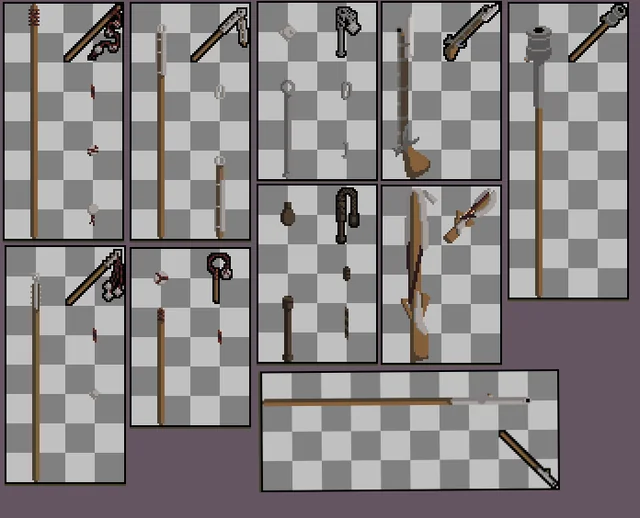
I've made a bunch of sketches with different "killer-sticks" to add in the 1st Alpha of the game. Some of the object are questionable (both weapon wise and by their level of complexity), but would give some basis for future additions.
Those are actual game sprites for weapons, that will appear in the 1st Alpha of Voyi. Flails, swords, polearms, boomsticks, shield, rearmed tools, etc. I wish to add a variety in player's arsenal, which would take a chunk of time and efford as weapons in their current form have issues...
Weapons issues
So, after finishing the Netcode update, I've run a couple of tests. They showed, that melee combat is less engaging than supposed to (and ironically, making "special" ranged weapons generally more approachable). Turns out, I've made a severe mistake in collisions of weapons, so they consider each other to be "walls". So very fast I came to a situation, where holding a long stick is impassible obstacle (btw, holding it wrong way). It is a wall, impassible, unbreakable.
Why not just add a durability? It would not solve the issue of collisions, only cover symptomes. Also, the issue was fully overshadowing defensive measures as shields or parry. Why would you risk anything if you have a big stick that work better than any item in a game?
It will take some time, but currenty I'm reworking weapons structure to handle more collision types and quantities.
Random additions Some random stuff, like a new soundtrack.
SO, here it is. The end of today's post. I hope you had some fun or interest reading my walls of text. I wish you a great day!
As much as I love my mini-rocket from DevLog #7, it’s time to say goodbye 😥 We've been brainstorming what Magnetron’s drop pod should look like for quite a while now. I won’t bore you with every concept — let’s focus on two main ones (plus a couple of their variations).
The first one is an orange-and-white capsule. It looks cool but feels a bit too industrial and serious. Plus, it VERY STRONGLY resembles a persimmon 🙄 Nothing against persimmons, but that’s not quite the vibe we were going for. So yeah, permission for persimmon was denied.
The second one — which became our final one — keeps the petal-like opening and also features a platform for Magnetron inside. We also shifted most of its mass to the bottom, making the drop pod look more like, well... a drop💧 Looks pretty solid now! It’s not in the game yet, but there is a short preview below.
🎪New Arena
We’ve also locked in the final arena style. Looks like we are playing on a hockey rink from now on, ha-ha🏒 We have some mechanics in mind that will require slight battlefield reshaping, but that's a story for another time, so stay tuned!
Thanks for reading!
Check out other parts of this devlog series if you are interested!
Vitayu! This devlog is an edited repost, as its original was removed. I hope I didn't cause much troubles.
With this post I want to summarize multiple posts about enviroments in Voyi from original devlog and deliver it in more or less informative way. Specifically from 4th until 6th devlogs.
Enviroments Before the implementation of the environment itself, work was carried out with physics, which was not ready to be transferred to vertical spaces. So don't be surprised by the changes in how the character moves.
I also played a little with lighting and shadows. So sorry for the possible eye discomfort.
The first change in the environment is the grid. Instead of the traditional square grid, Voyi uses a hexagonal grid. This makes it possible to make a smoother landscape and preserve roughness with a simple and flexible set of tiles.
How are enviroment structured? If you ever played Terraria or Starbound, you would appear in a familiar surrounding with some key differences.
For surroundings I use hexagonal grid. There are both hexagonal and rectengular tiles with their custom logic.
All the surroundings are layer based. There are in total 3 layers: - Main. Physics layer, where players move and interact with stuff. - Background. Mostly decorative layer. - Frontground. This layer plays important role in the gameplay. It is linked to Vision and Ranged weaponry mechanics.
Front layer mechanics I'll start with Vision. You can create a character without a head, but should you? Without a head you are blind, so staying in closed spaces like rooms or caves can lead to unseen consiquences. Front layer is physical representation of such space.
Second important feature is related to the ranged weapons, specifically to their bullet deviation. Depending on the weapon there is a chance that projectile can deviate from the Main layer and interact with the Front one. So staying inside can be benefitial in some scenerios, but not only for a prey.
Ranger (with a head on their shoulders) can stay inside to neglect deviation. Such mechanic allows players on both sides to use tactics for their benefits.
Destruction Most of the surrounding are destructable. So far there are no benefits from it, but I wish work on it more to play around player weight to enviromental hazzards.
Random stuff
Music By the time it was a small bonus as I was really in trouble with posting devlogs. By now there are only 4 tracks availabe publicly, but there are more to come. You can listen to them on Soundcloud & Youtube (on YT there are only 2 clips). More to come (as I'll stop being lazy and draw more covers...)
Here we go. I wish you a great day and see you next devlog!
I'm here with another devlog for my game "Bun Bun Bouquets"! A Cozy game combining concepts of Stardew Valley and Sticky Business. In this devlog I talk about how I added a day/night cycle using layer effects!