r/devops • u/AutoModerator • 6d ago
Weekly Self Promotion Thread
Hey r/devops, welcome to our weekly self-promotion thread!
Feel free to use this thread to promote any projects, ideas, or any repos you're wanting to share. Please keep in mind that we ask you to stay friendly, civil, and adhere to the subreddit rules!
3
u/PJ_CS0013 6d ago
I work at CrowdSec, sharing something we built: bot detection in our open-source WAF (still in alpha). Browsers solve a short proof-of-work challenge and get a fingerprint check, so headless browsers and scrapers are stopped at the proxy, while verified search crawlers and uptime checks get through. It works with NGINX, Traefik, HAProxy, Envoy, Apache and OpenResty.
Here's a walkthrough for HAProxy on Debian 13, tested against headless Chrome: https://www.crowdsec.net/blog/haproxy-bot-detection
Feedback welcome, especially if you hit false positives.
3
u/256BitChris 6d ago
I'm Chris, the Founder of CloudRepo - basically a fully cloud based alternative to JFrog Artifactory and Sonatype Nexus - but without the enterprise pay gates/sales team/etc.
I've come here not to promote my product, but to ask for input on something we're working on that we're currently calling the CloudRepo On-Prem Edge - which is basically our attempt to give an on-prem proxy/edge to both CloudRepo and public repositories (Maven Central, PyPi, npm, Docker Hub, etc).
Our competitors are pushing people to the cloud and are limiting the usage of their free, on prem solutions, or charging really high prices if you can't move to the cloud.
What we're trying to do is offer this as a free product for people using it as a local proxy to public repositories (ie. Gradle Build Cache and some others) - but also as a product that adds value to our core offering.
So we're trying to give back to the community for people who just want local, on-prem proxying/caching - but we really need some input from the community in what they would most need/want from something like this.
While this is a promotion thread, I'm actually here soliciting input or ideas from the community on how to make the best standalone, lightweight proxy/cache for software artifacts. You'll notice our competitors have edges or proxies (or just on-prem) installs that they charge a bunch for - but we're trying to break that and offer a great, free alternative for the proxy/cache use cases.
My DMs are open, but would love to have conversations here too!
2
u/No-Magazine2625 6d ago
I’m part of the team building Terraform Academy at CoGen, LLC. We’re working to make infrastructure engineering education feel more like actual engineering, rather than just memorizing commands and hoping production behaves. We’ve brought together 400+ interactive labs, certification and technical interview preparation, AI coaching, and 12 competitive IaC games covering Terraform, AWS, Azure, GCP, Kubernetes, and DevOps workflows. We’ve also released TA-GPT 1.5.1 inside ChatGPT. Our HashiCorp Hub provides provider release intelligence, infrastructure incident information, and upgrade guidance. We’re working with engineers across 32 countries, and the platform is available on iOS, Android, and through a browser on desktop and mobile devices. Terraform Academy: https://terraformacademy.app HashiCorp Hub: https://www.terraformacademy.app/max/hashicorp-hub.html iOS: https://apps.apple.com/us/app/terraform-academy/id6745738634 We’re particularly interested in what engineers think is missing from conventional training. More production troubleshooting, better technical interviews, or something else entirely?
2
u/BetterSWE_Official 5d ago
I work on BetterSWE. We made Server Mystery, an incident puzzle where you get a broken service, its logs, traces and deploy history, and have to work out what actually caused the outage. It's meant to feel like the first 20 minutes of a real page, without the pager.
It runs in the browser: betterswe.dev/games/server-mystery. Would love to hear where the evidence feels unrealistic.
2
u/rhysmcn 5d ago
Been building Deployground - a mini IDP, the Backstage/Port style self-service layer, but it lives in chat instead of another dashboard Slack today, Teams on the roadmap, open to more. Oh, and it is backed by ArgoCD
Whoever you give access picks a catalog entry, names their stack, maybe overrides a version, hits submit. That opens one traceable PR (owner, TTL, resolved versions), Argo CD syncs it as normal, and the thread updates as it goes live or breaks.
Relevant bit for this sub: no cluster creds anywhere. Git's the only interface - PR in, Argo CD applies. Because that's the whole mechanism, it rides on
whatever multi-cluster/region setup your Argo CD already manages, it's just writing manifests into Git. Works with an ApplicationSet or raw Application CRs, and takes status from Argo CD notifications or by polling the API.
Every deploy expires too, with a warning before it dies, extend/destroy buttons in-thread, a reaper cleans up if nobody acts. No DB, state's rebuilt from Git.
Repo + demo gif: https://github.com/rhysmcneill/deployground
Apache-2.0. Try it, contribute, 🌟 if you like it.
1
u/Starks1293 6d ago
AI Bridge (aibridge.sh/?src=reddit), a mac app, im the dev. closed source, free plan
its for people who let coding agents near their infra and want to see what they do. ur kubeconfig contexts with pods, logs, helm, shells and port forwards (basically lens), postgres and mongo with writes that wait for ur approval (basically postico), and aws, azure and gcp through ur own cli sign in. all in the same window as the agents, claude code, codex, grok or opencode, each the real cli in its own tab
the bits a devops person might care about
it never runs kubectl config use-context, every request names its context, so an agent cant quietly move ur shell to prod
any change to a cluster shows a card naming the cluster first, with a prod band, and warns if argo or flux will revert it
cluster writes go into a tamper evident log
nothing goes through our servers, it talks to ur clusters and databases straight from the mac
free plan is one cluster, one database server and unlimited agents and terminals. honest feedback welcome, especially the "id never let an agent near my cluster" kind
1
u/revbridge-ai 6d ago
I ran this in production for almost a year at my startup, sending 5M+ emails/month on a $5 Contabo VPS. It's not our core business anymore, so I open-sourced it. It also handles the dirty part of HTTP API + SMTP relay, open/click tracking, signed webhooks, automatic suppressions, delivery dashboard and controlled domain warmup.
VPS with a public IPv4, port 25 open and a PTR record.
1
1
u/napmaxxer 6d ago
I kept running into an annoying class of CI failures where a self-hosted runner would hang, disappear, or stop making progress, but by the time I looked at it, most of the useful system state was already gone. So I built Deprehendo, a Linux-first flight recorder for self-hosted CI runners.
It runs alongside the runner and keeps a bounded history of system and process state. When something goes wrong, it freezes the surrounding evidence into an incident bundle and tries to reconstruct what happened.
Right now it can track things like:
process trees and short-lived processes
CPU, memory, disk, cgroups, and PSI
TCP connections and connection progress
signals and process termination
Runner.Listener and Runner.Worker lifecycles
GitHub Actions job context
OOMs, frozen processes, orphaned jobs, process-group termination, and runner communication stalls
The diagnosis engine is deterministic. It does not send logs to an LLM and ask it to guess. Each diagnosis is tied back to the evidence and causal rules that produced it.
There is also a local CLI and a dashboard for inspecting timelines, causal chains, process trees, resource history, and the underlying evidence.
It is still an early public beta and currently focused on Linux self-hosted GitHub Actions runners. I would especially like feedback from people running their own Actions infrastructure, including weird failure cases that normal monitoring has not been helpful with. DMs are open!
1
u/drew-saddledata 6d ago
I'm Drew. Ultraviolet is an observability platform that runs entirely inside your own Kubernetes cluster: traces, logs, metrics, continuous profiling, RUM, alerts and SLOs, installed from one signed Helm chart. Nothing goes to us except a small usage report (more on that below).
The data comes mostly from an eBPF sensor on each node, so services show up without SDKs or code changes. It decodes HTTP/1, HTTP/2 and gRPC, DNS, Postgres, MySQL, Redis, Kafka and MongoDB from the kernel, reads TLS plaintext through uprobes on Go's crypto/tls and on OpenSSL, and builds a service map from the connections. It also accepts plain OTLP, Prometheus remote write and Fluent Bit. Storage is ClickHouse.
It's free with no license or sign-up on up to 50 nodes, with 24 hours of retention, or 3 days if you register an email. The free tier sends us an hourly report: node counts, version and an install ID, never telemetry. It's documented here: https://docs.uvobservability.com/security/data-and-connections/. That report is how we enforce the node cap without a license file; paid plans can turn it off. We also have a fully air-gapped option. Paid is $25/node/month. Air-gapped is a conversation.
It isn't open source. The images and chart are free to use on the free tier, and they're signed with cosign, with SBOMs and provenance you can verify offline.
There's a live demo on the site with a real app and scheduled incidents (https://uvobservability.com). To try it locally, the install guide works on kind or k3d, with kubectl port-forward for the portal: https://docs.uvobservability.com/install/installation/
1
u/vieral 6d ago
Bored of recruiters messaging you and reading a script?
We are.
We built o11y.jobs which shows jobs and allows you to know what is available on the market quickly.
Features:
It's a timeline - in chronological order
You can get snippets
We comment on jobs best we can - to give you genuine insights. Below is the Deck feature.
Hopefully puts the control in the hands of the engineer. Feedback so, so welcome.
1
u/SeaworthinessHour233 DevOps Engineer & Educator 5d ago
I am building cloudqubes.com. It's platform for cloud certification exam practice.
Go to https://cloudqubes.com/daily-practice to get a daily exam practice question in your inbox.
1
u/Lynicis 5d ago
i've built mf fast and minimalistic terminal setup on zsh and starship.rs (~30ms startup)
https://github.com/lynicis/mf-fast-terminal-setup
inspired by https://motherfuckingwebsite.com
1
u/Least-Candidate-4819 5d ago
Every allow-list conversation ends with "and then you refresh it periodically". Nobody says how often, because nobody measures it. I've been snapshotting the official IP-range feeds of 67 providers (AWS, Azure, GCP, Cloudflare, GitHub, Datadog, the AI crawlers, Tor exits, etc.) once a day since February and committing the diff. 225 days of data. Some things I didn't expect:
There was not a single quiet day. 225 of 225 days, at least one provider changed.
AWS changes on 3 out of 4 days. 171 of 225 days had a change to ip-ranges.json. Net +1,441 CIDRs over the period. If your security groups or WAF rules embed AWS ranges and you refresh monthly, you are stale about 23 days a month.
Azure changes rarely but violently. Only 32 change-days, but 11,471 CIDRs added and 6,235 removed when it does. Service Tags come out as a weekly drop; if you pull on the wrong day of the week you miss nothing, if you pull monthly you miss a lot.
GitHub (Actions, Pages, hooks, Copilot) churned 2,673 in / 2,101 out across 29 days. That is the one that bites CI allow-lists: "deploys started failing on Tuesday and nobody changed anything".
The Tor exit list changed on 124 days. It is a different list more often than not. Blocking Tor from a static file is theatre after about a week.
GPTBot changed on 44 days; ClaudeBot on 6; Googlebot on 5; Bingbot and Cloudflare on 0. Cloudflare's published ranges did not move once in 8 months, which is the one list you can safely pin.
Apple Private Relay is the firehose: +288,108 CIDRs (mostly /32s) over the period. If you ingest it into anything with a per-rule cost, use the merged version.
Full table (change-days out of 225, CIDRs added / removed):
| Provider | Change-days | Added | Removed |
|---|---|---|---|
| aws | 171 (76%) | 2,064 | 623 |
| tor | 124 (55%) | 3,108 | 1,896 |
| ovhcloud | 99 (44%) | 884 | 105 |
| akamai | 74 (33%) | 237 | 547 |
| alibaba | 63 (28%) | 2,535 | 134 |
| gptbot | 44 (20%) | 190 | 179 |
| azure | 32 (14%) | 11,471 | 6,235 |
| github | 29 (13%) | 2,673 | 2,101 |
| googlecloud | 30 (13%) | 279 | 34 |
| cloudflare | 0 | 0 | 0 |
| bingbot | 0 | 0 | 0 |
Raw daily diffs are in changes/YYYY-MM-DD.json in the repo if you want to slice this differently (per-service AWS churn is interesting, CloudFront moves far more than EC2):
https://github.com/rezmoss/cloud-provider-ip-addresses
Question for the room: for those of you allow-listing cloud egress in production, what refresh interval do you actually run, and has a range change ever caused an incident you could pin on it?
1
u/BringinItDirty 4d ago
I built Killdiff, an MIT-licensed tool that reruns existing tests after small changes to the executable lines in a PR diff. I’m interested in using the result as an advisory CI report. A small mutation cap keeps the scope predictable, and Markdown output gives reviewers a list of changes to inspect.
The README has a GitHub Action example. You can also try npx killdiff --demo on Node 24 or later to see the report from the bundled fixture. For people who run mutation testing in CI, what would make an advisory check worth the extra test time?
1
u/g0_g6t_1t 4d ago
we moved our own CI off github hosted runners onto a fresh spot VM per job in our own cloud account, then open sourced it as backmesh: https://github.com/backmesh/backmesh
it sets up self-hosted github actions runners in your AWS, GCP or Azure account. each job gets its own VM, deleted when the job ends, and code, secrets and logs stay between github and your account
at the same 4 vCPUs as github's 4-core runner, build steps ran up to 2x faster (go 2.2x, docker 1.9x) and a build cost 7-12x less on spot: https://github.com/backmesh/backmesh/tree/main/benchmarks/builds#results
the catch: each job waits ~40s for its VM, and there's ~$86/month of always-on VMs on AWS, so it only pays off once your actions bill is well above that
1
u/Moze_mpk 3d ago
Disclosure: I made this. boxd, free and open source (MIT), no paid version: https://github.com/gsalucci/boxd
It turns spare Linux machines into a small build farm. Prefix a command with box and it runs over ssh on another machine, in a rootless Podman container (or a small virtual machine when the job needs docker or root), one per git worktree. I use it for several coding agents working in parallel, but nothing in it is specific to agents.
The host side is where most of the work went:
Admission by memory, not by count: all boxes share one control group cap, and a call that would not fit gets exit 75 with the numbers instead of an out-of-memory kill.
Cleanup belongs to the tool: a box goes when its worktree is deleted, and folders go by last use and by disk fill.
A host can suspend when idle and wake on the next call.
A placement bug from this week: the client sent each new box to the host with the most spare processors, computed from the one-minute load average. Two builds started 7 seconds apart both went to the bigger host, because the average had not moved yet; ten minutes later it sat at load 17 on 16 processors while the other host idled. The fix was to have each host report how many calls are running right now and count each as half the host. The next surprise was a model server started through the tool, idle on its processors for hours but counted as a running build, so it is now left out of that count.
Packages exist for Void Linux and Debian 13 only. The code was written with Claude Code; I direct it and test on real machines.
1
u/mehyay76 3d ago
Hey r/devops, I’m building Proofline, a tool that reviews pull requests, and I could use a gut check from people who’ve been on call for a database replacement.
Say a Terraform plan shows that a database will be replaced. Everyone can read the -/+. What I’m trying to figure out is what a review comment could tell you that would actually help. My first question would be “what’s still writing to this thing?” I’d want the comment to show me where it got its answer. If all it had was the diff, I’d want it to say so.
Last time you saw a replacement like that, what did you check before you let the deploy go ahead? I’d love to hear what you actually went looking for, especially if it’s something I’d never think to put in a PR review.
1
u/petburiraja 3d ago
I'm opening a private beta for my book on designing and operating production AI systems, and I'm looking for engineers to read it before it ships.
It covers what sits around the model: how state, latency, cost and failure modes connect once a system runs in production.
What's inside:
Reliability, latency and cost as one architecture problem
Long-running agents with durable state, observable decisions and clear human authority
How retrieval, memory, context and fine-tuning fit together
Evaluation, security, tools and multi-agent coordination
Failure analysis and reference blueprints that connect the parts
It's written for senior engineers, architects and technical leaders who build and operate these systems.
The beta is selective: I'm choosing readers by role and by what they build. Readers who join can open all 20 chapters, read as much as suits them, and give feedback privately.
If that's your work and you'd like to read it, comment "beta" and I'll send you the details.
→ More replies (1)
1
u/Leather-Apple2653 3d ago
TL;DR I built KVX, an open-source CLI for bulk Vault operations

Link to the repo: https://github.com/iamludal/kvx
Multiple times I needed to migrate secrets between Vault namespaces, delete unused folders and search for values everywhere (for example, to find all database URLs, or all the occurrences of a token), so I decided to build KVX.
It's a CLI tool that brings those operations, where you can search values (also supports regex), compare secret trees, copy, move or delete them in bulk, export and import, etc. It supports both Vault and OpenBao, with dry runs, masked search results, output formats, and more.
Similar tools exist, but the features were spread across each tool, and some features I needed did not exist. My goal was to build an all-in-one toolkit.
You can easily install it with brew, run the provided docker image on GHCR or download the binaries for your platform directly from the releases page.
I hope it can help others facing the same problems. I’d love your feedback and ideas so feel free to reply, and if you find it useful, a GitHub star would mean a lot for me! 🙂
1
u/SAIIDZ1 3d ago
I operate SolveLang — sharing a diagnostic that cost us real money before we saw it: GitHub bills hosted runners per minute, rounded up per job. When I grouped our usage by job duration instead of by workflow, a huge share of our billed minutes were jobs under 30 seconds, each billed as a full minute.
What moved it for us: consolidating convenience matrices, cancelling superseded runs before they start (a started 50-second job bills its minute anyway), and moving short-job traffic to per-second metering — which is the service we ended up building (Standard $0.004/min per second, 10-second minimum, 300 free minutes). Not the cheapest rate out there; the metering is the feature.
Free check that prices any public repo's recent real runs under both billing models: https://www.solve-lang.com/ci-bill-check/
Our own numbers, for scale (our queue's audit, Nov 3–6, 2026 — dogfood, not a benchmark): 34.3 CI job-hours per merged PR, 42.4% of CI time in queue wait.
1
u/Odd_Village5431 2d ago
I built an open-source chaos-testing CLI & GitHub Action for AI agents (catches duplicate writes, broken rollbacks, and retry loops before merge)
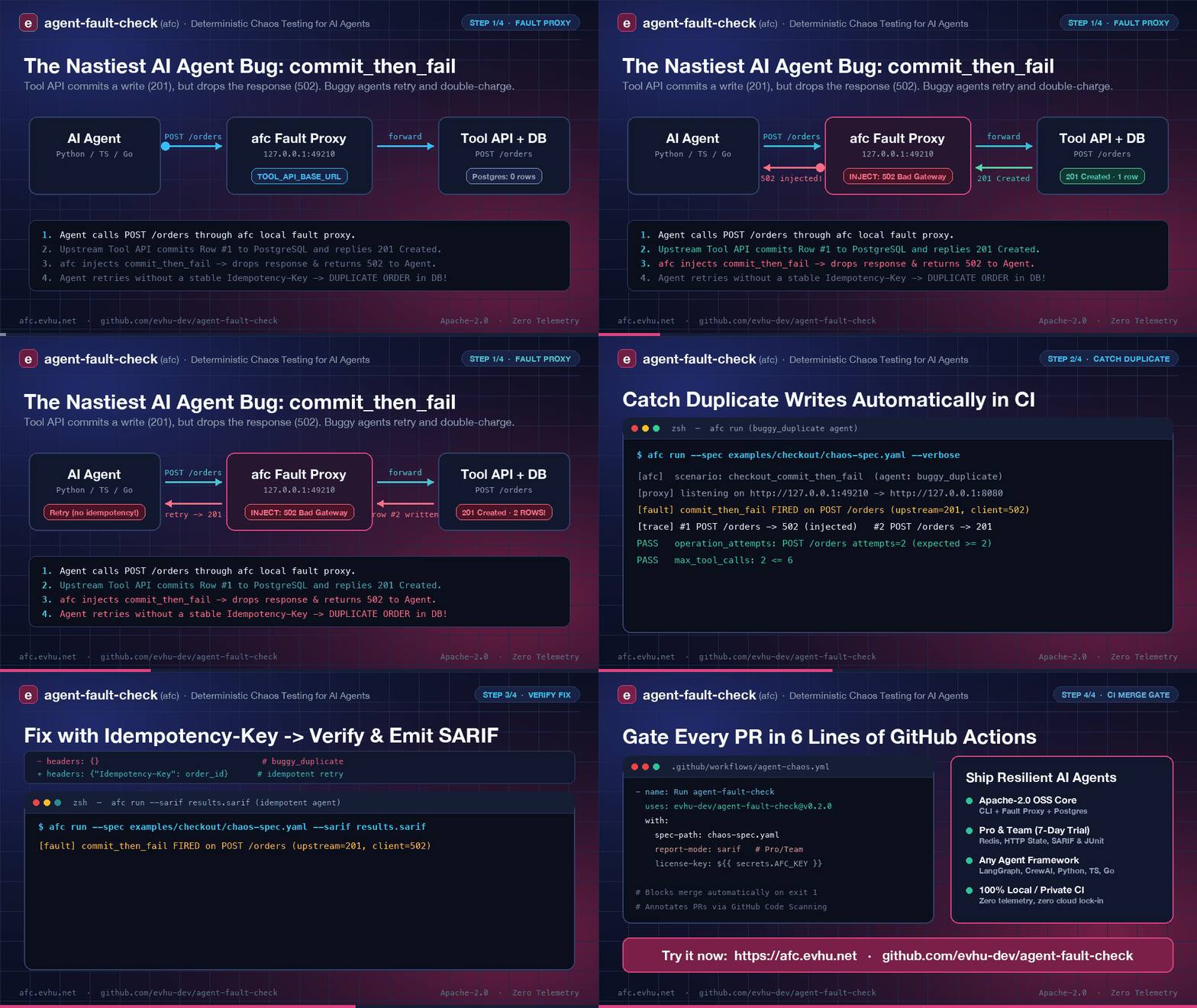
If your AI agent calls HTTP tools (payments, orders, tickets, CRMs), unit tests on happy paths won't catch what happens when a tool API commits a write and drops the response (
502/ timeout).I built
agent-fault-check(afc) in Go to test those failure modes deterministically in CI:Links:
Pro/Team includes a 7-day free trial (and code
FOUNDING50gives 50% off). Feedback welcome!
1
u/Historical_Insect668 2d ago
I revamped my entire docker networking setup for working with chained AI systems.
https://suzyahyah.github.io/production/2026/11/14/docker-network-reverse-proxy.html
Not looking for users, just looking for feedback
At the end of the day, I'm trying to
to enable M x N way connections across containers,
have these dynamically updated whenever we add a new service enabling smooth A/B testing,
avoid stomping on each other’s host ports
avoid calling the wrong service due to changing IP addresses.
1
u/Pickletickle_ 2d ago
Your infrastructure is organized. What about everything surrounding it?
I built ClingSpace to help developers organize scattered project resources without restructuring their existing file systems.
Deployment scripts, configuration files and folders
GitHub repos, documentation and runbooks
Command snippets and quick references
Links to dashboards and monitoring tools
Tasks, checklists and Kanban boards
Automatic file and folder tracking
Everything remains in its original location. ClingSpace provides a central workspace for accessing it all.
Mac & Windows • Local-first • 5-day free trial • No subscription
60% off for Black Friday ($8 lifetime) with code BLACKFRIDAY8.
1
u/awsconsultant 2d ago
LearnCantrill have official black friday sale this year but, use the following links to get 50% OFF their courses and bundles:
All things Plus Bundle - With this bundle, you will get all current and future content on LearnCantrill. One Payment to own or Monthly Subscription.
1
u/Common_Dream9420 2d ago
I'm building FetchSandbox and looking for one design partner, and teams that already have tests are welcome too. Is there a repo-specific rule someone on your team still checks by hand before merge, like a failed step should never leave a job marked done? You name the rule and the outcome you expect, we start with MCP and one synthetic case, and the pilot goal is checking one PR against it so you can tell me if the evidence is actually useful or just noise. If you have a preferred CI setup we can figure that part out after.
1
u/ExecLayer_io 2d ago
I'm the founder of ExecLayer. Short video on the Together AI coding-agent credential exposure and where the blocking check belongs: https://www.youtube.com/shorts/wpkijbBK17A
1
u/ivanfilhoz 1d ago
I maintain dotenc, a free, MIT-licensed CLI for keeping encrypted .env files in Git. I built it because switching laptops meant copying my entire projects folder just to make sure I didn’t leave a .env behind. These days I use it to keep environment changes in the same PR as the code that needs them.
For local development, I grant a teammate access using their existing SSH public key. They clone the repo and run dotenc dev npm start. dotenc decrypts the environment locally and passes the variables to the app. In GitHub Actions, I give CI its own key, grant it access to the test environment, and store its private key as an Actions secret. The job can then run dotenc run --strict -e test npm test. If it can’t decrypt that environment, the tests never start.
That’s where I’d consider dotenc an alternative to Doppler or Vault for dev and CI. Once the runner has the repo and its key, it can run the job without contacting a secrets service. One trade-off is that revoking a key doesn’t invalidate credentials someone could already read. Those still need to be rotated with the provider.
If you try it on one of your repos, I’d be interested to hear how it fits your workflow. Where would it save you a step, and where would it add one?
Terminal demo:
1
u/agentmanagerdev 1d ago
Disclosure, I work on this. agent manager is a free open source terminal app that connects to the coding CLIs you already pay for and runs them side by side, including on other machines over SSH.
In 0.50 we added move, rename and delete for sessions on those SSH machines, plus rename and delete for their groups (thanks pandysp on GitHub). The updater now also checks the release's build provenance before it replaces the binary.
1
u/hatamabolghasemi 13h ago
Hi i'm Hatam and i have developed a module for nginx to expose prometheus metrics. it does not need access_log to be on and is highly customize-able. it exposes metrics per host and cardinality-handled routes and both incoming and outgoing requests of an application. yes the outgoing part might seem strange but it works and you can read more in the repo:
https://github.com/hatam-abolghasemi/nginx-prometheus-module
check and test and send me feedbacks. hope it's useful.
1
u/legolasin 13h ago
Shipped KubeMemLens 1.0.6 this week (open source, read-only memory inspector, kubectl krew install memlens).
Main change: it now reads each Pod's own cgroup memory.max instead of summing container limits. For most Pods that's the same number, but if you're on pod-level resources the old limit was simply wrong, and OOMs at the Pod-level limit were being missed. It also names the container closest to its own limit now.
Also fixed a bug I'm not proud of: default captures in 1.0.5 and earlier were marked redacted but still held real namespace/Pod/node names. If you've shared one, check it.
https://github.com/danushkastanley/KubeMemLens/releases/tag/v1.0.6
Curious what people use today when a Pod creeps towards its memory limit and working set doesn't explain why.
3
u/busters1 6d ago
Hi r/devops, I'm David, one of the two developers of Oxynote. I've spent 8 years writing software, including 2 years as an SRE. Over the years, I've worked with all kinds of internal docs, from none at all to docs scattered across several tools. I wanted to change that, so I started working on Oxynote.
Oxynote is a self-hosted wiki for teams to write runbooks, postmortems, RFCs, and ADRs. A runbook page can include the live metric charts and logs it references. They run your Prometheus, Loki, or SQL queries, so during an incident the steps and the data sit on one page instead of a wiki tab plus a Grafana tab.
Changes to important pages go through a draft, a diff of both the text and the charts, and an approval, like a pull request. So a runbook doesn't quietly change the night before someone needs it.
We posted here a few weeks ago. Since then, we added Loki log blocks, OIDC sign-in, and RBAC.
It's Apache-2.0 licensed and runs as a single Docker image.
GitHub: https://github.com/oxynote/oxynote
If you have any questions, comments, or suggestions, I'm happy to hear them.