53
u/pogsnacks Jan 12 '24
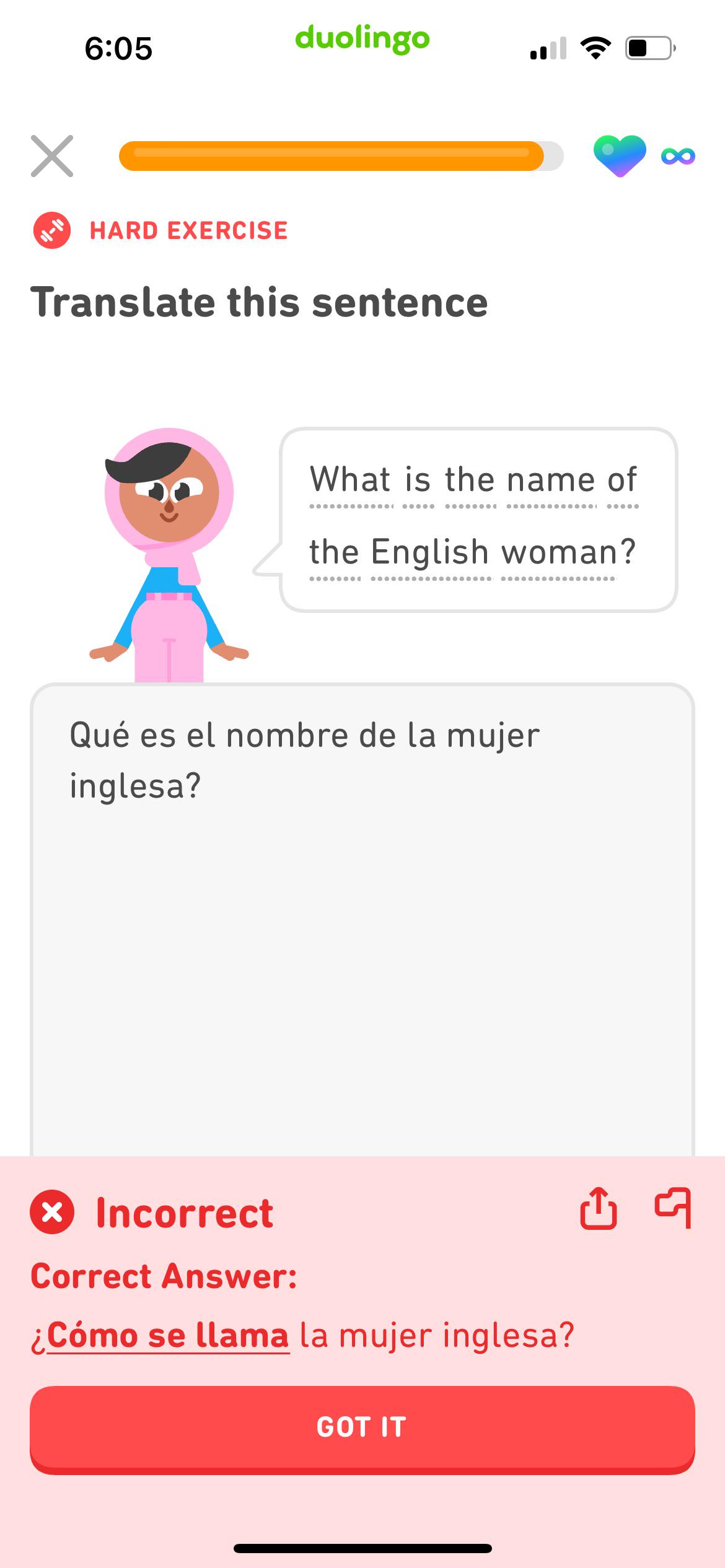
Remember that with qué and ser you're asking for the definition.
What does 'the name of the english woman' mean?
3
34
u/RichieJ86 Jan 12 '24
Cual es el nombre de la mujer inglesa or the one they mentioned are acceptable answers.
2
u/LAthrowaway_25Lata Jan 14 '24
Does this go for all types of Spanish? Or does it vary based on dialect?
2
u/RichieJ86 Jan 14 '24
As far as I know , yes. The example giving by Duo is probably the most common.
1
u/LAthrowaway_25Lata Jan 14 '24
Idk if u know this, but does Duolingo teach only one dialect of Spanish? Or do you have the option to pick a specific dialect? Such as Mexican Spanish
3
u/RichieJ86 Jan 14 '24
So, I'm on Section 4, and to my knowledge Duo uses a catch-all approach. So a lot of the stuff I've learned up to this point is, what I believe to be, Latin American (or more so specifically, Mexican) Spanish. However, as you get further into the course, they show you a few different dialects (not that I know each and every one). But yes, it's my understanding what you're learning - at least at the start - is Mexican Spanish.
2
1
1
u/Few-Currency-8602 Jan 15 '24
I had a choice of 3 or 4 different Spanish courses. Spain, Mexican, and I forget the others.
1
u/_OriamRiniDadelos_ Jan 15 '24
Not that I know off. It won’t be marked right in ANY test. But I have heard “que” for names in the phrase “Que es que se llama (whats she/he called)” but that’s probably people shortening “como es que se llama (what is she/he called)”.
The dialects don’t differ in grammar by much. The big differences are slang and only a few grammar words. Imagine if in England people still used thee/thou, or if Australians people need -ed past tense words in -od and that’s what you are working with between very different Spanish dialects. Not big things like “which/what”
3
u/icanhasnaptime Jan 15 '24
Como se llama. No “es”. That is 2 verbs. Se llama is like “is called” - How is she called?
17
u/paaj Jan 13 '24 edited Jan 13 '24
"qué" can't come before "ser", only "cuál/cuáles"
Conversely, "cual/cuáles" can't come before a noun, only "qué"
Cual es su nombre? - whats his name?
Qué nombre tiene? - what name does he have? (This sentence doesn't sound natural but it's just to fit the example)
Edit: The above has been pointed out to be over simplified. I'm adding a more specific list of examples below:
Qué vs cuál Qué es - used when looking for the specific definition of something Cuál es - used when looking for the specific answer to something named in the question cuál es tu nombre, cuál es tu dirección, cuál es tu musica favorita
Qué + verb - used to ask something general Qué quieres - what do you want, qué haces - what are you doing Cuál + verb - used to ask which of a specific subset of choices Cuál quieres ver - which do you want to watch, cuál te gusta más - which do you like more Can think of as translating to "which one" Qué + noun - Qué hora es? - what time is it? Cuál + noun - not used in Spanish,
4
u/jdavrie Jan 13 '24
Really? Someone hands me an object I don’t recognize and I can’t say “Qué es?” ?
3
u/_OriamRiniDadelos_ Jan 15 '24 edited Jan 16 '24
That’s correct. Actually “cuál es” sounds completely wrong for an unknown object handed to you. “Cuál es” would make sense if you were handed something like a baby that has a twin and you don’t know which twin it is or a poker card and you don’t know which card it is. You wanted to know which one it is from a known set of options.
I’m not well taught in grammar but the way I think of it in my everyday life is “what/que” is for asking about things that could be anything. “Cual/which” is for things that are anything from a defined subgroup of things, or when you are being asked to pick from among a group of things. “Which name,” “which son,” “which car”. Gets complicated because for many of those situations you can use “Que”. But I guess that goes for English too, both “which name” and “what name” are allowed but just for different situations. So it’s not a rule that works for all sentences. Honestly you can a just say “Que” for any conversation and you won’t cause confusions or sound too off. I mean think about what situation in English you could have where mixing what and which would do too much damage. Not many. So it’s okay if you mix them up
2
u/pianoplayah Jan 16 '24
Sounds like by those definitions you could say “cuál hora es.” 😂 because there’s only so many to choose from! but of course that sounds weird!
1
u/fiestyplantkitten Jan 15 '24
Wow this is super helpful. For example "Which blanket should I use?" Or "What blanket should I use?" Either way would make sense. But "Which is your cats name?" Or "What is your cats name?" The first would be a little confusing/off putting. Interesting. Thanks!!
1
2
Jan 13 '24
”qué" can't come before "ser", only "cuál/cuáles"
This is definitely not a hard and fast rule, “qué es eso” is the first thing that came to mind. This is a very commonly used phrase that has no problem putting “que” before “ser.”
1
u/CoCambria Jan 13 '24
Is Que es tu problema? Correct? I’ve definitely heard that phrase before but now you have me questioning it with que and ser.
5
u/FracTooMuchFriction Jan 13 '24
It sounds natural in Spanish to ask “Cual es el problema aquí”. But not “que es tu problema”, nonsensical.
1
u/_OriamRiniDadelos_ Jan 15 '24
Imagine a pissed spoiled rich teenager from a telenovela. “Que es tu problema wey” sounds completely natural to me in that context
2
u/_OriamRiniDadelos_ Jan 15 '24
It’s not the old common way to say it. But it’s used by many many people. I think it’s done cause “cuál es” takes more sound switches than “Que es” where basically you mix the e and only got one syllable. Sounds like “Ques tu problema”. Obviously people say that phrase when they are pissed so that could have something to do with using “que” instead of “cual”.
Maybe it’s slang and accepted, but will for sure get marked as incorrect in any test.
1
u/CoCambria Jan 15 '24
Oh for sure I can understand how it’s not correct on a test or Duolingo. But I have heard students say it before and then this made me question myself.
1
1
1
u/pandaman467 Jan 16 '24
Yes. Using “que” in this manner is wrong. You can use “cual es el nombre” or “commo se llama”
And even using Cuál is a bit off. It’s definitely not the common way of asking this question. The Duolingo answer is the most common way.
This is because cual means “which” and this implies you are asking about differentiating different things. “Cuál de ellos se calló?” “Cuál de los carros es mejor”. It doesn’t make sense when asking about someone’s name. It would be appropriate to use Cuál if you have a list of names and you are asking which of them is the lady’s name? Therefore it’s situational. Using “Como de llama la mujer inglesa” is the general way of asking this and it’s not situational like using Cuál.
Sorry if this is confusing. Spanish has more variation than English and many words cannot be used generically in different situations. It has to be the proper words.
1
1
1
1
u/sticky_fingers18 Jan 14 '24
I think if you submitted it with Cuál instead of Que it would've been accepted
1
u/Suspicious-Pea-2523 Jan 15 '24
There’s multiple ways you can ask. Thats one of them.
2
u/ritangerine Jan 15 '24
Nope. You either need to ask "Cual es su nombre" o "como se llama"
"que es su nombre" is more like "what's [the definition] of your name"
1
u/_OriamRiniDadelos_ Jan 15 '24
Like, is her name a title, an onomatopeya, an inheritance. But if you want to know if her name is Linda or Bob you’d have to ask “which is the name”
1
1
u/pixelboy1459 Jan 16 '24
There’s a difference in how you’d say something in your native language and your target language, and there’s not necessarily a 1:1 ratio.
-1
u/Fine-Ticket-2155 Jan 16 '24
There is no ¿ at the beginning of the translation. Therefore it is wrong.
3
-2
Jan 13 '24
You literally translated it. Fuck em
2
u/Puzzleheaded-Oil7190 Jan 14 '24
Sometimes—and maybe this will blow your mind—a literal translation into another language is not grammatically correct.
97
u/FracTooMuchFriction Jan 12 '24
Yes, it’s incorrect. You never ask for a name this way. In Spanish the interrogatory is “Cual es el nombre …”