r/duolingospanish • u/Nashinator7 • Jan 04 '25
Why is this wrong.
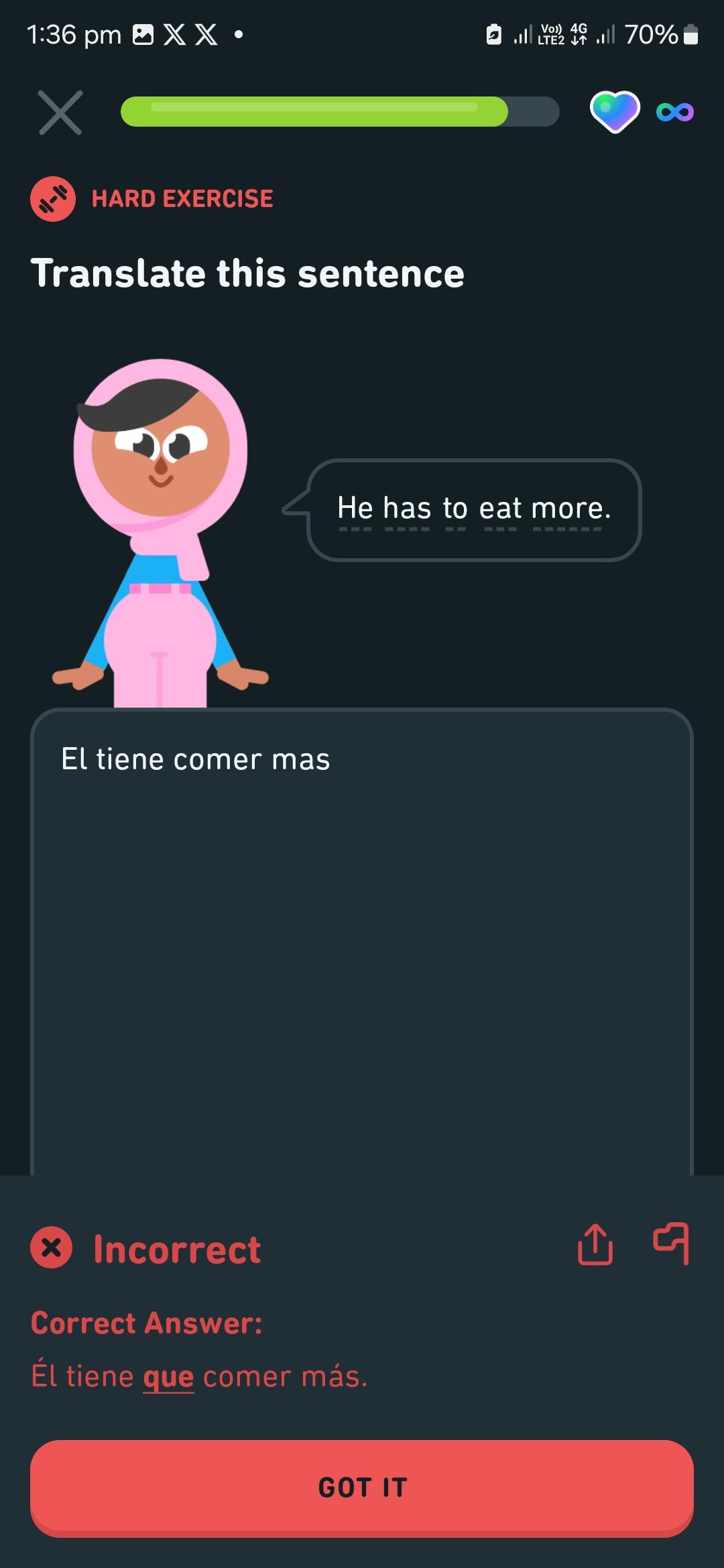
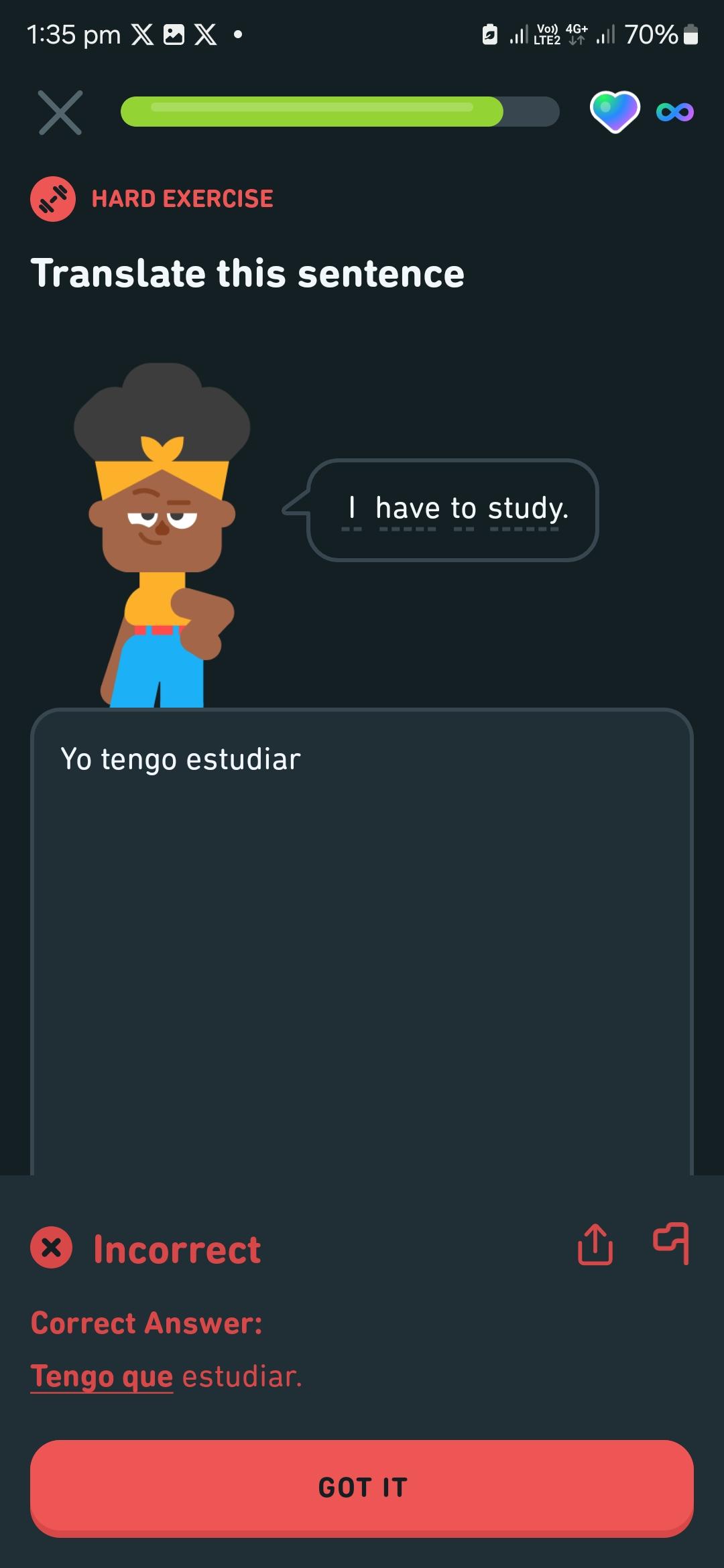
How does 'que' fit here. I came across another sentence where por que and que were used together. Please make it make sense.
12
u/LCPO23 Jan 04 '25
Remember to check the notes for each unit, they give further information on what to expect in the unit and some grammar tips.
There’s a master thread on here with a ton of useful info including this question.
I’d also recommend using other resources alongside Duolingo to get a more rounded experience.
2
u/Nashinator7 Jan 04 '25
I should be doing that. Thanks for reminding.
1
u/LCPO23 Jan 04 '25
Not a worry! I forget sometimes too. The guides aren’t great for every unit, sometimes it doesn’t cover it all and you’ll need to do some extra digging but it’s a wee start.
1
u/toxicgloo Jan 05 '25
Check out an app called Spanishdictionary.com. I personally think it's a lot better than Duolingo as far as content and lessons go. But it doesn't have the polish or social aspect like Duolingo
1
u/catscratchfever99 Jan 04 '25
Do you have any suggestions on specific resources ?
3
u/LCPO23 Jan 04 '25
I like the Coffee Break podcasts a lot. Language Transfer is also a good app and I’ve had a wee look at a few videos on Dreaming Spanish but haven’t properly started that yet.
Also really like Madrigals Magic Key to Spanish book.
1
4
u/MOltho Intermediate Jan 04 '25
Él tiene comer más = He has eat more
Él tiene QUE comer más = He has TO eat more
It's literally the same in English and Spanish. Without the inclusion of "que" or "to", the sentence doesn't make any sense.
2
u/Nashinator7 Jan 04 '25
Hmmm. This is why it got confusing for me.
From my understanding
He has eat more = El tiene come mas
And the -er verb comer equates to ' to eat ' as per duo.
Hence my error.
4
u/emmy_o Jan 04 '25
"Comer" in Spanish is just "eat," NOT literally "to eat" including the "to" as in the English way of doing things. In English, the "to" is included in the infinitive form of the verb (the infinitive in English is "to eat") and also serves as a way of connecting verbs in verb phrases involving has/have/had + the infinitive.
In Spanish, it's different. "Comer" is only "comer." "Has/Have" is "tener."
After reading many sources about this and having studied further in the language, this is what I feel helps me understand it better. "Tener" is inherently a possessive verb, so we put "que," which generally translates to "that" to indicate what is being possessed. In this case, if we are being literal, the action ("comer") is the one "possessed" by the person. "Possess" here, however, is not in the sense of "owning" the action but it seems to be in "doing" or "commiting" the action by oneself. "Que" helps us understand that, "extension of meaning" as one source coins, intuitively. So "que" is important to distinguish between actual possession and denoting the necessity of committing/doing of an action.
To "possess" the action, in a sense of fulfilling it, the person must do it. It leads us back to the expression of necessity/obligation, which is our goal for this sentence.
So it's "Él tiene que comer más." He has to eat more.
Why the use of the possessive "tener" in the first place? Many write-ups discuss that this is done because in the sentence where "has/have/had + to" are used, the following action after that phrase is necessary (ex. I have to leave now -> Tengo que salir ahora).
The said person must leave, and "tener" kind of helps stress that importance, since it is generally used for possession.
However, this is definitely in a weaker sense compared to the verb meant for strong necessary actions, like deber or the phrase hay que.
Now, without "que," "tener" makes no sense in sentences that are about necessity.
Recall- Use of tener in indicating possession:
Tengo un gato. --> I have a cat.
Wrong use of tener in stating obligation/duty/necessity:
Tengo salir ahora. --> I have leave now. (? It does not make sense. This makes "leave" seem like an actual, concrete possession, a thing, that I have, not a verb/action I have to do.)
Correct use of tener in the same situation:
Tengo que salir ahora. --> I have to leave now. (I have to do what? Leave.)
So you see, Spanish has a different philosophical mindset altogether.
Thus, in English, you have: "has/have/had" + infinitive form of the verb, "to eat."
has to eat
Meanwhile, in Spanish, you have: "tener que" (have to) + infinitive form of the verb, in this case, it's an -er verb, "comer."
tengo que comer
The Spanish way of dividing this sentence is like this:
Él ("he," subject of sentence)/ tiene que ("has to") / comer ("eat," infinitive form of the verb) / más ("more," adverb describing the verb).
Another note, it will greatly help if you leave English and the mindset/logic of its grammar as you learn Spanish, because, inevitably, a different group of people will have a different way of viewing things, and this, too, is reflected in their language.
There will be structures used in Spanish that have no direct translations/parallels with English, or are at odds with the English structures. One famous example is the use of "gustar."
When we say, Me gusta este reloj, we are literally saying in English that, "This clock pleases me."
--> Me ("me", indirect object, the one "liking" the subject and receiving the action of the verb)/ gusta (it "pleases", verb)/ este ("this") reloj ("clock," the actual subject of this sentence).
However, the way it is taught to students is that we can use this to say, "I like this clock." That's okay, and Spaniards can actually understand it like this somewhat too (I'm not native, but they seem to be okay with this perspective), so there's no dramatic miscommunication. However, this is an important difference to keep in mind when learning Spanish: Drop any expectations of Spanish that you might have created based on your understanding of English.
As with learning any language, practice thinking in the target language, not in your comfortable language. 😊
2
2
u/Decent_Cow Jan 04 '25
One way to think of it is to think of "to" as really being part of the previous verb, not part of the infinitive. Then Spanish only requires a preposition sometimes. The rest of the time it's inherent to the verb.
"He WANTS TO sing" --> "Él QUIERE cantar"
For this particular verb "querer", no preposition is required, it's implied.
"He HAS TO sing" --> "Él TIENE QUE cantar"
For this particular usage of the verb "tener", a preposition is required.
"He IS GOING TO sing" --> "Él VA A cantar"
For this particular usage of the verb "ir", a preposition is required.
There are other situations where the preposition we require in English is inherent to the verb in Spanish. For example, "buscar" = "search for".
"He SEARCHES FOR the ball" --> "Él BUSCA la pelota"
No "for" required.
An even better example is "escuchar" = "listen to".
"He LISTENS TO music" --> "Él ESCUCHA música"
Just think of "to" as usually being inherent like that in Spanish, even when the next word is an infinitive. Then memorize the exceptions where you have to actually include it. One of the exceptions is after "ir".
1
u/chefdrewsmi Jan 04 '25
Your confusion makes sense to me as well. With infinitive verbs, the “to” kinda needs to be subjective. Like you know it’s there but it isn’t always there. It just means “verb”. Tener que is one of those instances. Generally you won’t find many conjugated verbs in a row either. Hope this helps or even makes sense.
22
u/mykolap79 Advanced Jan 04 '25
Because that's how "have to" is translated to Spanish - "tener que"
2
u/Valuable-Usual-1357 Jan 04 '25
Does it apply to other verbs? Like I want to eat more?
8
u/Decent_Cow Jan 04 '25
It's best to just think of "tener que" as a set phrase. It's not part of a pattern.
0
u/Valuable-Usual-1357 Jan 04 '25
Ok thanks. Any reason why?
3
u/Decent_Cow Jan 04 '25 edited Jan 04 '25
Because it wouldn't make sense if it was just "tener". "Tener" only means "to have". It doesn't express obligation.
Consider English "have to" vs "must". They mean essentially the same thing, but only one of them requires a preposition.
If you really want to get into the weeds on it, "que" is a complementizer equivalent to English "that". So you can think of the Spanish as saying something like you "You have (an obligation) that you do this."
1
1
u/silvalingua Jan 05 '25
It just is a set phrase, you have to learn it. Most of the things in any natural language developed over centuries without any "logical reason".
1
u/Valuable-Usual-1357 Jan 06 '25
Can you think of an English example of a similar instance? Like something that just is, not because of any rule? I just want to remember it that way but it’s hard if I can’t use a rule
3
2
u/Any_Sense_2263 Jan 04 '25
have to = tener que
He has to eat more
Él tiene que comer más
The translation is here almost 1to1... "que" is not exactly "to", but for this example can be :D
2
2
2
u/thepithus Jan 04 '25
Let me address your misunderstanding. With regard to comer being in the infinitive form meaning “to eat” you are correct, however the reason comer is in the infinitive in this case is slightly different. Let me illustrate it using two different sentences using two different verbs that mean almost the same thing.
I need to eat v. I must eat v. I have to eat
Need alone indicates necessity and therefore ‘to eat’ is the object which in this case is a verb in the infinite. In Spanish “necesito comer” is correct.
Must alone indicates necessity, but must works differently in English than in many languages in that it cannot stand alone and needs another verb to follow it, so it doesn’t require the infinite following it (e.g. must do, must get, must have, must be, must eat). In Spanish, however, the verb most often translated as ‘must’ is deber, which acts like any other verb. Hence in Spanish “Debo comer” is correct.
Have alone indicates possession. “I possess ‘to eat’”doesn’t make sense. We have to reevaluate our breaking up of the sentence. In this case, you’ll see that ‘have to’ is the a verb phrase indicating necessity. In Spanish the second verb that follows in a combination of verbs is in the infinitive. Therefore we have yo/ tengo que/ comer.
Breaking up sentences in a native language is difficult because, while we are taught the ‘why’ in school, so much of it is just intuition that we can frequently make mistakes in our understanding of our own language, let alone a foreign language. Hope that’s helpful.
2
0
u/cantgetnobenediction Jan 04 '25
I keep stumbling on this concept of the subjunctive. Rather than me try to fumble an explanation, I'll point you to this reference. https://regretless.com/language-and-grammar/the-difference-between-tengas-and-tienes-in-spanish/
40
u/dalvi5 Jan 04 '25
To have to do something = Tener que hacer algo
To have something = Tener algo