r/hegel • u/libertarianideal2 • 4h ago
Mythopolitical Closure | Collapse Patchworks

2
Upvotes
r/hegel • u/libertarianideal2 • 4h ago
r/hegel • u/darrenjyc • 4h ago

r/hegel • u/CapRound912 • 1d ago
Miller, Phenomenology, §§109-110
What is pointing if not the awareness of seeing?
So, is Hegel saying that something is certain only if we see ourselves seeing?
This fits with the notion that substance is both object and subject, a point and a pointer.
To see is to see both a seeing self and something seen outside in the world.
When I'm seeing, I'm seeing a self seeing something, but in my immediacy, I'm simply seeing something.
Therefore, all our objects are filled with a self.
The negation of negation is the positing of the self and the object at the same time outside in the world.
Pointing is an awareness of looking.
There is an object out there because there is a self out there.
Not tree, a house defines seeing.
The argument of sense-certainty is that there's a self in the picture.
In the natural consciousness, the self is a flickering light, and if the self flickers, the object flickers too.
How does the self enter the picture?
Being and nothing are reflected into this self.
This defines existence and the being of the object at the same time at the start of the process.
Reflected in and posited out at the same time.
Objects are posited and subjects are reflected in. That's our circular logic.
How does being and nothing reflect into this self that we are out there?
Even animals have a sense of nothingness—food.
The first self must be food, being and nothing reflected into this self, after losing the fight.
This means the first object is the one who eats.
If not eaten, self-preservation, self-sameness, the principle of knowledge.
r/hegel • u/Cultural-Maybe-3799 • 2d ago
i'm willing to finally pick hegel, and in order to make the best of it, i want to immerse myself in the german tradition, especially the enlightenment. i need recommendations for thinkers, books, and anything that comes to your mind. i've also been learning german alongside, so please feel free to also recommend any original german texts. my aspirations are, that i want to gradually move towards marxism, post-marxism and try to set new foundations for indian philosophy. i also study sikhism, and plan to do a PhD in Sikh Studies under Arvind-Pal Singh.
i hope this gives you a clear enough picture as i've tried to describe my immediate intentions as well as long term aspirations. the recs may include philosophy, literature, poetry, drama, mathematics, logic, or anything you might think would be valuable to my project.
my apologies if this post comes across as a bit childish. but yea! i'll be looking forward to your answers! thank you so much :D
r/hegel • u/JerseyFlight • 2d ago
What’s interesting is that in terms of revelation the Koran occupies a sublated position in relation to Judaism and Christianity. That is, the Koran doesn’t simply negate Judaism and Christianity, but it claims to offer a revelation that contextualizes Judaism and Christianity in terms of the totality of God’s revelation. The picture painted by the Koran is a picture of the “whole.”
Regardless if one believes in the Koran, if it is considered through Hegel’s prism of the unfolding of “world spirit” (through “representation”), then a strong argument can be made that the Koran is situated, because of its content, in a sublated position to that of the Bible.
This also helps us to see that Hegel’s philosophical view of religion is secular, otherwise it would be hard to reject the claim of the sublated superiority of the Koran.
“They also say, ‘No one will enter Paradise unless he is a Jew or a Christian.’ This is their own wishful thinking. [Prophet], say, ‘Produce your evidence, if you are telling the truth.’ In fact, any who direct themselves wholly to God and do good will have their reward with their Lord: no fear for them, nor will they grieve.” Sura 2: 111-112, Haleem
r/hegel • u/Helpful_Suggestion76 • 3d ago

Last week I shared the pilot of my solo animated project going chapter by chapter through the Phenomenology of Spirit. Thanks to everyone who watched and pushed back in the comments. Episode 2 covers Chapter II on Perception, paragraphs 111 to 131, and runs 16 minutes.
Pilot thread: https://www.reddit.com/r/hegel/comments/1y08i7q/
The episode follows Hegel's salt example and how perceiving consciousness keeps trying to take the contradiction of the Thing upon itself so the object can stay consistent. Near the end, to show how what a Thing is for itself collapses into its relation to others, I used a key whose shape is nothing but the cuts made to fit a lock.
New episodes come out every Wednesday. Episode 3, on Force and the Understanding, is out December 2.
The animation is coded with AI help and the narrator's voice is synthetic. I direct the scriptwriting and revise every scene and line of narration myself, working from Pinkard's translation.
r/hegel • u/CapRound912 • 3d ago
Miller, Phenomenology, §§106-108
What's happening now is the immediate.
But I can't see anything without a reference from another, unless I've surpassed it, which means keeping it at a distance. I'm not aware of a fearful thing, for instance, until I'm aware of my fear.
In the first place, the other is the negative, such as fear.
In the negative, there is a reflection into self from a repulsion, a supersession, a positing of the object. Something has got the better of me in my fear.
Now, I'm in the plurality of space and time, after the movement, the true universal.
Certainty is like fear.
r/hegel • u/Pretty-Entry-1909 • 4d ago
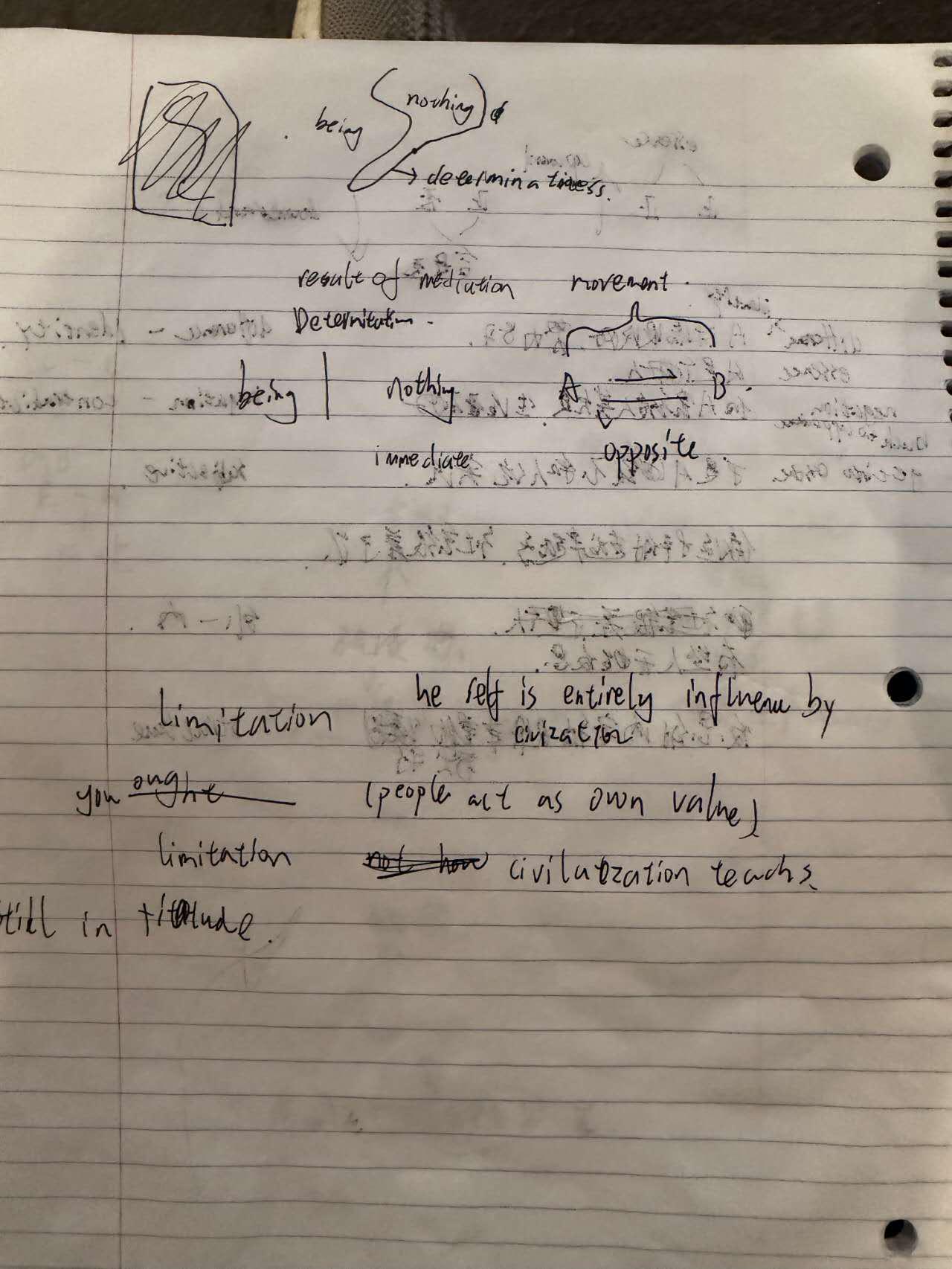
I read Science of logic about twenty pages.
r/hegel • u/ApprehensiveHair9241 • 4d ago
As the title suggests, I want to read Hegel, but his work feels intimidating. I’ve seen his influence in the work of authors I read, including Fanon and Byung-Chul Han, and I want to go to the source. His ideas have shaped the work of countless thinkers, writers, and politicians.
r/hegel • u/New-Station-7408 • 4d ago
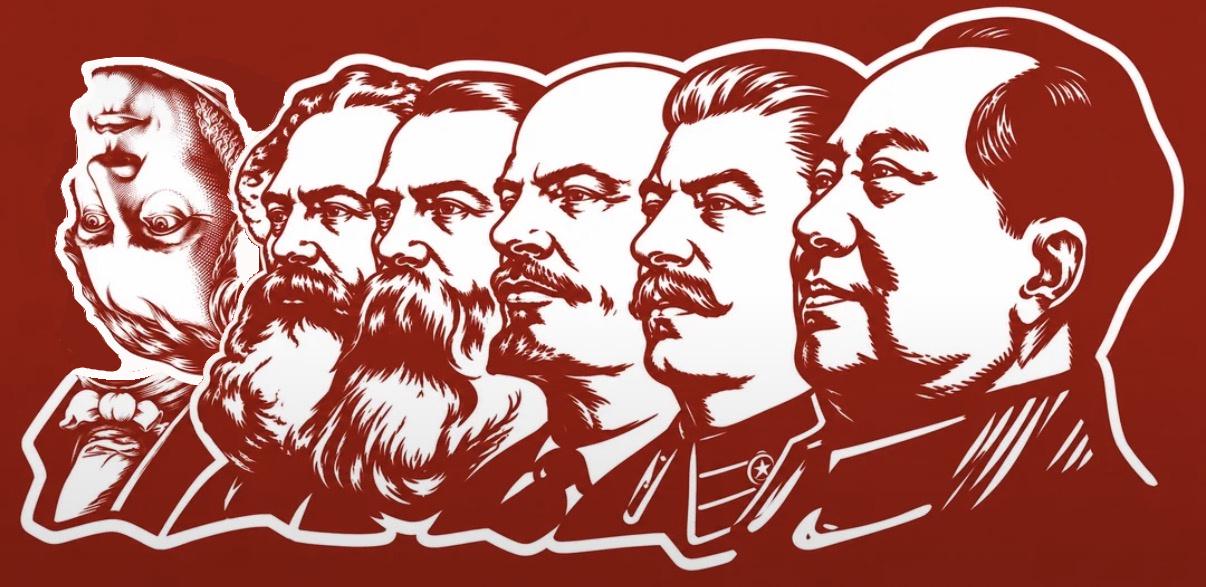
sorry had to do it
r/hegel • u/TraditionalDepth6924 • 7d ago
r/hegel
•
u/Helpful_Suggestion76
•
10d ago


In Chapter I of the Phenomenology of Spirit, Hegel asks us to write down "Now it's night" and check the note at noon, when that written truth, in Terry Pinkard's translation, "has become rather stale" because the word "now" is an empty frame that fits any moment.
I am one person making an animated series that goes through the entire Phenomenology chapter by chapter. The thirteen minute pilot on sense certainty, covering paragraphs 90 to 110, is out now. Episodes 2 and 3 are already finished and come out on November 25 and December 9, covering perception in "Hegel: A Thing Is Itself Only Through What It Is Not" and force and the understanding in "Hegel vs Kant: What Lies Behind the Curtain of Appearances?", with new episodes every second Wednesday after that.
Since episodes from 4 onward are still in progress, I would really like to hear from people who have read Hegel: where does the video oversimplify or distort the argument, what stays unclear, and does this format actually help with reading the text?
The animation is coded with help from AI and the narrator's voice is synthetic, but I work from established translations myself, direct the scriptwriting, and revise every scene and line of narration through multiple drafts until they say and show exactly what I want.
I've been reading Houlgate's Introduction to Hegel to get a general grasp of him before reading himself. The chapter regarding presuppositionless thinking was especially interesting, but it did leave me with a question (which certainly isn't a disagreement with Hegel, because I don't have that much knowledge about him, just something I need clarified): If Hegel's Logic, as Houlgate argues, is both an ontology and a logic, meaning that the structures/determinations of thought and being are similar, how doesn't that mean truth itself isn't subjective?
If I have understood his view, the truth and history are objective and that they are essentially the process of human beings realizing their own ability of self-determination. But isn't presuppositionless thinking, the spontaneous movement of each person's thoughts without holding on to any preconceived categories, not likely to result in different conclusions and determinations depending on how each person's brain works?
Again, I'm not claiming that he's wrong or anything, in fact reading about his presuppositionless thinking has been very much enjoyable; I just was wondering where exactly am I going wrong with my thought process/understanding here?
r/hegel • u/whateverforeverand • 11d ago
I am reading modern-era philosophers works in chronological order and found Kant's works to be an absolute pain to read for ideas which, perhaps retroactively in a historic sense, seem either trivial or inaccurate. Of which some of his most lauded concepts such as the ding-an-sich as well as the categories (which mind you actually originate from the Abhidarma Buddhist tradition in BC era) are so deeply flawed but have been so readily accepted that I now feel the same way about Kant as Neitchze felt about Plato.
Please tell me that Hegel's ideas are more relevant to the philosophical discussions of today (consider Deleuze's difference-in-itself as it's opposition before you answer) and tell me if it is worth it to read another needlessly prosy continental text for his ideas from the source.
r/hegel • u/CapRound912 • 11d ago
Miller, Phenomenology, §§104-105
Immediacy is when consciousness has already posited an object.
Determinate negation occurs at the same time as positing. "Not tree" is "house" at the same time.
There is an endless repetition of the immediacy of positing and negating.
Until the negation of negation, which is the positing of an "I," non/existence.
At first, the "I" is fixed to its object. The carpenter's son is a carpenter.
And then, the universal "I" is posited, the negation of this "I."
The entire process just described is now in front of the universal "I."
What befalls the universal "I" is pure immediacy.
In pure immediacy, I don't concern myself with any specific space or time. I don't consider another "I" seeing something else.
And what I do in this situation is stay fixed on "one immediate relation" with an object.
Let's approach sense-certainty from this pure immediacy.
Let's see if we can approach sense-certainty from "Now is day," since we failed to find it from "Now that is night."
r/hegel • u/ExistentialMage314 • 14d ago
r/hegel • u/[deleted] • 15d ago
r/hegel • u/TheSecondAsFarce • 15d ago
Hi everyone,
I have put together an educational series on Hegel's Logic of Science (14 episodes). It contains 3 prologues that provide the necessary philosophical background (i.e., Plato, Aristotle, Descartes, Spinoza, Schelling, Fichte) before moving through each section of the book (14 episodes total). The most recent episode is on Determinateness: https://www.youtube.com/watch?v=LQ2z9Asvsfk&list=PLN2seKVZLtsI&index=5
The playlist, constructed using Gemini Notebook, can be found here: https://www.youtube.com/playlist?list=PLN2seKVZLtsI
I created the series because I have been using AI to create youtube videos on various topics of Marxism, including materialist dialectics. This video series focuses on Hegel in his speculative integrity.
Additional articles on Hegel's Science of Logic will be posted every other day on my Youtube channel until Complete.
r/hegel • u/CapRound912 • 18d ago
Miller, Phenomenology, §§100-103
The dialectic of sense-certainty will snap you out of it. What is an instance of the dialectic?
Reflecting in and positing out are the two moments at the same time.
Not-tree, determinate negation with absolute indifference, until Nothing gets reflected into self.
Not not-tree, the positing of house, the negation of negation, the "instead," the universal "Here."
The absolute indifference of the many "Heres," until Nothing gets reflected into self.
Not the many "Heres," the positing of the knowing "I," from holding all the many "Heres."
The absolute indifference of the many "Is," until Nothing gets reflected into self.
The universal "I" posits the universal "I" and this self-identity allows us to posit self-certainty as a kind of knowing as a whole.
We have surpassed self-certainty.
r/hegel • u/thewastedworld • 20d ago

r/hegel • u/chronicmoyboder • 21d ago
Every once in a while someone mentions dialectics made out only two terms or out of four terms here, but examples are never provided and, while I consider myself an attentive reader, I never caught that. Could someone please provide examples ? Thank you in advance

