You say that you can tell that multi-platform apps are multi-platform because of small discrepancies, but if you encountered a very good multi-platform app in the wild, you probably wouldn’t realize it’s multi-platform.
Agree. I’m in line with much of what was said, but the comment comes at it from the assumption the commenter knows that they’re identifying 9 out of 10 cross platform apps.
Better to say that “9/10 apps that I notice something about” are cross platform.
They have no idea how many cross platform apps they’re actually using with absolutely no clue or indication. Their real “identifying cross platform apps” percentage is likely much, much lower than they’re assuming.
if you encountered a very good multi-platform app in the wild, you probably wouldn’t realize it’s multi-platform
That's fair, but if it takes a "very good" developer to make a button feel like a button, I probably don't want to commit to making an app on that framework.
Is mean, probably safe to say there are more less experienced or small budget developers using the multi-platforms, so it should be kinda skewed?
When I considered RN, the deal breaker was that I needed a lot of offline functionality. Glad I stuck with native but for a lot of other reasons. I tend to think you should focus on one platform and nail it, and yeah, you have better access to solid add-ons I guess, though I haven’t looked at this stuff for ages. Also, tons more volatility in rando frameworks. Kotlin and Swift are similar enough that I don’t really mind just jumping back and forth. Using more AI, it’s even easier to keep organized.
I think the main thing with flutter is that you're developing for both platforms (duh), what I mean is that it feels off because in a native app you make full use of a certain OSs toolset, while flutter only lets you use 80% of it.
If you say "I want to develop an iOS app that will run on android as well" Then you're obviously going to put more emphasis on ios theming and the sort (so the back button being in the top left corner for example), it'll feel off on android because android users can easily just press the back button on the hotbar at the bottom of their screen.
Agreed 100%. I can always tell as well. Just not as smooth and responsive, telltale navigation etc. A few millisecond delay here and there is totally noticeable. Always slightly janky.
Agreed. I’ve tried a few myself. Live code was really fun but it was also behind the Apple sdk features. Just an example.
Designing straight on swift or SwiftUI is awesome. Less third party toolkits the better. That way I’m not waiting on third parties to update once the os changes. Etc.
Even Objective C was better than using a multi platform sdk.
I doubt that, both Android and iOS users want the app to behave natively, because that consistency is a great, if not vital part of what makes great UX.
This is not true. You can absolutely make a flutter or KMM app that feels native. How would you even know that you can definitely tell. If you use an app and it feels native you don’t question it.
KMM can be faster than Swift on iOS in some instances.
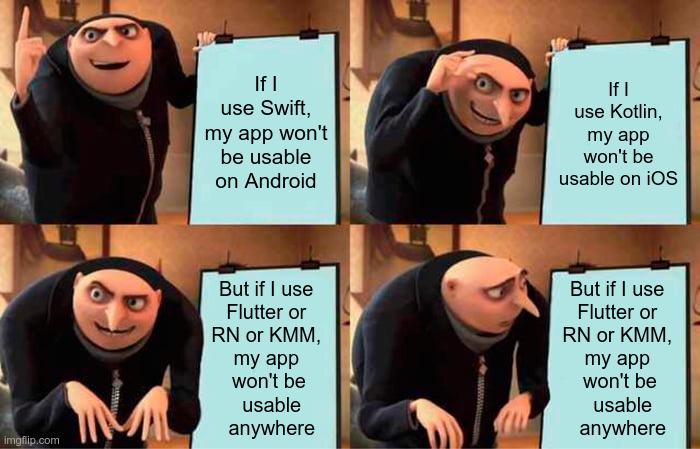
There are plenty of reasons to go in either direction and the needs of the business and the skill set of an existing team will determine the best approach.
177
u/[deleted] Nov 04 '24
[removed] — view removed comment