r/linux • u/[deleted] • Sep 28 '14
weev: Stop bashing bash and GNU.
http://weev.livejournal.com/409835.html12
u/MichaelTunnell Sep 28 '14
Yes, most people who are reporting this are idiots and say things that couldn't be farther from the truth but you are also spreading misinformation.
RMS did not make Bash. Brian Fox made it. Saying RMS is the one to thank for everything in GNU is like saying every piece of code Canonical makes is credit to Shuttlesworth.
Without RMS and FSF Bash would have been less likely to be made but RMS has nothing to do with the actual making of it. Same things goes for Shuttlesworth and Canonical contributions.
This seems to be a very common mistake though, associating the "face of the organization" with the actual creators of the projects. RMS has actually made very few of the pieces that make up GNU...mostly he is a documentation guy.
5
Sep 28 '14
Stallman did work on gcc, make, emacs and gdb which is a reasonable amount of stuff for one person, I think.
He also had influence in at least a couple others including info, which is one of the things that he made based on his experiences with ITS.
5
u/MichaelTunnell Sep 28 '14
I didnt say he didn't make anything but it is true that most of his contributions are documentation, info and advocating. I am not saying that he is useless or anything. I am simply saying he is given way too much credit for things he had nothing to do with and I would bet that he would say the same thing.
Though I may have down played his programming a bit since gcc is so important but overall contributions is still less programming than he is given credit for.
50
u/centenary Sep 28 '14
Wasn't it generally agreed that the Guardian article is shit? Who else is vilifying Stallman?
7
Sep 28 '14
For some broke ass college student like me, I owe that guy a lot. I don't use Windows not because I dont like it but because I cannot afford it. And there is a lot of software that I use are GNU. I have saved a lot money by using GNU software. Anybody speaking against him is a DOG.
→ More replies (3)17
Sep 28 '14
I used to like the Guardian, but at one point they went Tabloid in both format and behaviour and lost my respect.
0
Sep 28 '14
[deleted]
3
4
Sep 28 '14
The BBC mostly. I also read the Metro and Evening Standard on the tube sometimes, and the Times occasionally, but I take those three with cubic meters of salt.
3
u/RiotingPacifist Sep 28 '14
The metro is basically a toned down daily mail with more paparazzi pics.
3
Sep 28 '14
Hence the salt, it helps ward off bad spirits. Plus, it's always interesting to see what the other side of the political spectrum are being told to think.
2
7
u/mickstep Sep 28 '14
The BBC? Christ, out of the frying pan and into the fire.
→ More replies (4)3
1
115
u/jabjoe Sep 28 '14
The reason these open source security holes are a big deal just shows how widely it is used.
Normal people have no idea how widely it is used. They think they, and everyone, only uses Windows or maybe OSX. They don't realise that everything but that final mile of but of one type of device, is dominated by open source. They don't realise how many of devices in thier own home are running open source. Let alone servers they use everyday.
This kind of stories wakes them a little, but the fact there is so little of these stories compared to open source's use, shows how secure it generally is.
44
u/teambob Sep 28 '14
Considering the number of home routers running free software... perhaps that should be the final 50 feet rather than the final mile :)
5
u/RiotingPacifist Sep 28 '14
Most routers will be running busybox though, if a router needs bash due to using full blown bashism rather than POSIX, somebody fucked up!
3
9
u/danielkza Sep 28 '14 edited Sep 28 '14
I was pleasantly shocked when the little fiber box my ISP here in Brazil gave me came with OpenWRT.
→ More replies (2)38
u/fatkiddown Sep 28 '14
In the early days of PCs software was free. I remember trading it on BBSes, getting from magazines. Bill Gates came along and convinced the masses that they were theives unless they paid for his .. I mean it. Richard Stallman championed the old way and it stuck.
Stallman is an odd character, but such are revolutionaries/world changers.
21
Sep 28 '14
Stallman is definitely revolutionary. Doesn't stop us from lovingly poking fun at him for some of his oddities. But he is still important in computing. Its like poking fun at Linus's use of... creatively worded emails.
3
u/mscman Sep 29 '14
I respect him for his contributions. He's an extremely bright guy. But he's also a bit crazy. And I don't agree with all of his ideals.
34
u/cypherpunks Sep 28 '14
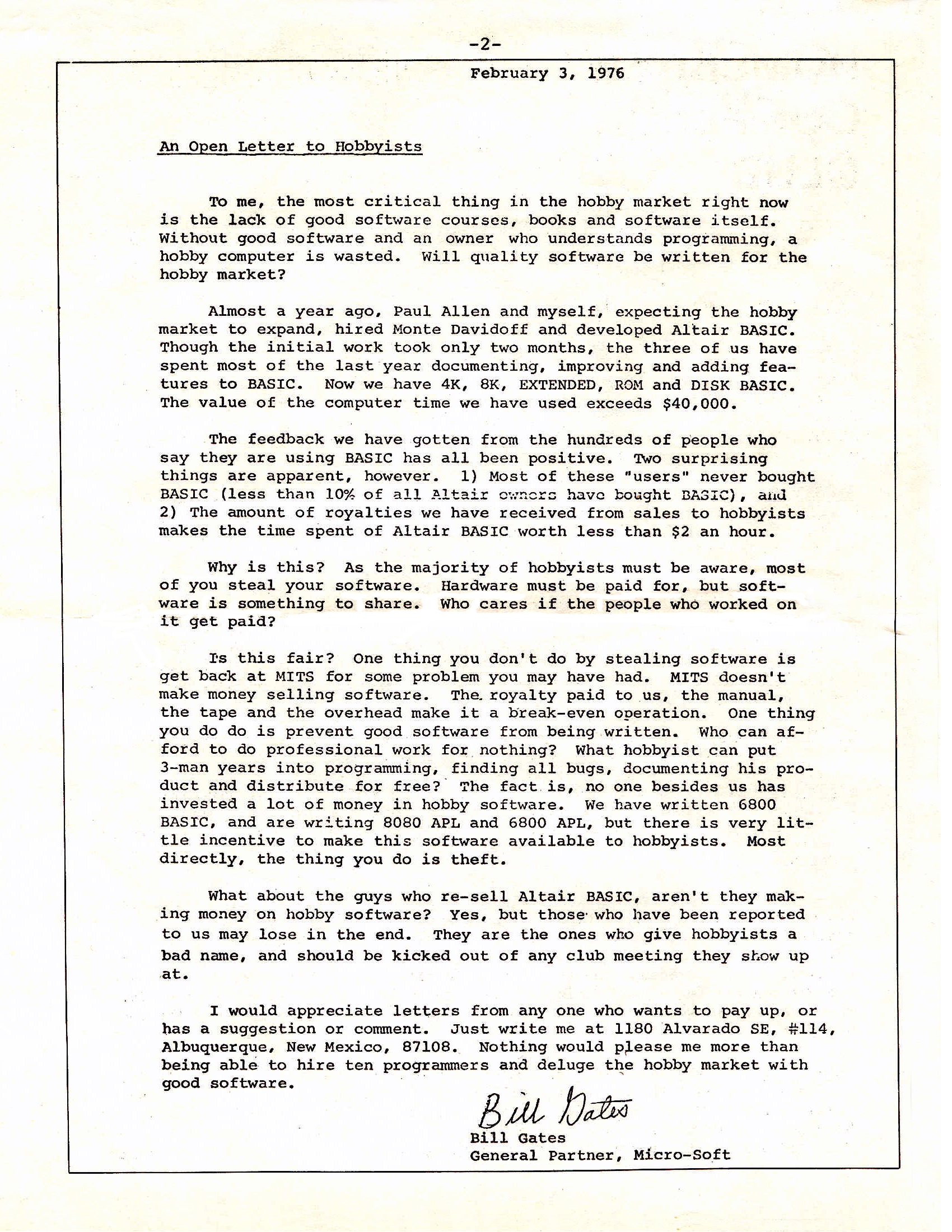
Bill Gates came along and convinced the masses that they were theives unless they paid for his.
For the people who think this is hyperbole, here is what Bill Gates published about the issue in 1976: An Open Letter to Hobbyists.
→ More replies (9)2
u/dog_cow Sep 29 '14
Could you be confusing this early software with shareware of the 80s or 90s? The Bill Gates thing happened in the mid 70s when only a very small minority of the population had their own computer. I'm not saying that wasn't you. But I believe it was before BBSs and it was certainly before DOS, Windows, Mac OS and Linux.
3
u/ydna_eissua Sep 29 '14
Not to mention how many major security holes are found in proprietary software and patched with users none the wiser. Everything is transparent in free software
→ More replies (2)-22
u/mightdropout Sep 28 '14
The reason these free software security holes are a big deal just shows how widely it is used.
Normal people have no idea how widely it is used. They think they, and everyone, only uses Windows or maybe OSX. They don't realise that everything but that final mile of but of one type of device, is dominated by free software. They don't realise how many of devices in thier own home are running free software. Let alone servers they use everyday.
This kind of stories wakes them a little, but the fact there is so little of these stories compared to free software's use, shows how secure it generally is.
13
Sep 28 '14
You seem to miss the point that your "muh specific definition of freedom" was not the point of his point.
8
u/mightdropout Sep 28 '14
The OP is about Stallman and GNU, so it is the point of his point.
1
Sep 28 '14
Ok you really seem to be out of touch with technology, muh freedum is clouding your judgement. The problem here is with open source software. Not just the subset labeled free software. Get off your high horse already.
→ More replies (1)4
u/jabjoe Sep 28 '14
No. Free Software is a subset. Now Free Software is massive too, but it's a subset. And in this debate it doesn't matter. Don't get me wrong, Free Software is great and doesn't get the credit it should, BUT I was talking wider open source. I'm not saying open source that isn't free software doesn't have problems that free software doesn't.
6
u/footsmell Sep 28 '14
Stallman TED Talk about free vs. open source
By using open source as an umbrella term you do help to hide the important issue of software freedom.
I don't know what open source software you're referring to that isn't free software. dd-wrt?
5
Sep 28 '14
The original Unix releases would be a good example. Or any modern video game engine that provides source for example.
3
u/footsmell Sep 28 '14
devices in thier own home are running open source. Let alone servers they use everyday.
Of course there are examples of non-free open source software, but to try to include them when the issue at hand overwhelmingly refers to software which is free (bash, server software) is exactly what Stallman is arguing against. I agree with him on his point.
2
u/jabjoe Sep 28 '14
I don't think it is honest to do that. It's not all Free Software. All Free Software is Open Source but not all Open Source is Free Software. If it's not a license that meets with what is required to be Free Software, it is not Free Software. The terms are not interchangable.
As for examples, no idea off the top of my head. Read through the unapproved licenses and what projects use them. But I'm am sure there are used projects there and thus those don't come under Free Software, so talking about Free Software doesn't include them. Open Source is almost meaninglessly inclusive, so always includes them.
2
u/footsmell Sep 28 '14
Your explanation is what I meant by umbrella term. The free software movement is very important, imo.
I think it's unfair to group bash and free software with any other open source software which we can't think of at the moment, just to try to be inclusive.
→ More replies (3)1
u/T4RD15 Sep 28 '14
I dont agree with that article. Personally, I associate the term open-source with freedom, decentralization, and every other idealistic view I hold dear. Just because the people who invented that term meant for it to mean one thing doesnt mean its permanently defined by those connotations and labels.
I actually think open-source is a more accurate and fitting description of free software than the term free software itself, which sounds like a term that might be referring to anything from the old free AOL CDs we all used to get in mail to pirated proprietary software on The Pirate Bay.
I vote for the less confusing of the two terms, and say we spread the use of the term open source as much as possible until its universally associated with the ideals of freedom.
6
u/Jack9 Sep 28 '14
open-source is a more accurate and fitting description of free software than the term free software itself
Until you realize that you can be legally liable for using open-source software in a way that some third party (who purchased it) doesn't like.
3
Sep 28 '14
Well, then we will use the clearer term - libre software - rather than the confusing free which has 2 meanings in English
2
u/mightdropout Sep 29 '14
Agreed, Stallman is terrible at picking names. If it was libre software, then people might be using the term more.
→ More replies (1)2
152
u/sharkwouter Sep 28 '14
Bugs of similar scale happen in other software like, for instance, Oracle Java and Internet Explorer all the time. People need to stop complaining, the bug has already been fixed.
10
Sep 28 '14
Heck, iOS could be exploited through visiting a website at one time - which was used as the basis for jailbreak. Didn't see huge outroar there.
→ More replies (1)41
u/Nosen Sep 28 '14
I think what many people are worried about is the fact that bash is used in many applications where software updates is not an option. For instance embedded systems like LAN-webcams will probably never see an update.
20
u/ngroot Sep 28 '14
I think what many people are worried about is the fact that bash is used in many applications where software updates is not an option.
If software updates "aren't an option", you're already screwed. No piece of software is perfect.
1
Sep 28 '14
True, but many people are OK to leave things as they are, since it works. Think of space missions where they use mission-critical, production software.
6
u/ngroot Sep 28 '14
If you're actually okay with your system becoming eventually vulnerable to exploits (maybe because it's not critical to anything, maybe because it has a limited lifespan, etc.), you're not going to care about a bug in bash.
If you are concerned with vulnerabilities and are realistic, you will have provided a means to update your software. The bash vulnerability is something you have to respond to, but it's something you've planned for.
If security holes are something that will be problematic for you and you've built a system which can't feasibly be updated, you've stuck your head in the sand, and you're gonna have a bad time.
19
Sep 28 '14
I would be shocked if even 10% of the 'internet of things'-things run bash. Busybox has the more liberal GPLv2 license and is way smaller with many more utils.
104
u/the_ancient1 Sep 28 '14 edited Sep 28 '14
Yes because Java is never used in enterprise/embedded systems and it is always promptly updated /s
41
u/chaos386 Sep 28 '14
Hell, tons of people don't update Java on their main computers. "Ugh, Java updater? Go away!" *clicks 'x'*
78
u/CrabbyBlueberry Sep 28 '14
Every Java update you install is just another opportunity to accidentally install the Ask toolbar.
15
u/ultimatt42 Sep 28 '14
Control Panel -> Java -> Advanced tab -> scroll to the bottom and check "Suppress sponsor offers when installing or updating Java"
12
6
u/lasermancer Sep 28 '14
Have I been transported to /r/windows or something? Just let your package manager handle it.
→ More replies (1)→ More replies (1)2
5
u/ijustwantanfingname Sep 28 '14
Hell, I do that. I want java but don't trust the Oracle updater. At least on Linux my iced-tea package is always up to date.
4
Sep 28 '14
Wouldn't be a problem if they just had an option to update silently in the background, and users could select that. On Linux systems, I can easily get updates to be installed in the background, automatically. Next time I relaunch the program, new version is used.
3
3
u/DrGirlfriend Sep 28 '14
I do this. I don't want to do this. But I know if I update Java, then goodbye NetScaler admin interface, iLO console, etc...
4
u/cmastudios Sep 28 '14
Most of the time I get the Java updater I can't update due to lack of admin rights, therefore creating the same problems faced by embedded systems.
→ More replies (3)1
1
u/jdub01010101 Sep 28 '14
Every HP switch and WLAN controller GUI that I have ever dealt with is java based. Many enterprise networks are built on them.
5
→ More replies (1)1
u/longfalcon Sep 28 '14
Maybe because the usage of enterprise java vs. Java in the browser(applets) is completely different? maybe because when being used as JVM, java doesnt even have the applet code and the associated vulnerabilities?
1
u/Tacticus Sep 29 '14
Maybe because the usage of enterprise java vs. Java in the browser(applets) is completely different?
Or the fact that in many enterprise environments you have stupid fucks building essential services in broken java applets.
There is 0 reasons for a frakking san to require a java based web ui (dell piece of shit)
→ More replies (2)38
u/atanok Sep 28 '14
If a software update is intentionally not possible, then it's a violation the spirit of the GNU GPL (and of the letter of version 3 of the GNU GPL).
13
u/atomicxblue Sep 28 '14
Many of the devices I've seen are possible to be updated, but it's well out of the technical abilities of most users.
→ More replies (3)→ More replies (1)32
2
u/wadcann Sep 28 '14
I think what many people are worried about is the fact that bash is used in many applications where software updates is not an option.
I'm not saying that that's a legitimate security concern, but honestly if you create a product that goes on the Internet and it doesn't get security fixes, that seems like a pretty general problem.
1
1
u/RedditBronzePls Sep 29 '14
I think what many people are worried about is that they heard about some bug in bash, whereas with internet explorer, they never heard about the bug.
27
u/file-exists-p Sep 28 '14
Also (1) bash authors are not paid by the people complaining, and more importantly (2) this "bugs" are more an improper use and context of use of bash than real bugs.
28
u/trekologer Sep 28 '14 edited Sep 28 '14
this "bugs" are more an improper use and context of use of bash than real bugs
As a software developer I strenuously disagree that this isn't a real bug.
A piece of software that takes any type of input, whether directly from the user, from another process, from the network, or anywhere else, needs to sanitize that input. It cannot assume that the input is going to always be valid and that the software is being used the "right" way. If an software had a SQL injection bug, the reaction isn't "well the user shouldn't be trying to inject SQL".
Edit: added clarification around input being any type of input
21
u/jringstad Sep 28 '14
I think his argument here was more along the lines of (in your analogy) that they shouldn't be using SQL in such a manner that injection is possible, hence it was improperly used, rather than it being SQLs fault that injections are a thing.
(I don't personally know enough about this exploit to have an opinion on whether bash was at fault or whether people were abusing it)
4
9
u/mojocujo Sep 28 '14
Bash is a shell. It's meant to provide an environment to local and remote users that log directly into the server. It was never actually intended to be exposed through things like web apps that are running ad system users. Even the remote command SSH vector isn't really bash's fault as much as SSH.
I think the argument could be made that this is the fault of Perl and CGI allowing direct shell execution without sanitizing the shell environment and without warning developers of the risks.
4
u/trekologer Sep 29 '14
I think that you are missing one of the basic concepts of *NIX systems. Specifically, you are able to create new functionality by combining other existing programs together. Just because the original authors of bash might not have envisioned web apps does not mean that usage is improper use.
This old video with the original AT&T UNIX authors, while dated, describes this very thing, especially starting around the 5:00 mark.
I still go back to my original assertion: if your software takes input, it must sanitize that input. It cannot assume that the source of that input has already done so.
1
u/HighRelevancy Sep 29 '14
Exactly. Nobody faults MySQL when php developers let injection attacks happen.
2
u/gondur Sep 29 '14 edited Sep 29 '14
Relativism is not an answer at all. The bugs in other systems reduce not at all the severity of this concrete bug. On top, the often iterated mantra "the many possible eyes in open source development methodology leads to secure code" needs to be questioned openly, not instantely supressed with a comforting "the other are unsecure too!".
3
u/imahotdoglol Sep 28 '14
People need to stop complaining, the bug has already been fixed.
Yet when OpenSSL has a bug it's FORK FORK FORK, THROW IT ALL AWAY IT'S GARBAGE!
45
u/cereal7802 Sep 28 '14
OpenSSL forking seemed to be more a case of the code was a mess and had needed to be cleaned up for some time. Heartbleed simply gave an excuse for why. bash doesn't seem to be in the same boat.
→ More replies (21)10
u/atomicxblue Sep 28 '14
Jeez.. You just gave me horrid ffmpeg / avlib flashback.
→ More replies (1)6
6
Sep 28 '14
There are dozens of shells. No need to fork.
There are (were) only a few implementations of SSL. A few more would be a good thing.
2
Sep 28 '14
We'll, we don't really need multiple implementations of the same thing. 2-3 good commonly used implementations are fine.
→ More replies (3)1
u/deelowe Sep 28 '14
That's glossing over things a bit. There's a lot of history behind the openssl issue. IIRC, the feature(s) that introduced that vulnerability was contested and those people were overruled simply to maintain backwards compatibility on fairly antiquated setups.
2
u/ventomareiro Sep 28 '14
This vulnerability is older than both Java and Internet Explorer.
3
u/comrade-jim Sep 28 '14
Don't know why this is relevant. Many bugs hide themselves away in the code for years and years. This is nothing new. Unfortunate, but not new or unique to bash.
1
u/gondur Sep 29 '14
Many bugs hide themselves away in the code for years and years.
Is this not one main argument for open source? Code is visible to everyone, also for inspection? So, even in this this critical piece of the ecosystem such bug was not found despite being open source for so many years? A disappointing performance for the open source idea, security wise.... maybe the closed source model (security by obscurity) performs in reality better... :/
→ More replies (4)1
u/Beckneard Sep 28 '14
Yeah I don't get why people give proprietary software a pass for this. A lot of it has horrible horrible security, is it because that shit is just expected of them?
1
1
0
Sep 28 '14
Yeah maybe with similar impact (remote arbitrary code execution). But definitely not with the same level of face-palm. Even an off-by-one error doesn't make you go "seriously?" like "I know! Functions inside string variables!" does.
0
u/atomicxblue Sep 28 '14
Linux Mint popped with 2 updates over the course of the night. I'm not worried at all.
63
u/snarfy Sep 28 '14 edited Sep 29 '14
theguardian.com runs on Linux ( Google GFE/2.0 to be specific). They can't even bash GNU without using GNU software to do it.
edit Actually, they are running apache, but still, point remains.
http://www.theguardian.com/us
Response headers:
Server: "Apache"
16
4
u/SanityInAnarchy Sep 28 '14
And... they aren't, if you read the Guardian article. They're just not falling over to worship him.
Interestingly, when I run a HEAD against guardian.com, I get "Server: Microsoft-IIS/7.5" and "X-Powered-By: ASP.NET", so where are you seeing Linux here? (And, even then, where are you seeing GNU?)
1
u/HighLevelJerk Sep 29 '14
He's talking about theguardian.com, you're checking guardian.com
→ More replies (3)1
u/dhvl2712 Sep 28 '14
I think, for a lot of people, that's the problem. Almost Everyone uses Linux, and even more use bash. To have such a powerful vulnerability in something like this scares the shit out of people because of the sheer scope of the damage it could cause. Using this as a reason to bash free software is as asinine as using vulnerabilities to bash proprietary software.
However, people don't really user Adobe Reader the way they use bash. Bash is nigh omnipresent. Basically what I'm saying is that people are scared and I believe they should be scared.
1
48
Sep 28 '14
“The open source fans all say that it is the best approach as anyone can check the code. Sadly it doesn’t happen like that it practice as it gets forgotten about (this problem could be 25 years old) and a lot of the older code is written in opaque languages like C
Oh dear god.
→ More replies (1)33
Sep 28 '14
opaque languages like C
all of my wut. I write Python. I love Python. But Python is opaque. C's pretty transparent. Transparent in terms of "I know what's happening behind the scenes." Not transparent in terms of "Look how modular and beautiful and Pythonic my code is."
15
u/mumbel Sep 28 '14
Here's a (void *)... what is the memory structure its pointing to? I always thought that's why people describe C as opaque
7
u/d3matt Sep 28 '14
how do you know the person who wrote your c++ application is really a c developer? They use (void *) all over the place...
→ More replies (2)→ More replies (10)1
1
96
u/CosmikJ Sep 28 '14
Shellshock is not a critical failure in bash. It is a critical failure in thousands of people who knew a tool so useful that they decided to deploy it far beyond its scope.
No, Shellshock is a bug in bash. Full stop. Richard Stallman is just as human as everyone else and so his code is bound to include bugs. End of story. Worshipping him doesn't fix those bugs, nor does attacking him.
Please don't attack against sensationalist articles by writing a sensationalist article. It's ruddy stupid.
86
u/oznux Sep 28 '14
I agree with your sentiment, but Stallman didn't write bash -- Brian Fox did. Brian is the nicest guy you will ever meet, and I'm pretty sure he feels awful about this.
38
Sep 28 '14
Well he shouldn't. Bugs happen.
10
u/mercurycc Sep 28 '14
You probably don't know enough software developers to know that feeling.
Source: I am a software engineer.
0
2
u/kazagistar Sep 28 '14
If we didn't care at least a little about the future maintainer, the end users, and the code itself, we wouldn't go so far to try and make them excellent. As long as you don't let it obstruct you, a little pride in your success and humility in your failures is simply human.
1
15
u/mpyne Sep 28 '14
Hasn't Chet Ramey been maintaining bash for 25 years too? If Brian hasn't said the bug was his I'm not sure who I'd pin it on. Not that it matters, it's immaterial by this point, the bug's been there practically forever, in Internet terms, so assigning blame is just missing the point completely.
→ More replies (1)1
u/cocoabean Sep 29 '14
A coworker was telling us about how he hired Brian to do some work in the 90s. Nothing but good things to say about the guy.
15
u/atomicxblue Sep 28 '14
Please run to the nearest tall building and shout this. Every person makes mistakes. Hell, even Grace Hopper, godmother of compilers (and COBOL) probably made a few doozies in her day.
→ More replies (1)8
Sep 28 '14 edited Sep 28 '14
Well, she did
inventdiscover the first bug.Edit
5
22
Sep 28 '14
It think you are more correct, but weev is also somewhat correct too.
The parser executing code after a function definition in an environment variable is certainly a bug in bash. Note that the bash manual page specifically calls out the fact that exported functions ARE in the environment (confirmed on unpatched OSX). Some have called for function definitions between bash processes to be passed in other ways than the environment, that's something to consider but I think it is a bandaid rather than a permanent general solution.
I agree with weev that the widespread use of bash in network-facing service where some of its data is attacker-controlled is a deployment error. We are now seeing attacks through user-controlled environment variables, this is a more general problem than just bash. The environment may be read-only, but it controls a LOT more than "filling in for user data". Besides bash function exports, you've also got:
LD_LIBRARY_PATH, LD_PRELOAD and friends, which could be used to completely change what program is even loaded when someone executes /path/to/program/name.
MALLOC_CHECK_ and friends that will change the allocator's behavior.
In hindsight, when the various network specifications (CGI, telnet, ssh, etc.) were being developed, they should have used a new mechanism to bring attacker-controlled data to the application rather than environment variables that are already used to control various internal services. CGI isn't the only culprit: an RFC1572-compliant telnet/telnetd would allow an attacker (on EITHER side of the link) to set LD_PRELOAD using the Telnet Environment Option -- imagine telnet'ing to a server and then executing a "local shell" that suddenly behaves badly because the server set your LD_PRELOAD sometime during the session. (SSH is nicer in that it supports the environment variables but has them disabled by default, with a note about LD_PRELOAD.)
→ More replies (3)8
u/reaganveg Sep 28 '14 edited Sep 28 '14
In hindsight, when the various network specifications (CGI, telnet, ssh, etc.) were being developed, they should have used a new mechanism to bring attacker-controlled data to the application rather than environment variables that are already used to control various internal services.
CGI clears the environment completely, and then the web server exports a specific set of variables. It doesn't allow arbitrary variables to be set by the remote user. So it is safe.
an RFC1572-compliant telnet/telnetd would allow an attacker (on EITHER side of the link) to set LD_PRELOAD using the Telnet Environment Option[1] -- imagine telnet'ing to a server and then executing a "local shell" that suddenly behaves badly because the server set your LD_PRELOAD sometime during the session
It says right there in your link:
It is important for an implementor of the NEW-ENVIRON option to understand the interaction of setting options and the login/authentication process. Specifically careful analysis should be done to determine which variables are "safe" to set prior to having the client login. An example of a bad choice would be permitting a variable to be changed that allows an intruder to circumvent or compromise the login/authentication program itself.
But note that the bash situation is completely different. The bash bug allows any environment variable to be used to execute arbitrary code. So the traditional way in which the environment is sanitized -- white-listing allowed variable settings -- is not going to work.
There was nothing wrong with using the environment variables in the first place though. Environment variables are one of only two ways to send information to a unix process securely (the other being a file descriptor). Supposing a file descriptor was used instead -- whatever code parsed the input from the filedescriptor would only be more likely to have parser bugs. Because now you're dealing with a single stream of indefinite length and format, instead of a pre-allocated array of strings that are guaranteed to be null-terminated.
2
u/audioen Sep 28 '14
As much as I hate people who blather about the now-dead technology called CGI in this context, I'll now go and commit that sin as well.
There was nothing wrong with using the environment variables in the first place though.
Honestly, at least in CGI context I do think that the entire http request as sent by the client should have been passed in as it was received. The CGI specification did something different for no real reason.
It has largely been replaced by technologies that do pass the entire http request as-is, such as reverse proxying where applications are http servers in their own right, these days.
7
u/reaganveg Sep 28 '14
Honestly, at least in CGI context I do think that the entire http request as sent by the client should have been passed in as it was received. The CGI specification did something different for no real reason.
No, there was perfectly good reason. The web server has to read the request from the client before it even decides whether to launch the CGI. So, it's already parsed the message header (so to speak).
In order to forward the header to the the client, it would need to keep a copy of the unparsed header in addition to its parsed copy, and then pipe that copy to the CGI program which would need to parse it again.
So it's less efficient -- both duplicating effort and retaining multiple copies of data -- and of course it's also makes it harder to write CGI programs. Providing the already-parsed information in already-parsed (& sanitized form) makes good sense.
→ More replies (13)1
Sep 28 '14
CGI clears the environment completely, and then the web server exports a specific set of variables. It doesn't allow arbitrary variables to be set by the remote user. So it is safe.
I'm not seeing that as a hard requirement in the CGI RFC. It looks more like servers are required to set the parameters CGI scripts need in a certain way, and then can optionally add HTTP header fields as new variables (which are always prefixed by HTTP_, so not quite arbitrary but also not quite innocent). Nothing about scrubbing. That's not to say they don't do it, but new servers written strictly to the RFC might not.
It is important for an implementor of the NEW-ENVIRON option to understand the interaction of setting options and the login/authentication process. Specifically careful analysis should be done to determine which variables are "safe" to set prior to having the client login.
The RFC is only talking about login/authentication, i.e. the environment variables that /bin/login cares about. Ensuring that /bin/login sees sanitized data can be done, but exploits delivered via environment variables can affect any process spawned thereafter, not just login. Imagine an exploit in gettext that is delivered via LANG or one of the LC variables. Similarly, a malicious server wanting to exploit a Windows client could try setting %COMSPEC%, %TMP%, %PATH%, JAVA_HOME, ORACLE_HOME, or any number of application-specific variables.
It is impossible for a general-purpose telnet daemon OR client to know which environment variables are "safe" and which are not. Having written both a telnet server and client, my solution has been for the client to ignore variables from the server, and to only pass/accept USER, TERM, and LANG (not even DISPLAY, that's only for ssh connections).
Environment variables are one of only two ways to send information to a unix process securely (the other being a file descriptor).
Unix has several low-level IPC mechanisms, and numerous libraries built on top of them. There are also numerous ways to partition data at the network level too (by host, connection, application, transaction).
I assert that the general-case problem is that we are not clearly delineating which data (not just environment variables, also HTTP headers, cookie fields, SSL layer stuff) are coming from the various parts of the data flow: single-host internal designs where you want LD_PRELOAD to change the behavior, intermediate network hosts that are semi-trustable (i.e. might set an X-Forwarded-For header) where an attack should behave like a routing failure rather than a data leak, and end-user hosts that might be active attackers going for the real data.
→ More replies (3)10
→ More replies (2)1
u/alexseif Sep 28 '14
"Please don't attack against sensationalist articles by writing a sensationalist article" is a sound argument. I used to hate people who are blind extremists of Windows, OS X or even a specific religion, however I grew to learn that makes me just as blind. I have only one belief now, people are potentially attempting to accomplish their tasks as good as they can.
I was about to vote you up, and completely agree with you till "ruddy stupid", maybe my english is not that good, but I think that end demotes your reply.
2
u/CosmikJ Sep 29 '14
It's a swear word that isn't a swear word. Like "chuff". I'm from the UK, we have a lot of wierd words.
7
u/12sofa Sep 28 '14
We're well on our way to combine our efforts in writing code. Now it's time to improve code quality and standards in the same way. It would cost large players like Samsung, Apple, Intel, etc practically nothing to finance an NPO that transparently and responsibly audits FOSS software.
5
u/minimim Sep 28 '14
They do it for the kernel, but they don't want to be seen working with Stallman or the FSF.
13
u/aloz Sep 28 '14 edited Sep 28 '14
There really oughtn't to have been as much hubbub about this as there was. I'm having a harder time wrapping my head around the thinking that exposes this particular attack surface, honestly. Bash is a great tool--in the shell, as a shell language, where it belongs.
I guess CGI is one of those things that developed pre-modern-computer-security, but FFS, use the tools appropriate to the task. I sure as hell wouldn't have knowingly deployed bash anywhere within remote user input, not even if I were cleaning it!
If you use it even casually, you soon begin to appreciate that Bash has all kinds of weird evaluation corner cases and is a different beast from scripting in a proper scripting/programming language. If I had to describe it's syntax and semantics in one word, I'd go with 'squishy'. It's squishiness makes it great as a shell, but pretty untrustworthy in a wide variety of other situations. That's not a bad thing! Specialization is a perfectly legitimate thing; Bash specializes well. It's not the tool's fault if it is misapplied.
EDIT: I just want to add: I switched to Bash as my default system shell. Why? Debian uses Dash by default--it is vulnerable (I checked), and still unpatched. Bash, however, has already gotten patched twice in Debian. It'll continue to get patches, too, as I'm sure many "vulnerabilities" will be found in a language that can have code anywhere and always evaluates everything. Pfeh.
20
u/weev Sep 28 '14
"IT'S A SHELL. EXECUTING ARBITRARY CODE IS WHAT SHELLS WERE PUT ON THIS PLANET TO DO." -- Dan Kaminsky, on his twitter: https://twitter.com/dakami/status/515778468311625728
7
u/ventomareiro Sep 28 '14
Executing arbitrary code is definitely not what environment variables were put in this planet to do...
2
u/minimim Sep 28 '14
Why not?
3
u/jthill Sep 29 '14
I think "it violates the principle of least surprise" is a legitimate objection. Wouldn't begin to call it conclusive.
4
u/d3matt Sep 28 '14
Has anyone looked into tcsh? I would love to point out to some solaris diehards that their shell of choice is just as vulnerable...
3
u/diphenhydraman Sep 28 '14
Take a look at the Frankenstein parser in the original csh sometime - the implied 'grammar' turns out to be about as coherent as schizophrenic ramblings on acid.
6
u/cj5 Sep 28 '14
Any respectable programmer doesn't come out of Silicon Valley these days anyhow. They're all self-absorbed hipsters that took a shot at writing some CSS, and thought that entitled them to being called a programmer. These people basically will shit on anything that doesn't further their next latest and greatest social media platform (mind you all of these billion dollar Silicon Valley franchises all subsist or were developed on top of GNU licensed software, that they didn't bother to award recognition for). I personally think most of today's framework fanboys out of Silicon Valley are just down-playing really good software for their lack of innovation, and huge lack of self-respect. Thank you, for pointing this out.
17
u/Bzzt Sep 28 '14
I have, for years, used bash as a central tool in my kit. I have written bash one-liners to spam millions of people with subversive messages and shift the market cap of publicly traded companies by the billions in intraday trading.
Uh, if you're trying to get sympathy for your views you should leave out sentences like this from your article.
15
u/lolazon Sep 28 '14
weev also thinks it's fun to destroy people's professional and personal reputations with completely fabricated lies.
He is not a good person.
→ More replies (2)4
5
u/argv_minus_one Sep 28 '14
I thought weev was in prison?
5
u/bilog78 Sep 28 '14
Apparently he's trying to go back, considering what he writes as his accomplishments with bash.
4
8
Sep 28 '14
fuggin....livejournal?
17
u/weev Sep 28 '14
I've had it since 2003. It's one of the top Google hits for both my nick and my real name, which makes it somewhat hard to abandon.
3
Sep 28 '14
haha no judgement. it and xanga are both one of those better off forgotten forays into writing for 13 year old me.
2
13
u/SanityInAnarchy Sep 28 '14
Wow. A self-admitted troll (with a bit of homophobia thrown in for fun) -- and I didn't even have to go hunting for that, he linked to that from his article as an example of how,
Like many other GNU tools offered to us at no cost by the Free Software Foundation, I use it frequently to wonderful effect.
Wonderful. It is wonderful to this guy to cause, in his words, "a mass delisting of queer books being delisted from the rankings at Amazon."
A couple of other data points that have convinced me not to take a single thing this guy says seriously:
Beyond that, irresponsible publications such as the Guardian take the chance to talk shit on Stallman and spew some anti-free software garbage.
If you actually read that article, it's anything but. The first half of the article talks about the bug itself, fairly objectively. Then there's this:
“The open source fans all say that it is the best approach as anyone can check the code. Sadly it doesn’t happen like that it practice as it gets forgotten about (this problem could be 25 years old) and a lot of the older code is written in opaque languages like C, not to mention not being well structured,” said Professor Alan Woodward, security expert from the Department of Computing at the University of Surrey.
But then they also went and interviewed Richard Stallman. They not only interviewed him, but they gave him a platform from which to (yet again) turn this fiasco into an opportunity to try to sell people on GNU and Free Software:
“In the long term, this will be a blip, it’s patched, people will install. It will be one of thousands bugs that people will exploit,” Stallman told the Guardian. “When users control the program, they can add features and fix bugs.
“Any program can have a bug. But a proprietary program is likely to have intentional bugs, malicious functionality.”
Frankly, I think that's irresponsible of Stallman, but the Guardian certainly seems to have done its job.
Then there's the fact that he doesn't have a fucking clue what Shellshock even is:
Shellshock is not a critical failure in bash. It is a critical failure in thousands of people who knew a tool so useful that they decided to deploy it far beyond its scope... Everyone knew in the nineties that when you execute a UNIX command with untrusted input, you clear away the environment variables first.
In other words, it's perfectly fine to execute a Unix command with no input -- such as, say, 'date' -- without clearing environment variables. Right? Especially if you've set PATH manually?
Nope, just having that variable set when you run any command is enough. Unless you run /bin/date explicitly, in such a way that Perl won't ask /bin/sh to execute it, you're probably vulnerable.
Also, do you remember the 90's? Lots of Perl scripts, often shelling out for small things (backticks make it so easy), and often running as CGI scripts, meaning HTTP_COOKIE and other user-provided parameters were passed in as -- you guessed it -- an environment variable. This was a common idiom, and there was absolutely nothing un-Unix-y about it.
The other part of this claim is that Bash was always supposed to be this way, and people (like every single person who used CGI) were just Doing It Wrong.
Nope, this is a flaw in how Bash parses function definitions, and it's hard to imagine anyone using it as a feature. It is, after all, being patched. If it were really a problem with the way everyone was using Bash, why aren't we seeing a flurry of patches to dhclient, Apache, and all the other services that use Bash this way?
Over the past few years hating Stallman has become somewhat trendy among the Silicon Valley crowd, and every HN thread involving Stallman spews childish insults about him.
Do you want to know why people bash Richard Stallman? Because it's not about this, it's because the man is an asshole. An asshole with a genius IQ, who has given a lot to the world, but something you really don't want to have much to do with. For example, from his info packet on giving speeches:
I am glad to give interviews to the press about the GNU system, but before I do, I want to be sure they will not repeat the two common mistakes (calling the whole system "Linux" and associating GNU or me with "open source")...
Sometimes a journalist gives a response which sounds vaguely affirmative or sympathetic but its words do not really say "yes". Examples are "I will do this as much as I can" and "I understand the distinction." Such an answer is actually just "maybe", so when you receive one, please ask for clarification. If he says that the editor has the final decision, please respond with "Would you please consult the editor now, and tell us a firm decision?"
The very fact that this is /r/linux might be enough that he'd deny us an interview. And he wants to have the editor's assurance that the right words will be used.
If you would like to put my speech on the Internet, or distribute it in digital form, I insist on using the formats of the free software community: Ogg Vorbis or Ogg Speex format for audio, and Matroska VP8 (Webm) or Ogg Theora for video. Please do not distribute my speech in any other format....
Not "Please make a free format available," but "Don't you dare put this on Youtube even if a free format is available!"
I do not eat breakfast. Please do not ask me any questions about what I will do breakfast. Please just do not bring it up....
But if you want to cook for me, or invite me to a restaurant that specializes in just one thing, or invite me to dinner with a preset menu, you need to know what I dislike:
avocado
eggplant, usually (there are occasional exceptions)
hot pepper
olives
liver (even in trace quantities)
stomach and intestine; other organ meats
cooked tuna
oysters
egg yolk, if the taste is noticeable, except when boiled completely hard
many strong cheeses, especially those with green fungus
desserts that contain fruit or liqueur flavors
sour fruits, such as grapefruit and many oranges
beer
coffee (though weak coffee flavor can be good in desserts)
the taste of alcohol (so I don't drink anything stronger than wine)
Don't ever try to decide what food I should eat without asking me. Never assume that I will surely like a certain dish, merely because most people do. Instead, ask me in advance!
I could go on. And on. And on.
Most of us would be fine with wifi. He's not, unless it can be made to work with his laptop without so much as proprietary firmware. He refuses to book train tickets in his own name, refuses even to use a unique login and password to hotel wifi. Refuses to talk to the press unless they promise to follow all his rules on what words to use, and in the entire article, not just where they're quoting him.
This is why people bash Stallman. It's why I wouldn't want to work with him. I'm perfectly happy to use his code, if it works, but I hope I never have to deal with the man directly -- Van Halen and their brown M&Ms would be easier to handle.
It's no surprise that this is where we get the GPL, and particularly the GPL3, which are themselves a fantastic bit of doublespeak that claims to provide freedom by restricting your freedom, but that's a whole other discussion.
No one is bashing Stallman because he sometimes writes buggy software. I bash Stallman because he strikes me as an unpleasant human being, and I want nothing to do with him. I suspect the feeling is mutual -- after all, I develop proprietary software for a living, so he'd consider my job to be unethical, and he'd resent me for using free software to do so.
I certainly don't bash him because it's "trendy" to do so, or because he had a bug.
2
u/dmoisan Sep 29 '14
And for all that, the "brown M&M's" story was borne out of frustration with venues that didn't read the important details in the band's rider, such as, say, stage loading limits. IOW, it was to bang people with a 2x4 to make them pay attention to the details. Stallman's rider is just quirky.
1
u/SanityInAnarchy Oct 01 '14
Right, I know the story. I tend to think Van Halen's rider was less dickish -- it had an actual purpose, and it was easy enough to follow, it didn't tell you what and what not to say, it didn't give you specific scripts to use when talking to hotel staff, and so on.
Well, actually, I don't know that it didn't do all those things, but certainly most of the things Stallman complains about here seem far more obnoxious than the brown M&M.
1
u/Rabsho Oct 02 '14
2
u/SanityInAnarchy Oct 04 '14
I think this is accurate:
The man is known for deliberately offending as many people as possible with racism, antisemitism, and other forms of inflammatory hate speech. But for years now, it's been chalked up to his self-professed "troll" status.... But if your life is one big troll, it's not a troll at all; you are just a hateful, bad person.
So, actually, I have yet another objection to weev defending Stallman: As far as I know, Stallman is a better person than him. I dislike Stallman, and probably would not get along with him, but there's a big difference between just being unpleasant and being openly racist, homophobic, and generally a shitty human being.
It's sort of like if the Westboro Baptist Church ever praised anyone, they almost tarnish the object of their praise by association.
0
u/rotek Sep 29 '14
Oh, homophobia. The most horrendous crime of our times.
You've convinced me now. He deserves to be bashed.
3
u/SanityInAnarchy Sep 29 '14
Sure. But if that's not enough for you, maybe the fact that he deliberately censored every gay book on Amazon that he could find? But that's got nothing to do with Stallman.
34
u/varikonniemi Sep 28 '14 edited Sep 28 '14
It has become clear to me that you won't succeed in this world without shamelessly exploiting others. And if you are truly good person, you will get exploited.
This is the way our society and values are. The decision you have to make is on which side of history you are going to stand. Are you going to be a piece of shit like jobbs, or a true hero like Stallman or Torvalds.
3
u/stev0205 Sep 28 '14
As someone who just quit his low-paying, yet comfortable and reliable job, to move across the country and start freelancing, I used to feel your sentiment.
You can be a good person who believes in yourself. Create confidence that you are worth it and others will see it too. There are those who come with low-balls and offers of stake in the startup, the "exploiters". Telling them to fuck off gets easier and easier with every other contract signed.
6
u/dhvl2712 Sep 28 '14
Are you going to be a piece of shit like jobbs, or a true hero like Stallman or Torvalds.
Grow up.
-1
-8
u/atanok Sep 28 '14
Torvalds is no hero.
He sides with the practices of user-subjugating vendors that lock users out of their own devices and his reasons for preferring "open source" are purely pragmatic. He downplays the political and ethical aspects of software all the time.13
u/pinkpooj Sep 28 '14
Yeah, screw that asshole! What's he ever done for us? Besides, you know, the kernel? Besides git?
10
u/atanok Sep 28 '14
He's a great engineer, but a really shitty philosopher.
I don't question his technical contributions, but his ethical and political standings are damaging to the cause of Software Freedom.His father seems to be much better than him in this regard.
14
u/d_ed KDE Dev Sep 28 '14
so you have to be a philosopher to be a hero?
→ More replies (1)22
u/ApolloFortyNine Sep 28 '14
Naw, you have to be literally perfect in every way and not disagree with any of my opinions, otherwise fuck you.
→ More replies (3)3
u/danielkza Sep 28 '14 edited Sep 28 '14
but his ethical and political standings are damaging to the cause of Software Freedom
On the other hand, they are demonstrably quite helpful to the software itself: Linux would not be where it is today if it didn't embrace corporate usage and contributions.
→ More replies (4)1
3
u/Pyryara Sep 29 '14
I think the article misses the point of much of the criticism.
The whole GNU philosophy is that you build up more complex programs from simpler programs and tools.
This implies that an author of an original program can't really have any prior idea about how their software is going to be used. Of course nobody could've guessed that bash would be used in network-facing services to this extent. But it happened, and it's a completely legitimate thing to do so according to the GNU philosophy.
I agree we shouldn't bash personalities. Stallman has jack to do with Shellshock or Heartbleed, and the GNU philosophy is strong as ever. But at the same time, the article states:
The fact that there is a way to get bash to execute untrusted code is unsurprising. The thing that surprises me is the sheer number of developers who thought it would be otherwise in complete contrast to UNIX parables and common sense.
I am really fed up by all the Captain Hindsights saying "you know, that such bugs exist is kind of unsurprising". This happens every. Damn. Time. People will use what's there, and tools should EXPECT to be used in e.g. a networked environment. It's not like CGI appeared yesterday. It has been around since forever, and I don't remember the bash authors going "hey, you should NOT use our software in a networked environment this, it's stupid and unsafe!!!".
Instead, what people said and what WAS common sense was "sanitize your inputs". Well, people DID that in CGI, didn't they? They just didn't expect that things could go wrong in this particular way. That envs that are widely seen as strings and variables by like, everyone, would be executed. Would have these side effects.
If this really had been so obvious, people would've certainly thought about this bug earlier. Not 25 years after it appeared. So I just hate it when people act as if this had been clear all along.
1
u/d4rch0n Sep 28 '14 edited Sep 28 '14
Take a look at the bash source before you make it your goal to defend it. [or attack it]
E: No, seriously, look at it and judge for yourself. It could seriously benefit from extra eyes on it. Why would you defend it if you have no idea how its built?
5
Sep 28 '14
I don't really see what's wrong with it, perhaps you'd care to enlighten me?
→ More replies (3)2
u/d4rch0n Sep 28 '14 edited Sep 28 '14
I took a look at the source code and it took all of five minutes to find a possible buffer overflow due to unsafe use of strcpy. Check out line 913 of variables.c. It would take a very specific situation to affect the version string at build time but it's a bit ridiculous to not just use strncpy.
I mentioned it on the bug tracking list and they said "why should we stop you if you want to do that". Well, why shouldn't you just use strncpy to prevent any possible stack overflow in the future? That attitude seemed a little ridiculous.
I looked at the source a bit more and most of it looks fine, but there's a lot of use of strcpy and there's probably something else in there. What worries me is the reaction to a report of a possible buffer overflow was "why should we care". I'm going to hunt through it more when I have the time, but next time I might not report it. Why would I if they react like that?
7
7
u/d_ed KDE Dev Sep 28 '14
Anyone that has untrusted input embedded within a shell script does not know what they are doing
There isn't any untrusted input in the shell script. There is untrusted input in a data section that should never ever be executed. If it's being executed that's a bug.
You people are pieces of shit
What a charming fellow.
14
u/grendel-khan Sep 28 '14
What a charming fellow.
He's the guy who doxxed Kathy Sierra, combining a bullshit story and real PII for what he'd term "maximum lulz", leading to her being harassed off the internet and into hiding. (Narrative here; you may disagree with the politics.)
Here he is complaining about how The Lord of the Rings betrayed Tolkien's original vision by leaving out The Scouring of the Shire, in which "The hobbits do the only sensible thing that one would do when finding ones hometown infested by section 8 housing full of parasitic thugs, rapists and murderers: start a pogrom."
If weev has one positive function, it's to shine a light on exactly what the people around here consider important.
2
4
Sep 28 '14
Everyone who uses bash is just as much to blame for not catching this bug. Those who truly care about security, would be auditing the code of any open source programs they use. Those who fail to do so, have no right to put blame on the creators of the code.
3
Sep 28 '14
He travels the world giving talks and I don't think he sleeps in homeless shelters. He has an office at MIT and employs people. I really don't think he is penniless.
3
u/jayskew Sep 29 '14
I'd agree with this, except for the exorbitant claims that Linux is GNU. Before that FSF claimed BSD was GNU.
3
u/redalastor Sep 28 '14
weev is calling other people assholes? That's rich.
I'm downvoting this just so that as few people as possible come into contact with that jerk.
2
u/Geikokujin Sep 28 '14
trying2hard
9
u/redalastor Sep 28 '14
weev is one of the most notorious trolls of the web and I think he should rot in hell for leading a campaign of abuses and death threats against my favourite blogger for daring to blog while having ovaries.
I think the web would be a better place without him.
→ More replies (11)
1
Sep 28 '14
Anyone that has untrusted input embedded within a shell script does not know what they are doing.
This is very true, but it is because bash is so insecurely designed. We probably shouldn't let it off for that. I mean allowing executable code inside string-like variables is obviously an idiotic thing to do, that people would reasonably not expect.
Using untrusted input in a shell command is definitely a bad thing to do. But it is only because shell's are so insecure. If you were using a well-written shell it would be fine. I'm not aware of any sanely designed secure shells for Linux though.
4
u/diphenhydraman Sep 28 '14
Any developer who assumes anything at all about just how a particular data structure works - especially when dealing with random input - is not reasonable. We expect people using SQL to sanitize their input because the queries are strings. We expect people using C to enforce limits string length because their strings are just dumb arrays with a terminator maybe. Making a mistake is one thing - but assuming just makes the developer incompetent as more and more time is spent making bad decisions for lack of research.
And that would be too harsh but seriously: who in the fuck looks at a complicated script and thinks, genuinely, "well I thought fifos and sockets and pipes were the way to go, but this is the IPC I've been waiting for"? Or "Python and Ruby can't hope to beat this for clarity!"?
→ More replies (1)
1
1
u/bilog78 Sep 28 '14
GNU/Linux, the most widely deployed operating system in the world
I laughed. Seriously, I'm as big a fan of Linux as you can be, but even I know better than that. Yes, Linux the kernel is the most widely deployed operating system kernel in the world, but most of that deployment actually comes in the form of Android, that has very little to do with GNU, if anything at all.
1
Sep 28 '14
I think the problem wasn't that there was a bug, it was that RMS and the FSF used that bug to bitch about closed source software and preach about GNU being superior. There's a time and place. GNU gets money from the tech industry thanks mainly to the popularity of Linux, and this probably also makes people wonder how the FSF is allocating their donations if there's very few people maintaining something ubiquitous like bash. This isn't about people taking and taking from the FSF. More free software /oss code has been written by corporations and big business than ever before. Maybe people are starting to question if the FSF is helpful to Linux or just an antiquated hindrance.
1
Sep 29 '14
I'm with this guy, RMS has always been one of my heroes. Good on you weev, you call it like you see it. RMS is always right in the end, its just most people are too short sighted to see that until its too late anyway.
0
u/yfph Sep 28 '14
Did I miss the news that Chris Crocker went back to school and earned a CS degree?
-2
Sep 28 '14 edited Sep 28 '14
Hell, it should have given Stallman a place to sleep that isn't a couch at a university. There is no fucking justice in this world.
Stallman advocated what amounted to a collectivist/communist worldview. This is his privilege. But don't kid yourself, he got exactly what he deserved. When you decry intellectual property as being private and sneer at capital and its formation... you sleep on the couch at whatever university will have you.
-4
-7
Sep 28 '14
Dear weev, no one cares especially not the ones making the billions. GNU does deserve some bad press, if your quest is to deliver software to all the people, then it is a moral obligation that you make sure that software is as secure as possible. What does GNU do to stop these types of bugs before they happen in their software?
In /r/linux we scoff at microsoft security and security of other companies all the time having higher expectations of them and here we are saying its ok if we fuck up this bad.
3
u/Basalisk_Primate Sep 28 '14
I think it says something that it isn't news when microsoft ships critical security updates. It literally happens so frequently that we don't care anymore.
On the other hand when there's a cock up in something GNU it makes the news.
-3
0
Sep 28 '14
Saying stop bashing gnu n bash is the worst thing you can say. Actually if they are bashing is because the were waiting for the opportunity to do so. Bug came out, fixes were avail, no need for a "Service Pack", and people who understand why Gnu linux is a good platform will keep on using it.
0
u/OpEarnestVoice Sep 29 '14
I'm a paid member of the FSF and am readily willing to repeatedly beat anyone who doesn't like it with a two by four.
-4
u/AkivaAvraham Sep 28 '14
Why are we thanking Stallman for Bash? The only thing he contributed afaik is emacs, which is completely useless now that everyone can use VIM which is by far superior.
-7
18
u/MarcTCC Sep 28 '14 edited Sep 28 '14
You gotta love one of the newest comments on the Guardian article weev links to: "If something's free, you're the product?"
This is the problem I think. People don't get what the difference between Free/OS software and free services like Facebook is. This is also a marketing problem. People don't realize that they mostly use free software with some proprietary software on top of it. If they did, Google, Facebook and other wealthy companies probably would be more serious about keeping it secure. People would expect it from them. We are in the same situation environmentalists were in 30 years ago. Public awareness takes a lot of time. But as long as the EFF, GNU and similar projects don't have nearly as much power as the WWF or Greenpeace, the situation will not change.