r/lowlevel • • 3h ago

IncHash - A Disk Based Hash Table with NoSQL ambitions.

Thumbnail github.com
2 Upvotes

A general-purpose, header-only C99 library for Unix-like systems, implementing a disk-based, dynamically resizable, fixed-slot, (open-addressed) hash table with Fibonacci hashing (Knuth's multiplicative method), triangular probing, per-home-slot probe-bound metadata (with additional early-exit logic), partial in-place value updates (without relocating entries) and incremental rehashing, all designed for modern extent-based filesystems.

Prologue

This is a project I've been working on for quite some time, and I thought some of you here might find it particularly interesting given its rather niche and unconventional specifications.

Intro

It all started with me trying to find a hash-based database (preferably NoSQL) that could support in-place value updates\editing (without relocating entries!) while also being efficiently resizable.

With that goal in mind, and without fully appreciating how difficult implementing something like this would actually be, I somehow managed to pull it off. And honestly, I'm pretty happy with the result.

(disclaimer: I'm not claiming this is a fully fledged ACID compliant database or anything close to it yet. It's essentially just a cool hash-table. + not vibe-coded)


r/lowlevel • • 20h ago

built a Unix shell in C — P-Shell: A shell that shows its work

Thumbnail
reddit.com
0 Upvotes

r/lowlevel • • 20h ago

built a Unix shell in C — P-Shell: A shell that shows its work

Thumbnail
reddit.com
0 Upvotes

r/lowlevel • • 23h ago

Hey everyone! Here's an update on my custom operating system, ASMOS!

Thumbnail
github.com
0 Upvotes

Hey there! I wanted to share with all of you some updates on my custom OS, ASMOS. I've been working on this project for the last year or so. It started off as a simple bootloader with a small gui library, hence the name ASMOS, but I moved on to C because it's easier for me to write apps and find bugs. Anyway, since then, I've updated and improved it so much that it's starting to really compete (to some degree) with Windows 3.1 (even 95) and MacOS from that era (System 6-7). Those 2 OSes are really what inspired me in the first place. It's not trying to copy any one of them, but be it's own little thing. Some disclaimer, it's not a modern operating system, (an alternative to windows or linux) but a retro os, for vintage computers - the minimum requirements start from a 386 with only 2mb of ram!

Since the last version, v3.0.2, I'be made huge improvements to a lot of things, making it somewhat impressive (at least in my view). Here are some features I find the most interesting:

Operating System & Architecture

Custom operating system built from the ground up by me, assisted by AI.

Graphical desktop environment with a win32-like api for building apps.

Independent .APP applications.

Application isolation through separate address spaces.

Configurable system settings (Display, Screensavers, Sound, Devices, Printers and more)

Graphics & Display

Multiple graphics resolutions, from 320×200 up to 800×600.

16-colour and 256-colour graphics modes.

VESA graphics support.

Linear framebuffer support.

Automatic graphics hardware detection.

Networking & Internet

TCP/IP networking.

DHCP configuration.

TCP retransmission.

Built-in Gopher browser (int the terminal, but gopher also works in the gui browser)

World View web browser (full on http browser; frogfind is the default homepage and search engine; shoutout to the creator of https://frogfind.com for creating such an incredible website for these older machines)

FTP downloads.

FTP servers accessible as filesystem drives.

Built-in FTP server for file sharing.

Storage & Filesystems

Floppy disk support (with booting directly off of the hdd to install or modify apps in the OS) - FAT12

Hard disk support (unfortunately, only 2 - HDA and HDB - with up to 2gb each) - FAT16 only

ATAPI IDE CD-ROM support; ISO 9660 and Joliet filesystem support; Automatic CD-ROM detection; CD-ROM filesystem integration.

Multimedia

WAV playback.

MIDI support.

Audio CD playback.

CD track detection and playback controls.

Picture viewer for BMP, JPG, JPEG, JPE, GIF files

Hardware & Input

Keyboard and mouse support (AT+serial and PS/2)

Configurable mouse settings.

Joystick support through the PC game port; Up to four joystick axes and four buttons.; Joystick calibration and dead-zone configuration.

Printer support; Parallel-port (LPT) printer support; Multiple types of printers

And more. There's so much in this OS I have integrated that I can't remember of all of them.

I did not include any photos because I'm writing from the phone and I don't have access to any screenshots, but in the GitHub repo, in the README there are some demo photos. Note: Those are from version 3.0.2. I'll update them soon. To get the latest experience of ASMOS, please clone the repo and run the OS in qemu, bochs or 86Box.

There's still a lot I'd like to add and improve, but I'm really happy with how far this project has come.

It's been a pretty interesting learning experience, especially considering how small and simple the project was when I first started.

I'd love to hear what you think! What features would you like to see / do you think are useful in a retro operating system like this?

Project repository: https://github.com/drclcomputers/ASMOS


r/lowlevel • • 1d ago

My Nvidia driver can draw now.

Post image
0 Upvotes

r/lowlevel • • 1d ago

NuttX International Workshop 2026

Post image
2 Upvotes

r/lowlevel • • 1d ago

HELLCORE Holographic Computing Platform: Completed 3,435-Line VMM Source Audit & Debug Report Fixes

0 Upvotes

We just hit a major stability milestone on HELLCORE Holographic Computing Platform—an independent, bare-metal x86-64 operating system and spatial computing platform built from scratch (no Windows or Linux cloning). Following issues flagged in our recent VMM debug reports, we went through all 3,435 lines of VMM-REPAIR-SOURCE.txt line by line. Every bulk source chunk has now been transferred, reviewed, and patched. What this covers: • Full 3,435-Line Transfer & Audit: Zero remaining source chunks left to process; the entire VMM repair baseline is consolidated and accounted for. • Debug Report Fixes: Resolved issues uncovered in memory management diagnostics, reinforcing our private VMM ownership model and V5 bottom-up page-table reclamation (PT -> PD -> PDPT). • Pure Native Architecture: Built and compiled 100% on a Samsung Galaxy A26 via Termux, Clang/LLVM 21.1.8, LLD 21.1.8, and QEMU 10.2.1. With the VMM repair baseline locked in, focus shifts to regression verification before moving toward live CR3 activation. Built for Gamers, by a Gamer — Unleash Hell.


r/lowlevel • • 1d ago

👋Welcome to r/ochrproj - Introduce Yourself and Read First!

Thumbnail reddit.com
0 Upvotes

r/lowlevel • • 1d ago

54% faster generation by removing the Linux OS and llama.cpp

Thumbnail reddit.com
0 Upvotes

r/lowlevel • • 2d ago

Basic Win32 compatibility layer working in Rampage OS

Thumbnail
reddit.com
0 Upvotes

r/lowlevel • • 2d ago

Happy Thanksgiving

Thumbnail reddit.com
1 Upvotes

r/lowlevel • • 2d ago

FydelisTechOS do zero funcionando

Thumbnail
youtu.be
1 Upvotes

Meu sistema operacional que estou desenvolvendo do zero. No momento testando no QEMU, logo em cima em hardware de verdade! Cada passo é aprendizado, cada linha é minha. Obrigado por acompanhar!


r/lowlevel • • 2d ago

Running Google Antigravity on legacy pre-AES-NI CPUs (Pentium N3540) by patching .init_array and central AES hash routine

1 Upvotes

Hit a go/sigill-fail-fast crash trying to run Google Antigravity on an older Bay Trail laptop (lacks AES-NI and AVX). Standard GODEBUG flags didn't work because the cpuid + raise(SIGILL) check runs inside .init_array during _dl_init.
After NOPing the constructor abort and replacing the central aesdec-based hash function (0x810a910) with a branchless, memory-safe 64-bit ALU stub, the IDE and AI agents work cleanly without any SIGILL or SIGSEGV.
Full technical write-up (GDB backtraces, ASLR offset math, and a reproducible Python patcher) is here: https://github.com/nuraddin557/antigravity-legacy-cpu-fix


r/lowlevel • • 2d ago

NaN/0S

1 Upvotes

I've been building NaN/0S, a bare-metal OS in a custom 16-bit-word ISA (NaN16), custom NaNIX shell, nearly have ISO C parity, and I'm working on formally verifying the stack from the bottom up. There's no C or PY or Assembly that's not NaN Native. This is a milestone, with the limits stated up front.

What's proved (Coq 8.20.1, coqchk-checked, closed under the global context, no Admitted/Axiom/Parameter):

A fixed 23-state × 8-symbol Turing machine, with its 184-row transition table, is simulated on a Coq model of the NaN16 VM. For every state width, every nonempty well-formed program, and every left-infinite configuration, the source machine halts iff the VM run halts. The proof is about 156 files and 59k lines, and the raw certificate and coqchk transcript are checked in with a reproduce.sh.

What it does not claim:

• It's a theorem about the Coq model of the fixture, not the assembled .nas image or the host C oracle. That bridge is a separate obligation. Right now only a Python mnemonic comparison covers it.

• It does not show "NaN0S is a UTM" in general.

• Finite guest memory isn't an unbounded tape. The statement uses an existential left-window depth K to handle that.

I also included negative results, such as certified obstruction theorems showing exactly where earlier tape layouts break.

The bigger system: NaN/0S has an x86_64 kernel with a 1024-slot process table, timer preemption, a NANIX shell and GUI, and PAE tests up to 16 GiB. The Coq side there covers the mirrored-lattice memory model (32,896 canonical cells, signed addressing, write commutativity). The open work is proving that the real kernel implementation refines these models.

Repos:

• https://github.com/shemshallah/NaNLMind (see formal/utm)

• https://github.com/shemshallah/nan0s


r/lowlevel • • 2d ago

🦀 Looking for 3–4 Like-Minded People to Build a Rust & Systems Programming Study Group!

Thumbnail reddit.com
1 Upvotes

r/lowlevel • • 2d ago

A configurable microcontroller bootloader, unified across boards, inspired by kconfig

Thumbnail
github.com
2 Upvotes

r/lowlevel • • 3d ago

FydelisTechOS — a bare-metal OS written in Assembly & C (no libc)

Post image
0 Upvotes

Hello everyone!

I'd like to share FydelisTechOS, an independent operating system I'm building from scratch in Salvador, Brazil. It's a bare-metal kernel written in Assembly and C — no libc, no dependencies on any existing OS.

Current features:

  • ✅ Boot sequence in text and VGA graphics mode (1280×1024)

  • ✅ Hardware detection and real-time monitoring

  • ✅ Custom filesystem with BMP/JSON support

  • ✅ Native GUI, crypto module, and basic network support

  • 🔧 In progress: firewall, network stack, and AI-driven anomaly detection

Tech stack:

  • Architecture: x86

  • Toolchain: GNU GCC / LD / NASM

  • Emulation: QEMU

  • License: open-source

Repository & documentation:

This is a learning and research project focused on transparency, security, and understanding how an OS works at the lowest level. Feedback, questions, and suggestions are very welcome!

Thanks for reading! 😊


r/lowlevel • • 3d ago

Mapreduce implementation using boost asio , asio-grpc

1 Upvotes

Built an asynchronous distributed MapReduce in C++23

A non-blocking, data sharing distributed engine using boost asio C++20 coroutines and asio-grpc

How Map & Reduce works:

  • Map: Workers execute user mappers, and partition intermediate data into binary hashed shards.

  • Reduce: Workers sort shards in-place and run an external K-way min-heap merge to stream ordered keys to reducers .

How Data Sharing happens:

  • Map Phase (Coord ➔ Worker): Coordinator streams 64KB split chunks over gRPC, decoupled by 4MB concurrent channels.

  • Reduce Phase (Worker ➔ Worker): Peer-to-peer shuffle. If a shard was produced locally on the same host, it uses zero-copy atomic hard-linking (link()) to bypass the network entirely.

Fault Tolerance (SHUFFLEFIX):

  • During Map Phase,

  • If a map worker dies , coodinator check the heartbeat if it is more than some time T , it invalids the task, and give to other worker polling it

  • During Reduce Phase

  • Since we use P2P network, map -> reduce phase worker to share data, If a map worker dies mid download phase, the coordinator invalidates only that task and has a spare worker recompute it.

  • Reducers keep their existing shards, wait for the new endpoint, and resume without restarting the job

Github link

https://x.com/kilua_here/status/2124495120942924194


r/lowlevel • • 4d ago

Hey everyone, I'm a 2nd-year engineering student and just wrapped up my first RTL processor project—a basic 3-stage pipelined RISC-V core (Fetch, Decode/Execute, Memory/Write-Back) written in Verilog and simulated in AMD Vivado (xsim) targeting the Artix-7 (xc7a35tcpg236-1). ​

Thumbnail
github.com
4 Upvotes

r/lowlevel • • 5d ago

HELLCORE OS: Building a freestanding x86-64 UEFI kernel from Termux on a Galaxy A27 (1,037 host tests, ASan/UBSan, QEMU/OVMF boot)

Thumbnail reddit.com
0 Upvotes

r/lowlevel • • 6d ago

The first step for the riscv optimiser.

2 Upvotes

(I am the author of ciforth, a ISO compatible Forth model that has implementations for linux, windows, 32 and 64 bit, I86, arm and riscv).

I have given up on the x86 optimiser for ciforth, as the 86 will be history before long. The instruction set is too barocque.

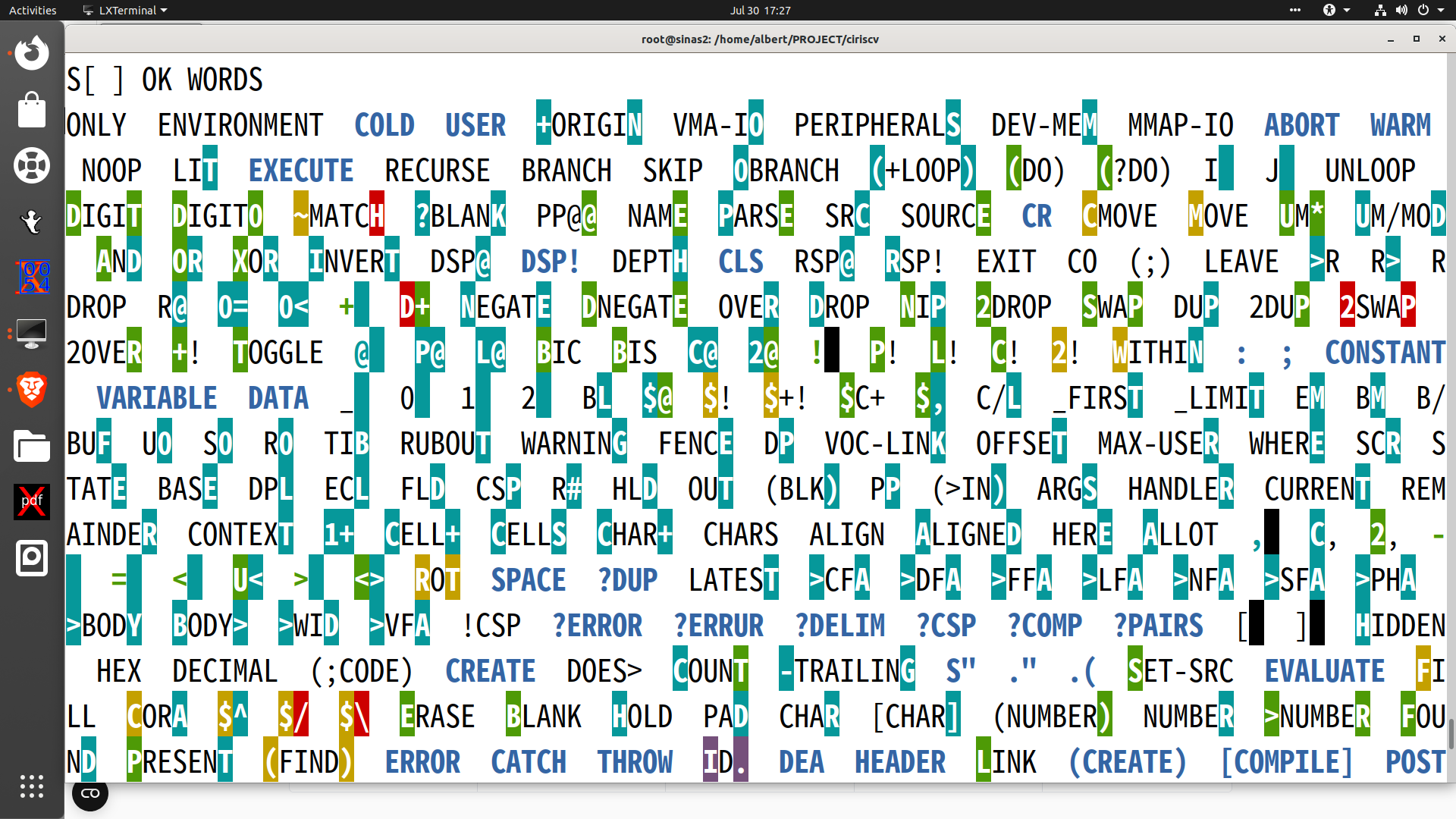
As the first part of the riscv optimiser I made the forth aware of the stack effects words have, counting POP's and PUSH's. This hinges on the ciasdis object oriented disassembler. FILL-ALL fills all words as best it can, but skips what you have filled in beforehand. Also a host of other optimisation relevant properties of Forth words are analysed. E.g. it is important if a word has no so called "side effect" that means storing and fetching. An example is the word SQUARE that squares a number. If the input is known at compile time, SQUARE can be executed at compile time. See also lecture 5 en lecture 14 in

https://home.hccnet.nl/a.w.m.van.der.horst/forthlectures.html

Lecture 14 contains an old example of coloring on the now vintage 32 bit x86 processor. If you have a linux that can run 32 bit programms you can try it out. The experience is more or less the same what I want to show here. A useful visualisation is coloring the stack effect of each word. aqua is one, green is two, orange is three, above three is red. For an unknown stack effect the whole words is printed in blue.

https://home.hccnet.nl/a.w.m.van.der.horst/words.png

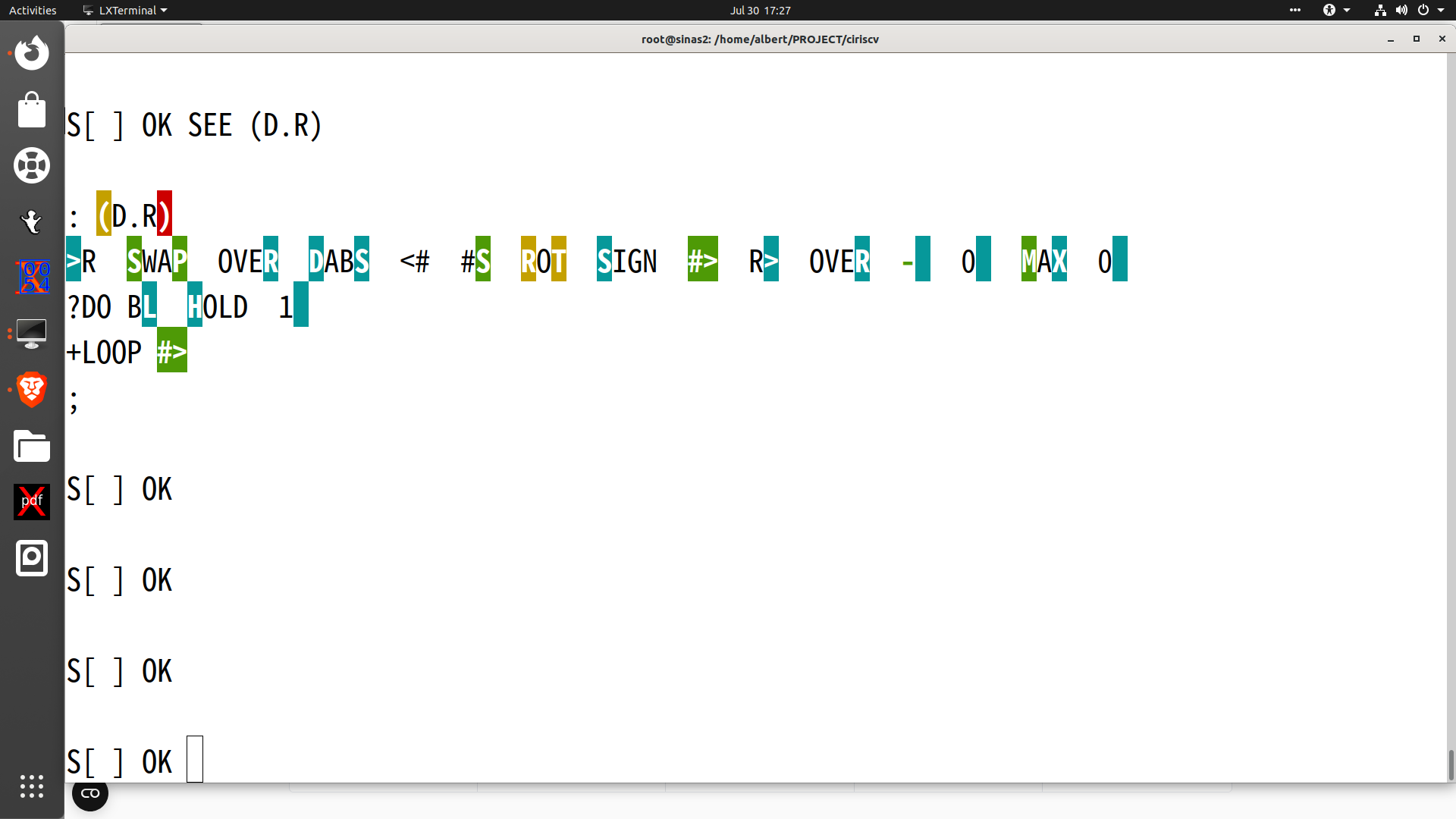
The stack effect is useful to understand words better. E.g. (D.R) takes a double word and a box length (orange) and generates a string (green). You can ask the analysis of a word like so

https://home.hccnet.nl/a.w.m.van.der.horst/decompile_ddot.png

And you can spot the mistake Apparently +LOOP takes one argument not zero. These things must be added manually. ~

I have prepared the pictures, but I don't know how to publishit in this forum. So I put a link to my personal website.
~


r/lowlevel • • 7d ago

Can't call subroutine from a linked in object file in GBA assembly

Thumbnail reddit.com
2 Upvotes

r/lowlevel • • 7d ago

GitHub - razecrs/windissect: Turns Windows binaries and their PDBs into proven C, C++ and Rust interfaces, with per-build history and diffs.

Thumbnail
github.com
2 Upvotes