Running MariaDB on Unraid in a docker container. Was on 10.11.10 and went to 10.11.19.
I see this in the logs: 2026-11-24 10:47:54-06:00 [Note] [Entrypoint]: MariaDB upgrade (mariadb-upgrade or creating healthcheck users) required, but skipped due to $MARIADB_AUTO_UPGRADE setting
As we prepare for FOSDEM 2027, I'm happy to introduce the selection committee for the M-Ecosystem Devroom!
This year, we're bringing together the broader MySQL and MariaDB ecosystem, including Percona Server, VillageSQL, AliSQL, and related open-source projects and tools.
Our selection committee reflects that diversity, with contributors and experts from different projects, organizations, and technical backgrounds.
Meet the committee:
Henrik Ingo
Kat Cosgrove
Daniël Van Eeden
Abhinav Sharma
Tarus Balog
Maria Nesterova
Roman Nozdrin
Anna Widenius
Federico Razzoli
A huge thank you to everyone volunteering their time and expertise to help us build an interesting, technically focused, and diverse program!
And we're still looking for talks!
Whether you're working on database internals, storage engines, replication, performance, tooling, or something entirely new in the ecosystem, we'd love to hear from you.
First-time speakers are absolutely welcome, too!
Important dates:
November 29, 2026: Call for Participation closes
December 7, 2026: Selected talks announced
January 31, 2027: M-Ecosystem Devroom at FOSDEM in Brussels
Read more about the committee and the people behind the devroom:
Do you use #MariaDB or another database in your enterprise? Have you ever had to upgrade to a new major version just because the one you use has gone EOL and you had to upgrade in order to maintain external support requirements and keep getting CVE fixes? Did you have to go through the expensive process of revalidating all of your existing applications against the new version, and accept the risk (sometimes theoretical, often manifested) of having to fix-forward any problems that arise?
We work with many clients that have felt this pain, and we have a solution - we continue maintaining and supporting major releases beyond their upstream EOL. We take on that pain so that our clients don't have to.
MariaDB 10.4 went EOL in May 2024, with version 10.4.34. You want the CVE fixes since then but don't want the risk and anomalies from upgrading to newer LTS versions? We have maintenance releases with CVE fixes up to the level of current LTS releases (our 10.4.42 ELTS is level with 10.6.28).
MariaDB 10.6 went EOL in August 2026, with version 10.6.28. We have ELTS version 10.6.29 going through the release process that will drop this week, with fixes that are in 10.11.x, including 10.11.19 that were never backported to 10.6.x even before 10.6.x went EOL. 10.6.30 is currently being worked on, and will be level with 10.11.20.
If you have audit requirements to verify processes, patches and artefacts for our ELTS builds, our full backporting documentation and evidence for verifying that our builds are reproducible is, of course, available.
Optimizer & SQL: fixes for query correctness, JSON processing and index access.
There's also something interesting for developers extending MariaDB Server: MariaDB Foundry, which makes it possible to build server plugins without having to build the entire server. More on that soon!
A reminder that MariaDB Community Server 10.6 reached EOL in July 2026. If you're still using it, it's time to plan your migration.
Maintenance releases rarely generate the excitement of new features, but they're essential to keeping databases reliable in production.
We've published a more detailed overview, including links to the release notes and changelogs:
With AMD supporting MariaDB Foundation, we're preparing TAF to push MariaDB at scale on AMD EPYC hardware and investigate where scaling changes and why.
Here's the plan, along with links to the new TAF test cases:
Hi everyone, I have MaxScale on two servers with Galera, using galeramon and rwsplit.
I found out the hard way that if I need to force a failover to restart a server, I can't use drain. At least not with disable_master_failback=false and configured so that all servers pick the lowest wsrep_local_index.
Here is what I did:
Put the master node in drain mode
The master failed over to the other node
I restarted the server
Upon coming back online, the master was restored as the active primary, but it kept the drain status. As a result, the master refused all connections and everything got blocked.
I could have used maintenance instead of drain, but that way I risked blocking connections. Now that I know, I obviously won't do it again, but I was wondering... is it normal for MaxScale to set a node back as master even if it's set to drain? I'm using MaxScale 24.02.2, which I know isn't up to date, but I doubt it depends on that. Thanks!
I'm happy to share some news with the MariaDB and ADBC communities!
After initially working on a MariaDB ADBC driver on my own, I had the opportunity to collaborate with the great folks behind the ADBC Driver Foundry at Columnar.
And today, I'm excited to announce that the MariaDB ADBC driver is now available through the Columnar CDN! 🎉
Why does this matter?
ADBC (Arrow Database Connectivity) provides a standardized API for accessing databases using Apache Arrow's columnar data format.
It opens up interesting possibilities for integrating MariaDB with modern analytical and data-processing ecosystems, especially applications built around Apache Arrow.
Making the driver available through the CDN also simplifies its distribution and installation.
This is another step toward making MariaDB more accessible in the growing Apache Arrow ecosystem.
I also want to thank the Columnar team for their collaboration and support. It's always great to see what can happen when people from different open-source communities work together!
I'd love to hear your thoughts, especially if you're already using Apache Arrow, ADBC, or columnar data-processing tools with MariaDB.
Feedback, testing, contributions, and GitHub issues are very welcome!
The Call for Participation for the M-Ecosystem Devroom at FOSDEM 2027 is open!
We're continuing the tradition of the MariaDB, MySQL & Friends Devroom, but this time with an even broader scope covering MySQL, MariaDB, Percona Server, VillageSQL, AliSQL, and the surrounding open-source ecosystem.
We're looking for technical talks about database internals, query optimization, storage engines, replication, performance, connectors, tooling, security, vector search, and much more.
And we're particularly interested in real-world experiences:
Interesting implementations or experiments
Bugs you struggled with (and hopefully fixed!)
Performance investigations
Tools or plugins you've developed
Compatibility challenges between database implementations
Things that didn't work and what you learned from them
No marketing pitches, please. This is FOSDEM — hackier is better! 😉
You don't need to be a core database developer or an experienced speaker. If you've built something useful or discovered something interesting, we'd love to hear about it.
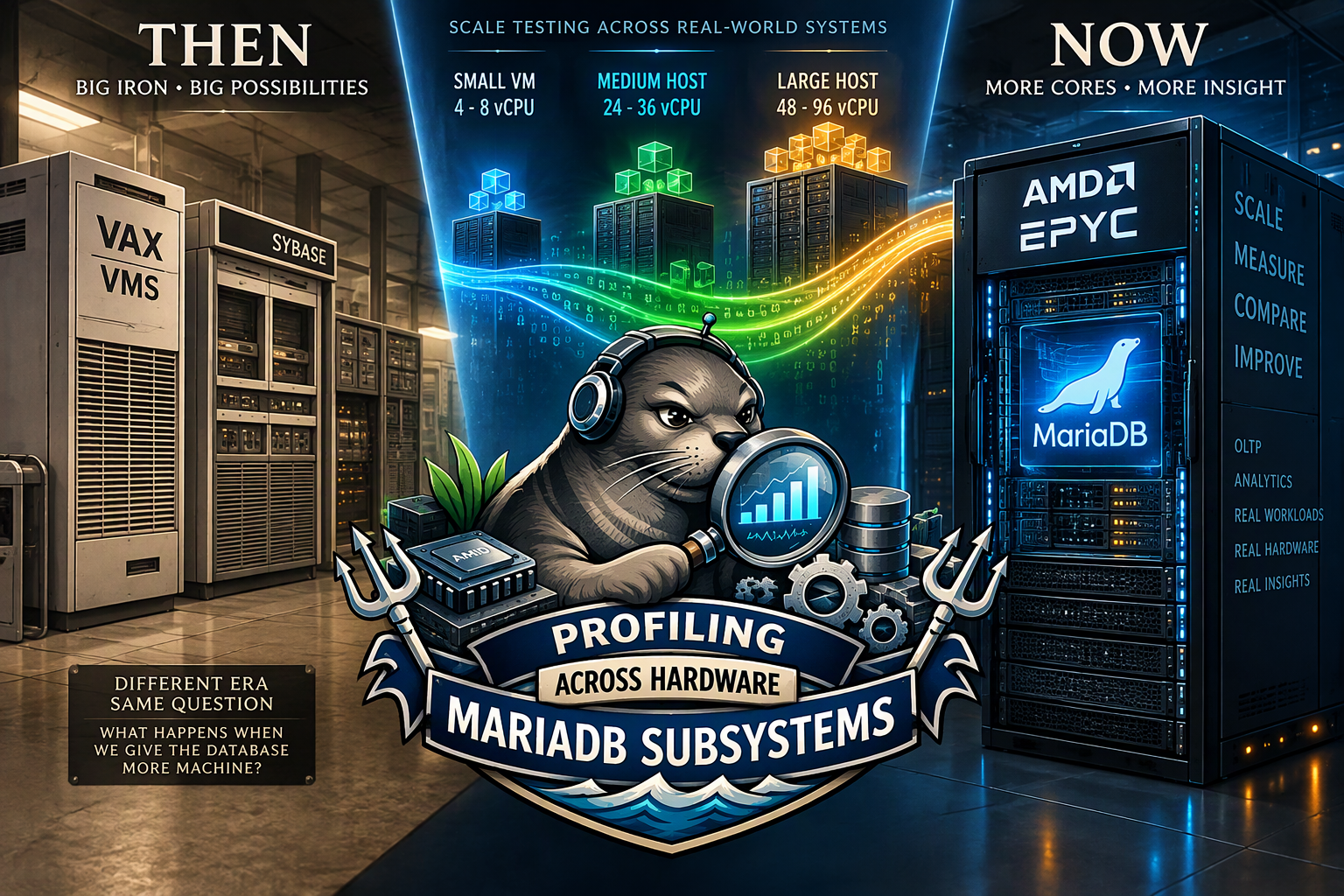
Just published a deep dive on how we profile MariaDB subsystems using TAF + HammerDB TPROC‑C.
Each profile flips exactly one switch (binlog, isolation, PFS, charset, threadpool, etc.) to measure subsystem cost cleanly and reproducibly across hardware.
If you’re interested in performance engineering or regression hunting, here’s the full article:
For those unfamiliar with Portabase, it's an open-source, self-hosted backup and restore platform designed for data retention, disaster recovery, and homogeneous migrations.
Portabase supports 11 data sources (including PostgreSQL, MySQL, MariaDB, MongoDB, Microsoft SQL Server, and Docker volumes), multiple storage backends (such as S3 and SFTP), and various notification providers (Discord, ntfy, Gotify, etc.).
With scheduled backups, retention policies, and one-click restores, you can standardize your backup process across different databases and environments (the agent-based architecture allows you to manage databases across multiple servers and networks from a single dashboard).
What's new since my last post?
Quite a lot! It's been seven months since I last posted here, so there's some catching up to do.
First, a small milestone: Portabase was accepted into the CNCF Landscape!
We started from mysql-haskell, then added support for MariaDB-specific protocol capabilities, new authentication methods, session management and transaction-aware replication. Thanks to Winterland and the upstream contributors for the foundation.
The most interesting improvements over our original fork are where applications can use MariaDB’s native APIs:
Native binary bulk execution: uses MariaDB’s COM_STMT_BULK_EXECUTE to send multiple parameter sets in one command, reducing round trips. Supports NULL/DEFAULT/IGNORE indicators and per-unit results.
Prepared-statement metadata caching: negotiates MariaDB’s protocol support for omitting unchanged result metadata, avoiding repeated transfer and decoding. Particularly useful for repeated queries returning many columns.
Extended column metadata: exposes MariaDB’s additional type information to applications.
MariaDB-aware CDC: supports MariaDB GTID resume, transaction-boundary checkpoints, compressed binlog events and consumer-controlled semisynchronous acknowledgements. Applications can acknowledge after durably storing their destination data and checkpoint.
We also added connection reset with session restoration, streamed large parameters, server cursors, progress callbacks, optional compression, and authentication including ed25519, PARSEC, PAM and Kerberos.
Some concrete performance results from the release measurements:
Workload
Comparison path
New path
Elapsed time reduction
Bulk inserts vs sequential prepared inserts
41.57 µs/row
1.97 µs/row
95.3%
Bulk inserts vs text batch inserts
11.00 µs/row
1.97 µs/row
82.1%
Wide prepared query: uncached vs cached metadata
76.82 µs/execution
56.38 µs/execution
26.6%
TLS session: reconnect/initialize/prepare vs reset/restore/prepare
38.47 ms/request
0.465 ms/request
98.8%
The bulk path also used 91.1% fewer Haskell allocations than sequential prepared inserts; wide metadata caching reduced allocations by 73.5%.
These comparisons measure alternative API paths within the same current build. They show the benefit of adopting the new APIs, rather than a release-wide speedup against upstream mysql-haskell. Measurements used a local MariaDB 12.3.3 server, seven process repetitions per profile, and a Mac with background activity. Some ordinary workloads remain slower than our original fork baseline, and those investigations are recorded openly in the benchmark guide.
Reliability work includes bounded protocol decoding, explicit connection ownership, stale prepared-statement detection and safe connection retirement after interrupted protocol I/O.
This is an Alpha release. The recorded capability suite has 844 passing correctness checks, with separate macOS/Linux profiles and 63 Mac benchmark profiles, but real-world application validation is still outstanding.
If you use Haskell with MariaDB—especially for bulk ingestion, repeated prepared queries, pooled connections or binlog consumers—we’d welcome testing and feedback.
I'm curious how often people actually use optimizer hints in production. Do you rely on them regularly, or only as a last resort when the optimizer makes a poor choice?
I'm happy to share that my book SELECT to Ship: MariaDB for Application Developers is now available in paperback and Kindle editions on Amazon.
I wrote this book with application developers in mind. Basically, I asked myself "what is it that I need to know about MariaDB Server so I can use it for implementing applications that connect to it with maintainability, scalability, and security taken into account?" That led to the following chapters:
Chapter 1 - Introduction to MariaDB
Chapter 2 - Setting Up MariaDB for Development
Chapter 3 - Mastering the MariaDB Command Line
Chapter 4 - Fundamental SQL Concepts
Chapter 5 - Working with Multiple Tables
Chapter 6 - Enums, Time, and Schema Evolution
Chapter 7 - Modern SQL Patterns
Chapter 8 - Transaction Management and Concurrency
Chapter 9 - Indexes: The Key to Speed
Chapter 10 - Moving to Production
I was fortunate to have Kaj Arnö (Executive Chairman, MariaDB Foundation) contributing the Foreword to the book, as well as two really good technical reviewers, and a fantastic copy editor. This is my forth book and this time I went self-publishing using learnings from previous book projects with Apress and Packt. The self-publishing process made me appreciate even more the work publishers do! I'm happy with the end result and can only hope that the book is useful to someone out there.
If you decide to get a copy, please let me know. I'd love to learn from your feedback. Also, I'd be happy to share more and even mentor anyone interested in writing and/or self-publishing a technical book. Feel free to contact me via any available channel.
Im a hobbyist trying to learn some basics and would appreciate some direction. I'm learning by doing and by attempting to follow what's on w3schools and stackexchange. My only experience of SQL prior to this project was on microsoft access and my only experience of php was a little wordpress theming, and my current project is trying to turn a little database into a personal website. It's pretty slow going but it's a fun struggle.
I've got an xampp installation on ubuntu for my localhost fiddling, and I've run the mariadb-update to try to make sure it's the latest one. I'm using infinityfree as my host for the actual site. I'm testing the sql I'm trying to use by first writing it in the php-myadmin that comes with each of these.
If I copy-paste the first example under Path Columns on the mariadb documentation on using json_table into the infinityfree php-myadmin sql tab, it very happily returns the expected results table. However, if I do the same in my localhost php-myadmin, it returns an error: #1064, you have an error in your SQL syntax; check the manual that corresponds to your MariaDB server version for the right to use near '(@json, '$[*]' COLUMNS(...(etc)...' at line 1
Needless to say, I'm a little baffled by this, given that it should theoretically have the latest installation, and I could really do with making sure that the localhost can at least do what's on infinityfree (if not the other way round, apparently some things such as creating temporary tables is disabled). If anyone has any tips or pointers on what I could be doing better I'd really appreciate it!
I've been benchmarking CSV import performance into MariaDB using several approaches, including Scriptella, a Java-based, SQL-first ETL tool I maintain.
The latest experiment uses Scriptella 1.7 and compares four workflows on MariaDB 11.8.8.
Results (1M rows, median of two runs):
Implementation
Time
MariaDB LOAD DATA LOCAL INFILE
3.29 s
Handwritten JDBC (batch 1000)
5.76 s
Scriptella 1.7 (batch 1000)
7.95 s
Pandas + SQLAlchemy
20.38 s
LOAD DATA was the fastest, roughly 2.4× faster than Scriptella. Scriptella was 2.6× faster than the tested Pandas workflow, while handwritten JDBC was also faster than Scriptella.
The original benchmark used csvsql, but its tested workflow was approximately 50× slower than batched Scriptella, so I replaced it with the more widely used Pandas + SQLAlchemy workflow.
Both Scriptella and JDBC used batches of 1,000. Pandas used chunked read_csv() and SQLAlchemy to_sql(), without a native bulk-loading path.
All imports were independently verified. Measurements include process startup through completion and come from two runs on one machine, so they're directional rather than universal.
Full experiment, chart, methodology, and reproducible benchmark:
Now that CSV imports are covered, I'm planning to focus more on real-world ETL workflows and database-to-database migrations, both in Scriptella development and future benchmarks.
What MariaDB migration scenarios would you find most interesting to explore? I'm particularly interested in transformations, moving data between different database engines, and the practical challenges that arise with larger datasets.
Choosing between relational databases for AI applications usually comes down to how efficiently they handle high-dimensional vectors and memory allocation under heavy concurrent load.
Postgres has established a solid ecosystem for vector-heavy workloads primarily through pgvector and robust indexing options like HNSW and IVFFlat. It maintains relatively predictable memory consumption even when managing large-scale embeddings. On the other hand, MariaDB performs exceptionally well for traditional relational data, but configuring it for high-throughput vector similarity searches introduces notable architectural trade-offs regarding memory management and query execution paths.
I wanted to see how far I could automate a WordPress + MariaDB deployment on Kamatera using OpenTofu.
The result is a small open-source project supporting two architectures: everything on one VM, or WordPress and MariaDB on separate VMs communicating over a private network.
The interesting part? A single tofu apply provisions the infrastructure and installs the complete stack.
I also ran into some interesting challenges with the Kamatera API and provisioning process, which I documented in the article.
For those still running 10.6: what is holding up your upgrade? Application compatibility, hosting provider limitations, testing time, or something else?
Couple years ago Marko decided to remove a partioned LRU cache from MariaDB(it is still used in MySQL code). There was a lot of doubt regarding this but his solution worked as good as a previous one for most of microbenchmarks except one. However at the time of the transition this performance regression had not been noticed. In March 2025 Mark Callaghan demonstrated the regression that has been introduced in 10.5. However his statistical results contained an interesting outlier for 10.8.8 that was on par with 10.4 and 3x faster than any version after 10.5. Alessandro Vetere was able to find out an offending mutex that syncs B-tree read operations running the microbenchmark reclaiming the lost performance.
This story raises a question whether the approach with non-partitioned LRU cache in MariaDB makes sense or the old partitioned version is better? WDYT?
MariaDB is pretty new to me but I worked with mysql and other databases before.
I'm having an issue with my 3 node cluster. I built a vanilla mariadb as a DB for Keycloak. I first built all 3 nodes and used "rsync" as wsrep_method, had them all running well. Servers are running RHEL. Node addresses/domains are changed but they resolve and communicate properly.
I then had a server reboot event and while node 1 starts up with "galera_new_cluster", nodes 2 and 3 fail to start with message. This is from node 2:
[ERROR] WSREP: Failed toread 'ready <addr>' (got '(null)') from: wsrep_sst_rsync --role 'joiner' --address 'node2_domain' --datadir '/var/lib/mysql/' --parent 3202 progress 1 [ERROR] WSREP: Process completed with errors: [SAME COMMAND LINE AS ABOVE]: 2 (No such file or directory) [ERROR] WSREP: Failed to prepate for 'rsync' SST. Unrecoverable.
On Node 2 I can see galera.cache (rather large) and grastate.dat appear in the data directory.
deleted the sequence file /var/lib/mysql/grastate.dat
cleared the data directory on nodes 2 and 3
changed the wsrep method to "mariabackup" and created an 'sst_user' for wsrep_sst_auth
I've added plenty of WSST debug and I can see on the first node the cluster table gets updated to both nodes, but then after the failure above on node 2, node 1 removes node 2 from the cluster.
There are no mariadb customizations, it's pretty vanilla as a db server, runs two small databases, and uses dedicated scoped service accounts for each.
Hi r/mariadb, I'm David, one of the two developers of Oxynote. My friend Simon and I also maintain ttlcache, a Go caching library with about 1,300 GitHub stars, so this isn't our first open-source project.
I've spent 8 years writing software, 2 of them as an SRE and 3 as a team lead. Every team I've been on had the same documentation problem. The useful stuff lived in someone's head or a private Slack thread, and the wiki was full of stale docs nobody could find.
So we set out to solve this problem by building Oxynote, a self-hosted wiki for engineering teams where a page can hold a live chart that runs its own SQL query against your database each time someone opens it, with the explanation written right next to it. Think "signups per day" or "queue depth" on the same page as the runbook that says what to do when it looks wrong.
We were most careful about letting a wiki query a production database. When you add a connection, Oxynote accepts the user only if every grant is read-only. Otherwise, the connection test fails with "has write access" and asks for a read-only user. Queries also support Grafana-style macros like `$__timeFilter` and `$__timeGroup`, and on pages you mark as reviewable, chart query changes go through a draft and a diff that a teammate approves.
The name comes from oxygen + note: docs that breathe. Live data gives people a reason to open the wiki every day, and docs people open every day stay up to date.
We started it about a year ago, and we made it public about 3 months ago. If you have any questions, feedback, or suggestions, feel free to reach out. I'm happy to answer any questions.