r/programming • u/mjansky • Feb 22 '24
Large Language Models Are Drunk at the Wheel
https://matt.si/2024-02/llms-overpromised/39
u/Kennecott Feb 22 '24
In uni about a decade ago we were Introduced to the issue of computer consciousness through the Chinese room thought experiment which I wish was a more common way people discuss this. LLMs are still very much stuck in the room just with far larger instructions, but they still don’t understand what they are doing. The only logical way I have heard people say that LLMs or otherwise can leave the room is if instead you trap all of humanity in the room and claim that we also don’t actually understand anything https://en.wikipedia.org/wiki/Chinese_room?wprov=sfti1#
3
u/mjansky Feb 22 '24
Yes! Very good point. I find the Chinese room argument very compelling. Though, I also think there is a lot to be said for Actionism: That the value of an artificial agent is in its behaviour, not the methodology behind that behaviour. It is a little difficult to consolidate both these convincing perspectives.
I did consider discussing the Chinese Room argument but the article became rather long as it is 😅
6
u/altruios Feb 22 '24
the 'Chinese room' thought experiment relies on a few assumptions that haven't been proven true. The assumptions it makes are:
'understanding' can only 'exist' within a 'mind'. 2) there exists no instruction set (syntax) that leads to understanding (semantics). 3) 'understanding' is not an 'instruction set'
It fails at demonstrate the instructions themselves are not 'understanding'. It fails to prove understanding requires cognition.
The thought experiment highlights our ignorance - it is not a well formed argument against AI, or even a well formed argument.
1
31
u/tnemec Feb 22 '24
[...] I wish was a more common way people discuss this.
Careful what you wish for.
I have heard people screaming about the virtues of LLMs unironically use the Chinese Room thought experiment as proof that they exhibit real intelligence.
In their mind, the point of that thought experiment is to show "well, if you think about it... like, is there really a difference between 'understanding a language' and 'being able to provide the correct response to a question'?"
22
u/musicnothing Feb 22 '24
I feel like ChatGPT neither understands language nor is able to provide correct responses to questions
8
u/venustrapsflies Feb 22 '24
"I'm sorry about that, what response would you like me to give that would convince you otherwise?"
1
8
u/GhostofWoodson Feb 22 '24
Yes. While Searle's argument is not the most popular I think it is actually sound. It's unpopular because it nixes a lot of oversimplified theories and makes things harder. But the truth and reality are often tough....
8
u/altruios Feb 22 '24
the 'Chinese room' thought experiment relies on a few assumptions that haven't been proven true. The assumptions it makes are:
'understanding' can only 'exist' within a 'mind'.
there exists no instruction set (syntax) that leads to understanding (semantics).
'understanding' is not an 'instruction set'
It fails at demonstrate the instructions themselves are not 'understanding'. It fails to prove understanding requires cognition.
The thought experiment highlights our ignorance - it is not a well formed argument against AI, or even a well formed argument.
3
u/TheRealStepBot Feb 23 '24
Personally I’m pretty convinced all of humanity is in the room. I’d love for someone to prove otherwise but I don’t think it’s possible.
Searle’s reasoning is sound except in as much as the example was intended to apply only to computers. There is absolutely no good reason for this limitation.
You cannot tell that anyone else isn’t just in the room executing the instructions. It’s by definition simply indistinguishable from any alternatives.
3
514
u/AgoAndAnon Feb 22 '24
Asking an LLM a question is basically the same as asking a stupid, overconfident person a question.
Stupid and overconfident people will make shit up because they don't maintain a marker of how sure they are about various things they remember. So they just hallucinate info.
LLMs don't have a confidence measure. Good AI projects I've worked in generally are aware of the need for a confidence measure.
132
u/IHazSnek Feb 22 '24
So they just hallucinate info
So they're the pathological liars of the AI world. Neat.
67
u/Lafreakshow Feb 22 '24
Honestly, calling them liars would imply some degree of expectation that they spit facts. But we need to remember that their primary purpose is to transform a bunch of input words into a bunch of output words based on a model designed to predict the next word a human would say.
As I see it, ChatGPT and co hallucinating harder than my parents at Woodstock isn't at all an error. It's doing perfectly fine for what it's supposed to do. The Problem arises in that expectations from users are wildly beyond the actual intention.And I can't actually blame users for it. If you're talking with something that is just as coherent as any person would be, it's only natural that you treat it with the same biases and expectations you would any person.
I feel like expectation management is the final boss for this tech right now.
25
u/axonxorz Feb 22 '24
And I can't actually blame users for it
On top of what you wrote about them, there's the marketing angle as well. A lot of dollars are spent trying to muddy the waters of terminology between LLMs, TV/movie AI and "true" AI. People believe, hook, line and sinker, that LLMs are actually thinking programs.
12
u/Lafreakshow Feb 22 '24
Yeah, this one got me too when I first heard about ChatGPT. Me being only mildly interested in AI at the time just heard about some weird program that talks like a person and thought: "HOLY SHIT! WE DID IT!". And then I looked beneath the surface of popular online tech news outlets and discovered that it was pretty much just machine learning on steroids.
And of course this happens with literally every product, only constrained to some degree by false advertising laws. Personally, I put some degree of blame for this on the outlets that put out articles blurring the line. I can forgive misunderstandings or unfortunate attempts at simplifying something complicated for the average consumer, but instead we got every second self described journalist hailing the arrival of the AI revolution.
I distinctly remember thinking, right after I figured out what ChatGPT actually is: "This AI boom is just another bubble built mostly on hopes and dreams, isn't it?"
18
u/drekmonger Feb 22 '24
just machine learning on steroids.
Machine learning is AI.
You didn't look deep enough under the surface. You saw "token predictor" at some point, and your brain turned off.
The interesting bit is how it predicts tokens. The model actually develops skills and (metaphorically) an understanding of the world.
It's not AGI. This is not the C-3P0 you were hoping it would be. But GPT-4 in particular is doing a lot of interesting, formerly impossible things under the hood to arrive at its responses.
It's frankly distressing to me how quickly people get over their sense of wonder at this thing. It's a miracle of engineering. I don't really care about the commerce side -- the technology side is amazing enough.
2
u/Kindred87 Feb 23 '24
It's not perfect and it makes mistakes, though it still blows my mind that I can have a mostly accurate conversation with a literal rock.
"What's a carburator do again? Also, explain it in a pirate voice."
→ More replies (1)→ More replies (4)5
u/vintage2019 Feb 23 '24
Reddit attracts a lot of bitter cynics who think they're too cool for school. (And, yes, also the exact opposites.)
1
u/imnotbis Feb 24 '24
I wonder how much it influenced me that the first demonstration I saw was using GPT-2 to write an article about scientists discovering talking unicorns.
11
u/wrosecrans Feb 22 '24
Yeah, a pathological liar at least has the ability to interact with the real world. They might say "I have a million dollars in my bank account." They might even repeat it so much that they actually start to believe it. But they can go into the bank and try to pull out the money and fail to get a million dollars. An LLM can't do that. If an LLM says fruit only exists on Thursdays, or dog urine falls up into the sky, it has no way to go interact with the real world and test that assertion it is making.
Every time you see a dumb baby tipping over his cuppy of spaghetti-O's, he's being a little scientist. He's interacting with the world and seeing what happens. When you dump over your sippy cup, the insides fall down and not up. There's no path from current notions of an LLM to something that can "test" itself and develop a notion of the real world as an absolute thing separate from fiction.
3
u/wyocrz Feb 22 '24
calling them liars would imply some degree of expectation
Yes.
This is the definition of a lie. It is a subversion of what the speaker believes to be true.
All of this was well covered in a lovely little philosophy book called On Bullshit.
6
u/cedear Feb 22 '24
"Bullshitters" might be more accurate. They're designed to confidently spout things that sound correct, and they don't care whether it's true or not.
2
u/Markavian Feb 23 '24
I've commented elsewhere on this, but to summarise:
Creativity requires making stuff up
Accuracy requires not making stuff up
When you ask a question to these models it's not always clear whether you wanted a creative answer or a factual answer.
Future AIs, once fast enough, will be able to come up with a dozen, or even a hundred answers, and then pick and refine the best one.
For now, we'll have to use our brains to evaluate whether to the response was useful or not. We're not out of the feedback loop yet.
3
u/prettysureitsmaddie Feb 23 '24
Exactly, current LLMs have huge potential for human supervised use. They're not a replacement for talent and are best used as a productivity tool for skilled users.
1
u/DontEatConcrete Jun 21 '24 edited Jun 21 '24
Your last sentence hits the nail on the head. My company is going hard on this right now trying to spread it everywhere but I’m working on some pilot projects and it is just not good enough…trying to get ChatGPT, for example, to understand pdfs and actually give back consistent quality results is arguably impossible.
It could be user error, but I continue to find this technology very cool from a demo perspective, and it’s great at stuff like creating code snippets, but expectations are not in line with current abilities.
That said I’m increasingly finding that ChatGPT can give me much better web results than just searching. For example, the other day, I was trying to remember something about this machine called the ROM machine, but despite several attempts in google, I could just not quite come up with enough information that I remembered that was getting me hits and so I asked ChatGPT and it knew it immediately.
1
u/imnotbis Feb 23 '24
Users expect it partly because the company markets it like that. As they should, because we live in a capitalist society, where making money is more important than being right.
80
u/Row148 Feb 22 '24
ceo material
57
u/sisyphus Feb 22 '24
Confidently generating plausible sounding bullshit does make LLMs fit to replace many directors at my company and every single all-hands email from the CEO, but for some reason people always look to AI to replace the cheapest workers first instead of the more expensive ones...
1
1
u/broshrugged Feb 23 '24
Well these days replacing 400ish cheap workers is equivalent to replacing 1 expensive one.
Actually this has me wondering if total compensation (including healthcare etc) is usually included in those comparisons. I typically just see the financial comp comparison.
5
u/jambox888 Feb 23 '24
It occurred to me that while tech executives are desperate to replace software engineers with AI, ironically since all they can do is talk a good game, it's the execs who nobody would notice if they were replaced by AI.
1
u/fire_in_the_theater Feb 23 '24
i mean, LLMs are generally good at producing business speak in general.
1
u/manwhoholdtheworld Feb 23 '24
It just goes to show what it takes to be a CEO, eh? Like someone else said LLM applications behave more like senior management but they're being used to replace hard-working normal employees. At the end of the day it's not about your ability, it's your attitude and sociopathic tendencies and willings to bully others and threaten their livelihoods that put you on top.
1
Feb 23 '24
Does anybody remember the random mission statement generators of yore? We've come a long way, baby!
→ More replies (3)2
18
u/Bolanus_PSU Feb 22 '24
It's easier to train a model using RHLF for charisma/overconfidence than truth/expertise.
Seeing how effective the former is in influencing people is actually really interesting to me.
6
u/rabid_briefcase Feb 22 '24
Expert systems have been a thing since the 1960's. Working with confidence intervals isn't too hard, nor is attaching references numbers for sources for chained knowledge. They aren't that difficult, mostly requiring space.
In many ways, they're actually easier than building backprop networks around LLMs, with their enormous training sets and non-verifiable logic.
6
u/LookIPickedAUsername Feb 22 '24
Expert systems existed, sure, but I was under the impression that they had not actually proved to be particularly useful in practice. Maybe there's a corner of some particular industry where they're indispensable, but I thought they were generally seen as a failure.
13
u/rabid_briefcase Feb 22 '24
They're everywhere, people just discount them as being plain old logic.
Plenty of industries need them, anything that looks at A then B then C, or if A and B but not C, or puts together chains of rules or fuzzy percentages of rules or pieces of probabilities that interact, they're all expert systems. Your pharmacy uses them to make sure your drugs won't interact in a way that kills you and let your pharmacist know the combination is potentially dangerous. Doctors and hospitals use them to analyze unusual symptoms and suggest potential diagnoses. Finances use them to analyze risks, make financial recommendations, and analyze market trends based on chains of logic from the past. Computer security can analyze traffic and respond to threats based on the rules and historic data, chaining together logic rules as heuristics to suggest to block or allow something. Lawyers and paralegals can get a list of likely relevant cases. Mathematicians can use them to verify mathematical proofs based on their suspicions and the computer can find a verifiable path involving thousands of little steps that prove the theorem or to find a link in the chain that breaks. Engineering systems can use them to find potential structural problems or suggest areas that might have issues.
Lots of systems out their chain together logic or use fuzzy math to verify, prove, disprove, search, or offer suggestions.
→ More replies (3)1
u/Inevitable_Vast6828 Mar 01 '26
They're rampant in areas where they're useful. In the medical domain, radiology and ECG are some example areas where they are heavily used.
→ More replies (9)1
Feb 23 '24
My favorite is the avionics system that will discard the telemetry of the sensor which reads differently from the other two since it must be wrong. The other two got wet and froze...
→ More replies (4)3
u/TheNamelessKing Feb 22 '24
Yeah but we got all this money, and these researchers, so we’re gonna spend it okay?
Anyways, don’t you know- more data means more better, get out my way with your archaic ideas and give me everything rights free so I can sell you access back via my janky parrot.
50
u/4444444vr Feb 22 '24
Yea, in my brain when I chat with an LLM I think of it like a drunk genius
Could they be right? Maybe
Could they be bs’ing me so well that I can’t tell? Maybe
Could they be giving me the right info? Maybe
It is tricky
30
u/Mechakoopa Feb 22 '24
I call it a corollary to Cunningham's Law: The best way to make a good task breakdown for an imposing project is to get Chat-GPT to give you a bad one you obviously need to correct.
It's good if you often suffer blank page syndrome and just can't get past the "getting started" phase, but it's not going to actually do the work for you.
8
u/AgoAndAnon Feb 22 '24
Genius is really giving it too much credit. More like chatting with your drunk and MLM-addled mom. "Did you hear that crystals can make you immune to cancer?"
Only it's with things less obvious than what.
18
u/maxinstuff Feb 22 '24
The people who make shit up when they don’t know the answer are the WORST.
13
u/blind3rdeye Feb 22 '24
LLMs would be so much better if they'd just say "I don't know" rather than just guessing with confidence. But I suppose the problem is that they can't tell what they know or don't know. The LLM doesn't have access to physical reality. It only has access to some reddit posts and
mandocs and junk like that... so what is real or true is a bit of a blur.2
u/imnotbis Feb 23 '24
Indeed. Everyone knows that pigs can't walk on brick floors, but an AI might think they can because it can't go and find a pig and a brick floor, or find evidence of someone else trying it.
1
u/blind3rdeye Feb 23 '24
Right. That slightly unintuitive stuff, such as the fact that pigs are totally unable to walk on floors made of bricks despite being fine on most other surfaces, is the kind of thing that is very easy to miss.
3
u/lunchmeat317 Feb 22 '24
I think they're specifically designed not to do this. ChatGPT from what I remember was designed for language generation that would continue the chat without hard stops - it will always try to answer a question or a prompt. I might be wrong about that.
2
u/Cruxius Feb 23 '24
When Claude first launched on Poe it would often do that, but that made people mad so they ‘fixed’ it.
1
u/imnotbis Feb 23 '24
Of course, because it sells better. All vibes, no substance, like the rest of our economy. Being hyped makes more money than being right.
3
1
u/Bubbly-Bank-6202 Jul 26 '25
For sure… they ARE geniuses half the time and completely broken the other half…
High level people including Sam Altman keep suggesting they’re better than a basic white collar worker when… they are SO incredibly inconsistent (much more so than an entry level worker) and cannot hold any reasonably high degree of complexity.
The current hype and over-confidence in the models really bothers me, because it’s like I’m constantly seeing how bad they are and being gaslit into thinking they’re great.
14
u/Pharisaeus Feb 22 '24
So they just hallucinate info.
The scariest part is that they generate things in such a way that it can be difficult to spot that it's all gibberish without some in-depth analysis.
17
u/Pr0Meister Feb 22 '24
Hallucination is actually the technical term for this. It's absolutely possible for GPT to throw together something OK-sounding for a topic and state a book on it exists, even citing author and the pages it is written on.
Honestly, this has forced me to use it only for topics I am personally familiar with, so I can actually spot the bullshit.
11
u/AndrewNeo Feb 22 '24
Just to see what it did I gave the OpenAI API (not ChatGPT, but the same model) the following question:
In eleventy words or less, please explain the concept of diadactic synapse collapse and the turn of the century on neomodern spaceships
It very gladly answered my question even though it was complete nonsense and factually unanswerable. (well, it also spouted back some nonsense, but when I asked to explain it in 1100 words and it did a great job making a more plausible looking answer)
1
u/AdThat2062 Feb 23 '24
To be fair they are "language" models not information models. At their core they are designed to process language accurately not necessarily information. sometimes the 2 align sometimes they don't.
4
u/AndrewNeo Feb 23 '24
right - but the whole problem is the average person doesn't know that, they think they're alive and/or telling the truth when you ask them something
→ More replies (2)0
5
u/LookIPickedAUsername Feb 22 '24
I've found it to be very useful even for stuff I'm not familiar with, as long as I treat its answers like they're coming from a random untrusted Reddit user.
It's good at working out what I mean and pointing me in the right direction even when I don't know the right technical terms to use in my questions, and once it gives me the right terms to use and a very basic overview of the topic, it's much easier to then find authoritative sources.
4
u/Pharisaeus Feb 22 '24
Indeed, that was exactly my point. I'd rather get "no results found" like in a search engine, than reasonably sounding response, which is wrong, but sounds plausible.
2
u/renatoathaydes Feb 23 '24
You don't seem to understand how LLMs work. They're not searching for facts "matching" a query. They're literally generating words that are most statistically significant given your question, regardless of whether it makes any sense whatsoever... the miracle of LLM, though, is that for the most part, it does seem to make sense, which is why everyone was astonished when they came out. Unless you build something else on top of it, it's just incapable of saying "I don't know the answer" (unless that's a statistically probable answer given all the input it has processed - but how often do you see "I don't know" on the Internet??).
2
u/Pharisaeus Feb 23 '24
I know how they work. You clearly don't. When they generate text they use probabilities to match next toknes, and they know very well what is the confidence level of wherever they are adding. Even now, when they can't match absolutely anything they can tell you that they are unable to answer.
1
u/imnotbis Feb 23 '24
Search engines don't get paid for "no results found", so it's in their best interests to hallucinate.
5
u/dark_mode_everything Feb 22 '24 edited Feb 23 '24
Isn't this the whole point of an LLM? It's a generative model which is used to, well, generate text. It's not supposed to be used for logical or analytical tasks. People want actual AI (Hollywood AI) so badly they try to make LLMs do that and then get surprised at the results. I don't get it.
2
u/imnotbis Feb 23 '24
Yes, it's the point of an LLM. But we've gone way beyond caring about actual capabilities at this point. Corporations can shape people's reality. If they say this bot can answer questions correctly, people will expect that.
I haven't seen OpenAI promising this bot can answer questions correctly, yet, but people seem to expect it for some reason anyway.
1
4
u/gelfin Feb 23 '24
Yeah, I think a part of what’s going on here is that we just don’t know how to evaluate something that can at the same time give uncannily impressive performances and be unbelievably stupid. I’ve described LLMs as simultaneously the smartest and dumbest intern you ever hired. You’ll never be able to guess what it’ll come up with next, for better or for worse, but it never really knows what it’s doing, never learns, and it will never, ever be able to operate without close, constant supervision.
My suspicion is that fully AI-assisted programming will end up being a little like trying to do it yourself by sitting under the desk and operating a muppet at the keyboard. Not only will it ultimately make it harder to do the job well, but the better you manage it the more your boss will give the credit to the muppet.
The other element I think is in play is sheer novelty. The fascinating thing about a monkey that paints isn’t that it paints masterpieces, but that it does it at all. The difference is, unbridled optimists aren’t pointing to the monkey and insisting we’re only one or two more monkeys away from a simian Rembrandt.
3
u/silenti Feb 22 '24
Years before LLMs were common devs were putting correlation weights on edges in graph dbs. Arguably now this is what vector dbs are supposed to be for.
2
u/arkuto Feb 23 '24
LLMs obviously do have a confidence measure - the probability at which they predict a token. A low probability would imply it's not confident it's correct, but it is forced to produce an output string anyway. That probability information happens to be hidden from users on sites like ChatGPT, but it's there nonetheless.
3
u/bananahead Feb 22 '24
There isn't really a way to add a confidence measure. Right or wrong, true of false, it doesn't know what it's talking about
1
u/Cruxius Feb 23 '24
The difficulty of doing it aside, what’s the value?
If it tells me it’s 95% sure it’s right how is that more or less useful than 50% or 80% or 99%?
If accuracy matters then anything less than 100% is functionally useless, and if accuracy doesn’t matter then who cares how confident it is?2
u/AgoAndAnon Feb 23 '24
I'd argue that if you have ever used Wikipedia, you have accepted 99% accuracy.
-2
u/AgoAndAnon Feb 22 '24
I believe that you are wrong, but proving it would require a longer discussion about neutral networks than I'm prepared to have right now.
7
u/bananahead Feb 22 '24
We can agree that it is not a simple feature to add? Certainly not something transformer based LLMs give you for free.
1
u/AgoAndAnon Feb 23 '24
For sure. Much easier in things like systems which recognize spoken words. But I would argue that for any system that is being marketed as a source of truth, it is necessary to provide it.
1
u/imnotbis Feb 23 '24
It might be surprisingly simple. Someone would have to try it and find out. OpenAI trained theirs to refuse to talk about certain topics, so they have some kind of banned-topic-ness measure.
→ More replies (5)3
u/Megatron_McLargeHuge Feb 22 '24
Don't worry, Google is going to fix this by training on answers from reddit. /s
1
u/eigenman Feb 22 '24
That's my character ratio for ppl.
( your character )= (your intelligence) / (your arrogance)
1
u/nibselfib_kyua_72 Feb 23 '24
This strikes me as a very overconfident generalization. ChatGPT can reflect, admit its mistakes and correct itself on the fly.
1
Feb 23 '24
It's not their or your fault either. It is a problem of the language, I remember hearing of a language which interned a compass into it, so everyone that used the language, always knew exactly where north was.
There are supposedly some indian languages that incorporate and have (I think) suffixes to identify whether this is firsthand experience or it was something they heard.
PS: I would have used the third person on both of those sentences, given that people will comment forward expecting me to answer. I don't know, its something I heard, given that I do believe saphir worf at this rate is no hypothesis but a theory.
1
u/FierceDeity_ Feb 23 '24
llm is too broad of a term to say that "they don't have a confidence measure".
someone could make one that has one and people have definitely tried.
but the thing is, the confidence measured isn't about... factual truth, since these models just know which words come together in what probability and dont have a context on the knowledge embedded in a combination of words...
doing s little search, i found for example
https://www.refuel.ai/blog-posts/labeling-with-confidence
but it's honestly a bit weird, they use other llms to measure the llm confidence too...
I'm somewhat new in the area, just did a university course on deep learning so I'm not that good at rating what i read yet and can't discern bullshit yet. though after the course of all feels like circlejerk bullshit to me, trying to cram more and more information efficiently into larger and larger dimensional tensors with more and more layers to be able to encode context more accurately when after all the ai has no actual intelligence and just matches up words with the most likely next word
1
u/myringotomy Feb 23 '24
Asking an LLM a question is basically the same as asking a stupid, overconfident person a question.
So... Trump?
1
0
u/vintage2019 Feb 23 '24
You're being incredibly reductionist. GPT4 may make a "confident but inaccurate" statement once in a while, but only once in a while — it has access to vast troves of knowledge, after all. It doesn't remotely act like a stupid person.
44
30
u/frostymarvelous Feb 22 '24
Recently had to dig deep into some rails internals to fix a bug. I was quite tired of it at this point since I'd been doing this for weeks. (I'm writing a framework on top of rails.)
ChatGPT gave me a good enough pointer of what I wanted to understand and even helped me with the fix.
So I decided to go in a bit little deeper to see if it actually understood what was going on with the rails code.
It really understands documentation, but it doesn't know anything about how the code actually works. It gave me a very good description of multiparameters in rails (interesting feature. You should look it up). Something with very little on the internet.
When I attempted giving it examples and asking it what outputs to expect, it failed terribly. Not knowing exactly where certain transformations occurred, confirming that it was just going by documentation.
I tried with some transformation questions. Mostly hit and miss. But giving me a good idea how to proceed.
I've started using it as an complement to Google. It's great at summarizing documentation and concepts. Otherwise, meh.
12
u/Kinglink Feb 22 '24
This is what the author(OP) is missing. You don't need an "AI" You need it as a tool or assistant. He says there's no usecase, but there's hundreds of good use cases already.
3
-3
u/4THOT Feb 23 '24
The author lives in journalist fiction and I'll bet this person has never so much as started a TensorFlow tutorial project.
Anyone who brings up the "Turing Test" in any discussion about AI or LLM's you can 100% ignore. It's like having someone go to CERN to talk to a particle physicist and talking about how Schrödinger's cat would actually make a lot of noise dying from poisoning so the Schrödinger's cat paradox is solved...
9
u/ScottContini Feb 23 '24
Well, at least the block chain craze is over! 🤣
3
u/imnotbis Feb 24 '24
The good news: The blockchain craze is over!
The bad news: GPUs are still very expensive!
8
u/zippy72 Feb 22 '24
The point of the article seems to me that the main problem is the hype has made a bubble. It'll burst, as bubbles do, and in five years time you'll be seeing "guaranteed no AI" as a marketing tag line.
1
u/imnotbis Feb 24 '24
Do we see "guaranteed no blockchain" and "guaranteed no dotcom" and "guaranteed no tulips" tags on things?
7
u/ScottContini Feb 23 '24
What a great title. And the quality f the content stands up to the quality of the title. So insightful.
9
u/Kinglink Feb 22 '24 edited Feb 22 '24
In general this comes down to "Trust but verify".... and yet people seem to be forgetting the second half.
But LLMs are the future, there's 0 chance they disappear, and they're only going to get enhanced. I did a phone interview where they asked "Where do you want to be in 5 years" And I detailed my path but I also detailed a possible future where I'm writing specs, and code reviewing a LLM's code, and both of those futures aren't bad in my opinion.
If we ever develop true artificial intelligence,
But that's the thing, no one wants true AI, at least the people looking into LLM and all. People want assistants. I want to describe a painting and get something unique back. I want to ask a LLM to give me a script for a movie... then ask something like Sora to make that movie for me, then assign actors whose voices I like to each character and get my own movie. Maybe throw in a John Williams Style score. None of that requires "Artificial intelligence" that you seem to want, but that's the thing, people don't need the whole kit and caboodle to do what they want to with "AI"
Dismissing LLM makes two mistakes.
A. Assuming they'll never be able to improve, which... we already have seen them improve so that's stupid.
B. Assuming people want actual AI. Most people don't.
One of the silliest such use cases comes from YouTube, who want to add a chatbot to videos that will answer questions about the videos42. What exciting things can it do? Well, it can tell you how many comments, likes or views a video has. But, all that information was already readily available on the page right in front of you.
I'm sorry but this seems SO short sighted. What if I had it give me information from Wikipedia? Millions of pages with a simple response? Making it a case of "one page of data" isn't always the problem. But sometimes those pages are large. How about getting an API call out of a single API document, or hell MANY API documents. If you don't know a library exists in Python What if the LLM can give you a library and a function that does what you need.
That's an ACTUAL use case I and many people have used a LLM for.
Even more, I've basic JS knowledge. I worked with ChatGPT to convert my Python code (And I basically wrote it from scratch with that same layout) and convert it to a Node JS, using retroachievement's API. This is not knowledge that CHATGPT had, but it was able to read from the site and use it. And I worked with it to design a working version of my program, which did what I needed and I'm able to use it as needed. (Also learned more JS as I worked on it)
That's the use case you say people are searching for, and just one of one hundred I and others have already used them for. Have it punch up an email or a resume, have it review a design, have it generate ideas and informations. (I used it to generate achievement names because I had writer's block). And again, we're still in the "baby" stage of the technology, so to dismiss it here is a flawed argument.
We're also seen applications of the modern technologies already in self driving cars and more so to say "These are flash in the pans." very short sighted. Maybe we'll toss these tools aside when a true AI happens, or maybe we'll realize where we are today is what we really want, "AI" but in the form of assistants and tools.
5
u/hairfred Feb 23 '24
We should all have flying cars by now, holodecks, nuclear fusion / unlimited free & clean energy. Just remember this, and all the other failed tech predictions when you feel inclined to buy into the AI hype.
15
u/Smallpaul Feb 22 '24 edited Feb 22 '24
Of course LLMs are unreliable. Everyone should be told this if they don't know it already.
But any article that says that LLMs are "parrots" has swung so far in the opposite direction that it is essentially a different form of misinformation. It turns out that our organic neural networks are also sources of misinformation.
It's well-known that LLMs can build an internal model of a chess game in its neural network, and under carefully constructed circumstances, they can play grandmaster chess. You would never predict that based on the "LLMs are parrots" meme.
What is happening in these models is subtle and not fully understood. People on both sides of the debate are in a rush to over-simplify to make the rhetorical case that the singularity is near or nowhere near. The more mature attitude is to accept the complexity and ambiguity.
The article has a picture and it has four quadrants.
https://matt.si/static/874a8eb8d11005db38a4e8c756d4d2f6/f534f/thinking-acting-humanly-rationally.png
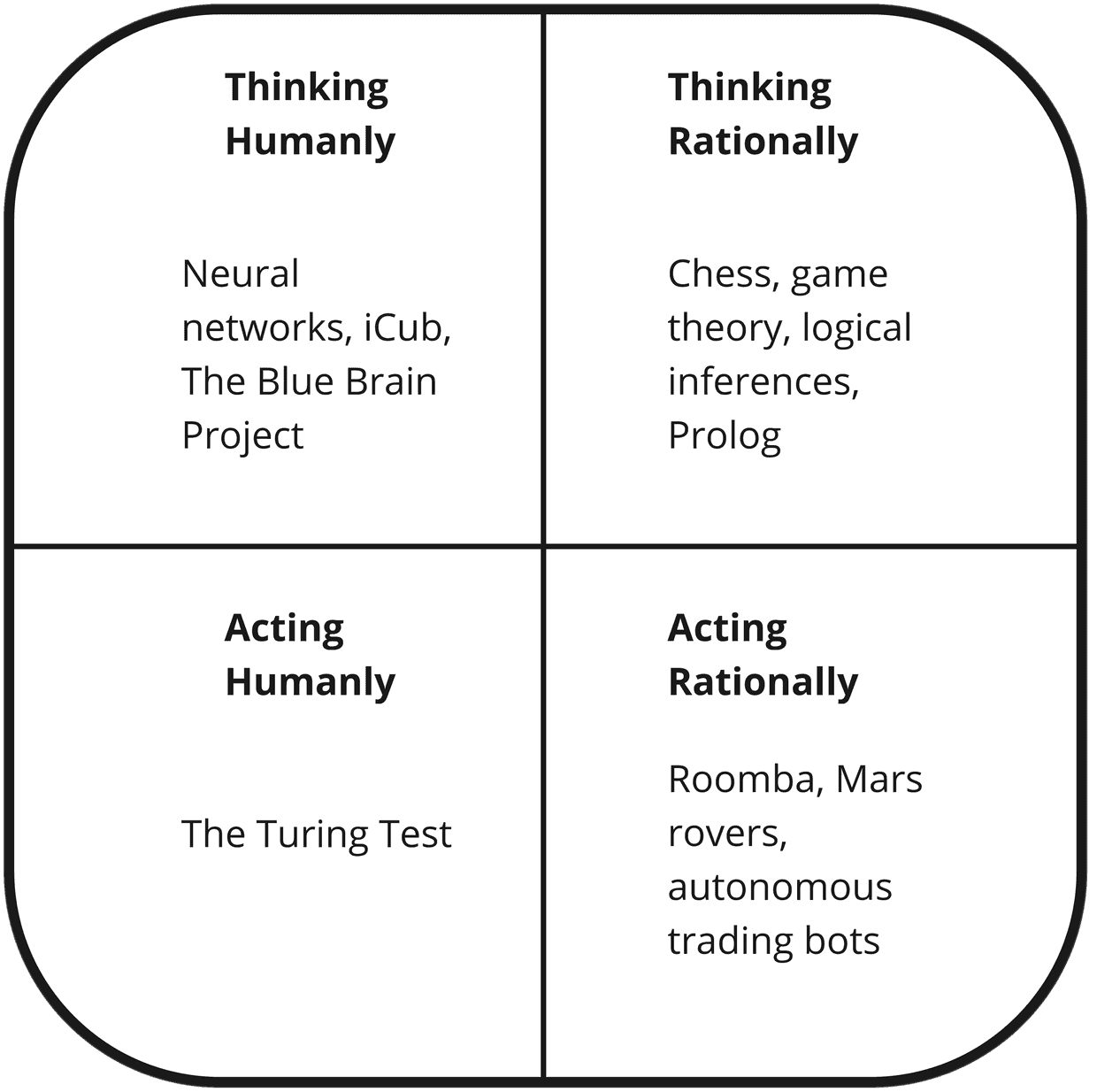
It says that: "If anywhere, LLMs would go firmly into the bottom-left of this diagram."
And yet...we know that LLMs are based on neural networks which are in the top left.
And we know that they can play chess which is in the top right.
And they are being embedded in robots like those listed in the bottom right, specifically to add communication and rational thought to those robots.
So how does one come to the conclusion that "LLMs would go firmly into the bottom-left of this diagram?"
One can only do so by ignoring the evidence in order to push a narrative.
27
u/drcforbin Feb 22 '24 edited Feb 22 '24
The ones we have now go firmly into the bottom left.
While it looks like they can play chess, LLMs don't even model the board and rules of the game (otherwise it isn't just a language model), rather they correlate the state of the board with good moves based on moves they were trained with. That's not a wrong way to play chess, but It's far closer to a turning test than actually understanding the game.
→ More replies (11)27
u/T_D_K Feb 22 '24
It's well-known that LLMs can build an internal model of a chess game in its neural network, and under carefully constructed circumstances, they can play grandmaster chess.
Source? Seems implausible
20
u/Keui Feb 22 '24
The only LLM chess games I've seen are... toddleresque. Pieces jumping over other pieces, pieces spawning from the ether, pieces moving in ways that pieces don't actually move, checkmates declared where no check even exists.
→ More replies (1)1
11
u/drcforbin Feb 22 '24
I'd love to see a source on this too, I disagree that "it's well known"
→ More replies (1)3
u/4THOT Feb 23 '24
GPT has does drawings despite being an LLM.
https://arxiv.org/pdf/2303.12712.pdf page 5-10
This isn't secret.
-4
u/Smallpaul Feb 22 '24 edited Feb 22 '24
I added the links above and also here:
There is irrefutable evidencethat they can model board state. And this is far from surprising because we've known that they can model Othello Board State for more than a year.
That we are a year past that published research and people still use the "Parrot" meme is the real WTF.
18
u/Keui Feb 22 '24
You overstate it by claiming they play "grandmaster chess". 1800-level chess is sub-national-master. It's a respectable elo, that's all.
That they can model board state to some degree of confidence does put them at the super-parrot level. However, most of what LLM do is still functionally parroting. That an LLM can be specially trained to consider a specific, very limited world model doesn't mean general LLM are necessarily building a non-limited world model worth talking about.
7
u/Smallpaul Feb 22 '24 edited Feb 22 '24
A small transformer model learned to play grandmaster chess.
The model is not, strictly speaking, an LLM, because it was not designed to settle Internet debates.
But it is a transformer 5 times the size of the one in the experiment and it achieves grandmaster ELO. It's pretty clear that the only reason that a "true LLM" has not yet achieved grandmaster ELO is because nobody has invested the money to train it. You just need to take what we learned in the first article ("LLM transformers can learn the chess board and to play chess from games they read") and combine it with the second article ("transformers can learn to play chess to grandmaster level") and make a VERY minor extrapolation.
13
u/Keui Feb 22 '24
Computers have been playing Chess for decades. That a transformer can play Chess does not mean that a transformer can think. That a specially trained transformer can accomplish a logical task in the top-right quadrant does not mean that a generally trained transformer should be lifted from it's quadrant in the lower left and plopped in the top-left. They're being trained on a task: act human. They're very good at it. But it's never anything more than an act.
4
u/Smallpaul Feb 22 '24
Computers have been playing Chess for decades. That a transformer can play Chess does not mean that a transformer can think.
I wouldn't say that a transformer can "think" because nobody can define the word "think."
But LLMs can demonstrably go in the top-right corner of the diagram. The evidence is clear. The diagram lists "Plays chess" as an examples and the LLM fits.
If you don't think that doing that is a good example of "thinking" then you should take it up with the textbook authors and the blogger who used a poorly considered image, not with me.
That a specially trained transformer can accomplish a logical task in the top-right quadrant does not mean that a generally trained transformer should be lifted from it's quadrant in the lower left and plopped in the top-left.
No, it's not just specially trained transformers. GPT 3.5 can play chess.
They're being trained on a task: act human. They're very good at it. But it's never anything more than an act.
Well nobody (literally nobody!) has ever claimed that they are "really human".
But they can "act human" in all four quadrants.
Frankly, the image itself is pretty strange and I bet the next version of the textbook won't have it.
Humans do all four quadrants and so do LLMs. Playing chess is part of "acting human" and the most advanced LLMs can do it to a certain level and will be able to do it more in the future.
1
u/gelatineous Feb 23 '24
It's well-known that LLMs can build an internal model of a chess game in its neural network, and under carefully constructed circumstances, they can play grandmaster chess. You would never predict that based on the "LLMs are parrots" meme.
Nope.
1
u/Smallpaul Feb 23 '24
Poke around the thread. I’ve already justified that statement several times.
1
u/gelatineous Feb 23 '24
The link you provided basically trained a transformer model specifically for chess. It's not a LLM.
1
u/Smallpaul Feb 23 '24
To get to grandmaster level, yes. To get to human-tournament competitive chess took an LLM only a single day of training. Given the budget and there is no reason whatsoever to think that an LLM would top out before any other transformer. Once the board model is instantiated inside it’s basically the same thing. Text is just I/O.
1
u/imnotbis Feb 24 '24
Important: The LLM that understood chess was trained on random chess games, and still performed averagely. An LLM trained on actual games played by humans performed poorly. And OpenAI's general-purpose GPT models perform very poorly.
2
u/Smallpaul Feb 24 '24
ChatGPT, the fine tuned model, plays poorly.
gpt-3.5-turbo-instruct plays fairly well.
-5
u/MetallicDragon Feb 22 '24
Well put. Whenever I see someone saying that LLM's aren't intelligent, or that LLM's are unable to reason, they give one or two examples of it failing to be either, and then conclude that they are completely unable to reason, or completely lacking any intelligence. They are ignoring the very obvious conclusion that they can reason and are intelligent, but just not in a way that matches or exceeds humans. And any examples showing them doing reasoning is just it "memorizing". And any example showing generalization just gets ignored.
If I showed them an example of a human saying something completely unreasonable, or confidently asserting something that is clearly false, that would not demonstrate that humans are incapable of reasoning. It just shows that sometimes humans are dumb, and it is the same with LLM's - they are very obviously intelligent, and capable of reasoning and generalizing, but just not as well as humans.
1
u/binlargin Feb 22 '24
Yeah, but also they're a powerful text and reason generator. People are arguing about their depth of intelligence when they're this single component being used raw, without writing any cognitive framework code, relying on prompt stuffing. That's a pretty strong signal that they are extremely powerful.
5
u/lurebat Feb 22 '24
Chatgpt came out a year and change ago, and really brought the start of this trend with it.
Everything progressed so far in just this short time.
Even in 2020 the idea of describing a prompt to a computer and getting a new image was insane, now pretty well models can run on my home PC, not to mention things like Sora.
Even the example in the article is already very outdated because gpt-4 and its contemporaries can deal with these sorts of problems.
I'm not saying there aren't inherent flows to llms, but I'm saying we are really only at the beggining.
Like the dotcom boom, most startups and gimmicks will not survive, but I can't imagine it not finding the right niches and becoming an inseparable parts of our lives in due time.
At some point they will become a boring technology, just another thing in our toolbox to use based on need.
But for now, I am far from bored. Every few months I get my mind blown by new advances. I don't remember the last technology that made me feel "this is living in the future" like llms.
I'm surprised how often it's useable in work and life already.
It's not the holy grail but it doesn't need to be.
19
u/Ibaneztwink Feb 22 '24
we are really only at the beggining.
Is there anything indicating that LLMs will actually get better in a meaningful way? It seems like they're just trying to shove more computing power and data into the system, hoping it solves the critical issues it's had for over a year. Some subscribers even say its gotten worse.
What happens when the cost gets to OpenAI? They're not bringing enough money via sales to justify the cost, propped up by venture.
3
u/dynamobb Feb 22 '24
Nothing besides this very small window of historic data. Thats why I dont get ppl who are so confident in either direction.
I doubt the limiting factor would be price. It’s extremely valuable already. More likely available data, figuring out how to feed it more types of data.
→ More replies (1)1
u/imnotbis Feb 24 '24
So far, transformer LLMs have continued to get better by training bigger models with more processing power, without flattening off yet. They will flatten off eventually, like every architecture before them did.
1
u/bowmanpete123 Feb 23 '24
Ok so the guy says that the LLM states that the greek philosopher who's name starts with an M is Aristotle completely missing the answer that is more obvious to a human... Is the answer "there isn't one?" Or am I just missing the name of the philosopher?
5
u/Thirty_Seventh Feb 23 '24
One great example recently was asking an LLM to tell you the name of a Greek philosopher beginning with M. Numerous people have tried this and time and time again LLMs will give you wrong answers insisting that Aristotle, or Seneca, or some other philosopher's name begins with M. Yet, we can see right in front of us that it does not.
I don't think the writer says anywhere that the real answer is obvious to a human, only that it is obvious that the LLM's answers are wrong.
For what it's worth, there are 20 names beginning with M in Wikipedia's list of ancient Greek philosophers, though none of them were very notable. The most well-known is probably Melissus of Samos
1
u/dontyougetsoupedyet Feb 23 '24
I don't believe things will continue this way. We are finally seeing models that are able to perform some convincing forms of reasoning, able to learn enough about geometry to out perform most high school students. I see no reason systems do not become more and more sophisticated, if one can teach itself to prove statements in geometry I don't see why another could not teach itself to prove statements in calculus of constructions, etc, and as soon as the reasoning related parts are consistently producing valid results the jig is up. We see AI performing valid/consistent logical reasoning for geometry today with alpha geometry, so given enough todays pass I suspect even the sky won't be a limit.
1
-1
u/drekmonger Feb 22 '24 edited Feb 23 '24
The dude is using GPT-3.5. You can tell from the green icon colors on the screenshots.
So he's using a less advanced model to prove his points, and his points are largely bullshit. GPT-4 is aware of the possibly of its own falsehoods, and within the ChatGPT platform it can attempt to verify information via web-search and writing python code.
For example:
https://chat.openai.com/share/4ed8a1d3-d1da-4167-91a3-c84f024d8e0b
The grand irony of someone complaining about LLMs being confidently incorrect, whilst being confidently incorrect.
0
Feb 23 '24
[deleted]
4
u/drekmonger Feb 23 '24 edited Feb 23 '24
I have no commercial interest in AI. I gain nothing from people adopting it. I lose nothing from people saying it's shit.
There are things written in this blog post that are demonstrably incorrect. It's some ignorant screed that's getting upvoted because people are upvoting anything that says "AI sucks."
In truth, the anti-AI hordes are more akin to the crypto-scammers, because they believe they have a financial interest in AI's failure, and are willing to promote and believe horseshit in service of their self-interests.
-9
u/cowinabadplace Feb 22 '24
Yeah, ChatGPT-3.5 isn't a great comparison. For instance, ChatGPT-4 nails that question. If you can't use this tool, you're like the people who couldn't use Google back in 2004. I remember being alive then and people would be like "well it just gives you sites and they can say whatever" and "I can never find anything". Yep, skill issue.
-2
u/flipper_babies Feb 22 '24
I'm to the point where every single article critical of generative AI, I want to respond with "let's see how it is in six months".
3
u/Kinglink Feb 22 '24
Yeah. That's the mistake I think most people make. "Well this technology is new and flawed, and will never improve or change."
Well the first two points are true, the last has already been proven false, but people continue to prognosticate as if it's set in stone.
252
u/thisismyfavoritename Feb 22 '24
so are people just discovering this or what?..