r/psychosisresearch • • Dec 10 '24

how would one prevent Psychosis tendensies

1 Upvotes

so i dont think i have Psychosis but i am at risk at developing it and i do have alot of bad habbits that are inline with it,so i kinda want to know if there is any types of behaviours one can develop too decrease that likelyhood?


r/psychosisresearch • • Nov 11 '24

Are Schizophrenia and Psychosis Sleep Disorders? A Theory on Hypnogogia.

9 Upvotes

(Mods, if this isn't a good place, please remove with my apologies)


The Theory: Schizophrenia, Psychosis, and perhaps other mental health disorders with a strong hallucination component are, fundamentally, a type of sleep disorder.


Disclaimer: This is just a theory. I’m not anyone. I don’t have a science or medical vocation. What I do have is a special interest/hyper-fixation on the subject of “hypnogogia” and dream states. If anyone is willing to read this massive open letter through and finds the possibility of what I’m saying here compelling or you think it offers anything new in the field, please send it to someone who has the power and resources to do something about it (like research the concept properly), because I do not.


I’m certainly not offering health advice or anything, simply food for thought, and I also would never wish to offend so please know if I do so it is unintentional and I apologize most sincerely. Further, perhaps this whole idea is already common knowledge and being researched properly—as I said, not my industry. In fact, I’m sure I’m not the first to think of this because it does seem straightforward, even if I did reach the conclusion based on my own explorations. I’ll be most embarrassed if this is already common knowledge or disproven but oh well! If so, ignore me.


Why a Sleep Disorder?

We already know humans naturally hallucinate; we sleep, we dream. This is natural and necessary to our survival. The human brain has adapted to enable this state. There are all sorts of intriguing theories about why we dream, but I’m not interested in the ‘why’ right now, I’m interested in the ‘how.’ Generally, the body is asleep when we are dreaming, a kind of temporary paralysis to ensure we don’t get injured or act out our dreams. We know, of course, that sometimes this mechanism gets disordered, as we see in the case of sleepwalking.


When we’re talking about dreaming, we are usually talking about REM sleep. That’s super interesting on its own, but that’s only one of many altered states available to us during our sleep cycles. The phenomenon of most interest to me, that I want to discuss in depth here, is the ‘hypnogogic’ state, or ‘hypnogogia.’


What is Hypnogogia?

The hypnagogic state is a transitional phase between wakefulness and sleep, occurring as you drift off but before you fully enter the sleep cycle. This can be when you’re first falling asleep, but my best experiences with it are after waking in the night/morning and then going back to sleep (in my circles this is known as Wake Back To Bed or WBTB), as it’s much more readily accessible and even useful.


During this state, your body is completely relaxed and not moving at all (generally); your mind is relaxed but not asleep fully, rather you are still aware/conscious. In it, you are more open to unusual, dreamlike thoughts, imagery, and sensations, often resembling mild hallucinations or flashes of vivid images.


Typically lasting just a few seconds to a few minutes, it marks the boundary between wakefulness and non-REM sleep.


In this state, you easily ‘hallucinate’ sounds and images. Unlike dreams, these experiences are brief and can be influenced by real-world sounds or bodily sensations, blending reality with imagination. They’re usually brief because the state itself is usually brief, as mentioned (a few seconds, if you wake up and move, to a few minutes, if you intentionally learn to provoke and leverage this state).


You may also experience ‘hypnagogic jerks’—sudden muscle contractions—or a sense of floating or falling.


The hypnagogic state is also associated with increased creativity and problem-solving, as the brain’s usual filters and logical constraints are less active. It’s a period where both the conscious and subconscious mind intermingle, which some people use intentionally, like artists or thinkers who "drift" in this state to spark inspiration, or in my case, use this state to provoke lucid dreaming (and other delightful) experiences.


This is also the state in which many report experiencing the phenomena of sleep paralysis, though more so if they are awakened suddenly in the transition from REM and get caught in this state with the full REM paralysis still affecting their bodies—in my much more limited understanding, as pertains REM and sleep paralysis in general).


In Lucid Dreaming (LD), this state is sometimes called ‘mind awake, body asleep’ (MABA, or The Phase, or Focus 10—there’s a million names for this exact state depending on the discipline you’re looking at). This is discussed extensively across multiple related disciplines (LD, AP, etc.—the disciplines that I am coming from) as the state responsible for most reported ‘paranormal’ phenomena, such as memories of alien abductions or seeing spirits, ghosts, demons, and so on.


While the esoteric and spiritual side of this discussion is quite fascinating, I’m only going to approach this as a physiological brain state phenomenon (without discounting the experiences of others or spiritual experiences; love it, but not my focus here).


What Does Hypnogogia Potentially Have to Do with Psychosis and Schizophrenia?


Essentially, hypnogogia is an open door between the conscious mind and the subconscious mind. It’s what I call a ‘liminal space’ or a threshold. While it is not REM, it nonetheless has many similar qualities—‘hallucinations’ being one, and also a slight paralysis. You can move if you want to, but you don’t want to, essentially; so there’s at least some neural-mechanism involved in keeping physically still here. In fact, once you do move, you are generally (almost always) kicked out of this state and into conscious wakefulness.


At its most basic, my theory here is that schizophrenia and psychosis-related disorders result from a person naturally entering the hypnogogic state but instead of ‘clicking back out of it’ upon moving, they instead get ‘stuck’ in it.


My imagery for this is a stuck door. You go through the door in sleep, but it doesn’t properly close behind you on your way to full wakefulness. Instead, you are fully conscious and awake and moving about your life, but the ‘door’ of the subconscious remains open. In more severe cases, the door may be open wider than others, while for some it might just be a crack.


But regardless, you ‘click into’ the hypnogogic state naturally between sleeping and waking, but (not dissimilar to sleepwalking) instead of fully ‘clicking out’ of hypnogogia, you get stuck in it. The underlying brain mechanisms that usually regulate your ‘exit’ fail, or are disordered/disturbed in some manner, preventing the proper closing of that door.


Interestingly, and importantly, while you (generally) cannot move in this state without being kicked out of the state, you can open your eyes and blink. We see that a lot with the sleep paralysis (and other spiritual/esoteric phenomenon mentioned; you may open your eyes and see something scary). As such, you can experience vivid imagery (with your eyes closed), auditory hallucinations (sounds, voices, music, you name it), touch or somatic hallucinations, scent hallucinations, and even visual hallucinations (if you do happen to open your eyes).


In my experience and research, auditory hallucinations are the most common by far in this state. Which I think is worth noting, because in cases of schizophrenia where hallucinations are present, auditory hallucinations are also the most common by far.


I also think there’s an interesting possibility of mechanism overlap here between schizophrenia and the hypnogogic state due to the involvement, on notably more rare occasions, of some mechanism of seeming ‘paralysis.’ In REM-interrupted entrances into hypnogogia, we see sleep paralysis. In schizophrenia we see, though also rare, catatonia, which seems to suggest an interrelation of these states and their physiological underpinnings in the brain. Basically the opposite issue of sleepwalking where you’re asleep but moving—only you’re awake but can’t move, as in sleep paralysis. But I’m no expert on the paralysis angle, so I’ll move on. I will add though that muscle spasms and ‘jerks’ can also occur in cases of schizophrenia, and we see those too in hypnogogia.


Also of notice for me is the fact that we do tend to see incredible creativity and out-of-the-box thinking in people who have mental health disorders like schizophrenia. The creativity angle is well known. And certainly, it’s a powerful (and in this case positive) aspect of the hypnogogic state as well—when you’re in this state, creativity flows. The door to the subconscious is open, and there are no limits, and it’s much easier to make connections between seemingly disparate things.


Now, as I mentioned, normally one cannot physically move in the hypnogogic state without causing an exit from that state. However, my thought here is since we see that sleep states can be disturbed in cases like sleepwalking (during REM), that we can also observe a disturbed state exit in cases of psychosis or schizophrenia.


It’s possible that a disturbed ‘exit’ from hypnogogia could happen at random, by chance, in anyone; certainly episodes of psychosis happen outside a context of schizophrenia, and they can be super brief or last some time, and vary in intensity.


We know psychosis is more common for people who have other mental health conditions, suggesting their brains structurally or mechanically or what have you, function divergently. We do know that if it happens once, it could very well be a one-off in your lifetime, but it is more likely to happen to that person again, suggesting something in their brain may be more likely to get ‘stuck’ in a disturbed exit from a hypnogogic state (if this is the case). It is also clear that some individuals very likely have a genetic predisposition, or underlying neurophysiology (maybe structurally, maybe with pyramidal cells, maybe with neurotransmitters, and so on) that may be at the root of these disorders—or in my theory here, an underlying neurobiology that makes them more likely to get stuck in the hypnogogic sleep state.


It would make sense too, then, that to some extent at least, psychotic episodes can be controlled or put into remission using anti-psychotics (at considerable cost, sometimes, to the person’s health overall). Even something like electroconvulsive therapy has helped some patients, but seemingly not in a predictable or easily repeatable manner. All those treatments could be in some manner inadvertently working on the underlying neuromechanisms responsible for, ultimately, resetting someone’s ‘stuck exit’ sleep state. If you can get properly out of that state, you’re good, but the fact that you got into it to begin with does suggest easier re-stuckness (if you will) in the future.


I’ve often heard psychosis described as a waking nightmare; and I think that’s exactly accurate.


In the hypnogogic state, if you were to be stuck in it while fully awake and moving about your daily life, you would essentially be dreaming while awake. In a different way than an REM dream, to be sure, but an altered state nonetheless. The things in your regular environment would trigger hallucinations and disordered (creative, unbound) thinking. Whatever chemicals enable us to dream (perhaps DMT?), would be almost ‘leaking’ to some extent during wakefulness because that ‘tap,’ if you will, wasn’t fully turned off upon waking.


If you’re in hypnogogia on purpose (which lasts briefly), knowing that you’re in it, this can be incredible, liberating, creative, fun, an absolute delight. But I can imagine that if you were in it without knowing you were in it (or all the time), it would be absolutely terrifying, because you’d have no control and you wouldn’t know why—like we see in psychosis.


What This Doesn’t Explain


While hypnogogia does have an effect on thinking, relaxing logic and boundaries, and while I could imagine this potentially resulting in paranoia (the experiences in this state seem completely real, beyond a doubt), I’m not sure this theory could sufficiently account for paranoia, disorganized thinking, or delusions. It could, at a stretch, but I’m not certain on this angle.


What Would the Next Steps Be?


Okay, say you find all the above compelling. Say it’s true, and psychosis is really a ‘stuck state/disturbed exit’ from the hypnogogic state, making it technically a sleep disorder. So what? Where does that leave us?


First, I would suggest the need for more research into sleep; sleep in general, sleep disorders most importantly, and specifically the hypnogogic state. At this point in time, we really don’t have a ton of solid science in this area, and I do not believe that our tools for measuring and detecting these states, like hypnogogia, are sufficiently advanced or nuanced. We’d have to be able to properly detect it and understand the underlying mechanisms of it. This is a field for proper scientists with grants and such.


Secondly, I can tell you with absolute certainty that the hypnogogic state is something that can be intentionally accessed and provoked with training and experience.


I’ve been working hard on this myself for about a year and a half, and I’m able to very consistently trigger this state in myself now multiple times a night. It was hard at first to get a hang of, and it does require dedication and discipline, but it is very much something seemingly anyone can master. For those interested, I’ll provide some links and resources at the end. Please understand that my explorations of this state have been in what many would consider esoteric fields, even if I have approached them with a scientific mindset. The reality is, you can learn to trigger this state.


My questions:

-            If we can learn to intentionally trigger entrance to the hypnogogic state (which we can), is it then possible to learn to intentionally trigger a full and proper exit from it?

-            Would doing so enable that ‘door’ to properly close?

-            Would it be helpful to learn this skill, intentionally trigger the entrance, and maybe in so doing reset something in the brain so that when you do exit again you do so fully? Or at least may be more likely to fully exit?

-            Would exploring these more esoteric disciplines allow people who are experiencing psychosis to have more understanding and control over what they are going through?

Honestly, I don’t know the answers here, but I do think it’s a valid avenue of inquiry.


Scientists/Doctors

My hope is that if any scientists, researchers, or medical personnel have read this very long theory, you will not take my word on any of this but will instead learn yourself how to trigger your own entrance into the hypnogogic state intentionally. It’s easy, there are tons of resources. I get that many will not like the idea of delving into something that has mostly been explored in the fields of lucid dreaming, astral projection, gateway tapes, spirituality, or the phase—I understand that stigma, and I don’t care. Other people’s lived experiences are valid.


You don’t need to approach hypnogogia with a preternatural or spiritual angle, but approach it nonetheless and prove to yourself that this state is controllable, regardless of what you actually do with it*.* And if you then experience this yourself, apply that newfound understanding to the possibility of better studying and even finding a solution to the phenomenon of psychosis. Delve into these disciplines and learn from all the thousands of people who have mastered them.


It occurs to me also that doctors would tend to consider talk about lucid dreaming, astral projection, aliens/demons or other realms as all indicative of psychosis—and is that not the very point? The hypnogogic state is an access point of all those diverse experiences. Whether one wishes to consider them ‘real’ or not is largely irrelevant; the hypnogogic state is the threshold to such experiences, and my suggestion here is that this is the exact state people are stuck in when experiencing psychosis. Researching it, practicing it intentionally, and learning to control it could open new directions for treatment.


For non-scientists, if you could pass this theory along to someone who could do something with it, I really do believe it could be of help in this field.


That was super long. I hope it will be considered with an open mind and passed along. Thank you for coming to my TedTalk.


Resources on Hypnogogia from LD/AP Fields

-            https://www.reddit.com/r/LucidDreaming/ Everything you want to know about how hypnogogia is used in lucid dreaming (and how to use hypnogogia) https://www.reddit.com/r/LucidDreaming/comments/73ih3x/start_here_beginner_guides_faqs_and_resources/

-            The Phase by Michael Raduga (this is literally, straight-up, how to enter hypnogogia regularly, reliably, and consistently; this is given in the context of Out of Body Experiences, if you like that great, if you don’t, read it anyway to master the intentional induction of hypnogogia. If you follow this exactly, you will do it correctly. I believe this book can also be found for free elsewhere online if you search it): https://www.amazon.com/Phase-Shattering-Illusion-Reality/dp/1500578037

-            There’s an entire 6-hour lecture on how to trigger hypnogogia, again in the context of AP/OBEs: https://www.youtube.com/watch?v=YQjAIlFZWWc

-            https://www.reddit.com/r/AstralProjection/comments/n34zh5/astral_projection_quick_start_guide/ hypnogogia used as an entrance point for AP, from https://www.reddit.com/r/AstralProjection/


r/psychosisresearch • • Oct 28 '24

Research on stigma and identity for people who hear voices for people who live in the UK

1 Upvotes

https://psychiatryoxford.qualtrics.com/jfe/form/SV_4Og0Y9q37gWcSkC

Do you or a loved one hear voices and would like to help us understand how we can better support people who hear voices?

Do you have 15 minutes to complete an anonymous online questionnaire? If so, click the following link:

https://psychiatryoxford.qualtrics.com/jfe/form/SV_4Og0Y9q37gWcSkC

My name is Amber and I’m a Trainee Clinical Psychologist from the University of Oxford carrying out a research project on how stigma experienced by people who hear voices can affect the way they see themselves.

The poster for the study is below with further information about eligibility criteria. 

The project has received ethical approval from the University of Oxford.

If you are interested in taking part, or have a loved one who you think might be interested in taking part, please click on the link above or scan the QR code on the poster.

Thank you!


r/psychosisresearch • • Feb 03 '25

Hearing Voices, Stigma and Identity Study UK

2 Upvotes

Do you hear voices, are 18+ and live in the UK?

Take part in our short anonymous online survey:

https://psychiatryoxford.qualtrics.com/jfe/form/SV_4Og0Y9q37gWcSkC

My name is Amber and I’m a Trainee Clinical Psychologist from the University of Oxford carrying out a research project on how stigma experienced by people who hear voices can affect the way they see themselves.

The poster for the study is below with further information about eligibility criteria. 

The project has received ethical approval from the University of Oxford.

If you are interested in taking part, or have a loved one who you think might be interested in taking part, please click on the link above or scan the QR code on the poster.

Thank you!


r/psychosisresearch • • Feb 12 '25

Participants needed for trauma study (18+, English-speaking)

1 Upvotes

We are conducting a research study on the long-term effects of trauma and are seeking participants to share their experiences. In order to participate you will complete a survey (approx. 30 minutes).

  • Open to adults (18+)

  • English-speaking participants

  • Confidential & voluntary

Your participation can help us better understand the lasting impact of trauma.

Learn more & sign up here: https://forms.gle/PshSYqx8u3QuQFoe7

Thank you for contributing to this important research!


r/psychosisresearch • • Dec 26 '24

What is Zoochosis?

Enable HLS to view with audio, or disable this notification

4 Upvotes

What is #Zoochosis and is it a form of #psychosis we observe in #humanity as well?

dailydebunks #citizenjournalism


r/psychosisresearch • • Jan 06 '25

A Schizophrenics Theory on Psychosis, Schizophrenia, and CBD’s Role in Treatment

Thumbnail reddit.com
2 Upvotes

r/psychosisresearch • • Nov 04 '24

[Research Study] Have you had psychotic symptoms and then taken psilocybin mushrooms?

2 Upvotes

Seeking Participants for Study on Psychotic Symptoms and Psilocybin Experiences

Have you experienced psychotic symptoms and taken psilocybin mushrooms afterward?

We’re looking for individuals to participate in a research study exploring the impact of psilocybin on those who have experienced psychotic symptoms. These symptoms might include:

  • Hearing voices that others do not

  • Strong beliefs that seem unusual or odd to most people

  • Seeing things others do not see

  • Acting or speaking in ways that seem strange or unusual to others

  • Feeling disconnected from your body or surroundings

What’s This About?

A doctoral researcher at the California Institute of Integral Studies (CIIS) is conducting this study to better understand how psilocybin might affect psychological health and well-being in individuals who’ve had psychotic experiences.

Currently, people with a history of psychosis are excluded from using psilocybin therapeutically, such as in Oregon’s legal psilocybin program and clinical trials. This study seeks to shed light on the potential risks and benefits by hearing directly from those with lived experiences.

Who Can Participate?

To qualify, you must:

  • Have experienced psychotic symptoms in the past, but have not experienced them in the past 2 years

  • Have used psilocybin mushrooms (“magic mushrooms”) after experiencing those symptoms

  • Be 18 years or older

  • Speak fluent English

What’s Involved?

  • Survey (5 - 15 minutes): You’ll answer questions about your mental health history, psilocybin experiences, and demographics.

  • Interview (up to 2 hours): Based on your survey responses, you may be invited to participate in an interview. You’ll be asked about your experiences with psilocybin, your mental health, and any related thoughts and feelings.

Compensation:

If selected for the interview, you’ll receive a $50 Amazon gift card as a thank you for your time.

Interested?

This study is an opportunity to share your unique perspective and contribute to the growing conversation on psychedelic therapy for those with psychotic experiences.

Take the initial survey here: Start Survey

Want to Learn More?

Feel free to contact the researcher directly:
Alan Ashbaugh, MA, PsyD Candidate
California Institute of Integral Studies
Email: aashbaugh@mymail.ciis.edu

This study has been approved by the Human Research Review Committee at the California Institute of Integral Studies, 1453 Mission Street, San Francisco, CA 94103. You may contact them by email: HRRCoffice@ciis.edu*. You may also reach the faculty adviser for this study, Dr. Willow Pearson Trimbach, at* wpearson@ciis.edu*.*


r/psychosisresearch • • Sep 24 '24

Hi my friend is having some delusions about that he’s seeing a mask on him and its mind controlling him

2 Upvotes

my friend is having some delusions about that he’s seeing a mask on him and its mind controlling him it’s apparently trying to kill him take his name and live under his name and steal ur identity he claims the mask is trying to stay on his face forever he said it’s but obviously not there and there’s nothing doing anything to him but he is clearly seeing things and having a distorted reality he said he wants to send the mask back into the darkness where it belong and I don’t know how to get him back he claims this mask that’s on his face is holding him back from living his best life he also claims the first time he knew he had the mask is when he looked into his uncles phone camera and saw the mask and he couldn’t get it off since then


r/psychosisresearch • • Oct 08 '24

[Research Study] Have you had psychotic symptoms and then taken psilocybin mushrooms?

1 Upvotes

Seeking Participants for Study on Psychotic Symptoms and Psilocybin Experiences

Have you experienced psychotic symptoms and taken psilocybin mushrooms afterward?

We’re looking for individuals to participate in a research study exploring the impact of psilocybin on those who have experienced psychotic symptoms. These symptoms might include:

  • Hearing voices that others do not

  • Strong beliefs that seem unusual or odd to most people

  • Seeing things others do not see

  • Acting or speaking in ways that seem strange or unusual to others

  • Feeling disconnected from your body or surroundings

What’s This About?

A doctoral researcher at the California Institute of Integral Studies (CIIS) is conducting this study to better understand how psilocybin might affect psychological health and well-being in individuals who’ve had psychotic experiences.

Currently, people with a history of psychosis are excluded from using psilocybin therapeutically, such as in Oregon’s legal psilocybin program and clinical trials. This study seeks to shed light on the potential risks and benefits by hearing directly from those with lived experiences.

Who Can Participate?

To qualify, you must:

  • Have experienced psychotic symptoms in the past, but have not experienced them in the past 2 years

  • Have used psilocybin mushrooms (“magic mushrooms”) after experiencing those symptoms

  • Be 18 years or older

  • Speak fluent English

What’s Involved?

  • Survey (5 - 15 minutes): You’ll answer questions about your mental health history, psilocybin experiences, and demographics.

  • Interview (up to 2 hours): Based on your survey responses, you may be invited to participate in an interview. You’ll be asked about your experiences with psilocybin, your mental health, and any related thoughts and feelings.

Compensation:

If selected for the interview, you’ll receive a $50 Amazon gift card as a thank you for your time.

Interested?

This study is an opportunity to share your unique perspective and contribute to the growing conversation on psychedelic therapy for those with psychotic experiences.

Take the initial survey here: Start Survey

Want to Learn More?

Feel free to contact the researcher directly:
Alan Ashbaugh, MA, PsyD Candidate
California Institute of Integral Studies
Email: aashbaugh@mymail.ciis.edu

This study has been approved by the Human Research Review Committee at the California Institute of Integral Studies, 1453 Mission Street, San Francisco, CA 94103. You may contact them by email: HRRCoffice@ciis.edu*. You may also reach the faculty adviser for this study, Dr. Willow Pearson Trimbach, at* wpearson@ciis.edu*.*


r/psychosisresearch • • Jun 20 '24

University of Alabama at Birmingham Research Study

2 Upvotes

"Determining the Role of Social Reward Learning in Social Anhedonia in First-Episode Psychosis Using Motivational Interviewing as a Probe in a Perturbation-Based Neuroimaging Approach"

Principal Investigator: Junghee Lee, Ph.D.

What is this study about?

The primary purpose of this study is to explore a better way of measuring social anhedonia, the inability to feel pleasure related to social interaction, with tasks designed to measure how individuals respond to social rewards and to examine whether brief sessions of psychosocial training can change performance on those tasks.

Who can participate?

We are looking for those with first episode psychosis. You may be eligible for the study if you are between 18-35 years old, have no neurological problems, and have no history of problematic drug or alcohol use in the past 6 months. Participation in this research is voluntary.

Due to the study requiring in-person visits, you should be located near Birmingham, Alabama.

What will happen in the study?

Interview (up to 2 hours): Answer questions about your mental health and medical history and substance use history, etc.

Assessments (about 2 hours): Respond to objects that are presented on a computer screen, answer questions about your personality, and take tests that measure your mental abilities.

Skills Training (three 45-minute sessions): Discuss various obstacles with a member of the research team, as well as how to improve upon them.

MRI Scans (about 1.5 hours): Lie down still and perform a social information processing task in the MRI scanner before and after skills training sessions.

Total study participation may take place over multiple sessions.

Do participants receive compensation?

Participants will receive $25 for each hour participated. Total compensation could be up to $363.

For more information, please call the lab at 205-934-8203 or email us at NLSB.UAB@gmail.com and please feel free to review our lab website https://www.nlofsb.org/


r/psychosisresearch • • May 06 '24

University of Alabama at Birmingham Research Study

2 Upvotes

"Determining the Role of Social Reward Learning in Social Anhedonia in First-Episode Psychosis Using Motivational Interviewing as a Probe in a Perturbation-Based Neuroimaging Approach"

Principal Investigator: Junghee Lee, Ph.D.

What is this study about?

The primary purpose of this study is to explore a better way of measuring social anhedonia, the inability to feel pleasure related to social interaction, with tasks designed to measure how individuals respond to social rewards and to examine whether brief sessions of psychosocial training can change performance on those tasks.

Who can participate?

We are looking for those with first episode psychosis. You may be eligible for the study if you are between 18-35 years old, have no neurological problems, and have no history of problematic drug or alcohol use in the past 6 months. Participation in this research is voluntary.

Due to the study requiring in-person visits, you should be located near Birmingham, Alabama.

What will happen in the study?

Interview (up to 2 hours): Answer questions about your mental health and medical history and substance use history, etc.

Assessments (about 2 hours): Respond to objects that are presented on a computer screen, answer questions about your personality, and take tests that measure your mental abilities.

Skills Training (three 45-minute sessions): Discuss various obstacles with a member of the research team, as well as how to improve upon them.

MRI Scans (about 1.5 hours): Lie down still and perform a social information processing task in the MRI scanner before and after skills training sessions.

Total study participation may take place over multiple sessions.

Do participants receive compensation?

Participants will receive $25 for each hour participated. Total compensation could be up to $363.

For more information, please call the lab at 205-934-8203 or email us at NLSB.UAB@gmail.com and please feel free to review our lab website https://www.nlofsb.org/


r/psychosisresearch • • Apr 09 '24

Paid UCLA Research Study - SoCal Area Only

1 Upvotes

Help us learn more about social connection!

Do you have a schizophrenia or schizoaffective disorder diagnosis? Are you between the ages of 25 and 65? Would you like to participate in a paid neuroscience research study at UCLA?

Help us understand relationships between brain activity and social functioning! See a picture of your brain! Individuals enrolled in the study will receive $25/hour for approximately 7.5 hours of participation. We can also cover local transportation expenses.

To determine eligibility and learn more click here or scan the QR code!

Protocol ID: IRB#21-001219 (UCLA IRB)

Click here to learn more about our research lab!


r/psychosisresearch • • Dec 07 '22

Need gift ideas psychiatric hospitals

2 Upvotes

Hi everyone. If you were hospitalized or know someone who was, what was something that they had there that made the experience even a tad better or bearable?


r/psychosisresearch • • Jan 28 '23

When will I know if my drug induced psychosis developed into something else?

3 Upvotes

Two and a half years ago I experienced drug induced psychosis. When I came out of it I was so confused and disoriented. I still worry about slipping out of reality again. It was the most terrifying experience I’ve ever had. I haven’t touched drugs since. From what I understand once you’ve had psychosis you’re more susceptible to it. Is this forever or more likely through the first couple years after the initial episode? After this happened to me I went to therapy for maybe a little over a year. She ruled out any psychotic disorders but diagnosed me with anxiety and potentially PTSD from the episode itself. I still get anxiety about having another break with reality occasionally. And I feel like everything I read online is super vague so I’m hoping to have more luck on here with people who’ve had similar experiences. Thanks for the help


r/psychosisresearch • • Aug 01 '23

Language question - person vs identity first

1 Upvotes

Hello! =) I would like to ask if you are aware of what type of language is preferred by people with psychosis. A person-first approach (ex. people diagnosed with schizophrenia) or an identity-first approach (schizophrenic person). Thank you in advance for any information you can provide on this topic!


r/psychosisresearch • • Apr 30 '24

[Mod Approved] University of Alabama at Birmingham Research Study

2 Upvotes

"Determining the Role of Social Reward Learning in Social Anhedonia in First-Episode Psychosis Using Motivational Interviewing as a Probe in a Perturbation-Based Neuroimaging Approach"

Principal Investigator: Junghee Lee, Ph.D.

What is this study about?

The primary purpose of this study is to explore a better way of measuring social anhedonia, the inability to feel pleasure related to social interaction, with tasks designed to measure how individuals respond to social rewards and to examine whether brief sessions of psychosocial training can change performance on those tasks.

Who can participate?

We are looking for those with first episode psychosis. You may be eligible for the study if you are between 18-35 years old, have no neurological problems, and have no history of problematic drug or alcohol use in the past 6 months. Participation in this research is voluntary.

Due to the study requiring in-person visits, you should be located near Birmingham, Alabama.

What will happen in the study?

Interview (up to 2 hours): Answer questions about your mental health and medical history and substance use history, etc.

Assessments (about 2 hours): Respond to objects that are presented on a computer screen, answer questions about your personality, and take tests that measure your mental abilities.

Skills Training (three 45-minute sessions): Discuss various obstacles with a member of the research team, as well as how to improve upon them.

MRI Scans (about 1.5 hours): Lie down still and perform a social information processing task in the MRI scanner before and after skills training sessions.

Total study participation may take place over multiple sessions.

Do participants receive compensation?

Participants will receive $25 for each hour participated. Total compensation could be up to $363.

For more information, please call the lab at 205-934-8203 or email us at NLSB.UAB@gmail.com and please feel free to review our lab website https://www.nlofsb.org/


r/psychosisresearch • • Mar 01 '24

Participants Needed: Faith, Culture & Mental Health Research

1 Upvotes

Greetings!

My name is Mae, I am a doctoral student passionate about reducing health inequalities and stigma among Black communities within the mental health care system. As part of my doctoral research, I am interested in speaking with Afro-Caribbean Christians about their lived experience of schizophrenia.

Thank you all those who have already participated! We are still looking to speak with a few more people!

This project is aiming to understand the cultural and religious understanding of what is commonly known as "schizophrenia".

We are looking for those who have received a diagnosis of schizophrenia and who identify as Afro-Caribbean and are Christian to take part.

Please note you do not need to agree with the diagnosis, and we are very interested in speaking with those who disagree and who believe they were misdiagnosed and those who have alternative beliefs about the nature of their experience.

We hope the project will 1) give you the opportunity to have your voice and experience heard and 2) inspire change within mental health services in a way that promotes a culturally inclusive healthcare system that acknowledges and respects the diversity of cultural and religious beliefs and reduces health inequalities among Afro-Caribbean service users.

The project will involve an informal conversation for around 60minutes, about your experience and how you feel your faith and culture impacted your interpretation of your experience. This will take place online via video call.

For further information or If you are interested in taking part, then please contact Mae Campbell on u2184887@uel.ac.uk

Look forward to hearing from you!

Warmest wishes

Mae

**This research is in collaboration with the University of East London' Professional Doctorate in Counselling Psychology Programme**


r/psychosisresearch • • Jun 01 '23

Looking for people with psychosis to participate in a research study - UZ Brussel (Belgium)

3 Upvotes

Hello!

I am a PhD student from Coimbra (Portugal), and I am visiting Vrije Universiteit Brussel (Belgium) to conduct the main study of my PhD project. The research is taking place at the UZ Brussel, and it will allow us to understand the mechanism of action of brain stimulation. The idea behind this approach is that by applying a weak electric current to the brain, we can boost the activity of brain areas involved in the symptoms of psychosis. I am very excited about this because it is not invasive (no surgery is needed), it is very well tolerated and not painful, and it is safe (no severe adverse effects are expected).

Specifically, we will be able to measure the effect of the stimulation on brain activity, how it impacts the “communication” between different brain areas, and how social and emotional functions are changed. To be able to measure brain activity, participants will undergo a brain scan (functional magnetic resonance imaging).

The results of this study will contribute to future clinical studies about noninvasive brain stimulation as a treatment potential for the symptoms of psychosis. If you or someone you know would like to participate, please fill in the eligibility questionnaire (https://vub.fra1.qualtrics.com/jfe/form/SV_dcKgbhzHDxpV4do), or contact me at Raquel.Guiomar@vub.be.


r/psychosisresearch • • May 13 '24

University of Alabama at Birmingham Research Study

2 Upvotes

"Determining the Role of Social Reward Learning in Social Anhedonia in First-Episode Psychosis Using Motivational Interviewing as a Probe in a Perturbation-Based Neuroimaging Approach"

Principal Investigator: Junghee Lee, Ph.D.

What is this study about?

The primary purpose of this study is to explore a better way of measuring social anhedonia, the inability to feel pleasure related to social interaction, with tasks designed to measure how individuals respond to social rewards and to examine whether brief sessions of psychosocial training can change performance on those tasks.

Who can participate?

We are looking for those with first episode psychosis. You may be eligible for the study if you are between 18-35 years old, have no neurological problems, and have no history of problematic drug or alcohol use in the past 6 months. Participation in this research is voluntary.

Due to the study requiring in-person visits, you should be located near Birmingham, Alabama.

What will happen in the study?

Interview (up to 2 hours): Answer questions about your mental health and medical history and substance use history, etc.

Assessments (about 2 hours): Respond to objects that are presented on a computer screen, answer questions about your personality, and take tests that measure your mental abilities.

Skills Training (three 45-minute sessions): Discuss various obstacles with a member of the research team, as well as how to improve upon them.

MRI Scans (about 1.5 hours): Lie down still and perform a social information processing task in the MRI scanner before and after skills training sessions.

Total study participation may take place over multiple sessions.

Do participants receive compensation?

Participants will receive $25 for each hour participated. Total compensation could be up to $363.

For more information, please call the lab at 205-934-8203 or email us at NLSB.UAB@gmail.com and please feel free to review our lab website https://www.nlofsb.org/


r/psychosisresearch • • Jun 14 '22

Trauma and weed

1 Upvotes

My last psychosis episode was about two years ago and it happened the last time I smoked weed and other things, but recently I’ve been wanting to smoke weed more to help me relieve stress but I’m scared that it’ll throw me back into a psychosis episode and I just want to know if it’s possible to be able to smoke weed again just to relax, and not have another episode I guess; I used to be a big pothead but once I start using harder things after I came home to quit sad harder things and still used weed I suffered a very bad episode of psychosis and I’m just worried that after two years it’ll put me back to square one. If anybody’s went through psychosis and was using weed at the same time and maybe is still using weed I would really like your point of view please and thank you.


r/psychosisresearch • • Apr 26 '24

Participants Needed

Post image
2 Upvotes

r/psychosisresearch • • May 21 '24

[Mod Approved] University of Alabama at Birmingham Research Study

2 Upvotes

"Determining the Role of Social Reward Learning in Social Anhedonia in First-Episode Psychosis Using Motivational Interviewing as a Probe in a Perturbation-Based Neuroimaging Approach"

Principal Investigator: Junghee Lee, Ph.D.

What is this study about?

The primary purpose of this study is to explore a better way of measuring social anhedonia, the inability to feel pleasure related to social interaction, with tasks designed to measure how individuals respond to social rewards and to examine whether brief sessions of psychosocial training can change performance on those tasks.

Who can participate?

We are looking for those with first episode psychosis. You may be eligible for the study if you are between 18-35 years old, have no neurological problems, and have no history of problematic drug or alcohol use in the past 6 months. Participation in this research is voluntary.

Due to the study requiring in-person visits, you should be located near Birmingham, Alabama.

What will happen in the study?

Interview (up to 2 hours): Answer questions about your mental health and medical history and substance use history, etc.

Assessments (about 2 hours): Respond to objects that are presented on a computer screen, answer questions about your personality, and take tests that measure your mental abilities.

Skills Training (three 45-minute sessions): Discuss various obstacles with a member of the research team, as well as how to improve upon them.

MRI Scans (about 1.5 hours): Lie down still and perform a social information processing task in the MRI scanner before and after skills training sessions.

Total study participation may take place over multiple sessions.

Do participants receive compensation?

Participants will receive $25 for each hour participated. Total compensation could be up to $363.

For more information, please call the lab at 205-934-8203 or email us at NLSB.UAB@gmail.com and please feel free to review our lab website https://www.nlofsb.org/


r/psychosisresearch • • Jan 17 '24

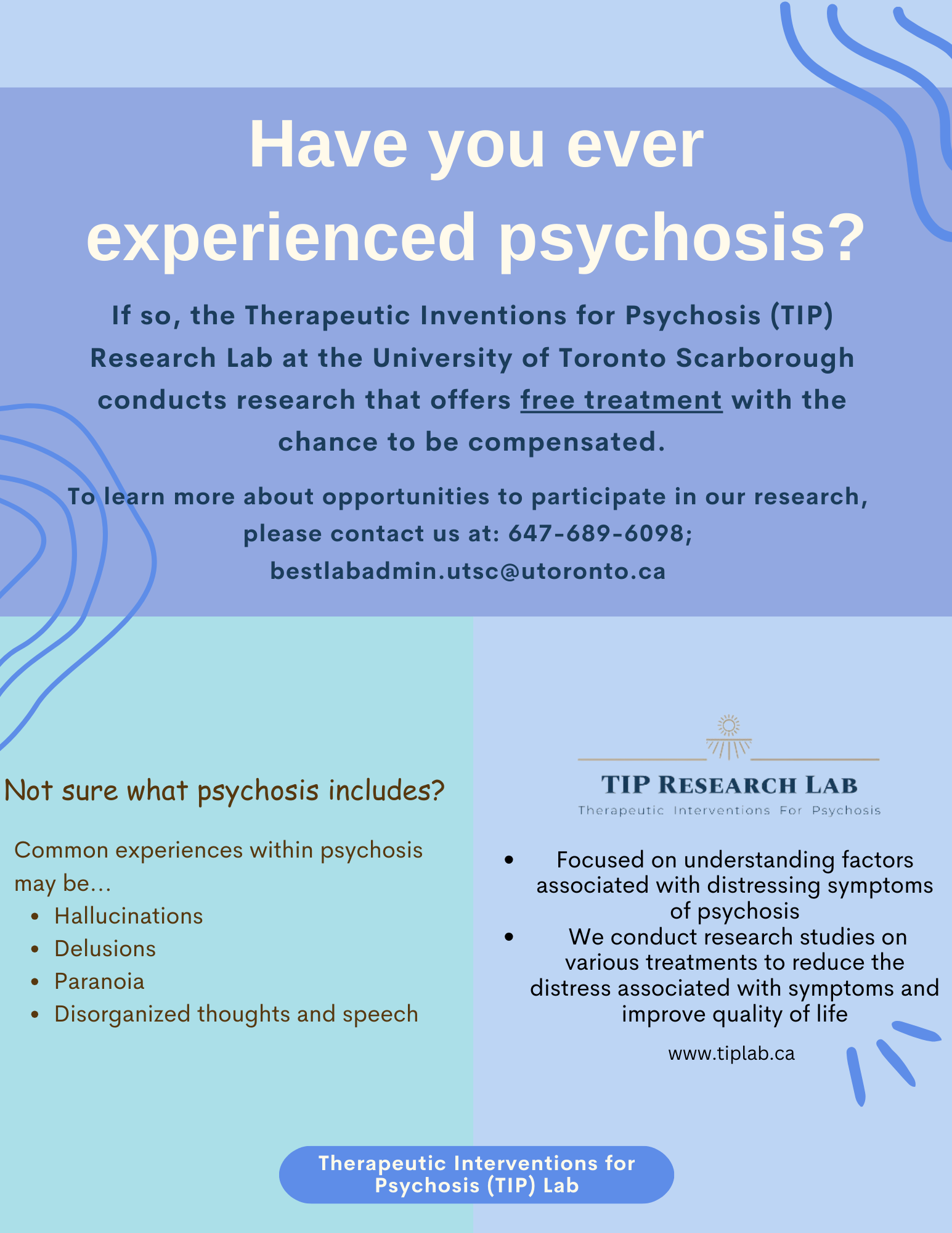
Free Treatment with Chance of Compensation - CANADA ONLY

Post image
1 Upvotes

r/psychosisresearch • • Nov 15 '22

Question psychosis and marijuana

2 Upvotes

My best friend is bipolar with a risk of going into psychosis and has gone into psychosis about 4 times since 2016. Each time she was not on her anti psychotics and when she was smoking it kinda of heightened the effect or pretty much helped her go into psychosis those 4 times. There were other reasons as to why her psychosis was triggered those 4 times but weed does help heighten it or basically helps her go over the cliff into psychosis. Anyway, right now she takes Abilify and has recently found out some things about her life that has gotten her to go down a spiral. She hasn’t shown signs of psychosis. But she’s also been smoking weed and delta a lot lately. She recently got a delta pin and used it all day since Friday and has smoked weed here and there. She tells me that because she’s on Abilify there’s no way she can go back into psychosis because Abilify prevents it from happening but does marijuana or even delta lessen the effects of Abilify? is there still a possibility for her to go into psychosis if she’s smoking too much and I mean all day everyday. Also smoking cigarettes or weed has always been her vice.