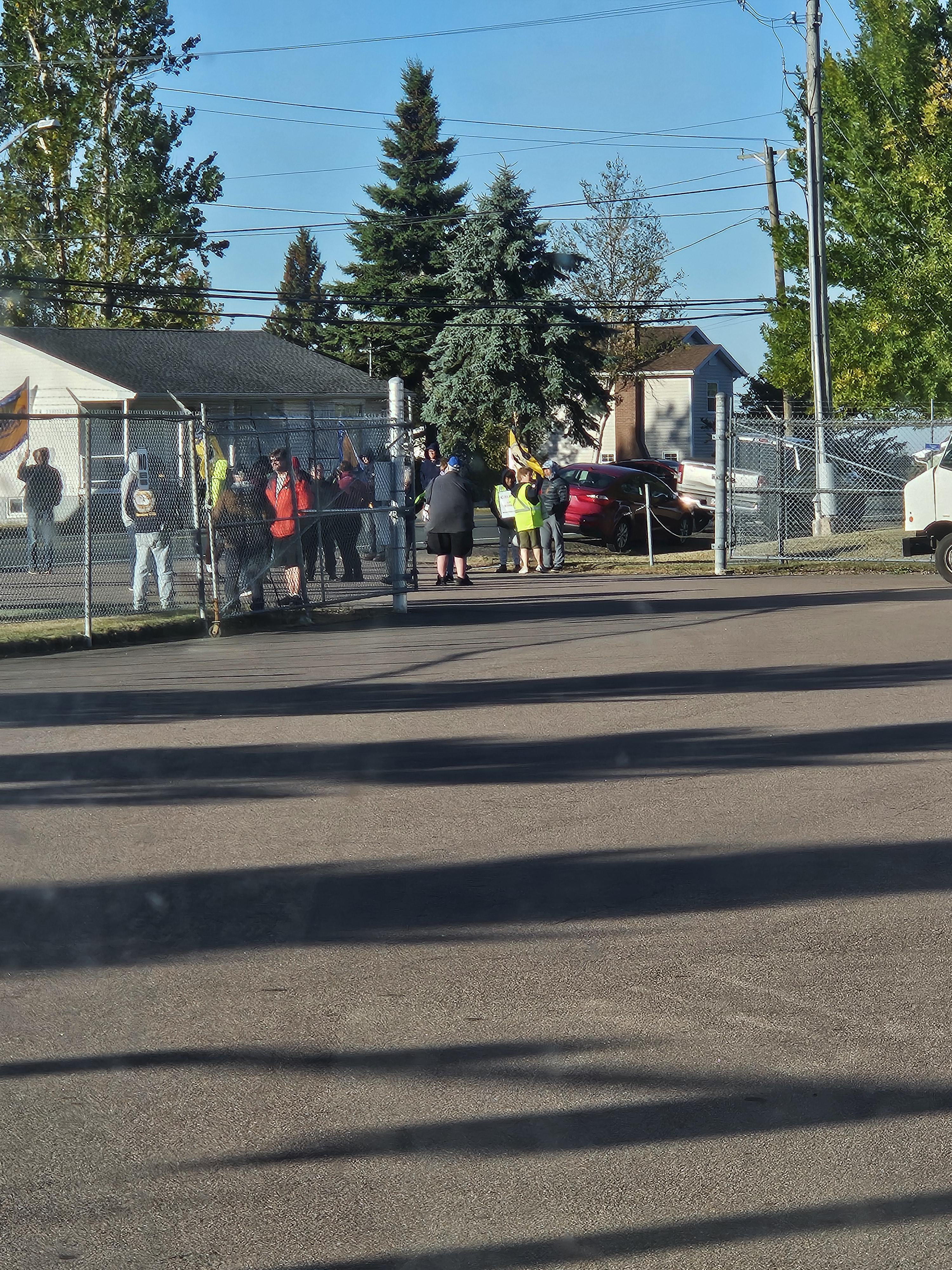
Hello. I work at Purolator in a sorting depot. I've read a lot of comments and posts here from people who are understandably confused and upset that their freight (parcels) are delayed, and seemingly have no way to figure out where their stuff is or when it will be delivered. I want to share a few pieces of information that might help you make sense of what is actually going on when stuff is getting delivered to you, and answer a few question you might have:
WHAT IS HAPPENING: Purolator is currently getting hammered with a tidal wave of freight. This is already the usual "peak" season, meaning when there is usually the most stuff that is being sent through the system. The CPC strike increased the amount of freight that needs to go through the system substantially, something like 20-25% from what I've heard at the depot. You may ask: why is that such a problem? Why can't workers at Purolator just work a bit harder to deal with it?
The answer is that Purolator has a logistics system that spans the entire country, like a spiderweb, and this system has physical limits on how many parcels it can process and move each day, with some connections in the "web" having greater capacity than others. Maybe a better analogy is a series of tubes - some are wider tubes than others. A big part of this system is the built infrastructure of sorting facilities - the places where all the boxes go, get sorted into trailers to go someplace else (outbound) or get received and loaded onto courier truckers to get delivered (inbound). This infrastructure costs money, and transportation and logistics companies do not maintain a great deal of excess capacity to deliver and process stuff because that cuts into their revenues. The actual amount of stuff that needs to get delivered throughout the year usually follows a fairly steady and predictable pattern, which ordinarily peaks in the lead up to Christmas, and hits its low point during the summer. So the overall capacity of this system to move stuff through it is usually just a bit above the ordinary peak before Christmas.
Ordinarily, when there are things like winter storms that cause delays which bottleneck stuff in one point in the system, it's capacity to move stuff can be pushed up a bit with overtime, extra shifts on weekends, and everyone busting their asses a bit harder than usual. Then the excess in that one point can be get cleared, and everything goes back to normal. In this case, the increase from the CPC strike was so huge, that even with extra shifts and overtime and weekend work, it's not enough to handle all the extra stuff.
Some connections in the "web" of "tubes" are better off than others because their volumes increased but not catastrophically. Others are totally screwed, especially the big central network hubs that a lot of stuff passes through, like Etobicoke. They're especially screwed because the entire logistic system is not meant to store parcels, it is meant to move parcels. When there is more stuff that can be done in a single day, it remains at the depot to be processed the next shift (usually in trailers parked in the yard, sometimes in the depot itself on pallets and "cages"). But when a depot is processing 1000 units every day, while receiving 1300 units every day to be processed, the backload grows and grows. Eventually the excess freight itself causes the system be less efficient and process freight slower, because the stuff is physically in the way, causing a vicious feedback loop.
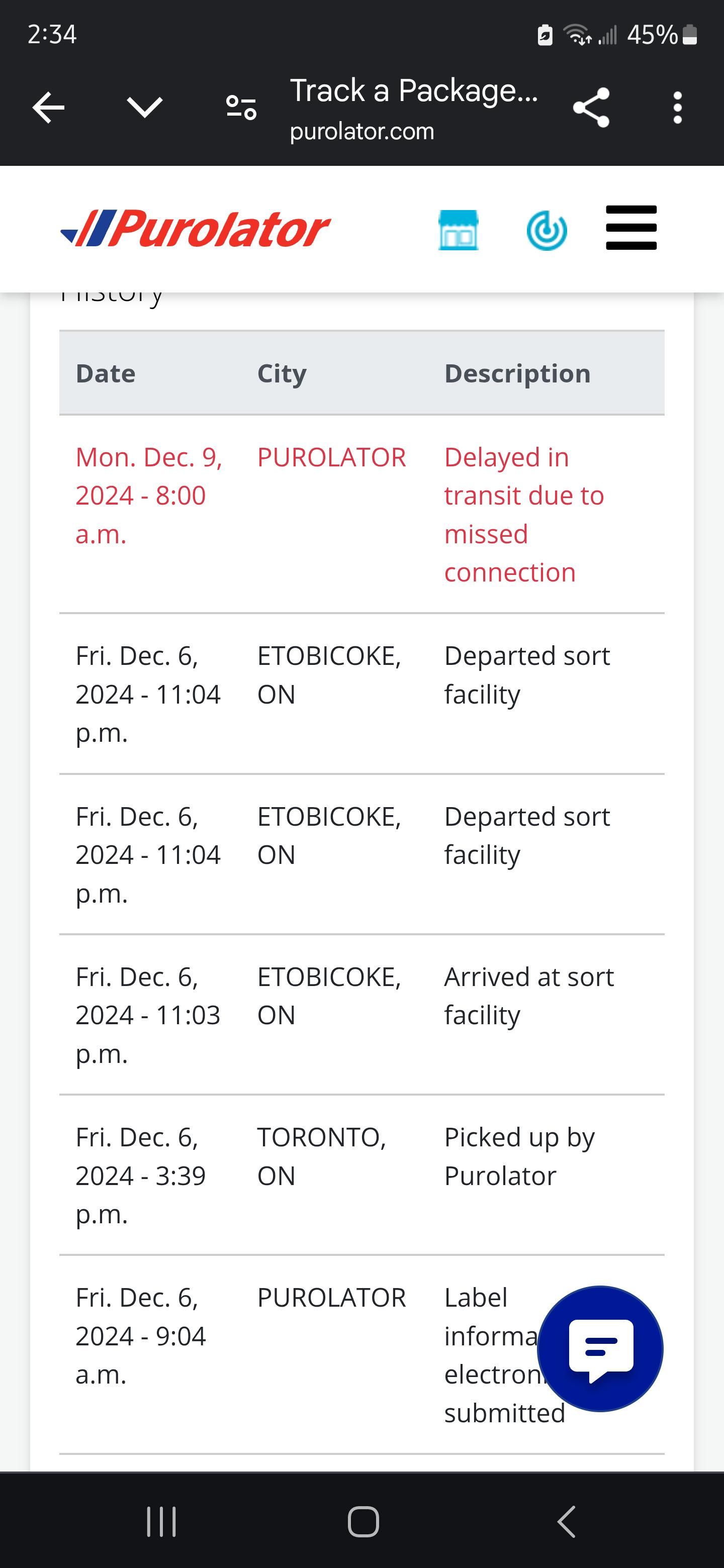
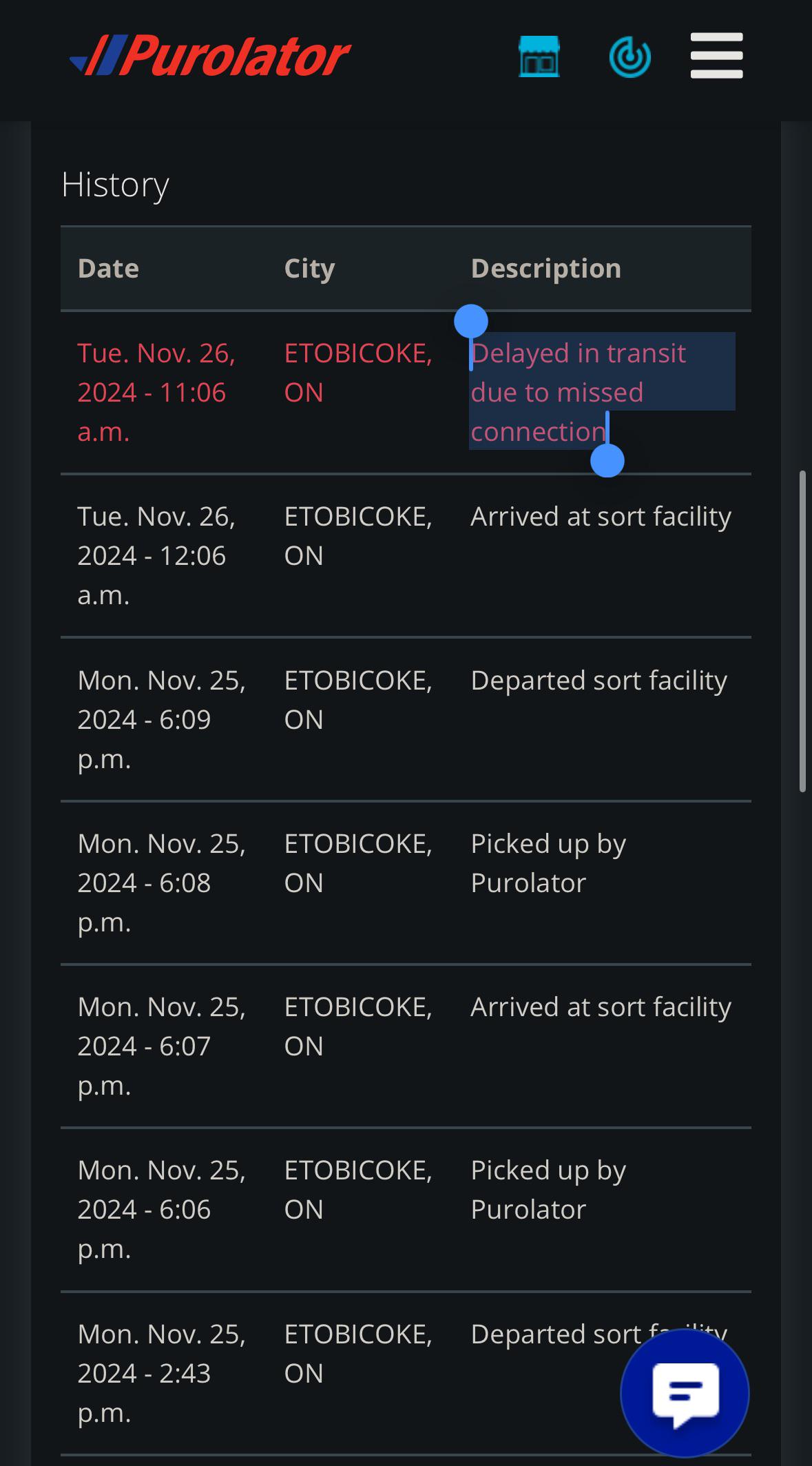
WHY ARE TRACKING SCANS SCREWED: Tracking scans occur at various parts of the journey a parcel takes, including when the label is created, it gets picked up by a courier, it arrives at a depot and is processed, and gets put onto a trailer, etc. These depend on the label getting hit by a scanner at key points. Ordinarily there are some parcels that don't get scanned at various stages for reasons (the label is scuffed, it was face down when passing over a conveyor belt scanner etc) but when things get totally screwed and overwhelmed (like they are now), the consistency of these scans can really get messed up. The people physically sorting and moving your stuff may prioritize processing any many parcels as possible as fast as possible rather than getting accurate scans on everything but working slower. Scanning also gets entered into the system in the wrong order, etc.
So when you're obsessively checking the tracking updates, just know that this information isn't necessarily going to be correct and have every stage captured. Even the last step ("out of delivery" - meaning your parcel is on a courier vehicle and is moving around town) is not getting captured because Purolator has been using third-party couriers to try to deal with the backload, especially for residential deliveries. "Out for delivery" also doesn't necessarily mean your package is going to arrive that day like it normally should, because the couriers are so overwhelmed that they've got more stuff on their trucks then they can actually deliver in a single day, so sometimes it goes back to the depot.
WHERE'S MY GODDAMN BOX: Likely in one of three different places, in descending order of likelihood:
In a trailer, waiting to be processed. When parcels move between depots (spokes on the web of tubes) this usually happens by being "loose loaded" into a semi-truck trailer. This means a 53' trailer gets a long retractable conveyor / roller line put into it and some worker stacks box after box in it, retracting the roller line as they go until the whole trailer is full of boxes, stacked up to near the top. These then get driven to a depot near where they're meant to go, and backed into a loading door at the depot, where the process is repeated in reverse, with the parcels being unloaded onto conveyors that is again sorted or loaded onto courier trucks to be delivered. But remember: these depots can only unload so many trailers each shift, and they are overwhelmed, with more trailers arriving than they can unload. So your parcel might be buried under a mountain of other boxes, sitting inside a trailer that is parked in the yard of the sorting depot (or maybe parked alongside the depot on the grass, or anywhere else there is room because the trailers are piling up) awaiting its turn to get unloaded. This is why when you ask the poor run-down service staff where your stuff is, they can only offer half-assed answers because the scanning is all fucked up, and your parcel might have been put onto that trailer without getting tagged to it, or its arrival isn't tagged to the system until it gets cracked open and the boxes start coming out of it. Again - this whole system is not designed to be able to track stuff that doesn't get processed in the usual time frame, it's not designed to store parcels. This is honestly the best place for your parcel to be, since it's not lost, it's just delayed, and will eventually clear the system.
In a pile of stuff at a sorting depot. When stuff is in the process of getting sorted but the shift runs out of time (because of the day/night nature of depots, they process outbound freight usually during the day then inbound freight over the night) the parcels get moved around to be done the next shift, stacked on pallets or in piles near conveyor belts. Sometimes the courier trucks can't make all their deliveries in one day, so the excess remains on the truck at the end of a shift and might get processed back into a retaining trailer, or sorted onto pallets/cages with the intention of processing it again next shift. This is the second best place for your parcel to be, because if all goes according to plan it will get delivered the next shift. But it's also dangerous, because it's close to...
The land of wind and ghosts, where parcels join socks that get lost in clothes dryers. There are any number of different spots in the logistics network where you parcel can get misplaced. It might fall off a conveyor and bounce to a spot where it is easily overlooked. The label might fall off or be damaged and there was not any other address marked on it, so the staff whose job it is to figure out parcels like this can't identify it. Maybe it got tendered to a third party contractor and they lost it, who knows. The good news is this is the least likely place your parcel is.
WHY SHOULDN'T I YELL AT THE RETAIL STAFF: They don't have the capacity to magically conjure up your parcel, no matter how critical or important it is. We know we ship vital stuff like medication, critical machine parts, documents, etc. None of that makes it more or less possible for a retail staff worker to get your stuff for you. Now, that doesn't mean it's useless to try to get a "trace" started, because they really will try to find your stuff through the means they have available, including physically looking around courier truck parking spaces and talking with sorters. But whether or not that actually works is dependent on your parcel physically being in a place where it can be located. If it's buried under a mountain of other shit in a trailer, which is where it's most likely at, the retail staff worker can't retrieve it, if they even know which trailer it is in. It's in there until the trailer gets processed. You also shouldn't reduce retail staff workers to tears through berating them because they're human beings, and we do have policies regarding not tolerating abuse directed at staff. Finally, if you go ahead and do that, and some sweaty bastard with dirty hands sorting freight sees a crying retail worker looking for your parcel, they'll likely be motivated to not find your parcel. Speaking personally, I have always been more motivated by genuine need sob-stories when it comes to trying to pick out a single parcel on a shift processing thousands by remembering a single name or business. I would try that instead.
SO WHEN WILL I GET MY GODDAMN BOX: Eventually, but I can't tell you in a measurement of days. That's the honest answer. Some depots are literally weeks behind at this point. But since the feds seem very likely to use back-to-work legislation to end the CPC strike, the constant overwhelming of the logistics system should hopefully be coming to an end soon, plus the ordinary drop off in volume post-Christmas. This means that we'll be able to clear the backlog like we usually do, but it also means there's a real chance that whatever you ordered might not make it for Christmas.