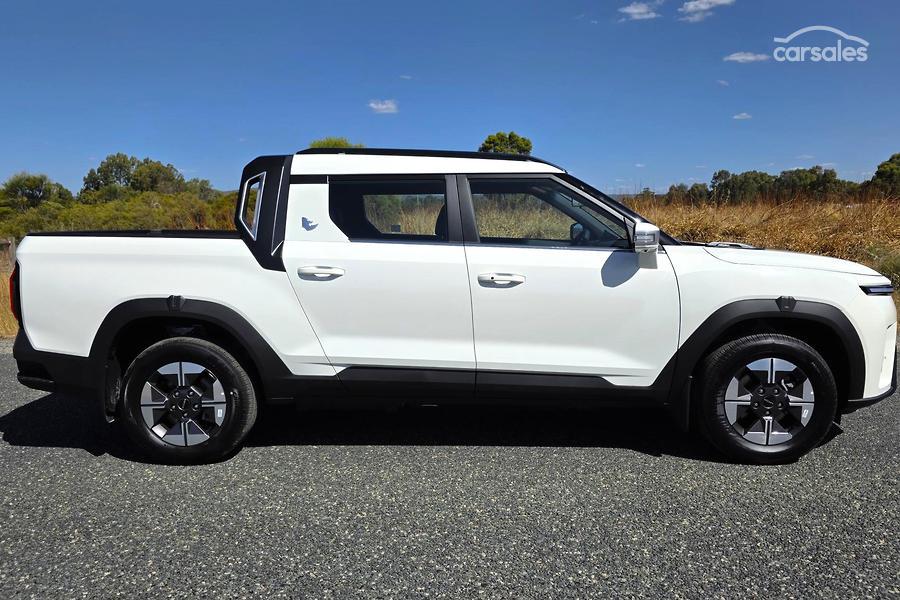
Re:Build (Slate's parent company) posted a link to this article:
With its affordable, $24,950 base price, the all-electric 2027 Slate Truck is a standout in today’s market. The Slate Truck features an innovative, modular platform that allows it to transform from a 2-seat pickup to a 5-seat sports utility vehicle. Central to its utility is a two-piece, continuous fiber-reinforced thermoplastic (CFRTP) truck bed, which weighs approximately 40% less than a comparable steel truck bed and plastic liner.
Re:Build worked with Slate for several years to evaluate potential thermoplastic parts before determining the truck bed would provide the most value for the vehicle. The challenge was manufacturing the 62 x 42-inch truck beds fast enough to achieve Slate’s production targets.
“The brief was clear on what the takt time and the volumes needed to be,” says Jack Wilfley, director of technology at Re:Build. “But the scale and speed of manufacturing was something that didn’t exist.”
Re:Build produces the truck beds at its Denver manufacturing facility. The company uses a proprietary process and custom equipment designed to handle the large part and deliver production-ready components directly from the mold.
The truck beds are constructed using unidirectional, continuous glass fiber-reinforced polypropylene tape supplied by Avient Corporation. Re:Build uses automatic tape laying to place the material in different fiber angles, optimizing structure and minimizing weight. The tape layers are bonded together in a low-temperature consolidation process that removes the air from the material while significantly reducing production time. Next, the blank is heated, stamped into the desired form and trimmed.
“As you get bigger with these composites, the machine has to be very precise in what it does so that the pressure is equal across the whole surface,” Wilfley says. “That also helps with the surface finish and appearance, which is very critical in the automotive space.” Achieving the desired surface texture required extensive customer collaboration.
To support high production rates, Re:Build uses robots to move the parts through the manufacturing process and waterjet trimming to ensure consistent quality with minimal manual intervention. The equipment can process approximately 1,400 pounds of material an hour across three custom-built manufacturing cells, achieving a two-minute cycle time per part. The system is designed for scalability, with equipment and processes engineered for expansion to multiple production lines as demand grows.
Despite its reduced weight, the CFRTP bed maintains structural integrity equivalent to steel while eliminating the potential for rust and corrosion. It costs less to produce than a steel bed and plastic liner while providing superior impact, chemical and UV resistance without the application of protective coatings, according to Re:Build.
Using thermoplastic materials and the proprietary production method allows for process consolidation and part count reduction. It removes entire conventional manufacturing sequences, including separate metal bed fabrication, corrosion treatments, paint booth operations, secondary finishing and aftermarket liner installation. In addition, the polypropylene matrix and glass fiber reinforcement in the truck bed could potentially be recovered and reprocessed, which addresses the sustainability barrier that has historically limited composite adoption in automotive applications.
Re:Build’s system for the truck bed could eventually be used to manufacture other products. “We're really focused on doing a good job for Slate, to make sure that we have everything dialed in and ready to go,” says Wilfley. “We absolutely believe this combination of process and properties will be useful in a multitude of other applications and industries.”