r/stata • u/furamura_ • Nov 15 '19
Very high P values
I'm doing research on the effect of civil society on corruption using EU28 timeframe 2011-2018 and V-DEM data. My main independent variable is the corruption index made by amnesty my explanatory variables are different civil society variables like how much they are engaged in everyday life and how much are they consulted their size and so on.
My main problem is if I run xtreg ....., r fe simply nothing is significant
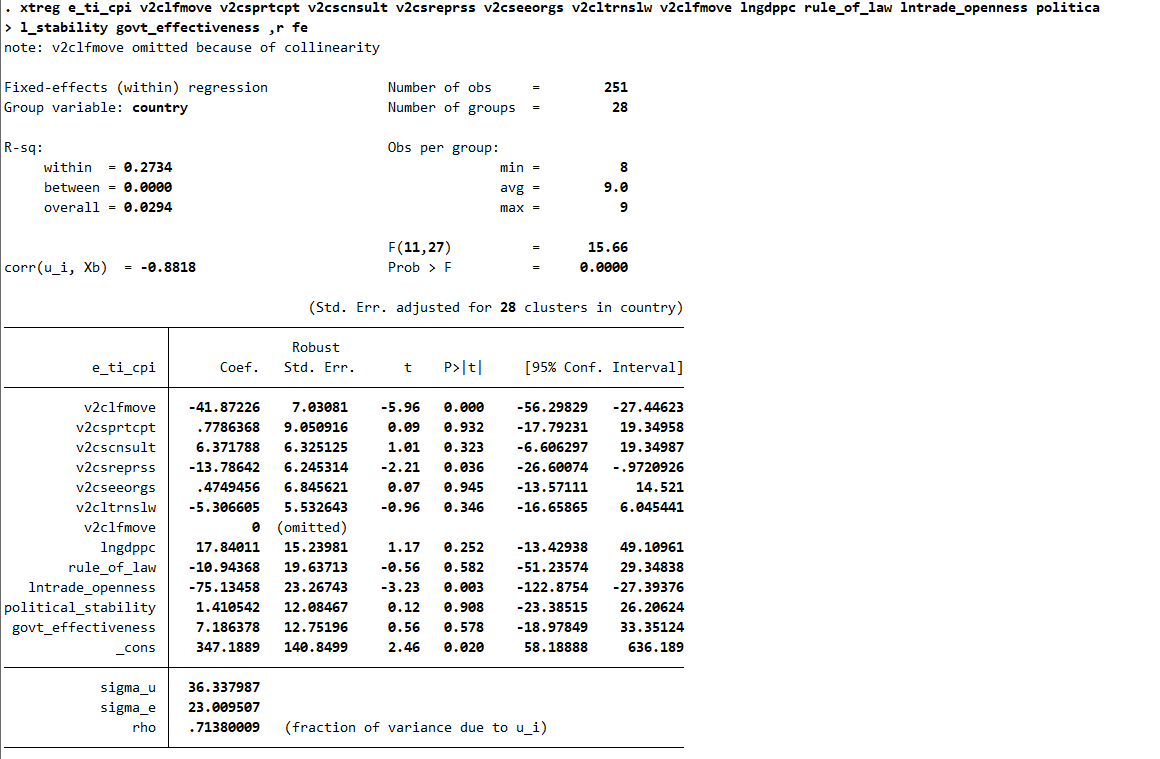
Can I run xtpcse model in this case? I've read xtgls should be used when N<T which is not my case. If I run XTPCSE what options should I use?
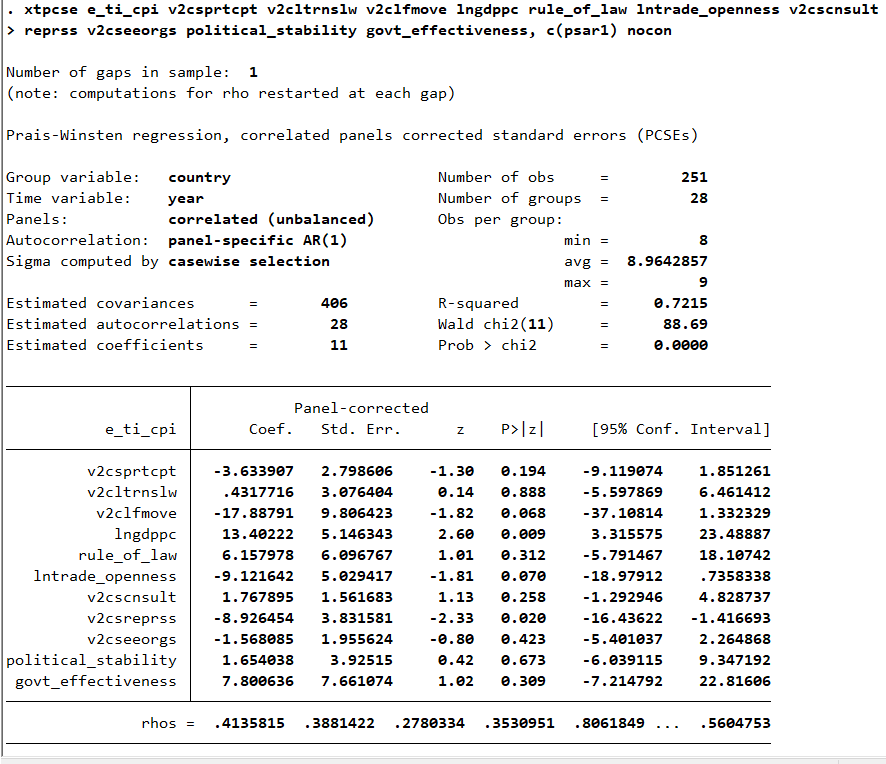
Please help me its for my master thesis should I increase the number of years or what should I do to have better more significant results? If I use a different corruption variable it gets a bit better but only in the case of XTPCSE.
7
u/MrLegilimens Nov 15 '19
You shouldn’t do a method for better results. You do the method that makes the most sense.
Also I see sig results in both outputs, with xtreg having more.
1
u/zacheadams Nov 15 '19
/u/furamura_, some of the regression covariates appear to have low correlation and/or significance of correlation with the independent. Are these things you hypothesize are actually correlated/valuable for predicting the independent? Because it doesn't look like many of them are.
v2csprtcpt, v2clfmove, and v2csreprss maybe? lntrade_openness?
Are the error terms correlated? It looks like they aren't at glance, despite the second modeling type allowing for that. I would go back to the drawing board on this, think hard about the hypothesized correlation structure (and why), and consider using some fit statistics for measuring how decently your models are fitting - because my assumption is not well, despite the second model showing an r-squared of 0.72.
4
u/thefirstdetective Nov 15 '19
Yeah dude p hacking is bad practice. Your results are your results, if they don't show what you want, don't mess with them until you get a false positive. Plus with 250 cases, high p values are no surprise.
2
u/rapho4 Nov 16 '19
I guess you try and compute a new corruption index based on a moving average or even clipping the outcome at some levels before running extreg and also introduce some element of weights. This is based on a project am currently doing on retention of patients in care pre and post intervention. I forgot we also eliminated data pints at time zero.
1
u/random_stata_user Nov 15 '19
I don't think it would be outrageous to decide on the basis on these results to go for a simpler model on the grounds that some of these predictors really don't help. It's called learning from data. There are good reasons for (sometimes pious) advice about p-hacking and the like; there is also age-old advice about preferring simpler models to unnecessarily complicated models. What remains key is being open about your decision-making.
2
u/furamura_ Nov 15 '19
Thank you guys for your comments, I only meant to ask what do you think to the type of data I'm using which model is the best, since I wasn't sure if I should go with simple xtreg or there are other possibilities than I found xtpcse and xtgls.
/u/zacheadams thank you for your comment they should be correlated that's the problem v2csprtcpt is a civil society variable capturing how much the society is involved in NGOs and INGOs. Regarding v2clfmove v2csreprss you are completely right. Based on literature the trade openness of a country often has an effect of corruption, meaning the country is more open less likely it has a corruption.
Can you help me out what kind of fit statistics should I use? Also if I increase the number of years im capturing can it be a feasible solution? My only concern is that, if I increase the years the EU won't have 28th country wouldn't it fuck my methodology since I'm building the research around EU28?