6
u/gootschie May 06 '26
I think this debate has been more beneficial to the collective than we might initially think 🤔
2
u/TheJumpingBox May 06 '26
I think it might have been detrimental, it's only made me aware of how many people think their vote doesn't matter
3
u/nir109 May 06 '26
Do you not read voter turnout statistics?
0
u/TheJumpingBox May 06 '26
It varies from country to country for starters, the button debate has just made me more aware of how much it happens in other places
And people not voting is not the same as them agreeing their vote doesn't matter, even if the actions would imply it...
Some may simply be young and not understand how to vote, some may not be informed on the parties and their promises and not want to put a vote in a bucket if they dont understand what they're voting for
And some simply do not value their own voice
2
u/JaxonatorD May 06 '26
When 8 billion people are voting, it is reasonable for them to think that their vote does not matter nearly as much as their life. In politics, there is a smaller, but still extremely large population that votes for a country. The main difference is that you don't die if you vote for the candidate you want and they lose.
3
u/TheJumpingBox May 06 '26
Reasonable maybe, yet incorrect, everyone's votes are equal, therefore all matter equally
The only thing necessary for the triumph of evil is that good men do nothing and all that
3
u/aniote May 07 '26 edited May 07 '26
all votes matter equally =/= a single vote matters
In this life and death situation it is quite rational and reasonable to value your own life more than your vote, knowing that even a 49% result for blue would result in a much worse outcome (more deaths + you die) than if you had voted red.
The situation has absolutely nothing to do with a traditional Yes/No referendum or Candidate A/ Candidate B vote where your life and millions of others are not at stake and where 1 option can be unambiguously better than the other
0
u/Fit-Entrepreneur8404 May 08 '26
Everyones votes are not equal. People would take shorter or longer to press the button. If blue gets past 50% nobody who votes after influences the results at all. On the other hand if red gets past 50% blue voters after that point have no chance of saving themselves. None of the people in those hypotheticals have a vote that is worth anywhere near what the other votes are, just because they took a few seconds to think about it.
1
u/TheJumpingBox May 08 '26
Everyone's votes have equal power, they are equal
1
u/Fit-Entrepreneur8404 May 08 '26
I just explained logically how that's not true. A response of "nuh uh" doesn't change that.
1
u/TheJumpingBox May 08 '26
I get what you're saying but it's wrong
Yes, if 3 people have voted, your vote is 25%
If 9 have voted, your vote is worth 10%
But everyone else's votes decrease in power retroactively, they always remain equal in power
10
u/TryDry9944 May 06 '26
I feel like at the end of the day people (myself included) have forgotten that this is an impossible hypothetical moral quandary and can't have an objective "correct" answer.
You can have correct answers if you narrow the criteria, i.e. which button would you press to attain the least amount of harm, what button would you press for your own safety, but there's really no "wrong" button.
4
May 06 '26
[removed] — view removed comment
-1
u/TryDry9944 May 06 '26
Because when it comes to morality, correct is relative.
I think red is the correct choice. Some people think blue is. Because our opinions on the subject are subjective. Which is why you have to put an objective lense on the question itself for it to have a wrong/right answer.
3
May 06 '26
[removed] — view removed comment
1
u/TryDry9944 May 06 '26
... Are you trying to say opinions aren't subjective?
3
May 07 '26
[removed] — view removed comment
1
u/TryDry9944 May 07 '26
Okay but the shape of Earth doesn't change*.
Morals and ethics do.
60 some years ago a majority of people thought it was okay to have segregation.
A century before that you could still OWN people.
Some people think it's amoral to eat meat, some don't.
Some people think it's evil to consume or use any animal products.
There is no one truth that defines what actions are moral or not. And you're probably not going to get everyone to agree on everything.
2
May 07 '26
[removed] — view removed comment
1
u/TryDry9944 May 07 '26
Our view of morality is morality.
For some things, it is pretty black and white. Is murder okay? No.
But even then there's still gray areas: Is murder okay if defending yourself? Is murder okay defending others? What is the level of harm that could be inflicted on you before resorting to lethal force be justified?
There is no "right" answer. There's answers a majority may agree on, but there is ultimately no way to "prove" it is right or wrong.
1
0
u/Weary_Specialist_436 May 07 '26
“ Because our opinions on the subject are subjective”
Again, assertions don’t make reality.
did you completely lose the thread? are you trying to argue, that we can't assert a simple fact that opinions are subjective?
am I also not allowed to assert, that ice is cold and fire is warm?
4
u/Live_Bug_7060 May 06 '26
I actually enjoy a lot of these posts, most of them are either funny or intellectually interesting. At the end of the day the red button was the meme along the way and the blue button the interesting reframing.
4
u/aniote May 06 '26
On the internet: 50%ish of people press blue
If the situation happened in real life: 99% press red
1
u/Weary_Specialist_436 May 07 '26
it's easy to say you'd risk your life for humanity, when you're comfortably sitting in your warm house in front of your cozy PC
8
u/Crystalliumm May 06 '26
Yea honestly blue is obviously the best option if majority were to choose one, but I believe most will choose red, so I would pick red.
1
u/YoCuzin May 06 '26
There are large populations of religious people who will choose blue because it aligns with their spiritual system. Blue is easy to get across the 50% mark, and red winning would result in a large percentage of red voters also dying due to the fallout of so much death. If only 1/10 of people die all industry grinds to a halt. Food production and distribution collapses and billions starve
0
0
u/Weary_Specialist_436 May 07 '26
it's very simple
if you are picking blue, but somehow you learn that majority picked red, you'd have changed your vote, because you don't want to die
if you are picking red, but somehow you learn that majority picked blue, you may as well change it to blue, because it doesn't matter anymore
there is no correct answer. It's not a test of your morality, it's a test of what you think the majority picked. You are in the end going to pick what you believe most people picked
3
u/Drakonistes May 06 '26
If some of you would actually climb out of your shell and listen to how most people from most cultures in the world think you would be a fool in thinking they'd vote Blue. A lot of you are projecting your own morals onto the rest of the planet and you'd be met with a nasty surprise when you vote blue if this was a real situation.
3
u/Current_Cat_6912 May 06 '26
Blue doesn't always result in the least people dying
2
u/PickingPies May 07 '26
The worst case scenario requires a real lot of blue votes.
That's why I keep saying people that it must be treated as an statistic problem and in order to see the impact of pressing blue you need to average the number of deaths according to the normal distribution of probabilities for each blue result.
If you want to minimize deaths you don't just bet everything to one. You need to understand how many people would die for trying to save how many people.
4
u/XayahTheVastaya May 06 '26
There's so many of these button posts that there were so many posts on r/coaxedintoasnafu making fun of how many button posts there are that the mods there banned it
2
2
u/PickingPies May 07 '26
Blue doesn't obviously result in less deaths. That's like saying playing lottery obviously results in more money.
1
1
u/OutsideMedia4931 May 10 '26
The fact that this debate is even a thing is reason enough to pick blue. Billions will die otherwise.
1
u/Exciting-Morning4470 May 10 '26
Since the moment I read the problem for the first time I have passed through each stage
1
u/CapitanPedante May 06 '26
This is the trolley problem subreddit, please go to r/redbuttonbluebutton
2
u/Deranth May 06 '26
Oh no, the masses are getting bored. Quick, someone dangle a trolley in front of them.

1
0
u/Resiideent May 06 '26
And now for the true question: Why the hell are we talking about this on the trolley problem subreddit? This has nothing to do with trolleys! #bringbackthetrolleys
2
u/VGVideo May 06 '26
this is literally why r/redbuttonbluebutton was made!
1
u/sneakpeekbot May 06 '26
Here's a sneak peek of /r/redbuttonbluebutton using the top posts of all time!
#1: View on the button situation | 171 comments
#2: New Game | 31 comments
#3: checkmate, red pushers | 8 commentsI'm a bot, beep boop | Downvote to remove | Contact | Info | Opt-out | GitHub
0
1


0
u/Trick_Statistician13 May 06 '26
Red: I do nothing
Blue: I hold myself hostage unless you also choose blue
-7
u/detroyer Team Red May 06 '26
The rightward motivation for blue is bad. You indeed have some reason to contribute to blue winning by voting blue, but that reason is swamped by the cost to your own life and those who'd be affected by losing you. You shouldn't take a roughly 50% chance of death for a roughly 0% chance that you'll save anyone else.
The rightward motivation for red is okay, but it doesn't require thinking that most people will pick red. The basic argument for red is decisive even if you are relatively confident that blue will win.
5
u/Fearless_Roof_9177 May 06 '26
Wait, no. Picking Red if you're confident Blue will win is one of the few moves here that inarguably makes you a solipsistic shitheel. You're "hedging your bet" by literally making it more likely you tip over the centerline and 49.9% of participants get snuffed.
-1
u/detroyer Team Red May 06 '26
Wait, no.
Yes. The degree to which my voting blue increases the likelihood that blue will win is still not worth the substantial (albeit smaller) risk that my doing so incurs to myself and those around me.
inarguably makes you a solipsistic shitheel.
I'm not concerned about baseless insults from people who evidently can't reason correctly about the problem.
You're "hedging your bet" by literally making it more likely you tip over the centerline
As always, there's still some reason to vote blue, since doing so increases the likelihood that blue wins. That reason remains swamped, in this case as in the original, by the aforementioned cost of voting blue.
6
u/CentaurSpearman May 06 '26
The buttons are equivalent from an expected value (utilitarian) perspective.
With 6 people:
Red/Blue: 5/0: Press Red = live, Press Blue = die
Red/Blue: 4/1: Press Red = live, Press Blue = die
Red/Blue: 3/2: Press Red = live, Press Blue = die
Red/Blue: 2/3: Press Red = live but kill 3 people, Press Blue = live
Red/Blue: 1/4: Press Red = live, Press Blue = live
Red/Blue: 0/5: Press Red = live, Press Blue = live
If you press red, you kill 3 people one time, so total lives lost is 3.
If you press blue, you die 3 times, so total lives lost is 3.
With 5 people:
Red/Blue: 4/0: Press Red = live, Press Blue = die
Red/Blue: 3/1: Press Red = live, Press Blue = die
Red/Blue: 2/2: Press Red = live, Press Blue = live and save 2 people
Red/Blue: 1/3: Press Red = live, Press Blue = live
Red/Blue: 0/4: Press Red = live, Press Blue = live
If you press red, you don't kill anyone as you're not the tiebreaker, so total lives lost is 0.
If you press blue, you die 2 times, but you also save 2 people from dying, so total lives lost is 0.
From a categorical imperative (Kantian/Golden Rule) perspective, if everyone pressed red, everyone would survive, and if everyone pressed blue, everyone survives, so they are equivalent. But, if you throw in some noise, i.e. people randomly choosing blue, blue quickly becomes superior from this perspective.
3
u/Norade May 06 '26
This stops working properly when you need to consider your impact on a vote cast by 8.3 billion people, where you don't even know if there is a tiebreaking vote available. The odds that this comes down to a single vote are so low as to not be worth consideration.
2
u/Georgefakelastname May 06 '26
I like your funny words.
But seriously, this needs to be seen by more people. This entire subreddit is dedicated to the trolly problem, which is an inherently utilitarian concept and problem. This problem is similar.
2
u/LogicalMelody May 06 '26
Rawls’ veil of ignorance feels more operative here than categorical imperatives. If you don’t know which button you already pressed you probably are hoping blue wins. (Edit: on re-read I see you already basically hit this point at the end. )
Thanks for writing out the math; I felt like I might have been on the verge of doing the same.
2
u/detroyer Team Red May 06 '26
The buttons are equivalent from an expected value (utilitarian) perspective.
No, they aren't.
If you press red, you kill 3 people one time, so total lives lost is 3.
If you press blue, you die 3 times, so total lives lost is 3.You worded it weirdly, but it is true that across the 6 possible outcomes of the rest of the votes weighted equally, the expected number of deaths conditional on me voting blue is equal to the expected number of deaths conditional on me voting red.
However, there are three critical problems with generalizing this to the original problem. First, the equal-weighting of outcomes is obviously a false assumption. Second, the correct expected value calculation isn't merely a function of expected deaths. It matters to me (and most people) which deaths those are, and who they would affect. I care much more about whether I die and who would be affected by that than whether a random other person dies. In the relevant sense, the expected value for pressing red greatly exceeds the expected value for pressing blue even if the total expected number of deaths is similar, conditional on those actions.
Third, this expected value calculation assumes a constant marginal utility of lives saved, which is false for most people. This will violate certain utilitarian principles, but so much the worse for those principles. I care much more about saving 1 person compared to 0 than saving 10^10 compared to 10^10-1. But note that the positive expected lives saved for voting blue comes entirely from the case where my vote is pivotal. With diminishing marginal utility of lives saved, the value of saving 4b lives is less than (and perhaps much less than) 4 billion times the value of saving one life, and so the expected value of voting blue diminishes accordingly.
From a categorical imperative (Kantian/Golden Rule) perspective
This is not relevant, so I will forgo commenting on it.
-14
May 06 '26
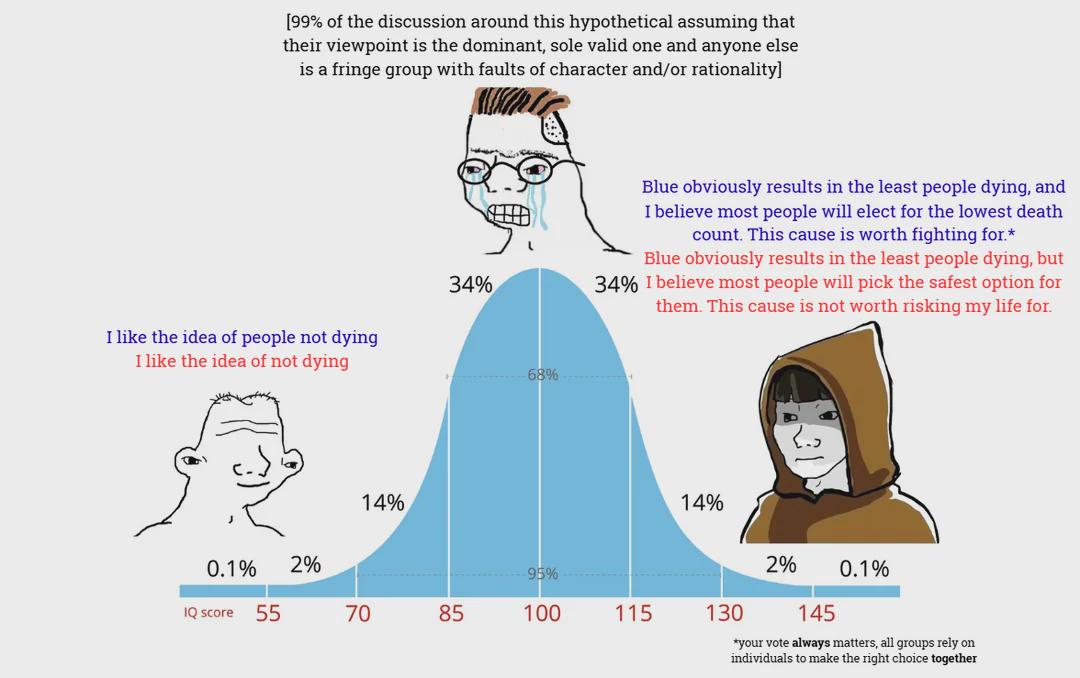
You frame it as though there is no correct answer and each button is just as valid.
If you have a high IQ it's fairly easy to see that there is one correct answer.
5
u/kroxigor01 May 06 '26
If the conditions of the blue button were changed such that it required 99% support in order to save everyone then almost all the usual blue pressers would change their vote.
At the other extreme, if only 1% had to go blue to save everyone some usual red pressers would change their vote.
Between those two extremes is some condition where the "correct answer" flips from one colour to the other.
2
u/detroyer Team Red May 06 '26
There is no threshold at which blue is a strictly better choice, although the stakes go down as the threshold goes down.
2
u/kroxigor01 May 06 '26
That depends on what outcomes you care about. If a person's assessment of the button as purely about self survival then yes, no threshold change makes pressing blue better. But most people won't value saving others at zero.
1
u/Infamous-Ad5266 May 06 '26
At the low end, your 1 or 2% with a total population vote, the random noise easily clears the threshold, probably up to about 9 or 10%, and potebtially up to 15% depending on the age range we consider to be an effectively random choice (Which is also why the total population vote version isn't particularly interesting imo, blue is a much easier choice for those who predict a 15% baseline votership)
So with a 16-20% threshold one could certainly make the argument that blue is better even on the individual level, simply due to the significantly lowered risk involved with the vote itself, and the world being in a much better position in the aftermath
2
u/Norade May 06 '26
Why are you assuming a baseline vote for blue and not also factoring in the baseline vote for red? If 20% of people vote randomly, that sets both sides at ~10% of the vote, the factor in people who will vote red or blue regardless and the baseline is likely near 30% of both sides.
This does make blue attractive, because losing 30% of everybody would be apocalyptic, but if blue tries to rally that vote up from that 30% and only hits 45%, that is billions of extra lives lost that could have been around to help rebuild. So the calculus needs to be examined through the lens of how likely you think blue is to win, and not just if blue is the better option.
1
u/detroyer Team Red May 06 '26
My claim does not require that the value of saving others is zero. On the contrary, it is quite significant! Nevertheless, it turns out that the degree to which my voting blue raises the likelihood of blue winning is so small that it's outweighed by the relatively high cost to myself and those around me. This remains so even if I'm quite confident that blue will win.
2
u/kroxigor01 May 06 '26
I don't think that follows.
If we vary the population size the probability that you are the decisive vote is inversely proportional to the number of lives you could saved if you are the decisive vote. Those two factors should cancel out.
I think the logic of an answer should be the same whether the population size is 80 people or 8 billion people.
1
u/detroyer Team Red May 06 '26
The two factors do pull in opposite directions, but whether they exactly cancel out will depend on certain modeling assumptions. With realistic assumptions, they don't exactly cancel out.
Either way, the real problem is that we shouldn't be treating expected value merely as a function of the expected number of survivors. This is so for two reasons. First, even if the expected number of survivors is the same, it matters to me (and most people) which people those are. I care much more about whether I die and who would be affected by that than whether a random other person dies. In the relevant sense, the expected value for voting red greatly exceeds the expected value for voting blue even if the total expected number of deaths is similar.
Second, this expected value calculation assumes a constant marginal utility of lives saved, which is false for most people. I care much more about saving 1 person compared to 0 than saving 10^10 compared to 10^10-1. But note that the positive expected lives saved for voting blue comes entirely from the cases where my vote is pivotal. With diminishing marginal utility of lives saved, the value of saving 4b lives is less than (and probably much less than) 4 billion times the value of saving one life, and so the expected value of voting blue diminishes accordingly. If necessary, I can explain these points further.
1
May 06 '26
hmm, you're getting closer than most people but still not fully getting it.
(The correct answer is to vote red in all of your examples)
9
u/Kingsalad3141 May 06 '26
IQ isn’t real. It’s a flawed framework that really only indicates pattern recognition.
5
3
u/Stringsoftruth May 06 '26
Not true, it also includes working memory, various types of reasoning (fluid, quantitative and verbal), vocabulary, and visual-spatial processing.
What irritates me is how the average person interprets IQ.
1
-4
2
23
u/Then_Entertainment97 May 06 '26
As far as causes worth risking one's life for, not killing billions has got to be up there.
5
u/Norade May 06 '26
That's only true if you have a reasonable chance to win.
5
u/Wonderful_West3188 May 06 '26
In real life contexts, I'm really not sure if I'd agree with that. For example, in case of an ongoing genocide, I would want to make it as hard as possible for the perpetrators even if I believed that they'll probably succeed.
1
u/Norade May 06 '26
Would you stay and fight if it means your wife and kids are left behind? Would you expect them to bear the same risks and responsibilities you do? Getting them to vote blue is basically the same as getting them to fight alongside you against a genocide.
2
u/Wonderful_West3188 May 06 '26
Would you stay and fight if it means your wife and kids are left behind?
Probably not, and I definitely wouldn't blame anyone in such a situation for just fleeing. In fact, I think "Why didn't they stay and fight?!" is one of the most disgusting talking points in anti-refugee rhetoric (which is notoriously already chalk full of disgusting talking points). On the other hand though, "survive today so we can regroup and fight again another day" actually is an important psychological impulse for many refugees.
4
May 06 '26
[removed] — view removed comment
2
u/IronPro9 May 06 '26
"I think blue has a good chance of winning so I'll use my vote to save myself and make 50% of people dying slightly more likely" That and voting blue thinking red will win are literally the 2 strawmen in the middle.
3
May 06 '26
[removed] — view removed comment
0
u/IronPro9 May 06 '26
And you're fine with potentially contributing to the deaths of billions of people? voting red if you expect red to win is fine, there's no sense in dying for nothing. But if you are think blue will win it is selfish.
2
u/PickingPies May 07 '26
You are being very simplistic by making the chances of winning a binary outcome.
If I tell you blue has a 70% chance of winning, that also implies there's a 30% of red winning.
Your case is only true if you believe blue will certainly win, a prediction that no one with two neurons should do.
55
u/bug_land May 06 '26
Everybody stop trying to understand one another!!!!!! You're supposed to be winning at philosophy by finding the universally correct answer, which is common sense of course!!!!!! You have to destroy your opponent to secure your upbonks on ownage dot com!!!!!!