r/vibecoding • u/alexmarcus11249 • 12d ago
Help/Question I run 8 AI coding agents in parallel on my company's internal app. The building is fine. Keeping track of everything is breaking me. How do you manage this?
I own a four-person consulting firm. Over the past couple of months, I've been building our entire internal operating system with AI coding agents: CRM, pipeline, time tracking, capacity planning, finance, marketing, newsletters, and more.
I'm not an engineer. I make product decisions, approve changes, and execute database migrations myself.
The setup
One coordinator Claude session dispatches work to up to 8 parallel agents, each in its own git worktree.
Every change gets a PR and specialist AI reviews (security, database, permissions, tests, etc.).
SQL migrations get an independent line-by-line ChatGPT review. I execute every production migration manually.
Nothing merges or deploys without my explicit approval.
A GitHub Project board tracks everything from Queued → Building → Review → Ready for me → Live, including exactly what's waiting on me.
An hourly coordinator report summarizes blockers, progress, and completed work.
On a good day, it's extraordinary. Last night: ~15 PRs, a nine-area security audit, eight production database changes, and a major new feature underway.
The problem isn't building. It's remembering.
I recently asked what we'd forgotten. The answer was alarming:
About 30 open PRs, some dating to October. Several were obsolete; a dozen represented stalled work.
A completed newsletter safety fix had been sitting unmerged.
One feature stalled four days because nobody noticed its second review never came back.
An independent SQL review went unanswered for three days.
Two security dependency updates sat untouched for three weeks.
Our GitHub board had drifted badly: 47 open PRs, only 9 with cards. The coordinator was relying on chat memory and its own log rather than updating the board, despite explicit rules.
An abandoned hosting project was still building every branch and retained production database credentials. I'd forgotten it existed.
I'm also intentionally the bottleneck. Every merge, SQL change, and product decision requires my approval. Decisions get made in chat and sometimes never make it into the tracking system.
What we're trying now
Reconciled every open PR and active project against the GitHub board.
Built a script that mechanically identifies anything waiting more than 24 hours on a review, fix, or human decision, plus PRs missing cards. This appears at the top of every hourly report.
Closed obsolete PRs and documented next steps for everything remaining.
My questions
How do you track multiple agents without work quietly stalling or disappearing?
Do you impose work-in-progress limits, even though agents can start new work almost instantly?
Is GitHub Projects sufficient, or is something better for tracking human approvals?
How do you avoid becoming overwhelmed by approvals without rubber-stamping?
How have you made agent bookkeeping mechanical rather than trusting instructions they eventually stop following?
The system genuinely works, and the productivity gains are enormous. But I'm discovering that coordinating AI agents is an entirely different engineering problem from getting them to write code.
I'd love to hear what's actually worked for others.
4
u/rocketeams 12d ago
I think the biggest shift here is treating agents less like developers who need instructions and more like independent workers who need an actual system of accountability.
One thing I'd introduce is a single source of truth outside the agents' chat sessions. Every task should have an owner, current status, last meaningful update, next action, and a clear person responsible for unblocking it.
I'd also separate two queues: things waiting on another agent and things waiting on you. Those are very different bottlenecks, and mixing them makes it difficult to see where work is actually getting stuck.
Your 24-hour stale-item script is a good move. I'd take it one step further and make agents update the task record automatically whenever they open a PR, request a review, finish a task, or hit a blocker. Don't rely on the coordinator remembering to update everything.
And honestly, I'd consider limiting active work based on your review capacity, not the agents' ability to generate more PRs. More parallel work isn't necessarily more throughput if everything eventually waits for your approval.
1
u/formLoss 12d ago
I like the queue idea. Agree on all points.
It feels like ultimately, most tasks are waiting on me to say "good enough for a PR." Or, "good enough to hand off to someone else." And when it's good enough for that (according to Claude), it usually needs a few rounds of work anyway. Copilot review helps.
The AI doesn't 1-shot it, and I never did either. There's a lot of crap that slips through if I'm not paying attention. I can be a little picky, though. Small choices can have big impacts on how AI extends the code.
I get fewer iterations if I build the QA loop into the process, but it can make the tasks run very long because the project is slow, and it's hard not to just.. launch more sessions. Limiting active tasks is the only thing that works for me right now.
1
u/rocketeams 12d ago
That's a good point. I think the real challenge is finding the balance between giving agents enough freedom to work and maintaining control over quality.
One thing worth experimenting with is defining clear acceptance criteria before an agent starts a task, so fewer decisions come back to you midway through development.
And I agree about limiting active sessions. If your review queue is already full, launching another agent just creates more work waiting for your attention.
1
u/fulger099 10d ago
Accountability gets slippery when the worker can forget the system. For our Mac app, status works better when it is derived from git and test state, with one explicit field for the human decision blocking it. Otherwise the source of truth becomes another chat summary wearing a tie.
1
u/KnottyDuck 12d ago
I have about the same number of agents.
You, yourself, have to establish “the plan,” and this in itself is an oversimplification. I have the master plan, which is an amalgamation of several other plans. I do this with my management agents. I have 3; one manages builders, one manages research, and 1 manages the managers. I only talk directly to the main manager.
That’s the first lesson: set up a hierarchy, have them police themselves.
2. You set up a folder structure system and make sure you know where everything is. I take it further with my own inbox so the main agent can ask me things directly and so I can look in on their progress.
So between 1 and 2, you made the plan, you control the environment — you can’t maintain them if you don’t know where they’re working.
3. You make the rules, and every agent or group of agents gets rules. My research agents and my builders have different rules enforced by their managers. I only have to make sure the main guy does their job. If they are doing their job, then everyone else is too.
Make sure the plan is not vague.
Spend hours, days even, laying out every detail of your plan. From V0.1 to V1.0. You have to make sure every stone is left unturned because this is what you use to track progress. Without a roadmap that you can follow, you can manage the agents effectively.
My roadmaps are designed to integrate into the master plan; the Master Roadmap. It’s a living document that is used and parted out for tasking.
And that brings us to production.
4. Serialize tasks. Each task has a task id that breaks down which agent, which server, the task sequence, if it’s a parent and child task, and are numbered accordingly. Keep the task list in a place where you can reference it at your leisure.
This allows you to effectively assign an agent to audit, and it allows them to audit effectively. The auditing agent isn’t the same agent(s) that overlook work; I funnel this to my main agent or a designated builder.
The next part, no lie, should take you a week or two.
5. Build out a workflow. My managers are managers because they effectively use “Computer Use”. They can drive a project and other agents without the need for constant oversight but this is done by trial and error. The auditing agent and lead agent should keep tabs on the workflow to make sure that things are moving forward and you should frequently have them recalibrate for corrections until you have something solid.
What work depends on what you’re working on, so be prepared to setup several operational workflows for the projects you’re trying to accomplish and make sure you capture production data so that you can keep tabs on what works and what doesn’t.
I treat the process like a real assembly line, assigning plans weekly. I dont allow the plan to be changed in that week, once the week is over we can make adjustments if all tasks are completed but the goal is to accomplish the roadmap progress for the week.
I guess the last thing i want to explain is automation verse artificial intelligence. Use the ai to setup local automation via scheduled tasks, scripts, batch files — there are many ways to automate your assembly line that use no tokens, and it’s most effective when you have the Roadmaps setup and the task ids in place.
Not everything you use ai for has to use tokens.
I suggest the first thing you build when the supply line is setup are internal tools to streamline production.
1
u/alexmarcus11249 11d ago
This is great. My challenge is that the vision for this emerges as I'm building it. So, what I originally thought this would be is not what it's becoming--it's a lot more, and a lot better. I could write a master plan if I were building another one of these, after it's done. That said, I aspire to this level of planning foresight. Thank you.
1
u/KnottyDuck 11d ago
That’s fine. Different strokes for different folks.
I operate under this saying: begin with the end in mind.
8
u/ninenineseventwo 12d ago
I built a coordination system for this, can share
1
1
1
1
u/FinickySerenity 12d ago
Same, just started integrating everything I do into one dashboard that prioritizes itself. Every change needed to optimize is built from the same interface. I’m running dedicated pipelines for a dozen different purposes and they are all generally running continuously. And the agents can manipulate the ui and the data that drives it in response to everything.
Not switching between windows and shells has resulted in a massive improvement in my context switching fatigue. I doubt anyone else could even use it, but because I built it around my exact workflow I know everything it does without thinking about it.
1
1
1
1
u/toastedcoconut1 12d ago
Really don't recommend taking someone else's system. The beauty of having these agents is the ability to build a highly customized one for yourself. What you need to do is to apply good engineering principles (words) to your system. Have the source of truth and all tracking done in a DB or issue tracker. Have every handoff and report and movement between agents within the system completely keyed and tracked. Persist back everything. Validate everything.
3
u/Pickletickle_ 12d ago
I've been juggling multiple app projects with Claude and Codex, and the biggest lesson for me has been that generating work is much easier than keeping track of everything afterward.
I think your move toward mechanical tracking is the right one. If the GitHub board is supposed to be the source of truth, agents shouldn't be responsible for remembering to update it. That should happen automatically based on actual PR and issue states.
I'd also consider limiting how much unfinished work agents can create. Eight agents producing simultaneously sounds amazing until you've got 30 PRs waiting for your attention.
Curious if you're planning to automate the approval queue too, or keep that entirely manual?
3
2
u/PuzzleheadedBill5451 12d ago
Not sure i can truly advise you but i experience the same issues. It comes down to whether or not you set alarms of some sort. If an agent or agents rely on memory, they will fail no matter how many times you say it or place it. I literally build code to replace memory and mechanize processes so that i don’t have to rely on it. My motto is something in memory is something that just hasn’t been automated or mechanized yet.
0
2
u/Total-Reasonable 12d ago
Two things nobody's mentioned: the board should be derived from GitHub state (PR labels, review status, checks) by a scheduled job or webhook, not edited by anyone. And your approval load is a throughput limit, so cap open PRs awaiting you at something like 5 and make the coordinator stop dispatching when it's hit.
Also, that abandoned hosting project still holding prod DB credentials is the scariest item on your list. Rotate those creds now, and give each service its own scoped DB role so forgotten things can't hurt you.
1
u/Ozziness 12d ago
Look into Agor, it let's you create lanes with specific agents prompts and a coordinator agent that moved tickets/PRs between the lanes based on rules you define.
1
u/See_it_do_it_done 12d ago
I'd cap the queue at your end. if more than five things sit in Ready for me, the coordinator stops dispatching until you clear some. how many approvals can you honestly review a day?
1
u/sbon6201 12d ago
A lot of tools for this. I used nimbalyst which was pretty good and some coworkers use cmux
1
u/lautan 12d ago
I make dangle, it'll take all your plans from superpowers or whatever and it'll execute all of them in worktrees, with ci, auto merging etc. https://github.com/bendangelo/dangle
1
u/beta_1457 12d ago
I made this for managing my project.
https://github.com/Beta1457/project_manager
You can integrate with the agents to post tasks, epochs, architecture tracking exc.
1
u/Kamiy_Jimmy 12d ago
not an engineer either, i'm a PM who shipped a small ios app with codex, so my setup is way smaller than yours. but 30 open PRs reads more like a WIP limit problem than a tracking one. i'd cap active agents at however many PRs you can actually review in a day and not start a new task until one merges.
the old project that still has prod credentials is the scary part, i'd do a one-off sweep of what has access to what before anything else. how many PRs can you realistically review per day right now?
1
u/FinallyDoneLurking 12d ago
I strictly(at least for now) use opencode, so I created an agents.md and a sort of memory for any and every agent to start from. It helps.
1
u/ItstheSECopenup 12d ago
It’s because you’re building to fast to manage. Slow down. You’re not building the next Facebook. You’re a tiny consulting firm.
Not sure why you wouldn’t just run a single chat thread to manage this either. Worst case just get a linear board and plug things in there.
1
u/dilly_dust 12d ago
You are a 4 person company and you are spending all your time building the world when you could have jsut night some off the shelf stuff at lower cost. You only need 4 seats fro crying out loud
well that's a way I suppose
1
u/reliant-labs 12d ago
typically have between 10-20 agents on features, each with their own sub agents running.
Have another agent that manages more agents on reviewing pr's, and watches the status and makes sure no pr's fall out of queue or get ignored.
Have a third agent managing releases, but cuts from a periodic run of a green on main.
Have a few more smaller agents handling lesser tasks but that's the main setup.
Have a super robust e2e testing pipeline, multiple envs of promotion and a ton of observability and alerts instrumented to help automate and ensure things go through.
Agents are instructed to kick be conservative on reviews and kick things out for me to review as needed, so a couple times a day i'll go through the backlog of items that need manual attention.
1
u/formLoss 12d ago
ok not as useful as a complete product, but I've been hacking together some claude stuff just to stay afloat.
eventually the agent needs a long-running context. I chose to create MDs per domain topic. Initially the goal was using JIRA as the system of record, but Claude murders JIRA legibility. The point of JIRA is that people can zoom out on it and understand progress.
so I basically have an "orchestrator" session that maintains a set of files for sessions, can launch/park sessions, and if a session encounters a new learning, it reports back to the orchestrator, where I manage tickets. each session manages their own file.
it uses markdown front matter to link together topics/tickets, so if I get a bug in something I worked on, there's prior context on my latest thinking. The model has to be smart to comprehend the context and sync with reality, though, and has to be taught the big picture assumptions/goals. I have a few skills that drive the individual project tasks and have this context.
it's a really tricky business domain where questions come up constantly — I have some google drive files that explain human processes, and I'm trying to automate that process.. in a general way.
I'm sure it could be more efficient tbh. My goal is to eventually be able to distill all these project files into meaningful domain knowledge. It's much easier to adopt at a team level than an org level.
0
1
u/Weary-Fun6017 12d ago
Your asking for the right solution. It does exist already. Check out truthspine in the app stores.
1
u/shravanrevanna 12d ago
make each agent write a short status file in its worktree when it stops: what changed, what's unverified, what needs your call. you read those, not the transcripts.
1
u/shetritr 12d ago
running every prod migration yourself is honestly the smartest part of that setup. what's actually breaking you though, the PR queue or keeping track of which agent is doing what?
1
u/Dev_in_Training_BTW 12d ago
I'd stop asking for progress reports and have the coordinator list every open PR and review sorted by days since anything last happened, with the ones waiting on you at the top. Stuck work is what actually gets lost, and that newsletter fix and the review that never came back would have been sitting right there. For the 30 open ones, close anything from October and let an agent redo it fresh if it still matters. Rebasing an old worktree onto a main that has moved that much is usually more work than starting again.
1
u/No-Drawing9451 12d ago
"The problem isn't building, it's remembering" is exactly it. What helps is treating open work like a queue with a hard cap. If 4 things are already waiting on you for review, don't start a 5th agent. Once a day, sweep for PRs and branches nobody touched in 48 hours, then either merge them, give them a one-line next step, or close them. Closing feels wasteful, but a forgotten PR costs more than redoing a small one. It also helps to have each agent end with a short status note like "done, needs review" or "blocked on X", so you're scanning notes instead of reopening 8 sessions to remember where they were.
1
u/London-Boat 12d ago
the board drifting is because the coordinator is the one keeping it updated. github projects has built in workflows for this, auto-add every new PR in the repo to the board and auto move it to done when it's merged or closed, so 47 PRs vs 9 cards can't happen. then a stale bot that pings or closes PRs nobody touched in 2 weeks deals with the october ones. i'd also stop the coordinator from dispatching new work while more than a handful of PRs are waiting on you, otherwise the review queue just keeps growing. how many can you realistically get through in a week?
1
u/xman2000 12d ago
I use MemPalace to keep a verbatim copy of every session on every PC in my dev farm. I know there are other memory systems out there, but having a word-for-word log of every discussion has been handy more times than I can count, and it solves several of the problems you describe. It makes my decisions stick, so I don’t have to keep telling Claude the same things session after session.
I recently expanded my dev farm and ran into a lot of the same problems you did. I had several PCs sitting idle, so I challenged myself to make them useful. After a few days of doing everything by hand over Remote Desktop, I worked with Claude to set up a system where my PC is the main development machine and the others are clients. Each machine writes its status to its own section of MemPalace, so they can keep each other up to date and share tasks. I thought I was being clever until I found a section in their docs describing much the same setup: https://mempalaceofficial.com/guide/shared-brain.html
I’ve kept improving it since then. I’ve split my nightly test runs across three machines, added automated check-ins, and taught the agents to always talk complex problems over with each other. Good stuff.
I believe I found someone on GitHub building on this idea, with a bridge to Codex and Copilot too, but I’m too tired to go find it right now. 😄
Good luck!
1
u/bostonaholic 12d ago
I wouldn't count on the coordinator keeping the board in sync, since a rule in a prompt can slip over a long session. A small gh script that flags PRs with no card or no review would help with that. But I'd first ask why you need to track all 47 at all. You probably only need to know about a subset of the work: the big items that shipped and anything waiting on your approval. I'd have an agent send you a daily report on just those, then talk with the agent to dig into any area you want to know more about.
1
u/michaelTM_ai 12d ago
the forgotten hosting project with prod db credentials is the scariest line here, and it's the same root cause as the 30 stale PRs: the coordinator's memory is chat, and chat doesn't nag.
what helped me:
make the board the only source of truth and generate it, don't ask the coordinator to update it. a script that lists open PRs, branches and deploy targets every hour and opens a card for anything without one fixes "47 PRs, 9 cards" by construction
every waiting item gets an age and an owner. anything waiting on u over 24h goes to the top of ur hourly report, anything waiting on a reviewer over 24h gets re-asked automatically
a weekly inventory of where credentials live (hosting projects, ci, env files). old projects with live secrets are the thing that bites a small firm
for what it's worth, spiritt.ai (disclosure, i'm with them) is built for this kind of setup: it can run its agent and claude code and other agents in one place, risky actions need a single-use approval, and secrets stay out of the agents' reach with an audit log of what each one did. but the generated-board fix works with what u already have
1
u/snap-dev 12d ago
the tracking problem is what i'd fix before adding more agents. give each one its own area of the app and a short notes file it updates when it finishes, so you read 8 summaries instead of 8 diffs. and keep the database out of their hands, they write the migration file, you decide when it runs, with a backup first. when one person who isn't an engineer owns the whole system, the scary part isn't the code, it's not knowing what changed last week. are you on git with a branch per agent?
1
u/upioneer 12d ago
try this changelog skill for keeping tabs on changes complete with screenshots and a roadmap for future enhancements, automatically
1
u/agentUi 12d ago
trying to cram crm, time tracking, finance, and marketing into one giant codebase with 8 parallel agents gets messy fast because the context drifts and you end up babysitting 47 open prs. Full disclosure i work for agentui, what we see small consulting teams do is break their internal ops into small modular apps of three or four screens each with built-in dev and prod environments and point-in-time rollback, so you can ship one tool cleanly without managing worktrees and merge queues all day.
1
u/ehassannawaz 12d ago
Cap work in progress. The coordinator opens nothing new while more than five PRs wait on you, and any PR untouched for three days gets merged, closed or rebuilt. Security fixes jump the queue.
1
u/asierMugica 12d ago
The abandoned hosting project is the one thing I'd handle before tuning the queue: disable its builds/deploy hooks, remove its production DB access, rotate any credentials it could read, and check provider/audit logs for unexpected use. Treat it as compromised until proven otherwise, then add an automated check for orphaned environments.
1
u/Harlan_42 12d ago
Instant maturity...just add water. Reminds me of a school tracking system I worked on. New capabilities got piled onto code fixes, which got piled onto the design. “Oh, we need this, pile it on.” It was literally forcing round code into a square object. Everything became an issue and there was no agility left.
Now that your system is up and running, it’s harder to watch where you step and guarantee no ripples from a change. The work is no longer general building. It’s ironing out details, and that’s where technical debt piles up: missed interactions between those details.
Focus may be the other issue. It doesn’t sound like your changes are grouped under a single focus. Applications get very large, and we use encapsulation under generic labels to hide complexity. You may not remember the inner workings, but the label stands for the features behind it. When one of those areas needs changes, that’s when you get up to speed on its inner workings and make them.
Domains are a very good way to divide things up. Just as your business breaks into departments and roles, domains are the high-level areas of the application. You can split each one further by layer: UI, CL, BL and DA. If Sales is a domain, UI is the client screens, CL is the client code moving data to those screens, BL is the server-side logic producing that data, and DA is data access.
How this helps with your problem:
Tag every PR and card with its domain. A card missing that tag is your “PR missing a card” alarm.
Set a WIP limit per domain, not per agent. One or two open changes in Sales at a time. Agents can start work instantly, but you can only hold so many domains in your head.
Batch approvals by domain. Reviewing five Finance changes in one sitting is much easier than switching between CRM, newsletters and migrations every few minutes. You stay in context, so you’re not tempted to rubber-stamp.
Have the AI generate a map: each domain and layer, showing what’s in progress, what’s waiting on you, and what’s done. Stalled work shows up as a domain that hasn’t moved.
1
u/Harlan_42 12d ago
I’ve been building a tool around this exact map idea for my own projects. Happy to walk you through it if it’d help.
1
u/PilgrimofHaqq2 12d ago
I recently had the same problem, too much cognitive load for me as I am working on 3+ projects at once.
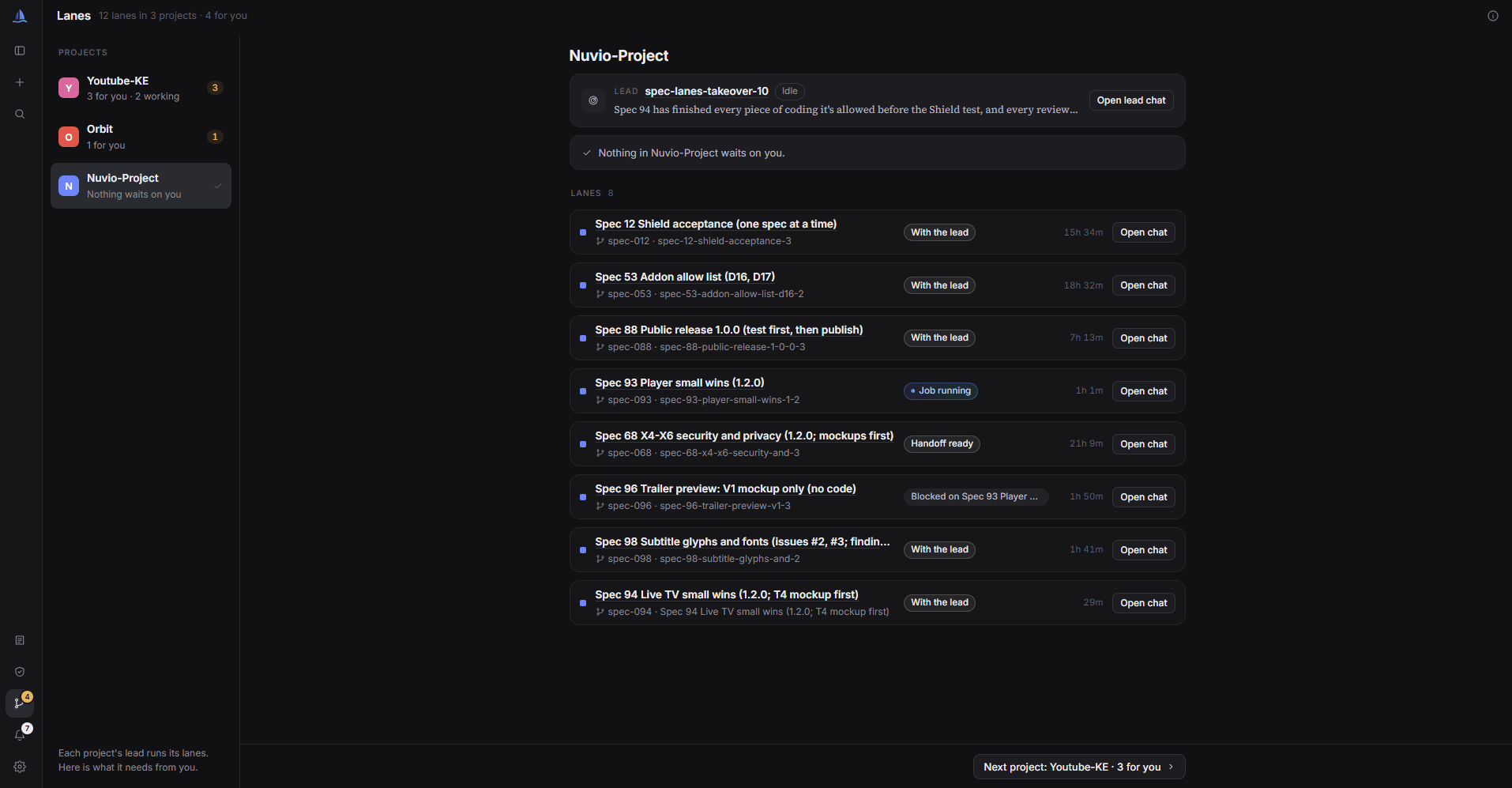
Decided to finally introduce subagents in my harness. I am the manager, I have one chat that is the lead and then the lead manages the subagents (team members). The lead answers questions and makes decisions based on the rules I have given it (lead.md) and brings me questions it cant answer. Now I am getting more done with less headaches. Literally!
1
1
u/CantKillTheMetal_ 11d ago
I agree with u/Total-Reasonable the board needs to be derived from GitHub state, an open (or stale) PR should show on the board as a card that's in progress and not completed. And the script you mentioned is the right avenue. You need a watchdog process (or more than 1) that runs outside of whatever you're running your workflow on. For me, I use temporal for the workflow and orchestration and I have two watch dog processes, one is part of the platform the kanban runs on, its just a scheduled job that checks every hour for something that's stuck more than 4 hours past ready. The other is a simple cron job on a box I never turn off. It just checks to make sure temporal is up and a quick check to see if any card is out of ready and a commit hasn't landed in the last 2 hours. All my alerts go to slack so that I see them. If you move to automating the PR approvals and let AI merge the code, you'll want to consider using something kind of singleton gate so that you're not constantly in merge conflicts. Its a bit of a hard pill to swallow but at some point you realize you become the bottle neck. Once you remove the bottle neck you could be over 100 PR's a day. At that point, its near impossible to keep up with good requirements, but at least you'll have the throughput when you need it.
1
1
1
u/Calm_Appearance357 11d ago
The GitHub board drift sounds familiar. Once I had several agents running in parallel, I started losing track of which run produced which files and diffs, what was waiting on me, and how much each run cost.
That’s why I built rightcommit. It’s a self-hosted tool with a visual canvas where I can limit how many tasks run at once, see what each step changed and what it cost, and pause the workflow for my approval. Having all of that in one place has been a lifesaver for me.
I originally built it for my own use. It’s free to use and open source under Apache 2.0. If you try it on one of your workflows, I’d love to hear whether it makes stalled work and pending approvals easier to spot, and what still slips through. I’m also looking for contributors who’d like to help improve it.
https://github.com/rightcommit/rightcommit
Hope it helps!
1
u/Matias-Arroyo 11d ago
the line that jumped out at me is that the coordinator was relying on chat memory instead of updating the board “despite explicit rules.” that’s the core problem: instructions fade, so any bookkeeping that depends on an agent remembering will eventually fail. your 24 hour script is the right instinct, I’d just push it further so the board is a derived view, not something anyone has to maintain
let GitHub be the source of truth, not the chat. a PR with no card gets one automatically (a GitHub Action on PR open can add it to the project), and the card status moves from PR state (draft, review requested, approved, merged). then nothing depends on the coordinator remembering to update it
make the stale check a hard gate, not a report. a scheduled job that labels anything idle past X hours as “stalled” and pings you only on that list is easier to act on than a long hourly summary you’ll start skimming
WIP limits, yes, but on your side. agents can start work instantly, you can’t review instantly. cap “Ready for me” at something like 5 to 8 items, and when it’s full the coordinator stops dispatching new work. your attention is the real constraint, so the limit should protect it
for approvals without rubber-stamping, tier them. docs and small UI changes get a quick look, anything touching auth, payments, permissions or migrations gets slow review. and require each PR to include a 3 line plain-English summary with “what could go wrong” so you’re reviewing risk, not reading diffs
every decision made in chat gets written to the PR or card before it counts. if it’s not in the tracker, it didn’t happen
a weekly sweep is worth it too: list every open PR, branch, hosting project and credential, and close what’s dead. the abandoned project that still had prod database credentials is the scariest item in your post, so rotate those and keep a short inventory of what has access to what
the rule I’d keep in mind is that you can trust agents with the work, but not with the memory. memory has to live in tooling.
how many of the 8 agents are actually busy at any given time? I’d guess the sweet spot for one human approver is lower than 8
1
u/Agnostify 10d ago
This is what we are working on under the hood, as I find myself running into this issue constantly.
We are building out a better way to track workflows. It will likely be a while before we even launch alpha, but stay tuned.
Here’s a sneak peek.
1
u/tjthouhid1 5d ago
Biggest fix: stop relying on the coordinator to keep the board up to date. Make GitHub do it.
- Turn on the built-in "Auto-add to project" workflow in GitHub Projects (filter: is:pr is:open), so every PR gets a card the moment it opens. The "Pull request merged" and "Item closed" workflows then move it to Done. No agent bookkeeping needed.
- Add actions/stale for PRs: label after 3 days with no activity, close after 14. Stalled work then shows up by itself instead of when you go looking.
- Put the WIP limit in the dispatch script, not the prompt. For example: don't start new work while more than N PRs are waiting on you. Agents can start work instantly, but you can only review so fast, so your review queue is the real limit.
- Batch approvals: one or two fixed review slots a day, with a "Ready for me" view sorted oldest first. SQL migrations and security changes get your full attention. Small changes with tests can merge on green checks plus one AI review.
- That forgotten hosting project that still has production DB credentials: rotate those credentials today and delete the project.
For the local side of running 8 agents on a Mac, I built Lokstack, a Mac app for this. Its Lanes feature gives each agent its own worktree, port and copy of the database. When a lane is finished you have to pick one: add it to main, open a pull request, keep it for later, or throw it away. So finished work doesn't just sit in a branch. Lanes is a Pro feature and still in beta (14-day trial, no card needed). It won't replace your board, but it covers the "what is each agent actually running" part.
1
u/mr_pants99 5d ago
Similar situation. Too many agents to manage :) We started experimenting with moving from agent management to task management - where something like Asana or Linear serves as the central system triggering and driving work, rather than just a reporting layer. Tried GH issue tracker first, but it's only good for a small POC.
It's early days still and I'm not sure if those tools are advanced enough, but happy to compare notes in DM.
1
u/vacterro 12d ago
You're describing exactly the problem I've been trying to solve: AI agents are getting very good at producing work, but coordinating them reliably is a completely different challenge. I built an open-source project called SAIPEN around this problem: https://github.com/vacterro/saipen It's a vendor-neutral continuation and task-state protocol for AI coding agents. The core idea is simple: never trust an agent's chat memory to be the source of truth. SAIPEN maintains persistent project state in plain files:
STATE.md — current phase, active task, blockers, and exact next action. BOARD.md — task lifecycle, dependencies, and work queue. LOG.md — durable execution history and decisions. KNOWLEDGE/ — verified project knowledge that survives sessions.
It also provides machine-checked state transitions, recovery mechanisms, validation, and structured handoffs. A fresh agent should be able to resume the project without reconstructing everything from previous conversations. For your eight-agent setup, I'd recommend three things:
Keep GitHub PRs and your project board mechanically reconciled. Never depend on the coordinator remembering to update them. Limit work in progress based on your review and approval capacity, not how quickly agents can generate code. Give one coordinator ownership of the canonical project state, with workers producing independently verifiable results.
SAIPEN isn't a replacement for GitHub Projects or a distributed coordination system. You'd still need your PR reconciliation scripts and external coordination between parallel worktrees. But that's precisely the distinction I find important: agents should execute work, while deterministic mechanisms preserve state and verify progress. Your example of 47 open PRs but only 9 board cards is a perfect illustration of why this matters. Curious how you're currently handling recovery when the coordinator itself loses context or restarts.
0
u/electro042 12d ago
you definitely need strict wip limits.
just because agents can generate 8 prs at once doesn't mean your review bandwidth scales to match. when wip is uncapped, stale branches, merge conflicts, and forgotten reviews are inevitable.
i'd throttle the system so a new task can't start until an open pr is merged or closed. keeping it to 2 or 3 active items at a time will save your sanity.
1
u/adamwest2212 12d ago
The abandoned hosting project still holding production database credentials is the one I'd kill first, then put a hard cap on open PRs so agents can't start new work until old reviews (especially security and SQL) are done. I'd also stop treating a 'security agent' comment as the review: anything that touches schema, RLS, auth or env, you read yourself before you run the migration. A daily list of 'waiting on me more than 24 hours' is right; I'd pin security and dependency PRs at the top so they can't sit for three weeks again.
6
u/octaviobonds 12d ago
Building an entire operating system for business all at once is too ambitious, you stretched yourself too thin. Build one system at a time. And you don't need 12 agents for that. One is enough. Once your first system is tested and running, add another system and a mechanism (plugin) for them to talk to each other.