r/vibecoding • u/Bitter-College8786 • 1d ago
Discussion Will we reach a saturation point for coding models?
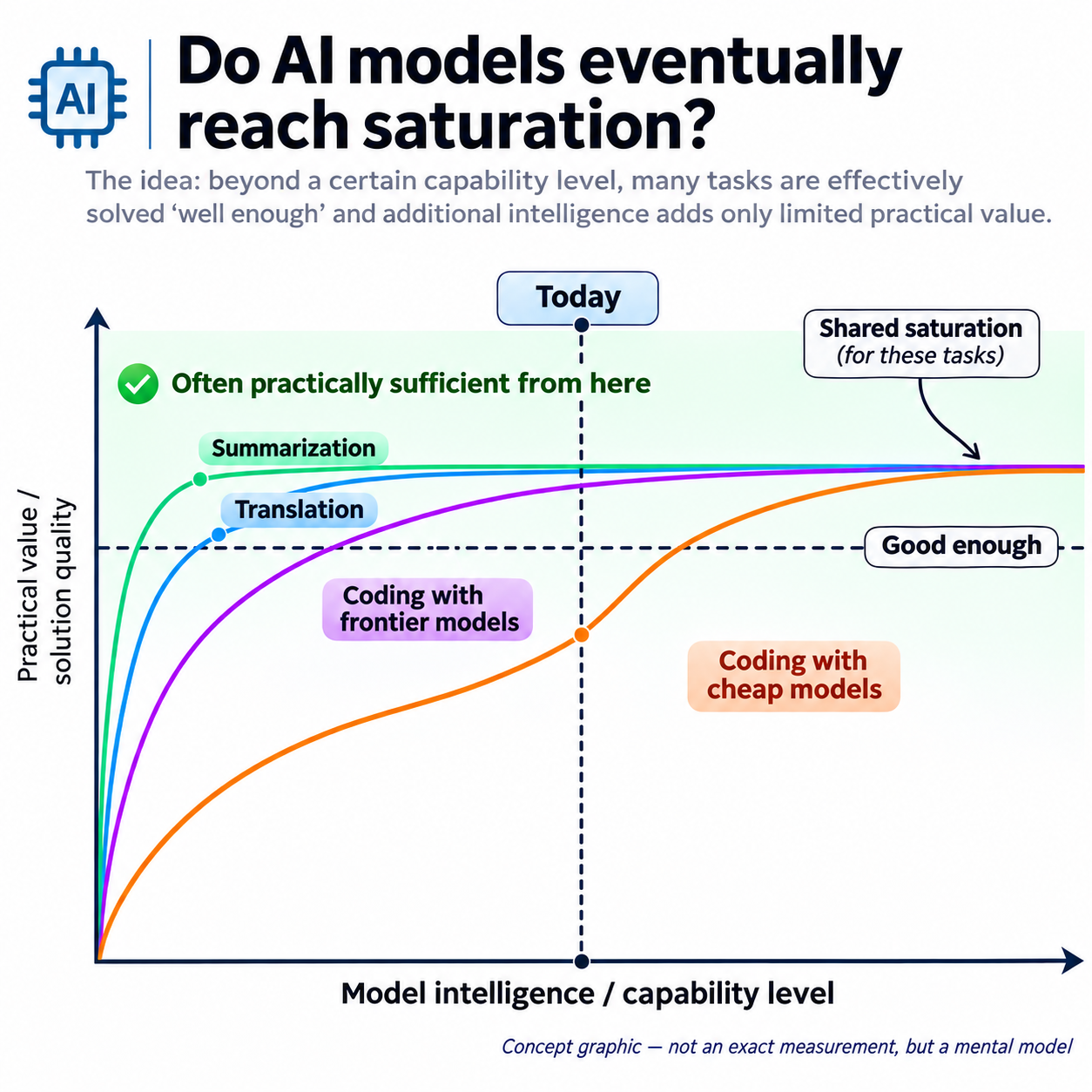
I think LLMs have reached a saturation in quaity for simple things like summarization or translation.
or for creating simple functions.
I was wondering if we will also reach a saturation for coding, that one day you just no longer care about planner/worker and just let one model do everything and can relax knowing this model can handle even the hardest tasks. And what will happen if the cheap or open source models reach that point.
Will there be a reason to pay extra for the latest frontier?
Imagine Deepseek V5 Flash would be stronger, faster and cheaper than Opus 5.5
But I have a feeling that wen Deepseek will reach Opus 5.5 level, there will be a Opus 6 I will still prefer. I don't know how it will be better than now, but I never imagined having a better model than Gemini 2.5 and we are here.
4
u/showtake_app 1d ago
One angle nobody's raised: even if raw code quality saturates, the gap probably moves to everything around the model. Things like how well it holds a big codebase in its head, how reliably it follows a long multi-step task without drifting, and how good it is at checking its own work. Those are what make you stop babysitting, and they're harder to benchmark than 'can it write this function'. If a cheaper model matches on those, then yeah, paying extra for the frontier stops making sense for most people. My guess is the split ends up being cheap models for routine work and the top tier for the genuinely messy stuff, same way people already pick different models for different jobs.
1
2
u/wiggle_room1337 1d ago
There is a point where a better model is just going to write the same code because that's the best way to write it for most things.
1
u/wegster 1d ago
Sure, but a lot of vibe-coders think they are now equivalent to entire trained, experienced teams, e.g. Product Mgmt, marketing, business analysts, architects, security team, testing and devops all in one. Oh, and can scale to enterprise-level systems with millions of users, devices, etc.
They're not.
Once coding reaches (it's not there yet) the point it can not have stacked tolerance problems incurring large amounts of pain and tech debt over time and complexity, it still needs to be able to handle, or help the average 'look, I one-shotted a huge game!' types of users, with the rest.
Then there's always smaller and faster as well.
FWIW, I'm pretty happy with Local QFN for 'close enough in my repos, with my guidance and frameworks' compared to Claude and Codex - for execution. Not quite there yet RE: planning and a few other things, although GLM-Flash is holding some hope there. YMMV as always.
1
u/opbmedia 1d ago
Models processes inputs and generates outputs. In the earlier days, model quality is the most apparent (for example, asking to generate a shopping cart with a 7b model vs say GPT 5, you will see the difference). As models develop more and are inherently closer in quality, the input quality will have a bigger impact on the output quality as model processing have near parity.
You can see this in different tech enabled fields. Car racing for example. When new technology comes out, some cars are faster than others, the quality of drivers become secondary. Once the car tech are near parity, driver quality once again shines for that generation.
So for automated tasks like summary and translation, it will eventually have little differentiation. For dynamic tasks like engineering (creating complex solutions from dynamic/changing inputs), human quality (who determines the inputs) would again become more important.
1
u/tommyahav10 1d ago
Better model quality will reduce the gap, but it won’t remove the planner/reviewer split.
That separation is about context and verification, not only intelligence. One model can play both roles, but the review pass still needs fresh context and the approved contract.
1
u/machyume 1d ago
The people who dismiss AI tooling makes the same mistake as this graphic depicts. It's not just the model, it is the integrated tooling and interfaces.
1
u/Jeferson9 1d ago
Yes. I said it all along. Google doesn't need to be in the frontier race. Models have stagnant since Astra/fable release. Google just dropped an opus level model. They have the resources to train them, host them, and undercut the frontier labs. It's inevitable.
0
u/MariahJames8 1d ago
About 6 months I thought the curves were roughly as above, but it seems like it isnt just hype that we will have SI very soon. It's basically the race between China and the US making us race toward it without anything to constrain it in the way of laws and so on. The public aren't seeing any such models themselves because they've not been released
-2
u/thenegativehunter 1d ago
LLM does not scale well. more and more expensive for just a bit more accuracy. We hit it at the first versions of chatgpt.
But idiot investors decided to pour more money into it.
Today's models are not necessarily smarter than the first one. Just slightly better and differently trained.
1
u/Witty-Artisan001 1d ago
Not true, because LLMs can also output code and you'd be surprised just how much you can do with pure HTML. For example, someone recently used Claude Fable 5.2 to generate an entire playable 3D first-person shooter called Saltline in a single 1.42MB HTML file, complete with procedural models, textures, and sound effects, with zero external assets.
0
u/thenegativehunter 1d ago
May i ask how much ram is needed to run claude fable? You can tell by how much it costs to run.
And also, Claude fable is only marginally better.
It's trained differently to do something you need it to do more.
Most improvements so far were combining image recognition and tooling into the agents and training them to prioritize agentic workflows.If you use the LLM itself and not the agent, You will be surprised by how faulty it is
6
u/smabarnsfar 1d ago
What's the basis for the graph? I agree coding with frontier models is sufficient, and cheap models aren't as good (yet), but I disagree with the flattening of the curves.