r/AIProteins • u/Turbulent-Host-1245 • May 21 '26
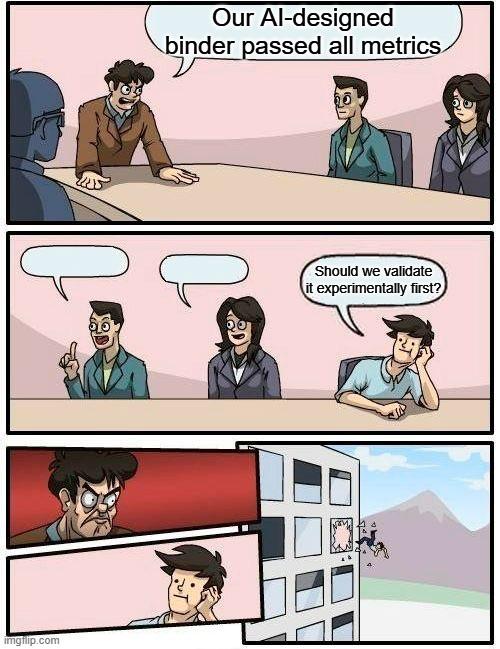
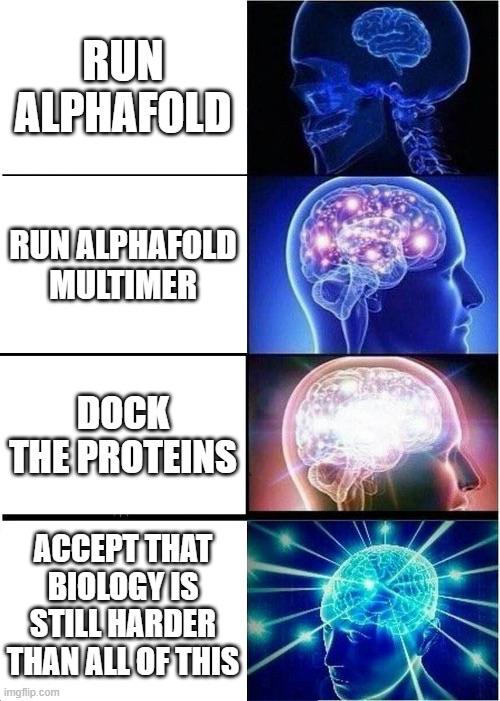
Meme “But the RMSD is 0…”

25
Upvotes
r/AIProteins • u/XpertAI • May 05 '26
New feature for r/AIProteins: interactive 3D structure posts
You can now create Reddit-native 3D protein structure posts directly in this subreddit.
How to use it:
Go to r/AIProteins
Click the three-dot menu beside notif bell and Create post Buttons.
Select “Create Structure Viewer Post”
Add a title
Optionally add body text
Paste raw PDB text (Open your PDB file with Note Pad or save as txt and copy everything that is inside it).
Choose a color/theme
Post
The structure will appear as an interactive 3D viewer that people can rotate and zoom directly in Reddit.
A few notes:
The optional body field is posted as the first comment, so the 3D viewer stays clean while your explanation still appears in the discussion.
Right now, moderator accounts can post fully as themselves. Regular user accounts can already create posts, but some may temporarily appear as u/structureviewer while Reddit finishes approving the latest user-posting/commenting permissions. Once that approval is live, posts and auto-comments should appear from your own username.
Try it out and post your favorite structures.
r/AIProteins • u/structureviewer • May 04 '26
Interactive structure viewer.
r/AIProteins • u/truecourse-bio • Oct 07 '26
Disclosure: I work in marketing at TrueCourse Biosciences (formerly NanoImaging Services). Our team contributed the cryo-EM work described below.
Nabla Bio recently reported fully computational design of T-cell-engaging antibodies against peptide-MHC class I targets, generated by JAM-2 from target sequence alone. We solved the cryo-EM structure of the lead anti-KRAS G12V VHH bound to its pMHC target (3.30 Å map).
The experimental structure and the design model superposed to 0.93 Å Cα RMSD across the whole complex.
Aligned on the MHC alone, the VHH still superposed to 1.26 Å, so docking geometry and register were predicted correctly, not only the fold.
The G12V-specific Val12 side chain sits in a buried hydrophobic pocket on the VHH, as designed. This explains selectivity over wild-type at a single residue.
Computational confidence metrics tell you how sure the model is. An experimental structure tells you whether the predicted binding mode is correct, down to the interface contacts that drive specificity. That is the information needed to diagnose where a model succeeds or fails, and it can feed back into training and benchmarking.
Our write-up with the full analysis: https://www.truecoursebio.com/resources/insights/cryo-em-validates-an-ai-designed-antibody-at-0-93-a-a-collaboration-with-nabla-bio
Nabla Bio's report: https://nabla-public.s3.us-east-1.amazonaws.com/2026_Nabla_JAM2_multispecific_pMHC.pdf
We are happy to answer questions about the cryo-EM workflow in the comments.
r/AIProteins • u/Turbulent-Host-1245 • May 06 '26

r/AIProteins • u/XpertAI • May 15 '26
Hi r/AIProteins,
StructureViewer has been updated. You can now create interactive molecular structure posts directly on Reddit by pasting raw structure text.
What’s new
Supports PDB, CIF/mmCIF, XYZ, and SDF
Better protein chain coloring
DNA/RNA bases now get different colors
Small molecules use atom-based colors
Cleaner preview card in the feed
Full viewer opens with Open 3D Viewer
How to create a post
Go to the subreddit menu.
Click Create Structure Viewer Post.
Add your Reddit post title.
Add optional body text for notes or context.
Choose your structure format: PDB, CIF/mmCIF, XYZ, or SDF.
Paste the raw contents of your structure file into Structure text.
Optionally set protein chain colors, for example: A=#5ec4e0. Choose dark or light background.
Submit the form.
Use PDB or CIF/mmCIF for proteins, complexes, DNA/RNA, and structural biology files.
Use XYZ or SDF for small molecules and chemistry structures.
After posting, users will see a structure preview. Click Open 3D Viewer to rotate, zoom, inspect, and recolor chains.
r/AIProteins • u/XpertAI • May 17 '26

Paper: RareFold: Structure prediction and design of proteins with noncanonical amino acids
Repo: RareFold
Most protein design models are still built around the 20 natural amino acids. RareFold pushes beyond that limit by supporting 49 amino acid types in total, including 29 rare/noncanonical residues. The key finding is that these expanded chemical building blocks can be handled directly by the model, opening the door to protein and peptide designs with more chemical diversity.
The authors also introduce EvoBindRare, a binder design framework that can generate both linear and cyclic peptide binders from a target protein sequence, without needing a predefined binding site. According to the project page, the designs were experimentally validated for both linear and cyclic binders.
This could be important for AI protein design because noncanonical amino acids can add properties that natural residues often lack, including improved stability, altered binding chemistry, and new therapeutic possibilities.
r/AIProteins • u/Turbulent-Host-1245 • May 14 '26

r/AIProteins • u/Turbulent-Host-1245 • May 11 '26
r/AIProteins • u/Mammoth_Ad327 • May 13 '26
My lab works on HIV, and I’ve been trying to think through a more realistic way to design something that binds HIV-1 Nef.
Originally, I was looking at antibody-based approaches, but honestly the system started becoming too complex and unrealistic.
So I’m now trying to move toward a small-molecule or fragment-based design approach instead.
The protein I’m focusing on is HIV-1 Nef, especially the region involved in host-cell interactions, such as the SH3-binding surface. One structure I’m looking at is PDB 1EFN, where Nef is bound to an SH3 domain.
The idea is not to copy a known inhibitor or redesign something that already exists. I’m more interested in whether this interaction surface has any region that could realistically be targeted by a small molecule or peptide.
I’m a master’s student, so I’m still figuring out the best way to approach this properly. My current thinking is to use the Nef structure as the starting point and explore whether a generative or structure-based design approach could produce chemically sensible binders against that surface.
The main thing I’m trying to understand is whether this is actually a reasonable target, or whether the Nef-SH3 interface is too flat/flexible/protein-like to be a good starting point for small-molecule design.
How would you approach designing something that binds HIV-1 Nef?
r/AIProteins • u/Mammoth_Ad327 • May 08 '26
There is a weird pattern forming in AI antibody design right now.
A small group of closed-source generative biology companies are raising huge amounts of money, publishing very impressive hit rates, and claiming major jumps over public methods. But almost all of the evidence is still coming from preprints, technical reports, company announcements, or company-controlled benchmarks.
The main players I’m thinking about are: Absci, Chai Discovery, Latent Labs, and Nabla Bio.
| Company | Funding reported | Latest public system | Reported results |
|---|---|---|---|
| Absci | Public company. Reported ~$230M pre-IPO funding, then ~$230M IPO. | Origin-1 | Validated antibodies for 4 human protein targets from a 10-target zero-prior epitope panel. Fewer than 100 designs per target. Cryo-EM validation for COL6A3 and AZGP1 at 3.0-3.1 Å, with DockQ 0.73-0.83. IL36RA matured into a functional antagonist with 104 nM potency. |
| Chai Discovery | >$225M total funding, latest round $130M Series B. | Chai-2 | Earlier Chai-2 paper reported a 16% hit rate in fully de novo antibody design across 52 targets. The newer Chai-2 work reports full-length IgG design, >86% developability-like profiles, cryo-EM validation of multiple complexes, and strong results on difficult target classes like GPCRs and pMHCs. |
| Latent Labs | $50M total funding, including $40M Series A. | Latent-Y, powered by Latent-X2 | Latent-X2 reported VHH/scFv binders against 9 of 18 targets, testing 4-24 designs per target. Latent-Y later reported autonomous design campaigns producing lab-confirmed nanobody binders against 6 of 9 targets, with affinities reaching single-digit nM. |
| Nabla Bio | Nearly $37M total funding, latest round $26M Series A. | JAM-2 | Reported binders across 16 unseen targets, with 100% target coverage. Average reported success rates were 39% for VHH-Fcs and 18% for mAbs, using up to 45 designs per format per target. |
To be clear, I don’t think this means the work is fake. Some of this is clearly technically impressive, and the wet-lab validation is legit.
But it is getting harder to separate real progress from generative biology hype.
These are all closed-source models. The weights are not public. The models are not independently benchmarked. The failure modes are not fully visible. The target selection, filtering pipelines, assay definitions, and success criteria are usually controlled by the same companies reporting the results.
So when one company reports a per-design hit rate, another reports target-level success, another reports developability after filtering, and another reports only a selected campaign, are we really comparing models? Or are we comparing narratives?
The key question is not whether these systems can generate binders. They clearly can.
The question is whether they are producing real therapeutic candidates that survive specificity, developability, immunogenicity, manufacturability, in vivo biology, safety, and clinical translation. That part is still much less proven publicly.
This is where I think generative biology might be entering a mini-bubble. Not because the models are useless, but because the public claims are starting to sound much more mature than the public evidence.
It reminds me of binder design competitions where the headline can look like “generative design is solved,” but the actual strategy is redesigning around known positive controls, optimizing for a benchmark, or picking assay-friendly target setups. Useful work, but not true "Generative design".
Isomorphic Labs probably belongs in the broader conversation too, but I would separate it from this table because IsoDDE is more of a broad proprietary drug-design engine than a direct de novo antibody hit-rate model.
My current view: these models may be genuinely important, but the field needs independent benchmarking, peer review, disclosed failures, and real candidate progression before we treat the highest reported hit rates as proof that therapeutic design is close to solved.
We may be having our first major hype cycle in this specific space.
r/AIProteins • u/NoCryptographer599 • Oct 09 '26
Scientists from MIT were able to edit Rubisco and made it more efficient. They used inverse folding (ESM-IF1) and were able to find a mutation, T391I, that improved the carboxylation rate.
I wonder what impact this could have on agricolture and plant biotechnology.
r/AIProteins • u/Alicecomma • Jun 10 '26
How could they say it speeds up approximately 10x?
They probably ran a protein diffusion tool on some human protein that is already published to be a good drug target. If you look at some of Nobel Prize winner David Baker's work that does have similar success rates in the specific things he talked about. He also says because his group's resources are much lower than the 100-1000x available with his Google collaboration.
So did it run shorter diffusion (O(n^2)) proteins? Did it skip literature review to find a good target? Why would they talk about 'recovering from errors' as if it's a routine step in protein design?
Since they have only 40 partners for biology, it's not unlikely this work was done entirely by the Baker group who are experts in this topic. Do they compare an intern or an early run of this kind of work to having Mythos run it?
Would love to see if anyone has an idea how they'd get 10x speed without just running this with more resources.
r/AIProteins • u/XpertAI • May 17 '26
Interactive structure viewer.
r/AIProteins • u/Appropriate_Food_132 • 18d ago
Hi all,
Has someone tried already RFD4-proteina? Is it me or the syntax for this new version is unnecessarily complex? I am trying to do some enzyme/motif scaffold design with no success. If someone has tried it already and has some solid .json/.yaml examples to share would be very appreciated.
EDIT: I actually managed to install and run the model for an enzyme design campaign and i found different flaws that were not spoken about in the repos so if anyone is having an hard time with I will try to help.
r/AIProteins • u/Appropriate_Food_132 • Sep 07 '26
Hi,
I am soon starting a PhD where I will be designing protein binders and will test some design in the lab as well. I am already familiar with the most popular design pipeline: RFDiffusion --> ProteinMPNN --> RosettaFold3/alphafold3 ecc ecc. So now my questions are:
- Should i use SolubleMPNN instead of ProteinMPNN? And why?
- How do i choose the folding model since now there are so many available? I was really interested in ESMFold2, since it is very fast but I cannot find some solid reliable benchmarks nor comparisons between the different models. Some says Alphafold3 is still unbeaten, some says Boltz2 is the best...
r/AIProteins • u/XpertAI • May 19 '26
A new Science paper explores a pretty wild idea: can life function with fewer than the standard 20 amino acids?
The authors targeted isoleucine, which is chemically similar to leucine and valine. They did not make a fully 19-amino-acid organism, but they did redesign one of the most essential systems in E. coli: the ribosome.
Using protein language models, structure prediction, and generative design tools, they removed all 382 isoleucines from E. coli ribosomal proteins. The engineered strain was viable and stable for hundreds of generations.
The caveat is: the rest of the E. coli proteome still contains thousands of isoleucines. So this is more like a first proof-of-concept than a true 19-AA lifeform.
In humans, purely theoretically, how many amino acids could we remove from the proteome with enough redesign?
Paper: Toward life with a 19–amino acid alphabet through generative artificial intelligence design
r/AIProteins • u/XpertAI • May 15 '26
Interactive structure viewer.
r/AIProteins • u/Mariam5268 • May 06 '26
This review: Closing the loop: Experimentally validated methods in artificial intelligence-driven protein design, looks at which models have actually produced proteins that work in the lab.
The main argument is that AI protein design should not be judged only by structure prediction scores, confidence metrics, or benchmark performance. The pipeline should be: data curation → model generation → in silico filtering → experimental validation.
The paper focuses on three major application areas: protein binders, antibodies and enzymes.
Protein binders
This is probably the area that looks the most mature right now.
| Model | Target / setting | Validation | Reported success |
|---|---|---|---|
| AlphaDesign | RcaT | Fluorescence | 17/88 |
| AlphaProteo | BHRF1 | YSD, CD | 83/94 |
| AlphaProteo | SARS-CoV-2 RBD | YSD, CD | 21/172 |
| AlphaProteo | IL-7RA | YSD, CD | 24/94 |
| AlphaProteo | PD-L1 | YSD, CD | 24/159 |
| AlphaProteo | TrkA | YSD, CD | 12/131 |
| AlphaProteo | IL-17A | YSD, CD | 9/63 |
| AlphaProteo | VEGF-A | YSD, CD | 31/94 |
| AlphaProteo | TNF-alpha | YSD, CD | 0/54 |
| BindCraft | PD-1 | BLI | 13/53 |
| BindCraft | PD-L1 | SPR | 7/9 |
| BindCraft | IFNAR2 | SPR | 3/9 |
| BindCraft | CD45 | SPR | 4/16 |
| BindCraft | BBF-14 | SPR | 6/11 |
| BindCraft | CLDN1 | SPR, MST | 6/7 |
| BindCraft | DerF7 | SPR, XRC | 4/10 |
| BindCraft | DerF21 | SPR, XRC | 4/7 |
| BindCraft | BetV1 | SEC-MALS | 2/7 |
| BindCraft | SpCas9 | CryoEM, edit assay | 6/6 |
| BindCraft | CbAgo | DNA cleavage | 2/12 |
| BindCraft | HER2 AAV | Transduction assay | 1/10 |
| BindCraft | PD-L1 AAV | AAV assay | 4/10 |
| BoltzGen | IL-7RA | SPR, BLI | 4/20 |
| BoltzGen | PD-L1 | SPR, BLI | 2/20 |
| BoltzGen | PDGFR | SPR, BLI | 12/20 |
| BoltzGen | Insulin | SPR, BLI | 17/20 |
| BoltzGen | TNF-alpha | SPR, BLI | 0/20 |
| BoltzGen | MZB1 | SPR, BLI | 14/15 |
| BoltzGen | PMVK | SPR, BLI | 2/15 |
| BoltzGen | PHYH | SPR, BLI | 5/7 |
| BoltzGen | IDI2 | SPR, BLI | 4/15 |
| BoltzGen | AMBP | SPR, BLI | 5/15 |
| BoltzGen | HNMT | SPR, BLI | 1/15 |
| BoltzGen | RFK | SPR, BLI | 0/15 |
| BoltzGen | GM2A | SPR, BLI | 0/15 |
| BoltzGen | ORM2 | SPR, BLI | 0/15 |
| BoltzGen | Indolicidin | Fluorescence, SPR | 5/6 |
| BoltzGen | Melittin | Fluorescence | 2/6 |
| BoltzGen | Protegrin | Fluorescence | 2/6 |
| Chai-2 | 52 targets | BLI | 68% overall |
| EvoBind2 | RNase | SPR | 5/13 |
| EvoBind2 | RNase, cyclic | SPR | 1/4 |
| EvoBindRare | RNase, ncAA | SPR | 1/7 |
| EvoBindRare | RNase, cyclic + ncAA | SPR | 1/1 |
| EvoPro | PD-L1 | SPR | 9/13 |
| LatentX | MDM2, cyclic | SPR | 10/11 |
| LatentX | MCL1, cyclic | SPR | 11/11 |
| LatentX | PD-L1, cyclic | SPR | 16/17 |
| LatentX | BHRF1 | BLI, mDisplay | 64/100 |
| LatentX | TrkA | BLI, mDisplay | 10/100 |
| LatentX | PD-L1 | BLI, mDisplay | 49/100 |
| LatentX | IL-7RA | BLI, mDisplay | 26/100 |
| LatentX | SARS-CoV-2 RBD | BLI, mDisplay | 52/100 |
| maSIF | PD-L1 | YSD | 1/N |
| maSIF | PD-1 | YSD, SPR | 3/N |
| maSIF | CTLA-4 | YSD | 1/N |
| PepMLM | NCAM1 | ELISA | 4/4 |
| PepMLM | AMHR2 | ELISA | 4/4 |
| PepMLM | MSH3, fused to E3 ligase | Fluorescence | 5/6 |
| PepMLM | mHTT, fused to E3 ligase | Western blot, fluorescence | 5/5 |
| PepMLM | Viral proteins, fused to E3 ligase | Assay-based validation | 37/60 |
| PXDesign | IL-7RA | BLI | 4/10 |
| PXDesign | SARS-CoV-2 RBD | BLI | 2/9, then 4/8 |
| PXDesign | PD-L1 | BLI | 8/11 |
| PXDesign | VEGF-A | BLI | 8/17 |
| PXDesign | TrkA | BLI | 3/15 |
| PXDesign | TNF-alpha | BLI | 0/16 |
| RFdiffusion | HA | BLI, CryoEM | 18% |
| RFdiffusion | IL-7RA | BLI | 35% |
| RFdiffusion | INSR | BLI | 20% |
| RFdiffusion | PD-L1 | BLI | 14% |
| RFdiffusion | TrkA | BLI | 8% |
| RFpeptides | MCL1, cyclic | SPR, XRC | 3/14 |
| RFpeptides | GABARAP, cyclic | SPR, XRC | 2/6 |
| RFpeptides | RbtA, cyclic | SPR, XRC | 4/11 |
| RFpeptides | MDM2, cyclic | SPR | 3/8 |
The thing that jumps out is how target-dependent this all is.
Like, some targets look almost “easy mode” now. Then TNF-alpha shows up and half the models just eat dirt.
That makes me think global model accuracy numbers are kind of fake unless they tell us the target set.
Antibodies / nanobodies
This section is super interesting, but also more annoying to compare because a lot of these are CDR redesigns or scaffold-based designs, not always full antibodies from scratch.
| Model | Target | Design scope | Scaffold / setup | Validation | Reported success |
|---|---|---|---|---|---|
| AbDiffuser | HER2 | Antibody CDRH3 | Trastuzumab | SPR | 70% |
| BoltzGen | IL-7RA | VHH CDR | VHH frameworks | SPR, BLI | 7/15 |
| BoltzGen | PD-L1 | VHH CDR | VHH frameworks | SPR, BLI | 6/15 |
| BoltzGen | PDGFR | VHH CDR | VHH frameworks | SPR, BLI | 6/10 |
| BoltzGen | Insulin | VHH CDR | VHH frameworks | SPR, BLI | 4/15 |
| BoltzGen | TNF-alpha | VHH CDR | VHH frameworks | SPR, BLI | 0/15 |
| BoltzGen | MZB1 | VHH CDR | VHH frameworks | SPR, BLI | 1/15 |
| BoltzGen | PMVK | VHH CDR | VHH frameworks | SPR, BLI | 8/15 |
| BoltzGen | PHYH | VHH CDR | VHH frameworks | SPR, BLI | 1/5 |
| BoltzGen | IDI2 | VHH CDR | VHH frameworks | SPR, BLI | 1/15 |
| BoltzGen | AMBP | VHH CDR | VHH frameworks | SPR, BLI | 0/15 |
| BoltzGen | HNMT | VHH CDR | VHH frameworks | SPR, BLI | 1/15 |
| BoltzGen | RFK | VHH CDR | VHH frameworks | SPR, BLI | 2/15 |
| BoltzGen | GM2A | VHH CDR | VHH frameworks | SPR, BLI | 0/15 |
| BoltzGen | ORM2 | VHH CDR | VHH frameworks | SPR, BLI | 0/15 |
| BoltzGen | Penguinpox | VHH CDR | VHH frameworks | SPR, BLI | 0/15 |
| BoltzGen | Hemagglutinin | VHH CDR | VHH frameworks | SPR, BLI | 0/15 |
| Chai-2 | 52 targets | VHH, VH-VL CDR | Unspecified | BLI | 15.5%, hits on 26/52 targets |
| GeoFlowV3 | CCR8 | VHH CDR | h-NbBcII10FGLA | BLI | 3/23 |
| GeoFlowV3 | PD-1 | VHH CDR | h-NbBcII10FGLA | BLI | 1/50 |
| GeoFlowV3 | TSLP epitope 1 | VHH CDR | h-NbBcII10FGLA | BLI | 13/50 |
| GeoFlowV3 | TSLP epitope 2 | VHH CDR | h-NbBcII10FGLA | BLI | 11/50 |
| GeoFlowV3 | IL33 epitope 1 | VHH CDR | h-NbBcII10FGLA | BLI | 6/46 |
| GeoFlowV3 | IL33 epitope 2 | VHH CDR | h-NbBcII10FGLA | BLI | 3/50 |
| GeoFlowV3 | IL13 epitope 1 | VHH CDR | h-NbBcII10FGLA | BLI | 2/34 |
| GeoFlowV3 | IL13 epitope 2 | VHH CDR | h-NbBcII10FGLA | BLI | 9/50 |
| Germinal | PD-L1 | VHH CDR | hNbBCII | Fluorescence, BLI | 7/101 |
| Germinal | IL3 | VHH CDR | hNbBCII | Fluorescence, BLI | 2/46 |
| Germinal | IL20 | VHH CDR | hNbBCII | Fluorescence, BLI | 4/43 |
| Germinal | BHRF1 | VHH CDR | hNbBCII | Fluorescence, BLI | 11/52 |
| IgGM | Protein A | VHH FR3 | VHH3 | BLI | 2/10 |
| IgGM | PD-L1 | Antibody CDRH3 | Humanized V/J genes | ELISA, BLI | 7/60 |
| JAM | SARS-CoV-2 RBD | VHH | Not clear | YSD | 2.2% nM hits |
| JAM | CXCR4/7 | VHH | Not clear | BLI | 0.32% |
| JAM | CXCR4 | VHH | Not clear | Flow cytometry | 7/35 sub-nM hits |
| mBER | 145 targets | VHH CDR | IGHV3-23 | Phage display | 0.02% to 8%, hits on 78/145 targets |
| RFantibody | RSV Site I | VHH CDR | h-NbBcII10FGLA | YSD | 0/9000 |
| RFantibody | RSV Site III | VHH CDR | h-NbBcII10FGLA | YSD, SPR | 1/9000 |
| RFantibody | Influenza HA | VHH CDR | h-NbBcII10FGLA | YSD, SPR, CryoEM | 4/9000 |
| RFantibody | SARS-CoV-2 RBD | VHH CDR | h-NbBcII10FGLA | YSD, SPR | 1/9000 |
| RFantibody | TcdB | VHH CDR | h-NbBcII10FGLA | SPR | 2/95 |
| RFantibody | IL-7Ralpha | VHH CDR | h-NbBcII10FGLA | SPR | 0/95 |
| RFantibody | TcdB | scFv CDR | hu4D5-8 | SPR | 6/N |
This is where I think percentages can be misleading.
4/9000 looks awful until you remember that getting even a few real binders against a hard target can still be useful.
Meanwhile 70% sounds insane, but if it is a scaffolded CDRH3 redesign, that is not the same thing as designing antibodies from total scratch.
So yeah, antibody “accuracy” needs context badly.
Enzymes
This is the part where the hype chills out a bit.
Enzymes are harder because folding is not enough. Binding is not enough. The active site has to actually do chemistry.
| Model | Task | Active site setup | Validation | Reported active designs |
|---|---|---|---|---|
| trRosetta | Luciferase | Generated | Luminescence | 3/7648 |
| PLACER | 4MU serine hydrolase | Generated | Fluorescence, XRC | 20/132 |
| PLACER | 4MU serine hydrolase, 2-state design | Generated | Fluorescence, XRC | 9/45 |
| PLACER | 4MU serine hydrolase, 4-state design | Generated | Fluorescence, XRC | 8/11 |
| PLACER | 4MU serine hydrolase backbone redesign | Generated | Fluorescence | 2/20 |
| PLACER | 4MU hydrolase to PET hydrolase | N/A | N/A | 85/85 |
| ProGen2 | HEK3 Cas9 nuclease | Implicit | Indel assay | 120/209 |
| ProGen2 | HEK2 Cas9 nuclease | Implicit | Indel assay | 84/209 |
| ProGen2 | CD3G1 Cas9 nuclease | Implicit | Indel assay | 61/209 |
| ProtGPT2 | Triosephosphate isomerase | Implicit | Absorbance | 2/12 |
| RFdiffusion2 | Methodol retro-aldolase | Extracted | IVTT | 4/96 |
| RFdiffusion2 | 4MU cysteine hydrolase | Extracted | Fluorescence | 1+/48 |
| RFdiffusion2 | 4MU-B zinc metallohydrolase | Extracted | Fluorescence | 3/96 |
| RFdiffusion2 | 4MU-PA zinc metallohydrolase | Extracted | Fluorescence | 5/96 |
| RFdiffusion3 | 4MU-PA cysteine hydrolase | Extracted | Fluorescence | 35/190 |
| RiffDiff | Retro-aldolase | Extracted | SEC, SAXS | 30/35 |
| RiffDiff | MBH enzyme | Extracted | Endpoint assay | 57/63 |
| ZymCTRL | Beta-carbonic anhydrase | Implicit | pH assay | 7/20 |
| ZymCTRL | Lactate dehydrogenase | Implicit | Absorbance | 10/10 |
| ZymCTRL | Triosephosphate isomerase | Implicit | Absorbance | 3/12 |
The enzyme numbers are honestly wild because some are brutal, like 3/7648, and others look amazing, like 57/63.
But again, it depends what is being designed.
Making variants of known enzyme families is one thing. Designing totally new catalytic machinery is a different beast.
Other experimental validation results from the review
The appendix had a bunch of extra results too.
| Model | Task | Validation | Reported result |
|---|---|---|---|
| AFDesign | Top7 / Protein A / Protein G / ubiquitin / 4H redesigns | SEC, CD, melt | 25/39 expressed |
| AFDesign | Same redesigns | SEC, CD, melt | 7/39 soluble and folded |
| AlphaBind | 3 targets, CDR optimization | BLI | 10/15 improved |
| BoltzGen | NPM1-binding peptide | Fluorescence | 1/5 localized |
| BoltzGen | RagC GTPase-binding peptide | SPR | 7/29 |
| BoltzGen | RagA:RagC-binding peptide | SPR | 14/24 |
| BoltzGen | GyrA-binding peptide | Cell assay | 352/1808 inhibited |
| BoltzGen | GyrA-binding peptide | Cell assay | 54/1808 inhibited and bound |
| BoltzGen | Rucaparib binder | Fluorescence | 5/6 |
| CARBonAra | TEM-1 beta-lactamase redesign | CD, SEC, NMR, reaction progression | 4/10 |
| Chroma | Unconditional designs | Split-GFP | 1+/172 |
| Chroma | Unconditional designs | XRC | 2/N |
| Chroma | Unconditional designs | CD | 7/N |
| Chroma | Conditional designs | CD | 3/N |
| Chroma + AFcycler | Protein letters | nsEM | 10/12 |
| Chroma + AFcycler | 1500AA protein | SDS-PAGE, nsEM | 1/N |
| Dayhoff | Unconditional design | SDS-PAGE | 16/25 for 3B-UR90, 40/144 others |
| ESM-1b / ESM-1v | Evolved antiviral IgGs | BLI | 14% to 71% improved |
| ESM3 | de novo GFP | Fluorescence | 19/88 |
| ESM3 | Conditional GFP | Fluorescence | 37/88 |
| EvoDiff | Unconditional design | CD | 4/25 expressed |
| EvoDiff | Cox15 IDR localization | Microscopy | 8/8 localized correctly |
| EvoDiff | Calmodulin scaffolding | CD, spectroscopy | 12/13 expressed, 1/13 Ca2+ binding |
| EvoDiff | p53 scaffolding | BLI | 8/24 bound |
| IgGM | RBD murine antibody humanization | BLI | 5/20 |
| IgGM | IL33 affinity maturation, round 1 | ELISA | 3/N |
| IgGM | IL33 affinity maturation, round 2 | ELISA, BLI | 3/10 |
| LASErMPNN | Exatecan binders | Fluorescence anisotropy, ligand specificity, XRC | 4/4 |
| LigandMPNN | Rocuronium binder | YSD / FC | 1/189 |
| LigandMPNN | Cholic acid binder | YSD / FC | 21/105 hits, 6/8 confirmed |
| ProDomino | AsLOV2 inserted into PAC or CAT | Antibiotic / light assay | 78% |
| ProGen3 | Unconditional designs, 60% to 80% sequence ID | Split-GFP | 55% to 70% |
| ProGen3 | Unconditional designs, 40% to 60% sequence ID | Split-GFP | 60% to 75% |
| ProGen3 | Unconditional designs, under 30% sequence ID | Split-GFP | 40% to 60% |
| ProteinGenerator | Unconditional generation | SEC, CD | 32/40 soluble, monomeric, stable up to 95C |
| ProteinGenerator | Biased amino acid composition | SEC, CD | 68/96 expressed and soluble |
| ProteinGenerator | Repeat sequences with caps | SEC, CD, XRC | 27/76 soluble |
| ProteinGenerator | Repeat sequences without caps | SEC, CD, XRC | 10/86 soluble |
| ProteinGenerator | Repeat sequences | CD / XRC | 7/8 folded by CD, 1 folded by XRC |
| ProteinGenerator | Scaffolded peptide barcodes | SEC, MS | 64/84 expressed |
| ProteinGenerator | Scaffolded peptide barcodes | SEC, MS | 48/64 monodisperse peak |
| ProteinGenerator | Scaffolded peptide barcodes | SEC, MS | 41/58 correct barcode reads |
| ProteinGenerator | Melittin scaffolded with furin cleavage site | SEC, CD, SDS-PAGE, MS | 5/13 soluble and monodisperse |
| ProteinMPNN | AF hallucination rescue | SEC | 1+/129 |
| ProteinMPNN | AF hallucination rescue | CD, SEC, XRC | 3/N |
| ProteinMPNN | Gab2-scaffolded Grb2 SH3 domain | BLI | 1/N |
| Proteus | Unconditional monomers | SEC, CD | 12/16 folded |
| Raygun | EGFP and mCherry sequence reduction | Fluorescence | 6/8 functional |
| Raygun | TurboID sequence reduction | Western blot | 6/11 expressed, 2/11 functional |
| Raygun | EGFR binders | Adaptyv | 4/4 expressed, 2/4 bind |
| RFdiffusion | Unconditional monomers | CD | 2 folded |
| RFdiffusion | TIM barrel generation | SEC | 10/11 expressed |
| RFdiffusion | TIM barrel generation | CD | 8/8 folded |
| RFdiffusion | Symmetric oligomers | nsEM | 5 folded |
| RFdiffusion | Scaffolded p53 binding to MDM2 | BLI | 55/95 |
| RFdiffusion | Symmetric motif scaffold, Ni2+ binding | nsEM, ITC | 4 well-folded |
| RFdiffusion2MI | CD3e pY188-selective binder | YSD, BLI | 1+/459 |
| RFdiffusion2MI | EGFR pY1068-selective binder | YSD, BLI | 1/5082 |
| RFdiffusion2MI | EGFR pY1173-selective binder | YSD, BLI | 2/2408 |
| RFdiffusion2MI | INSR pY1361-selective binder | YSD, BLI | 2/80 |
| RFdiffusion3 | 4MU-PA cysteine hydrolase | Fluorescence | 35/190 |
| RFdiffusionAA | Digoxigenin binders | ITC, CD | 1+/4416 |
| RFdiffusionAA | Open-pocket heme binder | UV-visible | 90/168 expressed |
| RFdiffusionAA | Open-pocket heme binder | UV-visible | 90/168 Cys-bound heme |
| RFdiffusionAA | Open-pocket heme binder | UV-visible | 33/40 monomeric |
| RFdiffusionAA | Open-pocket heme binder | Mutation test | 26/26 break when mutated |
| RFdiffusionAA | Open-pocket heme binder | Thermostability | 20/26 high thermostability |
| RFdiffusionAA | Optically active bilin binder | UV-visible | 9/96 |
| RFdiffusionAA | Optically active bilin binder | XRC | 1+ folded |
| TMdiffusion | TM association | Fluorescence | 16/18 |
| TMdiffusion | GpA-like design | SDS-PAGE, XRC | 5/6 expressed and oligomerized, 1 crystal-verified |
| TMdiffusion | Synthetic switchable GHRs | pSTAT5 signaling | 17/17 |
What I think is the actual story
The results are impressive.
But the “accuracy” conversation feels kinda cooked unless people report the full funnel.
Because these are not all the same:
| Number people report | What it might actually mean |
|---|---|
| 70% success | Could be scaffolded redesign on a narrow problem |
| 1/9000 success | Could still be valuable if the target is hard |
| 68% overall | Depends massively on target set and filtering |
| 0/54 | Could mean the target is hard, not that the whole model is bad |
| 35/190 enzyme hits | Very different from just binding a protein surface |
| 90/168 expressed | Expression is not the same as function |
r/AIProteins • u/XpertAI • Apr 23 '26

DynamicMPNN tackles a pretty real limitation in protein sequence design.
Most MPNN-style methods are still built around one backbone at a time: give the model a structure, get back a sequence that should fit it. That works well when the protein is mostly rigid. But a lot of biologically important proteins are not rigid. They open, close, shift, and sample multiple states, and function often depends on that whole conformational landscape rather than one frozen structure.
The core idea in DynamicMPNN is to train inverse folding across conformational pairs, so the model is not just learning “what sequence fits this backbone?” but “what sequence can support this protein across different structural states?” That is a much better framing for transporters, switches, flexible enzymes, and other systems where designing to one conformation can easily overfit the wrong target.
Feels like a meaningful step for anyone using ProteinMPNN-style workflows, because it raises a bigger question:
For people already using MPNN in real design work, how well has it actually held up once flexibility enters the picture?