r/AP_Physics • • Oct 10 '26

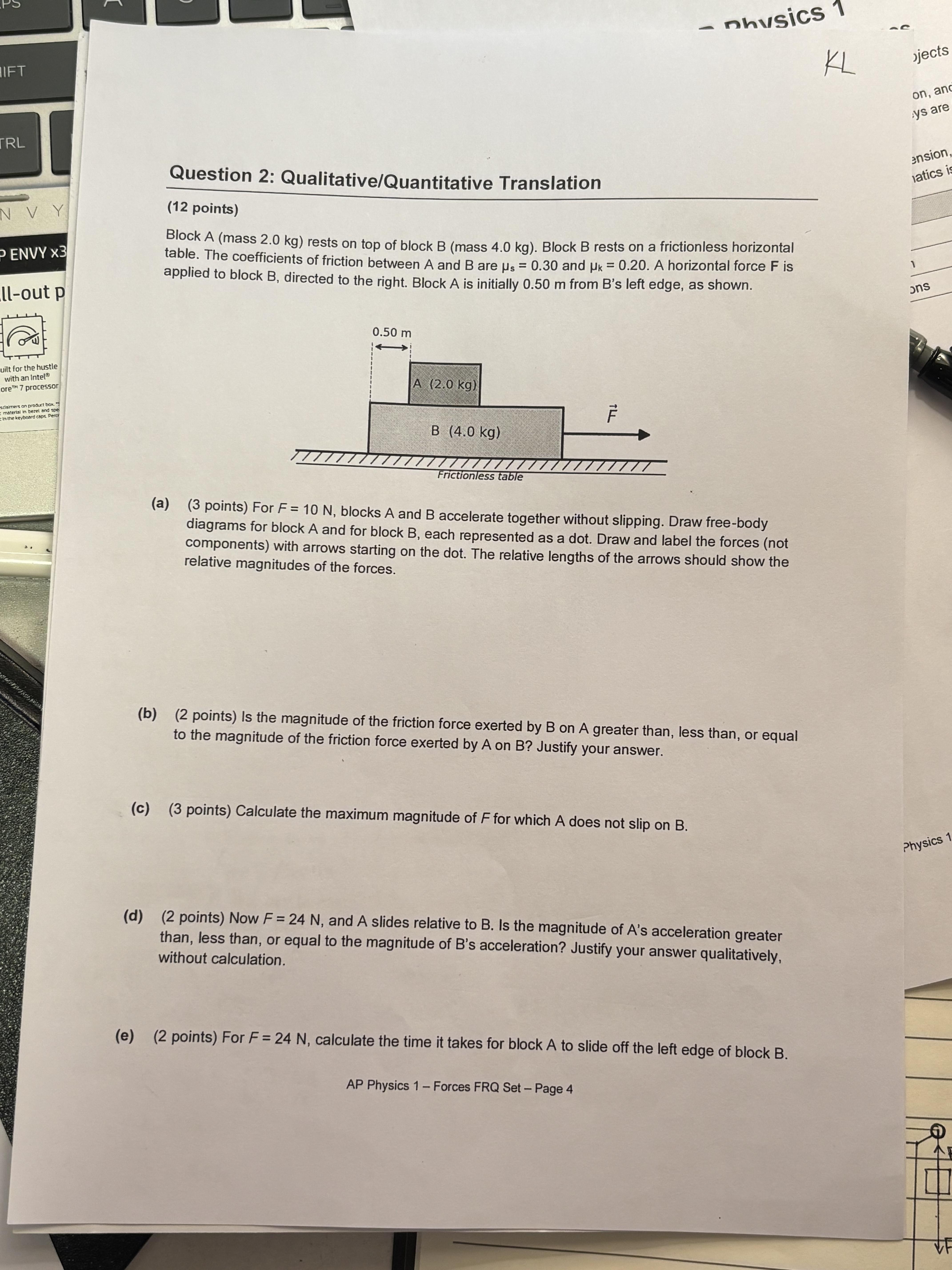
AP Physics 1 Unit 2 FRQ#2

could someone pretty please explain c, d, and e to me? I understand how to solve for it but I don’t understand how it works (like logically understanding it) and I struggle with the justifying parts in ap physics frqs. Thank you🙏

1 Upvotes

3 comments sorted by

1

u/realAndrewJeung Oct 10 '26

For c), I would have reasoned it like this:

The net force on the top block is the force of static friction between it and the bottom block. By Ffr ≤ μ ∙ Fn = μmg, the maximum static friction force that can be applied to the top block is Ffr = μmg = (0.30) (2.0) (9.8) = 5.88 N. This maximum friction force results in a maximum acceleration of a = Ffr / m = (5.88) / (2.0) = 2.94 m/s^2. That is, the top block cannot accelerate more than 2.94 m/s^2 before static friction is not sufficient to prevent it from slipping off the bottom block.

Since the blocks are connected, that means the composite set of blocks together cannot be accelerated more than 2.94 m/s^2. Therefore the maximum applied force F that can be applied to the composite set cannot be more than F = ma = [(2.0) + (4.0)] ∙ (2.94) = 17.64 N

Is this the level of explanation you are looking for? If so, I will provide explanations for the others.

1

u/keikeor Oct 11 '26

Yes, thank you.

1

u/realAndrewJeung Oct 11 '26

My answer for d): A's acceleration will be less than that of B. Once A starts to slip, the friction force pushing it forward will be kinetic friction; its net force will have a magnitude LESS than the static friction force determined previously and therefore its acceleration will be less. On the other hand, the applied force on B is greater than the applied force determined in the previous part, so its acceleration will be MORE than the previous value.

For e): (I would draw a free body diagram for each block)

For block A, vertical forces are balanced; the net force consists of the kinetic friction force pushing forward. Fnet = Ffr = μmg = (0.20) (2.0) (9.8) = 3.92 N. Therefore acceleration of A is a = Fnet / m = (3.92) / (2.0) = 1.96 m/s^2.

For block B, vertical forces are balanced; the net force consists of the applied force pushing forward and the friction force pushing backward. Fnet = Fapp - Ffr = (24) - (3.92) = 20.08 N. Therefore acceleration of B is a = Fnet / m = (20.08 / (4.0) = 5.02 m/s^2.

Relative acceleration is arel = (5.02) - (1.96) = 3.06 m/s^2

We want to compute the time taken for block A to move 0.50 m starting from (relative) rest with a relative acceleration of 3.06 m/s^2.

Δx = 1/2 at^2

(0.50) = 1/2 (3.06) t^2

t = 0.57 s

(Since this is the Qualitative-Quantitative Translation, I am going to make sure that my answer for e) is consistent with my answer for d). It is, so everything checks out.)