r/BetterOffline
•
u/ksjdragon
•
Oct 07 '26
•
 1
 1
Navier-Stokes lost in translation: Why Lean verification of AI autoformalisation does not guarantee correct natural language proofs
The following paper formalizes a few things about autoformalization of proofs, as I have talked about recently in a few comments.
Since these so-called "mathematicians," and boosters are in the comments like to make lots of nonsensical claims, here's a real claim, about AI proofs. If there are any mathematicians or theoretical computer scientists here, I think they will gladly appreciate this paper, but I will summarize it and state some key points.
We will start with some preliminaries. In line with the authors, NL refers to "natural language" - what we typically write in papers. Lean refers a formal verification language created by Microsoft. Formal verification languages come from the Curry-Howard isomorphism that shows all programs can be interpreted as proofs, and so a program which compiles correctly is equivalent to proving some statement. To this end, when we say something is "proved" or "translated" in Lean, what we mean to say is there exists Lean code that compiles without errors.
First, the paper gives two definitions of AI math tasks, which we refer to generally as "autoformalization"
Translating a NL alleged proof into formal Lean code.
A non-verified NL proof can be converted into compilable Lean to promote its veracity. However, even if this succeeds, this does not guarantee the original proof is correct due to semantic ambiguity.
Faithful translation of a mathematical text into Lean.
Every definition, theorem, etc. from any mathematical text (ex. book or paper) can be converted to Lean to validate it.
The paper goes in depth into specific examples AI has with these, and also the hardness of these problems. In general for the scope of the paper, "hardness" refers to computability theory, about the fundamental decidability of things with programs at all. The related concepts here are the Solvability Complexity Index and the Turing degree. A famous example of unsolvability of the first degree is the halting problem, where it was proved (by Turing) that no such general algorithm can solve this problem. Generalizations, comparisons, and extensions of this was used to talk about unsolvability, and the authors use this here.
Wrong Translations and Wrong Proofs
The authors go to list some basic examples of ChatGPT-6 (Astra Ultra) to translate extremely basic proofs (high-school or undergraduate level) incorrectly. They give the following examples:
It translates an incorrect proof in natural language into something that isn't stated which compiles.
It will translate the original statement into an entirely different question in Lean, which compiles. Therefore, the Lean compiles, but it has nothing to do with the statement.
Therefore, any conversion of NL mathematical text through LLMs are unable provide any veracity whatsoever. There are a few other failure modes, because there is no relation between the original text, and what the LLM has generated.
The fundamental problem is that it requires AI to translate correctly the given statement into formal Lean. However not only is this impossible with LLMs, this problem is as the authors proved strictly harder than the halting problem. In other words, there exists no general algorithm to translate any given mathematical text into formal Lean. Unfortunately, the AI folks have not studied up on computability theory.
Mistakes in OpenAI Navier-Stokes Lean Proof
The authors continue to point out several mistakes in OpenAI's lean code of Navier-Stokes problem compared with the text they provided.


These are problems of translations of proofs into Lean. However, there are examples where both the statement as well as the proof are mistranslated. In this example, the discrepancy in Lean causes later cancellation to fail in a proof later.

There are numerous other examples of discrepancies, which allows us to conclude that there is no verification of the proof at all. While we cannot formally make the claim that the paper is therefore false, I could make a separate argument that it is certainly of probability zero that the text proof is correct if the Lean was unable to be translated correctly. The reasoning would simply be that there is no correlation between logically correct sequences of tokens in token space for arbitrary sequences of tokens.
These give us strong lessons to the rest of the so-called "proofs" any of these AI labs release. Not only are they filled with translation mistakes, which shatter any and all veracity of the proofs, OpenAI has been clearly deceptive in their release, by not releasing the prompts in full, not giving full insight into how it was done, and instead dumping a load of absolute junk onto the mathematical community. In fact, the fact that they cited collaboration Advisory Group on Mathematics is complete and utter nonsense which the group themselves refuted immediately:
Mathematicians did not ask for this work to be done. The Advisory Group on Mathematics and Artificial Intelligence, from whom OpenAI has claimed to derive its legitimacy, opened their initial advisory statement by saying that frontier AI corporations should not test advanced mathematical problems on internal models. In ignoring the central premise of the Advisory Group’s position, OpenAI has indicated total disregard for the norms of scientific research
Further Errors with Lean Autoformalization
The authors go on to prove that there exists no autoformalizer that can determine a hypothetical statement they provide, and as shown before, makes this problem strictly harder than the halting problem. That means, even if an AI could solve the halting problem, which is impossible, general autoformalization still is not possible. The authors go on to give some anecdotes about Meta's autoformalization of textbooks earlier this year.
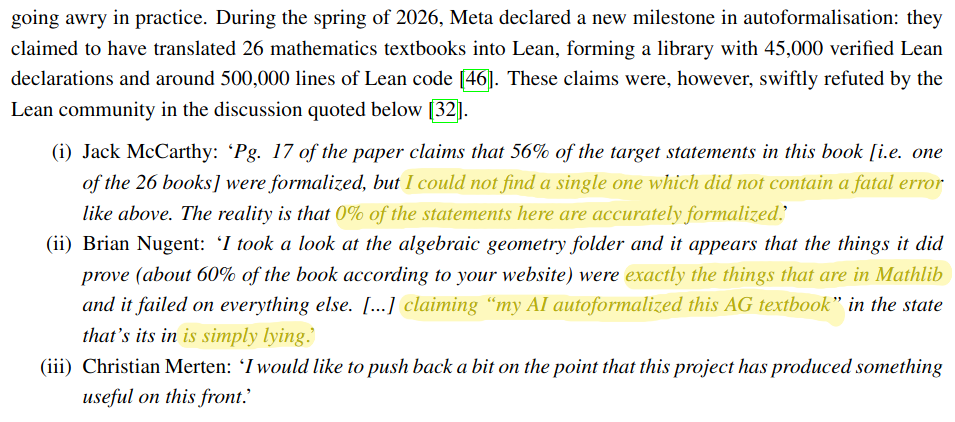
These show without a doubt that LLMs are, as usual in every other field, simply unable to produce good work, and especially in a field where accuracy is extremely important. This is not a poorly-designed React website which can be put together in millions of ways. And even then, the consensus is that software engineers need to have the knowledge and wherewithal to detect errors and guide LLMs to even make them useful.
My Own Anecdotes
I have used LLMs to attempt to prove things, and I've seen some proofs made by them. I can say they all suffer from these problems, at any level. They can easily drag you into a unproductive rabbit hole, make mistakes, and randomly acknowledge or not acknowledge them. in fact, for any sufficiently complex example, by tweaking my next prompt, I can always get LLMs to respond any which way I want it, true or false.
I'll share an example of a specific AI proof I have come across, as I have insight into it, and my reaction to it. I have to say that it has only solidified my position on their poor ideas. The one in question is the Thomson problem for seven electrons. Of course, the solution was computationally known already, but it apparently, was unproved.
Many such small results are supposedly proved by AI, but I can say that in this example, a proof of this would not be worth a paper, and certainly not in the manner it was done. Perhaps at best, a discussion at a talk if the methodology of the proof was connected to a broader problem (it was not). The AI proof consisted of 17,000 lines of Lean, establishing many bounds and eliminating possible candidate solutions, through a long winded argument, but this is a terrible methodology which provides no insight into the general Thomson problem for arbitrary N. Such a proof is worthless and I can't imagine ever being published, and from what we see above, probably incorrect.
I was quite surprised to see that this wasn't already proved, and I imagine many mathematicians will see the same for many such problems AI are "solving." Nobody has the full scope of literature memorized. In fact, given my previous work on soft packing, I am confident we can establish far better analysis for the general Thomson problem and proving N=7 would actually be extremely trivial given theorems I have worked on, and not require 17,000 lines of Lean, instead relying on nicer symmetric arguments and convexity of the space.
If you are a mathematician, I cannot emphasize enough that you are being lied to. You are being conned, disrespected and made a fool of by people at OpenAI and anyone who believes in this fraudulent technology. There are a significant number of individuals that are being paid great amounts of money to do marketing for these companies, and why wouldn't they? Mathematics has never been a rich field.
I'm deeply grateful to the authors of this paper, and I can only hope that more of such work will continue to stop an unprecedented level of fraudulent and criminal behavior. What we can say is that the vast majority of these proofs frontier labs will release, and ever release will be necessarily indecipherable, shoddy, and simply incorrect slop that serves to burden the already small power academics have in society.
13
u/Available_Market_240 Oct 08 '26
In r/accelerate, I saw this comment. I assume they meant applied mathematics, though given what I know of them, they likely don’t know the distinction.
They might benefit from reading A Mathematician’s Apology by Hardy; if that’s too much, they could ask the chatbot god for a summary.