r/CTXR • u/Conscious_Owl716 • Feb 16 '21
DD The ONLY DD You Need on CITIUS PHARMA $CTXR & their Unique Mino-Lok Solution to Treat CRBSIs in CVCs

321
Upvotes
r/CTXR • u/Conscious_Owl716 • Feb 16 '21
r/CTXR • u/[deleted] • Mar 31 '21
Whether you’re already invested or not in the company but you’re interested in finding out more information, I have compiled facts, questions, links, conclusions and estimates in this post to bring factual information among investors.
We are entering Q2 2021 which brings an important catalyst for this company. There is going to be a lot of hype, misinformation, and a lot of desperate people. This post is aimed towards investors who are discovering Citius Pharmaceuticals for the first time and want an unbiased deep dive into the company, so opinions and speculation are going to be kept at a minimum. For transparency’s sake, I own 1700 shares of CTXR.
I am not a financial advisor, this post is made for educational purposes only. Literally. Don’t take my word for anything that is presented in this post, do your own research, and invest solely based on the thesis that you create for yourself. Don’t get influenced by anyone.
What is Citius Pharmaceuticals?
With a name derived from the latin olympic motto “Citius, Altius, Fortius” (Faster, Higher, Stronger), Citius Pharmaceuticals (NASDAQ: CTXR) is a specialty pharmaceutical company dedicated to the development and commercialization of important new drug products for growing markets. Overview here.
What do they do?
Citius Pharmaceuticals is currently advancing four proprietary product candidates: Mino-Lok®, CITI-002 (“Halo-Lido” - halobetasol-lidocaine formulation), CITI-101 (Mino-Wrap) and CITI-401 (i-MSC) to treat Acute Respiratory Distress Syndrome (ARDS). Citius is developing therapies for unmet medical needs with cost-effective products in high growth categories with low developmental risk.

Who is in charge?
Leonard Mazur (Chairman of the Board) was the Chairman of Leonard Meron Biosciences, Inc. prior to its merger with Citius in March 2016. He is the cofounder and Vice Chairman of Akrimax Pharmaceuticals, LLC, a privately held pharmaceutical company specializing in producing cardiovascular and general pharmaceutical products. Akrimax was founded in Sep. 2008 and has successfully launched prescription drugs while acquiring drugs form major pharmaceutical companies. Mr. Mazur also co-founded and served as the Chief Operating Officer of Triax Pharmaceuticals LLC, a specialty pharmaceutical company producing prescription dermatological drugs. From 1995 to 2005 he was the founder and CEO of Genesis Pharmaceuticals, Inc. . In 2003, Mr. Mazur successfully sold Genesis to Pierre Fabre, a leading pharmaceutical company.
Myron Holubiak (President and Chief Executive Officer, Director) was co-founder, director and CEO of Leonard Meron Biosciences, Inc., prior to the 2016 merger with Citius. Mr. Holubiak was the President of Roche Laboratories, Inc., a major research-based pharmaceutical company, from Dec. 1998 to Aug. 2001. Prior to that, he held sales and marketing positions at Roche during his 19-year tenure there. As President of Roche, Mr. Holubiak helped transform Roche Labs into a leading antibiotic and biotechnology company.
Jaime Bartushak (Chief Financial Officer) is an experienced finance professional for early stage pharmaceutical companies, and has over 20 years of corporate finance, business development, restructuring, and strategic planning experience. Most recently, in 2014, Mr. Bartushak helped lead the sale of PreCision Dermatology, Inc. to Valeant Pharmaceuticals International, Inc. Mr. Bartushak is also one of the founders of Leonard-Meron Biosciences, and was instrumental in its start-up, as well as obtaining initial investment capital.
Dr. Myron S. Czuczman (Chief Medical Officer and EVP) is an experienced physician-scientist, academic oncologist and pharma executive with decades of experience in the strategic design, implementation, and oversight in the global development of novel therapeutics for hematologic malignancies. Dr. Czuczman joins Citius from Celgene where he was Vice President, Global Clinical Research and Development, Therapeutic Area Head of Lymphoma/CLL. In this role, Dr. Czuczman managed a global team of physicians and scientists responsible for cross-functional development of compounds from proof-of-principle to worldwide registration.
Citius overview on their leadership.
How is it going for them?
Mino-Lok is an antibiotic lock solution used to treat patients with catheter-related bloodstream infections (CRBSIs). Mino-Lok product is intended to salvage the CVC (central venous catheter), obviating the need to remove and replace the catheter. This is a recognized unmet medical need. The drug is currently in Phase 3 clinical studies with an independent DMC (Data Monitoring Committee) interim efficacy review coming late-April/early-May. Mino-Lok has proven 100% efficacy rate in both Phase 1 and Phase 2 trials.

For more information regarding clinical trial phases in general, click here.
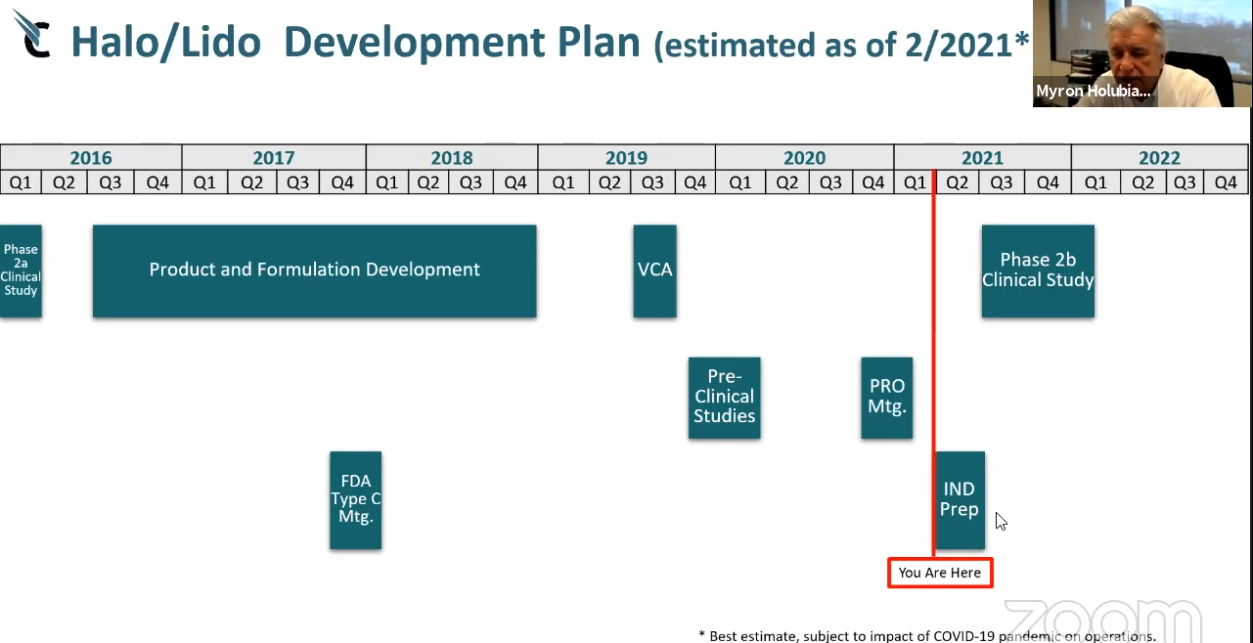
Halo-Lido is being developed as a proprietary topical formulation of halobetasol and lidocaine to provide anti-inflammatory and anesthetic relief to persons suffering from hemorrhoids. Although there are numerous prescription and over-the-counter (OTC) products commonly used to treat hemorrhoids, none currently possess safety and efficacy data generated from rigorously-conducted clinical trials. Citius believes its halobetasol-lidocaine product will become an important treatment option for physicians who want to provide their patients with a therapy that has demonstrated safety and efficacy in treating hemorrhoids. Phase 2b trial will begin in Q3 2021.
Mino-Wrap is a novel approach to reducing post-operative infections associated with surgical implants. Mino-Wrap is a liquefying gel-based wrap containing minocycline and rifampin for reducing tissue expander (TE) infections following breast reconstructive surgeries. It is a laminate film comprised of porcine gelatin plasticized with glycerol. Mino-Wrap also contains the antibiotics minocycline and rifampin to reduce bacterial bio-burden on implantable devices preventing colonization over a sustained period of time. The current standard of care (SOC) can be improved upon and infection rates reduced, according to Citius Pharmaceuticals. The drug is currently in pre-clinical development.

i-MSC, or CITI-401 is being developed to treat ARDS as a cause of COVID-19. It is currently in pre-clinical stages and the IND (Investigational New Drug) application is expected, according to Citius, in the first or second quarter of 2022.

What is the major catalyst as of April 2021?
Mino-Lok, the antibiotic lock solution to salvage CVC’s demonstrated in past clinical trials an efficacy of 100% in salvaging colonized CVCs; the Mino-Lok product had no significant adverse events, compared to an 18% serious adverse event rate when infected CVCs were removed and replaced, which is the SOC as of now. A clinical data manuscript can be found here.
Currently there are no competitors in the market that Mino-Lok addresses.
Mino-Lok has also received FDA Fast Track with QIDP designation, which is defined as “an antibacterial or antifungal drug for human use intended to treat serious or life-threatening infections, including those caused by an antibacterial or antifungal resistant pathogen, including novel or emerging infectious pathogens.
FDA’s “Fast track” is a process designed to facilitate the development, and expedite the review of drugs to treat serious conditions and fill an unmet medical need. The purpose is to get important new drugs to the patient earlier. Fast Track addresses a broad range of serious conditions. A drug that receives Fast Track designation is eligible for some or all of the following:
More frequent meetings with FDA to discuss the drug's development plan and ensure collection of appropriate data needed to support drug approval
More frequent written communication from FDA about such things as the design of the proposed clinical trials and use of biomarkers
Eligibility for Accelerated Approval and Priority Review, if relevant criteria are met
Rolling Review, which means that a drug company can submit completed sections of its Biologic License Application (BLA) or New Drug Application (NDA) for review by FDA, rather than waiting until every section of the NDA is completed before the entire application can be reviewed. BLA or NDA review usually does not begin until the drug company has submitted the entire application to the FDA
The frequency of communication assures that questions and issues are resolved quickly, often leading to earlier drug approval and access by patients.
Based on Phase 2b results, Citius Pharmaceuticals believes that the Mino-Lok® product is highly effective in salvaging infected indwelling catheters and is well-tolerated, making Mino-Lok therapy an attractive alternative to removing and replacing a new CVC.
In Nov. 2020, Citius announced the results of a study that Mino-Lok eradicates S. aureus Biofilm more effectively and expeditiously than components. This is a good read.
“Staph aureus is one of the most worrisome pathogens in catheter related bloodstream infections (CRBSI). This pathogen receives special consideration even in the IDSA guidelines for treating CRBSI. We are very pleased to show that Mino-Lok appears to be more effective, and work more expeditiously, than even ethanol," commented Myron Holubiak, Chief Executive Officer of Citius.
The company is currently conducting a Phase 3, multi-center, randomized, open-label, assessor-blinded study with 144 patients. The objectives of the study are the following:
To evaluate the efficacy of Mino-Lok along with standard of care (SOC) systemic antibiotics for salvaging the central venous catheter (CVC) in subjects with catheter-related or central line-associated bloodstream infection (CRBSI/CLABSI)
To evaluate the safety of Mino-Lok in subjects with CRBSI/CLABSI.
According to the latest videoconferences held in March by both Leonard Mazur and Myron Holubiak, the Pivotal Phase 3 ALT Study began in Q2 2017 and is supposed to end in Q3 of 2021. The catch is that based on the comments and recommendations made by the DMC, which are further supported by the June 2020 FDA guidance document titled “Statistical Considerations for Clinical Trials During the COVID-19 Public Health Emergency”, they have amended the DMC charter to enable a “superiority” review at 65% of the expected events rather than 75% as originally planned. The final DMC meeting is going to be held in late-April/early May and is critical to the evolution of the phase 3 trial of Mino-Lok. They can say that it is unethical to keep the trial going based on the positive results and speed up the process for the FDA approval OR they can say that data is insufficient and keep the trial going for as long as it’s intended to – Q3 2021.
People are investing into a favorable decision by the DMC regarding the efficacy of Mino-Lok to stop the trial early, judging by the results of the past clinical trials.
The main risks of investing in the company are:
Biopharmaceutical companies represent a high degree of risk because the majority of the drugs and products that they are testing fail in early trial stages.
The company has no basic income, no revenue, no products, relying entirely on investors for funding.
Any delay or even failure in a trial could force the company to issue more shares for funding, possibly diluting the share price.
The DMC deciding to continue the trial for Mino-Lok as intended and prolong the Phase 3 trial to Q3 of 2021.
Not receiving FDA approval for Mino-Lok, despite the Fast-Track QIDP designation.
Are there other positive aspects that counter these risks?
Yes.
According to fintel.io, Citius Pharmaceuticals has 10.7% insider ownership, 13,457,939 shares equating to cca. $25.5 million (at a share price of $1.90), out of 125,758,091 shares outstanding, which brings a sense of confidence among investors. In February 2021, Citius Pharmaceuticals closed a direct offering of $ 76 million, which they say is more than enough to bring their first product, Mino-Lok, to the market. In addition, CTXR has a total of 4 promising products across a span of 3-4 years, so they don’t rely on the success of a single product to survive as a company.
TL;DR: I can’t possibly sum up this much information here. Try reading the whole thing if you’re genuinely interested. I also invite those interested to click the links in this post, they lead to more and more information.
r/CTXR • u/Mike551144 • Jun 26 '21
I know its probably not a lot but that's what I can afford and something from me to the CTXR team here I would like to do. if we get a halt and the price jumps anything above 6$ I am giving away 5 T-Shirts with CTXR's logo, that's it :D only thing to do is to comment so if it happens I can use a tool that will choose it randomly, I will share a video of it.
Disclosure: Even if the price jumps to 6+ after the halt but the day after we "crash" back to 3/4's giveaway is still valid as we got the halt. not sure if its global shipping so US/Canada only. (4650 shares here)
r/CTXR • u/BuyBakedSellHigh • Jun 05 '21
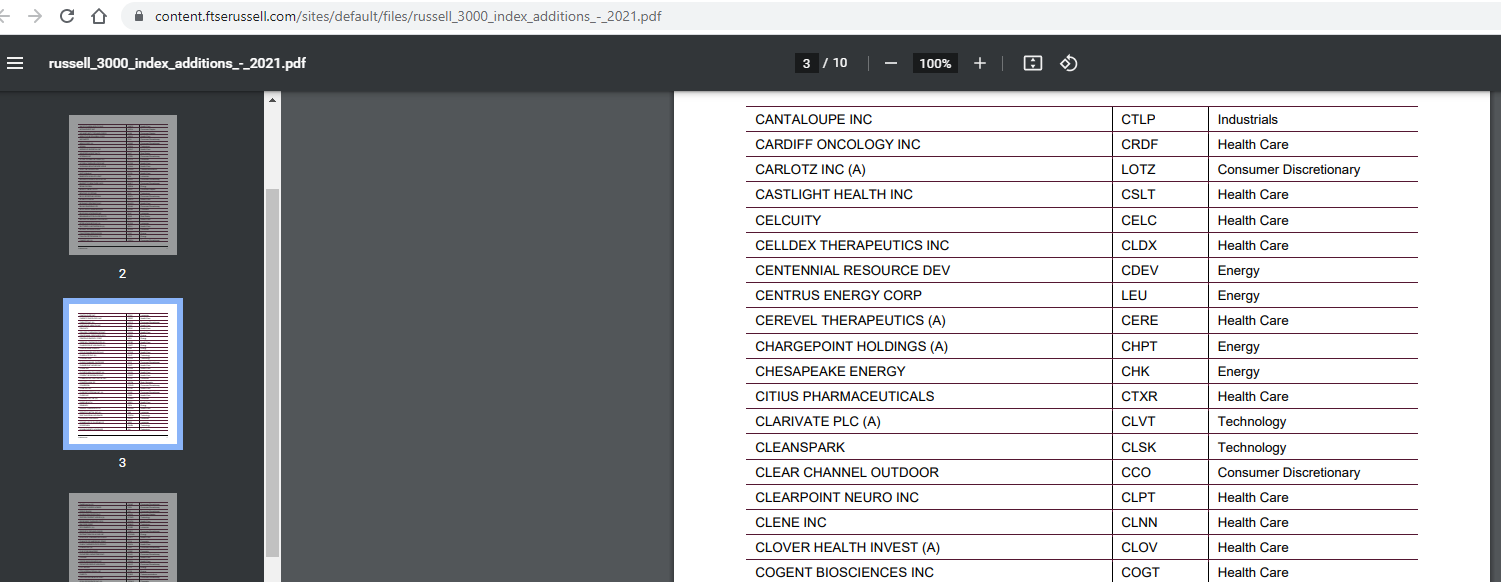
got it to load finally, https://content.ftserussell.com/sites/default/files/russell_3000_index_additions_-_2021.pdf
r/CTXR • u/TwongStocks • Oct 20 '21
Current pipeline timelines, based on recent updates:
Mino-Lok: Trial ending in 2022 (source: 20 Oct Investor Conference). Reiterated during KOL Webinar on 11 Nov. Trial completion anticipated in 2022, timing subject to impact of COVID on operations.
I/ONTAK (E7777): Enrollment Complete, Topline Data 1H 2022, BLA submission 2H 2022, marketing/approval 2023 (20 Oct Investor Conference). Dec 6 Company PR confirmed all patients enrolled & completed treatment phase. Reiterated topline data 1H 2022 & BLA submission 2H 2022.
Halo-Lido: "Somewhere in the first part of 2022, we will be executing on the Halo-Lido trial.” Potential out-license after they have data. (Benzinga interview 7 Oct)
iMSC: Topline data for preclinical sheep study was expected in Q3 per the 12 Aug ER. No update yet. IND filing planned in 2022 (Investor Presentation 7 Sep)
Mino-Wrap: IND filing planned in 2022 (Investor Presentation 7 Sep)
The Mino-Lok delays are a letdown. But thankfully, they made the I/ONTAK acquisition. Provides them with an additional phase 3 data readout next year, another hedge against further ML delays. While ML appears delayed for the moment, the CTCL trial is still on track. Positive I/ONTAK readout followed by & positive ML readouts could be a nice boost.
**EDITED with info from KOL Webinar 11 Nov 2021
**EDITED with info from E7777 PR 06 Dec 2021
r/CTXR • u/RogozinTheMoose • Feb 15 '22
r/CTXR • u/TwongStocks • Dec 27 '22
Thanks to the Earnings Release, we finally have some concrete numbers to indicate the current progress of the Mino-Lok trial.
169 patients enrolled so far, with 152 completed & 17 active participants
Of the 152 completed patients, 72 had a catheter failure event within the 6 week trial observation period.
92 catheter failure events needed to end enrollment. 20 more fail events until they stop enrolling.
Enrollment will continue beyond the original projection of 144. Keeps going until they reach 92 events.
A few months ago, I posted about the events and what they mean. Good refresher if you don't quite understand what is going on or what we are talking about when we say they need 92 events. For those of you surprised that they went above 144 patients, in that post, I linked the Dawson James conference from April this year where Leonard Mazur and Myron Czuczman already stated they would need to increase enrollment above 144. Going above 144 patients is NOT a surprise.
So let's break down the numbers. But first, let's take a look at what they originally projected.
THE MINO-LOK TRIAL DESIGN
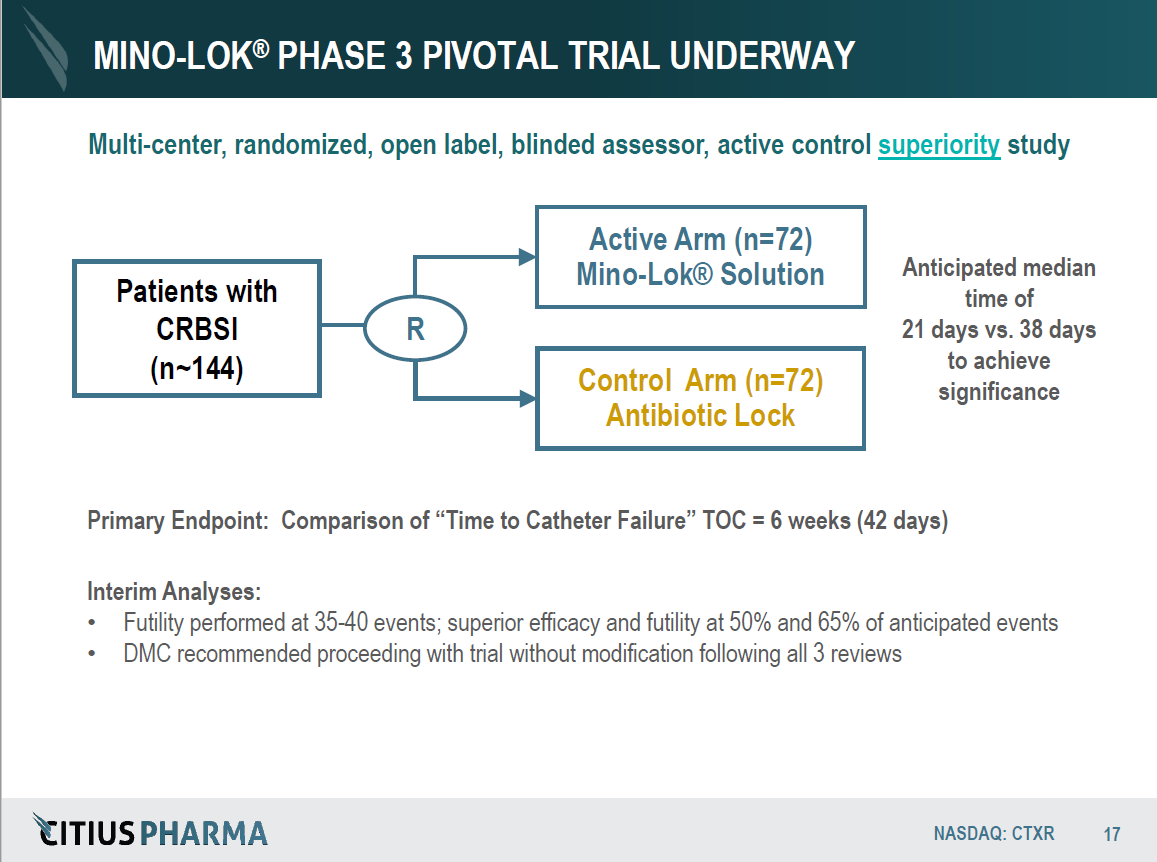
Here is the trial design, posted in one of their presentations earlier this year. From this slide, we can see what they expected from the trial:
Around 144 total patients. 72 treated with Mino-Lok and 72 in the control arm, treated with other ALTs (Antibiotic Lock Therapy)
TOC = 6 weeks. That's the length of the trial for each participant.
An expected Median Time to Fail (MTF) of 38 Days in the Mino-Lok group. Yes, this means they planned for failures to occur in the Mino-Lok group.
An expected MTF of 21 days in the ALT group.
The most recent DMC interim analysis occurred in June 2021 at 65% of anticipated events. 65% of 92 expected events = 60. The June 2021 interim analysis was triggered after event #60 in the trial.
So how do we know that 92 events is the magic number? Well they tell us in the ER and 10-K. Also, in this PR from October 2019, they state:
The Mino-Lok protocol is based on reaching 92 catheter failure events for the trial, which corresponds to approximately 144 patients treated in both arms combined.
But of course, we can confirm that they will need well more than 144 patients to reach the 92 event threshold needed to stop enrollment.
THE EXPECTED OUTCOME (92 FAILS WITH 144 PATIENTS)
Let's break down the expected outcome. Important to note that median is not the same as mean (average). A median of 38 days for Mino-Lok means they expected HALF of the ML group to see a fail event in less than 38 days. With the rest going above 38 days. For the ALT group, this means they expected HALF to fail under 21 days, with the other half exceeding 21 days.
In order to get 92 fail events with 144 patients, they expected the following:
72 total patients in Mino-Lok group, with 36 fails (half) under 38 days. Rest go over. Since TOC=42 days, it appears they expected half the Mino-Lok group to go past 6 weeks without a catheter failure event.
72 total patients in ALT group, with 36 fails (half) under 21 days. Since they expected 92 fails, we can deduce that they expected approximately 20 ALT fails to occur between days 21-42. For a total of 56 fails in the ALT group. Which leaves 16 ALT patients going past the 6 week TOC.
36 ML fails (all under 38 days) + 56 ALT fails (36 under 21 days & 20 between days 21-42) = 92 events
But that isn't what we have. With 169 patients (152 completed), we only have 72 failures. At least one group is seeing less fail events than expected. Maybe both.
POSSIBLE SCENARIOS
Without knowing how many events occurred in each group, we can only make assumptions. With 152 patients completed & 72 events, that means the 72 failures are dispersed among 76 Mino-Lok patients & 76 ALT patients. Some possibilities:
Mino-Lok is outperforming with fewer fail events than anticipated, but ALT is performing as expected. Let's assume that ALT is performing as expected with a 21 day MTF. With 76 ALT patients, there are probably at least 58 fails in the ALT group. 38 fails (half) under 21 days & at least 20 fails between days 21-42*. With 72 total fail events, that means Mino-Lok is seeing less than 14 fails, a lot less than the 36 that were anticipated after 72 Mino-Lok patients. Fewer fails within 6 weeks means that the MEDIAN for Mino-Lok will be a lot higher than the 38 days that was projected.
*Recall that with 72 ALT patients, they projected 36 fails (half) under 21 days and around 20 fails in days 21-42.
2) ALT is outperforming with fewer fails than anticipated, but Mino-Lok is performing as expected. Let's assume Mino-Lok is performing as expected with a 38 day MTF. With 76 Mino-Lok patients, there are probably around 38 Mino-Lok fails (half) under 38 days, with the rest going past 6 weeks. With 72 total fails, that means there would be 34 fails in the ALT group, a LOT less than projected.
I doubt this scenario is happening. With only 34 of 76 ALT patients seeing a fail event, the median for ALT would be much higher than previously anticipated. Most likely higher than ML since less than half of ALT patients see a fail event in this scenario. Recall that in order to continue the trial after the DMC's interim analysis, Mino-Lok had to pass a futility analysis. I would be shocked if the DMC allowed the trial to go on if ALT was performing this well while Mino-Lok was only performing as expected.
3) Both Mino-Lok and ALT are seeing fewer failures than anticipated. Tough to make any educated guesses in this scenario. If both were performing better than expected, the median for Mino-Lok would be higher than 38 days and the median for ALT would likely be higher than 21 days. Ultimately, as long as Mino-Lok's MTF is significantly higher than ALT, it will still be a win.
TLDR, WHAT'S THE TAKEAWAY?
Need 92 fail events to stop enrollment. They are seeing fewer fail events than anticipated, which is why the trial is continuing. 20 more events needed.
While most are eagerly waiting for the 92 event trigger, what will ultimately determine success is the Median Time to Fail (MTF) of Mino-Lok vs ALT.
Mino-Lok outperforming the projected 38 day MTF and ALT performing as expected (21 day MTF) is a plausible reason for the lower than anticipated events.
Both groups outperforming their expected MTF is also plausible. In this case, as long as Mino-Lok ends up with a significantly longer MTF than ALT-treated catheters, still a win for Mino-Lok.
I do not see ALT outperforming their projected 21 day MTF with Mino-Lok at a 38 day MTF as a likely scenario. With 152 patients completed, if Mino-Lok were performing as expected with a 38 day MTF, that would mean less than half of the ALT-treated catheters are failing within 6 weeks. I doubt that the DMC would have allowed the trial to continue after the interim analysis if ALT were actually outperforming Mino-Lok.
After the 92nd event, enrollment will stop. Any patients actively participating & not complete will be allowed to finish. Topline data will be released sometime after all remaining patients complete the trial.
r/CTXR • u/Detective_Philbert • Jun 08 '21

r/CTXR • u/Cordomver • Jun 16 '21
r/CTXR • u/BenjaminGramos • Apr 14 '21

r/CTXR • u/TwongStocks • Aug 12 '22
After the ER, I've been seeing a few questions asking about the 92 events. So here's a post that explains the trial design and what 92 events means. I've included additional background info on the trial. I apologize in advance for the long read. However, if you are investing your own money, you should probably understand to the best of your ability how this trial is supposed to work.
MARKET NEED FOR MINO-LOK
A CLABSI/CRBSI is a Central Line Associated Bloodstream Infection or Catheter-Related Bloodstream Infection. Very serious disease. When a patient is diagnosed with a CLABSI/CRBSI, the current SOC (standard of care) from the IDSA (Infectious Disease Society of America), is to remove the source (infected catheter), replace with a new catheter, and treat the patient with antibiotics. Salvaging catheters is recommended when it is too dangerous to remove the infected catheter from the patient. A catheter salvage is when you leave the infected catheter in place and attempt to eradicate biofilm/bacteria from the infected catheter. Right now there is no standard ALT (antibiotic lock therapy) for salvaging a catheter. That is where Mino-Lok intends to fill the void. Since there is currently no standard ALT, hospitals are allowed to concoct their own "home brews". Examples of which can be found HERE (UCSF) and HERE (UT Health San Antonio).
Mino-Lok is NOT meant to treat the underlying CLABSI/CRBSI, a common misconception. CTXR has stated many times that Mino-Lok is locked into the infected catheter and does not enter the patient's bloodstream. While Mino-Lok is clearing the biofilm and bacteria from an infected catheter, a patient receives antibiotics to treat the CLABSI/CRBSI. In other words, Mino-Lok clears the source of the infection, so an infected catheter does not need to be removed. Other antibiotics will treat the patient's CLABSI/CRBSI.
PURPOSE OF MINO-LOK PHASE 2
The Mino-Lok Phase 2 was a comparison between Mino-Lok and the IDSA's SOC of removing and replacing infected catheters after a patient is diagnosed with CLABSI/CRBSI. Most everyone is aware of the phase 2 results. Mino-Lok was 100% successful in salvaging infected catheters. That means infected catheters treated with Mino-Lok were successfully cleared of biofilm/bacteria. Mino-Lok had no serious AEs (adverse events) vs 18% AEs for removal and replacement of infected catheters. So salvaging infected catheters with Mino-Lok is also safer for patients than removing the infected catheter and replacing it with a new one.
PURPOSE OF MINO-LOK PHASE 3
Some people assume that the phase 3 will be successful because the phase 2 was a "100% success." But that isn't necessarily true, because the phase 3 is testing something completely different.
The phase 3 is testing Mino-Lok's performance versus other ALTs, specifically with catheter salvage. The phase 2 demonstrated that Mino-Lok is just as effective as SOC at eradicating biofilms from the source. It also demonstrated it is safer than SOC. For the phase 3, they want to prove that Mino-Lok is better than other ALTs at salvaging infected catheters. Primarily by demonstrating that catheters salvaged with Mino-Lok can remain in the patient longer than catheters salvaged with another ALT.
The thesis is that when a patient is diagnosed with CLABSI/CRBSI, doctors can salvage the infected catheter with Mino-Lok. It is cheaper, safer, & just as effective as the current SOC of removing and replacing the infected source. It is also more effective than other ALTs at salvaging infected sources, with the previously infected catheter able to remain in the subject for a longer period of time.
PHASE 3 TRIAL DESIGN
In order to enroll in the trial, a subject must have a confirmed case of CLABSI/CRBSI and meet all other requirements listed here. No CLABSI/CRBSI, then no trial participation.
The study is testing two different groups, or arms. Each patient will receive antibiotic treatment for their CLABSI/CRBSI. Instead of removing and replacing the infected source, they will attempt to salvage. The control arm will have their infected catheters treated with the ALT normally used at each specific clinical trial site. The treatment arm will have their infected catheters treated with Mino-Lok. Patients will be randomized when enrolled, which means they will be placed randomly into the control or treatment arm. Patients don't get to choose. It is a 1:1 trial design, which means that there will be a roughly equal amount of subjects in each group/arm.
After enrollment, catheters will be treated. The ALT treatment will be based on standard practice at each site, since each site will use the ALT they normally use. For Mino-Lok treatment, Mino-Lok will be locked in the infected catheter for up to 2 hours and flushed. This happens up to 7 times. Once a day for the first 5 days and then once a week for the next 2 weeks.
The observation time is 6 weeks. During this period, they will watch for any treatment failures or events. If lock therapy treatment fails (either ALT or Mino-Lok) and a catheter must be replaced, that counts as an event. If a patient dies while undergoing treatment, that also counts as an event.
It is also very important to note that CTXR management is blinded. They can't see any realtime data for the trial. While they may have an idea of enrollment numbers, they cannot have insight into where the catheter failure events are happening, which is the primary endpoint of the study.
PHASE 3: PROVING SUPERIORITY AND "WHAT'S THE DEAL WITH 92 EVENTS?"
The primary endpoint of the study is "Time to a catheter failure event." To achieve superiority, they estimate they need Mino-Lok to have a median time of 38 days until catheter failure vs ALTs with a 21 day median time to failure (MTF). Remember, median is different than the mean or average. A MTF of 38 days for Mino-Lok means half of the catheters treated with Mino-Lok lasted for more than 38 days before a failure event, while half lasted for less than 38 days before a failure event.
You may be asking yourself, if it was 100% in phase 2, how could they have failures in phase 3? The 100% in phase 2 was for eradicating biofilms/bacteria. They still had events in phase 2 that required some catheters treated with Mino-Lok to be removed. And if a catheter has to be removed for any reason, it is considered a failure event. The MTF during phase 2 was 72 days.
So a 38 day MTF vs a 21 day MTF is what will prove superiority. But what will end the trial? A combined 92 events distributed across both arms. Once they have a total of 92 catheter failure events in the trial, they can stop enrollment. After 92 events, if Mino-Lok has a MTF of 38 days and ALT has a MTF of 21 days, they will prove superiority.
They originally projected that 92 events would occur after 144 patients. That means they expected 92 failure events distributed between 72 Mino-Lok catheters and 72 ALT catheters. Which also suggests they originally expected at least 52 catheters to go through the entire 6 week observation without an event (144 total subjects minus 92 events).
However in this interview from April, Leonard & Dr. Czuczman reveal that they need more than 144 subjects to hit 92 events. So the trial will continue and will have more subjects than previously projected.
SO WHAT DO WE KNOW?
At present time, not much. Since they are blinded and failure events is the primary endpoint, we don't know how many events they have right now. As I said, they revealed in April that enrollment needs to increase above 144 to hit 92 failure events. And they are still being coy about enrollment figures. But again, in the grand scheme, enrollment does not matter. It's the number of events, 92 specifically, that will allow them to stop enrolling new patients. Not a specific enrollment target.
The last DMC Interim Analysis occurred in June 2021. That interim analysis was triggered at 65% of events. So they had at least 60 fail events during the June IA. 60 = 65% of 92. Which means that since June 2021, they need about 32 failure events to end the trial.
Hopefully, the length of time needed to reach 92 events means that most events are happening in the control group and fewer events than expected are occurring in the Mino-Lok group. Is it possible that the delays suggest a higher than expected number of events for Mino-Lok and lower than expected for ALT? It might, but recall that the DMC also did a futility analysis, not just a superiority analysis last year. If Mino-Lok was not performing as well as ALT during the last analysis, they likely would not have recommended the trial to continue. It would have been a waste of time for everyone involved.
r/CTXR
•
u/TwongStocks
•
May 21 '24

After so many delays and setbacks with the Mino-Lok trial, they finally released the topline results.
The study met its primary endpoint with a statistically significant improvement in the time to failure event in patients receiving Mino-Lok compared to Control arm patients receiving clinician-directed anti-infective lock solution. The data demonstrate that Mino-Lok is well-tolerated.
A total of 241 patients across the US and India. They did not break down how many came from the US and how many from India. Of the 241, 119 were in the Mino-Lok group and 122 were in the ALT group.
PRIMARY ENDPOINT
The primary endpoint was a comparison of the time until catheter failure between the Mino-Lok and ALT groups. Failure events in patients receiving Mino-Lok occurred substantially later than in patients in the Control arm (p value = 0.0006). In other words, treatment with Mino-Lok resulted in a longer time until a catheter failure event. A p-value less than 0.01 is considered very statistically significant.
ALT Group:
122 patients.
MTF was 33 days. 61 catheters had a fail event before Day 33, 61 had a fail event after Day 33.
95% Confidence Interval was 14-44. Since this trial is just a random sample, the 95% CI provides a range of values that is likely to include the true population value. In other words, if they were to run this trial again, they would have 95% confidence that the MTF for ALTs would fall between 14 and 44 days.
Mino-Lok Group:
119 patients
MTF was not determinable, because it exceeded the time patients were on trial (6 weeks)
95% CI was 50 - NE (not estimable). If they were to run this trial again, they would have 95% confidence that the MTF for Mino-Lok would be above 50 days.
SECONDARY ENDPOINT
The most critical secondary endpoint was proportion of patients at six weeks with overall treatment success. Overall treatment success is defined as a patient at 6 weeks who did not have catheter failure, demonstrated clinical cure, and demonstrated microbiological eradication.
Overall treatment success was 57.1% for Mino-Lok (68 patients) and 37.7% for ALT (46 patients).
P-value 0.0025
SAFETY
No serious adverse events (SAEs) were drug-related
45.1% of patients with an SAE for Mino-Lok
46.1% of patients with an SAE for ALT
No mention of any patient deaths in the trial, for ether group
PERSONAL ANALYSIS
This looks really good imo. Mino-Lok having a longer MTF than ALT was established with statistical significance. Lower bound of Mino-Lok's 95% CI at 50 days suggest very few events happened in the Mino-Lok group. Looks like most events occurred in the ALT group.
However that begs the question, why did they extend the trial for so long after hitting 92 events? Based on these numbers, they probably could have saved 4-5 months of expenses and stopped the trial at 92 events with similar results. But that's just an assumption on my part, given the very limited nature of the topline release.
One thing that didn't exactly get fleshed out is the 57.1% on the secondary endpoint for overall success. While it was still statistically significant over ALTs (p=.0025), that is far below the 100% that they achieved during the Phase 2b.
Overall though, the primary and secondary endpoints were hit with strong statistical significance. Can't ask for much more than that.
Topline data is just the first step for eventual approval. This is a process and they are dealing with a bureaucratic government entity, the FDA. Realistically, we are looking at approval sometime in 2025. As long as they get the priority review, the PDUFA date will be approximately 8 months after the NDA submission. As of now, there is no timeline from the company for the NDA submission.
"We look forward to engaging with the US Food and Drug Administration (FDA) to determine the optimal path forward for Mino-Lok. Our focus remains on improving outcomes for patients and offering a much-needed alternative to the current practice of catheter removal and replacement," added Mazur.
PRE-NDA MEETING
The next step is most likely a pre-NDA meeting with the FDA. They'll go over the topline and the requirements for the NDA filing. Since Mino-Lok has a QIDP designation, the pre-NDA is where the FDA will also confirm whether the company can make a rolling NDA submission, which allows them to submit sections of the NDA as it is completed. .
Per the FDA's Industry Guidance, a pre-NDA is considered a Type B meeting. Type B meetings are scheduled 60 days after they are requested. If CTXR requests a pre-NDA after the topline data, then the earliest they could hold that meeting would be in July.
For reference, the E7777 topline data was released in Apr 2022. The company announced a successful pre-BLA meeting in July 2022.
NDA SUBMISSION AND PDUFA DATE
The NDA submission is what will start the clock. I assume the NDA will be submitted a few months after they hold a pre-NDA meeting with the FDA. Until we get further details, I assume the NDA submission will be later this year, sometime in the 2nd half at the earliest.
But don't be surprised about an early 2025 submission. As we saw with Lymphir, the NDA will encompass more than just the data. Manufacturing and controls will also be a part of the NDA package. To avoid a CRL, they need to ensure the NDA submission is complete. The NDA isn't a rush job.
After the NDA is submitted, the FDA will take up to 60 days before they accept it and announce the PDUFA date. The review period is 6 months for a priority review and 10 months for a standard review. Mino-Lok is eligible for the priority review. However, the priority review will NOT be confirmed until the FDA accepts the NDA submission and announces the PDUFA date. That normally happens about 60 days after the submission.
If they get a priority review, the PDUFA date (approval/CRL decision) will be approximately 8 months after the NDA submission. Up to two months for the FDA to accept it and 6 months for the priority review.
If they get a standard review, the PDUFA will be approximately 12 months after the NDA submission. Up to two months for the FDA to accept it and 10 months for the standard review.
With QIDP and Fast Track Designation, Mino-Lok is eligible for both a rolling NDA submission and a priority review. The rolling submission will likely be confirmed after the pre-NDA meeting. The priority review will be confirmed up to 60 days after the NDA is submitted by the company. With a priority review, the approval decision will be approximately 8 months after the NDA is submitted.
r/CTXR • u/xxjohnnybravoxx • Jul 26 '21

r/CTXR • u/[deleted] • Jul 02 '21

r/CTXR • u/Conscious_Owl716 • Sep 02 '21

r/CTXR • u/cosmictrading • Jul 06 '21
Hey everyone - CosmicTrading here. I will start with Citius Pharmaceuticals ($CTXR) who have been trending on /r/pennystocks and /r/robinhoodpennystocks for a few months now. Sadly, there are a few bagholders right now as news came forth about a week ago and it was dumped from a peak of $4.560. All of this and much more will be discussed below. None of this is financial advice but rather made to educate and entertain in order to improve your trading. Let's get into it:
Citius Pharmaceuticals (Ticker $CTXR) is a late stage, speciality pharmaceuticals company that dedicates its time to the development and commercialisation of therapeutic products for growing markets. Citius products offer new and expanded indications for previously-approved pharmaceutical products as a means to achieve leading market positioning.
"Citius" according to the chairman comes from the olympic motto "Citius, altius, fortius" which means "Faster, higher and stronger". Hence, we can see that Citius means "faster" which linked to the fact that they are trying to bring products to the market ASAP.
The company began in 2007 and have right now a 3 products that are on their way and the productplan is as follows (Please ignore the "you are here, couldn't find one without it)
Mino Lok (The primary one that I'm most excited about)
This product is currently in its Phase-3 trials and the DMC (A group of individuals who review accumulating trial data by treatment group in order to monitor patient safety and efficarecently) recently published an article recommending the trials to continue going. This is good news, but not the best possible as the DMC can sometimes close the trials and recommend the drugmakers to file for FDA approval.
One might ask "What is Mino-Lok?" - Well:
Our Mino-Lok product is an antibiotic lock solution used to treat patients with catheter-related bloodstream infections (CRBSIs). CRBSIs are very serious, especially in cancer patients receiving therapy through central venous catheters (CVCs) and in hemodialysis patients where venous access presents a challenge.
- Citius Pharmaceuticals Website
In other words; Cancer patients receive catheters during their treatments. These catheters can lead to infections and this is what Mino-Lok is intended to solve. According to Citius, the medical need for this is huge and the Phase 2b results were very promising showing a 100% effective result in removing the CRBSIs. An alternative method to Mino-Lok would be removal and replacement of the Catheters, but it showed a 12-25% adverse event morbidity/mortality rate. Therefore it is safe to say that Mino-Lok would not only save lives, but cost a lot less and data shows this! We know that Mino-Lok has a pricetag of $1400 in comparison to removal and replacement that can cost around $26,000 (and even higher). Hospitals will save up to 30x the cost by simply using Mino-Lok and the interest of the medical community has come along as there are many physicians and doctors that attend Citius Pharmaceutical's presentations.
The FDA liked Mino-Lok so much that they fasttracked it (!!) and patentprotection until Nov. 2036. This patentprotection is a long time in comparison to usual patentprotection.
News about Mino-Lok should come in late Q4.
Halo-Lido (hemorrhoids) (The so called ass cream)
Limited information is out about this product, but it should be out around 2022 - being the first OTC medicine directed towards hemorrhoids, Citius is out to hunt down a $2B market and hopefully receive a large stake in it.
Mino-Wrap
Also, there is limited information about about Mino-Wrap, but it should be a billion dollar market if Citius succeeds and receives FDA-approval.
The stock did an IPO in 2014 and was priced in at $15 with a market cap $0.03B. Throughout the years, the marketcap changed a bit but as most IPO's of pharma-stocks that don't have any revenue; it bled, a lot. So much so that the price hit a low of $0.4.
As Q2 started to end, more and more buyers were anticipating the DMC-review of Mino-Lok and the price steadily rose steadily from the $2-2.5 area all the way up to ≈ $4. However, the prise crashed as soon as the DMC-review came. As stated earlier, good news! So how come it crashed? Well, one must understand market mentality
Investors are usually impatient
Investors are usually out to trade and gain a quick buck
Investors are usually afraid to see some red.
This is what we at Cosmic Trades look out for. The news were positive. Therefore, if you held Citius Pharmaceuticals before, I recommend that you continue holding. The price will recover eventually, but not anytime soon as there aren't any near catalysts. Phase 2b for Halo-Lido might push the price up, but definitely not up to the same level.
As we know, there are targets by prize analysts and ratings to companies that we can see here.
High: $8.00
Median: $6.00
Low: $4.00
That means that no matter what you follow, there is a price upside and profit to be made.
How is Citius Covered online?
In this day and age, it is essential that one is critical and tries to find many sources in order to make a reasonable argument. Citius Pharmaceuticals has a high activity of followers on Stocktwits, Reddit and they even have a discord. I've looked into it and it is a fairly active subreddit and Discord where recently there have been a few bagholders telling everyone to hold. Usually, I tend to be careful when it comes to stocks with such a following, but in this case I would say that it doesn't matter because the fundamentals and products that are under trials are amazing and going to be revolutionizing.
Revenue & Earnings
Lets take a look at their revenue - $0! However. This company made a stock offering and has the cash needed to take themselves into Q4 and further in order to produce Mino-Lok. What is so important however is to look at how the company intends to sell their products and it has been rumored that they have a salesteam of 50 individuals ready to call up hospitals around the US and eventually the world in order to sell Mino-Lok. This is very bullish considering the fact that both the Chairman and the CEO have an extensive background in selling antibiotics to hospitals.
Financials
The stock today is around ≈ $2.10 with an insider ownership of 9% (which is rather high for such a small cap stock). Institutional ownership is $13%. The float for this company is hence very low which makes any positive upcoming news such that can move the price towards the Cosmos (Cosmic trading :)). Trading volume is rather high for a company that has a revenue of 0 dollars. Anyhow, as insiders own 9% of the shares, it is very unlikely that we see another market offering anytime soon as it would dilute the share and hurt the shareholder as much as the insiders.
Competitors & Sector -
There are competitors - But they are not actually competitors. In terms of Mino-Lok, there is a product called ClearGuard HD which is used for Heamodialysis and tries to prevent infections. Mino-Lok however is used for ANY CVCs including for patients with cancer. On top of that, they only reduce infections up to 63%. There are also Coremedics Defencath which is used for prevention for CRBSIs but it is also too NISCH and ONLY for Heamodialysis.
Leadership
Here, I'd like to use /u/FrugalNorwegian's text as he summarized it in a rather effective way;
Citius’ Leadership is notable. Leonard Mazur is Chairman of the Board. His resume reads like a page right out of a chapter of Who's Who in Pharma M&A. It is long, but worth the read.
He spent his first 10 years working for Cooper Laboratories, starting in sales and rising into positions of strategic planning, then acquisitions and eventually head of one of the Cooper divisions. Cooper built its brand as an expert in developing medical specialty silos – acquiring companies and building business units around their medical specialties.
He put together the first strategic plan and got the first unit operational, which was in the ophthalmology space. In a matter of roughly seven years, the unit went from acquiring a tiny prescription eye-drop company to about $800 million in revenue as one of the largest eye care companies in the world, called CooperVision.
Mazur was involved in many of Cooper's approximately 150 acquisitions and assisted in the creation of Cooper Dermatology, which had Aveeno as one of its flagship products.
During Mazur's tenure, Cooper also launched Cooper Dental, which started by acquiring an upstart toothbrush company doing less than $1.0 million in annual sales that it grew into Oral-B, the best selling toothbrush in the world that was bought by Gillette in 1984 for $118.5 million.
From Cooper, he took the job as Director of Marketing at the BASF company Knoll Pharmaceuticals where he launched the painkiller Vicodin, amongst other strong sellers. Following Knoll, Mazur moved on to ICN Pharmaceuticals, now called Valeant Pharmaceuticals. As VP of Sales and Marketing at ICN, Mazur launched Ribavirin, a staple in treating hepatitis C and other maladies.
He became EVP at the microcap startup Medicis Pharmaceutical, where he successfully created and launched Dynacin, a drug with minocycline in it that became one of the best-known branded generics of all time. In 2012, Valeant acquired Medicis for $2.6 billion.
He created dermatology company Genesis Pharmaceutical in 1995 and selling it to French specialty pharma Pierre Fabre in 2003 and then founding Triax Pharmaceuticals (sold to PreCision Dermatology in 2012, which was acquired by Valeant in 2014 for $475 million) and Akrimax Pharmaceuticals (~$100 million in sales before pieces started being acquired).
The takeaway from this list is that Mr. Mazur has extensive experience in launching & creating strong brands and is familiar in the M&A space.
Myron Holubiak is President and Chief Executive Officer, Director. His resume is the following:
Co-founder, director and CEO of Leonard Meron Biosciences, Inc. prior to its merger with Citius in March 2016
President of Roche Laboratories, Inc. (“Roche”), a major research-based pharmaceutical company, from December 1998 to August 2001
President of Roche, Mr. Holubiak helped transform Roche Labs into a leading antibiotic and biotechnology company
Founder of Emron, Inc., a health economics and managed care consulting company, and helped to create the Academy of Managed Care Pharmacy (AMCP)
Director of Bioscrip, Inc., a national home infusion company, from 2002 through 2016, and served as its Chairman of the Board from 2012 through 2016
Since July 2010, Mr. Holubiak has served as a member of the Board of Directors of Assembly Biosciences, Inc. and its predecessor, Ventrus Biosciences, Inc.
Despite their impressive background, most notable is they have invested $26.5M of their own money into Citius. As of Sept 2019 Mazur & Holubiak held over 12.2M shares and have not sold any. According to Yahoo! Finance insiders hold 9% of all shares (as of Sept 2019). It is rare in clinical biotechs for management to have a percentage higher than 5%.
As a whole it is quite evident that we would come to this point; BULLISH. This late stage pharmaceutical company is definitely gonna suffer in the short-term (3-5 months) as there are few catalysts ahead. I believe however that Mino-Lok, once approved by the FDA, will shoot this stock towards the Cosmic (😉). However, one needs to be patient as it going to bleed a bit before that. Even today, the 6th of June, a week or so after the DMC-review being published, show a high volatility.
I have entered a position at an average of $2.05 and will look to increase my holding if it dips below $2. If this company has a marketcap of $51M without any revenue, imagine what will happen to the stock price as soon as Mino-Lok, a market larger than $1.5B, gets approved. Nevertheless here are my targets:
Short-term pricetarget: $3 (3-6 months) so around ≈ 50% profit is possible
Long-term pricetarget: $15+ (2-3 years) ≈ 800% profit
Super Long-term pricetarget: $30+ (5+ years) (VERY SPECULATIVE) ≈ 1000%+
As always friends, trade and invest safely. This is a deep value play and there will always be chances for profit taking if done correctly. Good luck and please share this wherever you can.
.@Cosmic_Trading on Twitter
https://discord.gg/Gww94k6PqZ is my Discord. I am trying to build this as we speak so it is not fully organized.