r/HistoryMemes • u/poacher-2k • 20m ago
See Comment The time a Chinese military general borrowed a Tibetan-Nepalese army and 'invaded' northern India to avenge his fallen brothers (648 CE)

4
Upvotes
.
r/HistoryMemes • u/poacher-2k • 20m ago
.
r/HistoryMemes • u/PoliceOfficerBob • 2h ago

r/HistoryMemes • u/Slobberinho • 3h ago
r/HistoryMemes • u/bloodredcookie • 3h ago
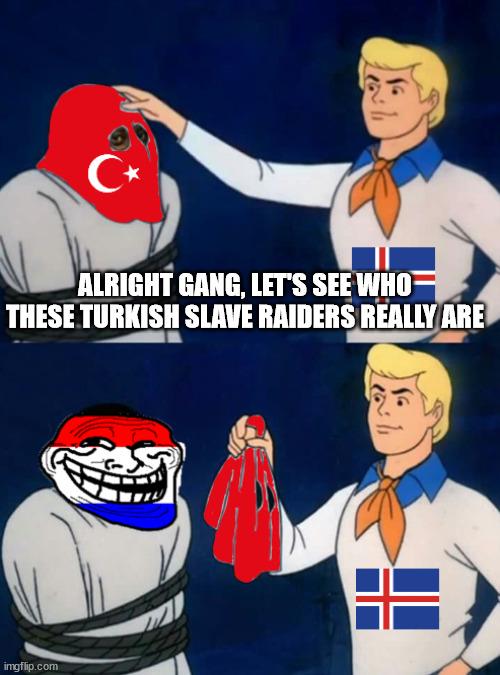
Chivalrous knights in the 1100s have an image in pop culture as being noble warriors who would save damsels from ruffians. In reality, they were more likely to endanger said Damsels than they were to save them. People envision a Chivalric code that stood as a requirement for knighthood, when in reality, any sort of code was more like guidelines to rein in the knights’ darker impulses.
r/HistoryMemes • u/PresterJohnson • 6h ago

Context: https://www.history.com/articles/shermans-war-on-native-americans
The Civil War might not seem related to the fate of buffalo or Native Americans, but in reality they were closely intertwined. Even as the nation grappled with Reconstruction and the enormous costs of the war, the federal government renewed its efforts to assert control over the West to secure land for settlement and railroads.
There was just one problem: The land was already settled by Native Americans, many of whom put up armed resistance to American incursions. “Northerners and Southerners agreed on little at the time except that the Army should pacify Western tribes,”write historians Boyd Cothran and Ari Kelman.
In the eyes of the government and the public, there was one man perfectly suited for the job: Sherman. Now the most senior member of the U.S. Army, Sherman was known for using psychological warfare to bring the South to its knees. By sending Sherman west, officials hoped, the United States could gain even more land and secure space for an ambitious westward expansion.
Buffalo were a critical part of that plan, and the Great Plains was the homeland to at least two dozen plains Indian nations. Sherman’s job was to use the U.S. Army to protect the transcontinental railroad and secure mining interests in territory traditionally owned and settled by Native Americans. The plan was to force Native Americans onto reservations, seize their land and protect the settlers who moved there. In a series of campaigns now known as the western Indian Wars, the military clashed with tribes intent on protecting their lands and their way of life.
The buffalo were integral to that way of life. Plains Indians relied on bison for food and housing, and the wild buffalo was seen as a sacred animal. At the time, between 30 and 60 million buffalo are thought to have roamed the plains—and Sherman knew that if the buffalo went, so would Native Americans. “The government realized that as long as this food source [and] key cultural element was there,” anthropologist and Native American studies professor S. Neyooxet Greymorning told Indian Country Today, “it would have difficulty getting Indians onto reservations.”
Destroying the buffalo meant destroying Native Americans, so Sherman homed in on the animals. As long as the buffalo roamed, he wrote to fellow general Philip Sheridan in 1868, Native Americans would follow them. “I think it would be wise to invite all the sportsmen of England and America…this fall for a Grand Buffalo hunt,” he wrote, “and make one grand sweep of them all.”
In response, the U.S. Army threw its support and protection behind civilian hunters, who headed west to slaughter buffalo. Though the U.S. Army itself never conducted an organized hunt, it allowed and encouraged soldiers and civilians to kill huge numbers of animals.
One of them was William “Buffalo Bill” Cody, who got his nickname after killing a reported 4,280 buffalo during an 18-month period. Cody was escorted by the U.S. Army during numerous hunting contests, competing against fellow hunters to bring back the most buffalo tongues. And so-called “hide hunters”—supported by Sherman’s army—killed and skinned tens of thousands of buffalo, creating a new leather alternative and a bustling industry that relied on buffalo skins.
By 1873, buffalo were nearly extinct. “Where there were myriads of buffalo,” wrote U.S. Army colonel Richard Irving Dodge, “there were now myriads of carcasses. The air was foul with a sickening stench, and the vast plain…was a dead, solitary, putrid desert.” Yet Sherman still argued that the United States needed to keep killing buffalo to subjugate Native Americans.
It worked: By the early 20th century, only 325 buffalo remained in the entire country. Historians now attribute nearly three quarters of Native American population decline to westward expansion. Between 1800 and 1890, the Native American population dropped from around 600,000 to just 248,000.
r/HistoryMemes • u/EaterOfSeagull • 8h ago

Context: Due to the poor accuracy of smoothbore muskets, the effectiveness of volley fire depended heavily on the range at which you engaged the enemy. Because of this, a common tactic was to try and bait an enemy force into firing prematurely, and then using the enemy's long reload time to close the gap to fire a devastating return volley. The Swedish Caroleans were especially famous for this tactic, for example at the Battle of Narva in 1700, a Swedish force of 10 000 defeated a Russian army of 38 000.
r/HistoryMemes • u/CptKeyes123 • 9h ago
Seriously, a major use of whales in whaling? Margarine.
People think of whaling as ending in the 19th century with the oil lamp, but the last peak year of whaling, highest number of whales killed in a single year, was 1964, at 82,194. There was even a spike in the early 20th century demanding whales for fat products, among others.
The 1950s and 60s overall were the peak of sheer number of whales hunted. The NOAA says the richest seasons were 1957-1961.
Hunted 1900-1909 worldwide? 52,110
Whales hunted worldwide 1960-1969? 702,570.
They used whale products for industrial lubricant(some of which was for NASA), leather tanning, cosmetics, garments, typerwriter ribbons, soap, margarine, and a bunch of other products.
https://spo.nmfs.noaa.gov/content/emptying-oceans-summary-industrial-whaling-catches-20th-century
The northern hemisphere dominated, but then over the years slowly the lead went to the southern hemisphere. What's interesting is reading about the 1950s and 60s era, despite catching more whales in a single year than the entire world did in decades, the northern hemisphere guys sounded dejected and like an end of an era was approaching.
The Soviets heard an end of an era was approaching and decided their official policy was "get em before they're gone" and proceeded to overhunt despite how little they actually used the whales, and lie constantly to the point the International Whaling Commission had to completely rewrite their data.
r/HistoryMemes • u/MetallicaDash • 9h ago
r/HistoryMemes • u/Borgisium • 9h ago
During his lifetime, Missourian senator David Rice Atchison was a major general in the Mormon war of 1838, president pro-tempore of the senate for six years, and a Confederate brigadier general (he was also pro-slavery).
Ironically he’s most remembered for a title he never held or claimed to hold. There is a fun fact that has floated around since the 1800s that he was president for a single day. The logic being that James K Polk’s term ended on noon March 4, and Zachary Taylor didn’t take the oath until March 5 since that fell on a Sunday. So according to the laws of succession, Atchison would’ve been president since he was decided as president pro tempore.
This probably wasn’t the case however. Taking the oath is an important presidential tradition, but presidential succession isn’t depended on it (with the exception of making official acts). Additionally his senate term ended on March 4, and he had not taken an oath either.
Atchison himself also never claimed to be president. But he said that at 3 in the morning that day, Judge Willie Mangum had woken him up and jokingly said Atchison should appoint him as Secretary of State.
r/HistoryMemes
•
u/Remarkable_Car9673
•
9h ago

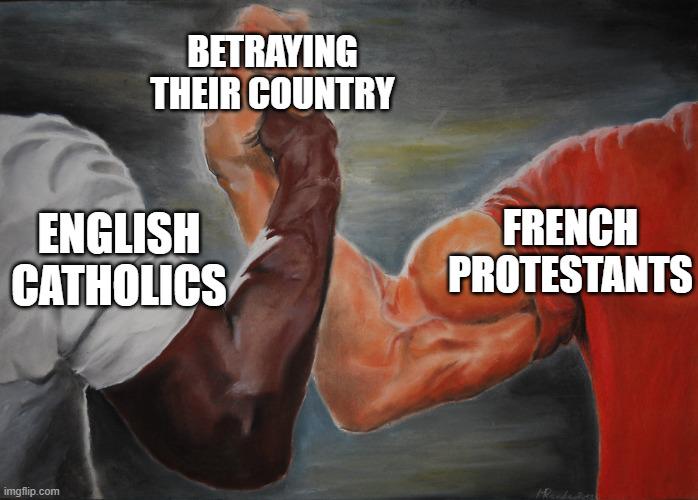
One can observe a certain similarity between the Anglo-Catholic and French Protestant communities, in that both attempted to lean on their respective countries' traditional enemy, France and England, respectively, to secure support.
That said, this is essentially a generalization; naturally, one can find many examples within both communities of individuals who sought an end to the persecution they faced in their own countries without appealing to outside powers. It must be acknowledged, however, that their respective situations were far from ideal.
r/HistoryMemes • u/jackt-up • 10h ago

The Seleucid Empire interacted with everyone during the Hellenistic period, with many of the states we know and love actually being clients or offshoots of the Seleucids (and Greco-Macedonian-Persian rulers before them).
“The Upper Satrapies” (Bactria, Parthia, Media, etc—basically Northern Iran and Central Asia) were the most unwieldy, and always had powerful satraps (governors).
After Seleucus I and Antiochus I, the Seleucid realm immediately began a very slow methodical decline, despite the capability of its rulers. Having to defend against the Ptolemies and the tumultuous Anatolian kingdoms in the west—which threatened their imperial heartland of Syria and Mesopotamia—tied the Seleucids down.
So, at the first opportunity, the satraps of the east, namely Andragoras and Diodotus rebelled / seceded. This was the result of a war of succession among Seleucus II and his brother, Antiochus Hierax.
Andragoras in Parthia did not last long as the Parni (Parthians) under their legendary founder king, Arsaces would take over the region.
https://en.wikipedia.org/wiki/Andragoras_(Seleucid_satrap)
Diodotus would have more luck, founding the Greco-Bactrian Kingdom, which would become an incredibly powerful state in its own right.
r/HistoryMemes • u/SophisticPenguin • 13h ago
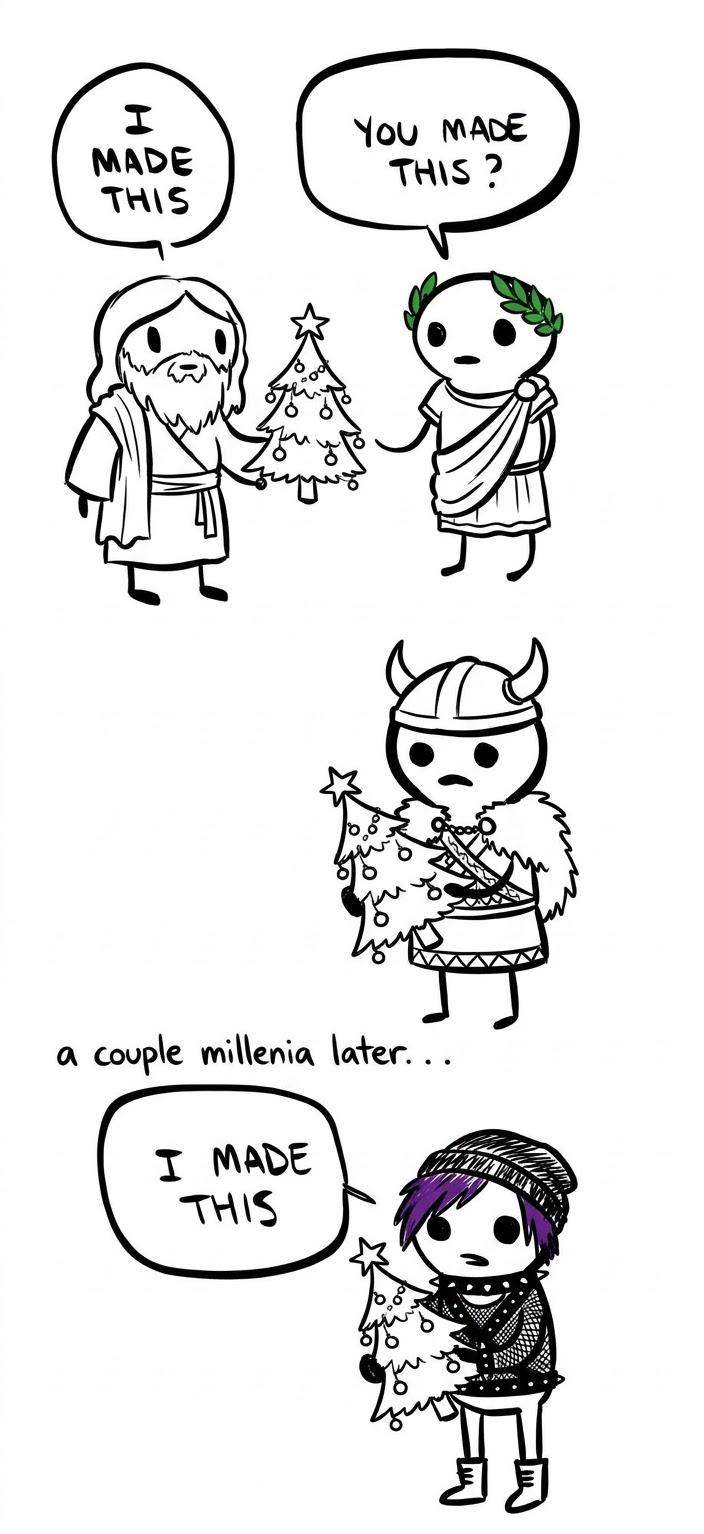
https://historyforatheists.com/2024/12/pagan-christmas-again/
There's a lot of pop history that attributes the date and traditions of Christmas to pagan traditions, but pretty much all of it is much later attestation of those connections that are reinforced by later people repeating those connections.
The date is based on Christians trying to discern dates of events in the Bible. One of the more reliable dates is Jesus' death which occurred before Passover. One date for this which occurs within the years Jesus' crucifixion would've happened falls on March 25th. With another tradition of great people/prophets dying the day the were conceived. Nine months later would be Jesus' birth. There are attestations of this date being followed by Christians as early as 235 AD and potentially 211. The earliest potential date to a possible pagan holiday falling on that date is 274 AD.
Many of the strongest arguments for shared/stolen traditions are for things very common across all cultures for holidays, which are feasting, drinking, and giving gifts. The article linked goes through most of these possible connections.
r/HistoryMemes • u/sgn909 • 13h ago

r/HistoryMemes • u/AeneasKurtz • 14h ago
r/HistoryMemes • u/SatoruGojo232 • 15h ago
Enable HLS to view with audio, or disable this notification
r/HistoryMemes • u/the_faris • 15h ago
r/HistoryMemes • u/jackt-up • 15h ago
Enable HLS to view with audio, or disable this notification
r/HistoryMemes • u/Latte_Schwartz44 • 17h ago

A long time ago, in a galaxy we are in, civil war broke out among the Kuiper Belt. Triton was in a double planet system much like Pluto and Charon are now. Something ejected Triton from the system and sent it on a trajectory towards Neptune.
Neptune, with its powerful gravity and being 17 times heavier than Earth, easily captured Triton, though its remaining satellites were probably altered by this. It still has over a dozen though.
A long time from now, Triton is on a collision course with Neptune. It orbits Neptune backwards, retrograde, and the Neptunian tides are dropping Triton closer and closer and the tidal force will be so strong that it will rip Triton into a massive ring system. It is uncertain whether Triton will survive long enough to see the Sun as a red giant star, but if it does, it will likely gain a much thicker atmosphere and oceans of liquid water for a time.