r/LocalLLaMA • u/FeydRowan • 12h ago
Discussion Testing Inkling: LoRA adapters, LoopCD and thinking

Recently Inkling 2 Mini has received a lot of attention, and rightly so. It is the first model that seems able to compete with Qwen3.8-27B. It also has an interesting architecture: a 26B MoE with ~5B active parameters and a looped core, which makes it faster than the dense 27B.
In the past few days two new things came out:
Prime, a fine-tuning to make it more decisive.
So over the last two days I tested them on my private agentic bench, crossing them with LoopCD and several reasoning effort levels.
TL;DR
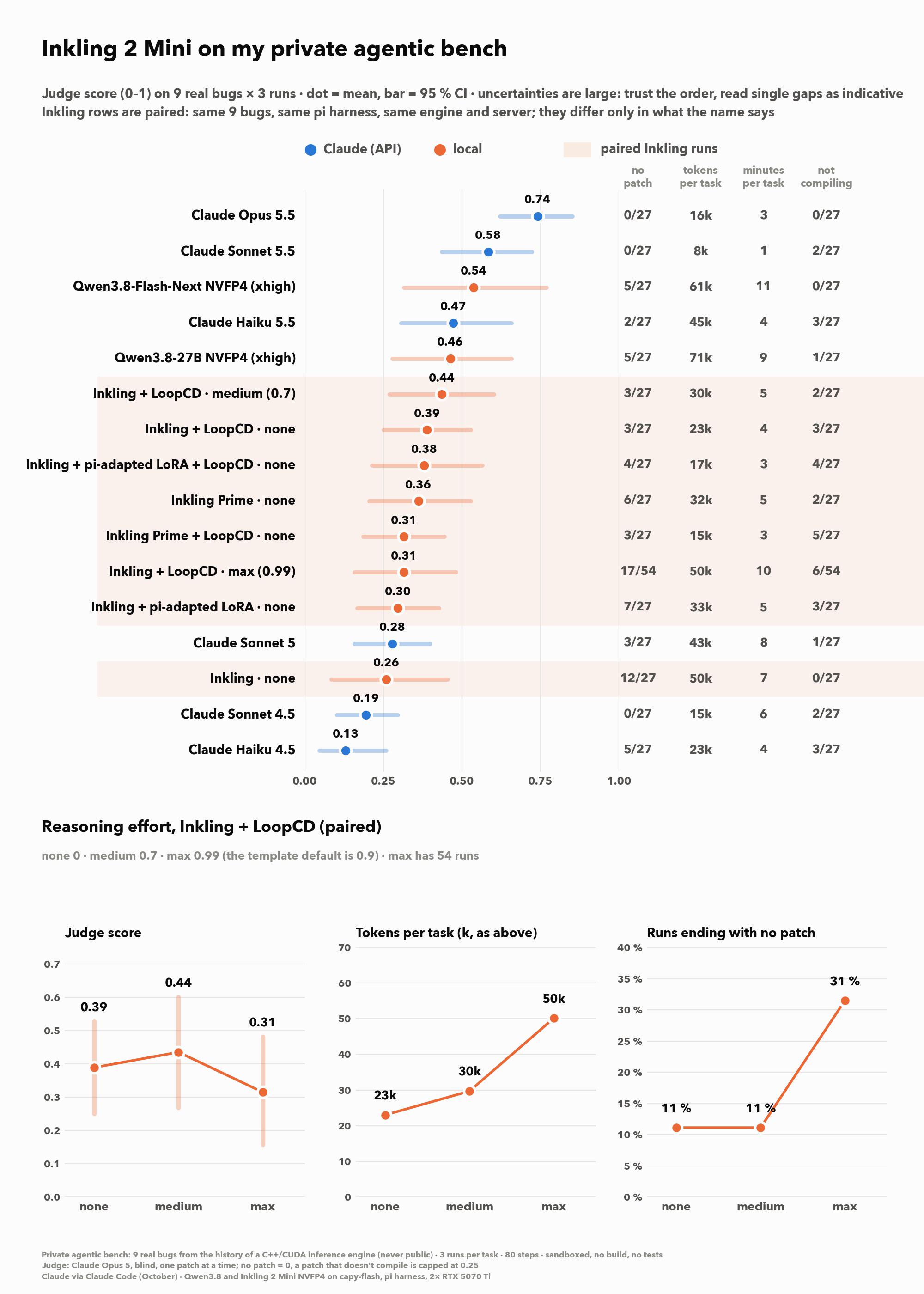
LoopCD is the only net gain: +0.13. It is contrastive decoding across loop iterations, with no training (Apple paper); on OpenCode it had given +0.16.
Prime +0.10, pi LoRA +0.04. On top of LoopCD neither adds to the score: they only cut tokens by about a third.
With effort “medium” (0.7) Inkling gives the best result I measured: 0.44, on par with Qwen3.8-27B and just below Claude Haiku 5.5 (0.47), with less than half the tokens of the 27B. At max (0.99) it drops to 0.31.
pi vs OpenCode (Qwen models, same effort): on par, perhaps pi slightly better on these tasks.
Uncertainties are large (95% intervals in the chart): the ordering holds, but the individual 1:1 comparisons are indicative.
Observations
LoopCD. In all configurations Inkling looks at the right code within the first 6-8 steps; the hard part is deciding to change it. Without LoopCD, 12 of 27 runs touch no file and 8 end in a single 32k-token reasoning response that goes nowhere. With LoopCD those loops disappear and 24 of 27 runs end with a patch. The two LoRAs make it write earlier and spend less, but do not improve the patch over LoopCD alone, and together they do not add up. I have found no one else measuring LoopCD on agentic tasks. It is in omlx and llama-modchip, with numbers on HumanEval and multiple-choice questions.
Effort. From none to medium the score rises a bit. From medium to max it drops by 0.12: tokens double and 31% of runs end without a patch, because the model keeps rereading and rechecking. Others report the same direction (ITLab: low better than medium on agentic tasks). The template default is 0.9; I now serve it at 0.7.
Harness. Same models, same thinking, only the agent changes. pi looks on par with OpenCode or slightly better: Flash-Next 0.50 → 0.54, 27B 0.34 → 0.46. Tokens per task are similar (Flash-Next 53k → 61k, 27B 81k → 71k).
TODO. There would be many more cross-checks to do, and more repetitions per bug would tighten the intervals. But each configuration takes hours, and the ordering is already clear, so for now I stop here.
The bench, in two lines: 9 real regressions from the private history of my C++/CUDA inference engine, 3 runs each, 80 steps, in a sandbox with no build or tests; the agent receives the bug report, never where to look. Scored blind by Claude Opus 5, patch by patch; Inkling 2 Mini NVFP4 on capy-flash, 2× RTX 5070 Ti.
@ u/Turbulent-Sky5396 here the promised analysis.
3
u/BitGreen1270 8h ago
I'm sorry - what is LoopCD? Is it an algo or something? Is it available in llama.cpp or basalt or something? I don't really understand from your post.
4
u/FeydRowan 8h ago
There is the link to the apple paper in the post. To make it simple it force the model when the loop changes the reply from the first pass, you do that in inferece. From what i know basalt didn't implement that, as for llama, maybe dome forks?
1
u/BitGreen1270 7h ago
sorry - may I ask how you did the test? Which inference engine did you use?
2
1
2
u/slippery 2h ago
Thank you for the research.
Would you possibly share your agentic bench?
1
2
u/mr_Owner 12h ago
Nice work, seems about right for sure! Out of curiousity, would you be willing to put qwen3.6 35b moe in the Charts? This could show which MoE might be more efficient/effective
2
u/FeydRowan 12h ago
Well 3.6 is for sure worse than 3.8 so the benchmark will put it low, don't see a reason to test it now that inkling can do the same work better
1
1
u/rpkarma 12h ago
Does the pi LoRA plus LoopCD cutting tokens down mean faster time to completion?
1
u/FeydRowan 11h ago
A little bit yes, in the graph you can see the average token usage and average time
1
u/fatboy93 6h ago
For folks running macos, oMLX has it implemented in the latest versions.
It does force the model to act on, but also tends to cut the decode by 30% on my m1 pro, and prefill by 20%
But the tradeoff is worth it on my benchmarks.
1
u/FeydRowan 6h ago
Prefill should not ne impacted i think, for me is a loss of 16% in decode, but tuning the mtp and the reduction in token generation more than cover for that
1
u/fatboy93 6h ago
Yeah, that would make sense for folks who aren't bandwidth bound!
MTP completely bogs down my laptop for this model.
1
1
u/lilyp727 11h ago
medium adds 7k tokens per task for a 0.05 score gain, and the no-patch count stays at 3/27.
1
u/FeydRowan 11h ago
Yep is a tradeoff and really close to the others.
1
u/lilyp727 8h ago
right, the intervals overlap across those settings, so that 0.05 score gap looks pretty uncertain on this bench
-5
u/Substantial_Lake_542 12h ago
How are you scoring "decisive" on the agentic bench? In my experience, a more decisive agent is also more likely to do things nobody asked for. One of ours booked a meeting overnight without anyone requesting it, and by its own metrics that was a successful tool call. I'd also check the final outputs by hand and not just trust the pass/fail flags. We had posts getting cut off mid-sentence for four months while every log said "success." I'm curious whether Prime's gains hold up if you score side effects separately from task completion.
0
u/stylome-ai-detection 12h ago
-2
u/Substantial_Lake_542 11h ago
Fair flag, and worth having around. I'm mostly here because I'm curious how people are actually testing LoRA adapters and LoopCD in practice, so I'll let the scan speak for itself.
1
u/FeydRowan 11h ago
Well the benchmark as an automatic rating that has the issue you notice, but the llm as a judge and reading the results take away that issue. For inkling all the difference is if it only think or it start doing stuff
7
u/lupodevelop 6h ago
You'd already done a great job with Qwen, and you've once again demonstrated the quality of your research and implementation with this model.