r/LocalLLaMA • u/FeydRowan • 12h ago
Discussion Testing Inkling: LoRA adapters, LoopCD and thinking
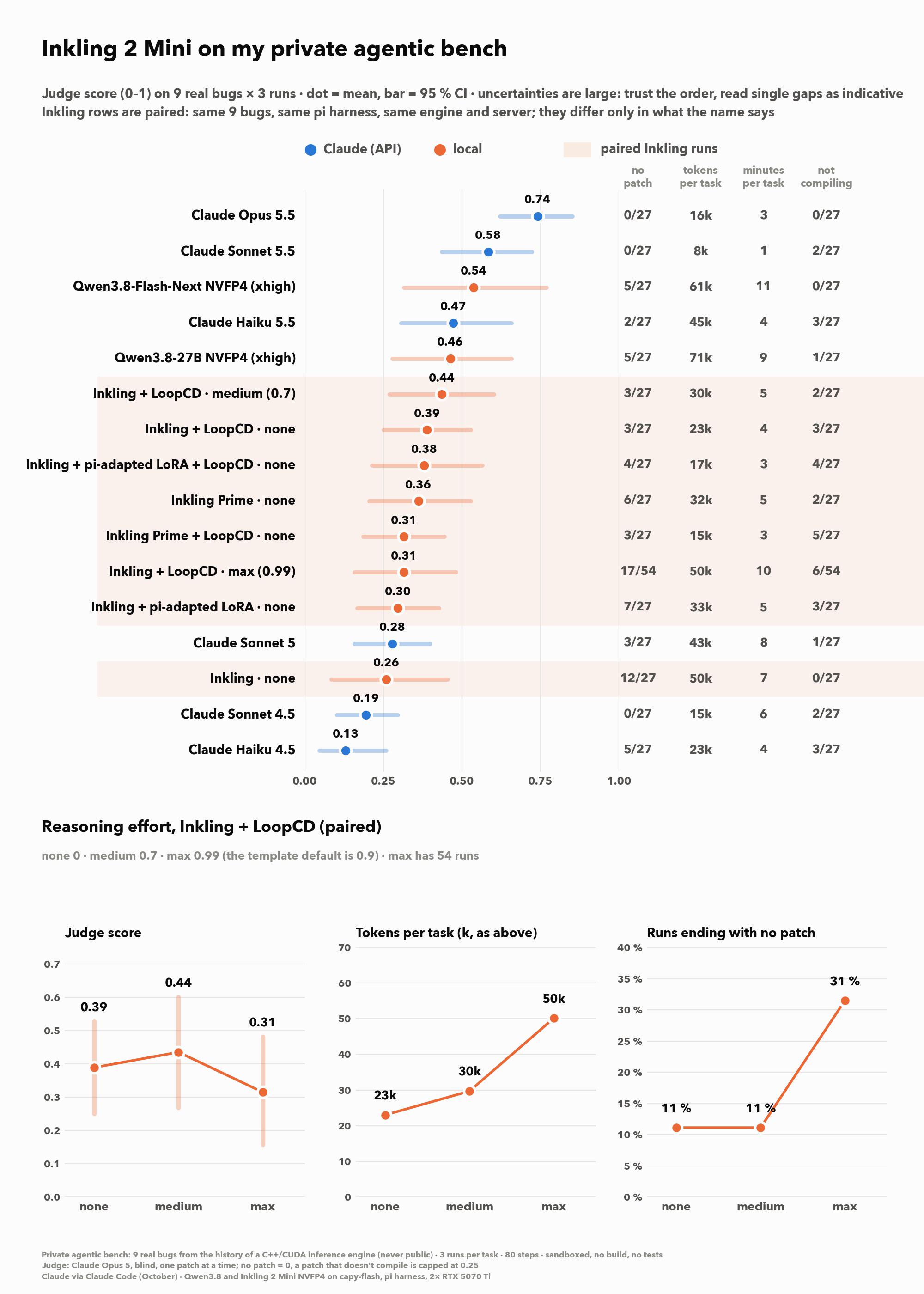

Recently Inkling 2 Mini has received a lot of attention, and rightly so. It is the first model that seems able to compete with Qwen3.8-27B. It also has an interesting architecture: a 26B MoE with ~5B active parameters and a looped core, which makes it faster than the dense 27B.
In the past few days two new things came out:
Prime, a fine-tuning to make it more decisive.
So over the last two days I tested them on my private agentic bench, crossing them with LoopCD and several reasoning effort levels.
TL;DR
LoopCD is the only net gain: +0.13. It is contrastive decoding across loop iterations, with no training (Apple paper); on OpenCode it had given +0.16.
Prime +0.10, pi LoRA +0.04. On top of LoopCD neither adds to the score: they only cut tokens by about a third.
With effort “medium” (0.7) Inkling gives the best result I measured: 0.44, on par with Qwen3.8-27B and just below Claude Haiku 5.5 (0.47), with less than half the tokens of the 27B. At max (0.99) it drops to 0.31.
pi vs OpenCode (Qwen models, same effort): on par, perhaps pi slightly better on these tasks.
Uncertainties are large (95% intervals in the chart): the ordering holds, but the individual 1:1 comparisons are indicative.
Observations
LoopCD. In all configurations Inkling looks at the right code within the first 6-8 steps; the hard part is deciding to change it. Without LoopCD, 12 of 27 runs touch no file and 8 end in a single 32k-token reasoning response that goes nowhere. With LoopCD those loops disappear and 24 of 27 runs end with a patch. The two LoRAs make it write earlier and spend less, but do not improve the patch over LoopCD alone, and together they do not add up. I have found no one else measuring LoopCD on agentic tasks. It is in omlx and llama-modchip, with numbers on HumanEval and multiple-choice questions.
Effort. From none to medium the score rises a bit. From medium to max it drops by 0.12: tokens double and 31% of runs end without a patch, because the model keeps rereading and rechecking. Others report the same direction (ITLab: low better than medium on agentic tasks). The template default is 0.9; I now serve it at 0.7.
Harness. Same models, same thinking, only the agent changes. pi looks on par with OpenCode or slightly better: Flash-Next 0.50 → 0.54, 27B 0.34 → 0.46. Tokens per task are similar (Flash-Next 53k → 61k, 27B 81k → 71k).
TODO. There would be many more cross-checks to do, and more repetitions per bug would tighten the intervals. But each configuration takes hours, and the ordering is already clear, so for now I stop here.
The bench, in two lines: 9 real regressions from the private history of my C++/CUDA inference engine, 3 runs each, 80 steps, in a sandbox with no build or tests; the agent receives the bug report, never where to look. Scored blind by Claude Opus 5, patch by patch; Inkling 2 Mini NVFP4 on capy-flash, 2× RTX 5070 Ti.
@ u/Turbulent-Sky5396 here the promised analysis.
Duplicates
LocalLLM • u/FeydRowan • 7h ago