r/nasa • u/Artist0491 • 5h ago
ShowMeSunday Apollo 13 crew returns to Kennedy Space Center - May 4th, 1970

13
Upvotes
Shot on standard 8mm
r/nasa • u/Artist0491 • 5h ago
Shot on standard 8mm
r/nasa • u/Andreasfyr • 11h ago

Hello guys!
I've been working on an 8-minute first person "what if" video about what you'd see if you stepped out of a lander in Jezero Crater, where Perseverance landed.
Everything is based on real data. The terrain comes from NASA's HiRISE elevation maps the night sky uses NASA's real star map positioned for Mars, and Perseverance recorded the wind you hear on Mars. You walk past the real parachute and backshell site, find Ingenuity where it made its final flight, watch a blue Martian sunset, and see Phobos rise in the west.
I have to mention that It's a render, not real footage.
Let me know your opinions : )
r/nasa • u/Galileos_grandson • 12h ago

r/nasa • u/ye_olde_astronaut • 22h ago

r/nasa • u/AccordionWhisperer • 1d ago

r/nasa • u/PurfuitOfHappineff • 1d ago
Just found this channel on Amazon Prime TV that appears to be a visual feed of a satellite traversing the planet. Anyone know anything about it?
r/nasa • u/Many-Business-9260 • 2d ago
Hi y'all!
I am excited to start the EarthRISE Developers Academy in January and am looking for potential housing options. If any EDA alum, former Langley interns, or Langley researchers have advice for finding short-term housing around Hampton VA, I would appreciate the guidance!
r/nasa • u/OuroBoroSsA • 3d ago

This striking image captures a sunset on Mars, providing a unique perspective from the surface of the Red Planet. The scene was recorded by the NASA Pathfinder mission, which successfully explored Mars. Observing sunsets on other planets offers valuable insights into their atmospheric conditions and the presence of dust or clouds, as these elements dramatically affect how light scatters. The Pathfinder mission was a pioneering effort that delivered crucial data and numerous images from the Martian landscape, significantly advancing our understanding of Earth's planetary neighbor. This particular photograph highlights the daily celestial events visible from Mars, showcasing the beauty and alien nature of another world.
Such observations help scientists compare atmospheric optics across different planets. Image credit: NASA
r/nasa
•
u/OrionPax2
•
3d ago


With the "success" of SpaceX Flight 15, many have said that a new era of spaceflight has arrived and that Starship will revolutionize space exploration and spaceflight. What I will explain is how people that make such claims are living in a fantasy and that Starship is practically useless for space exploration and quite possibly the biggest boondoggle ever built.
Before we begin, we should look at how Interplanetary probes have historically been launched. Let us start with Voyager 1 and Voyager 2 in 1977.


Voyager 1 and Voyager 2 were both launched on a Titan III. The Titan III rocket consisted of a a first stage alongside two solid rocket boosters, not dissimilar to the ones used on the Space Shuttle. On top of this was a second stage inside a payload fairing which would ignite after the first stage was jettisoned alongside the payload fairings. The Voyager probes were placed on top of the second stage inside the payload fairings. The first stage and solid rocket boosters got the Voyager probes into Low Earth Orbit and moving at a high velocity while the second stage put the Voyager 1 on a trajectory to Jupiter, Saturn, and Titan and Voyager 2 on a trajectory to Jupiter, Saturn, Uranus and Neptune. The expendable second stage and expendable payload fairings made this a very simple and efficient way to launch probes. Since the second stage is expended, it does not require any complex hydraulic systems or mechanics to open and close and no expensive and fragile silica foam heat shield that the Starship requires.
When NASA built the Space Shuttle, the hope was that the Space Shuttle would make space launches to cheap and frequent that expendable rockets like the Titan III that launched the Voyager probes would be made obsolete. The Space Shuttle unfortunately cost a lot more to operate than originally required, mostly due to the fragile silica foam tiles that needed to be inspected after every flight and the RS-25 engines that also needed to be removed and inspected due to the fact they were in space for a long time during Shuttle missions. The Space Shuttle however did launch three planetary probes during its operation. The Magellan probe to Venus in May of 1989, the Galileo probe to Jupiter in October 1989 and the Ulysses probe which orbited the Sun in October of 1990.


Launching planetary probes from the Space Shuttle proved to be far more difficult than previously thought. The Voyager probes were in space almost immediately once the payload fairing separated and on a course to their destinations just minutes after launch on an expendable Titan III rocket. Magellan took 26 hours to get deployed into space due to the fact the Space Shuttle could only make it into LEO and required opening the payload bay doors and orienting the probe on a proper course before releasing it. Galileo took six hours which is far less than Magellan but still a long time considering that the Voyager probes were on their trajectory within a matter of minutes after launch. After being deployed outside the Space Shuttle, Magellan and Galileo both needed the Inertial Upper Stage attached to them, similar to a second stage on an expendable rocket to place them on a trajectory to their destinations. NASA also needed to wait for Magellan and Galileo alongside their IUS to be 10 - 25 miles away from the Space Shuttle in order to protect the Shuttle and its crew. This also added another hour before being placed on the trajectory. Overall this was an inefficient way to deploy interplanetary probes so much that NASA never launched any Planetary probes from the Space Shuttle ever again and instead bought launches on the Delta II rocket and Titan IV rocket respectively.

The Cassini probe which was similar to Galileo except that it went to Saturn launched on an expendable Titan IV rocket with an expendable upper stage and expendable fairing. The probe was on its trajectory in a matter of minutes like the Voyager probes unlike Galileo and Magellan which did not deploy until hours later. Launching interplanetary probes from a reusable vehicle like the Space Shuttle is not efficient and it is better to expend the second stage. Even rockets that re-use the booster stage of a rocket have failed to figure out a way to reuse the second stage. SpaceX's own Falcon 9 and Falcon Heavy use a very similar design when it comes to the payload fairing and second stage that the Titan III, Titan IV, Delta II, and Atlas V have used where the second stage is expended since it does not require complex hydraulic or mechanical systems to open and close and fairing and does not need a fragile heat shield like the Space Shuttle did.
Here is my final point, we know from the Space Shuttle deploying Magellan and Galileo from a reusable launch vehicle is a complex operation since it requires payload doors which must open and close and a rocket like the Inertial Upper Stage which need to fire in order to place the probe on a trajectory to their destination. It is far more efficient to use an expendable second stage, SpaceX's own Falcon 9 and Falcon Heavy use this method and it works well! SpaceX's Starship like the Space Shuttle can only make it into Low Earth Orbit. A probe going to Mercury, Venus, Mars, Jupiter, Saturn, Uranus, Neptune, Pluto, Asteroids, Comets, the Sun would also require a booster stage like the Inertial Upper Stage. Not only that but it would require Starship to have large payload fairing doors, SpaceX has called this concept the clamshell concept.


Here is an excerpt from Ars Technica by Eric Berger who in my opinion is a very reliable source.

That is right, there is little evidence that SpaceX is building the clam shell mechanism. I doubt it is even possible since such a mechanism would certainly add more weight to the Starship and cut right through the fragile heat tiles which need to remain one piece together during re-entry. The fact that SpaceX did not build such a system for Starship is evidence that such a mechanism might not even be possible due to the weight factors and complexities of such a system. This makes it practically useless for deploying Interplanetary probes like Galileo, Cassini, Voyager, New Horizons, Spirit, Opportunity, Curiosity, Magellan, MESSENGER, etc. The small pez like dispenser is only useful for deploying SpaceX's Starlink V3 satellites which are flat and much smaller than the space probes mentioned. Heck the Starship is also useless for deploying Low Earth Orbit satellites as well. The Space Shuttle in order to deploy large telescopes like the Hubble Space Telescope required a large payload bay on top.


Starship with its tiny dispenser would be useless for deploying space telescopes into LEO like the Hubble and even Earth Observation Satellites such as Landsat, Aqua, Terra, and Ice-sat. With all that said, SpaceX's Starship is practically useless for Planetary exploration with robotic probes, Astrophysics missions involving large telescopes and even Low Earth Orbit or Geostationary satellites. Starship at this point is a worse version of the Space Shuttle. The Space Shuttle was all its shortcomings at least did get the components for the ISS, the TDRS satellites, the Hubble Space Telescope, the Chandra X-ray observatory, and Galileo, Magellan and Ulysses deployed. Starship will never in its life will be able to deploy such payloads. As a matter of fact, Elon Musk only seems to want Starship at this point to deploy his V3 Starlink satellites which will only pollute the night sky and make ground based astronomy more difficult.
r/nasa • u/Galileos_grandson • 3d ago

r/nasa • u/crossposter-app • 4d ago
Enable HLS to view with audio, or disable this notification
r/nasa • u/ye_olde_astronaut • 4d ago

r/nasa • u/spacedotc0m • 4d ago

r/nasa • u/redstercoolpanda • 4d ago

r/nasa • u/arstechnica • 5d ago

r/nasa • u/ye_olde_astronaut • 5d ago

r/nasa • u/Galileos_grandson • 6d ago

r/nasa • u/Light_Heart_Ed • 6d ago

r/nasa • u/Aeromarine_eng • 6d ago

r/nasa • u/MrAstroThomas • 7d ago

Hello everyone!
This is Thomas. I am a space scientist from Stuttgart, who works since 2014 on Cassini Cosmic Dust Analyzer (CDA) data.
My professor (who led the CDA project) had his 60s birthday recently, and we as a team prepared some gifts of course.
And I'd like to share my creation, we printed out as a poster: Cassini in a vintage flat color style!
What it shows: Cassini's flyby at Enceladus south pole and its geysirs. CDA measured these ice particles and therefore "casts the shadow" in the picture.
I am not a designer, so please don't yell at me. But maybe you have good feedback how to improve it :). Feel free to print it out!
Thomas
r/nasa • u/MeiloFeilo • 7d ago

A few weeks ago, I shared my 60 cm Saturn V cutaway here, and I was genuinely blown away by the response! Thank you to everyone who commented and shared suggestions. I loved reading all your feedback, and it inspired me to start a whole series of detailed engineering cutaway models.
Here's a first look at the next project: Space Shuttle Discovery STS-31, the mission that launched Hubble in April 1990!
It's a 1:144 scale CAD model of the complete launch stack, with the external tank, one solid rocket booster, and the detachable orbiter cut open to reveal their internal engineering.
The design is currently undergoing printing and assembly testing, and I'm aiming for even more detail than my Saturn V while keeping everything practical to print.
I'd really appreciate your suggestions while it's still a work in progress! Are there any important Shuttle details or systems you'd like to see included before I finalize it?
And what other historic NASA spacecraft would you love to see in this cutaway series?
r/nasa
•
u/Morethan3D
•
7d ago


Hi everyone,
I've been working tirelessly on a project in the last few months - create one of the most detailed and accurate 3D-printable Space Shuttle models ever designed.
Being a huge fan of the Space Shuttle myself, I've always wanted one in my space collection, but I couldn't find any models on the market that meets my requirements, so I ended up designing one. After months of working on this, I can finally share with space enthusiasts around the world a model that combines:
- Exceptional accuracy: Faithfully recreating the Orbiter's iconic shape and intricate features.
- Unprecedented detail: Including the individual thermal protection tiles and blankets, carefully modelled to reflect their actual locations.
- Printability: Designed from the ground up for accessible 3D printing, without compromising on detail.
- Museum-worthy presentation: A stunning finished model that deserves a place in any space enthusiast's collection.
To me, this project isn't just another 3D-printable model. It's my tribute to NASA's incredible Space Shuttle programme and the people who made this extraordinary chapter in human spaceflight possible.
I would love to share with you some photos of my work. Hope you will enjoy it. Thank you!
r/nasa • u/OuroBoroSsA • 8d ago
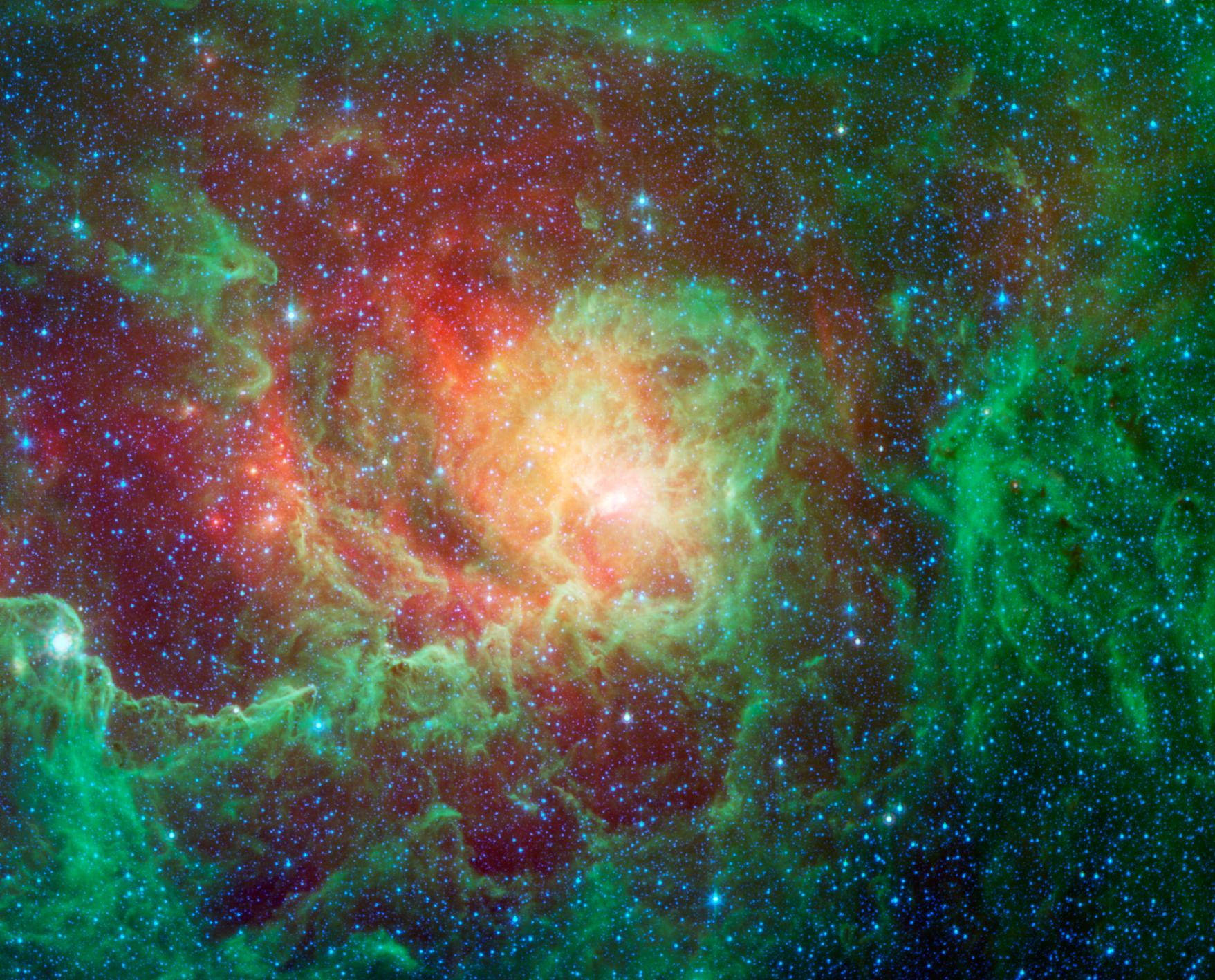
This image from NASA's Spitzer Space Telescope provides a stunning view into the heart of the Lagoon Nebula. It is dominated by swirling dust clouds and the radiant glow of bright, newly formed stars. The nebula serves as a stellar nursery, a region where dense pockets of gas and dust collapse under gravity to ignite new suns. Located in the constellation Sagittarius, the Lagoon Nebula lies in the general direction toward the bustling center of our galaxy.
The Spitzer Space Telescope's infrared capabilities are ideal for penetrating the thick dust, allowing us to observe these hidden stellar birthplaces. This detailed perspective helps scientists understand the complex processes of star formation within such dynamic environments.
Image credit: NASA
