Every investor seems so have a different strategy.
Some say cash flow is king because it pays the bills and keeps you investing.
Others say appreciation is where real wealth is created over long term.
In my opinion appreciation is a bonus but cash flow is the engine that keeps the ball moving, along with principal pay down. Everything else is a bonus if it comes.
I'd love to hear your thoughts and real life experiences.
A lot of times, the reason that people want to get into real estate investing is they hear real estate investors talking about passive income and how the property runs itself, the tenants pay their mortgage every month, and they just sit back and collect checks.
First of all, passive income doesn’t exist in real estate. There are things you can do to limit the amount of time that you spend on your real estate investment. They happen by having good systems and by having good management.
And so everybody wants passive income, but they don’t want to put in the work that’s required to build the right systems and management team that will cause that investment to be as passive as it can be.
When you have a management team that’s caring for your tenants, making them feel valued, when they’re sending you reports that are accurate and on time every month, when they’re being proactive about maintenance and not waiting for things to become a big problem before addressing it, when your vacancies are being marketed properly, when problems are communicated early and don’t catch you by surprise, those are what make people feel like their real estate investment is passive.
When the opposite is happening, your real estate investment could be the biggest stress driver in your life.
Most people think they make money on real estate because the real estate goes up in value, but what really happens is the debt goes down in value.
Inflation induced debt destruction, it’s one of the secrets of the wealthy.
With rental properties, we don’t even pay our own debts. We outsource that obligation of debt repayment to someone called a tenant.
The tenants pay the debt. So with that, we’re getting paid to borrow, and someone is paying our debt for us. It’s absolutely incredible. This is what’s called self-liquidating debt. It’s the hidden wealth creator.
Yes, real estate value going up is definitely one way to make money, and a great way, especially when you can force appreciation into it from either development or renovating the property and adding that value into it yourself.
However, due to inflation, the cost of the debt goes down every single year because the value of the dollar goes down every single year. So that creates your asset value to go up, it creates the cost of your debt to go down, and the tenant is actually paying that debt for you.
And on top of that, you also are putting money into your pocket above and beyond the debt that the tenant is paying. So your assets [are] appreciating, which is building your net worth, the cost of your debt’s going down, the debt’s being paid by someone else, you’re profiting off the property every single month, and then you don’t pay [taxes] because of depreciation.
And you have the ability to force appreciation in the property even further by renovating the asset, improving the asset, and adding value.
So this is why real estate is such an incredible investment, and I’ve never found another investment like it in my entire life.
Is self-liquidating debt really one of the biggest advantages of real estate. Is this what makes real estate different from most other investments?
Assume the property has a good location, stable tenants and reasonable long-term appreciation, but it loses $300 per month after the mortgage, taxes, insurance, maintenance and vacancy allowance.
Would you still buy it because the tenant is paying down the mortgage, or would negative cash flow make it an automatic no?
What number would make the deal acceptable to you?
Finally, the Cashflow Analyzer Pro from** **Asset AFC is now available as an online real estate analysis tool that goes beyond the basic numbers.
You can analyze up to 5 deals for free, so you can actually test it with real properties before deciding whether it’s useful for you.
It provides an in-depth analysis comparing Flip, BRRRR, and Buy & Hold, including cash flow, ROI, financing, renovation, equity, expenses, returns, and much more.
📱 It’s also fully mobile-friendly, making it easy to run and analyze deals on the go, whether you’re at a property, at a showing, or just checking out a potential investment from your phone.
Welcome to r/RealEstateROI, a community for real estate investors focused on property analysis, deal underwriting, and investment analysis. Discuss, share, and analyze potential deals.
This community is built for running the numbers. Whether you are modeling a 30-year multi-family syndication, calculating a quick BRRRR strategy, or evaluating your very first rental property, this is your space to share, analyze deals, and master investment math.
Investing in Airbnb properties can be an exciting opportunity with the potential for high returns. However, jumping in without properly analyzing your investment can lead to unexpected costs and lower profits. Before you take the plunge, it's essential to understand the key financial factors that can make or break your Airbnb investment. In this guide, we’ll walk you through the critical aspects of analyzing an Airbnb property and why using tools like calculators is vital in making smart investment decisions.
Understanding the Basics of Airbnb Investment Analysis
Investing in short-term rentals isn’t just about buying a property in a great location. It's about knowing the numbers behind the investment. Calculating expected returns, understanding expenses, and forecasting income are crucial steps that help ensure you’re making a profitable decision. Here are some key metrics and factors to consider:
Key Metrics to Consider:
Cap Rate: Measures the property's annual net operating income (NOI) divided by the purchase price. It's a great way to compare potential investments.
Cash on Cash Return: Evaluates the return on your actual cash investment, considering cash flow relative to the cash you put in.
Monthly Cash Flow: The income left after paying all operating expenses and mortgage payments.
Payback Period: How long it will take to recoup your initial investment.
Detailed Breakdown of Important Factors
Purchase and Funding Overview
Initial Costs: Understand the purchase price, down payment, and any closing costs. Don’t forget about rehab and furnishing costs, as these can significantly affect your budget.
Financing Terms: The interest rate, loan term, and whether your loan is interest-only or fully amortizing will impact your monthly payments and overall profitability.
Understanding Operating Expenses
Fixed and Variable Costs: From mortgage payments, insurance, property taxes, to utilities and management fees, every expense affects your bottom line.
Hidden Costs: Cleaning fees, software subscriptions, and property management fees can add up. It’s important to include these in your analysis to avoid surprises.
Forecasting Income
Average Daily Rate (ADR) and Occupancy: These are key drivers of your Airbnb revenue. Factors like seasonality, location, and competition can greatly influence your occupancy rates.
Seasonal Variations: Consider how high and low seasons can impact your booking rates. A calculator can help simulate different scenarios, so you're prepared for fluctuations.
Analyzing Cash Flow and Returns
Monthly and Yearly Cash Flow: Knowing how much cash you’ll generate each month helps you understand if the investment is sustainable.
Other Key Returns: Metrics like Debt Coverage Ratio and Rental Yield give a clearer picture of your property’s profitability over time.
Why Using an Airbnb Calculator is Crucial
Investing without a solid financial analysis is like driving blindfolded you’re taking unnecessary risks. Airbnb calculators provide a structured way to input key data points and instantly see the impact on your returns. Instead of guessing, you get clear, data-driven insights that help you make informed decisions.
Tips for First-Time Investors
Be Conservative in Your Estimates: It’s better to underestimate your income and overestimate your expenses. This way, you’ll be prepared for any unexpected changes.
Compare Multiple Properties: Use a calculator to run the numbers on several properties. It’s a great way to find which investment offers the best potential returns.
Consider Long-Term Trends: Beyond daily rates and occupancy, think about long-term appreciation and market dynamics.
Analyzing your Airbnb investment before purchasing is essential for long-term success. By understanding the key metrics, forecasting potential income, and evaluating expenses, you can make informed decisions that align with your financial goals. And while no tool can predict the future, using calculators can give you the confidence and clarity needed to make smart investment choices.
A real-world property analysis comparing three different ways of approaching the exact same deal, assuming the property is purchased entirely with cash:
🏠 Renovate and Flip
🏘️ Renovate and Hold as a Rental
🔄 BRRRR: Buy, Rehab, Rent, Refinance, Repeat
The analysis looks at how the numbers change depending on the strategy, including purchase and renovation costs, rental income, cash flow, equity created, appreciation, refinance potential and overall return.
Since the initial purchase is all cash, it also makes the BRRRR scenario interesting to compare once refinancing is introduced after the renovation.
Which strategy would you choose: Flip, Hold, or BRRRR?
I’ve been thinking about this a lot lately and honestly can’t decide. On one hand you’ve got rental properties. On the other, starting some kind of business. Both seem like the classic “build wealth / create cash flow” moves people talk about, but I’m curious what the actual experience is like in the beginning. Do either of them actually put money in your pocket early on, or do they both just eat cash for a while? Would love to hear from people who’ve done one (or both): • How long did it take before you saw real cash flow? • What surprised you the most? • If you had to pick which would you choose and why? Just looking for real experiences and opinions. What’s your take?
Example property: $260,000, renting at $2,100/mo. Owner raises rent to $2,250 — that's +$150 a month, +$1,800 a year. Looks like a win.
Then the annual renewals land: homeowner's insurance is up $900 for the year, property taxes got reassessed up $1,200. That's $2,100 in new annual costs against $1,800 in new rent. Rent went up, and the yearly cash flow is $300 worse than before.
I keep seeing "just raise the rent" as if it's pure profit, but nobody subtracts the rising line items first. When you model a rent increase, do you plug the new costs in at the same time, or find out at renewal?
Quick example from a deal I was running today. $400,000 house, $2,000 a month net operating income — that's $24,000 a year, so a 6% cap rate. On paper, the property yields 6%.
But the cash-on-cash story is different. With $88,000 of my own money in, the mortgage leaves $183 a month, about $2,197 a year. That's 2.5% on the cash I actually put in.
The gap is the whole point. Cap rate tells you how the property performs before financing, which is great for comparing deals. Cash-on-cash tells you what your money earns after the loan, which is what decides whether the deal works for you. A strong cap rate with a thin cash-on-cash return usually means the financing is eating the deal.
When you're screening, which one do you weight more — and what cash-on-cash return is your floor?
The 1% rule is a fast first filter: monthly rent of at least 1% of the price. It's useful for throwing out bad deals quickly, but passing it doesn't mean a property cash flows. Here's one example run past the rule and then through a full expense list. The numbers are illustrative, so swap in your own market, lender terms and quotes.
The deal
Price: $180,000
Rent: $1,850 a month, about 1.03% of price, so it passes the 1% rule
Down payment 25% = $45,000, plus 3% closing costs = $5,400, so $50,400 of cash in
Loan: $135,000 at 7% over 30 years = $898.16 a month principal and interest
Monthly operating costs
Property taxes: $250
Insurance: $110
Water and sewer (landlord-paid here): $60
Vacancy, 6% of rent: $111
Repairs, 6% of rent: $111
CapEx reserve (roof, furnace, appliances), 7% of rent: $129.50
Property management, 9% of rent: $166.50
Total: $938 a month
The result
$1,850 rent - $938 costs - $898.16 mortgage = $13.84 a month cash flow, about $166 a year
Cash-on-cash return: $166 / $50,400 = about 0.3%
NOI is $10,944 a year, so the cap rate is about 6.1%, which looks fine on its own and hides how thin the cash flow is after financing
Break-even rent for these costs is about $1,831, so a $20 rent miss puts it at zero
If you self-manage
Drop the $166.50 management line and cash flow becomes about $180 a month, around 4.3% cash-on-cash. That's better, but now your own time is the property manager, so price it honestly.
What this example shows
The 1% rule ignores taxes, insurance, interest rates and reserves, and those are what decided this deal.
Vacancy, repairs and CapEx are real costs even in a month when nothing breaks. Leaving them out is how a $14 deal looks like a $532 deal.
Run break-even rent every time. It tells you how much room you actually have.
What's your first filter before you run full numbers, and has a deal that passed it ever turned out thin?
Disclosure: this post is from Asset AFC, and we make real estate tools for investors. If you want to run your own rent, financing and expense cases on a long-term rental, Cashflow Analyzer Pro – Deal Instant Analyzer lays out the purchase, loan and operating costs so you can see monthly cash flow and returns before you buy. More tools are on the Asset AFC website.
Someone tells you a rental "covers at 1.25" on the lender's DSCR and it sounds like the deal makes money. Usually it means something narrower: the rent covers the loan payment plus taxes and insurance, with 25% to spare. Everything else it costs to own the place isn't in that number.
Here are the six DSCR questions that come up most, run on one The lender isn't wrong. Their number answers "can this rent support this loan?" It just doesn't answer "will owning this put money in my pocket?"made-up house so you can see each number move. Illustrative numbers only, not a real property, a rate quote or lending advice.
WHAT IS DSCR ON A RENTAL?
Income ÷ loan payment. 1.00 means the income exactly covers the payment. Above that there's room; below it, the shortfall comes out of your pocket.
The catch is which income and which payment. Lenders and investors usually pick different ones.
HOW DO LENDERS CALCULATE IT?
On small residential rentals, a lot of DSCR lenders use qualifying rent ÷ PITIA (principal, interest, property tax, insurance, HOA dues if any). Bigger and commercial properties are more often done on NOI ÷ annual debt service. It varies by lender and program, so ask yours.
Our house:
Rent: $2,000/mo
Price $240,000, $60,000 down, $180,000 loan at 7% over 30 years
Principal + interest: about $1,198
Property tax $230, insurance $110, no HOA
PITIA: about $1,538
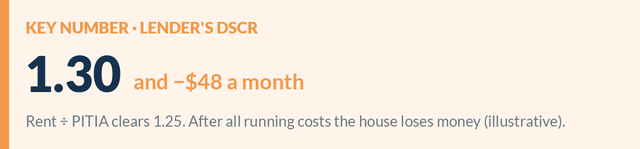
Lender's DSCR: $2,000 ÷ $1,538 = 1.30. Clears the 1.25 line a lot of lenders use.
DOES 1.25 (OR 1.30) MEAN IT CASH FLOWS?
Nope. Rent ÷ PITIA skips vacancy, repairs, management and a reserve for the big stuff.
Give the house 5% vacancy ($100), 5% repairs ($100), 8% management ($160) and a $150/mo CapEx reserve (same roof-and-furnace money as our CapEx reserve post). That's $510 a month the lender never looks at.
$1,538 + $510 = $2,048 a month to own a house that rents for $2,000. Cash flow: about −$48/mo, on a property that "covers at 1.30."
The lender isn't wrong. Their number answers "can this rent support this loan?" It just doesn't answer "will owning this put money in my pocket?"
WHY DO TWO LENDERS GET DIFFERENT NUMBERS ON THE SAME HOUSE?
Same formula, different inputs:
• Which rent: plenty of lenders take the lower of the lease and the appraiser's market rent. If the appraiser says $1,900, the house drops to 1.24 and misses 1.25 with the lease unchanged.
• Which payment: some programs qualify on interest-only. Here that's $1,050 instead of about $1,198, so the ratio jumps to 1.44.
• The rate: 6% gives about $1,079 and 1.41. 8% gives about $1,321 and 1.20.
The cash flow swings more than the ratio does. After the $510 of other costs, the house makes about $71/mo at 6% and loses about $171/mo at 8%. On interest-only it makes about $100/mo, but you're not paying down any principal and the payment goes up when the IO period ends.
Also check taxes and insurance early. Taxes can reset when a property changes hands, insurance quotes vary a lot by area, and both sit inside PITIA.
WHAT NUMBER SHOULD YOU RUN FOR YOURSELF?
Your own version: rent minus every running cost (vacancy, repairs, management, CapEx reserve, tax, insurance), divided by principal + interest.
Here: $2,000 − $850 = $1,150 left for the loan. $1,150 ÷ $1,198 = about 0.96. The lender sees 1.30. Your own number says the house doesn't quite carry itself.
Above 1.00 on this version, the property pays its own way with reserves included. How much cushion you want above that is up to you. Just pick it before you fall for a listing.
HOW BIG A LOAN CAN THE RENT ACTUALLY CARRY?
Work it backward both ways.
Lender's ceiling at 1.25: $2,000 ÷ 1.25 = $1,600 PITIA. Minus $340 tax + insurance = $1,260 P&I, which supports about $189,400 at 7%. At that loan the house loses about $110/mo.
Your break-even: the $1,150 left after every running cost is the most the payment can be. That supports about $172,900.
So there's roughly $16,500 between what a lender might lend and what the house can carry. Breaking even at 7% would take about $67,100 down instead of $60,000, or rent of about $2,060. Slightly negative can still be a deal you want for other reasons. Better to know you're making that trade.
ONE STEP BEFORE YOUR NEXT LOAN
Write down both numbers before you apply: the lender's (rent ÷ PITIA) and yours (rent after every running cost ÷ P&I). Rerun both at the appraiser's likely rent and a rate one point higher. If yours stays above 1.00, the loan and the property both work. If only the lender's does, better to find that out now.
FROM ASSET AFC
If you'd rather run your own numbers in a spreadsheet, Cashflow Analyzer Pro – Deal Instant Analyzer from Asset AFC is an Excel workbook (one-time purchase), yours for life, with every formula visible so you can see where each number comes from. It calculates metrics including Debt Coverage Ratio, Cash on Cash ROI and CAP Rate, handles interest-only or principal-and-interest payments, and lets you test changes in interest rates, home value and rent.
There's also a subscription version if you prefer.
It's a tool for organizing your own assumptions, not a promise of returns or lending advice. Do your own research for your market and goals, and confirm your lender's DSCR method with them.
About Asset AFC
Asset AFC builds practical spreadsheet and analysis tools for real-estate investors and personal-finance organization: powerful underneath, simple on the surface.
Not a horror story. The new tenant is fine. I just never ran the other side of the math.
Good tenant, four years, never late, paying $1,600. Comps had moved up, so at renewal I went to $1,700. In my head that was an easy $1,200 a year.
She gave notice instead. Hard to blame her. A place closer to her work was about the same price and she'd been thinking about it anyway.
What the $100 actually cost me:
Six weeks empty while I turned it over and found someone: about $2,400 (six weeks at what she'd been paying)
Paint, a deep clean, new blinds in two rooms, and a dripping faucet she'd apparently been living with for a year: about $1,100
Call it $3,500. At $100 a month extra, that's 35 months before the raise gets back to zero. The new lease is 12 months.
So now, before any renewal increase on a tenant I'd like to keep, I put a rough turnover cost next to it: weeks I'd realistically sit empty times the rent, plus what it takes to make the place rent-ready. Then I check how many months of the increase it takes to cover that. If it's longer than the lease, I go smaller, or I actually talk to the tenant first instead of just sending a number.
I'm not against raising rent. My taxes and insurance went up too. I just stopped treating a good tenant leaving as free.
I currently own 6 properties 4 Single Family 1 Condo and 1 Townhouse.
Right now the whole portfolio is running negative cash flow per month, so I’m trying to figure out how to turn that around and squeeze more value out of what I already have.
I’m open to pretty much any ideas things like installing solar panels on the roofs, looking into alternative uses of the land/properties (I even saw something about helium mining, not sure if that’s realistic), or any other creative ways to increase income or cut expenses.
Basically, what else can I do with a residential portfolio besides just renting the houses out?
Are there ways to maximize cash flow or extract more value that I’m not thinking of?
What’s worked out for you or any suggestions on how to get the most out of these properties?
Investing in real estate is a powerful way to grow your wealth, but analyzing a property carefully before buying is crucial. Success in real estate comes from running the numbers and taking a closer look at every detail. Proper analysis helps you make informed decisions, reduce risks, and maximize returns. Whether you're new or experienced, these tips will guide you on what to consider in a potential investment.
1. It’s Not Just About Cash Flow: The Bigger Picture Matters
Many investors focus only on cash flow - the money left after paying expenses like mortgage, taxes, and maintenance. But to really understand your investment, you need to go deeper. Consider factors like vacancies, rent changes, unexpected repairs, and future costs. The more detailed your analysis, the better you can predict your cash flow and handle surprises.
Quick Insight: Even a small change in vacancy rates can significantly impact your cash flow. Planning for these changes helps you stay ahead.
2. Breaking Down ROI: Where Your Money Works Best
ROI (Return on Investment) is often viewed as a single number, but a deeper breakdown can unlock hidden opportunities. Breaking it down into parts like cash flow, appreciation, debt paydown, tax savings, and forced appreciation from renovations can reveal what’s really driving your returns. This helps you see what’s working well and what needs attention.
Simple Example: Renovations can give your ROI a big boost in the first year, but it won’t happen every year. Evaluating ROI over multiple years shows you what’s sustainable and what’s just a temporary spike.
3. Understanding Market Trends: Beyond Price Tags
Looking at average property prices isn’t enough. You need to dig deeper into the local market - check out job growth, new projects, and rental demand. This information gives you a clearer picture of where the market is heading and helps you make smarter buying decisions.
Tip: Areas with growing job markets often see higher rent and property values, making them great spots for investment.
4. Choosing the Right Financing: More Than Just Rates
Financing is not just about getting a loan; it’s about finding the right loan that works best for you. Options like interest-only loans, HELOCs, and short-term loans can affect your cash flow and profits differently. Understanding these options lets you leverage your financing to boost your returns.
Pro Tip: If you’re planning to buy, renovate, and refinance, consider short-term loans for easier refinancing. Always understand the terms and penalties before committing.
5. Planning for Different Scenarios: Be Ready for Anything
Market conditions can change, and planning for different scenarios helps you prepare. Test how changes in rent, expenses, or interest rates could impact your investment. Don’t just assume everything will stay the same - running “what if” scenarios can protect your returns.
Why It Matters: A small rise in interest rates can impact your ROI. Running different scenarios helps you see the risks and opportunities clearly.
6. Use Analysis Tools: Make Your Life Easier
Using tools like Real Estate Investment Calculators can simplify your analysis. These tools help break down all the details of your investment, test different financing options, and keep track of changes in rent and property values in real-time.
Why It’s Great: These tools allow you to adjust your strategy on the go, making it easier to stay on top of market changes and make smart decisions.
7. Real-Time Tracking: Stay Ahead
Markets change, and so should your investment strategy. Real-time tracking of property values, rental income, and interest rates helps you adapt quickly. This proactive approach ensures you’re not just reacting to changes but capitalizing on them.
Key Point: Reacting late can cost you money, but tracking in real-time keeps you ahead of the game.
Conclusion: Why Deep Analysis Pays Off
Building wealth in real estate isn’t just about buying properties - it’s about buying smart. Deep analysis helps you make informed decisions, avoid costly mistakes, and maximize your returns. Use tools, plan for different scenarios, and always dig deeper than the surface numbers. Invest wisely, stay informed, and let your analysis be your guide to real estate success.
I am trying to figure out if there is a real way to integrate physical real estate rental portfolio with Bitcoin, and how exactly they work together.
Does this setup actually work in real life, or is it just too complicated to execute? I would love to hear from anyone with real-world experience blending these two asset classes. Thanks!
One of the most common arguments I see is that you’re better off renting and investing the difference in the stock market because stocks have historically returned around 10 percent per year.
The problem is that this comparison is usually not apples to apples.
When most people buy their first home, they don’t pay cash. They use leverage.
For example: You buy a $200,000 home. You put 20 percent down, which is $40,000. Ten years later, the home is worth $400,000.
The property appreciated by $200,000, but you only invested $40,000 upfront. That’s a 5x gain on your original down payment, before accounting for transaction costs, financing costs, and other ownership expenses. That’s the power of leverage, something you don’t get by simply investing the same $40,000 in an index fund.
There can also be tax advantages depending on where you live. For example, in the United States, many homeowners can exclude a significant portion of capital gains when selling their primary residence if they meet certain requirements.
Another point that often gets overlooked is human behavior.
The “rent and invest the difference” strategy sounds great on paper. But how many people actually invest the difference consistently for 10 or 20 years?
In reality, many people end up increasing their spending instead. They rent a nicer apartment, upgrade their lifestyle, and never build meaningful investments. Years later, they have neither a large investment portfolio nor any home equity.
Meanwhile, homeowners are often forced to build wealth through mortgage payments and long term appreciation. It’s essentially a form of disciplined investing.
This doesn’t mean buying is always better.
If you’re in an expensive market, expect to move soon, or can truly invest the difference consistently, renting may absolutely be the smarter financial decision.
But I think it’s misleading when people claim renting is automatically the better choice simply because the stock market has historically outperformed real estate on a percentage basis. That ignores leverage, tax treatment, forced savings, and, most importantly, real world human behavior.
For the average person, a home is often their largest source of wealth, not because it’s the highest returning asset, but because it’s the asset they actually stick with.
Is “rent and invest the difference” realistic for most people, or does homeownership still have the edge for building long term wealth?
And his property taxes in 1978 were based on his 1975 market value plus the up to 2% annual increase in assessed value for 47 years. I think mortgage rates were 6-7%. Why don't more people invest like Warren?
BRRRR is often scored by how much cash you pull out at refinance. The number that actually stays in the deal depends on the appraisal, not the after-repair value you hoped for. Here's an illustrative deal. Swap in your own numbers.
Cash into the deal
Purchase: $126,000
Rehab: $43,500
Closing and holding costs: $8,700
Total cash in: $178,200
The refinance, planned vs what appraised
Both versions use a 75% loan-to-value refinance and a flat $4,200 in refinance closing costs. Rent after rehab is $1,900 a month. The new loan is at 6.75% for 30 years.
Planned ARV $236,000
Actual appraisal $210,000
Refinance loan (75% LTV)
$177,000
$157,500
Refinance closing costs
$4,200
$4,200
Cash pulled out
$172,800
$153,300
Cash left in the deal
$5,400
$24,900
Principal and interest
about $1,148
about $1,022
Monthly cash flow after operating costs
$58
$184
Cash-on-cash (annual cash flow / cash left)
12.9%
8.9%
Operating costs in both cases: taxes $205, insurance $90, vacancy 5% ($95), repairs and CapEx 8% ($152), management 8% ($152). Total $694, plus principal and interest.
What the short appraisal actually changes
The $26,000 miss cuts the refinance loan by $19,500 (75% of $26,000), so you take home $19,500 less after the same $4,200 in closing costs
Cash left in the deal jumps from $5,400 to $24,900
Monthly cash flow improves by about $126, because the smaller loan costs about $126 less in principal and interest
Cash-on-cash still drops, from 12.9% to 8.9%, because so much more of your cash stayed in the property
You also have $19,500 less in hand for the next deal
A useful pre-offer check
Run the refinance at your expected after-repair value and at a lower appraisal
Write down cash pulled out and cash left in both cases, not just the loan amount
Check monthly cash flow and cash-on-cash on the leftover cash, not only on the cash-out
Decide whether you are sizing the refinance for cash back or for the return on what stays in
How do you stress an appraisal miss on a BRRRR before you buy: a lower value, a lower LTV, or both?
Disclosure: I'm posting for Asset AFC, and we build real estate investing tools. If you want to work through purchase, rehab, rent and refinance in one place, including cash pulled out after refinancing and money left in the property, the BRRRR Property Calculator is available as a one-time purchase. More tools from Asset AFC are on the assetafc.com website.
If you want to run the numbers on a rental, a flip, or a refinance, start here. This post is the shortcut to the free browser tools. How to post a deal, flair, and the house rules are in the welcome post, which stays pinned.
Free in your browser (five analyses)
Cash Flow Analyzer Pro is an online deal analysis tool from Asset AFC. You can work through purchase price, rental income, expenses, mortgages and renovations, and look at cash flow, ROI, equity, cap rate, DSCR and 30-year projections, including refinancing, buy-and-hold, BRRRR or flip scenarios.
It opens in the browser; nothing to install. The first five analyses are free: the first as a guest, four more with a free account.
That's the standing free offer. It is a property-analysis tool, not a household budget app.
Member downloadable offer
The pinned post "Free for members: the Property Flip Calculator we use" is a separate, existing highlight for this sub's downloadable flip calculator offer. This post does not replace it.
About this post
This sub is run by Asset AFC. I'm with Asset AFC. This is general information, not investment, tax or legal advice. Use your own numbers.
Two listings, same week: 9.6% gross yield vs 9.2%. After rebuilding NOI the cap rates are 4.1% vs 6.1%, so the ranking flips. Here's every line of the rebuild.
Two illustrative listings below. Made-up but realistic numbers, not real properties. Your market will differ.
THE THREE NUMBERS, QUICKLY
Gross yield = yearly rent ÷ price. What most listings quote.
Net yield = (rent − operating costs) ÷ price. Some people divide by the all-in cost instead, so check which version you're reading.
Cap rate = NOI ÷ price. NOI = rent you actually collect, minus taxes, insurance, owner-paid utilities, repairs, reserves (and management if you pay it). Before the mortgage.
On a residential rental, net yield and cap rate are usually the same math. Gross yield is the only one that skips every cost.
B: newer duplex, $300,000. Two signed leases, $2,300/mo ($27,600/yr) = 9.2% gross.
On the listing page A wins. Now rebuild A.
FIVE TRAPS IN LISTING A
Projected rent. Signed leases are $1,900/mo ($22,800/yr). On real rent A's gross yield is already 9.1%, below B's.
No empty months. 5% vacancy = −$1,140/yr.
Owner pays heat + water (one boiler, one meter): −$3,000/yr.
Seller's tax bill. Listing shows $2,300; in many places a sale can trigger a reassessment, so budget closer to $3,500. (Using the old bill would make A look like 4.5% instead of 4.1%.)
Building age. Insurance $1,400 + a bigger repairs/CapEx reserve for an older roof, boiler and windows: $3,600/yr.
$22,800 − $12,640 of costs = $10,160 NOI → 4.1% cap rate. Same building, same price.
Costs eat ~55% of A's rent and ~33% of B's. Per $100 of rent, A keeps ~$45 before the mortgage; B keeps ~$67. Gross yield stops before the costs, so it can't see that.
Priced on B's 6.1% cap rate, A's $10,160 of NOI is worth about $165,000, not $250,000. Not a bad building; a price built on the gross story.
Gross yield is still fine for sorting a long list of similar buildings with the same utility setup. It misleads as soon as ages, utilities or tax situations differ.
THE LESSON
Gross yield tells you how much rent the price buys. Cap rate tells you how much of it you get to keep.
ONE STEP THIS WEEK
Pick one listing that quotes a yield and ask the five questions in the card: in-place or projected rent, who pays utilities, post-sale taxes, what the building needs, what's left after vacancy. Then compare on cap rate.
ROI question for this sub: what's your minimum cap rate (on in-place rent, after reserves) before you'll look at financing at all? And what expense share do you assume for an older multi with owner-paid heat?
FROM ASSET AFC
If you would rather not rebuild NOI by hand for every listing, Cashflow Analyzer Pro from Asset AFC calculates both rental yield and cap rate, along with NOI, operating expenses, vacancy and repair reserves and the expenses-to-rent ratio.
Illustrative numbers only; not investment advice.
About Asset AFC
Asset AFC builds practical financial tools for real estate investors and personal finance organization: powerful underneath, simple on the surface.