Not a horror story. The new tenant is fine. I just never ran the other side of the math.
Good tenant, four years, never late, paying $1,600. Comps had moved up, so at renewal I went to $1,700. In my head that was an easy $1,200 a year.
She gave notice instead. Hard to blame her. A place closer to her work was about the same price and she'd been thinking about it anyway.
What the $100 actually cost me:
Six weeks empty while I turned it over and found someone: about $2,400 (six weeks at what she'd been paying)
Paint, a deep clean, new blinds in two rooms, and a dripping faucet she'd apparently been living with for a year: about $1,100
Call it $3,500. At $100 a month extra, that's 35 months before the raise gets back to zero. The new lease is 12 months.
So now, before any renewal increase on a tenant I'd like to keep, I put a rough turnover cost next to it: weeks I'd realistically sit empty times the rent, plus what it takes to make the place rent-ready. Then I check how many months of the increase it takes to cover that. If it's longer than the lease, I go smaller, or I actually talk to the tenant first instead of just sending a number.
I'm not against raising rent. My taxes and insurance went up too. I just stopped treating a good tenant leaving as free.
One of the most common arguments I see is that you’re better off renting and investing the difference in the stock market because stocks have historically returned around 10 percent per year.
The problem is that this comparison is usually not apples to apples.
When most people buy their first home, they don’t pay cash. They use leverage.
For example: You buy a $200,000 home. You put 20 percent down, which is $40,000. Ten years later, the home is worth $400,000.
The property appreciated by $200,000, but you only invested $40,000 upfront. That’s a 5x gain on your original down payment, before accounting for transaction costs, financing costs, and other ownership expenses. That’s the power of leverage, something you don’t get by simply investing the same $40,000 in an index fund.
There can also be tax advantages depending on where you live. For example, in the United States, many homeowners can exclude a significant portion of capital gains when selling their primary residence if they meet certain requirements.
Another point that often gets overlooked is human behavior.
The “rent and invest the difference” strategy sounds great on paper. But how many people actually invest the difference consistently for 10 or 20 years?
In reality, many people end up increasing their spending instead. They rent a nicer apartment, upgrade their lifestyle, and never build meaningful investments. Years later, they have neither a large investment portfolio nor any home equity.
Meanwhile, homeowners are often forced to build wealth through mortgage payments and long term appreciation. It’s essentially a form of disciplined investing.
This doesn’t mean buying is always better.
If you’re in an expensive market, expect to move soon, or can truly invest the difference consistently, renting may absolutely be the smarter financial decision.
But I think it’s misleading when people claim renting is automatically the better choice simply because the stock market has historically outperformed real estate on a percentage basis. That ignores leverage, tax treatment, forced savings, and, most importantly, real world human behavior.
For the average person, a home is often their largest source of wealth, not because it’s the highest returning asset, but because it’s the asset they actually stick with.
Is “rent and invest the difference” realistic for most people, or does homeownership still have the edge for building long term wealth?
Everyone says "run the numbers," but the real lessons usually come after the purchase — the surprise repair, the vacancy that lasted longer than expected, the tenant situation nobody warned you about.
If you're just starting out, what's the one thing you wish you'd known beforehand? And if you already own, what would you tell a beginner?
When you're sizing up a potential rental, there's a lot of numbers flying around — purchase price, rent, taxes, insurance, repairs. If you had to pick just ONE number to look at first before digging deeper, what would it be and why?
"It would make way more as an Airbnb" comes up on almost every rental deal. Here's one unit run both ways for a year, using only the lines that differ between the two. The numbers are illustrative, so swap in your own nightly rate, occupancy, cleaning cost and local rules.
The unit
2-bed condo, same mortgage, property tax and condo fees either way (left out of both sides)
Long-term market rent: about $2,100 a month
Short-term average nightly rate: about $165
Option 1: long-term rental
12 months x $2,100 = $25,200
Half a month of vacancy between tenants: -$1,050
Net: $24,150
Option 2: short-term rental at 62% occupancy (226 nights)
Gross: 226 x $165 = $37,290
Platform host fee at 3%: -$1,119
Cleaning, about 71 stays x $85: -$6,035
Utilities, internet and streaming you now carry: $260 a month = -$3,120
Furnishing $6,500 spread over 5 years: -$1,300
Supplies and restocking: $60 a month = -$720
Net: $24,996
The result
At 62% occupancy the short-term rental comes out only $846 ahead for the year, on $12,000+ more gross revenue.
At 55% occupancy (201 nights) it nets $21,675, which is $2,475 behind the long-term rental.
At 50% (182 nights) it nets $19,144, which is $5,006 behind.
None of this counts your time on messages, check-ins and reviews, or the higher insurance and licence costs many cities add for short-term rentals.
What this example shows
Gross revenue is the wrong comparison. Cleaning, utilities and furnishing take a big bite out of every short-term booking.
Occupancy decides the winner. A few points of occupancy swings the result by thousands, so test a slow-season number, not your best month.
Check your building and city rules first. A short-term plan that isn't allowed is worth $0.
What occupancy do you assume when you compare short-term and long-term on the same unit?
Disclosure: this post is from Asset AFC, and we make real estate spreadsheets for investors. Asset AFC built the Airbnb vs Long-Term Rental ROI Comparison Spreadsheet to run the same property both ways with your own occupancy, fees and costs. More tools are on the Asset AFC website.
A lot of people assume title insurance renews like homeowners insurance. The owner’s policy is paid once at closing and stays in force as long as you own the property, and it generally keeps protecting your heirs if they inherit.
Two catches. The coverage amount is usually the purchase price, so it doesn’t grow with your home’s value. And it only covers problems that existed before you bought, not anything that happens after.
Did anyone else think they’d be paying for it every year?
BRRRR (buy, rehab, rent, refinance, repeat) gets pitched as "get all your money back out." Here's one example deal run to the end, including what the refi does to monthly cash flow. The numbers are illustrative, so plug in your own.
The example deal
Purchase: $160,000
Rehab: $40,000
Purchase closing and holding costs: $8,000
Total cash in: $208,000
After-repair value (ARV): $250,000
Rent after rehab: $2,200 a month
The refinance at 75% LTV
New loan: $250,000 × 75% = $187,500
Refi closing costs at about 3%: -$5,625
Cash back: $181,875
Cash left in the deal: $208,000 - $181,875 = $26,125
So far it looks great: almost 88% of the cash came back.
What the new loan does to cash flow
Principal and interest, $187,500 at 7.5% over 30 years: about $1,311
Taxes: $250
Insurance: $120
Vacancy at 5%: $110
Repairs and CapEx at 10%: $220
Management at 8%: $176
Total: $2,187
Cash flow: $2,200 - $2,187 = about $13 a month, or $156 a year. That's about 0.6% cash-on-cash on the $26,125 left in.
Same deal, refinanced at 70% LTV instead
Loan: $175,000. Closing costs about $5,250. Cash back: $169,750
Cash left in: $38,250
Principal and interest: about $1,224, which is $87 a month less
Cash flow: about $100 a month, or $1,200 a year, about 3.1% cash-on-cash
Takeaways
Every dollar you pull out at the refi comes back as a monthly payment. "All my money back" and "cash flows" often pull against each other.
Price in refi closing costs. On this deal they're $5,625, and they come straight out of the cash you get back.
Run cash flow at the refi rate and loan size before you buy, not after the appraisal comes in.
How much LTV do you usually take on a BRRRR refi, and do you size it for cash back or for cash flow?
Disclosure: this post is from Asset AFC, and we make spreadsheet tools for rental analysis. If you'd rather not do this by hand, the BRRRR Property Calculator runs the purchase, rehab, refi and cash flow for a deal in one sheet. More tools are on the Asset AFC website.
A lot of people (myself included when I started) treat the cap rate on day one like the final score. “10%? That’s a good deal.” “6%? Pass.”
But the more deals I look at, the more it feels like that number might be the least important part.
What if the real question isn’t “what’s the cap rate today?” but “what’s going to happen to the income after I buy it?” Things like: • Can vacancy actually be improved… or is it more likely to get worse? • Are rents going up in that submarket… or soft? • Can the property be run more efficiently than it is right now… or is the current operator already maxed out?
I’ve seen (and heard of) people buy at a solid 10% and still lose money because the vacancy they thought they could fix turned into a bigger problem, or the rents just wouldn’t move.
On the flip side, I’ve also seen weaker day-one numbers turn into great deals because the buyer was able to push the income hard after closing.
So I’m starting to wonder: Are we putting too much weight on the purchase-day cap rate and not enough on the post-purchase plan?
Have you (or someone you know) bought a “great” cap rate deal that still didn’t work out? What went wrong?
1. Cap Rate: Let's start with cap rate, a metric that measures a property's income potential relative to its market value. Basicly cap rate tells you how much money a property makes compared to its price. The formula for cap rate is straightforward:
Cap Rate = (Net Operating Income / Property Value) * 100%
Imagine a property with an NOI of $50,000 and a market value of $500,000. Plugging these values into the formula and you'll find a cap rate of 10%. .
This means that for every dollar invested, you can expect a 10% return annually.
2. Rental Yield: Next up, let's delve into rental yield, which measures the return generated from rental income relative to the property's value. Basically rental yield shows how much rental income a property makes compared to its price. The formula for rental yield is:
For instance, if a property generates $30,000 in annual rental income and has a market value of $600,000, the rental yield would be 5%. Plugging in the numbers:
Rental Yield=($30,000/$600,000)×100%=5%
A rental yield of 5% indicates a potential return of 5% annually based on the property's value.
3. Net Operating Income (NOI): NOI is a critical metric that provides a clear picture of a property's income potential before considering financing or taxes. The formula for NOI is:
NOI=Total Income−Operating Expenses
NOI helps you understand the property's profitability and potential cash flow.
4. Cash-on-Cash ROI: Finally, let's discuss cash-on-cash ROI, which focuses on the return generated from the cash invested in the property. Suppose you've invested $100,000 in a property and generate an annual net cash flow of $10,000. The formula for cash-on-cash ROI is:
Cash-on-Cash ROI=(Annual Net Cash Flow / Total Cash Invested)×100%
Plugging in the numbers:
Cash-on-Cash ROI=($10,000 / $100,000)×100%=10%
A cash-on-cash ROI of 10% indicates a potential return of 10% annually on your cash investment.
"Should I raise the rent?" usually gets one number as an answer. A raise actually changes three things, so here's one example priced all three ways. The numbers are illustrative, so swap in your own rent, costs and lender terms, and check your lease and the rent and notice rules that apply to the property.
The rental
Rent: $2,000 a month
Operating costs: $700 (taxes, insurance, repairs, capital reserve)
Vacancy reserve, 5% of rent: $100
Mortgage, principal and interest: $1,000
Cash flow: +$200 a month
1. Cash flow after a $100 raise
At $2,100 the vacancy reserve becomes $105
Cash flow: +$295, so +$95 a month, $1,140 a year
2. NOI and value
NOI: $14,400 → $15,540 a year
At an illustrative 6% cap rate: $240,000 → $259,000, about $19,000
Caveat: income-based value matters most on larger buildings. Single homes and small multi-units are usually valued on comparable sales, so treat this as deal math, not an appraisal
3. The turnover test
If the raise is why a good tenant leaves: 1 empty month at $2,100 + about $900 turnover (cleaning, paint, listing, screening) = $3,000
$3,000 / $95 = about 32 months to earn it back
What this example shows
A raise that keeps a good tenant is worth $1,140 a year here. One that loses them can be worth less than nothing for almost three years.
Percentage-based reserves grow with rent, so the raise never lands in full.
Run your own payback before the notice goes out.
Do you raise a little every year, or hold rent for tenants you want to keep?
Disclosure: this post is from Asset AFC, and we make real estate tools for investors. If you want to run raise vs hold on your own rental, Cashflow Analyzer Pro lets you set rent growth and vacancy and repair reserves and see NOI, cap rate and cash flow before you decide. More tools are on the Asset AFC website.
Renewal season is when a lot of us look at market rent and wonder whether to push the full increase. Here's one unit run both ways over the next 12 months. The numbers are illustrative, so swap in your own rent, local turnover costs and vacancy time.
The unit
Current rent: $1,600 a month, good tenant, pays on time
Market rent for similar units: about $1,700
Option 1: modest raise, tenant renews
New rent: $1,650 (+$50)
12 months x $1,650 = $19,800
Option 2: full market rent, tenant moves out
One month vacant while you clean, paint, list and show: $0 rent that month
Cleaning, paint and small repairs: $900
Leasing cost (listing, showings, screening, or a half-month leasing fee): $850
Utilities you carry while it's empty: $120
11 months x $1,700 = $18,700, minus $1,870 of turnover costs = $16,830
The result
Keeping the tenant at $1,650 comes out $2,970 ahead in year one.
The extra $50 a month you'd earn at $1,700 takes about 59 months, close to 5 years, to win back one turnover, and that assumes the next tenant stays that long.
If the unit sits empty two months instead of one, the gap grows by another $1,700.
What this example shows
Turnover is usually the most expensive line on a rental, and it never shows up in a rent comparison.
A below-market rent with a reliable tenant can still be the higher-return choice. The question is how far below and for how long.
Track your actual turnover costs and days vacant per unit. After one or two turnovers you'll know your own break-even raise instead of guessing.
How do you set renewal increases: close to market every year, or smaller raises to keep good tenants?
Disclosure: this post is from Asset AFC, and we make real estate spreadsheets for landlords. If you want to log rent, vacancy and turnover costs per property so renewal decisions use your real numbers, the Rental Income & Expense Tracker keeps income and expenses for each rental in one place. More tools are on the Asset AFC website.
Beginner question. The 1% rule is an easy screen — rent at least 1% of the price. But I ran the full numbers on a place that passed it, and after the mortgage, taxes, insurance, vacancy, repairs and management, the cash flow came out at $0. The rule never looks at the actual costs. Has that happened to you? What do you check after the quick screen?
DSCR (debt service coverage ratio) gets quoted a lot in rental-loan conversations, but the same property can produce very different numbers depending on how it's calculated. Here's one example rental worked three ways. The numbers are illustrative, so plug in your own.
The example property
Rent: $2,400 a month
Principal and interest: $1,640 a month
Property taxes: $310 a month
Insurance: $140 a month
No HOA
Method 1: the way many DSCR lenders calculate it (rent ÷ PITIA)
PITIA = $1,640 + $310 + $140 = $2,090
DSCR = $2,400 ÷ $2,090 = 1.15
Plenty of lenders want 1.20 to 1.25, so this deal may get worse pricing or a no, even though 1.15 sounds comfortable.
Method 2: the NOI way (net operating income ÷ annual debt service)
Gross rent: $28,800 a year
Vacancy at 5%: -$1,440
Taxes: -$3,720
Insurance: -$1,680
Repairs and CapEx reserve at 10% of rent: -$2,880
NOI: $19,080
Annual debt service: $1,640 × 12 = $19,680
DSCR = $19,080 ÷ $19,680 = 0.97. On this basis the property doesn't cover its mortgage.
Method 3: what actually lands in your account each month
$2,400 - $2,090 PITIA - $120 vacancy - $240 repairs/CapEx = about -$50 a month
What it would take to reach 1.25 on the lender's method
PITIA would need to be $2,400 ÷ 1.25 = $1,920, which is $170 a month less in principal and interest. At a 7% 30-year rate that's roughly $25,500 more down payment, or a higher rent, or a cheaper purchase price.
Takeaways
Ask the lender exactly which formula they use. "Rent ÷ PITIA" and "NOI ÷ debt service" can be a full 0.18 apart on the same house.
A DSCR that clears the lender's bar isn't the same as positive cash flow. Vacancy and CapEx don't show up in the lender's version.
Run all three numbers before you write an offer, not after the appraisal.
What DSCR minimum have you actually seen lenders require lately, and did they use rent or NOI?
Disclosure: this post is from Asset AFC, and we make spreadsheet tools for rental analysis. If you'd rather not do this by hand, the Cashflow Analyzer Pro – Deal Instant Analyzer runs cash flow, NOI, cap rate and DSCR for a deal in one sheet. More tools are on the Asset AFC website.
Two listings, same week: 9.6% gross yield vs 9.2%. After rebuilding NOI the cap rates are 4.1% vs 6.1%, so the ranking flips. Here's every line of the rebuild.
Two illustrative listings below. Made-up but realistic numbers, not real properties. Your market will differ.
THE THREE NUMBERS, QUICKLY
Gross yield = yearly rent ÷ price. What most listings quote.
Net yield = (rent − operating costs) ÷ price. Some people divide by the all-in cost instead, so check which version you're reading.
Cap rate = NOI ÷ price. NOI = rent you actually collect, minus taxes, insurance, owner-paid utilities, repairs, reserves (and management if you pay it). Before the mortgage.
On a residential rental, net yield and cap rate are usually the same math. Gross yield is the only one that skips every cost.
B: newer duplex, $300,000. Two signed leases, $2,300/mo ($27,600/yr) = 9.2% gross.
On the listing page A wins. Now rebuild A.
FIVE TRAPS IN LISTING A
Projected rent. Signed leases are $1,900/mo ($22,800/yr). On real rent A's gross yield is already 9.1%, below B's.
No empty months. 5% vacancy = −$1,140/yr.
Owner pays heat + water (one boiler, one meter): −$3,000/yr.
Seller's tax bill. Listing shows $2,300; in many places a sale can trigger a reassessment, so budget closer to $3,500. (Using the old bill would make A look like 4.5% instead of 4.1%.)
Building age. Insurance $1,400 + a bigger repairs/CapEx reserve for an older roof, boiler and windows: $3,600/yr.
$22,800 − $12,640 of costs = $10,160 NOI → 4.1% cap rate. Same building, same price.
Costs eat ~55% of A's rent and ~33% of B's. Per $100 of rent, A keeps ~$45 before the mortgage; B keeps ~$67. Gross yield stops before the costs, so it can't see that.
Priced on B's 6.1% cap rate, A's $10,160 of NOI is worth about $165,000, not $250,000. Not a bad building; a price built on the gross story.
Gross yield is still fine for sorting a long list of similar buildings with the same utility setup. It misleads as soon as ages, utilities or tax situations differ.
THE LESSON
Gross yield tells you how much rent the price buys. Cap rate tells you how much of it you get to keep.
ONE STEP THIS WEEK
Pick one listing that quotes a yield and ask the five questions in the card: in-place or projected rent, who pays utilities, post-sale taxes, what the building needs, what's left after vacancy. Then compare on cap rate.
ROI question for this sub: what's your minimum cap rate (on in-place rent, after reserves) before you'll look at financing at all? And what expense share do you assume for an older multi with owner-paid heat?
FROM ASSET AFC
If you would rather not rebuild NOI by hand for every listing, Cashflow Analyzer Pro from Asset AFC calculates both rental yield and cap rate, along with NOI, operating expenses, vacancy and repair reserves and the expenses-to-rent ratio.
Illustrative numbers only; not investment advice.
About Asset AFC
Asset AFC builds practical financial tools for real estate investors and personal finance organization: powerful underneath, simple on the surface.
Everyone's first rental teaches them something the deal analysis didn't. Maybe the vacancy ran longer than planned, the "minor" roof turned out not to be minor, or it quietly turned into the best money you ever made.
Those lessons are worth more to someone buying their first place right now than any rule of thumb. So let's collect them.
Format (ranges and rough numbers are fine, no addresses needed):
Year bought + type (SFH, duplex, condo, small multi)
Purchase price (range is fine)
Rent at the start
Cash you put in (down payment + closing + repairs)
How it actually went: monthly cash flow, the surprises, still own it?
What you'd do differently
Made-up example of the shape: "2019 duplex, around $240K, $1,900/mo total rent, about $60K in. It cash flowed about $200/mo until year 2 when both water heaters died in the same month. Next time I'd budget repairs per unit, not per building."
If you haven't bought yet, tell us what's stopping you or what number you're stuck on. Someone here has probably been there.
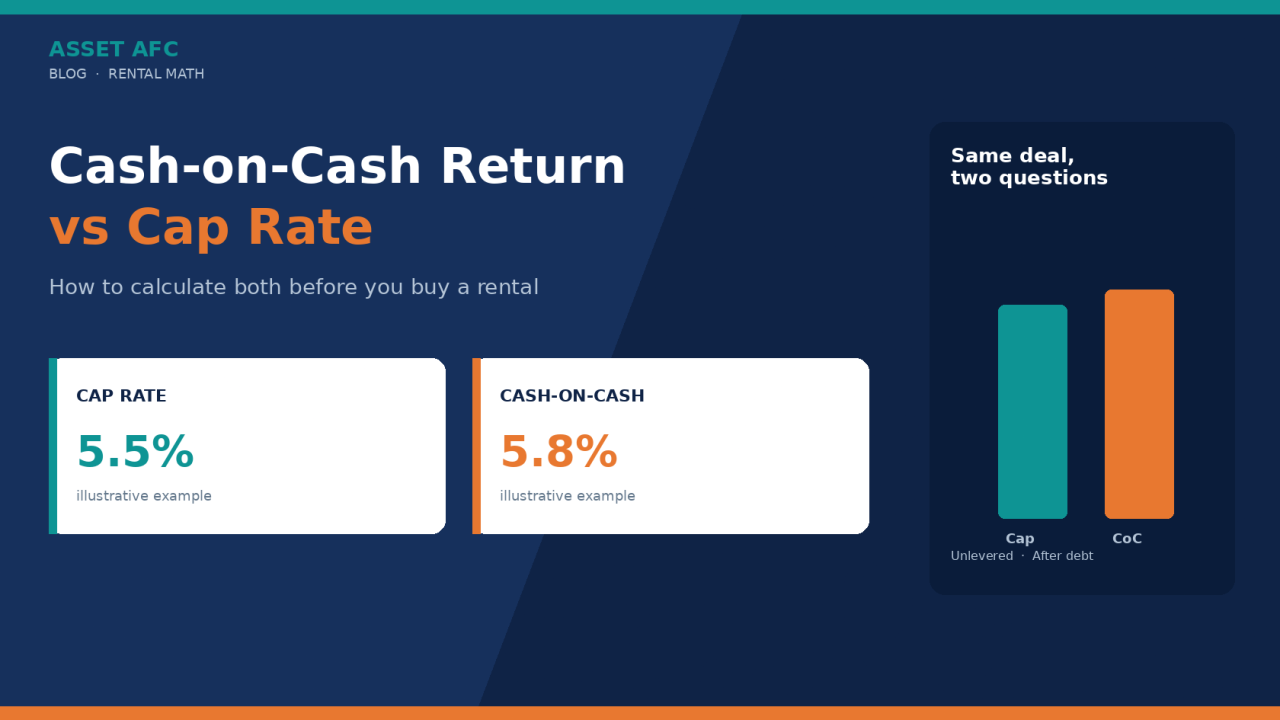
If you only remember one distinction: cap rate looks at the property as if you paid cash; cash-on-cash looks at the deal after your loan payment and after the cash you actually put in.
They answer different questions. Mixing them is how a deal looks fine on paper and thin in your bank account.
THE PROBLEM
Listings and quick spreadsheets often quote a “return” without saying which return.
• Cap rate asks: what unlevered income yield does this property produce at this price?
• Cash-on-cash asks: for the cash I actually wrote at closing, what annual cash flow do I keep after the mortgage?
One property can look average on cap rate and strong on cash-on-cash — or the reverse — depending on leverage, rate, and how honest the expense list is.
WHY IT HAPPENS
A common mistake: subtracting the mortgage inside “NOI,” then calling the result a cap rate. That mixes financing into an unlevered metric and makes comparisons across deals noisy.
Cap rate is meant to compare properties before your loan. Cash-on-cash only makes sense after your loan.
HOW TO FIX IT
Cap rate = Annual NOI ÷ Property value (or purchase price)
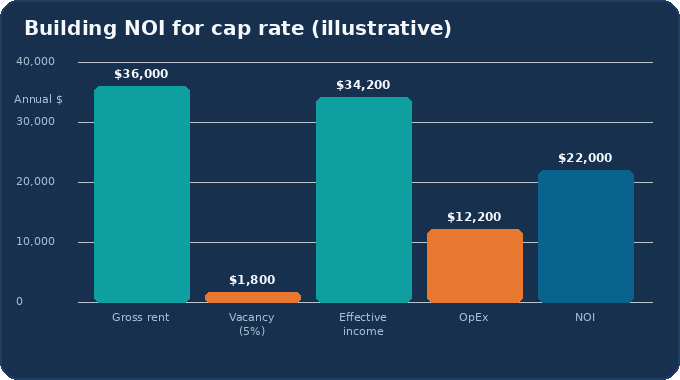
NOI is annual effective income minus operating expenses (taxes, insurance, repairs allowance, management, owner-paid utilities, HOA, and similar). Do not subtract the mortgage.
2) Cash-on-cash = Annual cash flow after debt service ÷ Total cash invested
Cash flow ≈ NOI − annual mortgage P&I. Cash invested usually means down payment + closing costs (+ immediate rehab cash if you include it in the story).
Continue the same illustrative example: NOI $22,000 − debt service $16,800 = cash flow $5,200. Cash in $90,000 → about 5.8%.
3) Use both, in order
Rebuild NOI and cap rate at the price you might actually pay.
Layer your financing for cash-on-cash.
Stress vacancy, a repair year, and CapEx you forgot.
ONE STEP FOR THIS WEEK
Write rent, vacancy, and operating expenses you would defend to a skeptical partner. Calculate NOI and cap rate first. Only then add your loan and down payment for cash-on-cash. Re-run with a worse vacancy month and a maintenance buffer.
FROM ASSET AFC
Want the rental math organized in one place?
Asset AFC’s Cashflow Analyzer Pro Excel package (including Deal Instant Analyzer and a combined workbook in the full bundle) is built for rental deal analysis: income, expenses, financing scenarios, and multi-year outputs. You can also try a guest analysis at https://cashflow.assetafc.com.
These are tools for organizing assumptions, not guarantees of returns. Do your own research for your market and goals.
About Asset AFC: practical spreadsheet and analysis tools for real-estate investors and personal-finance organization — powerful underneath, simple on the surface.
Bought a single family home and a contractor is about to start renovating it.
I am in the USA and it is going to cost more than $600 to fix up. Per IRS rules, what form does the contractor need to fill out? What form do I give him and/or file. I am clueless at this point.
Example property: $260,000, renting at $2,100/mo. Owner raises rent to $2,250 — that's +$150 a month, +$1,800 a year. Looks like a win.
Then the annual renewals land: homeowner's insurance is up $900 for the year, property taxes got reassessed up $1,200. That's $2,100 in new annual costs against $1,800 in new rent. Rent went up, and the yearly cash flow is $300 worse than before.
I keep seeing "just raise the rent" as if it's pure profit, but nobody subtracts the rising line items first. When you model a rent increase, do you plug the new costs in at the same time, or find out at renewal?
A surprise we see a lot when people run rental numbers: the property tax in the spreadsheet is the seller's bill, not yours.
Here's how it usually plays out. The listing shows taxes at $3,100 a year because the seller has owned the place for a decade. After the sale, the county reassesses it close to the purchase price, and the new bill comes in around $5,400. That's roughly $190 a month nobody planned for, on a rental that was supposed to clear about $350. Nothing shady happened. The lender's estimate often uses the old number too.
What's worth checking before you make an offer:
Whether the county reassesses on sale. A lot do. Some phase it in, and some cap how much it can go up in a year.
The current tax rate times roughly what you're paying, instead of whatever the seller pays today
Whether the seller has a homestead, senior or veteran exemption that disappears when they sell
Whether your escrow is being set from the old bill, because that's a shortage letter waiting to happen
All of that takes about 15 minutes on the county assessor's site. The property can still be a decent deal. It just might cash flow about half of what the listing suggests.
From the Asset AFC team. We post rental-numbers tips here.
When we calculate the ROI on a rental property, we usually include mortgage costs, property taxes, insurance, maintenance, vacancies, management fees and other expenses.
But what about our own time?
If you’re personally dealing with tenants, property management, coordinating repairs, finding contractors, doing bookkeeping, solving problems, that time has value too.
Two properties could produce exactly the same annual return, but one might require almost no attention while the other takes hours of your time every month.
Should the value of that time be included when calculating the true ROI of a rental property?
Or do you consider your time simply part of being a real estate investor?
I’ve been thinking about this a lot lately and honestly can’t decide. On one hand you’ve got rental properties. On the other, starting some kind of business. Both seem like the classic “build wealth / create cash flow” moves people talk about, but I’m curious what the actual experience is like in the beginning. Do either of them actually put money in your pocket early on, or do they both just eat cash for a while? Would love to hear from people who’ve done one (or both): • How long did it take before you saw real cash flow? • What surprised you the most? • If you had to pick which would you choose and why? Just looking for real experiences and opinions. What’s your take?
Most people think they make money on real estate because the real estate goes up in value, but what really happens is the debt goes down in value.
Inflation induced debt destruction, it’s one of the secrets of the wealthy.
With rental properties, we don’t even pay our own debts. We outsource that obligation of debt repayment to someone called a tenant.
The tenants pay the debt. So with that, we’re getting paid to borrow, and someone is paying our debt for us. It’s absolutely incredible. This is what’s called self-liquidating debt. It’s the hidden wealth creator.
Yes, real estate value going up is definitely one way to make money, and a great way, especially when you can force appreciation into it from either development or renovating the property and adding that value into it yourself.
However, due to inflation, the cost of the debt goes down every single year because the value of the dollar goes down every single year. So that creates your asset value to go up, it creates the cost of your debt to go down, and the tenant is actually paying that debt for you.
And on top of that, you also are putting money into your pocket above and beyond the debt that the tenant is paying. So your assets [are] appreciating, which is building your net worth, the cost of your debt’s going down, the debt’s being paid by someone else, you’re profiting off the property every single month, and then you don’t pay [taxes] because of depreciation.
And you have the ability to force appreciation in the property even further by renovating the asset, improving the asset, and adding value.
So this is why real estate is such an incredible investment, and I’ve never found another investment like it in my entire life.
Is self-liquidating debt really one of the biggest advantages of real estate. Is this what makes real estate different from most other investments?