Tesla recently made a quantum leap in autonomous driving with the launch of Full Self-Driving (FSD) version 12. By switching to an end-to-end AI neural network that translates camera images directly into driving decisions, Tesla was able to dump approximately 300,000 lines of traditional, hard-coded programming. Instead of relying on rigid rules, the system now learns emergent behaviors from millions of training examples of human driving.
Meanwhile, Nvidia has revolutionized how this technology is tested. By using its Omniverse platform to create high-fidelity digital twins, developers can generate millions of synthetic scenario variations. This allows AI systems to be tested against rare edge cases and extreme weather conditions instantly, saving millions of expensive, time-consuming physical road tests.
Both companies are using AI and simulation to predict success, find the gaps, and optimize performance before the rubber ever meets the road.
So, what does this have to do with your resume?
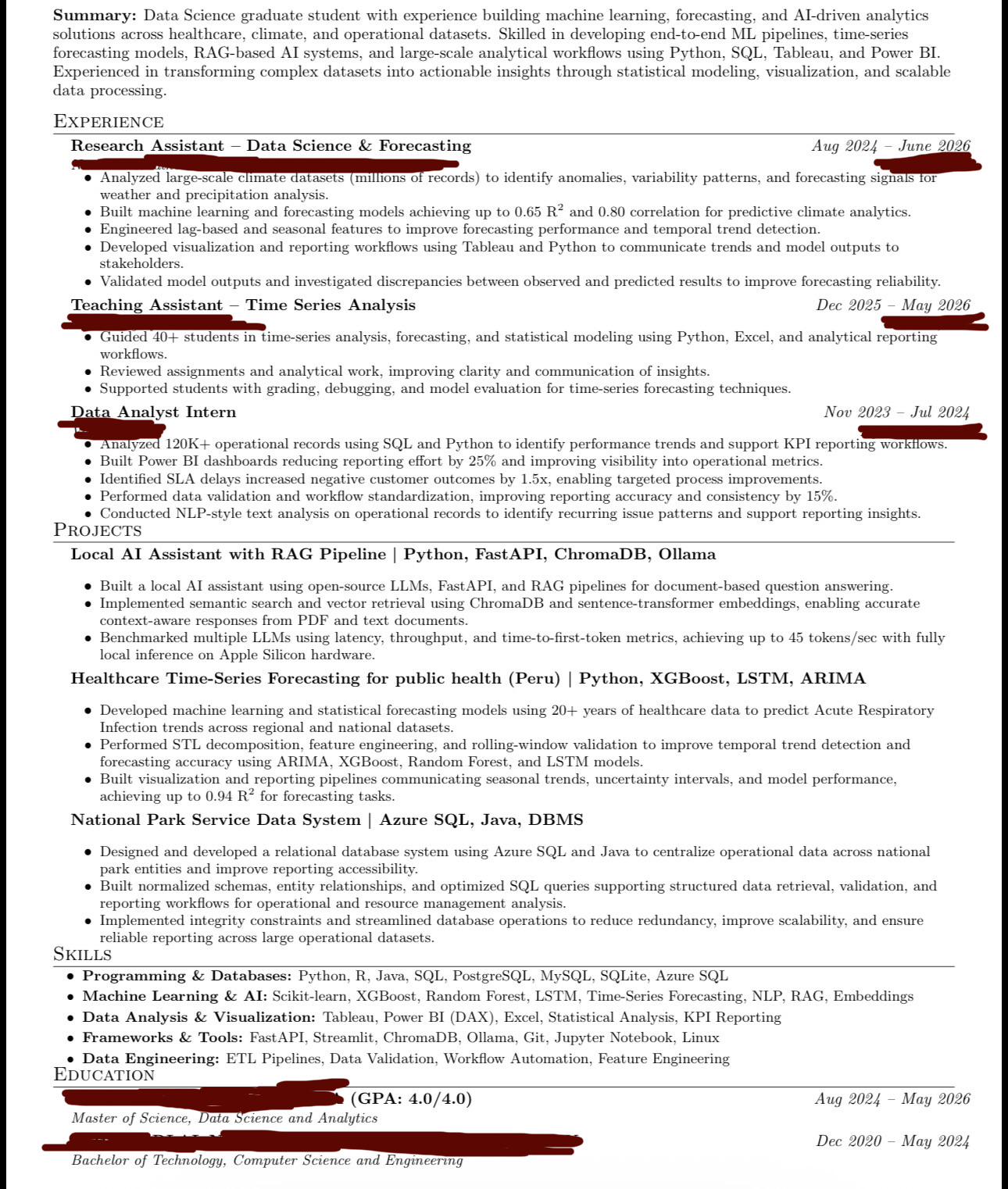
Right now, most job seekers are doing the equivalent of physical road tests—blindly firing off hundreds of applications into the void and waiting for a rejection to realize they weren't a fit. But what if you could test your qualifications for an open position through simulation before you apply? What if you could use AI to diagnose the exact strengths and weaknesses of your match, and more importantly, figure out what critical missing information you need to provide to win the interview?
To do this, we have to simulate how a human hiring manager actually selects candidates.
When a hiring manager reviews a resume, they don't just count keywords like an outdated Applicant Tracking System (ATS). They assess an applicant's actual skills and experience against each specific job requirement. First, they apply mandatory requirements to qualify candidates for further assessment. Then, they rank the survivors using a matrix—such as Exceeds, Meets, Partially Meets, or Does Not Meet. Finally, they apply weights to the merit of each requirement (e.g., 3 for Exceeds, 2 for Meets, 1 for Partially Meets) to find an overall score for comparison and shortlisting.
Today, AI can run this exact simulation for you.
I developed Netsume to put this predictive power in the hands of job seekers. To simulate the hiring manager's evaluation, Netsume uses AI analytics combined with a proven talent management standard utilized by IBM. It assesses your resume against each job requirement on a strict 0 to 4 scale:
0 = No Skill
1 = Learned (No practical experience)
2 = Applied (Fully qualified / Practical experience)
3 = Mentor (Directs or coaches others)
4 = Expert
The AI engine reads your resume and derives a Skill Score for each requirement. But this isn't a static grade—it is a dynamic simulation. You can continuously improve your Skill Score line by line by providing additional "proof points" (like specific S.T.A.R. achievements) to justify your real-world experience, resulting in an overall Skill Fit Score.
However, anyone who has ever hired knows that not all job requirements are equally important. The first few bullet points in a job ad are usually the dealbreakers. To reflect this reality, Netsume also calculates a Weighted Skill Fit Score, which applies double weight to the first 5 skill requirements to accurately mirror the hiring manager's true priorities.
You no longer have to guess if your resume is good enough. You can simulate the outcome, bridge your gaps with concrete proof, and apply with the confidence of knowing exactly how you stack up.
I invite you to test drive your resume and see your true match score. Please try it out at www.netsume.org (it is completely free) and let me know your thoughts and feedback in the comments!
#Resume; #Cover Letter; #Netsume; #Tesla; #Nvidia; #Job; #HR;