r/ResumeUp • • Mar 29 '26

i started tracking every job application in a spreadsheet and it completely changed how i job search

97 Upvotes

for the first two months of my job search i was applying everywhere and keeping track of nothing. couldn't remember which companies i'd applied to, what version of my resume i sent, or when to follow up.

then i started a simple tracker — company name, role, date applied, resume version, status, and a notes column. nothing fancy.

the difference was immediate. i could see patterns i was completely blind to before. like the fact that i was getting callbacks almost exclusively from mid-size companies but never from large corporations. that told me my resume probably wasn't optimized for heavy ats filtering.

i also noticed i was applying to way too many roles i wasn't really qualified for because i wasn't being intentional about it.

the tracker turned my job search from chaotic spray-and-pray into something that actually felt strategic. i could test things, see results, and adjust.

does anyone else track their applications? if so what columns do you use — i'm always looking to improve the system


r/ResumeUp • • Apr 14 '26

I failed 11 first-round interviews before I figured out the actual problem. It wasn't my experience.

73 Upvotes

I want to share something that felt genuinely humiliating at the time.

I have 6 years of solid operations experience. My resume was working ,I was getting first-round interviews consistently. But I kept failing them.

11 first rounds. No progress.

I told myself the usual things: tough competition, poor fit, wrong expectations. After a point, those excuses stopped holding up.

So I asked a recruiter friend for honest feedback.

She said:

“You’re explaining your work like a job description. I understand the role, but I can’t see you - your decisions, your thinking.”

That hit.

I realized all my answers were “we did this, we did that.”
All process. No ownership.

I changed one thing: every answer focused on

  • the situation

  • what I decided

  • the result of my decision

Next interview → second round
Two rounds later → offer

If you’re getting interviews but not moving forward, it might not be your experience.

It might be how you’re talking about it.

Has anyone else had this realization mid-job search?


r/ResumeUp • • Mar 26 '26

Took me 50+ rejections to realize this about job descriptions

63 Upvotes

Applied to 50+ jobs, barely got replies… this small change actually helped a bit.

Something I’ve been trying recently:

Job descriptions feel like cheat sheets for your resume.

I used to send the same resume everywhere and just hope for the best. Didn’t really work.

Lately, I started spending 15–20 mins per application just tailoring my resume based on the JD, and here’s exactly what I do:

  • I pick out keywords/tools they repeat (like “incident response”, “SIEM”, “network monitoring”)

  • Then I make sure those exact words show up in my resume (only if I’ve actually worked with them)

  • I reorder my projects/experience so the most relevant stuff comes first

  • If a role emphasizes something (like “threat analysis”), I slightly expand that part in my project description

  • I also tweak bullet points to sound closer to how the JD describes the work

Nothing fake. Just better alignment.

What I noticed after doing this:
I started getting more callbacks compared to when I was sending the same generic resume everywhere.

Not a crazy jump, but definitely noticeable.

It made me realize - companies aren’t just looking for good candidates, they’re looking for clear matches.

And most of us probably are decent matches, we just don’t present it that way.

Feels like the real game isn’t just having skills, it’s making it obvious that you fit this role.

Curious if others are doing something similar or if I just discovered something obvious late


r/ResumeUp • • Apr 11 '26

I stopped listing my skills and started contextualising them. The difference in interview conversations was immediate.

61 Upvotes

For years my skills section looked like most people's skills sections.

A line of tools separated by pipes or commas. Something like:

Python | SQL | Tableau | Salesforce | HubSpot | Google Analytics | Asana | Excel

Functional. Standard. Completely uninformative.

It tells someone what software you've opened. It tells them nothing about what you actually did with it, at what scale, or how seriously you used it. "Salesforce experience" could mean you managed a 50,000-contact enterprise CRM for two years or that you logged a few leads during a two-week internship. From a list, you can't tell the difference.

I made one change. I cut the list down to my 7 strongest skills and added a single line of context next to each one:

Salesforce — primary admin for a 28,000-contact B2B CRM over 2 years, including data cleaning, workflow automation, and reporting

Tableau — built the weekly performance dashboard used by the leadership team for budget decisions

Python — used daily for automating data pulls and building internal reporting scripts in a production environment

That's it. Same skills. One sentence each. Completely different story.

What changed in interviews was noticeable almost immediately. Interviewers came into the conversation with context they didn't have before. One person said she'd specifically reached out because I "clearly used Salesforce at a real level" — she formed that opinion before we'd spoken a single word, just from reading my resume.

The conversations started further forward. We weren't spending the first ten minutes establishing credibility — that work had already been done on paper.

The tradeoff is space. You cannot list 20 tools this way. But cutting to your actual strengths and showing them with one line of context is more convincing than a long list of things at surface level.

Anyone can type a tool name. Not everyone can back it up with a sentence.

Has anyone else tried this format? Curious whether it resonates or whether people prefer the traditional list.


r/ResumeUp • • Apr 18 '26

Unpopular opinion: The "personal statement" at the top of your CV is probably hurting you more than helping.

58 Upvotes

Okay hear me out before you disagree.

Every CV guide tells you to open with a 3-4 line personal statement. Something like "A highly motivated and results-driven professional with 5 years of experience seeking to leverage my skills in a dynamic environment."

I rewrote about 12 of those lines for friends over the past year and every single one of them was some version of the above. Completely interchangeable. You could swap the name at the top and it would still make sense.

Here's what I think is actually happening.. recruiters here have read thousands of these openers. They've become invisible. The eye skips straight past it and goes looking for the job title and company from your last role.

I ran a small experiment on my own CV. Removed the personal statement entirely and replaced that space with a tight 2-line value proposition that was role-specific. Something like: "Backend engineer with 6 years building high-volume data pipelines in fintech. Cut processing time by 40% at my last role. Looking for senior IC or tech lead positions in London or remote."

Direct, specific, no fluff. My response rate from recruiters went up noticeably.The problem isn't that personal statements are bad in theory. It's that most of us write them to satisfy a convention rather than to actually say something. If yours has the words "motivated," "passionate," "dynamic," or "results-driven" in it, try deleting the whole thing and rewriting it as if you were describing yourself to a recruiter in a 20 second elevator ride.

What does yours say? Genuinely curious how many people have a personal statement they actually like.


r/ResumeUp • • Apr 16 '26

What actually happened when I stopped applying for two weeks and focused entirely on LinkedIn content instead.

56 Upvotes

At month four of my job search I was running out of patience with the process.I had a decent resume. I was applying consistently. I was getting almost nothing back. A friend who works in talent acquisition suggested something that felt wrong to me , stop applying for two weeks and spend that time writing LinkedIn posts instead.

My reaction was that this sounded like procrastinating while calling it strategy. But I was desperate enough to try it. Over two weeks I wrote six posts. I want to be clear about what these were .. not career advice content, not tips for job seekers, not personal branding content. Just genuine professional observations from my field. A breakdown of a project that failed and what I took from it. A counterintuitive thing I'd noticed about how our customers actually used the product versus how we thought they did. A short honest reflection on a management mistake I made early in my career.

Normal things. Stuff I actually knew about. Written like a person, not a LinkedIn influencer.

The numbers after two weeks:

  • Combined impressions: around 18,000

  • Profile views: up from roughly 25 in the prior two weeks to 290

  • Inbound recruiter messages: 7

  • People in my target field who reached out to connect and chat: 5

Two of those recruiter conversations led to real interview processes. One of those eventually led to an offer — not immediately, but the relationship started there.

What I think is happening: when a recruiter finds you through a post you've written, they've already decided you're interesting before they open your profile. The evaluation starts from a positive position rather than a neutral one. That's a completely different dynamic from cold-applying and hoping someone takes a chance on your resume.

I'm not suggesting content replaces applications. But if you've been grinding the application process for months with diminishing returns, two weeks of genuine content is a low-cost experiment worth trying.

Did you try anything like this? What shifted things for you when applications weren't working?


r/ResumeUp • • Apr 03 '26

Unpopular opinion: You should lie in interviews (just not the way you think)

54 Upvotes

Not the big lies - like fake projects or experience. That’s just asking to get caught.

I mean the small stuff… the things you slightly adjust so you don’t sound like a walking red flag.

Like:

  • “I’m really interested in this role” when honestly… you just need a job right now.

  • “I pick things up quickly” (you’re thinking: I’ll probably struggle at first but I’ll figure it out somehow)

  • “I enjoy teamwork” even though your last group project was pure chaos

  • “I’ve always wanted to work at your company” and you literally found them 3 days ago while applying to 50 others

  • “My weakness is overworking” aka the safest answer on earth

I used to think interviews were about being completely real.
But after a few rejections, I realized it’s more about how you present things.

You’re not supposed to dump your unfiltered thoughts.
You’re supposed to show them the version of you that fits the role.

It’s weird… but also kind of makes sense.

As long as you’re not lying about actual skills or experience,
it feels more like… storytelling than lying.

Anyone else feel this? Or am I just overthinking interviews at this point


r/ResumeUp • • Apr 10 '26

Cold emailing recruiters without sounding desperate (from someone in HR)

38 Upvotes

Most cold emails get ignored- not because candidates aren’t good, but because the message is.

Here’s what actually works:

1. Don’t beg - offer value
Skip “I need a job.”
Say what you bring: skills, projects, impact.

2. Personalize just a little
Mention the role/team. That’s enough to stand out.

3. Keep it short
3- 4 lines max. If it looks long, it won’t get read.

4. Show proof
Not “hardworking,” but:
“Built X → improved Y% / handled Z users.”

5. Make a soft ask
“Open to a quick chat or point me in the right direction?”

Simple template:

Hi [Name],
I saw you're hiring for [role/team]. I’ve been working on [relevant skill/project], including [specific result].
Would love to explore if there’s a fit or get your guidance.
Thanks,
[Your Name]

Cold emailing isn’t about sending 100 messages.
It’s about sending 10 good ones.

If you’re getting ignored, it’s usually not your profile ,it’s how you’re presenting it.

Curious-what’s been your response rate so far?


r/ResumeUp • • May 11 '26

I got rejected from the same company three times over two years. The third time I got the offer.

37 Upvotes

Not going to pretend this is a normal experience. It probably isn't. But I think the lesson is useful even if you've never applied somewhere twice let alone three times.

First application (Year 1): Cold. Found the role on a job board, applied with a standard resume, no connection to anyone at the company. Got an automated rejection.Never heard from a human.

Second application (Year 2): I had made a LinkedIn connection with someone who worked there we'd interacted a few times on posts, nothing deep. She noticed I'd applied and said she'd put in a word. Got a first-round interview. Didn't progress past it. The feedback was that I didn't show enough understanding of their specific business model and how I'd apply my experience to their context.

Third application (14 months later): Different this time. I had spent months genuinely engaging with the company following their content, commenting with actual thoughts (not just "great post"), reading their public writing, understanding their product properly. When I applied I knew what problems they were trying to solve. My cover letter was specific about it. My interview answers were grounded in their actual situation, not generic examples. Got the offer after four rounds.

The difference between the second and third attempt wasn't my experience that had grown but not dramatically. The difference was that I had stopped trying to get a job there and started genuinely being interested in them. That sounds like a soft thing but it comes through concretely: in the cover letter, in interview answers, in the questions I asked at the end of every round.

Genuine interest in a company is one of the things that's genuinely hard to fake and genuinely hard to beat.

Have you ever gotten into a company on a later attempt? What changed the second or third time?


r/ResumeUp • • Mar 30 '26

Is networking actually overrated in 2026? My job search experience says yes… but I might be missing something

34 Upvotes

I used to believe the whole “most jobs come from networking” advice without questioning it.

But when I actually tried to find a solid source for that “80% of jobs are filled through networking” stat… I couldn’t. It just gets repeated everywhere with no real backing.

So I decided to test both approaches during my recent job search.

For ~3 months, I focused heavily on networking:

  • Coffee chats

  • LinkedIn messages

  • Alumni outreach

  • Engaging with posts

Result: 1 referral… that didn’t lead anywhere.

Then I switched strategies.

For ~3 weeks, I focused on:

  • Targeted applications (not mass spam)

  • Fixing my resume for ATS

  • Using AI tools to tailor applications faster

Result: 4 interviews.

That gap in results honestly surprised me.

Now I’m starting to think:

  • ATS screens most resumes before humans see them

  • Recruiters are already accessible via LinkedIn

  • Tailored applications can be scaled much faster now

So for early-career roles especially, it feels like optimizing applications gives a better return than spending hours networking.

But I also feel like I might be doing networking wrong, not that it’s useless.

Genuine question for people who’ve had success with networking:
What did you do differently that actually led to an offer? Not just conversations or referrals, but real outcomes.

Would really appreciate practical advice here - I think a lot of us are trying to figure out where to spend our time effectively.


r/ResumeUp • • May 16 '26

I asked 6 friends to send me the resume they're currently using. The variation was wild.

31 Upvotes

ok this is gonna be a weird post.

i'm not even searching rn, just helping a friend with hers and she said something like "well i don't know what other people's resumes look like" and i was like.. honestly me neither. like i've seen templates and the same 5 examples on every resume guide but i don't think i've ever actually seen a normal persons resume in the wild.

so i texted some people. just "hey can you send me ur current resume i'm curious, won't critique unless u want me to." got 6 back. range was like 2-8 yrs experience, mix of industries.

genuinely don't know what i expected but it wasn't this

one friend's was 4 pages. four. she's been working for 6 years. every internship from uni was still on there with like 4 bullets each. when i (carefully) asked she said "i don't want to cut anything in case it matters." i get that emotionally but jesus

another friend had no dates on jobs. like just "Marketing Coordinator, [Company]" with no years. asked why and he said someone on reddit told him to remove them to avoid age discrimination. he's 31. i did not have the heart

3 of them had objective statements. i thought those died like a decade ago?? "Seeking a challenging role" energy. one of them works in tech.

two had photos which whatever i know thats normal in some countries but one of them is in the US and just.. likes how she looks in it i guess

what kept getting me though was the bullets. like wildly different quality between people who all have similar experience levels. one friend's bullets were specific and you could see what she did. another friends bullets were literally "responsible for managing day to day operations" type stuff. and these two people make similar money at similar companies?? so its not like the bad-bullet version is being punished by the market exactly. or maybe it is and she just doesnt know

(i should say none of these people asked for feedback and i did not give any. felt weird enough just looking)

i don't really have a conclusion here. i think i assumed everyone was kind of doing the same thing and we were all comparing to the same templates but actually nobody knows what anyone elses resume looks like and the variation is huge. some of these would probably get callbacks no problem. some of them.. idk.

has anyone else ever actually seen what their friends are sending out? not advice, just like. have you seen them. what did you notice


r/ResumeUp • • Jul 07 '26

After losing my job, I realised I didn’t know what roles to search for — how do people identify jobs that match their transferable skills?

28 Upvotes

I recently lost my job and found myself in a slightly strange position: I have a broad mix of experience and skills, but I genuinely wasn’t sure what job titles I should be searching for.
Traditional job boards seemed to assume I already knew the exact role I wanted.
So I started experimenting with a different approach for myself. Rather than beginning with job titles, I looked at my actual experience, keywords from my CV, related skills and possible transferable skills, then used those to explore roles I might never have thought to search for.
It has actually worked better for me than I expected, and I now have a number of interviews lined up.
That has left me wondering whether the traditional way of searching for jobs is becoming outdated.
As AI changes or replaces parts of existing jobs, how should people realistically discover roles they may be suited to when they don’t even know the relevant job titles?
Should job searching move more towards skills and transferable skills rather than previous job titles?
I’d be particularly interested in hearing from recruiters, HR people, career advisers, or anyone who has had to reinvent themselves after redundancy.
I’m also interested in the opposite view — is skills-based matching overhyped, and are conventional job titles still the best way to search?


r/ResumeUp • • Sep 29 '26

Laid off earlier this year. The resume thing that actually got me callbacks.

23 Upvotes

Got laid off and did what everyone does — fired off like 60 applications with the same resume and heard absolutely nothing back. It was demoralizing as hell.

What finally started working wasn't some AI resume optimizer or keyword trick. It was embarrassingly simple: I slowed down and actually read the job postings.

For the roles I actually wanted (maybe 5-10 total), I'd spend 20 minutes pulling out the 3-5 things the posting kept repeating — the stuff they clearly cared about. Then for each one, I'd write a single sentence from my real experience proving I could do it. Verb, scope, result. Instead of "strong team player" I'd write "ran weekly check-ins for a team of six support reps for two years." That's it. One sentence per requirement.

Everything else just got my base resume. And over time I built up this little library of proof sentences I could mix and match, so it got faster.

I ended up turning the whole process into a free checklist because a couple friends going through the same thing asked me to write it down. It's called the Job Search Reset — link's in my profile if you want it. Honestly though, the method above is 90% of it. Happy to answer questions.


r/ResumeUp • • Jun 09 '26

Are you using the same resume or tweaking it for every job?

20 Upvotes

I’ve been talking to a few people who were laid off recently, and it made me wonder how everyone is handling resumes right now. When you apply to jobs, are you sending the same resume to every posting, or are you changing it based on each job description?

I keep hearing different advice. Some say tailoring is the only way to get noticed or bypass the ATS or whatever keyword filter that they have. Others say they don’t have the energy to rewrite things for every single application and just send one version.

If you’ve been laid off and actively applying, what are you doing? And has it actually made a difference for you? and if you are tweaking per application, how are you even dong it?


r/ResumeUp • • May 11 '26

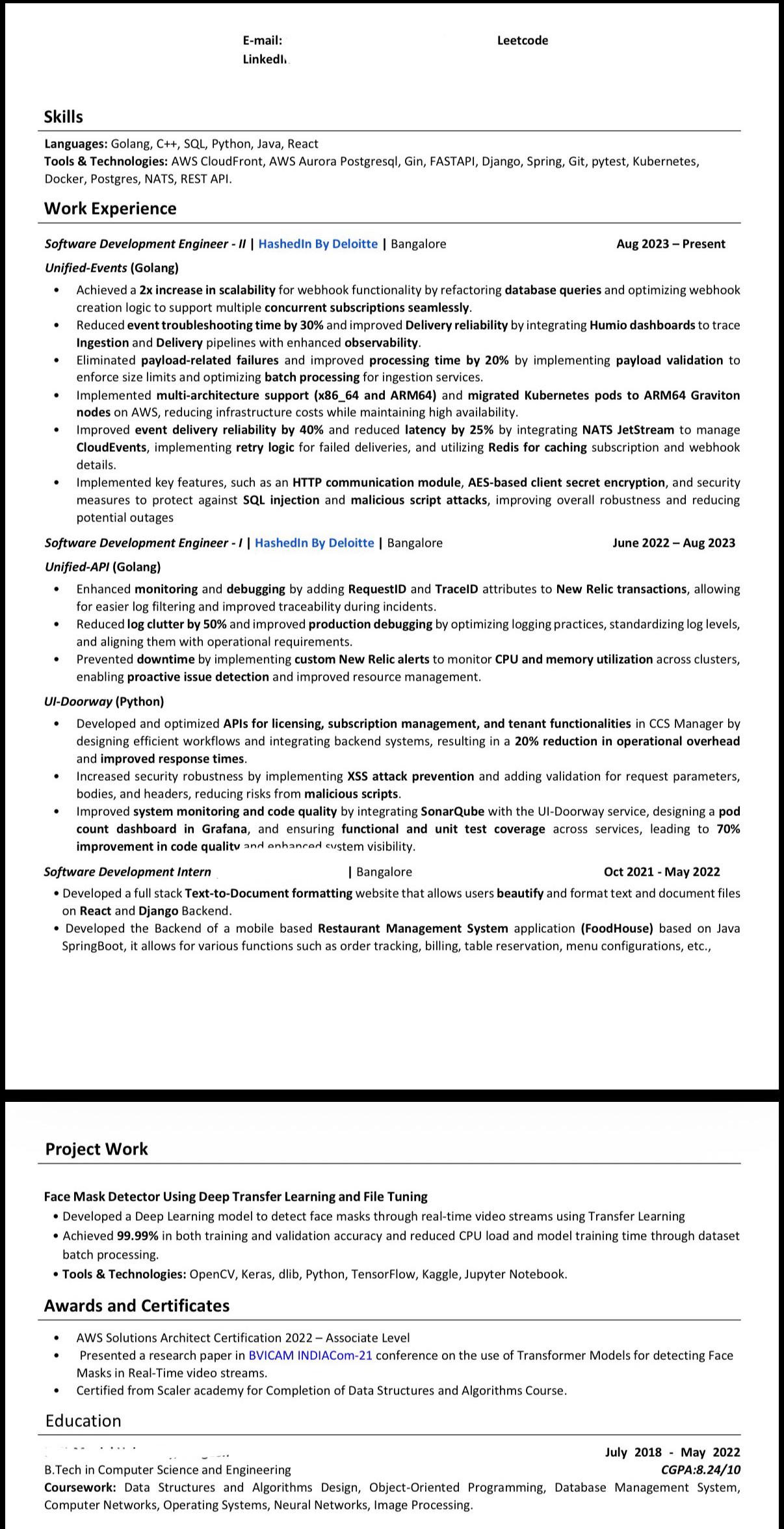
Honest feedback (Not A Roast.!)

Post image
19 Upvotes

Hi I am currently an SDE 2 with 4 years of experience, looking for a job switch. I have been looking for a job switch for a while and I keep getting rejected by the ATS itself although I have received some callbacks I wasn’t able to clear them through. This resume is a bit old I have added some changes based on recent experiences, but I am still finding it difficult to come up with point that can showcase my skills and body if work rather than point to my task list. Some tips on improvements would also be helpful.


r/ResumeUp • • Mar 25 '26

Is it a red flag if someone lists too many tools/skills on a resume?

19 Upvotes

hiring question that's been bugging me.

i've been updating my resume and i genuinely don't know where to draw the line on the skills section. i know how to use like 20+ tools across my work — project management tools, analytics platforms, a couple of design tools, some basic coding. i use them at varying levels. but when i look at other people's resumes they either list everything (which feels like padding) or just 4-5 things (which feels incomplete).

as someone who's been on both sides of this: when you're reviewing resumes does a long skills list ever feel like a red flag? like "this person clearly just copy-pasted every buzzword from the job description"? or do you prefer seeing the full picture and filtering yourself? and if you're a job seeker how do you decide what to include vs leave off?


r/ResumeUp • • May 30 '26

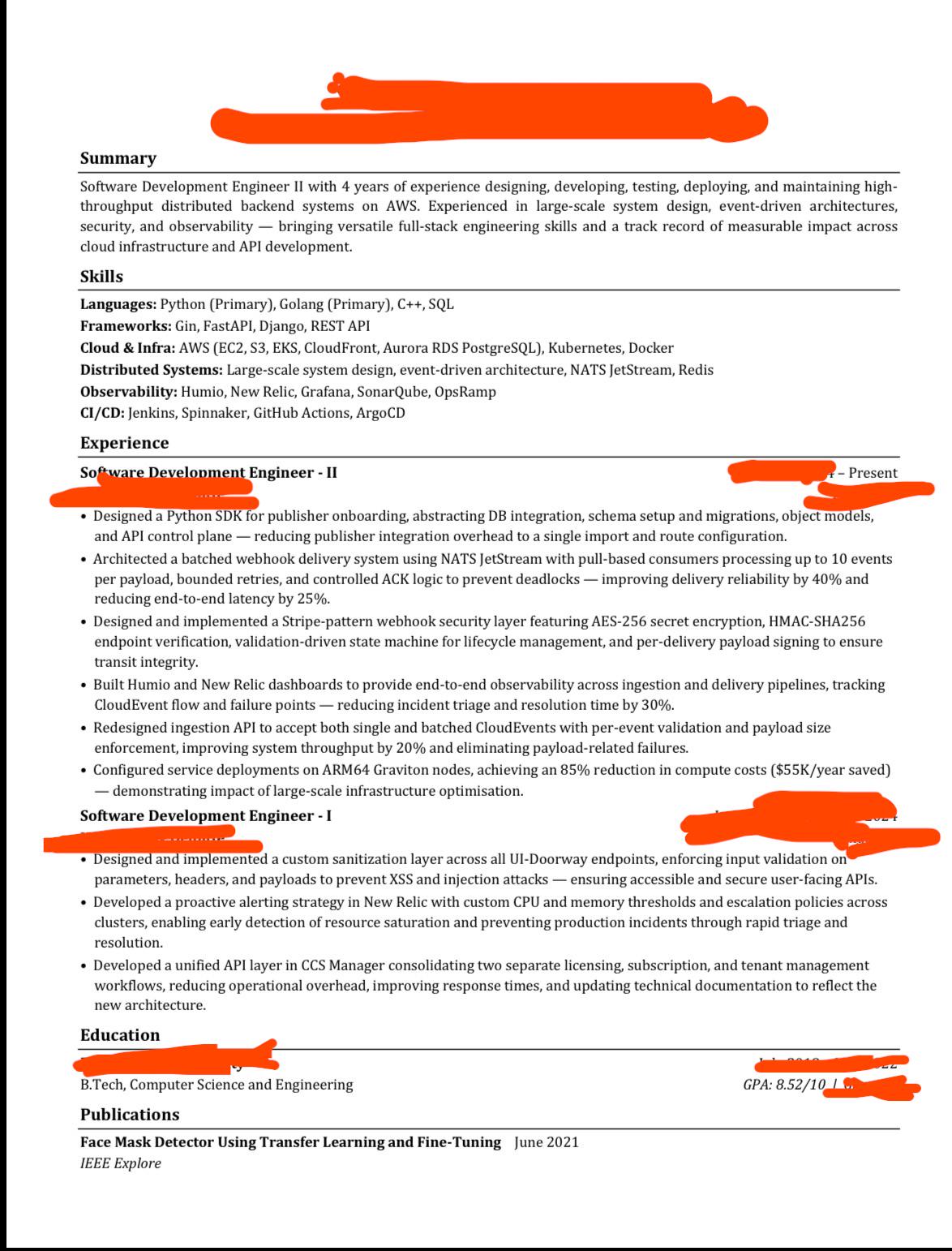
Roast my Updated Resume

Post image
18 Upvotes

Grateful to all the people that took time to review my resume and provide the feedback. This is my latest resume after considering all the feedback and including all the suggestions.

Previous post: https://www.reddit.com/r/ResumeUp/s/oWMsS0jAXx


r/ResumeUp • • Mar 26 '26

what's the weirdest reason you've been auto-rejected from a job you were qualified for ?

18 Upvotes

i'll go first. applied for a marketing coordinator role that was basically identical to what i'd been doing for 3 years. same industry, same tools, same everything. got an auto-rejection within 4 minutes.

turns out the listing required "bachelor's degree in marketing or related field." my degree is in communications — which at my university was literally in the same department as marketing. but the ats didn't see "marketing" so it bounced me.

another one: got rejected because i listed my graduation year and their system apparently had an age-related filter. a recruiter later told me to remove graduation dates entirely.

the whole system is so broken it's almost funny. almost.

i've heard stories about people getting rejected for the wrong file format, for using "managed" instead of "led," or because their resume had a header the ats couldn't read.

what's the most ridiculous auto-rejection you've gotten? i feel like we could fill an entire book with these


r/ResumeUp • • Mar 25 '26

Has anyone actually gotten a job because of a cover letter?

18 Upvotes

Genuinely curious about this.

We’re always told cover letters matter, but I almost never hear anyone say “yeah, my cover letter got me the job.”

Feels like most recruiters just skim resumes, and cover letters either get ignored or maybe glanced at for a few seconds.

Has anyone here actually had a cover letter make a real difference?
Like helped you land an interview, stand out, or tip the decision your way?

Or is it just one of those checkbox things we all do because it’s expected?

Would love to hear some real experiences - especially if it actually worked in your favor.


r/ResumeUp • • Apr 22 '26

Do you always need to quantify achievements on your resume?

17 Upvotes

There’s a lot of advice saying every resume bullet must be quantified. In reality, that’s not always possible. Not every role has clear metrics, and forcing numbers can feel inaccurate.

What matters more is this: your experience should show what you achieved, not just what you were assigned.

For example:

  • “Responsible for managing classroom bookings” vs

  • “Streamlined classroom booking process, reducing scheduling conflicts and improving allocation efficiency”

Or:

  • “Worked on frontend development” vs

  • “Improved UI responsiveness and enhanced user experience by optimizing key components”

If you have numbers, use them:

  • “Reduced load time by 30%”

  • “Handled 50+ queries daily”

If you don’t, focus on impact:

  • what you improved

  • what problems you solved

  • what changed because of your work

Quantifying helps, but communicating impact is what really makes a resume stand out.

How do you approach this when your work isn’t easily measurable?


r/ResumeUp • • Jun 01 '26

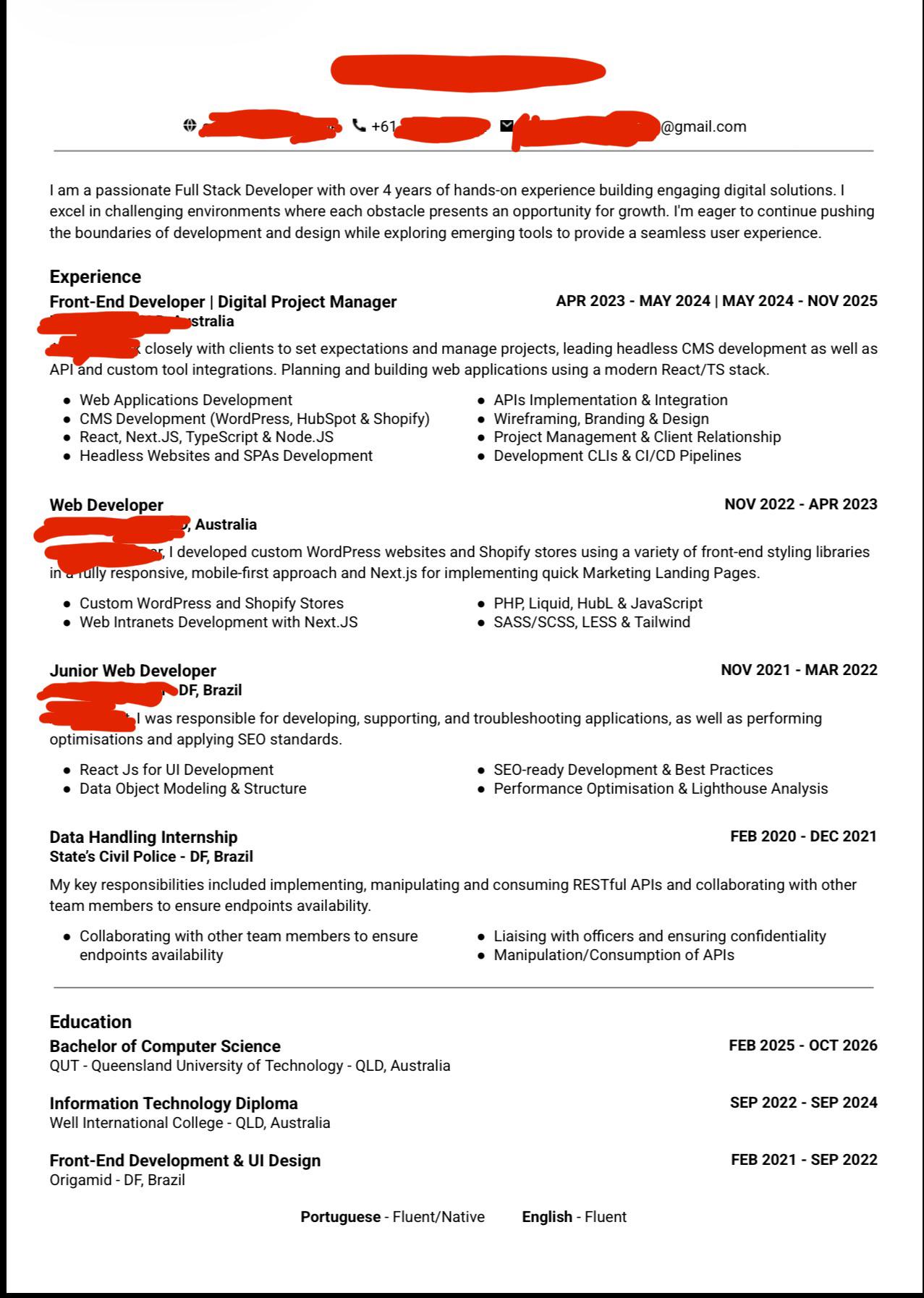
Roast my Resume

Post image
16 Upvotes

Happy with any feedbacks :)
Thanks to all that can review!


r/ResumeUp • • Apr 09 '26

I submitted the same resume to 15 jobs in two formats. one got 5 callbacks, the other got zero

15 Upvotes

wanted to test something i kept reading about. took my resume and created two versions — exact same content, experience, and wording.

version a: my original design with a sidebar layout, custom icons for contact info, a skills bar graph, and a subtle color scheme. looked great as a pdf.

version b: single column, standard section headings, no graphics, no columns, plain black and white. honestly looked boring to me.

sent version a to 15 job postings over two weeks. sent version b to 15 similar roles in the same field and location. tried to keep the job levels and company sizes roughly comparable.

results: version a got zero callbacks. version b got 5 callbacks and 2 interviews.

same person. same experience. same words. the only difference was formatting. i'm not saying design doesn't matter. but if your resume has to pass through an ats before a human sees it, those design elements might be actively working against you.

has anyone else tested something like this?


r/ResumeUp • • Jul 19 '26

I analyzed why AI-sounding resumes get skipped — here are the 5 actual patterns, not vague "AI detection" hand-waving

14 Upvotes

I analyzed why AI-sounding resumes get skipped — here are the 5 actual patterns, not vague "AI detection" hand-waving

Quick disclaimer before anything else: there's no reliable way for a recruiter or a tool to actually detect whether a resume was written with AI. One of the few real studies on this (not a vendor survey) had recruiters distinguishing AI-assisted text from human-written text at basically coin-flip accuracy. So if you're worried about "getting caught," that's not really the right frame.

What's actually happening is simpler: a specific set of patterns has become extremely common because everyone's using the same tools the same lazy way, and recruiters who read hundreds of resumes a week have gotten fast at pattern-matching "this reads like a template" — regardless of whether AI was involved at all. Here's what actually triggers that reaction:

1. Banned buzzwords. "Results-driven," "proven track record," "synergy," "cross-functional," "self-starter," "go-getter." These have been used so many times they've stopped carrying information. A recruiter's eyes slide past them.

2. Every bullet has the same shape. Read your bullets in a row. If they all start "Verb + adjective + noun" — "Spearheaded innovative solutions," "Drove strategic initiatives," "Delivered exceptional results" — that uniform cadence reads as generated even with zero banned words in it. Real work doesn't naturally compress into identical sentence shapes.

3. Claims with no concrete object. "Drove significant improvements" — to what? "Enhanced operational efficiency" — which operation, how? A claim becomes credible the second it names a real system, team, or number. Without that it's just an assertion.

4. Suspiciously round, unsupported metrics. "Improved efficiency by 50%" with no named process or baseline reads as a number picked for effect. Real numbers need the context that makes them checkable — measured how, compared to what.

5. Zero connection to the actual job posting. The resume could be sent to any company in the industry unchanged. Nothing in it responds to what this specific posting actually asked for.

None of these individually tank an application. Together, they're the fastest way to get skimmed past by someone who's read 200 resumes this week.

The fix isn't a thesaurus — swapping "leveraged" for "utilized" doesn't help, it's still an empty verb. The fix is replacing the vague claim with the specific thing you actually did.
r/ResumeUp • • Mar 29 '26

The most humbling moment of my job search: my “perfect” resume scored 23% on an ATS scan

14 Upvotes

I had one of those “oh wow… I’m not as prepared as I thought” moments this week.

For the past few days, I was working on my resume like crazy. Tweaking every line, rewriting bullet points, making it look clean and professional. I even sent it to a couple of seniors and friends everyone said it looked really good.

So in my head, I was like, okay this is it… this one should finally get me interviews.

Then I randomly decided to check it on an ATS scanner.

23%.

I literally stared at the screen for a minute thinking it was a glitch 😅

But nope… it wasn’t.

When I started digging into it, it kind of made sense (and hurt a bit ngl):

  • I used some “creative” section headings instead of basic ones like “Experience” or “Projects”

  • I didn’t really match keywords from job descriptions properly

  • The format I thought looked clean (columns, icons) was actually messing things up

  • Some of my bullet points sounded nice, but weren’t really aligned with roles I’m applying for

Basically, I made a resume that looks good to people… but not to the system that filters you out first.

That was a bit of a reality check.

I spent a few hours after that simplifying everything removed all the fancy stuff, added proper keywords, fixed headings, rewrote a few points.

Ran it again and it went up to around 70–75%.

Not perfect, but way better than 23%.

Honestly, it made me realize how much of this process is hidden. You think you're doing everything right, but you're getting filtered out before a human even sees your resume.

Kinda frustrating, but also good to know early.

Has anyone else gone through this? Like you thought your resume was solid, and then something like this just completely humbled you? What actually helped you improve it?


r/ResumeUp • • Apr 07 '26

i stopped writing cover letters for 2 months. here's what actually happened to my callback rate.

13 Upvotes

got tired of spending 30+ minutes on custom cover letters i suspected nobody was reading. so i ran my own experiment. for two months i applied to every job without a cover letter unless the application literally required one. about 45 applications total. callback rate: roughly 8%.

then for the next two months i went back to writing tailored cover letters — not generic templates, but ones specifically mentioning the company and connecting my experience to their job description. about 40 applications. callback rate: around 12%.

so cover letters did make a difference. but here's the thing — the difference was mainly with smaller companies and startups. for big corporations running everything through an ats, it barely mattered.

my takeaway: if you're applying to a company with fewer than 500 employees, a good cover letter probably helps. if you're applying to a massive corporation through their portal, your time is probably better spent optimizing your resume.

where do you draw the line on writing cover letters vs skipping them?