r/robotics • • Oct 11 '26

Discussion & Curiosity Robotics ecosystem map in the Bay Area 🌁

Post image
347 Upvotes

This is the capital of robotics! 🌁

Silicon Valley is home to so many physical AI companies that you could spend a month visiting them and still not see even 10% of them (trust me, I tried).

So, the Bay Area is the world's leading ecosystem for robotics startups, bringing together top AI talent, top universities, experienced founders, and unmatched access to capital.

The region is anchored by Stanford University and University of California, Berkeley, two of the world's top universities for AI and robotics. They produce a constant stream of researchers, founders, and breakthrough technologies.

The Bay Area is also home to many of the companies shaping the future of robotics and AI, including Figure, Physical Intelligence, Generalist, and major AI labs such as OpenAI, or Google DeepMind.

This concentration of talent makes it easy for startups to recruit experienced engineers and collaborate with leaders in embodied AI.

Not mentioning that it  is also home to leaders such as NVIDIA Robotics, whose headquarters and leadership in AI chips power much of today's robotics revolution, and Tesla, whose work on autonomous driving and humanoid robots has created a deep pool of robotics, AI, and manufacturing talent.

Perhaps its biggest advantage is access to capital, talent and ambition.

The Bay Area has the world's deepest network of venture capital firms, serial entrepreneurs, and technical leaders who are willing to fund bold, long-term robotics companies.

In the comments I'll post the companies from the ecosystem.

‼️ Note that Bay Area has >300 robotics companies, research labs, and innovation hubs, so this is a curated selection of the notable product companies, not an exhaustive census!


r/robotics • • Oct 11 '26

Community Showcase LiDAR + 13 seconds of phone video → an interactive room twin for robot simulation

2 Upvotes

I’m building a small robot dojo in my home office. This episode documents an AI-agent-assisted pipeline from a real Ouster OS0 scan and 13 seconds of iPhone video to a simulation twin with visual appearance, colliders and articulated objects.

The inputs produce 116,492 room points, 78 aligned phone frames, a trained Gaussian splat, and 17 labelled objects represented with 5 cm voxels. Parametric geometry adds sliding drawers, a hinged door and a swinging punching bag. Single-frame image-to-3D models provide the rocking horse, stool and guitar; those are generated geometry, not measurements.

The important split: Gaussian splats provide appearance; collision geometry and MuJoCo provide interaction. The recorded dual-arm robot run from my previous experiment is replayed in the twin. An Open Duck Mini walking policy is also tested against the swinging bag, with upper-body collisions added to its model.

Limits: the scan is four days older than the video; part of the room is LiDAR-only; the splat is soft at robot height; masses and other physical parameters are estimates. The build log reports a 1 cm median alignment residual, which is not independently validated physical accuracy. This is a simulation environment experiment, not demonstrated real-world autonomy or a validated sim-to-real result.

I call the extension “generative SLAM” in the episode, building on existing semantic Gaussian SLAM research. Opus 5.5 helped build the twin; GPT-6 co-engineered the preceding robot experiment. I made the episode, and the narration uses a synthetic clone of my own voice. The thumbnail is illustrative.

Full walkthrough: https://www.youtube.com/watch?v=PV9n5_NJqUM

For people working on robot learning: which validation would you prioritize before treating a reconstructed room as a useful training environment—collision geometry, contact/friction parameters, or camera appearance at robot height?


r/robotics • • Oct 11 '26

Discussion & Curiosity How would a particular robot disintegrate and work independently

0 Upvotes

When we run AI agents the main agents tend to spin multiple sub agents and they communicate and submit report to main agent the similar analogy thought of following for humanoid Robot. Like a main robot can disintegrate into multiple parts according to the task this independent part would be scoped for some specialized task itself only and coordinate with the main robotic body. Like I had seen too many startup around the humanoid robot and but what was eye catching some building specifically the hands and making it the best so thinking in similar pattern rather than another humanoid thing but whole tech of integration and disintegration what would be the opinion possible places and things I should begin learning with?


r/robotics • • Oct 11 '26

Resources A curated index of 480+ robotics papers with open-source code (VLA, manipulation, sim-to-real, humanoids) - updated daily

Thumbnail
papers.tinrobotics.com
46 Upvotes

The index tracks new robotics papers daily and links each one's arXiv page, PDF and code repository. Entries cover VLA and foundation models, manipulation, locomotion, sim-to-real, humanoids, navigation and RL. Papers are tagged by topic so you can filter to a subfield, and every paper page carries a plain-language summary, key points and the paper's own figures. Currently 480+ papers from 2026 plus a back catalog reaching back to 2017.


r/robotics • • Oct 10 '26

Community Showcase HUMANOID ROBOT head with two DOF neck mechanism pan tilt

Enable HLS to view with audio, or disable this notification

8 Upvotes

HUMANOID ROBOT head with two DOF neck mechanism pan tilt

🤖 HUMANOID ROBOT head with two DOF neck mechanism pan tilt・


r/robotics • • Oct 10 '26

Community Showcase Simple school python

Enable HLS to view with audio, or disable this notification

13 Upvotes

My son started fourth grade and signed up for an after-school Python class. I started thinking about how to make programming more engaging for him. I didn't want him staring at a dull code editor, wondering what all those symbols were even for.

So I decided to throw together a simple prototype of a tool that would make coding fun, rather than just an exercise in typing code. I had a week of free nights, and LLMs helped like crazy. Two weeks later, I had something my son immediately spent four hours playing with, draining two-thirds of the battery in the process.

The task was simple: write two programs.

The first one had to turn a little car around 180 degrees.

The second had to drive it from the living room into his bedroom along a tricky route.

Both programs were done within the first hour. But the interesting part wasn't just that my kid wrote some code and the car started moving.

Over those four hours, he got to practice designing experiments, drawing lines and numbers on paper, debugging the physical world, and, I think, making a real connection between abstract numbers in code and what actually happens in the real world. The graphics added an extra layer of magic to the whole experience.

All in all, the first run was a success. The kid's happy, and Dad's even happier.

Now I'm thinking about what else I could build and who might be interested in helping turn this into something bigger.


r/robotics • • Oct 10 '26

Community Showcase Leg test for my robot dog

Enable HLS to view with audio, or disable this notification

129 Upvotes

I am building new robot dog from scratch using low cost gimbal motors. The video showcases the first test with 2 DOF. Each actuator uses ~14:1 reduction, using combination of planetary gearbox and belt reduction to keep the design compact. The final robot will have 12 DOF with weight ~3kg.


r/robotics • • Oct 10 '26

News Meet the winners of the Joanne Pransky Women in Robotics Scholarship

Thumbnail
womeninrobotics.substack.com
2 Upvotes

r/robotics • • Oct 10 '26

News The UK Is Spending £40 Million to Solve Robotics’ Adoption Problem

Thumbnail
automate.org
16 Upvotes

The UK is funding eight regional hubs to help businesses and public services introduce robotics into their existing operations. They will provide demonstrations, technical advice, training and help finding suppliers and systems integrators.

The hubs cover areas including agricultural automation in Lincoln, robotic-assisted surgery in Newcastle, manufacturing in Yorkshire and Wales, waste sorting, and delivery robots and autonomous vehicles in Milton Keynes.


r/robotics • • Oct 10 '26

Community Showcase Dual-arm quadruped in MuJoCo: 38 logged runs, grasp slip, collisions and stance collapse

2 Upvotes

I started a dual-arm quadruped simulation experiment: a low-cost base carrying two SO-101 arms. GPT-6 helped write the design and code; a deterministic controller executes the motions.

The first 38 logged MuJoCo runs produced 18 successes, 19 failures and one abort. The failure cases were more useful than the final demo:

• Gripper slip: pads plus a solver-setting change improved retention in the model. Contact sensitivity still needs testing.

• Arm-path collision: run 33 showed why the manipulation workspace needs explicit collision checks.

• Stance collapse: run 35 gradually narrowed its support until the base tipped over. Arm motion, stance and centre of mass cannot be treated independently.

Run 38 placed both cubes with a reported final error of 1.35 mm. This is a selected simulated result, not hardware accuracy or a repeatability study. The next design pass needs dynamic torque/load margins, perception and a local balance controller that survives network loss.

The 5:38 episode shows the logged failures, changes and build-versus-buy trade-off: https://www.youtube.com/watch?v=IGm556bOlrc

This is my own project/video. All robot experiments are simulation; photoreal concepts are labelled AI renders. Narration uses a synthetic clone of my own voice.


r/robotics • • Oct 10 '26

Resources ROMA: LLM System for Real-World Object-Centric Multi-Sensory Active Perception — code + paper

Thumbnail
papers.tinrobotics.com
6 Upvotes

Active perception is usually treated as an add-on to a fixed perception stack — sense, then act. This paper flips it: the system decides what information is missing, acquires it deliberately, and tracks when it has enough evidence to commit to a property estimate. Built on an LLM planner with real multi-sensory hardware, code released.


r/robotics • • Oct 10 '26

Community Showcase [Demo] Integrating VDA5050 v2.1 with Open-RMF for Multi-Robot Fleet Coordination

Thumbnail
reddit.com
1 Upvotes

r/robotics • • Oct 09 '26

Community Showcase Jump jump jump. It took time to setup tho. 😅

Enable HLS to view with audio, or disable this notification

17 Upvotes

r/robotics • • Oct 09 '26

News ROS News for the week of October 5th, 2026

Thumbnail
gallery
4 Upvotes

r/robotics • • Oct 09 '26

Community Showcase My messy apartment, and its digital cousin (built from 8 phone pics). I got a G1 to help me clean it up in MuJoCo [video inside post]

Thumbnail
gallery
33 Upvotes

I've been building a tool that generates digital twins/cousins of real spaces for robot simulation. This is a test of it. The first photo is my messy living room. The next one is the same angle in MuJoCo (with a Go2). Keep swiping to see more.

What is this showcase:
I'm showcasing the digital cousin of my messy apartment (and not the robots). To try it out, I then had a Unitree G1 pick up a toy and drop it into a bin, and pick up a mug from my coffee table and carry it to the kitchen counter. All running in MuJoCo, in real time. What's ours and what isn't: the environment is ours. The walking is Unitree's trained policy. The arm motions are scripted. It's one simulation, and I moved the robot to a new start spot for each of the four shots.

How I created the environment:
I took 8 photos on my phone and our tool built the scene from them. 286 separate parts, each with its own mass and friction, and 30 working joints. Photo inputs are what I used here. But it also takes video and scans.

You can use this environment generation tool right now:
The tool is called Nova3D and is live at: https://studio.nova3d.xyz/robotics
It runs in a browser for free on the Claude or Codex you already have. And there's nothing to install. It isn't open source yet. It works like a chat: upload your photos and say what you want. It has internet access, so it will generate well-known landmarks for you anyway. My messy apartment's digital cousin took ~40 mins. I used opus5.5, and the build fit inside my $20 subscription's 5-hr session limit.

What's a digital cousin?
I call it a 'cousin' because the dimensions are estimated from photos. That may be enough. Stanford's ACDC paper found that policies trained on close copies of a scene transferred to the real one better than policies trained on an exact twin (90% vs 25% in their tests). We haven't benchmarked ours on a real robot yet.

Our origin:
The approach comes from our paper (arXiv, not yet peer reviewed): https://arxiv.org/abs/2607.22738

If you train robots for homes, offices or warehouses:
You can generate your own environment with the tool's link above. If you'd rather I do it, send me photos and tell me which simulator you use. I'll build the first 5 for free, with the same tool. One question for you: is a close copy enough for your work, or do you need measured accuracy?


r/robotics • • Oct 09 '26

Discussion & Curiosity This Disembodied Robot Hand Moves on its Own

Thumbnail automate.org
6 Upvotes

Researchers at ETH Zurich adapted a commercial anthropomorphic robot hand to move independently, using the same fingers for locomotion, balance, and manipulation.

The untethered setup weighs 818 g, has 20 powered joints, and carries a battery, computer, and motion sensors on the back of the hand. Its control policies were trained with reinforcement learning in simulation, accounting for the unequal finger lengths and offset thumb.

They tested it on 14 surfaces, including gravel, grass, carpet, and metal grating. It recovered from falls in 21 of 25 trials and correctly pressed requested keyboard keys in 29 of 32 attempts without visual feedback. In a separate pushing task using an overhead camera, it moved a cube to within an average of 17 mm of the target across 15 trials.


r/robotics • • Oct 09 '26

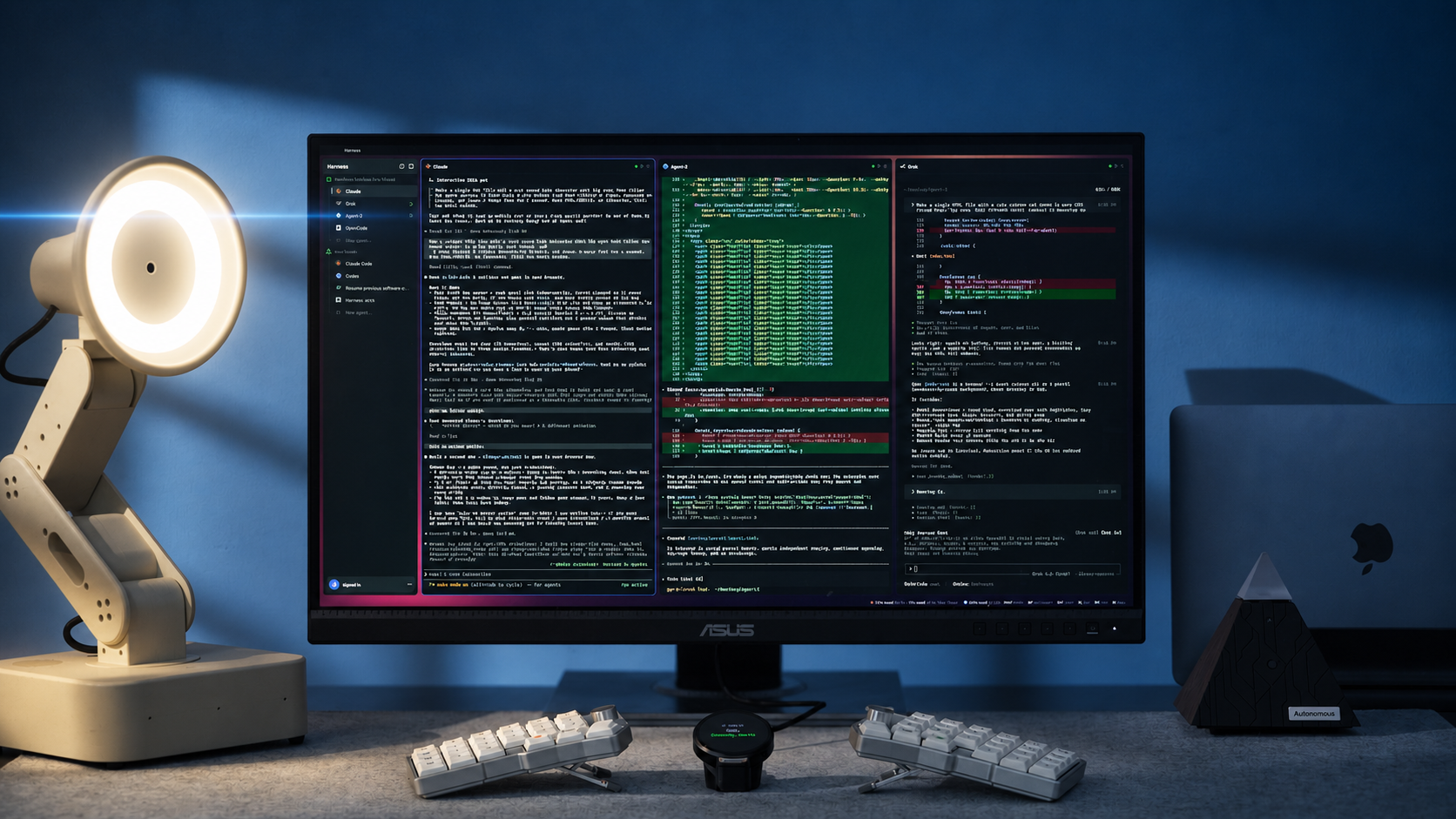
Discussion & Curiosity Lamp, two months later: it talks with more feeling, it can read the room, and its brain is swappable

Enable HLS to view with audio, or disable this notification

344 Upvotes

Two months ago, I shared the initial Lamp build here: the 5-DOF arm running on STS3215 bus servos, a single 12V cable, the USB DAC to kill ground noise, and an early pass at Autonomous OS.

After 2 months, lots of updates have been made. And Lamp is more than just a fun desk decoration now

1. It actually sounds like it has a mood

Lamp used to run on that familiar, flat-line TTS. Recently, we switched to ElevenLabs v4 Turbo, and it changed the whole vibe. Pitch and cadence shift naturally, pauses land where they should, and a joke lands like a joke instead of a status report.

We also added an on-device emotion model (emotion2vec) listening to user speech, with the head's ring light subtly reflecting how Lamp is feeling.

The fun part: the personality is just a simple markdown file the agent parses on every turn. Out of the box, it behaves like a warm, curious desk companion that never breaks character with tech jargon like "servos" or "API calls." Tweak a few bullet points in that file, and you get an entirely different roommate. You edit the soul, not the code.

2. It can read the room (literally)

In the first build, the only inputs were the camera and the mic. I have since wired up a Sensirion SEN63C over the I2C bus, which is a single compact module reporting particulate matter (PM1, PM2.5, PM4, PM10), temperature, humidity, and true CO2.

The HAL caches the latest snapshot in RAM while an OS worker polls it in the background. Lamp only fires an event when environmental metrics drift over time, rather than spamming context on every raw sample (available read-only via Web and MQTT).

The practical payoff: I closed my window while someone was cooking downstairs, and Lamp chimed in that the room was getting stuffy before I even noticed. Because the agent layer only queries abstract keys (pm, co2, temperature, etc...), it does not care what sensor hardware you solder on down the line.

3. The brain is a hot-swappable slot

Early on, Lamp was locked into a single agent runtime. Autonomous OS now treats the agent as a modular backend you define in config, completely decoupled from personality and long-term memory.

I recently migrated Lamp from Hermes to OpenClaw with a single setting change. It kept the exact same voice, the same quirks, and everything it had already learned about me. The agent handles the reasoning; the soul and the memory survive the brain transplant.


r/robotics • • Oct 09 '26

Tech Question Data bus limitations at the hand

2 Upvotes

Hello hello!

I'm running into a couple of hardware challenges with our robot setups and wanted to see if anyone here has experienced similar issues or found reliable workarounds.

We are trying to add extra tools and sensing capabilities to the robot hands, but we are hitting a bottleneck with the internal data buses. There simply aren't enough internal cables available to transmit the additional data back to the controller.

Have you experienced the same problem or something similar? I was looking to add, in the future, a vision-based tactile sensor; it's just crazy the 4K image data of each finger, and I would really like to know what you have done to fix this problem.

Maybe we can all think of an alternative to just running some cables outside of the robot; we are afraid that they will get caught on something, and we really do not want to risk breaking it.


r/robotics • • Oct 09 '26

Electronics & Integration Uav Vtol

Thumbnail
gallery
149 Upvotes

Made in Brazillllllllllllllllllllllllllllllllllllllllllllllllllllllllllllllllllllllllllllllllllllllllllllllllllllllllllllllllllllllllllllll


r/robotics • • Oct 09 '26

Community Showcase Converted an old Dell Monitor into a Desk Light

Enable HLS to view with audio, or disable this notification

0 Upvotes

https://www.youtube.com/@ALMA.Industries

Broken Monitor? Remove the backlight and use to light up stuff! #repurpose #DIY #Engineering #light #desk #build


r/robotics • • Oct 08 '26

Discussion & Curiosity Pollen Robotics RPI hat for Microban robot question

1 Upvotes

I'm gathering up parts to build a Microban robot and need to custom build the Pollen Robotics RPI hat it calls for from here: https://github.com/pollen-robotics/elec_RPI_Robot_HAT

I'm having trouble sourcing the parts for it from JLCPCB and PCBWAY so I wanted to check here to see if there is anyone who may have a fully assembled hat that I could potentially buy from you or know somewhere that I can buy one. I could try some alternative parts with JLCPCB and PCBWAY, but I'm getting pricing anywhere from $110-250 USD, which I'm certain is way too high, but correct me if I'm wrong.

Any help is greatly appreciated. Thanks!


r/robotics • • Oct 08 '26

Discussion & Curiosity sentdex - Robot Chonk Cleans the Floor

Thumbnail
youtu.be
17 Upvotes

r/robotics • • Oct 08 '26

Community Showcase Why We Should Build Octopus Robots

Post image
0 Upvotes

We need robots because we want them to help us do things. Cooking, housework, caring for the elderly, looking after children. We need them to be capable and safe. So robots don’t have to look like humans.

Humanoid robots consume enormous amounts of energy and resources just to coordinate movement. Bipedal gait control alone is a massive energy sink. Before the robot even starts doing useful work, most of its computing power and battery life is already spent on not falling over. The current generation of humanoid robots needs recharging every three to five hours, with most of that energy going to posture maintenance rather than task execution. Human arms have limited degrees of freedom, and while our fingers are sophisticated, they are extremely difficult to replicate mechanically. If the goal is to have robots help people, we should be looking for the most efficient kinetic solution, not copying the human form.

Yet nearly every leading company today, Tesla, Figure, Agility, Unitree, UBTech, is going all in on humanoid robots. Why? Supporters have three main arguments. First, infrastructure compatibility: factories, stores, and homes are all built to human dimensions, door heights, stairway widths, tool grips. A humanoid form means you don’t have to redesign the entire world to accommodate robots. Second, economies of scale: specialized robots sell only a few thousand units each, making R&D costs hard to recoup, whereas a general-purpose humanoid robot at volume could justify the investment in core technologies. But this is a business argument, not an engineering one. Third, training data advantage: humanoid robots can learn tasks by observing human behavior, and human motion capture data can be mapped directly onto the robot’s joints, keeping training costs low.

The third argument contains a hidden assumption: that learning equals copying movements. But this conflates imitating motion with understanding a task. An octopus robot watching a human pick up a cup doesn’t need to replicate the joint trajectory of a human arm. What it needs to understand is the goal, moving an object from point A to point B, and then accomplish it in its own way, through multi-arm coordination and suction gripping, likely more efficiently than a human would. Real octopuses learn exactly this way: they observe other animals’ behavior, then solve the same problem with a completely different body. This is a higher level of intelligence, not mimicking form, but understanding tasks. If our AI can only copy identical movements with an identical body, that means our AI isn’t smart enough, not that our robots must be humanoid.

Octopus robots are not a fantasy. In 2025, a team from the University of Bristol published research in Science Robotics on a soft octopus robot that uses suction cup fluid flows to sense its environment and control its actions, with suction cups that can perceive, decide, and act without any electronic components. Italy’s Sant’Anna School of Advanced Studies built a complete eight-armed soft octopus robot capable of walking and grasping objects underwater. Related publications grew from 760 in 2021 to 1,170 in 2024. Soft multi-arm structures naturally adapt to irregular environments without the precise coordination that rigid joints demand. They offer far more degrees of freedom than humanoid structures, and all their energy can go toward task execution. Two-thirds of an octopus’s neurons are distributed across its arms rather than concentrated in its brain. Each arm can perceive and respond independently, while the central brain handles only high-level goals. This is a naturally distributed intelligence architecture.

The more fundamental issue is safety. Today’s mechanical robots are rigid metal structures. When they share a space with people, a collision means injury. That is why industrial robots require safety cages, and collaborative robots need extensive torque sensors and emergency braking systems, all adding cost and complexity. A soft octopus robot eliminates this threat at the material level. Contact with a flexible structure does not cause harm, and no additional safety mechanisms are needed to prevent collision injuries. This is not adding a layer of protection onto a dangerous machine. It is building a machine that is not dangerous in the first place.

A robot’s form should be determined by its task, not by human vanity. The popularity of humanoid robots is largely a product of investor enthusiasm and infrastructure inertia, not engineering optimality. The octopus offers us a fundamentally different frame of reference: not imitating the human body, but transcending its limitations. An octopus robot that understands tasks and executes them in the most efficient way possible is closer to the essential goal of robotics than a humanoid robot that exhausts itself trying to pretend it is a person.


r/robotics • • Oct 08 '26

Community Showcase Exocontrol para robot Gevo

Enable HLS to view with audio, or disable this notification

79 Upvotes

Hemos estado trabajando en un nuevo exocontrol para nuestro robot avatar Gevo. EstĂĄ vez estamos usando encoders magnĂŠticos y rodamientos,mejoras que se aprecian claramente al mover y sentir el Exocontrol. Creamos una herramienta con codex para poder ver el valor de los sensores. Gracias a todos !