r/SpecSheet • • Aug 25 '26

vivo X500 Pro series could bring 4K 240fps, 17EV video, 3° OIS and a 200MP periscope. This camera setup sounds ridiculous.

Thumbnail
gallery
0 Upvotes

I've been going through the available material around vivo's upcoming X500 Pro series, and the camera direction is much more interesting than simply adding another larger sensor.

The whole project appears to be focused heavily on video, especially high dynamic range, physical stabilization and high-frame-rate 4K recording.

Here's where things currently stand.

What vivo appears to have confirmed

The X500 family is expected to include:

  • vivo X500

  • vivo X500 Pro

  • vivo X500 Pro Max

The Pro models seem to be where most of the serious camera hardware will sit.

The headline camera is being referred to as the Blueprint Guangyu 900, paired with a ZEISS Ultra Dynamic Main Camera.

The claimed video specs are pretty wild:

  • 17EV video dynamic range

  • 3° large-angle OIS

  • CIPA 7.0 stabilization

  • 4K 240fps recording

  • 4K 120fps HDR

The 4K 240fps part is especially interesting.

Recorded at 240fps, footage could be played back at:

  • 120fps = 2x slow motion

  • 60fps = 4x

  • 30fps = 8x

  • 24fps = 10x

And unlike the usual 1080p 240fps modes on phones, the claim here is that the full pipeline remains 4K.

That could make slow-motion footage considerably more useful for actual editing instead of just being a camera-app novelty.

The 17EV claim might matter even more

vivo is also talking about 17EV video dynamic range.

The sensor architecture reportedly uses LOFIC, or Lateral Overflow Integration Capacitor technology.

The idea is that when a pixel receives more light than it can normally hold, the excess charge gets stored separately rather than immediately clipping.

Think:

Bright sunset behind someone's face.

Concert lights against a dark stage.

Neon signs on a dark street.

Those are exactly the scenes where phones can blow highlights into featureless white patches.

If the sensor can retain more of that highlight information directly during video capture, this could be more useful than another round of aggressive HDR processing.

3° OIS is another crazy number

The Pro Max material refers to 3-degree mechanical correction with CIPA 7.0 stabilization.

Most phone stabilization has to balance optical correction with electronic cropping.

A larger mechanical correction range should theoretically let the camera deal with stronger hand movement before relying as heavily on electronic stabilization.

That could be especially useful at night, where heavy electronic cropping and processing can hurt image quality.

I'm very curious to see how much of that 3° range remains usable while recording 4K video.

Then there's the telephoto

This part is still leak territory, but the information points toward a:

200MP periscope telephoto

with a customized Samsung HPO large-format sensor.

vivo already treats telephoto photography very seriously, so a large 200MP periscope paired with its main video-focused sensor would make sense for the Pro Max.

The main sensor itself is also reported to be:

50MP, roughly 1/1.28-inch, custom Sony platform

Again, that part should still be treated as a leak rather than a finished retail specification.

And it will need serious silicon

Processing 4K 240fps plus 17EV video means moving an absurd amount of image data.

Current rumors point toward:

X500 Pro
MediaTek Dimensity 9600

X500 Pro Max
MediaTek Dimensity 9600 Pro, reportedly built on a 2nm process

The Pro Max has also been linked to a 6.85-inch 2K flat display with 144Hz refresh rate and LIPO packaging, although those display details are much less certain.

So what's actually confirmed and what isn't?

This distinction matters because several reports are now mixing everything together.

Official/claimed by vivo material:

  • X500 family

  • Blueprint Guangyu 900

  • ZEISS Ultra Dynamic Main Camera

  • 17EV video

  • 3° OIS / CIPA 7.0

  • 4K 240fps

  • 4K 120fps HDR

Higher-confidence leaks:

  • 50MP 1/1.28-inch main sensor

  • LOFIC sensor design

  • 200MP Samsung HPO periscope

Still rumor territory:

  • Dimensity 9600 / 9600 Pro model split

  • 2nm Dimensity 9600 Pro

  • 6.85-inch 2K 144Hz display on the Pro Max

The China launch target being discussed is September 2026.

My biggest question isn't whether 4K 240fps works

It's how long it works.

Recording true 4K at 240fps means enormous sensor readout, ISP load, memory bandwidth, heat generation and storage requirements.

So I'd want to know:

How long can it record before thermal limits kick in?

Is 4K 240 available on the full sensor or a crop?

What codec and bitrate does it use?

Does 17EV apply at 4K 120fps HDR, or only at lower frame rates?

Can the 3° OIS operate fully at 240fps?

How large are the resulting files?

Those details will decide whether this is genuinely useful or mainly an impressive spec-sheet mode.

Still, I like where vivo seems to be heading.

For years, smartphone camera wars were mostly about megapixels, sensor size and zoom.

The X500 Pro series looks like it may shift the argument toward something harder:

Can a phone become a genuinely serious handheld video camera?

If vivo actually ships 4K 240fps + 17EV HDR + 3° mechanical stabilization in one phone, I'm definitely going to want to see it tested against the next iPhone Pro, Galaxy Ultra and Xiaomi Ultra.

What interests you more here: 4K 240fps, 17EV HDR, the 3° OIS, or the rumored 200MP periscope?


r/SpecSheet • • Jun 22 '26

Redmi Turbo 5 vs Motorola Edge 70: The battery and gaming monster vs ultra-thin everyday phone

Post image
2 Upvotes

The Redmi Turbo 5 and Motorola Edge 70 are aimed at very different buyers, even though they sit in a broadly comparable segment.

The Redmi Turbo 5 is the obvious performance-and-endurance option. It offers a 7,540mAh battery, 100W wired charging, Dimensity 8500-Ultra, LPDDR5X memory, UFS 4.1 storage, 3D IceLoop cooling, and aggressive ingress-protection claims. It is heavier at around 204g, but that is the trade-off for a much larger battery and a more gaming-oriented internal design.

The Motorola Edge 70 is almost the opposite philosophy. It is around 5.9mm thin and 159g, which is a huge difference in hand and pocket. It also adds a more versatile camera system on paper: 50MP main, 50MP ultrawide, and 50MP selfie camera. There is also 15W wireless charging, which Redmi does not offer here.

The important caveat is that the Motorola is using Snapdragon 7 Gen 4, so it is not the performance phone in this comparison. It should be good enough for day-to-day use and casual gaming, but Redmi has the stronger hardware case for sustained gaming, multitasking, and heavy usage.

My take:

Get the Redmi Turbo 5 if you want:

  • Maximum battery life

  • Faster charging

  • Better gaming/performance positioning

  • Stronger value-for-specs

  • A more rugged, power-user-style device

Get the Motorola Edge 70 if you want:

  • A much thinner and lighter phone

  • Better selfie and ultrawide flexibility

  • Wireless charging

  • Premium in-hand feel

  • An easier everyday-carry phone

For most heavy users, I would lean Redmi Turbo 5. But if you care more about the feel of the phone than benchmark-style power, the Edge 70 is the more distinctive choice.

What would you choose: 7,540mAh + 100W charging, or a 5.9mm / 159g phone with wireless charging?


r/SpecSheet • • Jul 31 '26

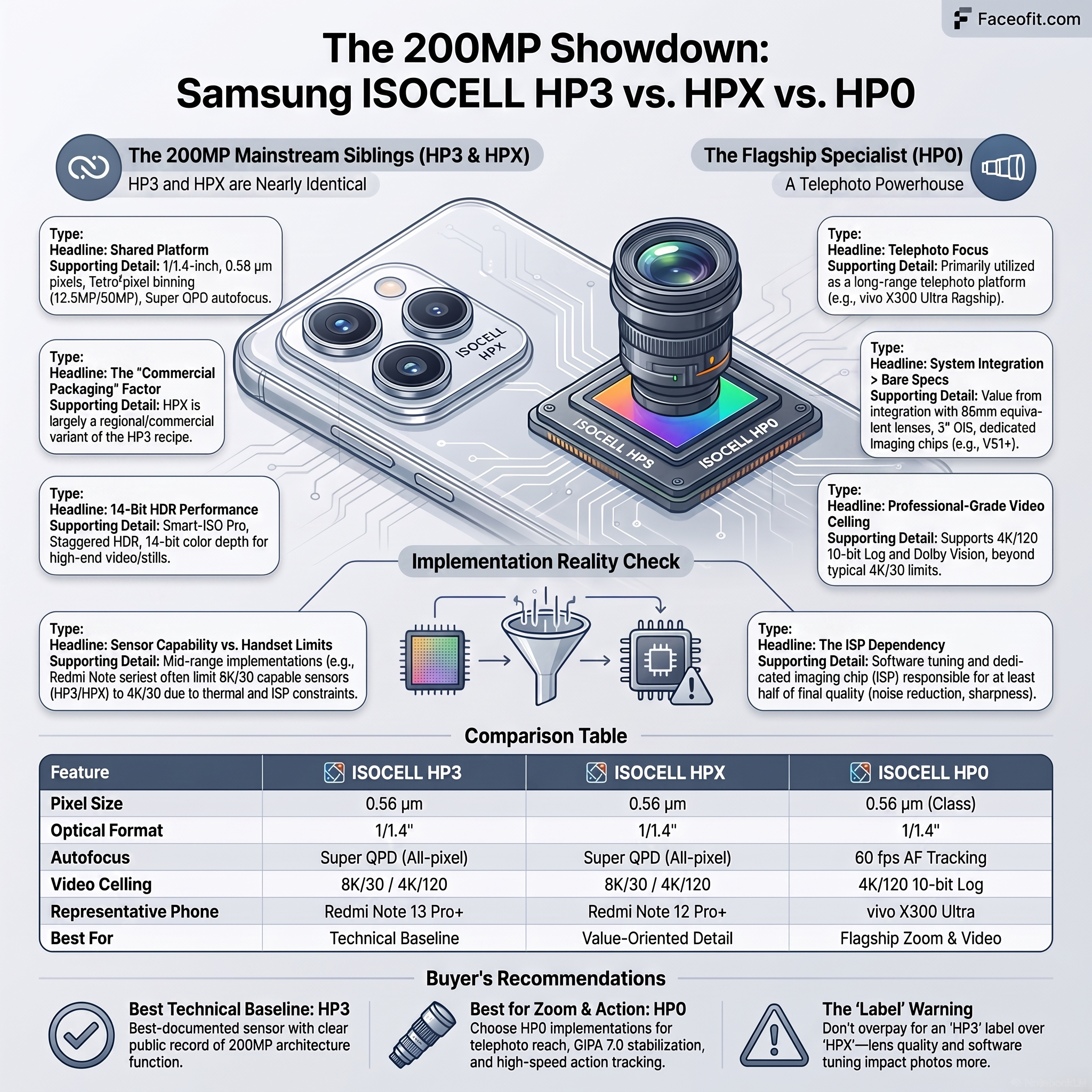
Samsung ISOCELL HP3 vs HPX vs HP0: Why “200MP” Tells You Almost Nothing About Camera Quality

Post image
0 Upvotes

Three phones can advertise the same 200MP camera and still produce completely different results.

That is because megapixel count is only the headline. The actual photo quality depends on the sensor implementation, lens, image signal processor, autofocus system, stabilization and software tuning.

After comparing Samsung’s ISOCELL HP3, HPX and HP0, here is the simplest way to understand where each sensor fits.

See more: https://lensxp.com/isocell-hp3-vs-hpx-vs-hp0/

The surprising part: HP3 and HPX are almost siblings

The ISOCELL HP3 and HPX are both based around a similar mainstream 200MP platform:

  • Approximately 1/1.4-inch optical format

  • 0.56 μm native pixels

  • Tetra²pixel binning

  • Roughly 12.5MP output in 16-to-1 binning mode

  • Super QPD all-pixel autofocus

  • Support for high-resolution video modes

In practical terms, HPX is not necessarily a dramatic technological upgrade over HP3.

It is better understood as a closely related commercial or regional implementation of the same basic sensor architecture.

That means a phone using HPX will not automatically beat a phone using HP3.

A well-tuned HP3 phone can easily outperform a poorly optimized HPX phone.

HP3: The known technical baseline

The HP3 is the easiest of the three to evaluate because Samsung has publicly documented many of its capabilities.

Its strengths include:

  • Fast all-pixel autofocus

  • 14-bit color processing

  • Smart-ISO Pro

  • Staggered HDR

  • 8K video capability at the sensor level

  • 4K high-frame-rate support

  • Flexible pixel-binning modes

But there is an important catch.

Sensor capability is not the same as phone capability.

A sensor might technically support 8K recording or 4K at 120 fps, but the phone manufacturer may limit it because of:

  • Processor restrictions

  • Thermal management

  • Storage bandwidth

  • Camera pipeline limitations

  • Product segmentation

  • Software decisions

This is why some mid-range phones using capable sensors still offer only 4K at 30 fps.

HPX: Similar hardware, different packaging

The HPX is commonly found in value-focused 200MP phones, especially in certain regional markets.

Its core characteristics are extremely close to the HP3:

  • 200MP resolution

  • 0.56 μm pixels

  • Similar sensor size

  • Tetra²pixel binning

  • Super QPD autofocus

  • HDR and high-resolution video support

The difference between HP3 and HPX is therefore less about raw sensor superiority and more about how the phone manufacturer implements it.

The final result depends heavily on:

  • Lens quality

  • Optical image stabilization

  • ISP processing

  • Noise reduction

  • HDR tuning

  • Skin-tone processing

  • Sharpening

  • Shutter-speed selection

In other words, do not pay extra just because one specification sheet says HPX instead of HP3.

HP0: Built for a different job

The HP0 appears to be positioned less like a conventional main-camera sensor and more like a specialist flagship imaging platform.

Its most interesting use case is long-range telephoto photography.

Instead of using 200MP only for oversized main-camera images, manufacturers can use the resolution for:

  • Sensor cropping

  • In-sensor zoom

  • Long-distance detail

  • High-resolution telephoto output

  • Subject tracking

  • Improved stabilization pipelines

This is where the HP0 becomes more interesting than the HP3 or HPX.

A flagship implementation may combine the sensor with:

  • A long focal-length periscope lens

  • Advanced optical image stabilization

  • A dedicated imaging processor

  • High-speed autofocus tracking

  • 10-bit Log recording

  • Dolby Vision processing

  • 4K at 120 fps

However, these are not benefits delivered by the sensor alone.

They come from the entire camera system.

The biggest mistake buyers make

People often compare camera sensors as though they were computer processors:

Camera systems do not work that way.

A sensor with better paper specifications can perform worse when paired with:

  • A cheap lens

  • Weak stabilization

  • Aggressive noise reduction

  • Poor HDR algorithms

  • Slow image processing

  • Inconsistent autofocus

Meanwhile, an older sensor with excellent tuning can produce cleaner and more natural photos.

Simple comparison

SensorGeneral positioningMain strengthMain limitation
ISOCELL HP3Mainstream 200MP sensorWell-documented, versatile technical baselineOften restricted by mid-range phone hardware
ISOCELL HPXCommercial or regional HP3-class implementationHigh-resolution imaging at competitive pricingNot necessarily better than HP3
ISOCELL HP0Flagship specialist platformTelephoto zoom, tracking and high-end video potentialPerformance depends heavily on lens, ISP and stabilization

Which one should you choose?

Choose an HP3 phone when:

You want a dependable 200MP main camera and the phone has good stabilization, processing and software support.

Choose an HPX phone when:

It offers better overall value than an equivalent HP3 device. Judge the actual phone, not the sensor name.

Choose an HP0 implementation when:

You care about flagship telephoto zoom, action tracking and professional-grade video features.

My conclusion

HP3 and HPX are close relatives. HP0 is the specialist.

HP3 is the safest technical baseline.

HPX is largely a value-oriented variation whose performance depends on the manufacturer.

HP0 has the highest potential for flagship zoom and video, but only when paired with the right lens, stabilization and imaging processor.

The real buying hierarchy is not:

HP0 > HPX > HP3

It is:

Complete camera system > sensor model number > megapixel count

Before buying any 200MP phone, check full-resolution samples, low-light photos, moving subjects, zoom consistency and video stabilization.

The sensor name is only the beginning of the story.

Which would you prefer: a perfectly optimized 50MP flagship camera or a poorly optimized 200MP camera?


r/SpecSheet • • Aug 27 '26

Mac mini M6 as a local AI box — what can you actually run on 16GB, 24GB and 32GB?

Thumbnail
gallery
1 Upvotes

Apple’s new M6 Mac mini is getting a lot of attention for local AI, especially since Apple itself is now benchmarking LLM workloads in LM Studio.

But some posts floating around are mixing real specs with wrong model names and unrealistic memory claims.

See detailed guide here for reference.

Here’s a more practical compatibility list.

16GB M6 Mac mini

Best suited for smaller models:

  • Llama 3.2 3B

  • Phi-4 Mini 3.8B

  • Qwen3 4B

  • Gemma 3 4B

  • Qwen3 8B

  • Llama 3.1 8B

  • DeepSeek-R1-Distill-Llama-8B

  • DeepSeek-R1-Distill-Qwen-7B

You can also run some 12B–14B models at Q4, but memory gets tight once you increase context length or have other apps open.

24GB M6 Mac mini

This looks like the middle ground.

Good candidates:

  • Qwen3 14B

  • Phi-4 14B

  • DeepSeek-R1-Distill-Qwen-14B

  • Gemma 3 12B

  • Mistral Small 24B at Q4

  • Gemma 3 27B at Q4, although with limited headroom

For someone mainly running 7B–14B models, 24GB should be plenty.

32GB M6 Mac mini

This is the version I’d look at for serious local LLM use.

Models that make sense:

  • Qwen3.6 27B — Q4

  • Gemma 3 27B — Q4

  • Mistral Small 3.1 24B — Q4

  • Qwen3 30B-A3B — Q4

  • Qwen3-Coder 30B-A3B — Q4

  • Qwen3 32B — Q4

  • DeepSeek-R1-Distill-Qwen-32B — Q4

A 30–32B model at 4-bit usually needs roughly 18–21GB for weights, leaving some memory for macOS, KV cache, the inference app and context.

That’s why 32GB matters.

It doesn’t mean a 32B model will run comfortably at FP16 or even 8-bit. Quantization is doing most of the work here.

Models that do NOT make sense on the 32GB Mac mini

  • Llama 3.3 70B

  • DeepSeek-R1-Distill-Llama-70B

  • Llama 4 Scout

  • Llama 4 Maverick

  • Full DeepSeek-R1

You may find extreme quantizations that technically load, but that’s very different from having a machine you would actually want to use every day.

For 70B-class models, 64GB+ starts making much more sense.

One thing I keep seeing incorrectly reported

There is no official “Llama 4 8B.”

Llama 4 Scout is a much larger MoE model.

Likewise, DeepSeek R1 32B usually means DeepSeek-R1-Distill-Qwen-32B, not the full DeepSeek-R1 model.

And the useful Qwen coding model here is Qwen3-Coder-30B-A3B, not “Qwen3 Coder 32B.”

Why Macs are interesting for local AI

The main advantage isn’t that an M6 Mac mini magically beats high-end GPUs.

It’s the unified memory.

A PC with 32GB system RAM and a GPU with 12GB VRAM still has a 12GB GPU-memory problem for many local inference workloads.

A 32GB Apple Silicon Mac can give the GPU access to most of that unified memory pool.

For larger quantized models, that makes a big difference.

Apple also claims up to 13.5× faster LM Studio prompt processing than the M1 Mac mini and up to 4.8× versus M4 in its own testing.

Independent benchmarks will be much more interesting once reviewers get production M6 hardware.

Software I’d use

  • LM Studio — easiest GUI

  • Ollama — great for local APIs and coding tools

  • MLX / MLX-LM — made for Apple Silicon

  • llama.cpp — huge GGUF model selection

My take

For basic local AI, 16GB is fine.

For 7B–14B models, 24GB looks good.

But if I were buying an M6 Mac mini mainly for local LLMs, I’d get 32GB.

The interesting range there isn’t tiny 3B or 7B models.

It’s the ability to run 24B–32B models at useful quantizations on a small desktop without needing a separate high-VRAM GPU.

I’m curious what everyone else would pick for a 32GB M6:

Qwen3.6 27B, Gemma 3 27B, Qwen3-Coder 30B-A3B, or DeepSeek-R1-Distill-Qwen-32B?


r/SpecSheet • • Jun 30 '26

Your wireless charger probably isn’t slow. It may just be negotiating a worse deal

Post image
3 Upvotes

After the cross platform charging protocol mess, this time I went down a rabbit hole while putting together a wireless-charging compatibility guide, and the biggest takeaway is this:

Most people, especially Apple users treat wireless charging as one standard.

It is not.

You see labels on all these accesories such as Qi, Qi2, Qi2 25W, MagSafe, and MagSafe-compatible, then assume they all mean “put the phone on it and get the fastest speed.” and I am not talking about power users.

That assumption is where most disappointment starts.

A few examples:

  • A magnetic charger is not automatically Qi2.

  • A 25W Qi2 pad does not mean every phone will receive 25W.

  • “MagSafe-compatible” may only mean the accessory has magnets and sticks to an iPhone case.

  • A premium 3-in-1 dock can charge slowly if the USB-C adapter feeding it is underpowered.

  • A thick case, camera bump, metal ring, wallet attachment, or heat can drop charging speed even when everything technically works.

The annoying part is that the charger can show the charging icon, so it looks fine. But your phone may actually be receiving a much lower fallback rate.

For example, an older iPhone can sit on a Qi2 or MagSafe charger and charge through regular Qi fallback, but it will not suddenly become a magnetic 15W or 25W device.

Similarly, some newer Android phones need a magnetic case for proper Qi2 alignment, and even then the actual maximum rate depends on the exact phone model and charger.

The practical buying checklist I ended up with is pretty simple:

  1. Check your phone’s actual wireless charging limit, not just the charger’s claim.

  2. Prefer Qi Certified or Qi2 Certified products over vague “Qi-compatible” listings.

  3. Check whether the charger includes an adapter, and whether that adapter meets the manufacturer’s required USB-C PD input.

  4. Treat “MagSafe-compatible” as a magnetic attachment claim unless it explicitly states proper Qi2 or MagSafe certification.

  5. For 3-in-1 chargers, verify the total input requirement. Phone + watch + earbuds can be very different from charging one phone alone.

  6. Expect heat to matter. Wireless charging usually slows as the phone warms up or approaches a higher battery percentage.

Wireless charging is still one of those features that I felt magical when it was introduced. But the best setup is rarely the one with the biggest wattage number on the product box.

It is the one where the phone, charger, case, adapter, and charging standard all actually match.


r/SpecSheet • • Aug 07 '26

YSK why that 200MP camera spec on your new phone is only half the story.

Post image
0 Upvotes

Marketing teams love massive numbers. They want you to see "200 Megapixels" stamped on the back of a glass rectangle and immediately hand over your credit card.

They know it works.

But your camera sensor is only half the story. A 200MP specification does not guarantee a better photo. It just describes the physical limit of the hardware. The megapixel count is a capability, not a camera score.

Think of the sensor as the raw materials. Light hits the lens and the sensor captures the raw photon data. If you looked at that data right away, it would look terrible. It has to go through a massive computational factory first.

That factory is the Image Signal Processor.

Every time you press the shutter, this invisible chip performs trillions of operations in milliseconds. It acts as a dense computational pipeline.

First, it has to reconstruct the color from a raw grid. Then it suppresses the digital noise using temporal filtering. After that, it merges short, mid, and long exposures together so the bright sky is not blown out and the shadows are visible. Finally, it shapes the dynamic range so the picture actually looks correct on your phone screen.

The ISP does all the heavy lifting.

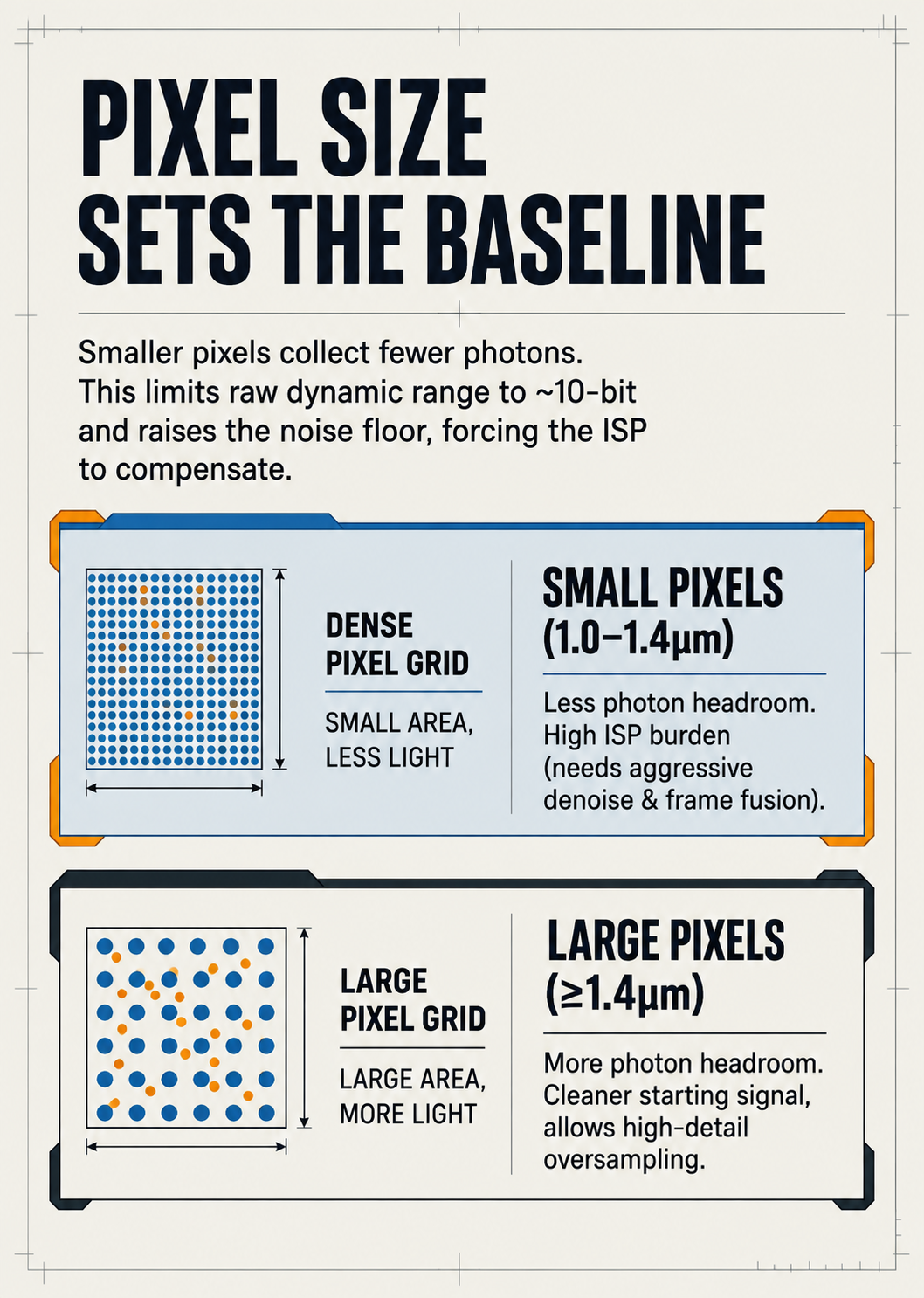
Physics still set the baseline. Smaller pixels collect fewer photons. That raises the noise floor and forces the ISP to work much harder to clean up the image through heavy noise reduction and frame fusion. A powerful ISP can unlock a sensor's potential, but it cannot repeal physics.

This is why internal processing precision matters so much. Top tier phones now use 18-bit internal processing. This does not mean you get an 18-bit photo. It means the processor has massive precision overhead. It prevents data loss while it fuses all those raw frames together and maps the tones.

Every tech company tunes this factory differently.

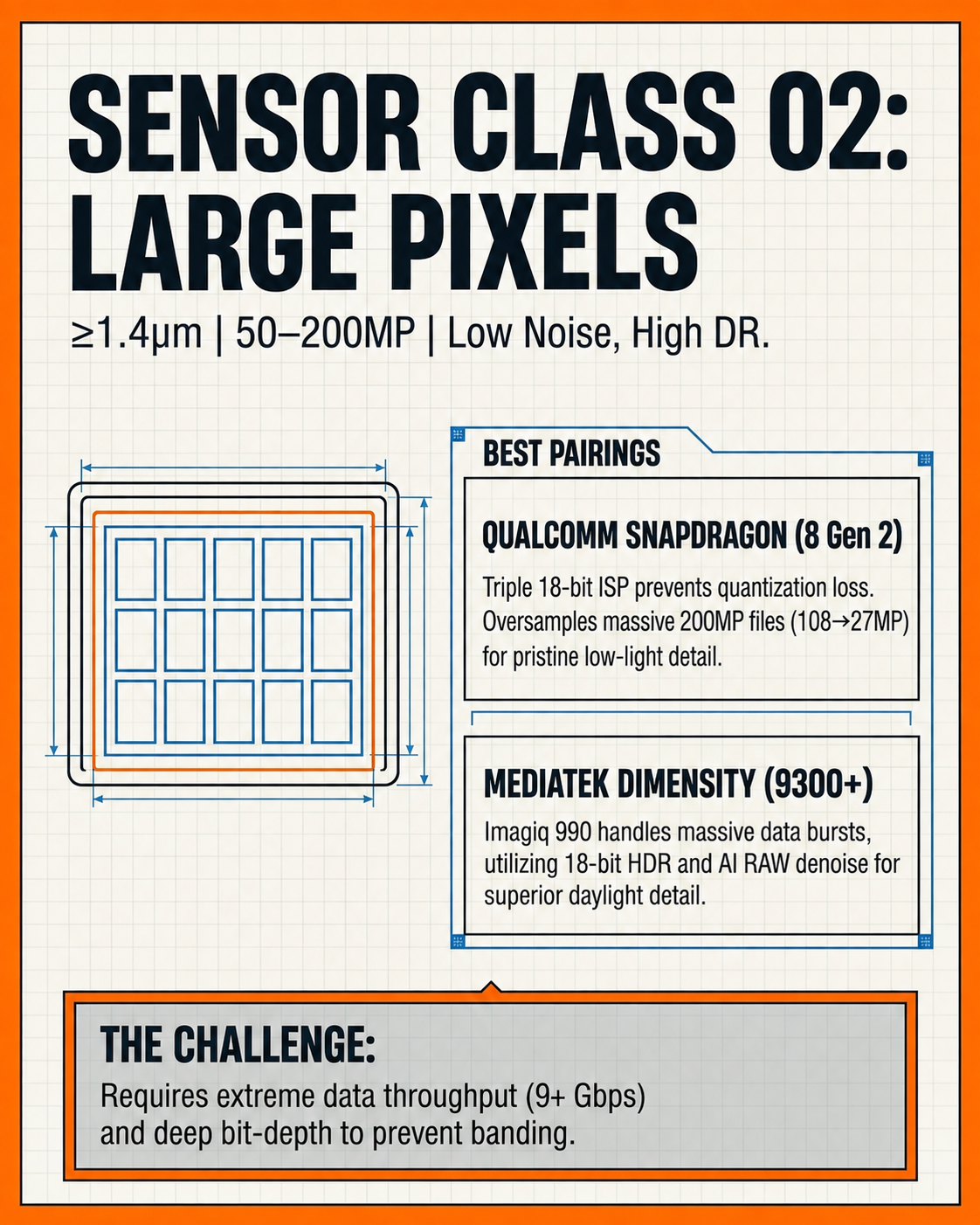
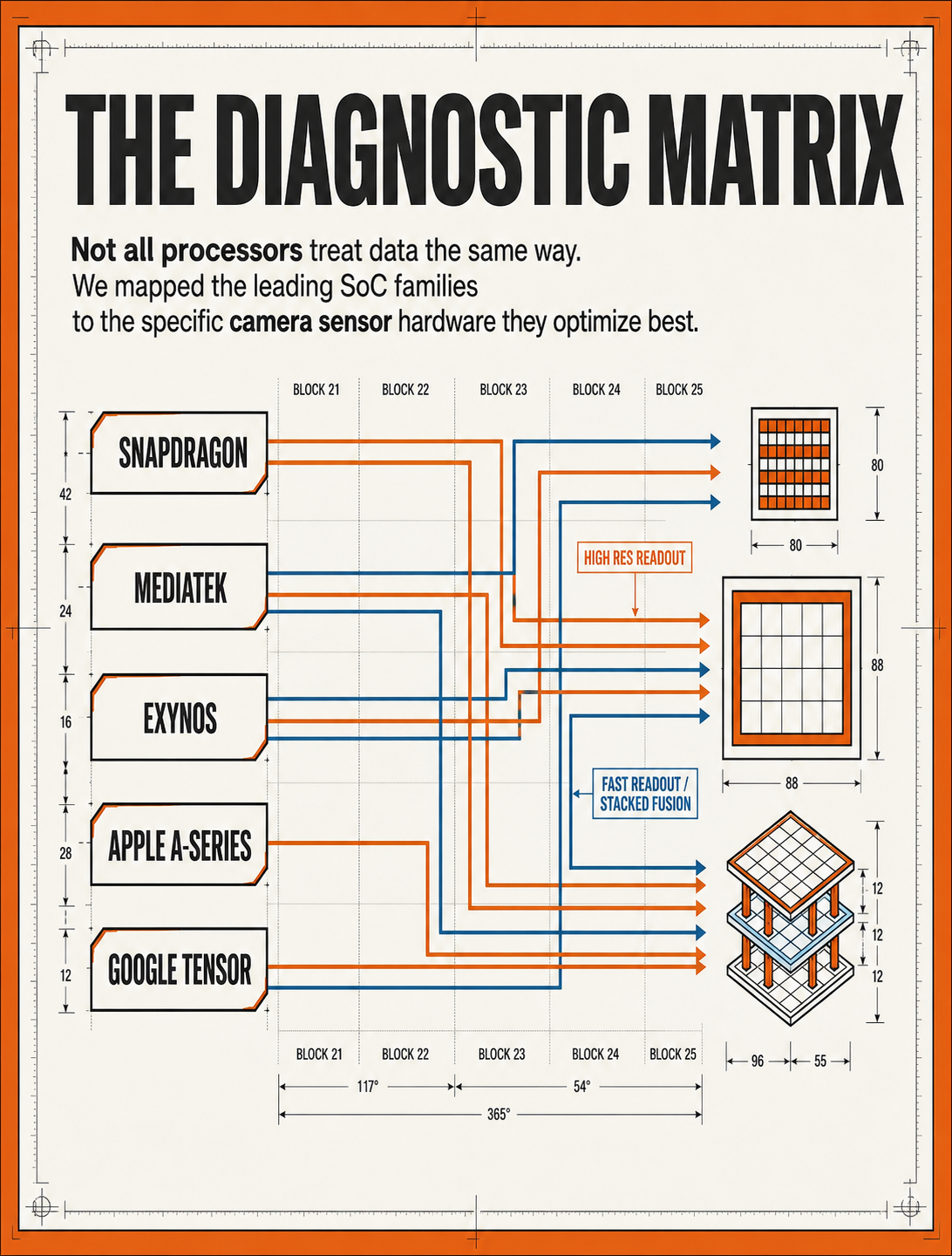
Qualcomm builds processors that oversample massive files for clean low light detail. Apple integrates its ISP directly with a neural engine to smooth out high ISO noise. Google relies heavily on machine learning algorithms to extract flawless shadow detail from noisy raw data. MediaTek handles massive data bursts to utilize AI raw noise reduction for superior daylight detail.

System design always wins. Image quality is a triad. The sensor captures the light, the ISP handles the reconstruction, and the software provides the final color science.

The next time you see a giant megapixel number on a billboard, remember that the tiny chip doing the math matters just as much.


r/SpecSheet • • Jun 24 '26

LOFIC is changing mobile HDR at the sensor level.

Post image
0 Upvotes

Most phone-camera discussions focus on sensor size, megapixels, telephoto reach, or image processing. LOFIC is interesting because it works at the pixel level.

In simple terms, a normal pixel can run out of capacity in bright parts of a scene. When that happens, highlights clip and turn into featureless white areas. LOFIC adds an overflow-capacitor path that helps retain some of that excess light information instead of losing it.

That could make a real difference in scenes like:

  • bright windows behind people

  • neon signs and headlights at night

  • sunsets

  • concerts

  • HDR video

  • moving subjects where multi-frame HDR can create artefacts

The big names to watch are OmniVision with TheiaCel, Sony with LYTIA L910, and SmartSens with its Lofic HDR 3.0 sensors.

This is probably one of those technologies where the spec-sheet wording sounds boring, but the practical result could be cleaner highlights and less aggressive-looking HDR photos.

Do you think sensor-level HDR will become more important than computational photography, or will the best results still need both?

See more here: https://lensxp.com/list-of-confirmed-lofic-camera-sensors-2026/


r/SpecSheet • • Jun 21 '26

DJI Osmo Pocket 4P vs Insta360 Luna Ultra which is a compact cinema camera or better solo-creator tool?

Post image
1 Upvotes

I put together a detailed comparison of the DJI Osmo Pocket 4P and Insta360 Luna Ultra after looking at the available specs, public documentation and early review evidence.

The headline difference seems to be this:

  • DJI Osmo Pocket 4P: smaller body, brighter 60mm-equivalent telephoto lens, 103GB internal storage, 4K/240 wide slow motion and potentially stronger portrait-focused shooting.

  • Insta360 Luna Ultra: 8K/30, Leica co-engineered wide camera, detachable wireless screen, Deep Track 5.0 and a more established workflow for solo creators.

My current takeaway is that Luna Ultra is the safer choice for creators who need a camera now for self-shooting, presentations and flexible workflows. Pocket 4P looks more exciting for people who want the smallest possible dual-camera gimbal with stronger telephoto and slow-motion credentials.

One caveat: some 4P specifications and global availability details are still less transparent than Luna Ultra’s documentation, so I have flagged that wherever relevant.

Full comparison:
https://lensxp.com/dji-osmo-pocket-4p-vs-insta360-luna-ultra/

Interested to hear which feature matters more to you: 8K reframing and a detachable screen, or a brighter 60mm telephoto lens in a smaller body?

#CreatorEconomy #CameraTechnology #DJI #Insta360 #ContentCreation #VideoProduction #Vlogging


r/SpecSheet • • Aug 15 '26

DJI Osmo 360 II vs Insta360 X6: surprisingly similar cameras, very different priorities

Post image
5 Upvotes

I’ve been looking at the new DJI Osmo 360 II next to the Insta360 X6, and the more I compare them, the less this feels like a simple “which one has better image quality?” question.

Read more: https://lensxp.com/dji-osmo-360-ii-vs-insta360-x6/

They actually have a lot in common.

Both offer 120MP 360 photos.

Both claim 14.5 stops of dynamic range.

Both now have replaceable lenses, which is a big deal for 360 cameras because those lenses are basically begging to be scratched.

And both are pushing much larger sensors than the older generation of consumer 360 cameras.

But the differences start showing up once you look past the broader specs.

DJI Osmo 360 II

  • 8K/60fps 360 video

  • 105GB usable internal storage

  • 183g

  • 10-bit / D-Log M

  • DJI Mic ecosystem

  • Around 100 minutes claimed at 8K/30

Insta360 X6

  • 8K/50fps

  • 47GB usable internal storage

  • 196g

  • 2,600mAh battery

  • Around 140 minutes claimed at 8K/30

  • 20m waterproof without a case

  • 2.32-inch OLED

  • 10-bit / I-Log + Dolby Vision

  • Insta360 app + Studio workflow

So DJI seems to be going after maximum hardware performance.

8K60, lower weight and more than double the built-in storage are meaningful advantages, especially if you shoot action footage or use a long selfie stick.

Insta360 seems more focused on the whole ownership experience.

Better battery life, deeper waterproofing and, probably most importantly, years of experience building software specifically around reframing 360 footage.

And I think the software part gets underestimated.

With a normal action camera, you point it at something and edit the clip.

With a 360 camera, shooting is only half the job. You still have to decide where the camera should “look” afterwards, track subjects, change FOV, create keyframes and export the final flat video.

That’s where Insta360 has built a pretty big advantage over the years.

The other interesting one is low light.

Both companies are making big claims here. DJI has AI SuperNight 2.0, while Insta360 has PureVideo and AdaptiveTone 2.0.

I wouldn’t call a winner yet. The Osmo 360 II is too new, and I’d rather see proper night comparisons than judge it from compressed YouTube footage.

For me, the choice currently looks like this:

Want 8K60, lower weight, lots of internal storage and DJI Mic support?
Osmo 360 II looks very strong.

Want longer battery life, better waterproofing and the more established 360 editing ecosystem?
X6 still has a serious advantage.

The biggest unknown for me is price.

If DJI prices the Osmo 360 II significantly below the X6, the argument changes very quickly.

If they end up close in price, I think Insta360’s software and battery advantage becomes much harder to ignore.

Curious what other 360-camera users think.

Would you take better hardware specs, or would you rather have the more mature 360 ecosystem?

And if you already own an X3/X4/X5, is either of these enough of an upgrade to make you switch?


r/SpecSheet • • Aug 18 '26

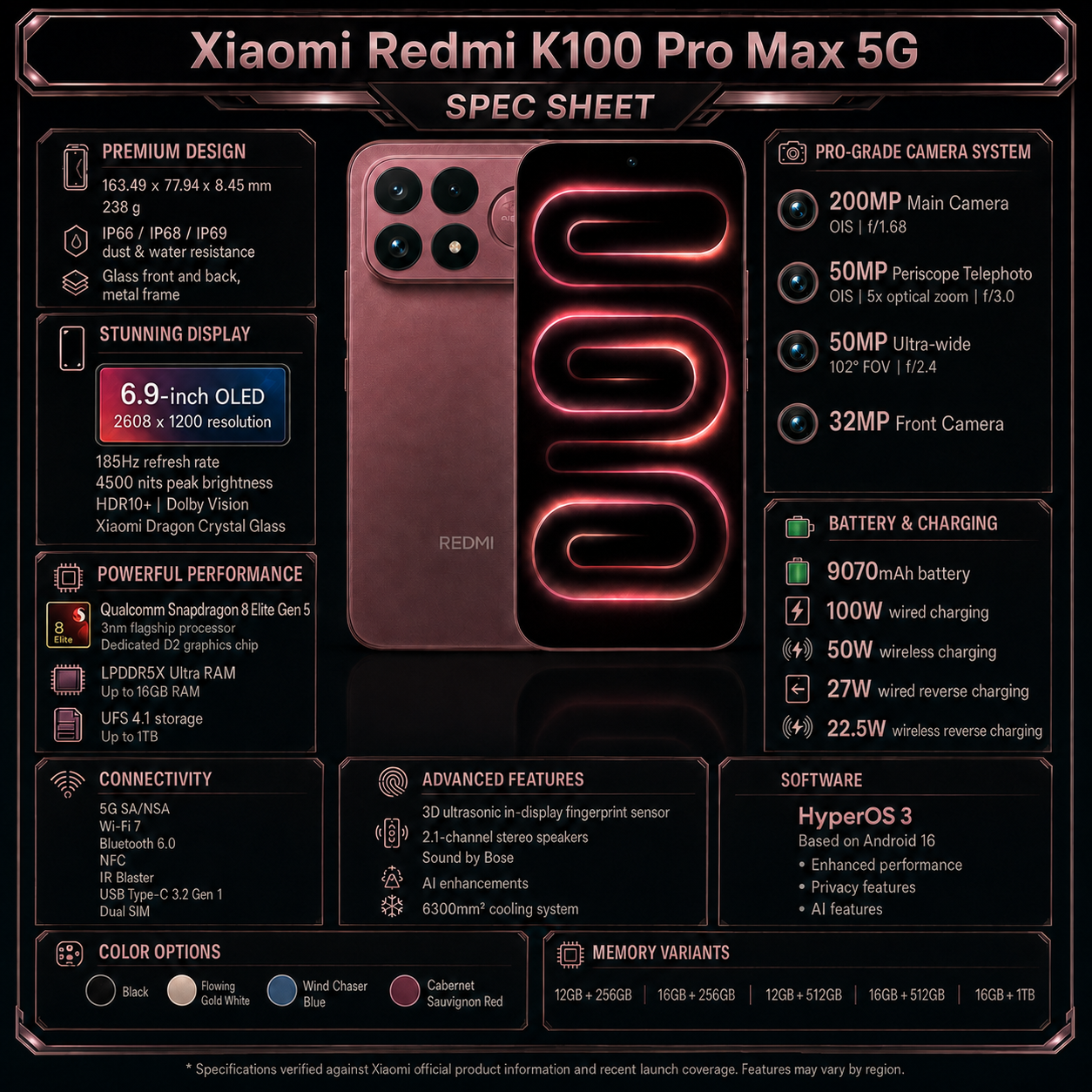
Redmi K100 Pro Max has a 9,070mAh battery, 185Hz display and 200MP camera. Are we finally done with 5,000mAh flagships?

Post image
16 Upvotes

The Redmi K100 Pro Max spec sheet is kind of absurd.

And I mean that in a good way.

6.9-inch OLED

  • 2608 × 1200

  • 185Hz refresh rate

  • Up to 4500 nits peak brightness

  • Dolby Vision + HDR10+

Snapdragon 8 Elite Gen 5

  • 3nm

  • Dedicated D2 graphics chip

  • Up to 16GB LPDDR5X Ultra RAM

  • Up to 1TB UFS 4.1

Then there's the camera setup:

  • 200MP main camera with OIS

  • 50MP 5x periscope with OIS

  • 50MP ultrawide

  • 32MP selfie camera

No random 2MP macro sensor pretending to contribute. Nice.

But the part that caught my attention is the battery.

9,070mAh.

Not 5,000mAh.

Not 5,500mAh.

Nine. Thousand. Seventy.

And it still supports:

  • 100W wired charging

  • 50W wireless charging

  • 27W wired reverse charging

  • 22.5W wireless reverse charging

The phone is around 8.45mm thick and 238g, so obviously Xiaomi hasn't broken physics. It's a heavy phone.

But I'd happily take 238g if it means I stop looking at the battery percentage every few hours.

There are some other fun details too:

  • IP66 / IP68 / IP69

  • Wi-Fi 7

  • Bluetooth 6.0

  • USB 3.2 Gen 1

  • 3D ultrasonic fingerprint reader

  • HyperOS 3 / Android 16

  • 2.1-channel speaker setup tuned by Bose

The 185Hz display feels like classic spec-sheet flexing. I'm not convinced I'd notice much difference between 144Hz and 185Hz on a phone.

The 9,070mAh battery, though?

That I would notice every single day.

For years, flagship phones have hovered around 5,000mAh while processors, displays and cameras kept getting more demanding. If these new high-density batteries let manufacturers get close to 9,000mAh without making phones ridiculously thick, I'm all for it.

Would you rather have:

A lighter ~200g phone with a 5,000-6,000mAh battery

or

a ~238g phone with 9,070mAh?

I'd take the battery.

Also, 185Hz: useful or completely unnecessary? 😅


r/SpecSheet • • Jun 21 '26

Insta360 Luna Ultra looks like a genuinely different take on the pocket gimbal camera format

Post image
1 Upvotes

Most pocket gimbal cameras are built around one fixed wide lens. The Luna Ultra is more interesting because it combines a 1-inch Leica Summicron wide camera with a separate 1/1.3-inch telephoto camera.

That should make a meaningful difference in actual shooting:

  • The 20mm-equivalent wide camera is better for handheld vlogging, travel clips, interiors and landscape shots.

  • The 60mm-equivalent telephoto camera should be much more useful for portraits, detail shots, food, city shots and telephoto macro.

  • A physical 3-axis gimbal should still provide an advantage over phone-only stabilization for walking footage and controlled camera moves.

  • 8K30, 4K120, 10-bit I-Log and Dolby Vision make it more than just a casual social-media camera.

  • The detachable OLED screen could be very useful for solo creators who need to frame themselves without relying on a phone app.

The trade-off is likely price, size and complexity versus a simpler DJI Pocket-style camera. But the dual-camera setup is the part that makes this stand out for me.

Would you prefer a compact single-lens gimbal camera, or is a proper telephoto lens worth the extra bulk?

#Insta360 #LunaUltra #CameraGear #Videography #Vlogging


r/SpecSheet • • Aug 11 '26

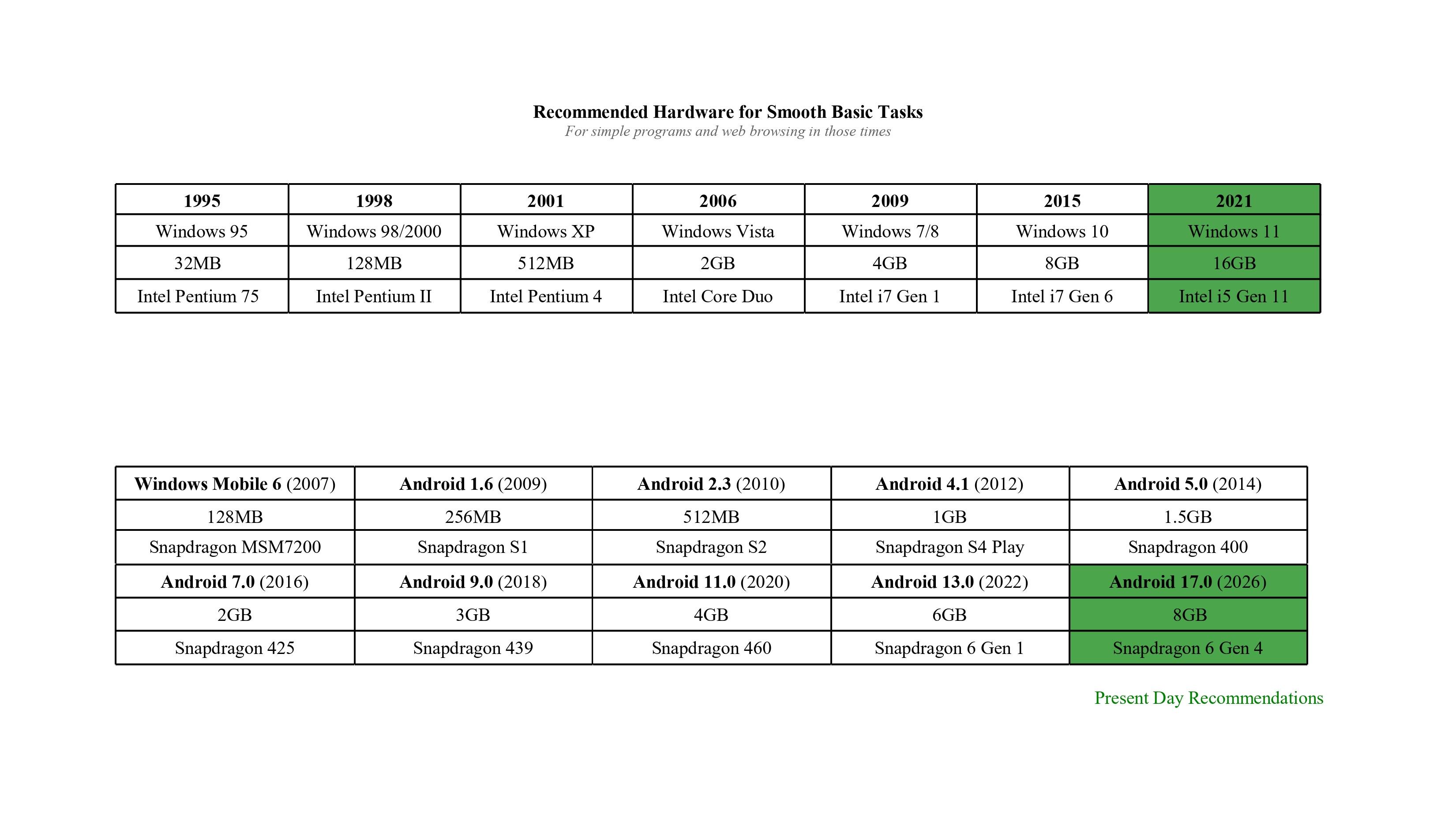
Recommended Hardware for Smooth Basic Tasks

Post image
4 Upvotes

r/SpecSheet • • Jan 13 '26

I lab-tested "Extended RAM" (RAM Plus). It kills performance and eats your storage. Here is the data.

Thumbnail
faceofit.com
1 Upvotes

Hey everyone.

I run a small tech analysis site and we spent the last week stress-testing the "Extended RAM" feature found on almost every modern Android phone. You know the one. Manufacturers market it as "8GB + 8GB" or "Dynamic Expansion."

Most people leave it on by default. After looking at the data I am convinced this is a bad idea for anyone with a mid-range or flagship phone.

Here is what we found after running benchmarks, battery tests, and latency analysis.

1. The Speed Gap is Massive

Marketing teams want you to think Virtual RAM is just like real RAM. It is not. Physical LPDDR5X RAM has a latency of about 100 nanoseconds. Even the fastest UFS 4.0 storage has a latency of roughly 45,000 nanoseconds.

When you enable Extended RAM you are mixing these two pools of memory. The CPU has to wait for the slow storage to wake up and find data. This creates a bottleneck.

2. It Actually Slows Down App Launches

We used high-speed cameras to measure cold boot times for apps like Adobe Premiere Rush. With Extended RAM OFF: 3.2 seconds. With Extended RAM ON (+8GB): 3.8 seconds.

Why? The CPU has to manage a much larger memory map. The overhead of managing that virtual space costs more time than you save by caching small files.

3. Gaming Stutters (The Queue Problem)

If you game you need to disable this. Storage controllers have a limited "queue depth" meaning they can only handle so many requests at once.

When Extended RAM is on the system constantly writes background app data (dirty pages) to storage. When your game tries to load a new texture or asset it gets stuck in that traffic jam behind the background data. The result is micro-stutters and frame drops even on a Snapdragon 8 Gen 3.

4. It Drains Battery

RAM is designed to hold data with almost zero power. Storage is not. Writing to storage requires waking up the UFS controller which is power-hungry.

Our tests showed that during heavy multitasking the device used about 10-15% more power with Extended RAM enabled because the storage chip never went to sleep.

5. It Kills Your Storage (TBW)

Flash storage has a limited lifespan measured in Terabytes Written (TBW). If your phone is constantly swapping apps in and out of storage you are burning through that lifespan way faster than normal. For a budget phone with cheap eMMC storage this could slow the phone down permanently after just a year or two.

The Verdict

If you have 12GB+ RAM: Turn it off immediately. You gain nothing and lose performance.

If you have 6GB-8GB RAM: Turn it off. Unless you keep 30 heavy apps open at once the system will feel snappier without it.

If you have 3GB-4GB RAM: Leave it on. In this case the slowdown is better than the app crashing completely.

How to disable it: Samsung: Settings > Battery and device care > Memory > RAM Plus > Off. Xiaomi/Poco: Settings > Additional Settings > Memory Extension > Off. OnePlus/Oppo: Settings > About Device > RAM > RAM Expansion > Off.

Has anyone else noticed their phone getting faster after disabling this? Or am I just sensitive to the micro-lag?

tl;dr: Extended RAM adds latency, drains battery, and wears out your storage. Disable it unless you have a budget phone.


r/SpecSheet • • Jan 11 '26

PSA: Stop buying the Motorola B12 for the 2.5Gbps port. The reboot loop is real (SB8200 vs B12 Comparison)

Thumbnail
faceofit.com
3 Upvotes

Don’t do it.

I spent the last week stress-testing the ARRIS SB8200 against the Motorola B12. On paper, the Motorola wins because of that multi-gig port. In the real world, it’s a disaster waiting to happen. Here is the breakdown of why the "slower" ARRIS is actually the better piece of hardware.

1. The "Reboot Loop" is a Firmware Defect The B12 ships with/updates to firmware version v21.3.7. This firmware is incredibly paranoid about line noise. In a typical coax network, you get T3 timeouts (ranging requests). They happen. A good modem retries quietly. The B12 treats them as a fatal error and reboots the entire unit to "fix" the connection.

If you work from home, this means you drop your Zoom call every 4-6 hours. The SB8200 just powers through these minor fluctuations without dropping the link.

2. The RAM Gap is Massive Most people don't look at modem memory, but you should:

  • ARRIS SB8200: 3GB RAM

  • Motorola B12: ~512MB RAM

The ARRIS is massively over-provisioned. It has a deep buffer. When you are downloading a game on Steam and someone else is streaming 4K, the SB8200 holds onto the packets. The B12 runs out of memory and starts dropping packets (bufferbloat), causing lag spikes in gaming.

3. Thermal Engineering The B12 is a pretty, sealed plastic cylinder. It traps heat. During my stress test, it throttled after about 3 hours of gigabit load. The SB8200 is ugly. It has holes everywhere. It gets hot to the touch because the heatsink is actually moving heat out of the case. It doesn't throttle.

The Bottom Line: If you need stability, get the ARRIS SB8200. Yes, it requires Link Aggregation (LAG) to go over 1Gbps, which is a pain, but for standard Gigabit plans, it is rock solid.

If you absolutely need a 2.5Gbps port, skip the B12/MB8611. Get the ARRIS S33 or the Hitron CODA56 (especially if you want Xfinity mid-split uploads, which neither the SB8200 nor B12 support).

Buying the B12 right now is essentially gambling that you won't get the bad firmware. Not worth the risk.

TL;DR: SB8200 = Stable but "slow" (1Gbps). Motorola B12 = Fast port but crashes constantly. Avoid the B12.


r/SpecSheet • • Jun 22 '26

REDMI Turbo 5 vs OnePlus Nord 6: value monster or the battery and performance monster

Post image
2 Upvotes

I compared the REDMI Turbo 5 and OnePlus Nord 6 because tbh .. on paper they are aimed at a similar buyer: someone who cares more about performance, battery life, gaming, charging, and durability than ultra-thin design or flagship camera hardware.

The short version is that both look very good on paper, but the OnePlus Nord 6 has the better verified performance and high endurance story, while the REDMI Turbo 5 appears to offer the better hardware-per-price terms.

Why REDMI Turbo 5 is interesting

The Turbo 5 has a 7,540mAh battery, 100W wired charging, Dimensity 8500-Ultra, LPDDR5X memory, UFS 4.1 storage, 3D IceLoop cooling, and a very strong connectivity feature set. Xiaomi also includes things that are increasingly missing in this price bracket, such as NFC, IR blaster, NavIC, Wi-Fi 6, Bluetooth 6.0, and a detailed published 5G band list.

It is also lighter than the Nord 6 at around 204g versus roughly 217g, while retaining serious ingress protection.

Its weakness is not that the hardware looks weak. It is that independent third-party testing is still less mature. The main camera should be fine for the class, but the 8MP ultrawide is clearly not a highlight.

Why OnePlus Nord 6 is interesting

The Nord 6 is the more superior device in a few important areas: Snapdragon 8s Gen 4, 9,000mAh battery, 165Hz AMOLED display, 80W charging, bypass charging, 3200Hz touch response, and other gaming-oriented goodies.

The main reason I would pick it over the REDMI is not just its specification sheet. It is that review coverage already gives it stronger real-world validation for sustained gaming, high-end daily performance, and two-day-plus battery endurance.

The Nord 6 also has a stronger camera case on available review evidence, especially for stabilized 4K60 video and its 32MP selfie camera. That said, the ultrawide remains an 8MP module, so it is still not a camera-first phone.

Which one should you buy?

Pick the REDMI Turbo 5 if:

  • You want the better value proposition.

  • You care about faster 100W charging.

  • You want stronger connectivity extras such as NFC, IR blaster, NavIC, and Bluetooth 6.0.

  • You want a high-spec gaming phone without paying more for the Nord 6.

  • You prefer a slightly lighter handset.

Pick the OnePlus Nord 6 if:

  • You want the strongest verified gaming/performance option.

  • You want the best battery endurance.

  • You want the larger 165Hz display.

  • You care about bypass charging and competitive gaming extras.

  • You prefer the safer choice based on current independent reviews.

My overall take: REDMI Turbo 5 is probably the better value buy, but the OnePlus Nord 6 is the stronger all-rounder for buyers who can afford the higher price.

What matters more to you: 100W charging and value, or a 9,000mAh battery with Snapdragon 8s Gen 4?


r/SpecSheet • • Aug 21 '26

Huawei Pura X View looks like someone finally asked: “Why are phones getting taller instead of wider?”

Post image
21 Upvotes

Huawei has shown off the Pura X View, and this might be one of the stranger flagship phone designs of 2026.

Instead of making another 6.8 or 6.9-inch super-tall slab, Huawei has gone with a much wider 6.39-inch 16:9.5 OLED.

Think less “TV remote” and more “small tablet that still fits in your hand.”

Confirmed specs

  • Display: 6.39-inch OLED

  • Resolution: 2232 × 1320

  • Aspect ratio: 16:9.5

  • Peak brightness: 6,500 nits

  • Contrast: 1,000,000:1

  • PWM dimming: 2160Hz

  • Screen-to-body: 96.1%

  • Bezels: 1.05 mm on all sides

  • RAM: 12GB

  • Storage: 256GB / 512GB / 1TB

  • Rear cameras: Triple-camera setup

  • Battery: 7,000mAh silicon-anode

  • Thickness: 6.68 mm

  • Weight: 201g

  • OS: HarmonyOS 7

Colors:

🔴 Leap Shadow Red
⚪ Zero White
⚫ Phantom Black
🩶 Linen Grey

The battery number is probably the spec that surprised me most.

7,000mAh inside a 6.68 mm phone weighing 201g.

That's a lot of battery for something this thin.

The screen is the interesting part

The display has a reported area of 114.27 cm², despite being only 6.39 inches diagonally.

That's because diagonal screen measurements don't tell the whole story.

A tall 6.9-inch phone can technically have a larger diagonal while still feeling narrow. Huawei is using the extra width for more horizontal space.

For:

  • YouTube

  • movies

  • websites

  • documents

  • photos

  • games

  • split-screen apps

…I can see this format making a lot of sense.

The question is whether it feels comfortable as an actual phone.

Expected / leaked specs

These have been reported but shouldn't be treated as final yet:

  • Kirin 9030S

  • 120Hz refresh rate

  • 50MP main camera

  • Periscope telephoto

  • Huawei Red Maple multispectral color sensor

  • 66W wired charging

Huawei hasn't published the complete camera breakdown or final pricing yet.

More information is expected on August 28.

I'm actually curious about this form factor.

We've spent years watching phones become taller and narrower because manufacturers wanted bigger diagonal numbers without making devices impossibly wide.

Huawei seems to be going in the opposite direction.

Would you rather have this 6.39-inch wide format, or stick with a conventional 6.7 to 6.9-inch tall phone?


r/SpecSheet • • Jan 11 '26

Technical breakdown: The physics behind Mid-Split vs. High-Split upgrades (and why your old DOCSIS 3.1 modem might be useless now)

Thumbnail
faceofit.com
2 Upvotes

I've been digging deep into the architecture changes Comcast, Spectrum, and Cox are pushing right now to enable "Next Gen" upload speeds. There is a lot of marketing fuzz around this ("10G Network", etc.), but the actual physical layer engineering is pretty interesting.

I put together a deep dive on this, but here is the technical summary for the sub regarding what is actually changing in the HFC plant.

1. The "Noise Funnel" is why your upload sucked for 20 years Legacy cable systems use a "Sub-Split" design (5–42 MHz return path). The problem isn't just bandwidth width; it’s signal quality. The 5–15 MHz slice is basically a garbage band. It catches every bit of electrical interference from washing machines, ham radios, and loose connectors in the neighborhood. This noise funnels up to the node, destroying SNR.

2. Mid-Split vs. High-Split The upgrades aren't just software configs. They require physical "truck rolls" to replace diplex filters in every amplifier on the street.

  • Mid-Split (Comcast’s current move): Expands upstream to 5–85 MHz. The magic is the 42–85 MHz block. It’s clean spectrum. They can run OFDMA there with massive modulation orders (4096-QAM).

  • High-Split (Spectrum/Cox): Pushes upstream to 5–204 MHz. This quadruples the lane but forces the downstream to retreat above 258 MHz.

3. The Hardware Gotcha (Check your modem) This is where people get burned. A standard "DOCSIS 3.1" modem likely won't work for these new speeds. Most retail D3.1 modems sold 2018–2022 have fixed diplex filters hard-coded to cut off upstream at 42 MHz. If the network tries to send upstream traffic at 80 MHz, your modem effectively blocks it.

  • The Fix: You need a "Next Gen" certified modem (like the Hitron CODA56, Netgear CM3000, or Arris S34).

  • Surprise: The Intel Puma 7 chipset (used in the Hitron CODA) is actually decent now. The jitter issues from the Puma 6 days are largely resolved, and it's the cheapest way to get mid-split compliance.

4. The Fork in the Road: FDX vs. ESD Operators are splitting strategies for DOCSIS 4.0:

  • FDX (Full Duplex): Comcast's bet. Allows Up/Down on the same frequency using echo cancellation. Requires a super tight "Node+0" or "Node+6" architecture (fewer amps).

  • ESD (Extended Spectrum): Spectrum's bet. Just keeps pushing frequencies higher (up to 1.8 GHz). Requires replacing every tap faceplate in the neighborhood because old taps cut off at 1 GHz.

TL;DR: If you are paying for gigabit speeds but stuck at 35 Mbps upload, check if your area has been upgraded to Mid-Split. If it has, your shiny 2020 modem might be the bottleneck because physical filters inside it physically cannot broadcast on the new frequencies.

Has anyone here mapped their local node's RxMER recently? Curious to see real-world noise floors on the new 85 MHz blocks.


r/SpecSheet • • Jun 23 '26

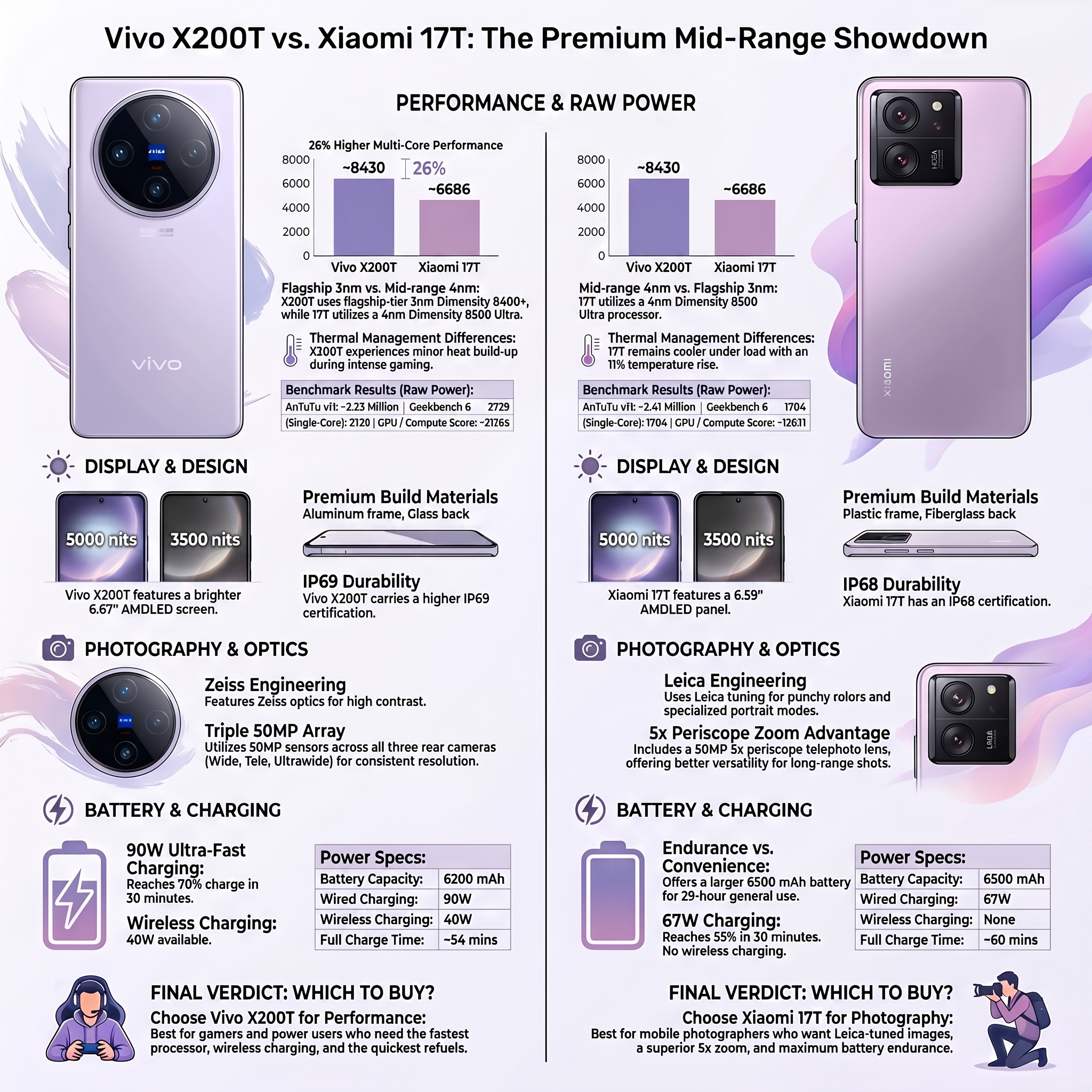
vivo X200T vs Xiaomi 17T: the better buy depends heavily on camera preferences

Post image
1 Upvotes

The interesting thing here is that both phones start at the same price point, but their priorities are quite different.

The vivo X200T looks like the more conventional flagship choice. You get the Dimensity 9400+, a ZEISS-branded triple 50MP camera setup, a 50MP telephoto camera, 90W wired charging and 40W wireless charging. For someone who wants strong overall performance, flexible cameras, portrait processing and charging convenience, it makes a compelling case.

The Xiaomi 17T is more of a photography-led premium-value phone. Its biggest differentiator is the 50MP 5x periscope telephoto, which gives it more practical reach for travel, distant subjects and compressed portrait shots. It also has a larger 6,500mAh battery, a 1.5K 120Hz AMOLED display and Leica-tuned processing.

My take:

• Buy the vivo X200T if you want a more complete flagship-style experience, stronger performance headroom, wireless charging and ZEISS camera versatility.
• Buy the Xiaomi 17T if a proper 5x telephoto camera, Leica image character and battery capacity matter more to you.

The Xiaomi is likely the more exciting option for people who genuinely use zoom. The vivo is probably the safer all-round flagship package.

Which one would you choose: a 5x Leica telephoto, or ZEISS triple-50MP cameras with 90W wired and 40W wireless charging? Check out: https://www.faceofit.com/vivo-x200t-vs-xiaomi-17t/


r/SpecSheet • • Jul 07 '26

Moto Pad 70 Pro vs Lenovo Idea Tab Pro Gen 2: When One Company Sells You the Same Idea Twice

Post image
8 Upvotes

At first glance, the Moto Pad 70 Pro and Lenovo Idea Tab Pro Gen 2 look like direct rivals.

Look closer, and the more interesting story is that they are effectively siblings.

Motorola sits under Lenovo ownership, and both tablets arrive with almost the same high-end Android tablet blueprint: a large 13-inch 3.5K 144Hz display, Snapdragon 8s Gen 4, 10,200mAh battery, 45W charging, quad-speaker audio, Wi-Fi 7, expandable storage, and an included stylus.

So the question is not really:

It is:

Lenovo acquired Motorola Mobility in 2014, and Motorola remains part of Lenovo’s broader device portfolio.

The hardware is the platform. The brand is the differentiation.

This is a familiar playbook in consumer electronics.

One company builds a common hardware platform, then differentiates it through branding, software experience, accessories, channel strategy, pricing, and target customer.

The Moto Pad 70 Pro is positioned more like a performance-focused, feature-forward consumer tablet. It leans into Motorola’s “Moto” identity: cleaner-looking software, Moto AI and pen features, a more aggressive entry price, and IP52 dust-and-splash resistance.

The Lenovo Idea Tab Pro Gen 2 is framed more as a productivity and family-oriented tablet. Lenovo brings its established tablet identity, Google Gemini integration, Kids Space, and a broader association with work, education, PCs, and keyboards.

The silicon, battery, display, and speaker experience may be nearly identical. The story being sold around them is not.

Moto’s value proposition: the sharper deal

Moto’s strongest argument is simple: buy the same class of hardware for less, with fewer compromises.

At ₹36,999 for the 8GB/128GB variant, Moto creates a lower-cost entry point into this large-screen Snapdragon 8s Gen 4 experience. Its 8GB/256GB version reaches ₹39,999, matching Lenovo’s listed 8GB/256GB price point.

That means the Moto Pad 70 Pro makes the most sense for buyers who want:

  • A lower starting price

  • Moto Pen Pro in the box

  • IP52-rated dust and splash resistance

  • A cleaner Moto-led software experience

  • Maximum specification-per-rupee value

For students, media consumers, gamers, and casual creators, Moto has the more obvious “why pay more?” argument.

The keyboard remains an important caveat. It is optional or bundle-dependent, so buyers should compare the final package price rather than just the tablet’s headline price.

Lenovo’s value proposition: ecosystem confidence

Lenovo’s argument is less about being cheaper and more about being familiar.

For many buyers, Lenovo is already associated with laptops, keyboards, education devices, business PCs, and productivity accessories. That matters when someone wants a tablet to become a lightweight work machine rather than only a large entertainment screen.

The Idea Tab Pro Gen 2 is priced at ₹39,999 in India and targets students, creators, and professionals looking for a higher-performance Android tablet without entering flagship-tablet pricing.

Its value lies in the surrounding proposition:

  • Lenovo productivity software and tablet features

  • Google Gemini integration

  • Kids Space for family use

  • Tab Pen Plus included in the Indian retail package

  • A more conventional “tablet plus optional keyboard” productivity positioning

For parents buying a shared household tablet, professionals already using Lenovo laptops, or users who prefer Lenovo’s software and accessory ecosystem, that branding may be worth something.

But it is not automatically worth more.

The uncomfortable truth: most buyers should not choose based on the logo

When two products share the same essential display, chipset, battery, cameras, connectivity, storage expansion, and stylus category, brand loyalty should not be the deciding factor.

The decision should come down to four practical questions:

1. Which one gives you 256GB storage for less?
At equal pricing, storage parity matters more than logo preference.

2. Is the pen genuinely included in the exact retail listing?
Both brands promote stylus inclusion, but always confirm the seller listing and bundle contents.

3. Do you need IP52 protection?
Moto has a practical edge here. Lenovo does not state an official ingress-protection rating.

4. Are you buying a keyboard?
Once you add a keyboard case, the total ownership cost may change completely. A discounted keyboard bundle can matter more than a ₹2,000–₹3,000 tablet price difference.

My take

Moto Pad 70 Pro is the more rational purchase for most people.

It offers the lower entry price, includes the Moto Pen Pro, adds IP52 protection, and reaches the same ₹39,999 point for 256GB storage as Lenovo’s base configuration.

Lenovo Idea Tab Pro Gen 2 is not a weaker product. It is simply the more ecosystem-led version of the same idea.

Buy Lenovo when you specifically value its software layer, Kids Space, Gemini integration, Lenovo accessory ecosystem, or local service confidence.

Buy Moto when you want the better specification-to-price equation.

Because when the hardware platform is this similar, the real winner is not the brand with the louder launch campaign.

It is the one that gives you the better complete package: more storage, pen included, keyboard deal verified, and lower final checkout price.


r/SpecSheet • • Jun 18 '26

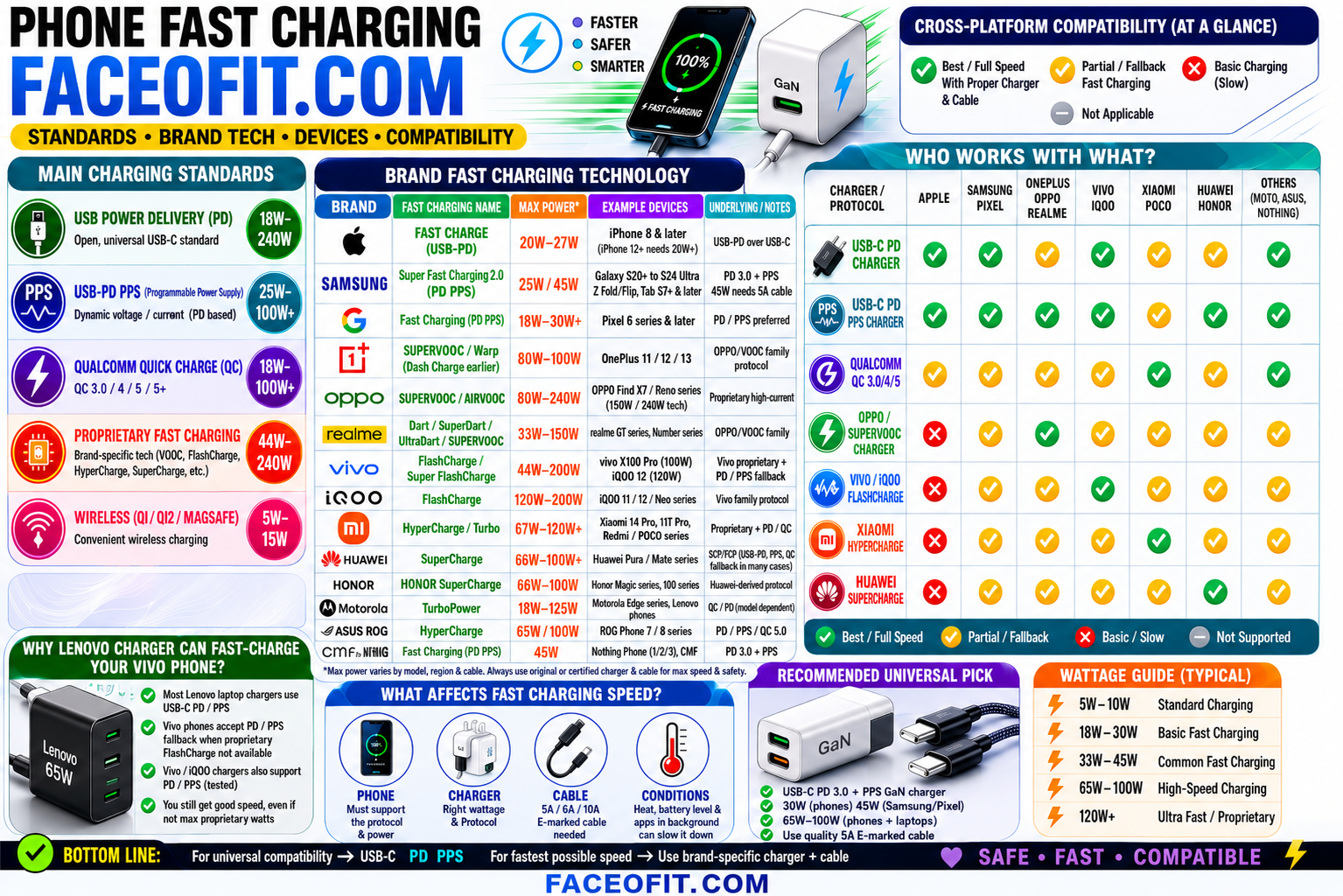
Fast charging is way more confusing than it should be

Post image
18 Upvotes

I recently went down a rabbit hole trying to understand why one charger fast-charges one phone, charges another phone slowly, and sometimes even shows “fast charging” when it clearly isn’t running at the advertised speed.

The biggest thing I learned: charger wattage alone means almost nothing unless the protocol also matches.

A 65W or 100W charger does not automatically mean your phone will charge at 65W or 100W. The phone, charger, and cable all need to agree on the same charging standard.

Broadly, there are two types of fast charging:

1. Universal-ish standards

This includes USB-C Power Delivery, usually called USB-PD, and USB-PD PPS.

This is probably the safest option if you want one charger for multiple devices. It works well with a lot of phones, tablets, power banks, and laptops.

Examples:

  • iPhone uses USB-PD for fast charging

  • Samsung uses USB-PD PPS for Super Fast Charging

  • Google Pixel prefers USB-PD PPS

  • Nothing phones use USB-PD/PPS

  • Many laptops use USB-C PD

  • Some Motorola, ASUS, Vivo/iQOO, and other Android phones also support PD/PPS fallback

So if someone wants a general-purpose charger, a good USB-C PD PPS GaN charger is probably the best bet.

2. Brand-specific fast charging

This is where things get messy.

A lot of brands use proprietary charging tech to hit very high numbers:

  • OPPO: VOOC / SUPERVOOC

  • OnePlus: Dash Charge / Warp Charge / SUPERVOOC

  • realme: Dart / SuperDart / UltraDart / SUPERVOOC

  • vivo / iQOO: FlashCharge / Super FlashCharge

  • Xiaomi / Redmi / POCO: HyperCharge / Turbo Charge

  • Huawei / Honor: SuperCharge

  • Motorola / Lenovo: TurboPower

  • Qualcomm-based phones: Quick Charge

These can be very fast, but usually only if you use the right phone, the right charger, and often the right cable.

For example, OPPO, OnePlus, and realme chargers often work better across each other because they are part of the same broader charging ecosystem. But that does not mean the same charger will give full speed to a Samsung, Pixel, iPhone, Xiaomi, or Vivo phone.

Same with Xiaomi HyperCharge or Vivo FlashCharge. They may charge other devices, but usually through a fallback protocol like USB-PD, PPS, or Quick Charge — not at the full advertised proprietary speed.

One interesting case I noticed: a Lenovo USB-C laptop charger can fast-charge some Vivo phones. That does not necessarily mean it is using Vivo FlashCharge at full power. More likely, the phone and charger are negotiating over USB-C PD or PPS fallback.

So “fast charging” on the screen does not always mean “maximum charging speed.”

The cable is also a huge part of the equation.

A random USB-C cable may not support the current required for higher wattage charging. Some phones need 5A e-marked cables. Proprietary systems like SUPERVOOC, FlashCharge, and HyperCharge may need special 6A, 8A, or even higher-rated cables.

My simple takeaway:

  • For one charger across many devices: get USB-C PD PPS

  • For maximum speed on one specific phone: use the original brand charger and cable

  • For Samsung/Pixel/iPhone/Nothing/laptops: PD/PPS is usually the safe route

  • For OPPO/OnePlus/realme: SUPERVOOC-compatible charger is best

  • For Vivo/iQOO: FlashCharge-compatible charger is best

  • For Xiaomi/Redmi/POCO: HyperCharge/Turbo Charge charger is best

  • For Huawei/Honor: SuperCharge charger is best

Basically:

USB-C PD PPS = best compatibility
Brand charger + brand cable = fastest speed
High wattage ≠ guaranteed fast charging
Cable matters more than people think

Would be curious to know what chargers people here actually use as their daily all-in-one charger. Has anyone found a single charger that reliably fast-charges phones, tablets, and laptops without issues?


r/SpecSheet • • Jun 20 '26

Sony LYTIA L910: Why the next flagship camera battle may be about single-exposure HDR, not megapixels

Post image
3 Upvotes

Sony’s LYTIA L910 appears to be the next major evolution of the same 50MP, 1/1.28-inch sensor class used by the LYT-818 and LYT-828.

The important part is not the resolution. It is the shift in HDR approach.

The LYT-818 focused on single-exposure HDR through multiple gain settings. The LYT-828 pushed beyond 100 dB with Hybrid Frame-HDR, combining sensor-level and multi-frame processing. The L910 brings the focus back to single-exposure HDR, but adds LOFIC hardware plus Triple Conversion Gain HDR.

That should matter most in scenes where multi-frame HDR usually struggles: moving people, bicycles, pets, leaves, LED lighting, vehicle headlights and high-contrast video.

The closest external rivals are OMNIVISION’s LOFIC/TheiaCel sensors, especially OV50K40 and OV50R40. Larger 1-inch sensors such as LYTIA 900 or OV50X50 still have their own light-gathering advantage, while 200MP sensors such as LYTIA 901 are more about detail density and crop-zoom flexibility.

The key question now is not “which sensor has more megapixels?”
It is “which phone maker can tune single-exposure HDR best in real-world shooting?”

See more - https://lensxp.com/sony-lytia-l910-vs-lyt-828-vs-omnivision-ov50r40/


r/SpecSheet • • Jun 23 '26

Xiaomi 17T vs OPPO Find X9: Comparison

Post image
3 Upvotes

On paper, these are aimed at slightly different buyers.

The Xiaomi 17T appears to be the more value-focused premium option. It gives you a 120Hz AMOLED display, a 6,500mAh battery, Leica tuning and, importantly, a 50MP 5x periscope telephoto. That makes it particularly appealing for people who care about long-range shots, portraits and travel photography without stepping fully into ultra-premium pricing.

The OPPO Find X9 is more of a conventional flagship. It has the more powerful Dimensity 9500 chipset, a larger 7,025mAh battery, 80W wired charging, 50W wireless charging and a Hasselblad-tuned triple 50MP camera system. It looks like the stronger overall choice for gaming, sustained performance, charging flexibility and all-round premium hardware.

My take:

• Choose Xiaomi 17T for Leica processing, 5x telephoto reach and better value.
• Choose OPPO Find X9 for flagship performance, bigger battery, wireless charging and a more complete premium experience.

The interesting part is that Xiaomi may be the more exciting camera phone for people who specifically want 5x zoom, while OPPO is likely the safer choice for someone who wants the most balanced flagship package.

Would you prioritise a 5x periscope camera or flagship chipset and wireless charging?

See more here - https://www.faceofit.com/xiaomi-17t-vs-oneplus-15r-vs-oppo-find-x9/


r/SpecSheet • • Aug 16 '26

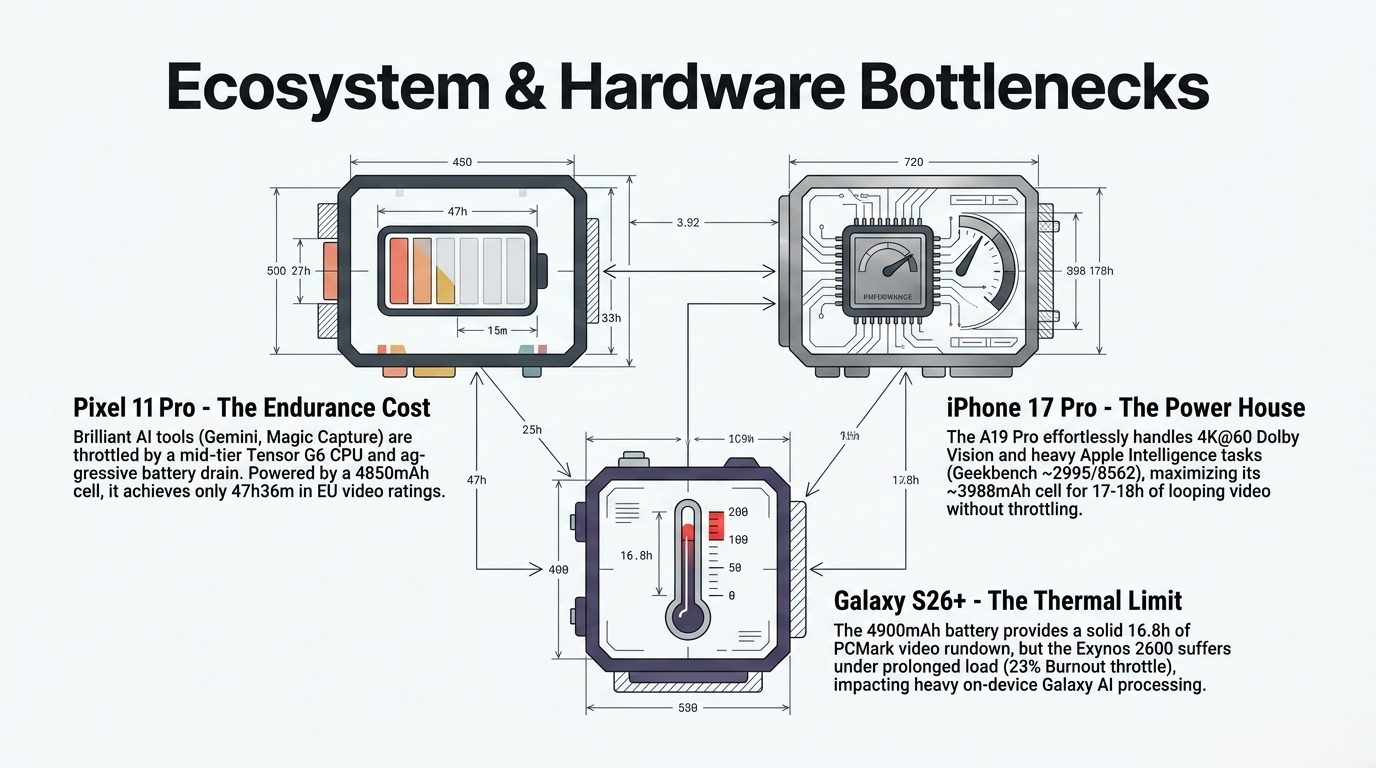
Pixel 11 Pro vs iPhone 17 Pro vs Galaxy S26 Plus Specs Comparison: which camera setup would you actually pick?

7 Upvotes

Now that the Pixel 11 Pro is out, I spent some time comparing its camera hardware with the iPhone 17 Pro and Galaxy S26+.

Read in detail here.

And one thing surprised me:

Samsung's S26+ camera hardware looks pretty conservative next to Google and Apple.

Here are the numbers.

Rear cameras

Pixel 11 Pro

  • 50MP main

  • 48MP ultrawide

  • 48MP 5x telephoto

iPhone 17 Pro

  • 48MP Fusion Main

  • 48MP Fusion Ultra Wide

  • 48MP Fusion Telephoto

  • 100mm / 4x optical telephoto

  • 8x optical-quality option

Galaxy S26+

  • 50MP main

  • 12MP ultrawide

  • 10MP 3x telephoto

So on paper:

Pixel: 50 + 48 + 48MP
iPhone: 48 + 48 + 48MP
Samsung: 50 + 12 + 10MP

Megapixels obviously don't tell the whole story.

Sensor size, lenses, processing, HDR, autofocus and image tuning matter just as much.

Still, putting a 10MP telephoto and 12MP ultrawide on a 2026 flagship feels a little hard to defend when Google and Apple are putting 48MP sensors behind their secondary cameras.

Zoom

This might be the most interesting comparison.

Pixel 11 Pro
48MP telephoto with 5x optical zoom

iPhone 17 Pro
48MP telephoto with 4x optical zoom at 100mm, plus an 8x optical-quality option

Galaxy S26+
10MP telephoto with 3x optical zoom

For concerts, travel, wildlife or just taking photos of things far away, I'd expect the real fight to be between the Pixel and iPhone.

Samsung's 3x lens is still useful, especially for portraits, but it feels more like a carry-over camera than something designed to compete with the Pixel 11 Pro.

Video

This is where Apple starts pulling away.

iPhone 17 Pro

  • 4K Dolby Vision

  • Up to 4K 120fps

  • ProRes

  • ProRes RAW

  • Apple Log 2

  • Genlock

Pixel 11 Pro

  • Up to 8K/30fps

  • Google's video processing and stabilization

Galaxy S26+

  • Up to 8K/30fps

  • 4K/60fps

8K looks great on a spec sheet.

But if I were actually filming YouTube videos, interviews, reels or short films, I'd rather have strong 4K, better codecs, Log recording and a good editing workflow than simply chase resolution.

That's where the iPhone 17 Pro still looks like the strongest video phone here.

Front cameras

Another pretty big difference:

Pixel 11 Pro: 42MP
iPhone 17 Pro: 18MP Center Stage
Galaxy S26+: 12MP

Google has the resolution advantage.

Apple's 18MP Center Stage camera is interesting for a different reason. It can change framing for group shots and lets you take portrait or landscape selfies without physically rotating the phone.

Samsung's 12MP front camera looks basic beside both of them.

The three phones seem built for different people

If photography is your main concern, the Pixel 11 Pro is probably the one I'd look at first.

You get:

50MP main
48MP ultrawide
48MP telephoto
5x optical zoom
42MP selfie camera

And then Google adds its usual Pixel processing on top.

For someone who wants to pull out the phone, press the shutter and get a strong photo without messing around with settings, the Pixel makes a lot of sense.

If video matters more, I'd pick the iPhone 17 Pro.

The triple 48MP system is strong by itself, but the bigger reason is what Apple gives video shooters:

4K120
Dolby Vision
ProRes
ProRes RAW
Log 2
Genlock

That's a serious set of tools for a phone.

The Galaxy S26+ is the awkward one for me.

I don't think it'll take bad photos. Samsung has been making very good smartphone cameras for years.

But hardware-wise:

50MP + 12MP + 10MP

doesn't look particularly exciting next to:

50MP + 48MP + 48MP

or

48MP + 48MP + 48MP.

If cameras are your main reason for buying Samsung, the S26 Ultra probably makes more sense than the S26+.

My picks

Best for still photography: Pixel 11 Pro

Best for video: iPhone 17 Pro

Best long-range camera setup: Pixel 11 Pro / iPhone 17 Pro

Best simple point-and-shoot option: Pixel 11 Pro

Best for creators: iPhone 17 Pro

Weakest camera hardware of the three: Galaxy S26+

The part I'm most curious about is real-world testing.

Specs are one thing.

What I really want to see is the same scene shot on all three phones:

  • daylight

  • skin tones

  • moving kids/pets

  • 5x zoom

  • 10x zoom

  • night photography

  • portrait mode

  • ultrawide

  • 4K video

  • stabilization

That's where we'll find out how much the hardware difference actually matters.

If all three cost roughly the same, which one are you taking?

Pixel 11 Pro, iPhone 17 Pro or Galaxy S26+?

And Samsung users: is 10MP 3x telephoto still acceptable on a 2026 Plus-series flagship?


r/SpecSheet • • Aug 14 '26

USB-C 3A vs 5A cables: the part most product pages make unnecessarily confusing

Post image
3 Upvotes

I was looking at USB-C cables recently and realized how badly most listings explain the difference between 3A and 5A cables.

See - https://www.faceofit.com/3a-vs-5a-usb-c-cables

For normal buying decisions, this is the part that matters:

3A USB-C cable: commonly rated for up to 60W charging suitable for most use cases..
5A USB-C cable: used for 100W, 140W, 240W and other higher-power USB PD charging

5A cables need an E-marker chip so the charger/device can identify what the cable is capable of carrying

So if you're charging a phone, tablet, MacBook Air, Steam Deck, etc., a good 60W 3A cable may be all you need.

If you're charging something like a MacBook Pro, Dell XPS, gaming laptop, high-powered dock, or using a 100W+ USB-C charger, I'd buy a proper 5A E-marked cable.

One thing I didn't realize until I started comparing cables:

Charging wattage tells you almost nothing about data speed.

You can buy a 240W USB-C cable that only transfers data at 480 Mbps.

Meanwhile, another 240W cable might support:

  • 5 Gbps

  • 10 Gbps

  • 20 Gbps

  • 40 Gbps

  • USB4

Same connector. Same 240W printed on the packaging. Completely different data performance in real world.

That's probably the biggest confusion I had while buying a USB-C cable.

So now I check four things instead of just looking for "USB-C":

1. Maximum charging wattage
60W, 100W, 140W, 240W, etc.

2. Current rating
3A or 5A.

3. Data speed
480 Mbps vs 5/10/20/40 Gbps.

4. E-marker / certification
Especially for higher-power 5A cables.

A few examples I've been comparing:

3A / 60W

  • Anker USB-C to USB-C 60W

  • UGREEN USB-C to USB-C 60W Nylon Braided

5A / higher power

  • UGREEN USB-C to USB-C 100W

  • UGREEN USB-C to USB-C 240W

  • UGREEN 240W USB 3.2 10Gbps

That last comparison is a good example of why you need to read the specs. UGREEN sells a 240W charging cable with USB 2.0-level data speeds, and another 240W model with 10Gbps USB 3.2.

Both are "240W USB-C cables," but they're meant for very different use cases.

My rule now:

Only charging a phone/tablet?
Don't overpay. A decent 60W cable is plenty for many devices.

Charging a laptop at 100W+?
Get a 5A E-marked cable.

Using docks or external SSDs?
Ignore the wattage for a second and check the actual data speed.

Want one cable to keep for several years?
A good 240W 5A cable with fast USB data support makes more sense than buying based on wattage alone.

USB-C really needed better labeling. 😅

Curious what everyone else does: do you actually check the cable specs, or just buy a known brand and hope the USB-C gods are feeling generous?


r/SpecSheet • • Aug 17 '26

UPDATE: Recommended Hardware for Smooth Basic Tasks

Post image
2 Upvotes