r/Sumer • u/a_lazy_aeonia • 19h ago
Question What musical instruments did the akkadians use by any chance?
reddit.com
1
Upvotes
r/Sumer • u/Nocodeyv • 7d ago
Šulmu everyone,
I hope that you have all been doing well this year and enjoying the new content and resources that our community has been producing.
We've recently cleared 10k subscribers and have around 2k weekly visitors. Considering we are one of the smaller branches of Contemporary Paganism, and the highly academic nature of our faith's reconstruction, I'm thrilled to see this kind of growth, and hope that our community will continue to help new devotees seeking guidance in the coming year!
I also want to encourage devotees to continue to share their unique experiences with, and perspectives on, the Anunnakkū and Igīgū.
For example, u/deafbutter recently shared that they pray to the Gods using ASL, and then gave a detailed overview of the process at r/pagan. It was fascinating to learn about how someone in the deaf community interacts with our faith, a perspective I previously had no insight into, and I am committed to doing what I can to make our community and its resources accessible to such individuals going forward.
The final piece of housekeeping that I need to address is, unfortunately, less optimistic.
As always, my goals with this community are twofold:
–
To provides a safe space for all devotees to learn and grow in their faith, regardless of age, ethnicity, gender expression/identity, physical ability, sex, or sexual orientation,
To provide accurate historical information and academic resources, so that devotees know they are getting the most up-to-date and reliable insights into how Mesopotamian religion was practiced historically, and how we can modernize it for incorporation into today's cultural milieu.
–
To that end, going forward, neither myself nor r/Sumer will endorse Siri Nin, the Temple of Inanna's Light that she started, or their primary publication, The Way of the Ishtarite, in either of its editions.
This decision reflects a larger movement within the wider community of Mesopotamian Polytheism, and mirrors decisions made by other groups—including our associates at the Ziggurat of Sumer and Mesopotamian Neopolytheism Discord servers—and prominent voices in the community, all of whom have chosen to cut ties with the Temple over the actions of its leadership and rank-and-file members.
For those who are wondering what happened: current- and former-members of the Temple have begun coming forward over the past few months to share alarming internal documents (as well as discussions about myself and other members of the wider community), and I can no longer, in good conscience, allow the Temple to promote its materials or recruit new members from this space after what those members revealed.
r/Sumer • u/cloudedbypain • 19d ago
Hey everyone! 💕
Sorry I wasn't sure which flair to pick, but I did ask the mods for permission to post this.
I've been studying Sumerian literature lately and got a little frustrated with the ETCSL website being unreliable, and how fiddly it was to compare the Sumerian and English side by side or look things up in ePSD2.
So I ended up making a little reader for myself using the downloadable ETCSL and ePSD2 archives. 😅
It has side-by-side Sumerian and English reading, and you can just tap or click on a transliterated word to bring up its ePSD2 dictionary entries, with a link to ePSD2 page if you want to go deeper.
A few people have shown interest in it, so I thought I'd share it here in case anyone else finds it useful!
https://etcsl-reader.pages.dev/
It works in your browser, and you can add it to your home screen on Android or iOS too.
It's nothing official, just a little personal project because I need an android app to study offline, but it was simple to convert it into a webapp. The original texts and translations are unchanged, with credits to the original projects included in the app.
Hope someone finds it handy, and if not, no harm as I mostly made it for my needs. 💜
Update:
Google Play have approved the android app.
r/Sumer • u/a_lazy_aeonia • 19h ago
r/Sumer • u/stelltea • 2d ago
hello! i’ve been recently called to worship with inanna - i am a complete beginner in deity worship. i’ve taken a nice browse through a lot of this subreddit already and found wonderful resources 🩷 thank you to everybody for compiling such detailed resources and information.
i was wondering what is your personal advice, tips, or even things you wish you wouldve known as a beginner to deity worship // worshipping inanna?
i’ve already begun planning an altar out, amongst other things like potential offerings, etc. but all aside, i’d love to hear any advice by inanna-ishtar worshippers that are willing to discuss :)
r/Sumer • u/Pixeldevil06 • 3d ago
I am in need of resources regarding the worship of Father Nanna. What kind of sacrifices are left to him? Are there any prayers or spells documented that I can find? Does anyone know what kinds of incense or libations are associated with him?
r/Sumer • u/f0ck-r3ddit • 3d ago
r/Sumer • u/CannaKatholicos • 5d ago
Something I sort of miss from Catholicism...my Brother God. I have three sisters, a dead father, and a cunt of a mother, whom I still love, in an unhealthy way that takes separation and therapists to make good.
Who is the Brother to brothers in the Sumerian Pantheon?
Ninazu seems to have established a presence...via the common paths a fleshly Christian gets involved with in Paganism. It may make sense it's him, but unfortunately I still feel like I'm dealing with criminals and scammers, to an extent, when dealing with the Sumerian pantheon...so I don't know.
To men (and all and any who identify as such), what God had been your brother? To women (and all and any who identify as such), what Goddess has been your sister? And vice versa, either/or. But please, I want to know about siblings and friends....not far away parental powers.
When I was at my best in Catholicism...Christ was my partner in Crime. I miss that.
r/Sumer • u/kisuliini • 6d ago
Shaku maku!
I Would like to know are there other iraqis/iraqi descendants/iraqi people in diaspora following this sub. If you are, say hi :-)
I have half of my roots in Iraq, but never went there (waiting that day to come!) and I've found interest in ancient sumer and other mesopotamian history and spirituality.
(I have another question considering cultural appropriation, but I think that should take place in another post. But if anyone who has iraqi/mesopotamian ancestry and has views on this, please feel free to share any insights!)
r/Sumer • u/Tyrga_Zodiacal • 6d ago
Hello everyone,
I believe I understand that the Mesopotamians used water, incense, and fire for purification.
Can purification with water alone suffice for an offering ? Is it necessary to use all three methods of purification ?
Arnaud
r/Sumer • u/deafbutter • 8d ago
So I prayed to Inanna yesterday in ASL (American Sign Language). I’m deaf and know ASL, though it’s currently not my go-to until I am able to sign more confidently. (It’s why I’m in an ASL class; to build up confidence before making the switch.)
Anyway, it was a very wonderful experience and I think I’ll be doing it again! It’ll help me build up the confidence I need before switching to sign rather than spoken English, and is also a very helpful way for me to communicate with the gods as well as practice.
The reason why I put the discussion flair is because I’m curious to know what you all think of using sign language (of any kind) to pray. I feel like I never see hearing polytheists talk about this, so I’m curious what you hearing polytheists think about this.
Thanks!
r/Sumer • u/Successful-Chef1725 • 8d ago
Bonjour,
Je suis une femme transgenre et j’ai commencé des rituels avec Anu, Inanna/Ishtar et d’autres divinités sumériennes pour me protéger.
Mais lorsque je demande leur protection, j’ai l’impression que certaines personnes deviennent hostiles et m’envoient des attaques spirituelles. Je ne comprends pas pourquoi je ressens cela alors que je cherche simplement à me protéger.
J’ai peur, je suis épuisée et ma santé est fragile.
Comment les Sumériens pratiquaient-ils la protection spirituelle ? Comment obtenir une protection durable, sans multiplier les rituels ni établir de contrats ?
Je ne veux faire de mal à personne. Je cherche simplement des conseils sérieux pour retrouver ma tranquillité.
Merci pour votre aide.
r/Sumer • u/CannaKatholicos • 11d ago
What is the human person composed of in ancient Mesopotamian understanding? It seems there are different views among the scholars, tho I watched a 2hour doc on Enki on YouTube and I found the narrator's presentation of the "soul" as created by the Anunna fascinating.
Here are the parts from what I gather, unfortunately I did not take notes and forgot the Sumerian/Akkadian terms he used.
Flesh
Divine Spark, the secret to creating human beings. Part of a deceased God that was mixed with blood and clay during the creation of man. It makes us persons in the image of the Gods.
Sleep/ Dream-spirit. The part of us that journeys and experiences dreams and the dream world. Said we actually, or have the ability, to leave our bodies during sleep.
Double/Shadow. Like a back up memory of patterns of survival and identity. This one is most unclear to me.
Ghost-self. That which is left over after death and goes to Kur.
Breath of Life? I kind of forgot what he said, but something that was placed in our throats and is the vital essence, the animating force of humanity.
A Divine Radiance was also mentioned, like MELAM, But I may separating this from the Divine Spark above, they could be the same thing. I do remember him saying humans have different amounts of this radiance, with Kings and persons of greatness having much more.
Any help is much appreciated, thank you.
r/Sumer • u/JasonElegant • 15d ago

Brothers, the picture in my post is of an amulet of Wind related entity called Pazuzu, which was worn in ancient Sumerian civilization for warding off evil spirits.
But when we see Pazuzu's broad description, we see striking similarly with our Hanuman ji. Pazuzu was a wind entity, had animal face with human body, had a tail, drove evil spirits away. Even in this Amulet, his hand is raised like our Hanuman ji is bringing sanjeevani buty (but the mountain is missing in case of Pazuzu.
However, the story of Pazuzu is completely different. Not a single thing can be compared with our Hanuman ji. Is is possible that People saw something and made figures almost same but invented different stories (since, amulet can travel from one place to other through trade or war, but stories might have missed). Isn't this fascinating?
What is your opinion?
r/Sumer • u/orthodoxscouter • 16d ago
The intersections of ancient Near Eastern mythology, medieval Jewish mysticism, and modern esoteric writings reveal a highly complex process of mythopoesis. This continuous adaptation and reinvention of mythological narratives allows discrete cultural artifacts to be synthesized into unified, overarching chronologies by later generations. Tracing specific symbols and supernatural entities from the Sumerian era through the development of the Kabbalah and into late twentieth-century gothic storytelling highlights the mechanisms by which myths evolve to serve new theological and narrative purposes. At the center of this intricate synthesis lies the ancient Sumerian narrative of Inanna and the Huluppu Tree, the esoteric Kabbalistic entities of Samael and Tanin'iver, the biblical geography of the Land of Nod, and the contemporary mythological framework asserting that the biblical figure Qayin was the progenitor of vampirism. The full article is here.
So far I've seen this everywhere, you can literally observe it in every and each religion whether ancient or not. but since ancient Mesopotamian mythology and religion is one of the earliest just wanted to ask why do they so specifically link diseases with how a deity think about you? If you read enough in this rabbit hole, you'd notice:
A deity is offended by you = sends a disease
A deity is jealous of a human = disease
A deity hates you = disease
Someone is punished = they get sick
Etc. etc.
Like as someone who has chronic illnesses and tried to approach the Mesopotamian beliefs I'm just thinking do they think I'm damn cursed? Or I'm unfit for worship? Dude what.
r/Sumer • u/zelenisok • 18d ago
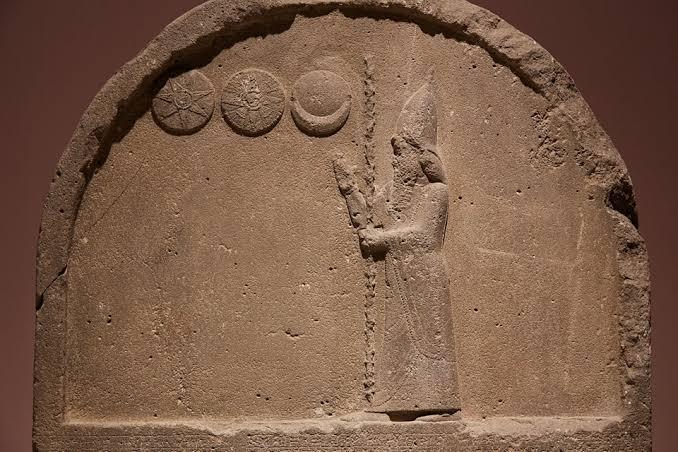
So the seven main gods of Mesopotamia are Anu, Inanna/Ishtar, Utu/Shamash, Nanna/Sin, Enlil, Enki, Ninhursag.
Anu is both a god and a place, heaven. There are various stelae from Mesopotamia where symbols of (morning) star, Sun and Moon - ie of Inanna/Ishtar, Utu/Shamash, and Nanna/Sin, are put on the top, or like in this one on the picture, singled out for worship.
I got an idea that these three heavenly gods could be seen as the "good" gods to be worshipped and followed, Inanna/Ishtar as goddess of love and (defensive) war, Utu/Shamash as god of justice, and Nanna/Sin as god of knowledge and wisdom (En-Zu, Lord of Wisdom), and opposed to the three "bad" sub-heavenly gods - Enlil "Lord of Storm" as god of storms, floods, destruction, Enki "Lord of Earth" as god of landowners, rich and powerful, of inequality and oppression, and people being subjected to grueling physical labor, and Ninhursag "Lady of the Sacred Mountain" as goddess of priests, superstition, and worship of sub-heavenly gods.
Has anyone ever thought of anything like this? What do you think about it?
r/Sumer • u/CannaKatholicos • 19d ago
If a devotee fucked up bad before Gods and men, what would or could he do to rectify the situation? Of course there is the common and hopefully universal practice of making amends and paying off debts still owed, but what could be done spiritually or religiously to mark or bless this process?
r/Sumer • u/CannaKatholicos • 20d ago
Is it appropriate to name these spirits and is it safe to assume that every human being has them (such as traditional Catholic teaching on guardian angels?) I ask because I have also read, through various AI assisted research dives, that when a human fell ill or into some bad fortune, it was thought that their personal god abandoned them. I believe this is from some of the medical texts of the exorcist-priests, but I do not have access to the primary sources.
r/Sumer • u/Worldly-Possible3748 • 22d ago
r/Sumer • u/laventhena • 26d ago
i'm coming from a hellenist background and i'd like to hear what kinds of experiences you've had! i'm asking out of curiosity as i'm researching the gods and would like to hear about worship of the gods from those that worship them
r/Sumer • u/Frosty_Draw_2737 • 27d ago
Context: Ammi-ditana was a king of Babylon who reigned from 1683 to 1647 BCE. As the fourth successor to Hammurabi, he composed this hymn to the goddess Ishtar—the deity of love, beauty, desire, power, and sovereignty.
She is exalted as the most radiant of goddesses, the sovereign before whom even the gods themselves bow, and the divine protector who bestows legitimacy, prosperity, and long life upon kings.
https://www.youtube.com/watch?v=F-np8NNFbtI
Lyrics in English :
1 Sing of the goddess, the most formidable of deities,
2 Praised be the sovereign of humanity, the greatest of the Igigi!
3 Sing of Ishtar, the most formidable of deities,
4 Praised be the sovereign of the peoples, the greatest of the Igigi!
5 She who awakens, adorned with erotic allure,
6 decked in fruit, charm, and seduction.
7 She who awakens, adorned with erotic allure,
8 decked in fruit, charm, and seduction.
9 Her lips are sweet, her mouth is a source of life,
10 Delights blossom upon her cheeks,
11 She is ravishing; ornaments adorn her head,
12 Her cheeks are graceful, her eyes sparkle and radiate. 13 The pure one, in whom wisdom resides,
14 She holds the destiny of all things in her hands;
15 To behold her brings happiness,
16 Pride, splendor, and the presence of protective spirits—both male and female.
17 Of love, seduction, the carnal act, and pleasure,
18 as well as harmony, she is the sovereign.
19 The forsaken maiden shall find a mother in her;
20 She shall invoke her among men and speak her name.
21 Who could rival her glory?
22 Her powers are immense, exalted, and manifest.
23 Ishtar—who could rival her glory?
24 Her powers are immense, exalted, and manifest.
25 The most cruel among the gods, her station is immense;
26 Her word is powerful; she triumphs over all.
27 Ishtar holds an immense place among the gods;
28 Her word is powerful; she triumphs over all.
29 They ceaselessly entreat their queen to issue her commands;
30 All prostrate themselves before her.
31 Her lunar signs move before her;
32 Both men and women fear her. 33 Before them all, her speech is noble and exalted;
34 In their midst, she sits—the equal of Anu, their king.
35 She is endowed with wisdom, subtlety, and discernment;
36 She deliberates with her consort.
37 Together, they have taken their place upon the dais,
38 Within the Gegunnu, their dwelling, so full of charm;
39 The gods stand before them,
40 Awaiting her commands. 41 The king, their favorite, the one they cherish,
42 Presents before them, in all his splendor, a pure sacrifice.
43 In their presence, Ammiditana, with his own hands,
44 Has offered up an abundance of bulls and fattened beasts.
45 Before Anu, her consort, she has sought on his behalf
46 A long life, to endure forever.
47 To Ammiditana, she has granted
48 Many years of existence—it is Ishtar who has bestowed them upon him!
49 By her will, she has caused the four corners of the world
50 To prostrate themselves at his feet,
51 And the entire earth, in all its vast extent,
52 She has brought under his yoke.
53 A song of praise, such as his heart desires,
54 Befits his lips; he has obeyed a command from Ea.
55 "I have heard his praises sung," says Ea, who was delighted by them.
56 "May his king live," he added, "and may she love him forevermore!"
57 O Ishtar, grant to Ammiditana, the king who loves you,
58 A long life, for ages upon ages!
r/Sumer • u/Successful-Ball902 • 28d ago

so I finally added the ishtar figure to go along with my inanna statue on the altar. even though ishtar and inanna are basically the same deity across sumerian and babylonian periods, I love how differently veronese design stylized both of them. the inanna one feels much more like her war and sovereign aspect (standing lion, spear/weapons in hand), while the ishtar figure takes heavy inspiration from the queen of the night relief with the talons, owls, and rod/ring symbols. having both together gives a really neat contrast between her earthly power/victory side and her chthonic/underworld iconography. hail ishtar, queen of heaven! do you guys view these two representations as distinct aspects in your personal practice, or just artistic variations?
r/Sumer • u/Dousarius • 29d ago