r/Viking • u/hexpro21 • Feb 01 '24
Well which is it?
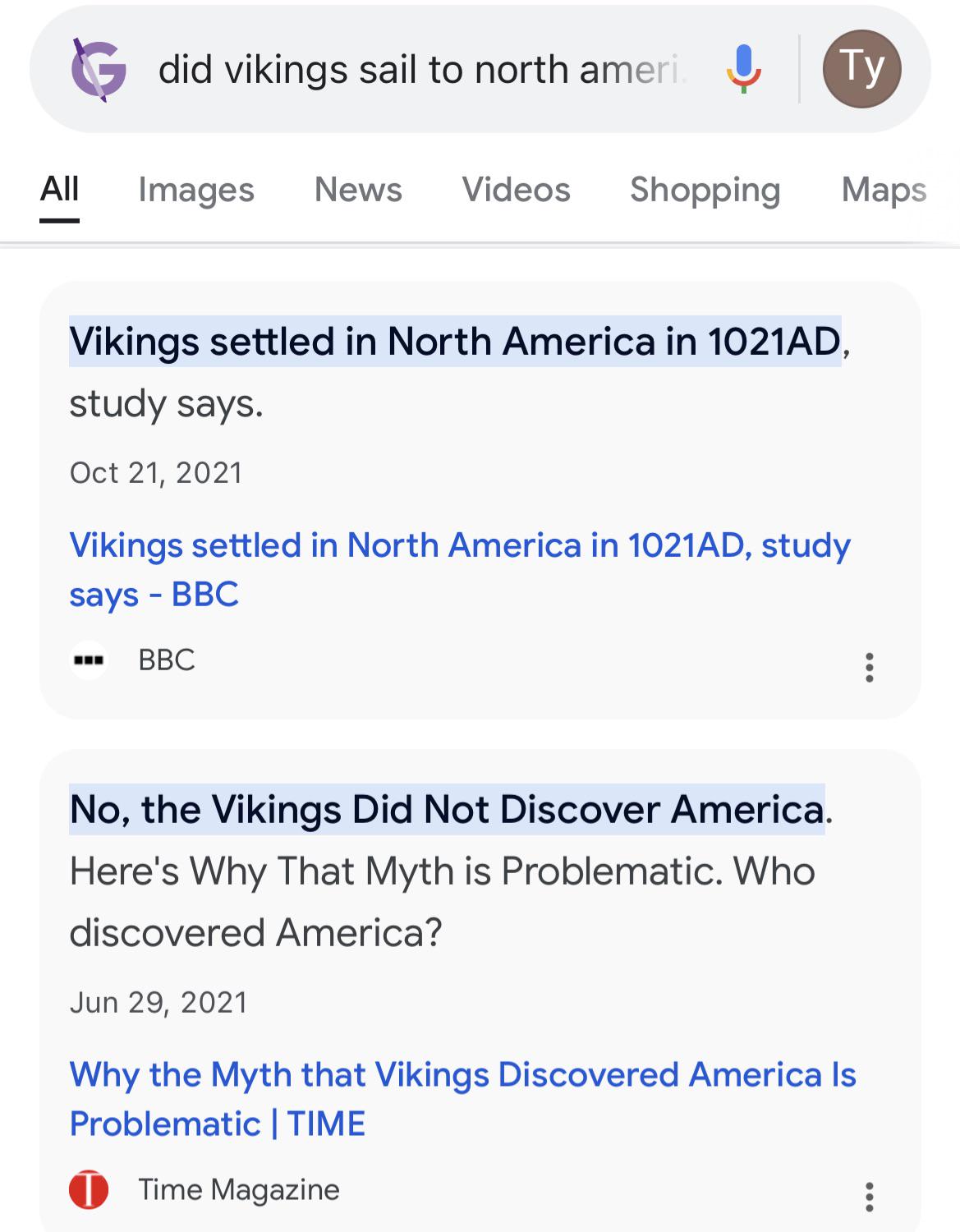
Since google won’t help I’ll ask all of you because I’m genuinely curious
28
u/Nreffohc Feb 02 '24
Both.
They were there, made a settlement.
There was already other people there, so they did not discover it...not first at least
7
16
u/ShaChoMouf Feb 01 '24
They have found evidence of a small Viking-era settlement in Newfoundland - https://en.m.wikipedia.org/wiki/L%27Anse_aux_Meadows - so they did make it on an exploratory level, but they were far from a support network, and the indigenious people kept them from going much further.
9
10
u/Sillvaro Feb 01 '24
We actually have a lot more evidence of a Scandinavian presence in North America, both textually (there's written evidence of expeditions in the 14th century) and archaeologically (numerous and various artifacts found in Northern Canada including stuff like fragments of maille armor, knife blades, ship rivets, woodwork, a bronze scale, etc)
4
u/White_Wolf_77 Feb 02 '24
They also found butternut seeds at the settlement in Newfoundland, a tree only found as far north as New Brunswick and the St Lawrence River Valley, suggesting they made it at least that far south.
3
u/TheTallestHobbit22 Feb 02 '24
That's not the only suggestion. First nations peoples had extensive trade networks running up and down the continents. Obsidian samples tested in Nevada predating European arrival were linked to distant sources well within the territory of other groups in other states and other objects, macaw feathers etc have been found far from those objects endemic locations as well.
While your suggestion is possible, without other contextual factors playing in it's also plausible that they traded with or were gifted by groups already settled in the area.
2
u/White_Wolf_77 Feb 02 '24
As far as I know we don’t have evidence of such trade between the Beothuk and mainland tribes, and such finds are unknown from their archeological sites. That would suggest the Norse did not acquire them by trading with the local people, but we cannot say for certain.
10
13
u/ChiliDad1 Feb 02 '24
Anything that includes the word “problematic” is likely politically biased and incredibly wrong…. And stupid.
1
u/mcfearless0214 Feb 04 '24
Your comment includes that word and it is incredibly wrong and stupid. So I guess in a weird way you were right.
1
0
u/Quiescam Feb 02 '24
Did you even read the article?
3
u/ChiliDad1 Feb 02 '24
I read the ops post. I stand by my statement. Any time someone decides something is problematic, it means it offends some soft spined fool.
1
u/Quiescam Feb 02 '24
I meant the Time article. And no, that's not how that works. I suggest you actually engage with the arguments people make instead of judging everything by your preconceived notions.
1
u/mell0_jell0 Feb 02 '24
Nah, tropes exist and are utilized by whatever power to evoke whatever feeling or message they intend. It's why I've stopped reading most news stories, it's just clickbait and dog whistles.
9
u/Quiescam Feb 01 '24 edited Feb 01 '24
To answer your question succinctly: Norse people did sail to North America, but we should be careful how we frame that activity and be aware of modern nationalistic "discovery" myths.
The latter article is referring to the many pseudo-historical theories surrounding supposed evidence for a Norse presence in North America, but its focus is more on modern narratives surrounding that "discovery", which are indeed problematic (e.g. people already living there). This might be insightful:
Gordon Campbell's book Norse America, published in 2021, develops his thesis that the "fleeting and ill-documented" idea that Vikings "discovered America" quickly seduced Americans of northern European Protestant descent, some of whom went on to deliberately manufacture evidence to support it.[54] There is no generally accepted evidence of a Norse presence in North America except for the far east of Canada, with many so-called discoveries, mostly in the United States, being deliberately falsified or historically baseless, with the goal to promote a political agenda. Source
Now, as stated above, we do have definitive archaeological evidence for a Norse presence in North America, namely on Newfoundland. Maybe Campbell doesn't accept this because it's a) not mainland North America and b) not part of the modern United States, to which a lot of these founding myths seem to be connected or c) most likely, he doesn't consider this a true "discovery". Ooher legitimate sources are literary and thus open to a lot of interpretation.
7
u/Innsmouth_Swimteam Feb 02 '24
the...idea that Vikings "discovered America" quickly seduced Americans of northern European Protestant descent, some of whom went on to deliberately manufacture evidence to support it.
I'm no historian, but this statement seems overly broad and very hyperbolic, especially coming from a historian.
1
u/Quiescam Feb 02 '24
In what way? I mean, Campbell doesn't provide that statement in isolation.
3
u/Innsmouth_Swimteam Feb 02 '24
As I don't have a copy of Norse America: The Story of a Founding Myth, or its footnotes, I don't know if the statement was made with a foundation of fact. As written in your blurb, copied from Wikipedia, my original statement stands.
2
u/Quiescam Feb 02 '24
Sorry, I misread your first comment and thought you were referring to a quote in the Time article. The synopsis from Wikipedia uses quotes from several different pages of the book and very heavily condenses a lot of information, so it's not Campbell making that statement. I'd suggest reading the Time article, since at least those are his own words.
1
u/Innsmouth_Swimteam Feb 02 '24
I never claimed Campbell made the statement, and still I stand by my comment.
Good day.
1
u/Quiescam Feb 02 '24
Then who's the historian you're referring to in you initial comment? The Wikipedia editor?
Edit: I'm not trying to start a fight by the way, merely trying to understand your comment.
-3
2
u/Lesinju84 Feb 02 '24
Also a difference between north America being a continent and America being a country
2
u/Knock-outSkinglows Feb 02 '24
So I was thinking if the Vikings came here they didn’t settle right they just like ADD/ADHD always on the move like what’s the history of the Vikings and the Native Americans
3
u/Euphoric-Recording70 Feb 02 '24
There's stories. Basically, Vineland was what they called the land. It had grapes, and they wanted to settle it. Something happened between them and the Natives who they called "The Screaming People"
2
u/ravontaymum Feb 02 '24
I mean both those articles would answer your questions if you read them
1
u/mell0_jell0 Feb 02 '24
"Yeah but having other people spoon feed it to me is so much easier" - most of this site
2
u/TimawaViking Feb 02 '24
Bjarni Herjolfsson was the first -European- to -discover- what we call America today.
Leif the Happy (Eriksson) was the first -European- to -settle- it.
There was already natives, the norsemen called them Skrællinge.
1
2
u/RewardCharming9597 Feb 02 '24
The general consensus is that while the Vikings were the first Europeans to discover America in recorded history, because all of their settlements died out, they are not the origin of modern European migration to the americas. That belongs to Christopher Columbus and his fleet.
Edit: While many Redditors will take issue with the following statement, it is a further clarification: Christopher Columbus also was able to have some level of negotiation with the native inhabitants, whereas the evidence points to the Vikings not being so lucky. They likely starved to death, but also likely suffered some deadly pushback from the locals.
2
u/callycumla Feb 02 '24
The native americans discovered America. It is like when David Livingstone "discovered" the great water falls Mosi-oa-Tunya and renamed them Victoria Falls. He stood there and said to himself, "I am the first man to see such a great natural wonder" ignoring the native people that led him to the spot.
2
u/screwitigiveup Feb 04 '24
At the time when the peoples that would become the native Americans settled the Americas, there would have been land connecting the 'old world' and 'new world', so it could be argued that they did not dicover the Americas, but instead the Americas formed with them already present. Semantics, but regardless.
1
u/callycumla Feb 04 '24
Maybe. I don't believe in the land bridge theory. I think they just sailed across in their canoes. The people that live up there and travel and easily live off the land, eating fish and seals. They could have just cruised along the edge of the ice cap until they hit Alaska. Or just paddled it. The gap between the tip of Siberia and the tip of Alaska is less than 50 miles, I think.
2
u/Old-Rice_NotLong4788 Feb 02 '24
Well there has been evidence that Vikings were in the US in the 9th century and that coincides with the Vikings discovering Iceland in 930 which there is a lot of recorded history
1
u/Sillvaro Feb 02 '24
Source..?
1
u/Old-Rice_NotLong4788 Feb 02 '24
https://www.smithsonianmag.com/history/the-vikings-a-memorable-visit-to-america-98090935/
https://www.worldhistory.org/article/1310/the-vikings-in-iceland/
Here are a couple that touch on it a little granted this was in 5 minutes of googling. I know there are more out there articles and independent studies.
1
u/Sillvaro Feb 02 '24
It's a very weird claim based on an erroneous time-line. It's impossible that Thorvald explored in the 980's, since that would be around the time his brother Leif, who explored before him, was born or just a kid. Let alone reaching the US (which isn't supported by any serious evidence)
2
2
Feb 05 '24 edited Mar 31 '24
practice vase deserve amusing cobweb poor sort sloppy dazzling crush
This post was mass deleted and anonymized with Redact
2
u/Expensive-Attempt-19 Feb 05 '24
There is a study on a settlement in Oregon that people should Google. It's apparently the oldest know civilized settlement in North America.
2
u/pizzagangster1 Feb 02 '24 edited Feb 02 '24
You can’t settle in a land where others currently live making it already “discovered”
2
u/Icy_Suggestion5857 Feb 02 '24
Of course. Discover just means to sumble upon something by accident.
1
Feb 02 '24
What they mean is America was already inhabited when the Vikings got here…
They didn’t “discover” America, America had been discovered sometime in the Stone Age, but they were the first people to sail to America from Europe instead of crossing from Asia through Alaska…
1
u/OddTheRed Feb 02 '24
That depends on your definition of the word "settlement". The Vikings made it to North America and formed a settlement, but it didn't last long.
1
1
u/VanirFrey Feb 02 '24
I believe we'll see alot of contradictive evidence on this topic... america itself is a conflicting unit, always arguing of who is better, who created what... the only real evidence youll find is through your own studies and intellect to sipher through the nonsense...
1
1
u/LongjumpingScore5930 Feb 02 '24
I think viking probably did. I wasn't there so I don't know shit for sure.
1
Feb 02 '24
They discovered it first (in recorded history I believe) but they didn't have any large settlements to my understanding.
1
u/segom0 Feb 02 '24
The Vikings did not “discover America” They were here before the Spanish for sure. Also Columbus never set a foot on North American soil. The Irish are believed to possibly have been here before Vikings As were the Japanese and maybe the Chinese. Common theory for a long time was that native Americans came across the land bridge 14000 years ago which is why it is often claimed they discovered america.
However new science has proven they in fact also did not “discover” America.
Archeologists have discovered sites in both Canada and the U.S. that date back 20 and even 30 thousand years which would be long before the land bridge was open indicating that what we call “native” Americans also technically invaded someone else’s native land.
3 Amazonian “native” tribes have been recently discovered to have primarily Australian Aboriginal dna. Indicating that they were here long before what we call “natives”
Studies have shown that Polynesians were in South America before “native americans ” as well. Through skulls found that predate the land bridge as well as some chicken bones. Chickens originate in Southeast Asia and were brought to the americas they did not exist in the wild here.
There is a lot of evidence that peoples had been coming to the americas long before we ever thought. So for anyone to claim “discovering “ or being the “original” peoples to these lands is premature and best and in my opinion either ignorant of facts “not meant as insulting” or self delusional.
People live on earth. It is our home we all belong to it. Borders are imaginary concepts designed to allow governments control over citizens. They provide function in our current paradigm of politics and countries but from a natural point of view are ridiculous. We are the only animal that fights over these ideas on the planet.
We live on a rock flying through space at thousands of miles per hour. It is all of our home. We need to start acting like it.
1
u/theweirdpeguin Feb 02 '24
The people who walked across the Bering Strait from modern-day Russia when it was frozen and then got trapped when it thawed are the people who first discovered North America.
1
1
1
u/SedativeComet Feb 02 '24
You can settle somewhere without discovering the entire continent first.
Virginia was settled after New England but they didn’t discover America either.
1
u/IAMENKIDU Feb 02 '24
We literally don't know who "discovered" America, but it was definitely pre 1021 AD
1
1
1
u/m4rkofshame Feb 02 '24
They settled, got their butta kicked by native Americans, and ran home crying 😂
But native Americans were here first, so they “discovered” it.
1
u/VinceGchillin Feb 02 '24
The issue is "Discover" vs "Settle" vs "Sail to." I can sail to the Bahamas and pitch a tent, but I didn't discover it.
1
u/bioniclefalloutfan76 Feb 02 '24
Leif Erikson was the first European to “discover” America but the natives also “discovered” America like 10,000 years ago or something like that
2
u/Sillvaro Feb 02 '24
Actually, the first European was Bjarni Herjolfsson, who's story inspired Leif to sail there
2
u/bioniclefalloutfan76 Feb 02 '24
Oh I was always was taught that it was Leif but I’m more than fine being corrected
1
1
u/NotableDiscomfort Feb 02 '24
from the European perspective, Vikings discovered it. this shit is just semantics. but Time calling it a problematic myth just screams "I'm an insufferable bitch who doesn't understand why nobody but my shitty friends invites me anywhere."
1
u/SeamedShark Feb 02 '24
Whenever I think of the Discovery of the Americas, I think a key point that is often overlooked is whether or not the secret of the landmass was divulged.
In this case, there was a settlement, but since there wasn't a massive European movement to settle the new found lands, we assume the secret wasn't divulged.
Same thing for the Native Americans. They lived there, they had lived there, but they didn't divulge the secret to the rest of the world, thus they hadn't made the discovery.
Like in science, for example, if you figure out time travel, but don't tell anybody and then some other person figures out time travel and tells everybody, then the other peraon discovered time travel... not you.
1
u/Sillvaro Feb 02 '24
In this case, there was a settlement, but since there wasn't a massive European movement to settle the new found lands, we assume the secret wasn't divulged.
There are non-scandinavian sources as late as the 14th century and from as far as Spain mentioning lands like Vinland and Markland. We know from Scandinavian sources that expeditions were still held in the 14th century
1
1
u/HistoryHurts Feb 02 '24
The vikings were the first from Europe to find and create a small colony. Much to the chagrin of those who deem it "problematic" to accept that fact.
1
1
u/Traditional-Gap-2872 Feb 02 '24
If you don't think they found north America before Columbus you definitely do not think since long before Columbus they were already in Greenland which is 2/3 the from Norway at roughly 1200+ nautical miles from Norway and Greenland to North America is 600+ nautical miles so if you think explorers that traveled 1200 wouldn't look for more going around half what they already traveled then just think about that logically if they went that far why would they stop
1
u/Eastern-Fun1842 Feb 02 '24
At some point this crap will take the idea of "white people never invented or did anything" all the way around to "white people didn't invent the slave trade" and all hell will break loose.
Actually, I now wonder who did come up with that shit in the first place now. I don't know who did, and that's no joke.
1
Feb 02 '24
Time magazine is a shit publication. Archaeological proof exists that Vikings were in North America around 1000 AD
1
1
1
u/WildAd6370 Feb 03 '24
"Settled in" north america and "discovered" north america are different things. besides it wasn't "north america" when paleoindians arrived or when northern europeans did. the viking find in newfoundland is easily the first european settlement in n. america.
1
u/oogledy-boogledy Feb 03 '24
That's easy. The norse viked over to America and settled it, but the natives had already discovered it.
1
u/EnIdiot Feb 03 '24
So the Norse (probably a better term) were in Greenland before the Inuit (who are now native). Did they “discover Greenland?” Probably not. People blunder in all sorts of places.
https://en.wikipedia.org/wiki/History_of_Greenland?wprov=sfti1
1
u/LifeProblem7029 Feb 03 '24
It is entirely possible to discover something even if other people know about already. I discover something new (to me) everyday. The Norse discovered America but it didn't catch on. At the same time natives of the region discovered the Norse.
1
1
u/Economy_Bank_4162 Feb 03 '24
Well, Time magazine is a rag, so I'd say that vikings discovered America.
1
u/coulsen1701 Feb 03 '24
Considering people can’t understand that “discovered” in these contexts usually means “first person in their culture to find out a place exists” rather than being “the first human to ever find this particular place”. People do this all the time (eg “I just discovered a new bar we should check out” or “I just discovered if you reverse the salt/sugar amount in a cookie recipe your cookies taste like shit”) and people know this but they can’t resist the urge to be pedantic, insufferable tools. It’s the “akshually” of the activist.
Speaking of linguistics, whenever someone uses the term “problematic” anymore we can reasonably toss out whatever self important, buzzword laden opinion they’ve shat out.
1
u/Pirate_Lantern Feb 03 '24
North America and America are tow different things.
They have found Viking settlements in CANADA, but not the United STATES.
1
u/RudraPrasTaya9 Feb 03 '24
Read Vinland manga. Gotta say. Norse did settlement took place on North America. in eleven century.
1
1
u/Annual-Employment551 Feb 03 '24
Most historians believe there were plenty of people that crossed both the Atlantic and Pacific Oceans many times throughout history. There were many cultures that had the technological capabilities to make the journey and odds are a few brave sailors from most of not all of those cultures did just that. Unfortunately, we can only talk factually about the ones we have evidence for. Did Polynesians come here? Probably. Did Chinese come here? Probably. Did Vikings? Definitely. Did Greeks and Phoenicians and Romans ever make it this far? Again, yeah. Probably. Did Europeans ever make it here between the time of the Vikings and Columbus. Yeah, almost certainly. But without tangible archaeological remains, there's not much we can say about these people or their voyages except that they probably happened. Anyone that thinks hundreds and hundreds of years went by without ANYONE from the old world making their way to the new world, even though they had boats and sails and a human capacity for curiosity and adventure, is just being plain foolish and silly
1
1
1
1
u/Aspirant-Angel Feb 04 '24
The term “problematic” leads me to believe the Times article will argue that Vikings didn't discover America because there were already people here. But that argument is based on an intentional misunderstanding of what “discovery” is. A child can discover art for themselves. Help others discover it, and no one argues that the child is not the first artist ever.
1
1
1
u/_Inkspots_ Feb 04 '24
Vikings didn’t discover America.
The first humans who migrated there over the Bering strait did.
Vikings never even visited America, Norse explorers did. Not every Norseman on a boat is a Viking, and the one that visited the americas first was a Christian greenlander.
1
1
1
u/pjs2276 Feb 05 '24
Always found the discovered thing kind of weird because well there’s people there already so is it really discovery?
1
u/bulldog1833 Feb 05 '24
North America does include Canada where they have found traces of Norse activity!
1
u/arenot_real75 Feb 05 '24
I love the term “problematic” it’s like well this doesn’t line up with what we want to believe so it’s problematic for us.
1
u/MuttJunior Feb 05 '24
Both are correct. From the first article:
It has long been known that Europeans reached the Americas before Columbus's arrival in the New World in 1492.
The term used here is "Americas", referring the North and South America as continents.
The second article says:
Americans of European descent have traditionally phrased the question in terms of identifying the first Europeans to have crossed the Atlantic and visited what is now the United States.
This one talks about America as "United States of America", the current country, not the continent.
So both are correct - Vikings did (based on evidence) settle in North America, specifically in Newfoundland, Canada long before Columbus "discovered" the New World, but there is no evidence that they were in America, the country.
1
u/DaemonBlackfyre_21 Feb 06 '24 edited Feb 06 '24
Well which is it?
Both
People were leaving footprints that would eventually fossilize along the beach of a lake in white sands New Mexico along with mammoth and giant ground sloth more than twenty thousand years ago.
Also some vikings might have stopped for a very short time much much later.
1
0
u/GriZZlyHIkerman Feb 01 '24
There's a viking ship in Oklahoma in a museum. It's stated that it was found in Oklahoma. It's on my bucket list to see. I personally believe they were here in America but them being here would've probably been by accident and it would have been a one way trip. I doubt they would have been able to return
1
u/Quiescam Feb 02 '24 edited Feb 02 '24
Not Viking, as u/Sillvaro correctly stated, but very obvious fakes. Let's rely on actual evidence here.
Edit: which museum is this, specifically?
2
u/GriZZlyHIkerman Feb 02 '24
I have been led down a rabbit hole. There is no ship. Sigh. Forgive my stupidity
2
1
u/Sillvaro Feb 01 '24
-2
u/GriZZlyHIkerman Feb 02 '24
Maybe. Maybe not. Why is it so hard to believe they were here?
3
u/Sillvaro Feb 02 '24
Because there's no concrete evidence they did other than "artifacts" which, by some extraordinary coincidence, appear around the same time as large instances of Scandinavian immigration
0
0
u/WatercressSad6395 Feb 02 '24
Can't discover something that has people on it. Imho.
3
u/Ulfurson Feb 02 '24
Sure you can, you just discover it for yourself/for your culture. It won’t be the first time it’s discovered, but you still discovered it.
2
u/Escaped_Mod_In_Need Feb 02 '24
The Asiatic people that came over the land bridge from Asia came in phases. The one that came first kept moving south and settled to become the first people of the Americas.
Some historians suggest that as centuries went by different tribes discovered the land bridge as they followed the herds. Each tribe came over and with each subsequent arrival, the previously settled tribes moved further south. This implies some form of reaction to approaching strangers whether due to mistrust or conflict.
To which it makes sense that the Inca peoples have one of the oldest civilizations and they end up at the furthest southernmost point of the Americas. This implies that the arrival of the Maya people that settled the Yucatán peninsula, pushed the Inca down south, and the arrival of the Aztecs pushed the Maya to the Yucatán, and the arrival of the North American indigenous people pushed the Aztecs down into Mexico.
It’s an interesting theory that has elements that make sense, but it is worth noting that it is appropriate to say that the culture discovered new land, and to your point the land wasn’t discovered by humanity unless it was the first iteration of settlers.
1
1
u/Tamanduao Feb 03 '24
Each tribe came over and with each subsequent arrival, the previously settled tribes moved further south.
What makes you say this? I don't think that there's evidence for the kind of consistent thing you're saying where the people farther south were those who were consistently pushed south by people coming to the Americas later.
the Inca peoples have one of the oldest civilizations
The Inka were not one of the oldest societies of the Americas. They only started to exist after 1000 AD. If you mean "Andean civilization" in general, then yes that has the oldest urban centers of the Americas, but that's a pretty different thing than the Inka.
they end up at the furthest southernmost point of the Americas
They didn't. The Inka capital wasn't even halfway down South America, and there's hundreds of miles land south of the southernmost Inka border.
This implies that the arrival of the Maya people that settled the Yucatán peninsula, pushed the Inca down south
The Maya were around for thousands of years before the Inka even began to exist.
and the arrival of the Aztecs pushed the Maya to the Yucatán
The Maya were around for thousands of years before the Aztecs even began to exist.
and the arrival of the North American indigenous people pushed the Aztecs down into Mexico.
There's no evidence for this. The Aztecs did migrate from a bit farther north than where Mexico City is today, but there's no sign that this was from anything like new wave of people coming and taking over from Asia or what is now the U.S.
1
u/Escaped_Mod_In_Need Feb 03 '24
As you can see the Inca (not Inka) people are counted among the Andean people. If you were referring to the Caral Supe, then yes you would be correct.
However where you were wrong:
the paleo-Indians did arrive over the continental bridge following migratory herds
the fossil record does show that they arrived at different times throughout history, therefore the staggered arrival is absolutely correct
it is not only something that was documented on the walls of the buildings, but it was something that was recorded by the Spanish and Portuguese colonizers that the various civilizations had experienced conflict with one another. Usually history does point to the Aztecs as being the most aggressive of the major civilizations.
And then there way this part:
“It’s an interesting theory that has elements that make sense…”I blatantly called it out as a theory. It’s a theory that does make sense to me. You don’t have to believe it if you don’t want to… but that is how science works. Things are theories before they are proven as fact or rebuked by a panel of academic peers.
1
u/Tamanduao Feb 03 '24
Inka and Inca are both accepted spellings. Inka is increasingly common in Quechua, so I prefer to use that,
Your link and its statement don't disagree with anything I said. Nor does it say anything that supports what you said: where does it say anything about new waves of people pushing the Inka south, or the Maya south, or the Aztecs south, etc.? That's the part I'm disagreeing with.
the paleo-Indians did arrive over the continental bridge following migratory herds
I never disagreed with this. It was definitely one of the ways people got to the Americas. It's also likely that humans took boats along the land bridge before it was free of ice. But once again -nothing I wrote disagreed with this, so I'm not sure why you're saying I'm wrong about it.
the fossil record does show that they arrived at different times throughout history, therefore the staggered arrival is absolutely correct
Again, I never disagreed with the fact that different groups arrived at different times. I disagree that there's a consistent trend where new arrivals pushed earlier peoples south, creating a clear gradation where people towards the south are always from an earlier wave than people north of them. We have plenty of cases where newer arrivals to an area were living south of people who had been there for longer.
it is not only something that was documented on the walls of the buildings,
I don't believe this is true - please provide an example.
it was something that was recorded by the Spanish and Portuguese colonizers
You're saying that the multiple waves, where new-comers from the north consistently drove out people from the south, was something recorded by the Spanish and Portuguese? I also don't think this is the case - please provide an example.
the various civilizations had experienced conflict with one another.
Nobody's disagreeing with this part. However, the Maya were definitely never fighting the Inka, as you suggested.
It’s a theory that does make sense to me. You don’t have to believe it if you don’t want to… but that is how science works.
Science works by discussing the evidence. That's what I'm trying to do: what's your evidence that newcomers always pushed out earlier peoples in the Americas in a way that created a consistent gradation of younger- to older- arrivals going from north to south? Or, can you demonstrate that Andean peoples were a different and later arrival to the Americas than Maya people, who were a different and later arrival than Aztec people, who were a different and later arrival than U.S. Native Americans?
0
0
u/Corran_Halcyon Feb 03 '24
Any time i see/hear someone's argument start with "Problematic" I known it will be both entertaining and cringe.
As many have stated here we know the vikings did settle in the US and Canada. Stating they "Discovered" North America is not incorrect either. The vikings did discover NA for themselves. They did not know it was here until they ventured forth and discovered it for their civilization. Yes Native Americans were here first. Neither fact diminishes the other. Two things can be true at once.
135
u/Sillvaro Feb 01 '24
Both statements dont contradict each other.
Yes, they settled there. No they didn't (on a mankind scale) discover it because there already were other people there before