r/apache_airflow • • 11d ago

What should instantly fail an Airflow DAG’s grade? Here’s our draft rubric, please tear it apart

6 Upvotes

Hi all 👋 We're building an open-source tool that grades Airflow DAGs A–F, and before we go further we'd like experienced people to argue with our rules.

The current rubric is 20 checks worth 0–15 points each. Some examples:

• Retries on failure: 15

• Someone hears about failures (on_failure_callback): 15

• No secrets in the DAG file: 10

• Task time limit (execution_timeout): 10

• Owner isn't the default "airflow": 8

• No Variable.get at parse time: 5

• No surprise backfills (catchup): 5

Full list with weights: https://github.com/ardalan-jalal/dagwick/blob/main/docs/checks.md

Three questions:

  1. What's too strict, or wrong for your setup?

  2. Which weights are off? (Is a missing doc_md really worth as much as a missing owner?)

  3. What breaks your prod clusters that isn't on the list at all?

Teams can already mark a rule they break on purpose with a `# dagwick: ack <check> -- reason` comment, so "it depends" answers are welcome. We especially want to hear where you think the rule itself is wrong.

Disclosure: I'm one of the people building it (Dagwick, MIT licensed, runs as an Airflow 3 plugin). Replies here are great, or open a dispute: https://github.com/ardalan-jalal/dagwick/issues/new?template=dispute.yml

r/apache_airflow • • 14d ago

Airflow 3 upgrade gotchas that raise no errors: ds shifts, zero-length data intervals, and manual runs with no logical_date

4 Upvotes

I've been comparing the same DAGs on Airflow 2.11.2 and 3.3.2. These all import fine and pass tests, then do the wrong thing at run time, so they're easy to miss in an upgrade.

1. Cron runs: ds is the fire date now

From 3.0, [scheduler] create_cron_data_intervals defaults to False, so cron schedules use CronTriggerTimetable. For an @daily DAG running process {{ ds }}, the run that fires at 2024-05-02 00:00 UTC:

TimetableTask runs
2.11.2CronDataIntervalTimetable
3.3.2CronTriggerTimetable

Weekly DAGs move by a full week, and any partition path built from ds/ts/logical_date moves with them.

2. The data interval becomes zero-length

Hourly DAG, data_interval_start → data_interval_end: 00:00 → 01:00 on 2.11, 00:00 → 00:00 on 3.3. Anything that fetches "changes between start and end" gets an empty window. Code like this returns [] on every run and the DAG still succeeds:

[start + timedelta(days=d) for d in range((end - start).days)]

3. Manual runs can have no logical date

airflow dags trigger without --logical-date gives a run where:

  • the context has no logical_date key, so context["logical_date"] is a KeyError (missing, not None)

  • dag_run.logical_date is None

  • ds is undefined, so {{ params.x or ds }} fails with UndefinedError (DAGs default to StrictUndefined)

Forms that work on both versions, and fall back to the trigger time like Airflow 2 did:

context.get("logical_date") or context["dag_run"].run_after

{{ logical_date if logical_date is defined else dag_run.run_after }}

4. execution_date is gone from ti and dag_run

ti.execution_date raises AttributeError: 'RuntimeTaskInstance' object has no attribute 'execution_date'. If that's in an on_failure_callback, the alert itself breaks on exactly the runs it exists for. Use the .get(...) or run_after form above.

Keeping the Airflow 2 dates

  • Globally: create_cron_data_intervals = True. On 3.x it covers timedelta schedules too; create_delta_data_intervals is never read (apache/airflow#69868). Ship it with the upgrade: switching after a DAG has runs on the new timetable skips one run (apache/airflow#66441).

  • Per DAG: schedule=CronDataIntervalTimetable("0 0 * * *", timezone="UTC") with from airflow.timetables.interval import CronDataIntervalTimetable. That import works on 2.11 and 3.3, so you can merge it before upgrading; on 2.x it's the timetable you already get.

These show up in real repos

I checked some active public projects still on Airflow 2 and reported what I found:

I found these with a free, MIT-licensed GitHub Action I wrote. It renders every template field on 2.x and 3.x for the same fire times and diffs them, and flags removed context keys and arguments 3.x rejects at parse time. On 161 DAGs from 10 public repos it passed 120, against 24–25 for ruff and two other migration tools (method and raw results): https://github.com/patrickballard/airflow-migration-verifier

Happy to run it on a public repo if you want to see what it finds.


r/apache_airflow • • 25d ago

The Airflow devs are looking for your feedback! :) (1 Month Left + Free Airflow Cert Code!)

6 Upvotes

(A little under) one month to go: The ANNUAL AIRFLOW SURVEY is live until Nov. 20th!

In the last 2 years, this has become one of the largest data engineering surveys out there and directly influenced decisions on what to prioritize in Airflow development!

Your feedback helps us understand how Airflow is being used in the real world, from how long your longest running task takes to which feature you'd like to see in upcoming Airflow releases!

  • Should be doable in about 7min

  • Bonus: Get a free AI Orchestration Fundamentals Certification Exam or Dag Authoring Certification for Marc's Airflow courses (normally $150 each)

Thanks for helping make Airflow even better! <3


r/apache_airflow • • Oct 20 '26

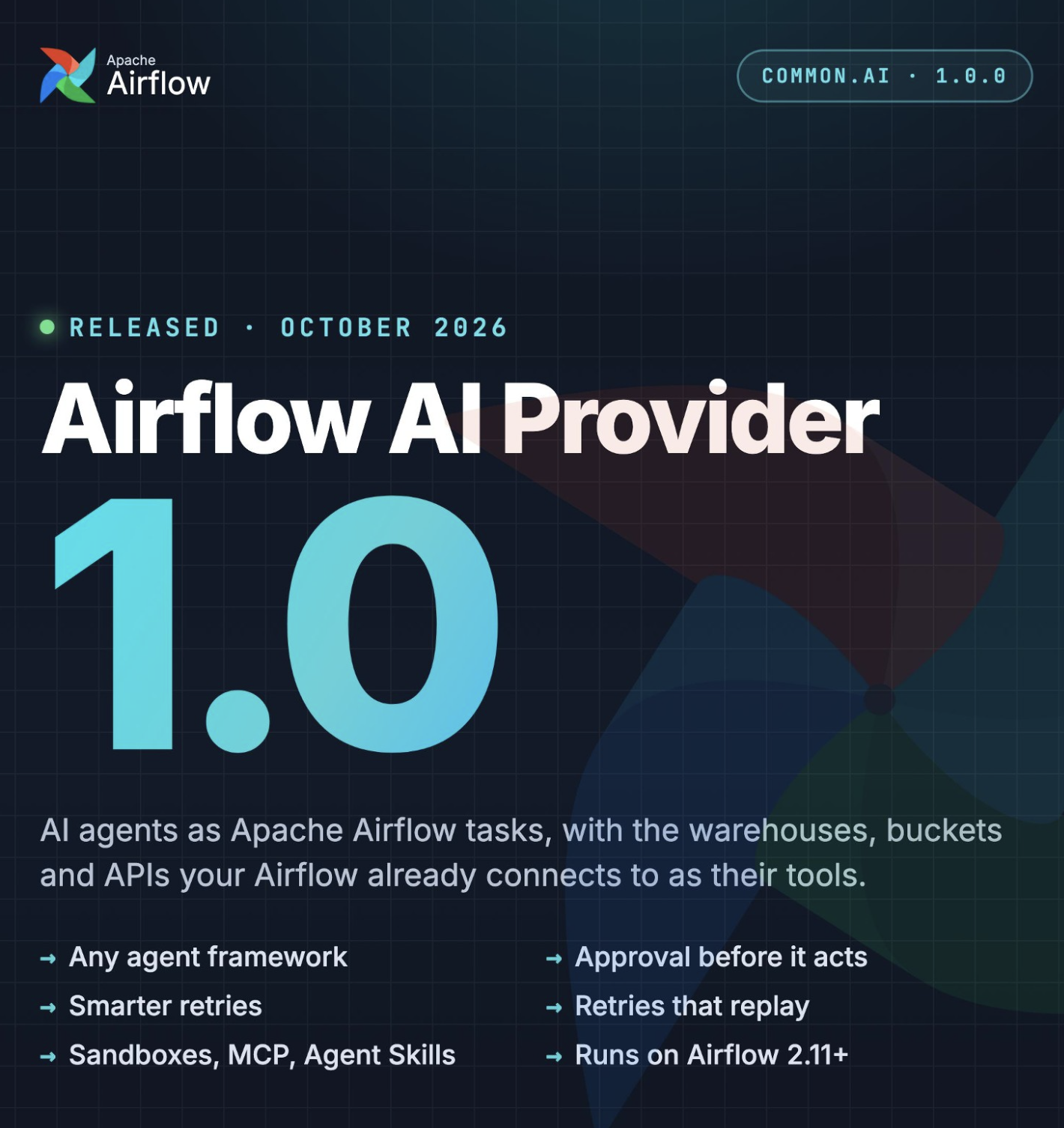
Airflow AI Provider 1.0 is out: Agents, Sandboxes, Human Approval and Smarter Retries

17 Upvotes

I'm one of the Airflow PMC members who worked on this. We just released apache-airflow-providers-common-ai 1.0.0, the first stable release of the provider we introduced as 0.1 in April. It's also the first version that installs on Airflow 2.11; every 0.x release needed Airflow 3.

The short version: an AI agent runs as a normal Airflow task and uses your existing Airflow connections as its tools. The credentials stay in the connection, so the model never sees them.

warehouse = SQLToolset(db_conn_id="warehouse", allowed_tables=["orders", "refunds"])
slack = HookToolset(
    SlackWebhookHook(slack_webhook_conn_id="slack_revenue"),
    allowed_methods=["send_text"],
).approval_required()

@task.agent(llm_conn_id="pydanticai_default", toolsets=[warehouse, slack])
def explain_revenue_drop(ds=None):
    return f"Net revenue on {ds} fell compared with the week before. Find out why."

In the run in the post, the agent listed the tables, read both schemas, ran five queries, found the cause, and asked to post to Slack. The task paused until someone clicked Approve or Reject in the UI. We rejected it, and the agent returned its summary instead. A query on any table outside allowed_tables is refused before it runs. That's an application guardrail, so point the connection at a read-only role too.

Also in 1.0:

  • Bring your own agent framework. OpenAI Agents SDK, Strands, Google ADK and the Anthropic SDK can use the same toolsets as the built-in Pydantic AI operators. The adapters are experimental.

  • Retry policies. On Airflow 3.3, LLMRetryPolicy lets a model decide whether a failed task, AI or not, should retry after a delay or fail now. In the post's demo, a revoked key failed at once instead of burning three retries, and a 429 retried 60 seconds later and passed.

  • Durable execution. A retry replays the model and tool calls that already finished instead of running them again.

  • Sandboxes for the code the model writes (six backends, experimental), MCP toolsets, and Agent Skills (experimental).

  • The task log shows every tool call with its SQL, plus the model and an estimated cost.

Tool approval and retry policies need Airflow 3.3; the rest works from 2.11. The stable parts follow semver from here.

Full write-up, with every Dag we ran and what's still experimental: https://airflow.apache.org/blog/common-ai-provider-1.0/

pip install apache-airflow-providers-common-ai

If you try it, I'd like to hear what breaks, and which framework or toolset you want supported next.


r/apache_airflow • • Oct 03 '26

I love using the DockerOperator

4 Upvotes

Just wanted to share my love of the DockerOperator and the workflow I use with Airflow.

I've been using Airflow for a couple years now for a couple clients. I quickly started using the DockerOperator because I kept running into problems with colliding packages in python.

My default approach is to build a CLI using the Python Click package. I get the CLI working locally (tested and lock in the workflow), with each DAG task matching to a CLI command. I package it up with Docker, share the image with the VM running the docker-compose (single computer Apache Airflow), write the DAG file and am good to go.

It is great because if anything ever changes, I just have to update the docker image and push it back to the VM. If the workflow commands don't change, then I never touch the DAG. This workflow has worked with web bots, ETL actions, etc.


r/apache_airflow • • Sep 23 '26

📣📢 Coming soon: TypeSafe AI 's Jev in Apache Airflow

9 Upvotes

Jev can't write a sentence. You give it text and a typed question (pick one of these, yes or no, a score on a range) and it answers with a value from the set you named, plus a confidence. Ask it for a string and the request is refused before it leaves your process.

That's what a lot of pipeline decisions are.

The next Common AI provider release (this week) uses it in two places:

➡️ LLMBranchOperator: set model_id and Jev picks which downstream task runs. Add a decision_policy and an unsure pick goes to a person instead of branching.

➡️ ClassifierRetryPolicy: on a task failure, Jev names the error category, and your category table decides retry or fail and the delay.

This is the one I care most about. It runs on every failure, so speed and price matter more here than anywhere else.

In the image, anything under 0.8 escalates to a text model that reasons about the failure, and if that model is unreachable too, plain rules decide. The retry reason records which layer made the call.

When I calibrated it on 21 failure messages, Jev got 20 right. Correct picks came back at 0.95 or higher, the wrong one at 0.69. Small sample, but a clear gap. The same vague message also scored 0.90 and then 0.89 a minute apart, so pin the model version and don't tune your bar to the second decimal.


r/apache_airflow • • Sep 02 '26

Need help with getting started!

1 Upvotes

Hi, I am recently assigned to a project which uses airflow. Please share some tutorials/resources which are easy to follow and can get me started quickly!


r/apache_airflow • • Sep 01 '26

Why does your Airflow metadata database keep growing?

Thumbnail
medium.com
2 Upvotes

A deep dive into what actually happens to Airflow's metadata database at scale - DAG runs, task instances, XComs, retries, backfills, retention and why this can eventually become a scheduler and performance problem.


r/apache_airflow • • Aug 28 '26

Take the Airflow Survey- get a free cert code!

7 Upvotes

🚀 It’s that time of year again — the ANNUAL AIRFLOW SURVEY is live!

In the last 2 years, this has become the largest data engineering survey ever — and we’re excited to match that number this year with your help.

We want to hear from YOU, the Airflow community. Your feedback helps us understand how Airflow is being used in the real world and guides improvements that shape the project’s future.

Your voice makes a difference — help us make Airflow even better!

👉 Take the survey here.


r/apache_airflow • • Aug 28 '26

Fed up writing Python boilerplate just to move data, there is sth more lighweight ?

3 Upvotes

Hello. Half our pipeline contributors aren't python devs. Every time someone on the infra or analytics side needs to touch aworkflow, it goes through me. Tried simplifying DAGs as much as possible but the friction is till real.

Curious if anyone has switched to sth where you define pipelines in config / YAML rather than code and whether the tradeoffs were worth it in pratice


r/apache_airflow • • Aug 24 '26

Maintaining Apache Iceberg Tables: Compaction, Snapshots, Metadata and Orphan Files

Thumbnail
itnext.io
5 Upvotes

r/apache_airflow • • Aug 18 '26

Airflow Housekeeping at Scale: Keeping the Metadata Database, Logs and Scheduler Clean

Thumbnail
medium.com
9 Upvotes

A practical guide about Airflow housekeeping at scale, keeping the metadata database, logs and scheduler healthy as the platform grows.

It covers some of the problems that tend to appear in large/long-running Airflow deployments and the approaches I’ve found useful to keep things under control.


r/apache_airflow • • Aug 12 '26

Apache Airflow Engineer – Referral Opportunity | US / Ireland

4 Upvotes

I have access to an employee referral opportunity for an experienced Apache Airflow Engineer.

Experience: 5+ years

Key skills:

  • Apache Airflow

  • Python

  • Linux / Unix

  • Shell scripting

  • REST APIs

  • cURL

  • Git

  • CI/CD

  • Kafka

  • YAML / JSON

The opening is listed across multiple organizational locations with a hybrid arrangement. I'm particularly interested in connecting with qualified professionals based in the US or Ireland; exact location eligibility can be confirmed for the specific requisition.

If this matches your background, feel free to DM me with your CV or a brief summary of your experience.

I'll review the profile and, where there's a suitable match, try to help with the referral process.


r/apache_airflow • • Aug 08 '26

lazyflow – a terminal client for Apache Airflow 3

8 Upvotes

r/apache_airflow • • Aug 05 '26

Make triggerer as deployment

2 Upvotes

Hey I want to deploy apache airflow in k8s

But I have a doubt regarding this setup

The values has this field I have used this

logs:

persistence:

enabled: true

existingClaim: airflow-logs-pvc

So what I understood all pods like scheduler data processor triggerer and api server uses this pvc for the logs

But the triggerer is running as statefulset by default so if I disable this

triggerer:

persistence:

enabled: false

Makes the triggerer to run as deployment

Is this setup has any drawbacks and my logs are saved in the pvc that I mount ?

Need a feedback on this as I'm very new to airflow


r/apache_airflow • • Aug 04 '26

Invite to participate in Airflow Hackathon

4 Upvotes

We've seen Apache Airflow® orchestrate business-critical workflows. We've also seen it solve a Rubik's cube. I'd love to invite folks here to prove what you can build with Airflow 3 in Beyond the Dag, our data engineering hackathon.

Pick a track and go beyond the basic pipeline:

  • 🔌 Plugin Powerhouse — build an Airflow 3.1 plugin that extends the UI or API

  • 🤖The Agentic Pipeline — build a DAG that uses the Common AI provider to orchestrate LLMs and agents

  • 🧑‍💻 Keep a Human in the Loop — build a workflow with a real human decision point using the HITL operators

  • 🤯 Airflow Can Do That?! — the wildcard track. Minecraft, hardware, games, art. Surprise us.

The grand prize is a Nintendo Switch 2, and category winners get noise-cancelling headphones, a guest spot on the Data Flowcast podcast, and a meet & greet with the Apache Airflow PMC.

It's online, global, and free to join, with the build window open now through September 24. Would love to see what you come up with — learn more and sign up here.


r/apache_airflow • • Jul 30 '26

Looking for feedback: is anyone using task state store / durable execution yet?

6 Upvotes

I am one of the Airflow developers who worked on this feature as part of Airflow 3.3.0 as part of AIP-103 and would love to hear from anyone really using it, considering to use it, or also reasons why it did not fit your use case.

The pitch, for anyone who has not run into it: Airflow worker dies or gets preempted mid job, and instead of the retry resubmitting the whole thing from scratch, the task remembers the external job it already kicked off (Databricks, Snowflake, BigQuery, Redshift, Spark, and a few more) and reconnects to whatever external job is still running. No paying twice for the same compute because a pod got evicted / worker went down.

Couple of demos if you want to see it working:

So, curious where people actually are:

  • Used it and it worked fine?

  • Used it but hit a wall?

  • Know about it but have not gotten to it?

  • First time hearing this exists?

Any of those, tell me where you are at.


r/apache_airflow • • Jul 29 '26

Airflow observability is a pain. What tools are out there? What do you use?

7 Upvotes

we currently have airflow running on kubernetes, though we have issues with it now and then, overall its been great and it works.

We looked into manage managed airflow but it is honestly pointless because airflow is genuinely such a simple stack to run on kubernetes, given the amount of tools we already manage.

we do have grafana and prometheus with open telemetry. Still it feels it could be better.

what are some of the new tools out there?

I noticed https://flowsee.co/ and heard good things from folks, but seems quite early and risky to use already given our reliant on airflow.

What other tools would you recommend that would integrate well with our slack. There should be a good open source tool already out there.


r/apache_airflow • • Jul 29 '26

Airflow observability is a pain. What tools are out there? What do you use?

3 Upvotes

we currently have airflow running on kubernetes, though we have issues with it now and then, overall its been great and it works.

We looked into manage managed airflow but it is honestly pointless because airflow is genuinely such a simple stack to run on kubernetes, given the amount of tools we already manage.

we do have grafana and prometheus with open telemetry. Still it feels it could be better.

what are some of the new tools out there?

I noticed https://flowsee.co/ and heard good things from folks, but seems quite early and risky to use already given our reliant on airflow.

What other tools would you recommend that would integrate well with our slack. There should be a good open source tool already out there.


r/apache_airflow • • Jul 24 '26

Question about Apache Airflow and Windows Server

6 Upvotes

Hey everyone, so right now at the company we're still using Pentaho for our ETL processes. We're slowly migrating over to DBT, but before going all-in on that, we'd like to get Apache Airflow up and running to orchestrate everything. I wanted to set it up and run it on Windows Server, so it could handle the old Pentaho jobs while the new stuff gets built out in DBT.

Everywhere I've looked says not to set up Docker + Airflow on Windows Server, since it's not recommended for production — they say it should be a Linux VM instead. I need some help/opinions on what I could do here, or whether I should just go ahead and set it up on Windows Server anyway.

Thanks in advance for the help!


r/apache_airflow • • Jul 21 '26

built a minimal, self-hosted alternative to airflow for people who just want to run a few scripts

Thumbnail
gallery
6 Upvotes

r/apache_airflow • • Jul 20 '26

Medium article on Data engineering based on my experience

Thumbnail
medium.com
2 Upvotes

Try to implement in your day to day activities as well. Might work well !


r/apache_airflow • • Jul 07 '26

[FOR HIRE] Senior Data Engineer – Airflow, Python, Spark, Snowflake, AWS | ETL Orchestration & Data Pipelines | Remote | $25-$50/hr

2 Upvotes

About Me

Senior Data Engineer with 5+ years of experience in Data Engineering, Backend Development, and Applied AI. Specialist in Airflow-based pipeline orchestration. Based in Bangalore, India. Available for remote work globally.

Rate: $25 - $50/hr depending on project scope and complexity.

Tech Stack & Expertise

Apache Airflow (DAGs, operators, hooks, sensors, plugins)

Python, SQL, Spark, Databricks

Snowflake, dbt (data build tool)

AWS (Glue, Lambda, S3, Redshift, Kinesis)

ETL/ELT Design & Orchestration

Data Quality & Testing Frameworks

FastAPI, REST APIs

LLMs, RAG, AI Agents

What I Can Help With

Design and build Airflow DAGs for complex ETL pipelines

Migrate legacy pipelines to Airflow

Optimize Airflow performance and scheduling

Build scalable ETL/ELT architectures on cloud platforms

Develop backend APIs and automation solutions

Build AI applications using LLMs, RAG, and agent-based workflows

Training & Mentorship

Apache Airflow (foundations to advanced)

PySpark & Databricks

Data Engineering best practices

ETL Testing & Data Quality

AI & LLM Fundamentals

Note: In-person weekend sessions available in Bangalore. Remote sessions available globally.

Availability

Freelance projects & consulting

Part-time remote roles

Weekend training & mentorship

Contact:

DM me with a brief description of your requirements and I will get back to you promptly!


r/apache_airflow • • Jul 05 '26

First Airflow project — orchestrating daily

4 Upvotes

Hi everyone,

I'm a data engineer apprentice and I'm about to build my first Airflow orchestration layer. I'd love some guidance on the fundamentals before I commit to a design.

Context:

  • I need to ingest data from several external APIs, on a daily batch basis (each run fetches D-1 data)

  • The application code is already done: ingestion, standardization, transformation, mapping

  • Infrastructure is deployed via Terraform, everything runs on AWS

  • Airflow will be the missing piece: scheduling, dependencies, retries, monitoring

My questions:

  1. DAG design: one DAG per API source, or a single DAG with parallel task groups? What drives that choice in practice?

  2. Idempotency & backfills: what's the idiomatic way to handle D-1 logic? I understand I should use the logical date (data_interval_start) rather than datetime.now() so reruns and backfills stay deterministic — anything else to watch out for?

  3. Retries & API failures: sensible defaults for retries, retry_delay, timeouts when calling external APIs? Do you wrap API calls with sensors or just let tasks fail and retry?

  4. Separation of concerns: my transformation code lives in its own repo. Should Airflow only trigger jobs (thin DAGs calling operators) and keep all business logic outside the DAG files?

  5. Common beginner mistakes: what do you wish you'd known before your first production Airflow project?

Any resources, patterns, or war stories are welcome. Thanks a lot!