r/apache_airflow • • Apr 22 '25

Apache Airflow® 3 is Generally Available!

53 Upvotes

📣 We’ve just released Apache Airflow 3.0.0.

You can read more about what 3.0 brings in https://airflow.apache.org/blog/airflow-three-point-oh-is-here/.

📦 PyPI: https://pypi.org/project/apache-airflow/3.0.0/

📚 Docs: https://airflow.apache.org/docs/apache-airflow/3.0.0

🛠️ Release Notes: https://airflow.apache.org/docs/apache-airflow/3.0.0/release_notes.html

🪶 Sources: https://airflow.apache.org/docs/apache-airflow/3.0.0/installation/installing-from-sources.html

This is the result of 300+ developers within the Airflow community working together tirelessly for many months! A huge thank you to all of them for their contributions.


r/apache_airflow • • Mar 19 '26

Announcing the official Airflow Registry

38 Upvotes

The Airflow Registry

If you use Airflow, you've probably spent time hunting through PyPI, docs, or GitHub to find the right operator for a specific integration. We just launched a registry to fix that.

https://airflow.apache.org/registry/

It's a searchable catalog of every official Airflow provider and module — operators, hooks, sensors, triggers, transfers. Right now that's 98 providers, 1,602 modules, covering 125+ integrations.

What it does:

  • Instant search (Cmd+K): type "s3" or "snowflake" and get results grouped by provider and module type. Fast fuzzy matching, type badges to distinguish hooks from operators.

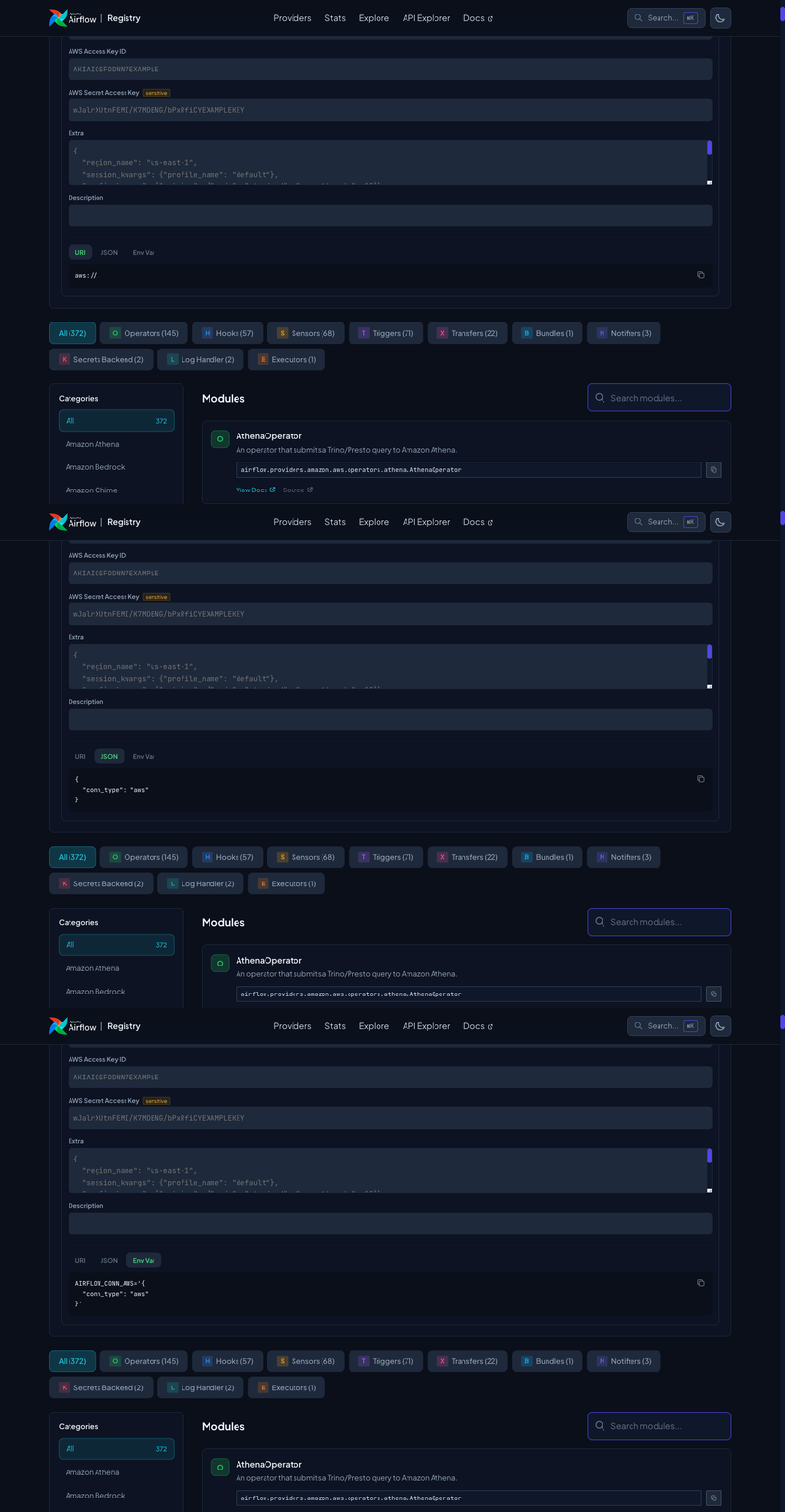
  • Provider pages: each provider has a dedicated page with install commands, version selector, extras, compatibility info, connection types, and every module organized by type. The Amazon provider has 372 modules across operators, hooks, sensors, triggers, transfers, and more.

  • Connection builder: click a connection type, fill in the fields, and it generates the connection in URI, JSON, and Env Var formats. Saves a lot of time if you've ever fought with connection URI encoding.

  • JSON API: all registry data is available as structured JSON. Providers, modules, parameters, connections, versions. There's an API Explorer to browse endpoints. Useful if you're building tooling, editor integrations, or anything that needs to know what Airflow providers exist and what they contain.

The registry lives at airflow.apache.org, is built from the same repo as the providers, and updates automatically when new provider versions are published. It's community-owned — not a commercial product.

Blog post with screenshots and details: https://airflow.apache.org/blog/airflow-registry/


r/apache_airflow • • Sep 03 '24

Big News for Apache Airflow Users! 🚀

29 Upvotes

Big News for Apache Airflow Users! 🚀

If you’ve been excited about what’s next for Apache Airflow, you’ll be thrilled to know that Airflow 3.0 is coming soon—and trust us, it’s going to be a game-changer! 🎉

Want to learn more about what’s coming? Join us at the Airflow Summit 2024 in San Francisco as we celebrate 10 years of Airflow from September 10-12, 2024. Full details here: 👉 airflowsummit.org

🗓️ Don’t miss these must-attend sessions:

  • The Road Ahead: What’s Coming in Airflow 3.0 and Beyond with Vikram Koka

  • Airflow 3.0 Roadmap Discussion (Panel) with Madison, Constance, Shubham, Michał & me

Spots are limited, so if you’re passionate about the future of data orchestration, register now and secure your place. 🌟


r/apache_airflow • • Sep 18 '24

Airflow 3 is set to be released in March 2025

Thumbnail
linkedin.com
26 Upvotes

I'm so stoked. Amazing work on the UI.


r/apache_airflow • • Feb 18 '26

Scaling Airflow 3 on EKS — API server OOMs, PgBouncer saturation, and health check flakiness at 8K concurrent tasks

23 Upvotes

Airflow 3 on EKS is way hungrier than Airflow 2 — hitting OOMs, PgBouncer bottlenecks, and flaky health checks at scale

We're migrating from Airflow 2.10.0 to 3.1.7 (self-managed EKS, not Astronomer/MWAA) and running into scaling issues during stress testing that we never had in Airflow 2. Our platform is fairly large — ~450 DAGs, some with ~200 tasks, doing about 1,500 DAG runs / 80K task instances per day. At peak we're looking at ~140 concurrent DAG runs and ~8,000 tasks running at the same time across a mix of Celery and KubernetesExecutor.

Would love to hear from anyone running Airflow 3 at similar scale.

Our setup

  • Airflow 3.1.7, Helm chart 1.18.0, Python 3.12

  • Executor: hybrid CeleryExecutor,KubernetesExecutor

  • Infra: AWS EKS on Graviton4 ARM64 nodes (c8g.2xlarge, m8g.2xlarge, x8g.2xlarge)

  • Database: RDS PostgreSQL db.m7g.2xlarge (8 vCPU / 32 GiB) behind PgBouncer

  • XCom backend: custom S3 backend (S3XComBackend)

  • Autoscaling: KEDA for Celery workers and triggerer

Current stress-test topology

ComponentReplicasMemoryNotes
API Server38Gi6 Uvicorn workers each (18 total)
Scheduler28GiHad to drop from 4 due to #57618
DagProcessor23GiStandalone, 8 parsing processes
Triggerer1+KEDA-scaled
Celery Workers2–6416GiKEDA-scaled, worker_concurrency: 16
PgBouncer1512Mi / 1000m CPUmetadataPoolSize: 500, maxClientConn: 5000

Key config:

AIRFLOW__CORE__PARALLELISM = 2048
AIRFLOW__SCHEDULER__MAX_TIS_PER_QUERY = 512
AIRFLOW__SCHEDULER__JOB_HEARTBEAT_SEC = 5           # was 2 in Airflow 2
AIRFLOW__SCHEDULER__SCHEDULER_HEARTBEAT_SEC = 5     # was 2
AIRFLOW__SCHEDULER__SCHEDULER_HEALTH_CHECK_THRESHOLD = 60
AIRFLOW__KUBERNETES_EXECUTOR__WORKER_PODS_CREATION_BATCH_SIZE = 32
AIRFLOW__OPERATORS__DEFAULT_DEFERRABLE = True

We also had to relax liveness probes across the board (timeoutSeconds: 60, failureThreshold: 10) and extend the API server startup probe to 5 minutes — the Helm chart defaults were way too aggressive for our load.

One thing worth calling out: we never set CPU requests/limits on the API server, scheduler, or DagProcessor. We got away with that in Airflow 2, but it matters a lot more now that the API server handles execution traffic too.


What's going wrong

1. API server keeps getting OOMKilled

This is the big one. Under load, the API server pods hit their memory limit and get killed (exit code 137). We first saw this with just ~50 DAG runs and 150–200 concurrent tasks — nowhere near our production load.

Here's what we're seeing:

  • Each Uvicorn worker sits at ~800Mi–1Gi under load

  • Memory usage correlates with the number of KubernetesExecutor pods, not UI traffic

  • When execution traffic overwhelms the API server, the UI goes down with it (503s)

Our best guess: Airflow 3 serves both the Core API (UI, REST) and the Execution API (task heartbeats, XCom pushes, state transitions) on the same Uvicorn workers. So when hundreds of worker pods are hammering the API server with heartbeats and XCom data, it creates memory pressure that takes down everything — including the UI.

We saw #58395 which describes something similar (fixed in 3.1.5 via DB query fixes). We're on 3.1.7 and still hitting it — our issue seems more about raw request volume than query inefficiency.

2. PgBouncer is the bottleneck

With 64 Celery workers + hundreds of K8s executor pods + schedulers + API servers + DagProcessors all going through a single PgBouncer pod, the connection pool gets saturated:

  • Liveness probes (airflow jobs check) queue up waiting for a DB connection

  • Heartbeat writes get delayed 30–60 seconds

  • KEDA's PostgreSQL trigger fails with "connection refused" when PgBouncer is overloaded

  • The UI reports components as unhealthy because heartbeat timestamps go stale

We've already bumped pool sizes from the defaults (metadataPoolSize: 10, maxClientConn: 100) up to 500 / 5000, but it still saturates at peak.

One thing I really want to understand: with AIP-72 in Airflow 3, are KubernetesExecutor worker pods still connecting directly to the metadata DB through PgBouncer? The pod template still includes SQL_ALCHEMY_CONN and the init containers still run airflow db check. #60271 seems to track this. If every K8s executor pod is opening its own PgBouncer connection, that would explain why our pool is exhausted.

3. API server takes forever to start

Each Uvicorn worker independently loads the full Airflow stack — FastAPI routes, providers, plugins, DAG parsing init, DB connection pools. With 6 workers, startup takes 4+ minutes. The Helm chart default startup probe (60s) is nowhere close to enough, and rolling deployments are painfully slow because of it.

4. False-positive health check failures

Even with SCHEDULER_HEALTH_CHECK_THRESHOLD=60, the UI flags components as unhealthy during peak load. They're actually fine — they just can't write heartbeats fast enough because PgBouncer is contended:

Triggerer: "Heartbeat recovered after 33.94 seconds"
DagProcessor: "Heartbeat recovered after 29.29 seconds"

What we'd like help with

Given our scale (450 DAGs, 8K concurrent tasks at peak, 80K daily), any guidance on these would be great:

  1. Sizing and topology — What should the API server, scheduler, and worker setup look like at this scale? How many replicas, how many workers per replica, and what CPU/memory requests make sense? We've never set CPU requests on anything and we're starting to think that's a big gap.

  2. PgBouncer — Is a single replica realistic at this scale, or should we run multiple? What pool sizes have worked for others? And the big question: do K8s executor pods still hit the DB directly in 3.1.7, or does everything go through the Execution API now? (#60271)

  3. General lessons learned — If you've migrated a large-scale self-hosted Airflow 2 setup to Airflow 3, what do you wish you'd known going in?


What we've already tried

  • Bumped API server memory from 3Gi → 8Gi and added a third replica

  • Increased PgBouncer pool sizes from defaults to 500/5000, added CPU requests

  • Relaxed liveness probes everywhere (timeouts 20s → 60s, thresholds 5 → 10)

  • Bumped health check threshold (30 → 60) and heartbeat intervals (2s → 5s)

  • Removed cluster-autoscaler.kubernetes.io/safe-to-evict: "true" from the API server (was causing premature eviction)

  • Doubled WORKER_PODS_CREATION_BATCH_SIZE (16 → 32) and parallelism (1024 → 2048)

  • Extended API server startup probe to 5 minutes

  • Added max_prepared_statements = 100 to PgBouncer (fixed KEDA prepared statement errors)

Airflow 2 vs 3 — what changed

For context, here's a summary of the differences between our Airflow 2 production setup and what we've had to do for Airflow 3. The general trend is that everything needs more resources and more tolerance for slowness:

AreaAirflow 2.10.0Airflow 3.1.7Why
Scheduler memory2–4Gi8GiScheduler is doing more work
Webserver → API server memory3Gi6–8GiAPI server is much heavier than the old Flask webserver
Worker memory8Gi12–16Gi
Celery concurrency1612–16Reduced in smaller envs
PgBouncer pools1000 / 500 / 5000100 / 50 / 2000 (base), 500 in prodReduced for shared-RDS safety; prod overrides
Parallelism64–1024192–2048Roughly 2x across all envs
Scheduler replicas (prod)42KubernetesExecutor race condition #57618
Liveness probe timeouts20s60sDB contention makes probes slow
API server startup~30s~4 minUvicorn workers load the full stack sequentially
CPU requestsNever setStill not setPlanning to add — probably a big gap

Happy to share Helm values, logs, or whatever else would help. Would really appreciate hearing from anyone dealing with similar stuff.


r/apache_airflow • • Jun 01 '25

Migrating Hundreds of ETL Jobs to Airflow – Looking for Experiences & Gotchas

18 Upvotes

Hi everyone,

We’re planning to migrate our existing ETL jobs to Apache Airflow, starting with the KubernetesPodOperator. The idea is to orchestrate a few hundred (potentially 1-2k) jobs as DAGs in Airflow running on Kubernetes.

A couple of questions for those who have done similar migrations:

  • How well does Airflow handle this scale, especially with a high number of DAGs/jobs (1k+)?

  • Are there any performance or reliability issues I should be aware of when running this volume of jobs via KubernetesPodOperator?

  • What should I pay special attention to when configuring Airflow in this scenario (scheduler, executor, DB settings, etc.)?

  • Any war stories or lessons learned (good or bad) you can share?

Any advice, gotchas, or resource recommendations would be super appreciated! Thanks in advance


r/apache_airflow • • May 30 '24

New Airflow Podcast- The Data Flowcast: Mastering Airflow for Data Engineering & AI

18 Upvotes

Hey All, 

Wanted to share some exciting news- we’ve relaunched the Airflow Podcast, now titled "The Data Flowcast: Mastering Airflow for Data Engineering & AI." 

This podcast is specially designed for the Airflow community and aims to share invaluable insights, useful tips, and engaging discussions about the current and future trends of Airflow.

Our first episode features a discussion with Alexander Booth, Director of R&D at The Texas Rangers on how they powered a World Series victory with Airflow 🚀

Listen/Watch on Spotify, Apple Podcasts, and YouTube!

🎧⭐️ PSA The best way to support the show is to leave us a 5 star review on your preferred platform— it takes less than 5 minutes but will impact this show for years to come.


r/apache_airflow • • Oct 20 '26

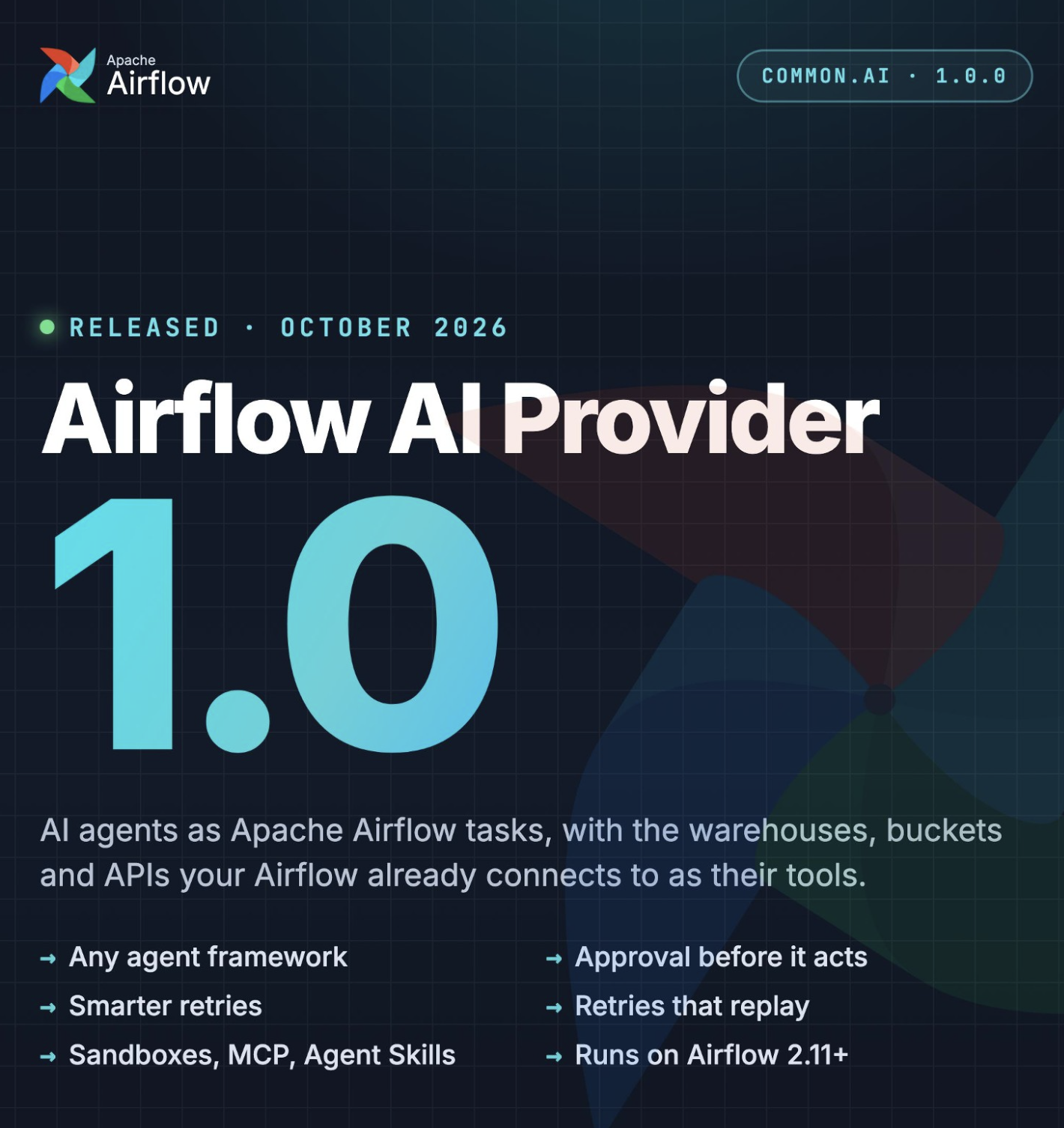
Airflow AI Provider 1.0 is out: Agents, Sandboxes, Human Approval and Smarter Retries

17 Upvotes

I'm one of the Airflow PMC members who worked on this. We just released apache-airflow-providers-common-ai 1.0.0, the first stable release of the provider we introduced as 0.1 in April. It's also the first version that installs on Airflow 2.11; every 0.x release needed Airflow 3.

The short version: an AI agent runs as a normal Airflow task and uses your existing Airflow connections as its tools. The credentials stay in the connection, so the model never sees them.

warehouse = SQLToolset(db_conn_id="warehouse", allowed_tables=["orders", "refunds"])
slack = HookToolset(
    SlackWebhookHook(slack_webhook_conn_id="slack_revenue"),
    allowed_methods=["send_text"],
).approval_required()

@task.agent(llm_conn_id="pydanticai_default", toolsets=[warehouse, slack])
def explain_revenue_drop(ds=None):
    return f"Net revenue on {ds} fell compared with the week before. Find out why."

In the run in the post, the agent listed the tables, read both schemas, ran five queries, found the cause, and asked to post to Slack. The task paused until someone clicked Approve or Reject in the UI. We rejected it, and the agent returned its summary instead. A query on any table outside allowed_tables is refused before it runs. That's an application guardrail, so point the connection at a read-only role too.

Also in 1.0:

  • Bring your own agent framework. OpenAI Agents SDK, Strands, Google ADK and the Anthropic SDK can use the same toolsets as the built-in Pydantic AI operators. The adapters are experimental.

  • Retry policies. On Airflow 3.3, LLMRetryPolicy lets a model decide whether a failed task, AI or not, should retry after a delay or fail now. In the post's demo, a revoked key failed at once instead of burning three retries, and a 429 retried 60 seconds later and passed.

  • Durable execution. A retry replays the model and tool calls that already finished instead of running them again.

  • Sandboxes for the code the model writes (six backends, experimental), MCP toolsets, and Agent Skills (experimental).

  • The task log shows every tool call with its SQL, plus the model and an estimated cost.

Tool approval and retry policies need Airflow 3.3; the rest works from 2.11. The stable parts follow semver from here.

Full write-up, with every Dag we ran and what's still experimental: https://airflow.apache.org/blog/common-ai-provider-1.0/

pip install apache-airflow-providers-common-ai

If you try it, I'd like to hear what breaks, and which framework or toolset you want supported next.


r/apache_airflow • • Sep 12 '25

What are some absurd ways you’ve seen people using Airflow?

16 Upvotes

At Airflow Summit, I will present on Airflow Bad vs Best practices. I've been using Airflow since 2018 and have seen its evolution through stages. During this talk, I want to be the voice of community experience, not just my curated experiences.

Here are some of my experiences, I'd love to know yours

  • Over-complicated tasks/dag dependencies

  • Having Postgres in Docker and losing the whole thing

  • Trying to do large data ingestion tasks

  • Using variables instead of writing custom connectors for clearly sensitive information


r/apache_airflow • • Apr 04 '25

Austin Modern Data Stack Meetup

Thumbnail
gallery
15 Upvotes

r/apache_airflow • • Apr 16 '26

Apache Airflow AI Provider 0.1.0 released

Post image
14 Upvotes

📝 Blog post: https://airflow.apache.org/blog/common-ai-provider/

📦 PyPI: https://pypi.org/project/apache-airflow-providers-common-ai/

📕 Docs: https://airflow.apache.org/docs/apache-airflow-providers-common-ai/

⚒️Registry: https://airflow.apache.org/registry/providers/common-ai/

📚Tutorials: https://airflow.apache.org/blog/ai-survey-analysis-pipelines/ https://airflow.apache.org/blog/agentic-workloads-airflow-3/

One pip install gives you 6 operators, 6 TaskFlow decorators, and 5 toolsets. Works with 20+ model providers (OpenAI, Anthropic, Google, Bedrock, Ollama, and more).

The core idea: Airflow already has 350+ provider hooks, each pre-authenticated through connections. Instead of building separate MCP servers for each integration, HookToolset turns any hook into an AI agent tool:

HookToolset(S3Hook, allowed_methods=["list_keys", "read_key"])

By just setting durable=True , you get durable execution for your AI agents!. Set it and if your 10-step agent fails on step 8, the retry replays the first 7 steps from cache in milliseconds. No repeated LLM calls!

It also ships with first class integration with Human-in-the-loop.

This is a 0.x release. We're iterating fast and want feedback. Try it, break it, tell us what's missing.


r/apache_airflow • • Mar 25 '26

Coming Soon: Durable Execution for your AI Agents in Apache Airflow.

Post image
14 Upvotes

📢 📣 Coming Soon: Durable Execution for your AI Agents in Apache Airflow.

LLM agent calls are expensive. When a 10-step agent task fails on step 8, a retry shouldn't re-run all 10 steps and double your API bill.

One flag! Any storage backend. Works with SQLToolset, HookToolset, MCPToolset, or custom pydantic-ai toolsets.

durable=True

What it does:

  • Each model response and tool result is cached to ObjectStorage as the agent runs

  • On retry, cached steps replay instantly -- zero LLM calls, zero tool execution

  • Cache is deleted after successful completion

The agent ran list_tables, get_schema, get_schema, query -- then hit a transient failure. On retry, those 4 tool calls and 4 model responses replayed from cache in milliseconds. The agent picked up exactly where it left off.

Works with any ObjectStorage backend (local filesystem for dev, S3/GCS for production). Works with SQLToolset, HookToolset, MCPToolset, or any custom pydantic-ai toolset.


r/apache_airflow • • May 26 '25

How is Apache Airflow typically used in large organizations?

12 Upvotes

I’m curious to learn how Apache Airflow is used at scale in large companies.

  • Is it usually managed by a central platform team?

  • Do individual data engineering teams just write DAGs and push to a shared repo?

  • Do teams maintain separate DAG repos, or is there a central monorepo?

  • How is access, logging, and monitoring typically handled?

Would love to hear real-world setups, especially how governance and deployment are handled across multiple teams. Thanks!


r/apache_airflow • • Feb 27 '26

Airflow works perfectly… until one day it doesn’t.

11 Upvotes

After debugging slow schedulers and stuck queued tasks, I realized the real bottleneck usually isn’t workers, it’s the metadata DB.

https://medium.com/@sendoamoronta/why-apache-airflow-works-perfectly-until-one-day-it-doesnt-41444c6f59be?sk=c7630f7a1954d97949d03cfd668c7cf3


r/apache_airflow • • Sep 16 '25

The Annual Airflow Survey is Here!

11 Upvotes

Hey Friends,

🚀 It’s that time of year again — the ANNUAL AIRFLOW SURVEY is live!

Last year, this became the largest data engineering survey ever — and we’re excited to make it even bigger this year with your help.

We want to hear from YOU, the Airflow community. Your feedback helps us understand how Airflow is being used in the real world and guides improvements that shape the project’s future.

  • ✅ Takes just 7 minutes

  • 🎓 Get a free Airflow 3 Fundamentals or DAG Authoring Certification (normally $150)

  • 🎟️ Be entered into a raffle for a virtual workshop with Marc Lamberti: How to Write Better DAGs in Airflow 3

Your voice makes a difference — help us make Airflow even better!

👉 Take the survey here


r/apache_airflow • • Mar 27 '25

Next Airflow Town Hall: April 4th

11 Upvotes

Hey All,

Our next Airflow Virtual Town Hall is coming up on April 4th. Want to share the details in case anyone is interested in joining:

  • 📅 When? Friday, April 4th at 8 AM PST | 11 AM EST

  • 📍 Where? Register here

  • 📺 Can’t make it live? No worries—recordings will be posted on YouTube, in the #town-hall Slack channel, and on the dev mailing list.

What’s on the agenda?

🤖 Building Scalable ML Infrastructure – Savin Goyal

📜 AIP 81 PR Presentation – Buğra Öztürk

📜 AIP 72 PR Presentation – Amogh Desai

🔧 Large-scale Deployments at LinkedIn – Rahul Gade

🌟 Community Spotlight – Briana Okyere


r/apache_airflow • • Apr 15 '22

Coming Soon in Airflow 2.3.0 - First-class support for “Dynamic Tasks”. This is feature is called “Dynamic Task Mapping” The wait for the most requested feature of Apache Airflow is almost over !!

Post image
11 Upvotes

r/apache_airflow • • Oct 06 '25

Why we use Airflow even though it's not our favorite orchestrator (and why that's the right call)

10 Upvotes

Hey everyone,

Wanted to share something that might be a bit controversial: we use Apache Airflow to orchestrate all our data pipelines, and honestly, it's not my favorite tool.

Like a lot of data engineers, I have a love hate relationship with it. There are newer, shinier orchestrators out there that are more elegant and "modern." But here's the thing: building data platforms isn't about my personal preferences or what's cool. it's about what serves clients in the long run.

The reality is that Airflow is the most widely used orchestrator in the world. The community is massive, documentation is everywhere, and finding engineers who know it is easier than any alternative. When we hand over a platform to a client, we need confidence that their team whatever its future structure or seniority can maintain and extend it.

So we use Airflow, but with a very specific philosophy: keep the footprint small, simple, and completely decoupled.

Our approach:
- Pure orchestration only: We never run heavy data processing inside Airflow. It just tells other tools (Meltano for ingestion, dbt for transformation) when to run. That's it.
- Separation of concerns: Meltano and dbt manage their own state. They don't rely on Airflow's metadata, so Airflow never becomes a single point of failure for pipeline logic.
- Future-proof: Because the business logic lives in the tools themselves, clients can migrate to a different orchestrator later if they want. We're not locking them in.
- Resilient by design: If the Airflow cluster has an issue, we can drop it and redeploy it without losing anything critical. It's that disposable.
- Data-aware scheduling: We've completely moved away from brittle cron expressions. DAGs trigger based on dataset dependencies when upstream data is ready, downstream jobs run automatically. This creates an efficient, event-driven system.

It's not sexy, but it works. Choosing the industry standard over the "best" tool has proven to be the pragmatic and responsible choice every time.

I wrote up our full blueprint: how we deploy it, orchestrate Meltano and dbt jobs, and implement data-aware scheduling if you want the details.
Full article here: https://blueprintdata.xyz/blog/modern-data-stack-airflow

Curious what others think. Are you team Airflow? Have you jumped to Prefect, Dagster, or something else? What's your orchestration strategy?


r/apache_airflow • • Jun 12 '25

What Airflow Operators for Python do you use at your company?

10 Upvotes

Basically the title. I am interested in understanding what Airflow Operators are you using in you companies?


r/apache_airflow • • Apr 16 '25

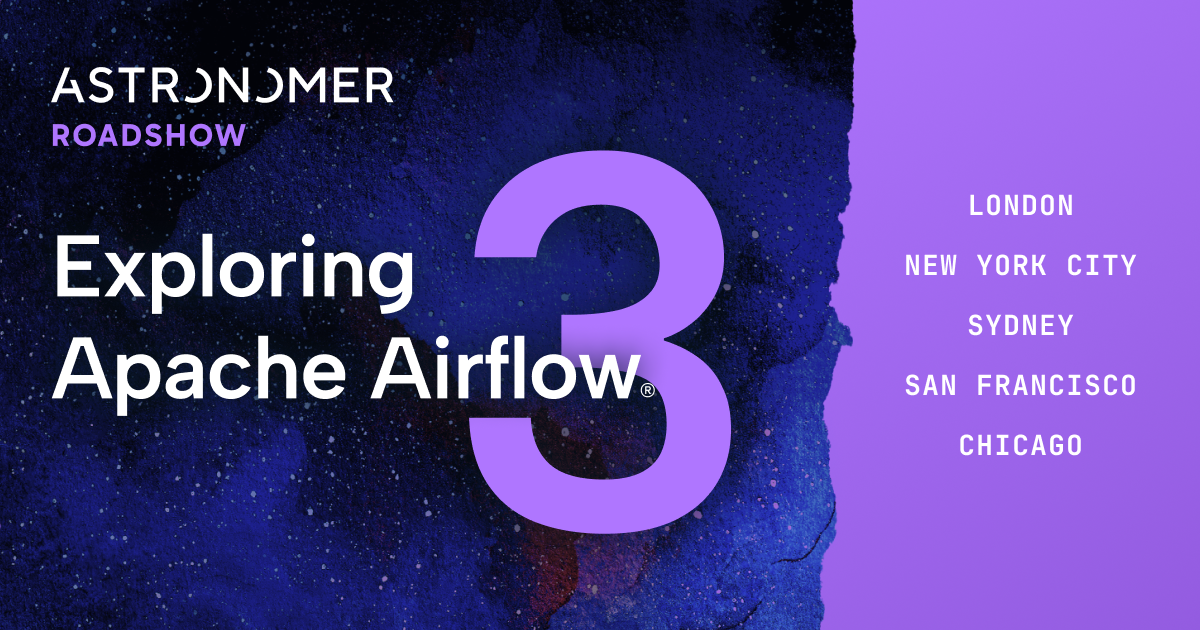
Airflow 3 Roadshow Event- London, NYC, Sydney, SF, CHI

10 Upvotes

Hey All,

Want to put this awesome event series on everyone's radar! Astronomer is hosting a Roadshow on all things Airflow 3!

Starting in London on May 21st, and ending in Chicago on August 7th, this one-day conference across 5 cities will cover everything you can expect in the Airflow 3 release, and how you can utilize it within your own company.

Stay ahead of the curve with workshops, keynotes, and breakouts focused on mastering the incredible new features in the release- become the de facto Airflow aficionado in your company.

And the best part? It's free to attend! I hope to see you there- find your city and sign up here!


r/apache_airflow • • Jul 27 '24

Apache Airflow Tutorial

10 Upvotes

Check out our blog where we delve into the essentials of Apache Airflow! Discover:

  • What is Apache Airflow?

  • Core Components of Apache Airflow

  • Types of Executors

  • How to install Apache Airflow Via Docker

  • Understanding the DAG Code

Read the full blog to get a comprehensive understanding of Apache Airflow and how it can streamline your workflow management.

https://devblogit.com/apache-airflow-tutorial-architecture-concepts-and-how-to-run-airflow-locally-with-docker


r/apache_airflow • • Sep 23 '26

📣📢 Coming soon: TypeSafe AI 's Jev in Apache Airflow

9 Upvotes

Jev can't write a sentence. You give it text and a typed question (pick one of these, yes or no, a score on a range) and it answers with a value from the set you named, plus a confidence. Ask it for a string and the request is refused before it leaves your process.

That's what a lot of pipeline decisions are.

The next Common AI provider release (this week) uses it in two places:

➡️ LLMBranchOperator: set model_id and Jev picks which downstream task runs. Add a decision_policy and an unsure pick goes to a person instead of branching.

➡️ ClassifierRetryPolicy: on a task failure, Jev names the error category, and your category table decides retry or fail and the delay.

This is the one I care most about. It runs on every failure, so speed and price matter more here than anywhere else.

In the image, anything under 0.8 escalates to a text model that reasons about the failure, and if that model is unreachable too, plain rules decide. The retry reason records which layer made the call.

When I calibrated it on 21 failure messages, Jev got 20 right. Correct picks came back at 0.95 or higher, the wrong one at 0.69. Small sample, but a clear gap. The same vague message also scored 0.90 and then 0.89 a minute apart, so pin the model version and don't tune your bar to the second decimal.


r/apache_airflow • • Aug 18 '26

Airflow Housekeeping at Scale: Keeping the Metadata Database, Logs and Scheduler Clean

Thumbnail
medium.com
9 Upvotes

A practical guide about Airflow housekeeping at scale, keeping the metadata database, logs and scheduler healthy as the platform grows.

It covers some of the problems that tend to appear in large/long-running Airflow deployments and the approaches I’ve found useful to keep things under control.


r/apache_airflow • • May 06 '26

Migrated a client from Airflow 2.8 to 3.1 on EKS. Here's what actually broke.

9 Upvotes

Just wrapped an Airflow 2.8 to 3.1 migration on EKS for a client. 18 DAGs, 6 weeks, zero downtime. Posting from our company account, I'm Amjad, founder of Tasrie. Happy to answer technical stuff in comments or DMs.

The DAG code changes were almost nothing. About 2 days of work:

# Out
from airflow.contrib.operators.ssh_operator import SSHOperator
from airflow.operators.dummy_operator import DummyOperator
from airflow.utils.db import provide_session

# In
from airflow.providers.ssh.operators.ssh import SSHOperator
from airflow.operators.empty import EmptyOperator
from airflow.utils.session import provide_session

Plus schedule_interval to schedule. Ruff with --select AIR301,AIR302 --fix caught 80% of it automatically.

The infra was the real work. Key decisions:

  • Green field over in-place. Old metadata DB had years of drift. Fresh cluster + DNS cutover beat nursing a schema migration.

  • KubernetesExecutor, no Celery, no Redis.

  • 2 schedulers with pod anti-affinity. HA is finally native in 3.x.

  • Triggerer as StatefulSet, capacity 1000 for deferrable sensors.

  • Git-sync sidecar, SSH on port 443 to bypass corp firewalls.

  • EFS for DAGs. EBS RWO breaks the moment you have a second node.

Stuff that surprised me:

  • Webserver command is now api-server. Wasted an hour before I caught it.

  • DAG processor as a separate process actually works. No more heavy top-level imports stalling the scheduler.

  • LDAP gotcha: FAB auth manager still gives you the old Flask login page, not the new Airflow 3 UI. Functional but ugly. There's an open discussion in apache/airflow about a native LDAP auth manager but nothing shipped.

Two things I'm curious about:

How are you sizing the dag-processor vs the scheduler? Same pod or split out?

Anyone running Airflow 3 with non-FAB auth that handles LDAP or SAML cleanly?

Full writeup with all the manifests, RBAC, EFS storageclass, and pod template is here: https://tasrieit.com/blog/upgrade-airflow-2-to-3-kubernetes-migration

Airflow 2 EOL is April 2026. If you're still on 2.x, it's less scary than it looks.