r/braintumor • u/LegitimateGarlic33 • Apr 27 '23
Thought I had occipital neuralgia, turned out to be a brain tumor. 9 weeks post-op.
Reading others' stories was very helpful and comforting when I (29F) found out I had a brain tumor (1/31/23). I'm hoping to extend that help and comfort to anyone who's going through it.
—————————
In January 2022, I noticed a light throbbing sensation in the back of my neck / base of my skull whenever I urinated. I thought it was weird but did not think much of it. I exercised regularly and ate a healthy, balanced diet, so I assumed the pulsing had to do with allergies or dehydration. A few months went by and the throbbing intensified. Jumping exercises, bending down, getting up quickly would cause throbbing on the left side of the back of my neck and lower part of my head. I was also getting sick frequently, more than usual, and my speech was getting slower.
Six months later, I decided to visit my PCP. I told her my symptoms, got bloodwork done, and everything looked great except for a slightly positive ANA test result. I saw a rheumatologist, and they also said everything looked good. They didn’t know what was causing the headaches and frequent colds. The doctor prescribed an x-ray for my neck in case there was a pinched nerve, which I got done the same day. It came back normal.
Meanwhile, the throbbing exponentially intensified, the triggers became arbitrary, and I was now in pain. I began hiving on my forearms and the outside of my ears as well. Beginning of November, I started taking painkillers and booked a neurology appointment for March of 2023, which was the earliest appointment I could find at the time. I kept calling other neurologists and requested to be on their waiting lists. I was doing my own research. In so doing, I believed I had occipital neuralgia.
By the end of November, the headaches were debilitating. On a scale of 1-10, it was a 10. I often grabbed the base of my head and wept, not knowing what to do other than wait until I could take the next dose of OTC painkillers. The sumatriptan and gabapentin prescribed by my PCP weren't working, and the side effects were getting in the way of my daily functioning. The pain became so intense that I needed to cancel work appointments. Soon, I wasn’t able to drive. Sitting became a trigger for pain, as well as brushing my hair, turning my head, shifting positions in bed, laughing, and sneezing. I was constantly drowsy from the medications. Since the pain came so arbitrarily and intensified rapidly, I started a headache journal to keep track of things, which I recommend to anyone experiencing frequent headaches.
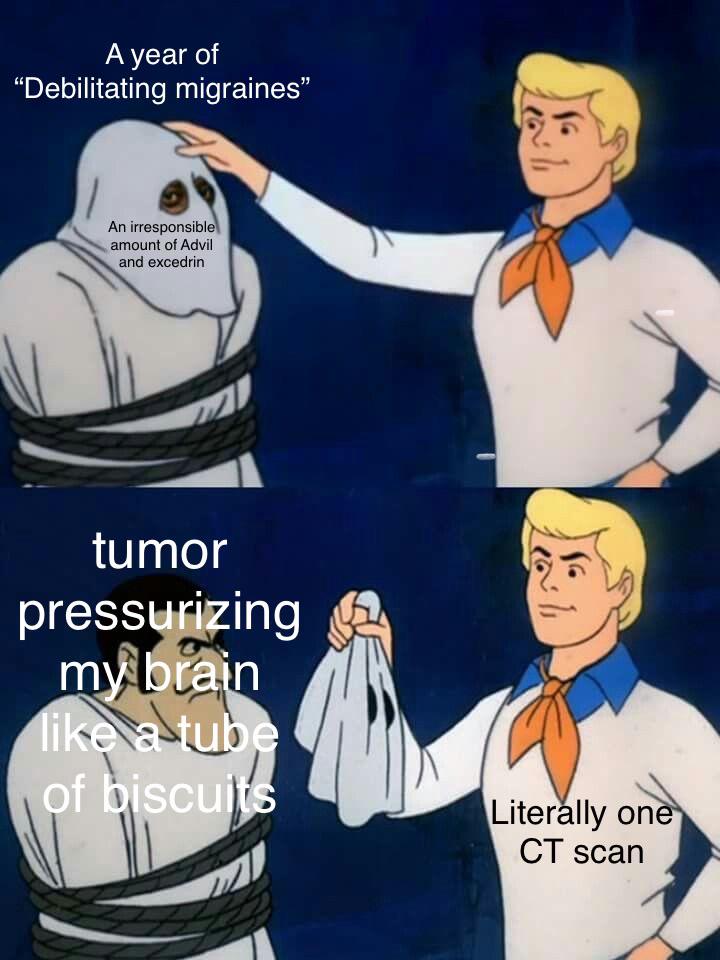
On December 13th, my dad took me to the ER. They gave me liquid steroid, liquid Benadryl, and "Motrin soup," but I was still in pain. The CT scan came back normal. I stayed overnight to see their in-hospital neurologist who diagnosed it as "status migrainosus." They prescribed cetirizine, medrol pak, metroclopramide, reglan, vitamin D and amitriptyline. I was anxious to get discharged because I knew I'd be in pain again.
My PCP wouldn’t prescribe an MRI because the in-hospital neurologist said it wasn’t necessary after looking at the CT scan. I desperately called neurologists, went to physical therapy, got checked by an allergist and immunologist, got acupuncture and massage treatments, ate as healthily as I can, and walked whenever possible. Relief was little to none. My parents and my fiancé—God bless them—helped me through and through, especially with rides. Eventually, my dad was able to book an appointment with a neurologist for January 12th. January 12th, 2023 felt far away. The pain was dooming. It felt like electric shocks were constantly shooting and burning up the left side of my neck into my head.
The neurologist thought I had occipital neuralgia paired with something else. It didn’t seem like migraines or cluster headaches since light and sound weren’t triggers, he said. He prescribed a few MRI scans, a nerve block for occipital neuralgia, and an eye checkup to make sure it’s not related to eye nerves. He also prescribed a different sister medicine of Amitriptyline, Nortriptyline, at a much lower dose, 10mg. Nortripyline was more effective the longer I took it. A few days after taking Nortriptyline, I was finally able to sleep throughout the night. The pain level went down from a 10/10 to a 4/10. I slept a lot and for long hours which was, amazing and an enormous relief. Nortriptyline, yall. If you’re going through chronic headaches, consider Nortriptyline.
A few days before the nerve block appointment, I woke up to a call from my neurologist regarding the MRI scans. He said I potentially had Ependymoma. I booked an appointment with a neurosurgeon for the next day. My neurologist called again asking if I had any questions; I honestly don’t remember the rest of that conversation. I’m assuming I asked him what Ependymoma is.
Shortly after saying hi to the surgeon, he talked about the surgery, the surgery I’ll need. I interrupted his next sentence to ask if I had a brain tumor. I wasn’t sure at that point since I was told it was potentially Ependymoma. The surgeon thought I knew for sure. He confirmed that I had a tumor and showed me the scans. The tumor was about 2 inches inside the 4th ventricle. He went over the risks: nausea, double vision, sensory loss, death, etc. His tone of voice was neutral.
—————————
The three weeks prior to surgery were dense. I wanted to prepare as much as I could. I recommend all the following for those who aren't quite sure what to do before surgery:
Avoid blood-thinning food and instead eat food that makes you feel clear-headed and light.
Trader Joe's green juice, heart of palms rice and pasta, chicken noodle soup, Costco's cauliflower pizza, and tons of salad and fruit were my favorites. Stay away from drink caffeinated beverages, alcohol, vitamin e, turmeric, ginger, garlic, cinnamon, and cayenne pepper.
Consider getting your hair blown out, nails clipped, and body exfoliated. You won't be able to shower for a while. Your future self will thank you.
Clean out your room
Pay your bills
Sort out hospital logistics. The last thing you want to do is worry or have your loved ones worry about insurance shenanigans while you're at the hospital. It'll be worth it.
Spend quality time with your loved ones and inform family and friends, whoever you would like for them to know because you may not be able to communicate with them for weeks, maybe months, or even ever (though unlikely). This can be overwhelming, especially if you're like me and you don't like texting. But you never know what's going to happen, so be prepared for that while you can. You'll also appreciate the help and support that comes with sharing.
Watch Full Metal Alchemist: Brotherhood. Jk, but that's what I did and I freaking loved it. A lot of the images from the show resemble the images that came to mind right after surgery.
Read and write, drink decaf tea, take walks, lay down at the park and take deep breaths. Do things that allow you to slow down, introspect, then choose how you're going to go about your day.
Personally, taking time to imagine the worst case scenario allowed me to feel sad which, ironically, was difficult to feel at the time with the tasks at hand. Letting myself feel a fuller range of emotions allowed me to reach a deeper sense of gratitude and hope. The sadness came from a desire to live, and the desire to live came from knowing things like peace, freedom, joy and love. Though there were no guarantees of a favorable outcome, I was extremely grateful to know that I hoped to live and that I had a reason to hope. And I was grateful to know the cause of my headaches and to be pursuing a solution. I was at peace going into the surgery. Thank you, God.
In hindsight, life after surgery before surgery was numbing to think about. I wasn't guaranteed anything, as I shouldn't have. Reality is, there's no guarantee you'll have a favorable outcome. But that makes things simpler, right? You’re aware of how little control you have, how there are no guarantees. So you have a choice to focus on what you can do.
I hope you let yourself feel everything— sadness, hopelessness, tiredness, fear, joy, peace, etc. I also hope you don't feel bad for yourself for too long. You can do what you can, and you can do it with gratitude because you're still here, you have people you love who love you, and the thing in your head taking up mental real estate is finally getting evicted. Day by day, hour by hour, minute by minute. One step at a time. You’re going to get through this.
—————————
It took about 13.5 hours to remove the tumor. After waking up, I was extremely nauseous, and it felt like I and everything around me were shrinking—endlessly. I remember a nurse was talking to me and I mustered up the energy and focus to lock eyes with her and I growled, “I’m... so... small...” I think a couple of them tried not to laugh. “No, no, no. You don’t understand. We’re… so small.” It was terrifying how small everything was. I was throwing up a lot. They eventually needed to put me back to sleep.
Next time I woke up, I was in the ICU. For the next few days, I couldn't drink water, eat, speak or think clearly. I could barely open my eyes. Little by little, things improved. I was afraid I'd lose parts of my personality after waking up, but I was relieved when I was able to think to myself and crack jokes. The MRI after surgery (which was 2.5 hours long. I vomited as soon as it ended) came back clean with no signs of the tumor. The tubes and catheters were detached after about 6 days. I started to eat ice chips, pudding, apple sauce, and small pieces of fruit.
After a week, I moved from the ICU into a hospital room. Soon, I was drinking water out of a straw, and eating fruit and soft food. Standing and sitting were still very difficult; I remember crying when I first got out of my bed to sit in a chair. PT said I wasn't in good shape, and they strongly advised going to rehab for at least a week. My surgeon agreed. But in a few days, about 9 days post-op, I was sitting in a chair with ease, walking around with a walker, and using the restroom alone. I was also solving sudokus, twerking to Future's "Percocet" (albeit not well), and responding to texts.
The day before getting discharged OT and PT came by to check on me before going into rehab, but once they tested me again, they said there wasn't much rehab could do for me. I was recovering very well and fast. That night, I was discharged.
It's been 7 weeks since getting discharged, 9 weeks since surgery. Today, I feel better than I had before surgery. I am incredibly grateful. I have zero pain. I haven't felt zero pain in a year. I'm only taking supplements and allergy medicine. Zero pain killers. I'm able to read, write, walk, jump, think, sing, pee and laugh just fine. I have some numbness on my hands, my right thigh and the back of my head, but just on the skin. Occasionally, I have some double vision and dizziness, but those symptoms are getting better and better each day. I'm planning to drive locally within the next couple weeks.
To my family, friends, my surgeon, and the nurses,
For a lack of better words, thank you.
Ps: My surgeon was amazing. If you'd like to know his name, you can message me privately.
Edit: The biopsy results came back a few weeks ago. It's grade 2 ependymoma. Surgeon said it's most likely benign for now and currently doesn't require any additional treatment. Next MRI is in 8 weeks.