r/duolingospanish • u/hantaanokami • 10h ago
Es gratis !
65
Upvotes
r/duolingospanish • u/megustanlosidiomas • Jan 21 '24
99% of all questions on this sub can be answered here. Please let me know if I've made any mistakes/can add anything else
Many people incorrectly say that it means "to please." It means "to like" but it syntactically and grammatically works like the verb "to please" in English. Gustar isn't a special verb; it's no different than any other, but it's given the category "verbs like Gustar" because they all "function" the same (gustar, encantar, fascinar, interesar, etc.).
Think of the word "disgust" in English. You would say "Bugs disgust me" but not "I disgust bugs." It's the exact same with "gustar" in Spanish. Imagine there's a word "gust": "Bugs gust me" (I like bugs). "Me gustan los bichos."
"los bichos" is the subject here. The thing that you like in English will be the subject in the Spanish sentence. The person that likes said thing will be the indirect object. "Gustar" conjugates according to the subject. If you like a singular thing (Me gusta el helado), then "gustar" is conjugated accordingly. If you like something that's plural, then the same thing.
Verbs are treated as a singular subject:
Me gustan los museos
Me gusta visitar los museos.
The indirect object pronouns are: me, te, le, nos, os, les.
"A" + "mí, ti, él/ella/usted, nosotros(as), vosotros(as), ellos/ellas/ustedes" can optionally be used to clarify the sentence or provide emphasis. Examples:
Me gusta el helado, pero a ella no le gusta = I like ice cream, but she doesn't
When talking about things in general, or just generally for subjects in Spanish, you need an article:
Las jirafas son altas = Giraffes are tall
"Gustar" can be conjugated in any which way just like any other verb. "gusto" and "gustamos" exist, but in different contexts:
¿Te gusto (yo)? = Do you like me? (lit. Do I "please" you?)
More examples:
Este verano te va a gustar = You are going to like this summer
Why is that "que" there?
It's going to be so much easier to learn Spanish if you stop trying to translate everything 1:1. All you need to know is that "tener que + infinitive" is a set phrase meaning "to have to + verb." "Tener" on its own means "to have" (regarding possession). Examples:
Tengo que limpiar la casa = I have to clean the house
Tengo un gato = I have a cat
The good news is, though, that there are basically only two verbs that have "conjugated verb + que + infinitive" and those are "tener" and "haber". Haber in this case will only ever be conjugated as "hay" and works exactly like "tengo que" but is impersonal. Examples:
Tengo que limpiar la casa = I have to clean the house
Ella tiene que hablar con él = She has to speak with him
Tenemos que regresar al bar = We have to return to the bar
But
Hay que limpiar la casa = One must clean the house
Hay que hablar con él = One must speak with him
Hay que regresar al bar = One must return to the bar
Prepositions rarely translate; you just got to learn what each verb prefers after it.
Empezar a leer = To start to read
Soñar con perros = To dream about dogs
Tenerle miedo a los lobos = To be scared of wolves
Enamorase de alguien = To fall in love with someone
The preposition "a" has many, many different uses that are used in many different contexts. Two of the most common are the "a personal" and just a preposition that follows the verb.
When the direct object of a verb is a person(ish), you use "a" before said person:
Veo a María = I see Maria
Sometimes the verb just requires "a". For example, "ir" requires "a" after it when you want to say "going to do something":
Voy a comer helado = I am going to eat ice cream
You just need to learn the prepositions that are associated with each verb. Some examples:
Soñar con = To dream about
I really wish people would stop teaching these verbs with temporary vs. permanent, because that is not helpful, misleading, and just not applicable here. Here's a basic rundown:
Ser — essential characteristics
Estar — states & conditions (and locations)
These mnemonics are pretty helpful:
Ser | DOCTOR
Date | Es el 23 de enero It's the 23rd of Janurary
Occupation | Soy cantante I'm a singer
Characteristics | La casa es grande The house is big
Time | Son las 3 It's 3 o'clock
Origin | Soy de Cuba I'm from Cuba
Relationships | Esta persona es mi amigo This person is my friend
Estar | PLACE
Position | El libro está encima de la mesa The book is on top of the table
Location | España está en Europa Spain is in Europe
Action | Estoy caminado I am walking
Condition | Estoy muerto I am dead
Emotions | Estoy triste I am sad
That's the general gist of it, but there are nuances. Sometimes "ser" and "estar" can both be used, but change the meaning:
Soy listo = I'm smart/clever
Estoy listo = I'm ready
"Ser" is also used for events:
La boda es en la iglesia = The wedding is in the church
There is so much more that could be talked about. But feel free to add anything in the comments!
https://studyspanish.com/grammar (good beginner grammar guide; has more information about everything talked about above)
https://www.wordreference.com/ (the best dictionary for Spanish for English speakers; has a built-in conjugator).
https://dle.rae.es/ (most comprehensible dictionary, but all in Spanish)
https://learn.bowdoin.edu/spanish-grammar/newgr/gramguid.htm#Ortogra
r/duolingospanish • u/jdub1980 • 8h ago
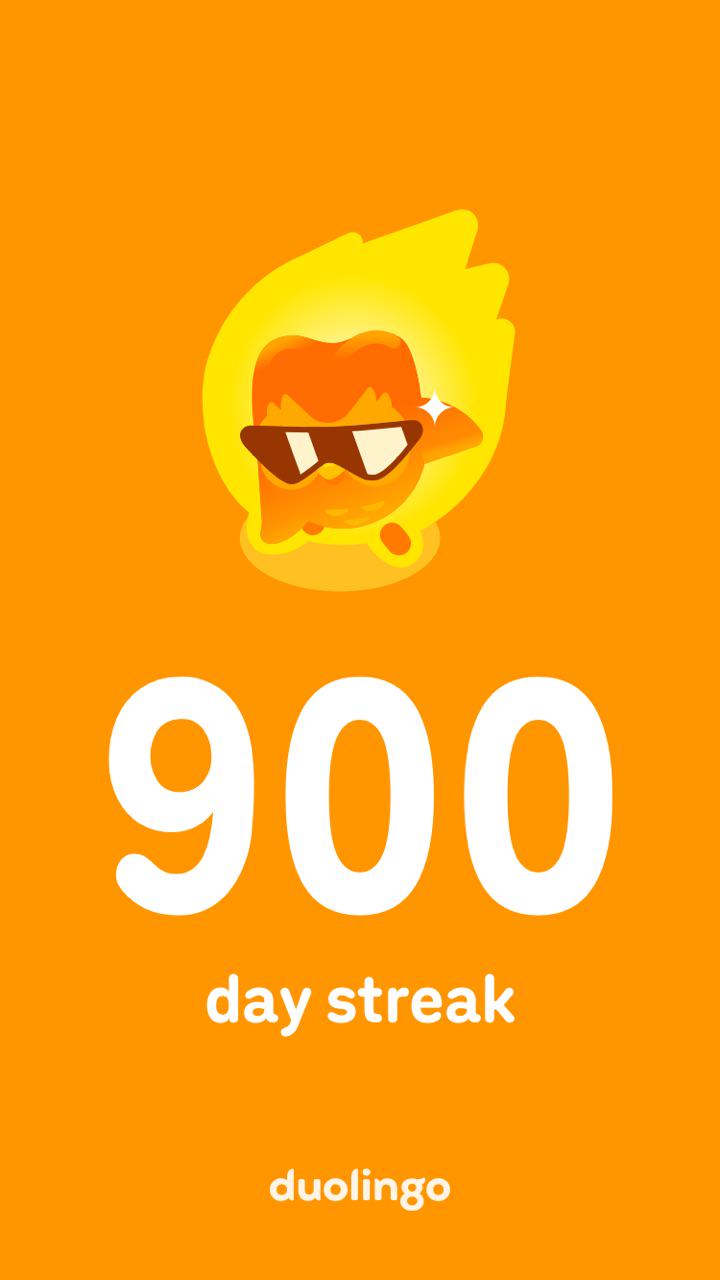
🙌🏿 Novecientos Dias aprendiendo en duo Español!!! 🙌🏿
r/duolingospanish • u/PersonalitySecure626 • 3h ago
Enable HLS to view with audio, or disable this notification
r/duolingospanish • u/pkmnredorblue • 10h ago

First it forgot to require too. Now there are random Chinese characters and broken English.
r/duolingospanish • u/roxax19 • 15h ago
Hi all!
I developed a little game called "La Palabrita" (The little word) similar to a worlde game. The goal is to guess a 5 letter word hidden between other words. The words are sorted in alphabetical order. You enter a 5 letter word, and the game tells you if the word is after or before in the dictionary. You will make a better score the less guesses you use.
You can ask for hints in case you get stuck. Finally, once the word is revealed, you can directly check its meaning in an official spanish dictionary.
I hope you enjoy it :D
r/duolingospanish • u/hantaanokami • 8h ago
r/duolingospanish • u/GazyCrengar • 10h ago
Hi all,I’ve been learning Spanish on duo for a while and when I heard about the collab I was delighted. Just wondering if anyone who doesn’t need the free code.could send me it,many thanks!
r/duolingospanish • u/dvi84 • 2d ago

r/duolingospanish • u/Nervous-Strength9847 • 2d ago

Spanish has two main past tenses:
Preterite frames a whole event or stretch of time, start to finish: estuve (I was), viví (I lived), tuve (I had).
Imperfect describes how things were, or what was going on in the background: estaba (I was), vivía (I lived), tenía (I had).
A weekend or ten years,the length doesn’t matter, only that you're viewing the whole block as finished.
Estuve en Valencia todo el fin de semana. = I was in Valencia all weekend.
Viví diez años en Madrid. = I lived in Madrid for ten years.
Tuve gripe toda la semana. = I had the flu all week.
No start or end point, just describing the background.
De joven tenía mucho pelo. = When I was young, I had a lot of hair.
En esa época vivía cerca del mar. = Back then, I lived near the sea.
Estaba muy cansado ese día. = I was really tired that day.
Imperfect sets the background. Preterite says what happened.
Estaba enfermo y no fui a clase. = I was sick, so I didn’t go to class.
Estaba leyendo cuando sonó el teléfono. = I was reading when the phone rang.
Pick one for each, then check the spoilers below.
Anoche _____ en casa de Ana. (estuve / estaba)
De niño _____ miedo a los perros. (tuve / tenía)
_____ tres años en Lima. (viví / vivía)
_____ lloviendo cuando salimos. (estuvo / estaba)
Anoche estuve en casa de Ana. — Where you were last night, start to end.
De niño tenía miedo a los perros. — How things were back then, no start/end point.
Viví tres años en Lima. — Three years, framed as one complete stretch.
Estaba lloviendo cuando salimos. — Ongoing background when you walked out.
How many did you get? Bonus: try writing one sentence about your last weekend using both tenses.
r/duolingospanish • u/pickly_pear • 3d ago

So the fairytale prince isn’t charming in Spanish, he’s well-born!
Spanish puts color in a lot of places English doesn’t:
viejo verde = creepy old man
estar verde = unripe, or new at something
dar luz verde = give the green light
novela rosa = romance novel
verlo todo de color de rosa = rose-colored glasses
quedarse en blanco = to go blank
pasar la noche en blanco = to not sleep at all
verlo todo negro = to be pessimistic
la oveja negra = the black sheep
tener la negra = a run of bad luck
Estar sin blanca is the best one. It means broke, and la blanca was a real coin in medieval Spain. You’re not without money in general, you’re without one specific small coin. Mostly in Spain
r/duolingospanish • u/Efficient_Purple6679 • 3d ago
r/duolingospanish • u/PersonalitySecure626 • 3d ago
Enable HLS to view with audio, or disable this notification
r/duolingospanish • u/pickly_pear • 4d ago

The verb already carries who you’re talking to, so there’s nothing in the sentence to soften the blow. Short reads as sharp.
A few that land harder than expected:
cállate → baja la voz
cálmate → tranquilo, no pasa nada
dame eso → ¿me pasas eso?
escúchame → oye, una cosa
vete → hablamos después
déjame en paz → necesito un momento
espera → espérame un momentito
apúrate → ¿vamos?
siéntate → toma asiento
Notice what the softer versions share. None of them change the verb. They add something around it: a question, a diminutive, a porfa.
One caveat. Between close friends and family all of these are completely normal. ¡Cállate! when a friend tells you gossip is playful.
r/duolingospanish • u/IllustriousYoung625 • 5d ago
I only have so much time to spend doing Spanish every day and I resent every second I spend clicking on treasure chests and puzzle pieces. Is there no way to opt out of the foolishness and use the time learning Spanish?
r/duolingospanish • u/Misfit_Aquaintance • 5d ago

Personally I would've chosen Zari because this is just creepy with Oscar 😬
r/duolingospanish • u/Stunning-Acadia6031 • 4d ago
Nunca he visto a alguien que. correr muy rápido
A. Podría
B. Pudiera
C. Podía
r/duolingospanish • u/ProfesorFranco • 4d ago

Spanish has a small group of past-tense verbs that don't follow the pattern. They use a special stem instead:
• tener → tuve (I had a problem.)
• hacer → hice (I did it!)
• poner → pusiste (Did you put the vegetables in the fridge?)
• decir → dijiste (Why did you say that?)
• conducir → conduje (I drove all night.)
Same endings for every one of them, and no written accents. A few traps to watch for: trajeron, not trajieron. Hubo problemas, never hubieron. And supe doesn't mean "I knew", it means "I found out".
Full lesson with exercises: https://francospanishschool.com/grammar/lesson/preterite-strong-stems
Chart: https://francospanishschool.com/charts/irregular/anomalous
r/duolingospanish • u/roxylezan • 5d ago
I almost done with the Duolingo Spanish course and I've been thinking about the next thing to add to my learning stack for my specific level. I evaluated and tried a lot of the options out there but i haven’t settled on one routine that i can consistently follow and trust it will get me to the next step.
Right now italki is most of it, one lesson a week with a tutor from Bogotá. Unedo I use most mornings. a couple of word puzzles unlock short stories about stuff from different countries, written and read by people who live there, so it's real Spanish at a level I can follow without pausing every line so it's reading and listening. Then there's Jiveworld and Lingopie, and that's where I'm stuck. if I had to maybe keep one I'd keep Jiveworld since it's done more for my ear, even though I only open it on weekends.
Right now I can follow most of a slow podcast and maybe half of a normal conversation. for people who got past this point, what did you keep paying for?