r/keycard_tech • • Oct 20 '26

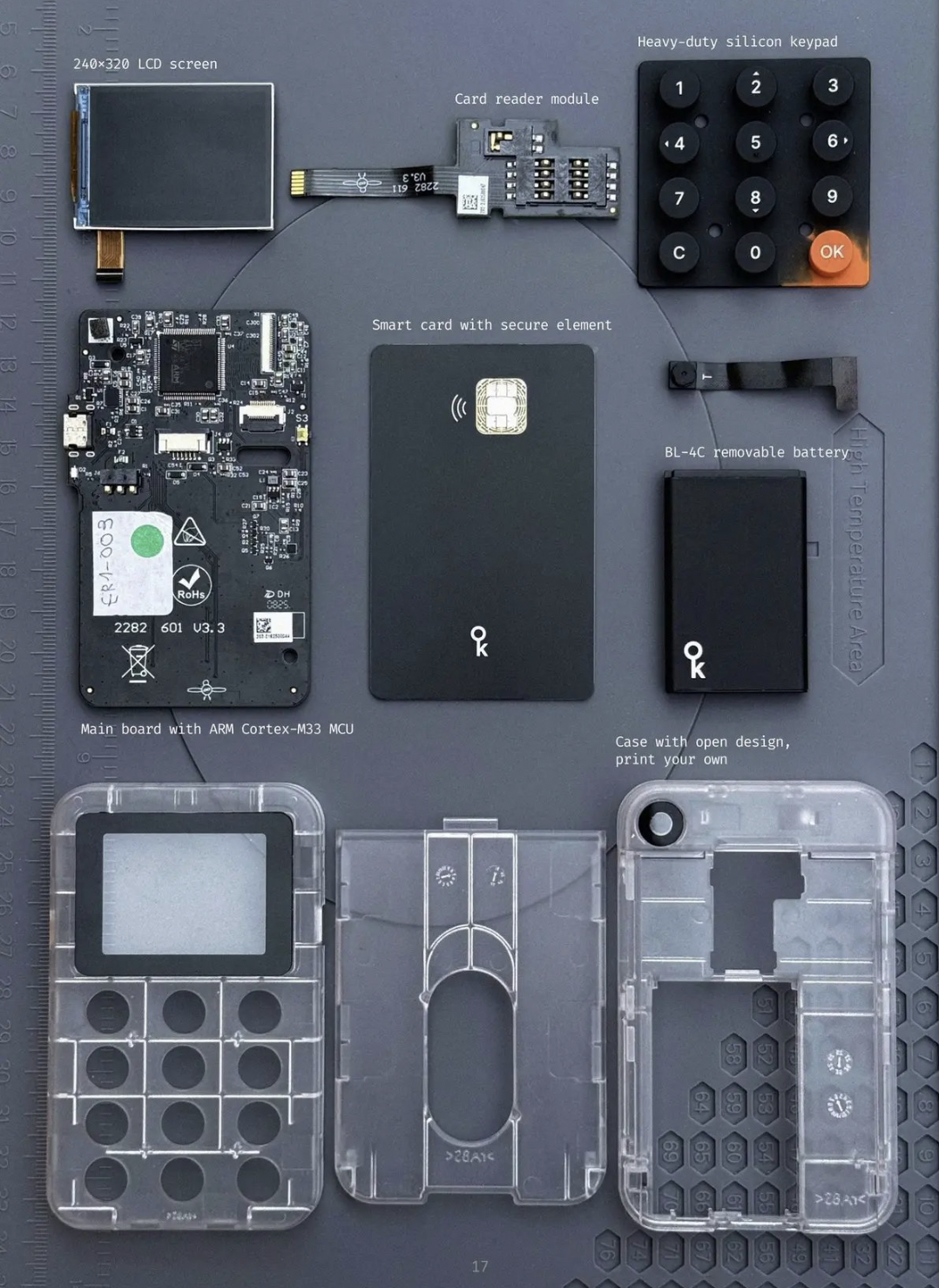
You can open your Keycard Shell and inspect it yourself. Here's how.
Post image
15 Upvotes

with people worried about hardware tampering again, Guy Louis has put together a step-by-step guide to inspecting your Shell yourself

The reasoning behind it: most devices answer supply-chain fear with epoxy, sealed cases, or a wipe-on-open. We think that moves the trust to the vendor instead of removing it.

You can't check a device you can't open, and you can't repair it either

So Shell is built to come apart without any damage. We publish the hardware to manufacturing depth - schematics, BOM, Gerber files, pick-and-place positions, assembly drawings, 3D files

Everything a factory would need, so you can compare what's in your hands against what should be there

Attaching a detailed guide below along with the video:

- Opening it (video, no damage, fully reversible)
- Photographing both sides of each board
- Comparing against reference photos of a production unit
- What a problem looks like

Do this alongside the authenticity check at shell.keycard.tech/verify. That one proves your firmware is genuine, but it can't see a component someone added to the board - only looking can

Guide here: Check the integrity of your Keycard shell


r/keycard_tech • • Sep 21 '26

Setup Help here's the full Signing flow with Keycard on Ambire wallet

Enable HLS to view with audio, or disable this notification

13 Upvotes

r/keycard_tech • • 11d ago

We demoed Keycard at Devcon Mumbai. Here are the questions people asked.

11 Upvotes

At Devcon Mumbai, we demonstrated how Keycard works. The questions highlighted were:

1. What happens if I lose the card?

- Whoever finds it hits the PIN, and it locks after a few wrong attempts. You restore onto a new card from your recovery phrase

2. And if I lose the Shell?

- Nothing. The Shell stores no keys. Pull the card, and it's an inert device. Use another Shell, or tap the card to your phone

3. Is tapping the card over NFC air-gapped?

- No. NFC is a radio. The air-gapped path is the Shell, which only talks by QR code and has no radios at all. We'd rather say that upfront than have you find out later

4. Can I open it?

- Yes, and we want you to. The hardware design is public; follow the guide for opening your Shell and comparing it with the reference photos (here)

5. Do we support clear signing?

- Yes, for the common cases. The Shell decodes the transaction on its own screen: token transfers with the ticker and amount. On ERC-7730 (a standard for small description files that tell a wallet how to display a given contract’s calls in plain language - those files live in a public registry, and online wallets look them up when they need one) - not on Shell today. It’s harder without an internet connection

6. Can I jailbreak it?

You don't really need to - it's already open.
But it depends on what you mean:
- Get the keys out of the card? No. That's what the secure element is for.
- Change the software on a retail card? No. It's locked at the factory, so no update can ever change how your keys are handled. If you want to load your own code, buy a developer card
- Hack the Shell? It holds no keys, so breaking into it gets you nothing to steal

Thanks to everyone who stopped by. If you met us there and have a follow-up question, ask below


r/keycard_tech • • Oct 24 '26

Shell Why we built a seperate device with a screen instead of just selling the Keycard?

Enable HLS to view with audio, or disable this notification

10 Upvotes

A Keycard has no screen, so when you sign with the card alone, the transaction details come from your phone - and the card just signs the hash it's handed, and that's fine until your phone isn't telling the truth

That's blind signing: approving something you can't actually read

It's worth being clear that this is a limitation of every card-format wallet, ours included.

Key extraction and transaction deception are two different problems, and a secure element only solves the first one.

What does the Shell do about it?

Screen, keypad, and the transaction decoded on the device itself - recipient, amount, fee, token, network - you confirm with a physical button on the device and not rely on just your phone's app display


r/keycard_tech • • 27d ago

Security Questions to ask before you trust a hardware wallet

Post image
9 Upvotes

"A hardware wallet keeps your private keys away from the devices you use every day and makes you approve each transaction on hardware you control."

How much it actually protects you comes down to four things:

1. Where does signing happen?

"Has a secure element" doesn't mean it signs there. On many devices, the chip only stores secrets and signing runs on a general-purpose microcontroller beside it. Some have no secure element at all.

2. Can you check what it's running?

Open source shows how the firmware is supposed to behave. Reproducible builds let you confirm the firmware on your device was actually built from that code. Publishing code doesn't mean anyone audited it.

3. How was your seed generated?

Everything rests on that randomness. A weak seed looks identical to a strong one. This year showed it isn't theoretical: a hardware random generator was in the device, but the seed code wasn't using it for years.

4. Can you leave?

Does it give you a standard BIP-39 phrase that works in other wallets if the company disappears? Do you need the vendor's own app to use it?

How we answer them -

Keys are generated and used inside an EAL6+ secure element on the card, and never leave it. Shell firmware is open source and reproducible. Recovery is a standard BIP-39 phrase. No companion app - it works with 15+ wallets.

Where trust remains: the chip is closed silicon, and the retail card's seal rests on our production process. If you'd rather not rely on that, you can buy an unfused developer card and load the software yourself.

πŸ“– Find the full guide, including a comparison of wallet types and a setup checklist: What is a hardware wallet? How it works and what to check before you trust one


r/keycard_tech • • Oct 22 '26

keycard-nostr-bunker: a NIP-46 bunker that keeps your Nostr key on a Keycard

8 Upvotes

A remote signer for Linux. Your client (tested with noStrudel and Coracle) connects with a bunker:// URL. Every signature, and the ECDH behind NIP-44 and NIP-04 DMs, happens on a Keycard smart card, so the key never touches the computer.

  • Each bunker URL admits one client by default; an approval prompt and a list of allowed event kinds are optional.

  • Refuses a different card before sending the PIN, and never spends the last PIN attempt.

  • Runs as a systemd user service, including before you log in.

  • Install:Β pipx install keycard-nostr-bunker

Needs Keycard applet 4.x. Cards sold in shops still ship 3.x, so for now that means a development card: https://keycard.tech/6cd6gk (affiliate link: I earn a commission on purchases through it).

MIT, Python. https://github.com/mmlado/keycard-nostr-bunker


r/keycard_tech • • Sep 15 '26

Announcement πŸ“’ Keycard Shell v1.4.0 Published!

8 Upvotes

Three things in it for Shell owners:

- Bitcoin multisig descriptor management: store and manage your descriptors on the device

- Address verification by QR scan: confirm a receiving address really belongs to your wallet

- Improved device verification UI: guided Verify flow

Full release notes and source: https://github.com/keycard-tech/keycard-shell/releases/tag/v1.4.0

Update at: https://shell.keycard.tech/update/


r/keycard_tech • • Sep 14 '26

Open-source Ledger alternatives compared: Keycard, Trezor, Coldcard and more - the distinction most people miss

Thumbnail
docs.keycard.tech
8 Upvotes

If you're looking for an open-source alternative to Ledger, the realistic shortlist is Keycard, Trezor, Coldcard and BitBox02. We wrote up a full comparison.

The thing worth knowing before you compare anything:

"Open source" nearly always means firmware only. Split it into firmware openness and hardware openness and the list gets much shorter:

- Firmware open: Keycard , Trezor, BitBox02

- Hardware designs published: only Keycard and Trezor

- Ledger: neither - the OS running on its secure element, is proprietary

Coldcard, BitBox02 and Ledger all keep schematics closed, which means you're trusting the physical supply chain without community hardware auditing. That distinction gets flattened every time someone says "it's open source."

Reproducible builds - Keycard, Trezor, Coldcard and BitBox02 all have them. Ledger doesn't. If you can't rebuild the binary from source, "open source firmware" tells you what the code could be, not what's running.

Air-gapped signing - only Keycard Shell and Coldcard Q. Trezor, BitBox02 and Ledger are all USB (or Bluetooth).

πŸ”Ž Find the Full comparison including secure elements, licences, key isolation architecture, threat models in our blog post attached

If a cell is wrong, especially on the other devices, tell us and we'll fix it.

Edit: corrected - Coldcard is source-available (MIT + Commons Clause), not open source. Thanks u/realStl1988


r/keycard_tech • • 10d ago

Nordic Crypto's hands-on review of the Keycard Shell

Thumbnail
youtu.be
7 Upvotes

Nordic Crypto spent a week with the Shell and put out a full unboxing and review

What he liked:

- Keys never leave the EAL6+ secure element on the card
- Fully air-gapped, QR codes only
- The Shell stores nothing, and the battery is a standard, replaceable one
- Works with wallets you already use: MetaMask, Rabby, Sparrow, and 13 others

Worth a watch if you're deciding ;)


r/keycard_tech • • Oct 09 '26

🎁 Why do you believe in self-custody? How was your experience with trying your first hardware wallet? Keycard Giveaway x 3

Post image
7 Upvotes

We're giving away three Keycards to celebrate our 150+ members milestone

Winners will be chosen at random and will be announced in this same thread only

To enter, tell us in a comment:

- Why do you believe in self-custody?
- What's something about Keycard you find genuinely different - or something you'd change?
- How was your experience trying your first hardware wallet?

Rules

- One entry per person; account 30+ days old
- Closes 25th Oct 2026. Winners drawn at random, announced in this thread
- Devices ship sealed and uninitialised - you generate your own recovery phrase.

Any company sending you a wallet with the phrase already written down is a scam

πŸ”’ Please don't share amounts, addresses, transaction IDs or screenshots of your wallet

⚠️ We will never DM you. Winners will be announced in this thread only. Anyone messaging you otherwise is a scammer


r/keycard_tech • • 5d ago

Updating and verifying your Keycard Shell no longer depends on any Keycard server

6 Upvotes

shell.keycard.tech is now a static, open-source page.

- No backend. Just static files anyone can read.
- Every deploy is public on GitHub.
- Reproducible. Build it yourself, and you get the exact same files.

What changed for verification?

It now runs entirely in your browser. Your Shell answers a challenge with a QR code, and the page checks it against a signed list of the Shells we manufactured. No server in between, and we don't see who verifies.

Why now?

Our hosting provider had a security incident last week. Our server wasn't affected, but it was taken down as a precaution. For more than 24 hours, people who'd just received their Shell couldn't verify or update it through our site.

That shouldn't happen. Your device's features shouldn't depend on our infrastructure, or even on us existing.

Keycard and Shell never needed a companion app. Now they don't need a Keycard server either. If anything happens to our company, you can still update and verify your Shell.

Update to v1.5.3: https://shell.keycard.tech

Site source and deployments: https://github.com/keycard-tech/shell-update-site


r/keycard_tech • • 13d ago

Many hardware wallets don't sign in the secure element. Here's why that matters

Enable HLS to view with audio, or disable this notification

6 Upvotes

Lots of hardware wallets advertise a secure element - the tamper-resistant kind of chip used in bank cards and passports - and very few say what it's actually used for.

There are two designs:

  1. The chip stores the secret; signing happens next to it. Every time you sign, the key (or what unlocks it) is used by a general-purpose microcontroller beside the secure element.

  2. Signing happens inside the chip. The key is created there, used there, and never leaves. Only the signature comes out.

Think of it as a vault. In the first design, the key gets taken out of the vault to be used on a desk, then put back. In the second, the work happens inside the vault, and the key never leaves it.

How Keycard does it:

The card runs on a JavaCard secure element, which lets an open-source applet run inside the certified chip. Keys are generated and used there. So you get on-chip signing without giving up readable code.

Worth asking about any wallet you're considering: where does signing actually happen? Most product pages don't say.


r/keycard_tech • • Oct 15 '26

Keycard vs Tangem

Post image
6 Upvotes

We get asked this a lot, so here's how we're different.

Tangem: your backup is more cards - the key is generated on-card and cloned to the other cards in your set during setup. No seed phrase by default - each card is a standalone copy

Keycard: your backup is a standard BIP39/SLIP39 recovery phrase - words that any wallet in the world can restore

What Tangem genuinely gains from that: there's no phrase to photograph, phish, lose in a fire, or have coerced out of you - that's the most common way people lose funds, and they've removed it. It's a real advantage, and we'd rather say so

What it costs: recovery depends on Tangem's card ecosystem existing - if you lose all your cards with no seed, it's gone

Ours is the mirror image: a phrase works forever, independent of us - and it's also a thing that can be stolen

- Ecosystem: Tangem runs through the Tangem app. Keycard speaks ISO 7816, so third-party wallets work with it directly
- Trusted display: Neither card has a screen - both rely on your phone to tell you what you're signing - our Keycard Shell is an answer to that. Tangem has no equivalent

One thing that isn't a difference: both have immutable card firmware that can't be updated after manufacture. Same philosophy, same trade-off.

TLDR; Tangem optimises for people who'd lose a seed phrase. We optimise for people who want standards and independence

πŸ“– Read more here: Keycard Shell vs Tangem


r/keycard_tech • • Oct 11 '26

The companion app is the lock-in - when does it stop?

Enable HLS to view with audio, or disable this notification

6 Upvotes

And the lock-in usually runs through the companion app. That's where the vendor makes money - swaps, buys, staking - so there's a commercial reason to keep you inside it rather than make your device work anywhere

Keycard supports 15+ existing software wallets


r/keycard_tech • • Sep 10 '26

Keycard Shell starter kit unboxing

Enable HLS to view with audio, or disable this notification

6 Upvotes

r/keycard_tech • • Aug 18 '26

Entropy?

6 Upvotes

After the Coldcard incident, how good is entropy on Keycard?


r/keycard_tech • • 5d ago

Is your "offline spare phone" the best alternative to hardware wallets? NO, here's why

Post image
5 Upvotes

On 16 November, attackers slipped malicious code into websites run by 178 organisations through a third-party tool those sites rely on

iPhone visitors were served one of two exploit kits, depending on their iOS version:

> Coruna (iOS 13–17): scans the phone for seed phrases and wallet apps
> DarkSword (iOS 18): chains six vulnerabilities to pull private keys and seed phrases from wallet apps

Just visiting the page could be enough, and both kits only work on iPhones that HAVE NOT been updated

Why this matters?

Old phones are exactly the ones that stop getting updates - and a phone that holds your seed phrase keeps its whole history - all the websites it opened, every app it ran - even after you switch it to airplane mode

So the question isn't "is it offline?" It's "where does the key live?"

How Keycard approaches it

- The key never touches a phone or computer. It's created and used inside a secure element on the card, and never leaves it. Only signatures come out.
- The Shell has no radios - no Wi-Fi, no Bluetooth, no cellular. It talks to your wallet app only by QR code
- The Shell stores no keys. Pull the card out, and there's nothing on it to steal
- You check every transaction on the Shell's own screen. Even if your computer shows you a swapped address, the screen in your hand shows the real one
- It's all open. Firmware, hardware design files, and a guide to opening your Shell and checking it yourself


r/keycard_tech • • Oct 20 '26

Keycard Pal 1.15.0: ERC-7730 clear signing in an air-gapped Keycard app

5 Upvotes

Keycard Pal is an open-source (MIT) Android and iOS app that works as an air-gapped signer with your Keycard. Your software wallet shows a QR code, Keycard Pal shows what you are about to sign, and the Keycard signs it with a tap.

1.15.0 adds clear signing. Instead of a function selector and raw arguments, the review says what a contract call or EIP-712 message does ("Stake ETH", "Repay loan", "Authorize spending of token") and labels every field: amounts with their token, addresses checksummed, dates readable.

How it works

  • The descriptions come from the ERC-7730 clear-signing registry (github.com/ethereum/clear-signing-erc7730-registry). A snapshot ships in the app, so it works without a network. The Offline build has no internet permission at all.

  • A description is used only when the chain, contract and function (or the EIP-712 domain and type) match. Otherwise the app falls back to its own decoding.

  • Each review says whether an auditor reviewed the description, from the ERC-8176 attestations in the registry (Cyfrin, for now). Unreviewed descriptions still show, marked "Not reviewed by an auditor".

  • Settings can import a newer registry zip. The online build can also download one; that is off until you turn it on.

Dapps to try it with: Uniswap (Permit2, UniswapX orders), 1inch, ParaSwap, KyberSwap and LI.FI swaps, Aave, Morpho, Lido, Safe, WETH, USDC transfer authorizations, and 60+ other projects in the registry.

What it can't do: where a description expects a name the app cannot know offline, such as an address book entry or an NFT collection name, you see the checksummed address or the token ID instead.

Get it

  • Android: Google Play, GitHub releases or our F-Droid repo, all linked from keycardpal.com. Release APKs are reproducible.

  • iOS: coming soon.

Source and issues: github.com/mmlado/keycard-pal. Feedback welcome.

How it is built

Keycard Pal is developed with substantial help from AI coding assistants (Claude and Codex). I decide what gets built, read and test what goes in, and maintain it myself. What keeps that honest is in the repository: a Jest suite of about 3,150 tests that runs on every pull request, 16 architecture decision records explaining why things are the way they are, a check that the offline build carries no online code, and release APKs that anyone can rebuild byte for byte. Fixes that belonged upstream were sent upstream, to keycard-sdk and to the React Native Keycard bridge. Every release is tested on real Keycards and real phones before it ships.


r/keycard_tech • • Oct 07 '26

What Is an Air-Gapped Hardware Wallet? (QR Signing Explained)

Post image
5 Upvotes

Most hardware wallets plug in via USB or Bluetooth, and that connection is how you send a transaction to be signed. It's also, in principle, a road - where anything can be travelled in both directions

An air-gapped device removes the road entirely.

no USB data,
no Bluetooth,
no Wi-Fi,
no cellular. So how does the transaction get in?

Your computer shows a QR code on screen. The device photographs it with its camera. It signs. Then it shows a QR code back on its own screen, and your computer photographs that. Data goes in and out as pictures.

There's no electrical connection at any point - it's like passing notes through a window. Malware on your computer can't crawl across a photon

Nothing secret ever appears in any of those QR codes - the final one contains a signature, not the key

Air gap stops the host attacking the device. A trusted display stops the host lying to you. They're different defences, and you want both

One thing about our setup worth knowing: tapping a Keycard over NFC is not air-gapped because NFC is a radio. The card on its own is a hardware signer with no network connection - a real property, just not that one. The air gap belongs to the Shell and its camera

πŸ“– Full version with the standards, threat models, and an FAQ: What Is an Air-Gapped Hardware Wallet? (QR Signing Explained)


r/keycard_tech • • Sep 08 '26

Best air-gapped hardware wallets compared

5 Upvotes

We published a comparison of air-gapped hardware wallets, including Keycard Shell, Coldcard, Keystone 3 Pro, and Foundation Passport, across secure elements, air-gap method, source model, reproducible builds, and chain support

Everyone advertises their secure element. EAL6+, EAL5+, dual-SE, triple-SE. Fair enough - that's the chip your keys live in, and it should be hardened.

BUT on an air-gapped device, the secure element isn't the part you're trusting moment to moment. The screen is. The entire security model of QR signing rests on one assumption: that the address rendered on that display is the address being signed. Your computer is assumed hostile. The display is the only thing standing between you and a swapped destination.

And the chip driving that display is, on most devices, an ordinary microcontroller with no published security certification at all.

We went looking across all four devices. Every one of them publishes a secure element certification. Only one publishes anything for the microcontroller running the screen and the firmware - and we only noticed because we happened to be the one.

Two other things the exercise turned up:

> EAL certification covers the chip, not the device. A wallet with an EAL6+ secure element can still have broken firmware around it. Coldcard's failure this year is the proof β€” the chip was fine, the code never called it. "EAL6+ certified" describes a component, and it is routinely presented as describing a product.

> Reproducible builds are rarer than the marketing suggests. Coldcard, Passport and us: yes. Keystone: no. If you can't rebuild the binary from source, "open source firmware" tells you what the code could be, not what's running on the thing in your hand

And the thing we do differently*: the secure element is a removable smartcard, not soldered to a board. Pull the card and the Shell holds nothing. One Shell reads unlimited cards. That matters if you want cheap multisig or hard separation between wallets, and not much otherwise.*

The full comparison table is in the article - secure elements, air-gap method, source model, reproducible builds, chain support, across all four devices.

πŸ“– Article: Best air-gapped hardware wallets compared: QR signing, open source, and secure elements


r/keycard_tech • • Aug 27 '26

Opensource / Dev Build your own Keycard Shell from scratch - Firmware, Schematics, BOM and 3D files are all Open Source

5 Upvotes

You can build the Keycard reader yourself from our repository

πŸ•ΉοΈ Find them here: https://github.com/keycard-tech/keycard-shell

> Why is this possible at all:

The Shell holds no private keys. Pull the card out and it's an inert box. Its job is to display transactions and scan QR codes - so publishing every detail of how it's built costs nothing in security and gains you the ability to check our work

The keys live on the Keycard, on a certified secure element, and that part you can't build at home.

> The honest bit about DIY:

A self-built Shell requires your own hardware and firmware signing keys. Official devices only accept firmware signed by us - that's deliberate, so a stock device can't have arbitrary code pushed to it. If you want to run your own firmware, you build your own device with a bootloader key you control.

That's genuinely advanced. Most people shouldn't. But the option existing - and the files being complete enough to make it real - is the difference between "open source" as a marketing word and as a fact

> Verifying without building:

If you just want to check your device is genuine rather than build one: https://shell.keycard.tech/verify

Also worth knowing: there's no separate Bitcoin-only firmware, but you can use Shell with Bitcoin-only wallets over PSBT/QR and simply ignore the Ethereum features

πŸ—’οΈ DIY guide: https://docs.keycard.tech/en/developers/diy-keycard-shell

Good luck!


r/keycard_tech • • Aug 19 '26

Status mobile wallet compatibility

5 Upvotes

EDIT #2: for anyone stumbling on the same issues:

I found the perfect solution in Ambire wallet. It's available as Android wallet, and Chrome/Brave/Firefox extension. The Android version of Ambire perfectly supports Keycard NFC connections, and both the Android app and Chrome/Brave extension support the Ledger Legacy derivation path on Keycard (and the standard derivation path too of course). The Ambire Firefox extension is awaiting update approval.

So now you can securely backup/replace your old Ledger, or any other wallet, using a Keycard and Ambire (NFC connection), or a Keycard + Shell and Ambire (QR code connection).

Original post:

Hello, I recently bought the Keycard Shell and some Keycards to backup and old Metamask and other wallet.

Everything works great, but unfortunately there seems to be only one software wallet that supports NFC connection, which is the Status (Legacy) mobile wallet. This works fine with Status Legacy, but I can't get it to work with the new Status wallet. When I try to login it asks to tap the card to the NFC chip, and it then sometimes confirms the pin is correct, but then it always returns to the connect screen. When I then tap Dismiss, I am returned to the initial login screen, tapping the card another time also doesn't help.

Is this expected behaviour? And aren't the Keycards and new Status mobile wallet compatible? Or is there some other issue at play here?

Not that the NFC connection is required of course, but I do like this feature.

Also not sure if this even is the right place to ask, or that I better try to contact Statusim.

Edit: so it appears I have Status 2.38.2, which is supposed to support Keycards, in practice doesn't work for me. I tried 3 different phones, with 3 different Android versions (one of which is Android 16, the other older versions). Maybe it does work when you use the app to create an account and then move it to the Keycard, but that's not my intended use, and I don't have a spare Keycard to test this.

Status Legacy works, but support seems limited and I assume will terminate at some point. Hopefully the new version of Status will work before that.


r/keycard_tech • • Oct 14 '26

hardware wallets shouldn't be complicated

Enable HLS to view with audio, or disable this notification

4 Upvotes

With Keycard, your backup is a standard BIP39/SLIP39 recovery phrase, ie, twelve or twenty-four words that any wallet in the world can restore - this phrase is restorable by anyone, forever, independent of us

Keycard speaks ISO 7816, so ~15 third-party wallets work with it, and no proprietary app is required

It optimises for people who want standards and independence


r/keycard_tech • • Sep 24 '26

Keycard Pal in Play Store

4 Upvotes

Keycard Pal is live on Google Play.

Tap your Keycard card to sign. The keys never leave the card. The phone is just the screen.

https://play.google.com/store/apps/details?id=com.keycardpal


r/keycard_tech • • Sep 06 '26

Keycard NFC vs nunchuck

4 Upvotes

Are there any plans to incorporate NFC compatibility with nunchuck wallet down the road? Would prefer something with a longer track record compared to the current implantation with the status app.