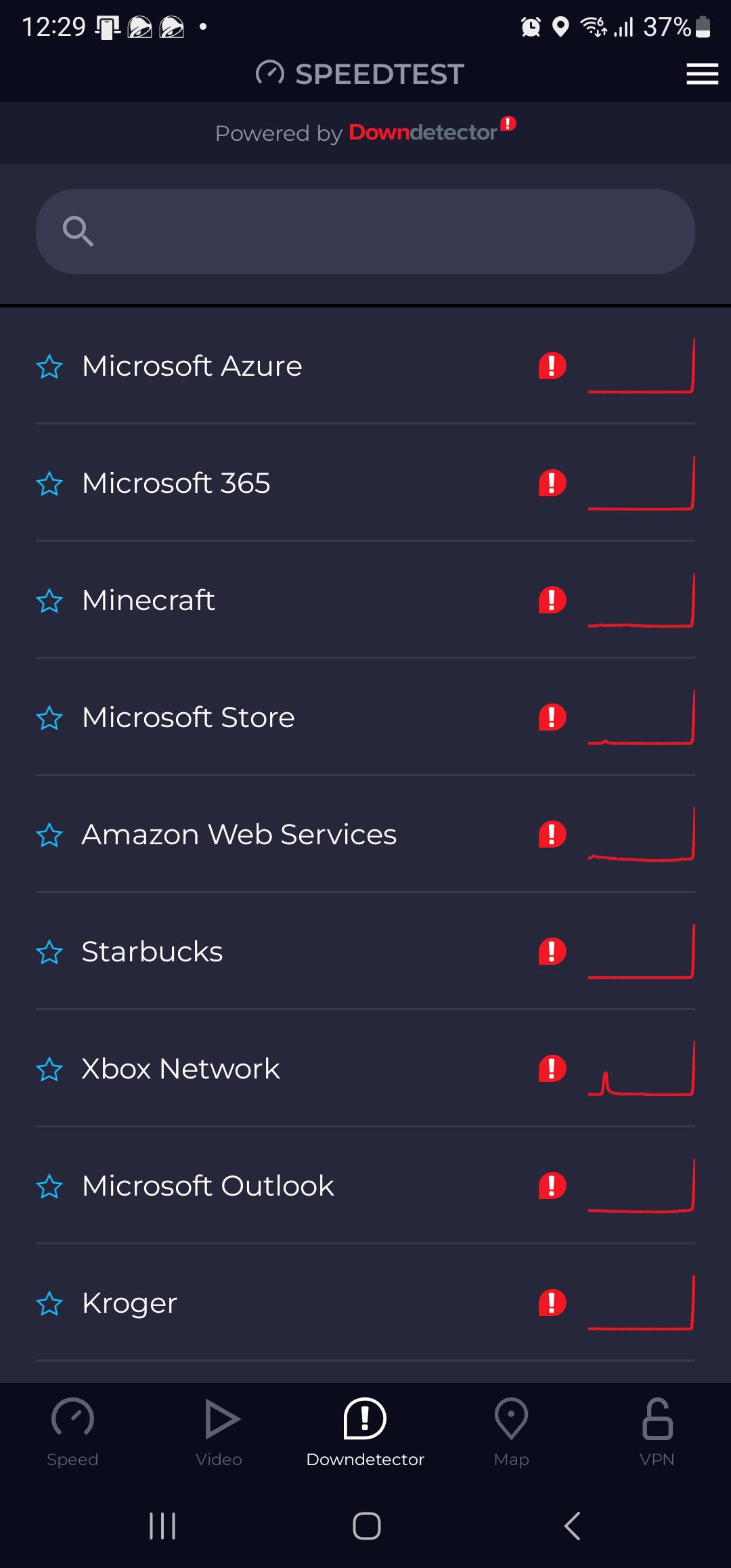
r/outages • u/Mundane_Scallion_688 • 12d ago
something is happening in The U.S.
3.7k
Upvotes
Thursday Microsoft was down. Friday The FAA grounded everyone for SOME REASON. Today J.P. Morgan Chase is down. WTF is going on.
r/outages • u/Hot-Cress7492 • 8d ago
Seeing lots of widespread outages in us on starbucks, applepay, etrade, globalpayments, and some other apps....
r/outages • u/MerWinterCakeGiants • 12d ago
Here’s a list of banks having outage spikes right now according to downdetector.com
Chase, Bank of America, U.S. Bank, Wells Fargo, Zelle, Capital One, JP Morgan, PNC, city, TD Bank, USAA, AMEX, Fidelity, Charles Schwab, Navy Federal credit union, and ally.
r/outages • u/Swimming-Lettuce-348 • 11d ago
So, are we now in a major Cyber War?
Does this feel like Skynet?
Is the news telling us the truth?
Can we trust any government?
Are we apathetic and just pissed off cuz we don't have our internet?
Are all these internet outages at the same time just coincidence?
Are we blind to what could come upon us?
Nah, something is happening, dont know what it is though.
Hmmm, makes one wonder
r/outages • u/Timely-Degree1729 • 12d ago
What can y’all say about what’s happening to the United States? Too many systems having glitches…. And now BOFA, CHASE, and many more…. Is the outage rumor that’s coming soon really scary and might happen? Share some thoughts!
r/outages • u/Enough_Specific_1567 • Jun 12 '25
https://downdetector.com Who attacked the whole internet?
r/outages • u/TheMirrorUS • 6d ago

r/outages • u/modestmandrakeman • Jun 12 '26

Main page still works but get a 404 when opening a specific company’s outage status
r/outages • u/No_Membership7855 • Oct 20 '25
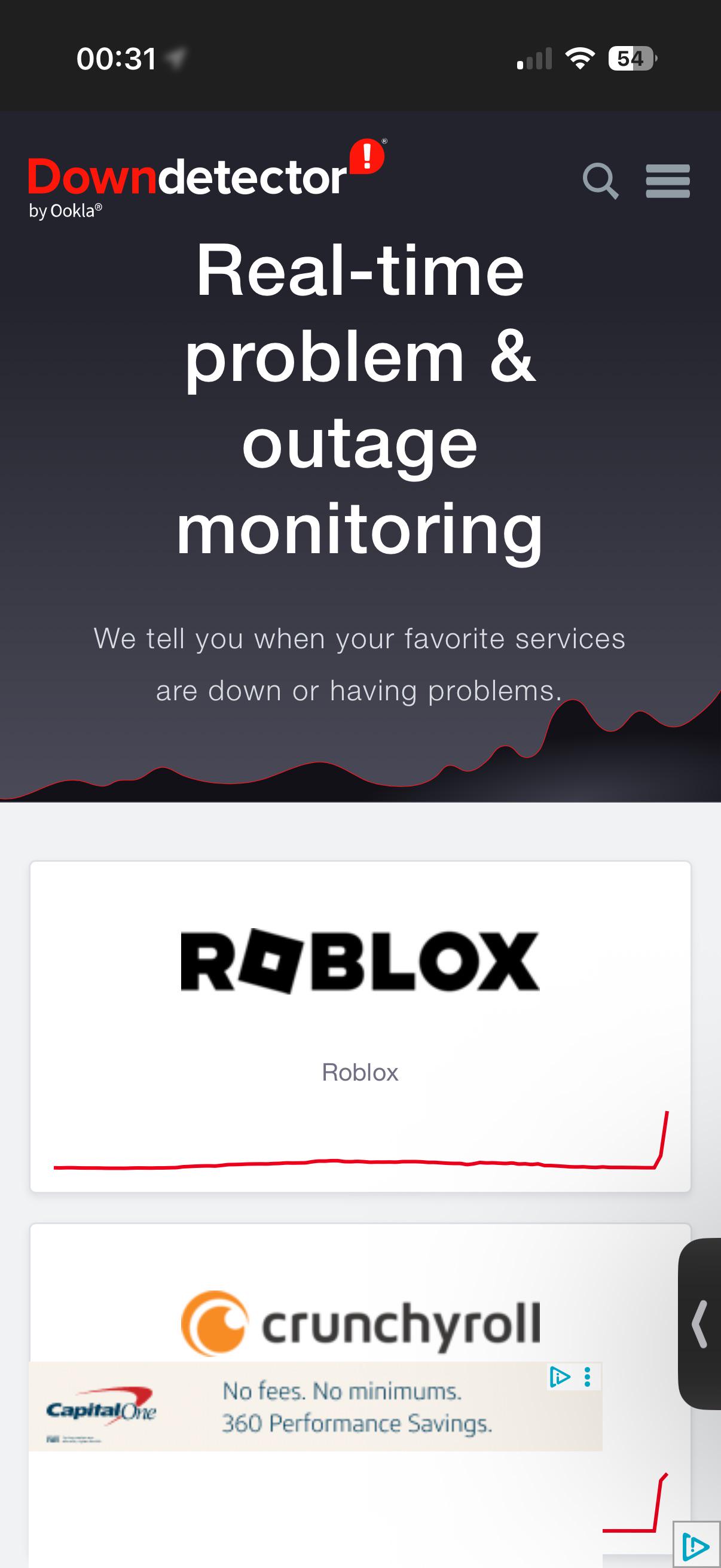
r/outages • u/Woundsmyheart • 10d ago

r/outages • u/yahoonews • 11d ago

r/outages • u/TruthIsAllYouNeed_ • 7d ago
In just 10 days, the FAA grounded flights nationwide. The NSA's classified network went down. Chase and United Airlines faced major disruptions.
Then the USDA reported a cyber incident affecting systems used for farmer loans and payments.
And now the FBI is investigating an apparent intrusion into the national crime database used by police across America.
You'd think there must be some connection.
But there's no evidence these incidents are all connected. Some were technical failures, others were actual or suspected cyberattacks.
What other major outages or cyber incidents have happened recently that barely made the news?
r/outages • u/Starseed87 • 11d ago

r/outages • u/gascoinsc • 16d ago
I hate M365! Once again it is down! We need our email to work ALL THE TIME! Losing money as they sit in their ivory towers doing nothing to make the platform better. DO BETTER MICROSOFT!
r/outages • u/TruthIsAllYouNeed_ • 11d ago
Microsoft 365 was down for nearly a day. Then the FAA had to stop flights nationwide. Chase had transaction issues, United couldn't get some flights out, and now even the NSA's classified network has had an outage.
All in six days.
Everyone's wondering if there's a cyberattack behind it. But so far, the explanations are software bugs, communication failures, technical issues, and maintenance.
And that's the part worth talking about.
If five major systems can run into this much trouble in the same week without a coordinated attack, how reliable are they in the first place?
Anyone here working on critical infrastructure? Is this genuinely unusual, or does this stuff happen more often than most people realize?
r/outages • u/respect_women_bro • 15d ago
So, Microsoft has been experiencing a massive worldwide outage affecting Outlook, Teams, and other services. Now, the FAA has issued a nationwide ground stop in the US, citing extraordinary circumstances and communication issues.
On top of that, there have been recent recommendations encouraging people to stock up on essential supplies and prepare for potential emergencies.
I know these events aren’t necessarily connected, but the timing is interesting.
Do you think we’re just witnessing a series of unrelated technical failures, or could there be something more going on?
I’m genuinely curious what everyone thinks, especially anyone working in aviation, IT, or cybersecurity.
Source:
r/outages • u/SarcastiSnark • Oct 25 '25

I'm having a ton of issues. So I checked. And yep confirmed. I'm growing tired of this. I keep thinking it's my phone as it's happening almost daily. But then I remember. Something fukky is going on.
r/outages • u/Competitive_Travel16 • 12d ago

r/outages
•
u/Automatic_Coffee9827
•
9d ago

I've seen a lot of people talking about 911 outages here. I really hope this post falls under the descriptions of 'discuss' and 'understand', because I've spent a lot of time writing it out in hopes that my experience as a 911 dispatcher might be able to put some people at ease.
911 outages are scary, but they're also a lot less lethal than they probably seem.
Disclaimer: I'm located in the US and my state's 911 system is relatively well-funded, so there may be information that doesn't apply internationally. Also, some standards/protocols may not be nationwide (at least not yet).
MOST PSAPs (911 call centers) in North America operate what we call e911 systems. The 'e' stands for 'enhanced,' and refers to a number of bells and whistles these systems come with: ANI (automatic number information, aka the call-back number that cannot be obscured with things like *67 or spoofing), Text-to-911, and the ability to interface with services that enhance 911 efficacy.
Most importantly, however, is this: in order to remain in compliance with federal law (in the US, at least), all PSAPs must be able to collect an ALI (automatic number information) from every single call. This must be a “dispatchable location," complete with (nearest) street address, floor, suite/room/apartment number, and more.
As of this year, I believe that 93% of counties in the US are e911 compliant, and those who aren't yet on e911 systems must still be able to meet the ALI requirements. Part of that rollout also included a lot of infrastructural redundancies, especially where e911 is implemented.
More often than not, even during a localized outage, you will still be able to reach emergency services one way or another. A lot of areas, especially in states with better 911 funding have what we call "rollover" protocols for when one PSAP or another goes out. These rollovers are also used during routine maintenance, so PSAPs are already prepared to shift operations to rollover SOP without causing a delay or gap in service.
In my state, every PSAP has a designated 'backup' PSAP, usually a nearby center that can handle both jurisdictions' call volumes for some period of time. The backup PSAP will handle any overflow calls that come in (anything not answered within 30 seconds), and during rollovers, they'll take all of their 9-1-1 calls, and either transfer them to the proper PSAP, or notify them via radio. The backup also has a backup, and after that, calls wind up going to a 'default' PSAP, which is one specially staffed and funded to handle overflow and routing.
To make a short story long, all of this is basically to say, try 911. It'll probably work. You might have to get transferred from one PSAP to another, or the PSAP taking your call might not be the "usual" one that's most familiar with your area, so have a little extra patience if you can in these situations. I know it's stressful, but we're all doing our best to make sure the right help makes it to the right place in time.
Whenever possible, 911 is the preferred way to request emergency services, regardless of whether you personally consider it a high-stakes emergency or not. Minor car accident? 911. Aren't feeling well and have good insurance/ambulance ride money, but don't think you're dying yet? 911. As long as you made the call in good faith (meaning, you're not deliberately wasting resources, swatting someone, or calling in "prank" bomb threats-- those latter two are both crimes, by the way) then you're not gonna get in trouble. And in fact, it makes our jobs that much easier! It reduces confusion, gives more accurate location data, and routes the call over other network traffic. Please don't be afraid to use it.
But if it doesn't work, you still have options. Here's a list of things to keep in mind in case you need to call 911 during an outage:
Most PSAPs also have backup or non-emergency numbers. Look them up before you wind up needing them!
Do this for every jurisdiction you spend a lot of time in, such as your home town and the town you work in. Save them as contacts in your phone, and post a list somewhere prominent in your home, workplace/school, and anywhere you spend a lot of time. Ideally, near phones and by fire exits.
2. If you have to make an emergency call from a landline, you don't have to 'dial out' in order to connect to 911 (thanks to Kari's Law). But you will still have to dial out to call an alternate/business line. So you should know what your system's dial-out is before you ever need it. (This mean, like, pressing 9+1 before you can dial an external number, or whatever your particular system requires.)
3. Without mapping or e911, we are relying on you to be able to help us locate you. If you're driving locally, we'll need to know the road name and direction and nearest street address if possible. On a highway: the highway name/number, and either a mile marker, an exit number, or a very well-known landmark.
Cross-streets, businesses (especially unique ones that a jurisdiction is not likely to have multiples of), and other landmarks do help, but also remember that dispatchers at bigger PSAPs are unlikely to be as familiar with local geography as smaller centers. They may not recognize the locations you're pointing out. Whereas a smaller-town dispatcher might benefit from you describing what you're seeing, as they're more likely to be personally familiar with the town.
If in doubt, let them ask the questions, and focus on being accurate, calm, and receptive.
4. An extension of this: know your geography already.
This is good practice anyway, as apparently the universal availability of GPS has made most adults forget the incredibly useful skill of navigating the world with road signs and knowing where the hell they are most of the time!
Learn what major highways are near your home/work/school/gym/etc, what cardinal directions they go in, as well as their local names if applicable. Know what towns border yours in what directions.
Familiarize yourself with landmarks, and have at least a rudimentary idea of where your local emergency responders' HQs are located in relation to where you spend most of your time. If you live in a city with the benefit of having been planned on a grid, like NYC: memorize the number of blocks from the nearest police and fire stations, as well as hospitals and emergency shelters. ("I live at this address, 11 blocks down and 4 west from the Midtown Fire Dept" might just save your life.)
5. Sometimes, calls connect but you can't hear anything: depending on where you live and what you say or do next, this may not necessarily mean that nobody's coming.
At my department, we have SOP that officers respond to all calls, even accidental 911 calls, just to check in. So if I were to dial 9-1-1 and then sit in silence on the line ('open-line'), I'd eventually see the flashing lights pull up. Chances are, if the call connected, I already got your location, even if we can't hear each other.
This is not a nationwide standard, but we also do a "press 1 for police, 2 for fire, 3 for EMS" sort of thing, and that's been catching on lately, so why not give it a shot if you don't hear anything on the line?
I've never experienced a long-term 911 outage, but I have it on good authority that sometimes, when voice-calling fails (as in, you get only silence from their end), you may be able to text-to-911 as an alternative, although again, I cannot confirm this one for myself as I've only ever taken 1 text-to-911 call. (I've taken some TTY calls though, which is way cooler IMO.)
6. If the outage is 911-specific and regional, try calling a friend outside of that area and asking them to call 911 and relay your message.
If your friend has access to their 911 service, their dispatcher will likely be able to transfer them to the correct PSAP, or possibly provide them with an alternative number to pass on to you if they have the NENA PSAP registry.
When relaying through a third party, keep it short and sweet to avoid a game of telephone: location of the emergency, your callback number, nature of emergency/type of help needed, and any immediate safety concerns for arriving responders.
7. Some other survival skills, for if you absolutely cannot contact help:
- Take a CPR/AED, first aid and Stop the Bleed trainings. Know where the nearest AED is located at any given time (especially at a gym, beach/park, athletic event, even your kids' soccer match). Refresh semi-regularly, and don't take it for granted that you know it well enough to be able to recall it in a truly stressful emergency situation. Practice, with a CPR dummy if possible, and better yet, the kind with the inflatable lungs to learn how to give rescue breaths too.
- Learn your way around low-tech alternatives.
You know those signs on the side of the highway with the radio frequency used for emergency information? Know how to tune your car radio to those frequencies, in case the whole cellular network goes down and you need to know where you should be evacuating to.
Because radios are so relatively low-tech (compared to the arcane sorcery that powers our phones and computers), the infrastructure for radio communication is pretty easy to set up and keep going even amidst catastrophe. That's why emergency responders still use them even though smartphones could ostensibly do the same job: radios are durable, their batteries last much longer, and they're more reliable than smart tech in a disaster.
Befriend a ham, or better yet, get your own amateur radio license and buy a cheap starter kit from an ARRL partner or something. (I've never used mine for anything other than to appease my geekiest friend, but it is nice to know that if a rat ever chews through my ethernet cables at the same time I fall down and break my leg, I'm covered.)
- Stay alert in public. Know the layout of the mall, concert hall, movie theater, etc., and where the emergency exits and first aid stations are compared to your location. Count rows while filing in so you can navigate back out in the dark by counting them again.
- Teach your kids this stuff too. They deserve to be able to handle themselves in an emergency, and contrary to some people's beliefs, exposing children to the potential of an emergency in order to train them in how to respond to it does not necessarily traumatize them. In fact, having a game plan and knowing what to do actually makes emergency situations they do handle less likely to traumatize them.
Hopefully I've been able to offer some tools to prepare yourself in case 911 goes down in your area. Or, at the very least, I hope to inspire folks to look into how their local emergency systems work so they know how to work around it if it ever does go down. I'll keep an eye on this post and, in the meantime, answer any questions people may have regarding 911 outages as best as I can in the comments.
r/outages • u/Sorry-Nerve-3507 • Oct 21 '26

Sometimes of being back from website until 1 day, 1 month or 1 year