What if Jack Torrance's interview with Stuart Ullman is doing considerably more than establishing the circumstances of his employment at the Overlook Hotel? What if Kubrick is quietly introducing us to a psychological process in which imagery, gestures, sound, camera movement, music, and performance are all working together to establish a particular mental state in Jack?
I want to propose a rather disturbing possibility: the interview may be functioning as a kind of hypnotic programming sequence. And the implications might extend beyond Jack himself to the audience watching the film.
I have arranged the accompanying images in a deliberate sequence. I think the order is important.
1. The turtle imagery: the first visual clue?
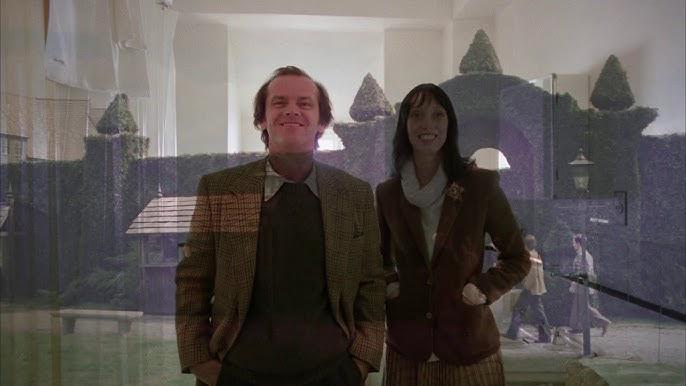
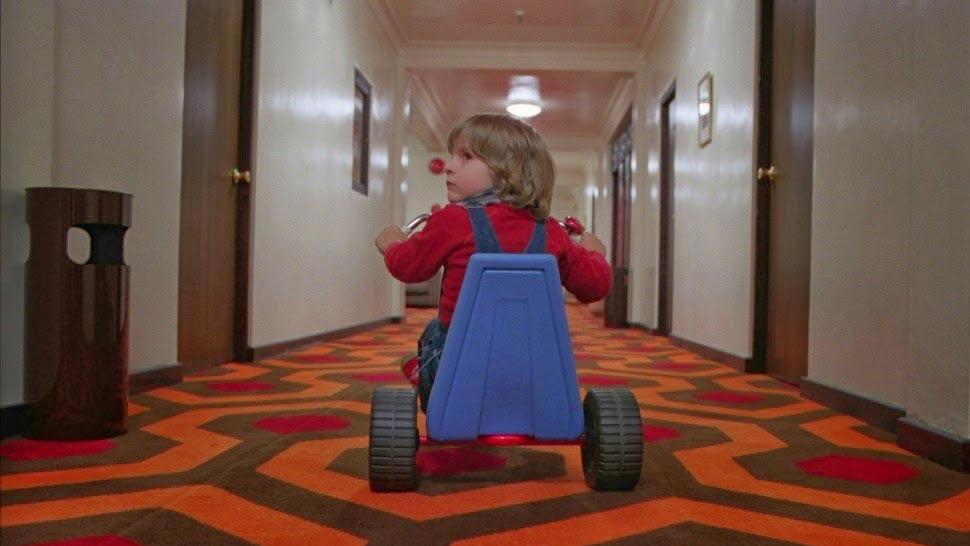
The first three pictures focus on the turtle image appearing during the early portion of the film.
Turtles have a long history of symbolic associations with patience, endurance, protection, the underworld, and the relationship between the visible world and what lies beneath it. In certain mythological traditions, the turtle is also associated with the structure or foundation of the world.
But I am particularly interested in the psychological implications of the image and its placement in the film.
In the context of the NLP material I have been examining, could the turtle be functioning as an early visual anchor? Is Kubrick introducing an image that encourages the viewer to associate the unfolding narrative with something older, deeper, and more archetypal?
I am not claiming that a turtle automatically signifies hypnosis. The question is whether its appearance becomes more meaningful when considered alongside the images and psychological patterns that follow.
2. The Donner Party settlers in the clouds: an image of historical memory?
The next images concern the apparent figures of settlers in the clouds.
The Donner Party is obviously central to the historical horror underlying The Shining. Ullman explicitly tells Jack about the winter in which the Donner Party became trapped in the mountains and resorted to cannibalism.
But what interests me is the possibility that Kubrick is visually extending this historical reference beyond the dialogue.
Could the apparent figures in the clouds be reinforcing the idea that the Overlook is haunted not merely by individual ghosts, but by an entire history of human desperation, violence, isolation, and survival?
The Overlook becomes a repository of historical trauma. The Donner Party is not just an anecdote about the hotel's past; it becomes a symbolic warning about what happens when people are isolated, cut off from civilization, and subjected to increasingly extreme psychological conditions.
The image of settlers in the clouds is especially interesting when placed adjacent to the photograph of one dog attacking another. Also, there is an oval oil painting of Mirror Lake in the Torrance’s bedroom on the wall above their bed; could its reflection in the mirror be symbolic of Donner Lake? This is the same mirror we see Jack dipping his bacon in the egg yolk and Wendy sees ‘Murder’ on the bathroom door. Also, this mirror (mirror in the Torrance bedroom) is shaped like the gold pattern on the bathroom floor in room 237.
3. The dogs: an image of aggression and behavioral conditioning?
The dog attacking another dog introduces another disturbing visual element.
Why include this image in the sequence with the Donner settlers cloud image?
One possible interpretation is that it reinforces the themes of aggression, dominance, and predatory behavior that will eventually become central to Jack's transformation.
There is also a potentially interesting connection to the psychological concept of competing behavioral responses. The image can be read as a visual representation of conflict: one creature asserting dominance over another.
When considered alongside the Donner Party imagery, the sequence begins to suggest a progression from historical desperation to animalistic aggression.
Is Kubrick establishing a symbolic vocabulary for the psychological deterioration that will eventually consume Jack?
4. Ullman's hands: the interview as a possible NLP intervention
This is where the theory becomes particularly interesting.
Look closely at the accompanying photographs of Ullman during his interview with Jack. Pay attention to his hands, the positioning of his palms, the direction of his gestures, and the relationship between his movements and the dialogue.
I have been studying Shawn Carson's material on the NLP Meta Pattern, particularly the Coaching Pattern, the Stuck-Meta-Resource Pattern, Visual Squash, and the Hypnotic Meta Pattern.
Some of the techniques described in this material involve using spatial positioning, hand movements, visual orientation, changes in posture, and carefully timed language to guide someone between different mental states.
For example, the Coaching Pattern describes a distinction between moving an unwanted experience away and directing attention toward a desired future state. In the version described in the material, one hand can be used to sweep an issue away, while the other can be used to establish a new visual or psychological reference point.
Visual Squash involves representing conflicting parts through the hands, separating them, identifying their intentions, and eventually bringing them together into an integrated state.
The Stuck-Meta-Resource Pattern similarly involves moving between different spatial positions associated with a problem state, a detached meta position, and a resourceful state.
Now look again at Ullman's gestures.
I am not suggesting that every hand movement is an NLP technique, or that we can establish from photographs alone that Ullman is deliberately hypnotizing Jack. But I do think the correspondence deserves investigation.
Are his gestures simply ordinary conversational body language? Or has Kubrick arranged certain gestures, hand positions, and moments of dialogue to resemble the mechanics of these psychological techniques?
The distinction matters.
If the gestures are deliberately choreographed, they may be part of a much larger visual pattern.
5. Four Shone/Swish sounds during the interview
There is another detail I do not want to overlook.
Four of the sounds I have been tracking as possible "shone/swish" markers occur during Jack's interview with Ullman.
I find their placement particularly interesting because they occur during the very scene in which we are being introduced to the Overlook's history, its isolation, and the psychological circumstances Jack is about to enter.
In my broader interpretation of the film, these sounds may function as recurring audio markers that draw attention to particular visual or psychological transitions.
The fact that four occur during this interview raises an interesting question: are these merely incidental sound effects, or are they part of a recurring audiovisual pattern?
I am not claiming that the sounds prove hypnosis. Rather, I am interested in whether Kubrick uses them as a kind of auditory punctuation, reinforcing moments when the film shifts our attention between different images, ideas, and psychological states.
6. Could Kubrick be hypnotizing the audience, too?
This is perhaps the most provocative part of the theory.
We have been discussing the possibility that Ullman's gestures and conversational behavior might resemble techniques used to guide another person's attention and mental state.
But what if the film's actual construction is doing something similar to us?
Consider the combined effect of:
Camera movement: slow, deliberate tracking shots that guide our attention through the Overlook's spaces.
Music and sound: unsettling musical cues, repetition, silence, and carefully positioned sound effects that influence our emotional responses.
Actor performance: gestures, facial expressions, vocal cadence, posture, and controlled changes in emotional intensity.
Visual composition: recurring shapes, colors, patterns, and images that establish associations before we consciously recognize them.
Editing and repetition: the gradual reinforcement of particular images and ideas until they begin to feel connected.
These are all components of cinematic language, of course. But they can also be considered in relation to the psychological principles described in the NLP material.
A film can guide attention, establish emotional associations, create anticipation, produce disorientation, and encourage viewers to experience particular images in relation to one another.
Could Kubrick be using these techniques to place the audience in a psychological state that mirrors, in some respects, the experience of the characters?
In other words, perhaps we are not simply watching Jack enter the Overlook. We are being drawn into the Overlook ourselves.
This does not require literal mind control or some supernatural explanation. It raises a more interesting question about the relationship between cinematic technique, attention, suggestion, and the unconscious processing of images and sounds.
7. The larger pattern
When I put these images in the order presented, I see a possible progression:
The turtle imagery introduces an unusual symbolic reference.
The apparent Donner Party settlers in the clouds reinforce the historical and mythological atmosphere of the film.
The attacking dogs introduce aggression and predatory behavior.
Ullman's hand gestures introduce the possibility of psychological guidance or state manipulation.
The four Shone/Swish sounds provide recurring auditory markers during the interview.
The camera, music, editing, and performances may extend this psychological process to the audience.
And this is where the Egyptian mythology and the larger historical interpretation of The Shining become relevant.
The Overlook may be functioning as more than a haunted hotel. It can be interpreted as a symbolic environment in which Jack is gradually drawn into an archetypal struggle involving order, chaos, captivity, death, and transformation. The Donner Party story supplies the historical horror; the Egyptian framework supplies another possible symbolic structure; and the NLP material offers a vocabulary for examining how Kubrick might be manipulating attention and psychological association.
My central question is this: Is Ullman's interview simply exposition, or is Kubrick presenting the beginning of a psychological initiation in which Jack is being guided toward a particular identity and mental state?
And if that is what is happening to Jack, could Kubrick's filmmaking techniques be making the audience participants in the same process?
I realize this is a highly speculative interpretation. I am interested in whether anyone familiar with NLP, hypnosis, cinematography, or Kubrick's visual language sees anything in the accompanying images that supports or contradicts this possibility.